Camping in November: Where to Go, What's Still Open, and How Cold It Really Gets (2026)
Can you camp in November? Yes — if you pick the right half of the country. Region-by-region open/closed guide, real November low temps, and the gear shift your sleep system needs.
It's 4:37 p.m. on a Saturday in mid-November. The light is already going sideways and orange, and you realize you have about forty minutes to cook dinner, clean up, and get the kids into warm layers before it's fully dark and the temperature drops off a cliff.
That's the month. November isn't October with a jacket on — it's the month the door closes. Most of the northern half of the country is shutting campgrounds down, water systems are being drained for winter, and a hard freeze is no longer a fluke. Meanwhile, in Arizona, southern Utah, and the Gulf Coast, November is genuinely the best camping month of the year.
So the honest answer to "can you camp in November?" isn't yes or no. It's where.
This guide is the planning piece we use ourselves every year: which regions stay open, what actually closes, the real temperature numbers, and what has to change in your gear before you go. If you're still deciding on the month before this one, start with our October fall camping guide — November picks up exactly where it leaves off.
Can You Camp in November? The Short Answer
Yes — and in some parts of the country November is the single best month to camp. But the answer splits in two, and mixing the halves up is how people end up miserable on a 26°F night.
- If you have a camper, van, or RV: November is wide open. Most RV parks, private campgrounds, and year-round public campgrounds stay open through the month. Hookups keep working, rates drop into off-season territory, and you get the sites that were booked solid in July.
- If you're in a tent: November is a real-weather month. You can absolutely tent camp — but you need to be south of the freeze line, or bring a sleep system rated for the temperatures you're actually going to get rather than the ones you're hoping for.
The rule that governs this whole month: November camping is a geography question before it's a gear question. Get the region right and the gear conversation gets easy. Get it wrong and no amount of gear saves a night in the Rockies at 8,000 feet.
What Actually Changes in November (vs. October)
If you camped in October and think November is "the same but colder," these six shifts are what will surprise you.
1. The freeze line drops south — this is the whole story
In October, a hard freeze is a northern-tier event. In November, it walks south about two climate bands. Roughly: the northern tier is already into hard freezes by early-to-mid November, the mid-Atlantic and Ohio Valley get their first hard freeze mid-to-late month, and the Deep South usually holds off until December — sometimes January on the Gulf.
That single line decides whether your trip is a pleasant 55°F afternoon or a frozen-water morning. It also means altitude matters more than latitude in November: a campground at 7,000 feet in Arizona can be colder than one in Michigan.
2. Campground water gets shut off before the gate closes
This is the detail that catches people. Northern state parks don't usually close with a bang — they wind down. The showers and dump station close first, then the potable water spigots get drained to keep the pipes from bursting, and you're left with vault toilets and whatever water you brought.
Practical consequence: call ahead and ask specifically "is the water still on?" — not "are you open?" A campground can be open and completely dry. Bring water, or a way to filter and treat it.
3. Sunset lands before 5 p.m. — you spend far more time in camp
In mid-November, sunset across most of the lower 48 lands between about 4:40 and 5:15 p.m. That's roughly an hour and a half earlier than a July evening, and it changes the shape of the trip: far more of your day happens at camp in the dark, and far less of it happens on the trail.
Practical consequence: camp becomes the destination. Good lighting and a warm, comfortable place to sit stop being luxuries. Our camp lighting guide covers the lantern and headlamp side of this properly.
4. Northern campgrounds close; southern ones hit peak season
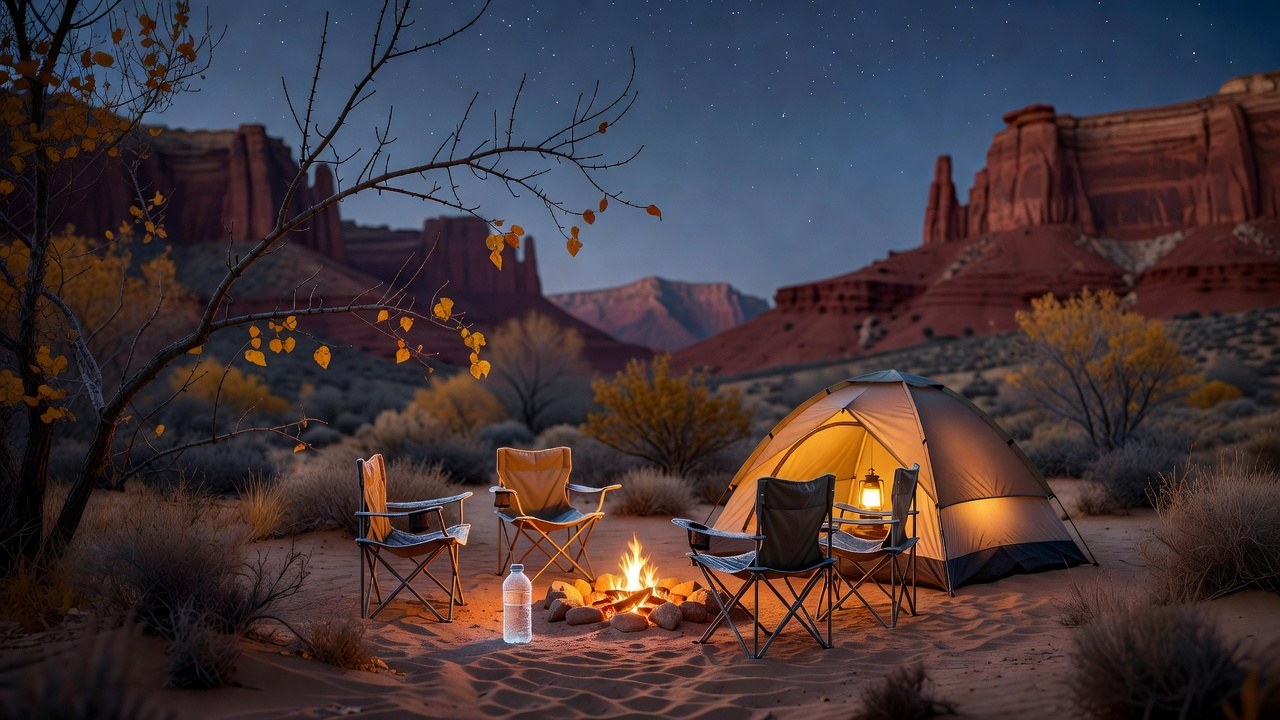
This is November's great inversion. The places that were perfect in July are shuttered, and the places that were unbearable in July are at their absolute best. November is peak season for desert camping — Joshua Tree, Death Valley, Big Bend, southern Utah, southern New Mexico, and most of Arizona. It's also when Florida and the Gulf Coast come into their own.
The tradeoff: because everyone has figured this out, southern November campgrounds book up, and Florida's snowbird season starts cranking. Reserve ahead for Thanksgiving especially.
5. Hunting season peaks — blaze orange is not optional
Firearms deer seasons peak in November across a huge share of the country — Pennsylvania, Michigan, Wisconsin, New York, Missouri, Texas, and many more. On public land where hunting is permitted, this is the month to rethink where you walk.
Practical consequence: wear blaze orange if you're on public land during an open season, keep dogs close and visible (our guide to hiking with dogs during hunting season covers the dog side), and know that "I didn't see any hunters" is not the same as "no season is open."
6. Your propane behaves like a different fuel
This surprises everyone the first time. A 1-lb propane canister that runs a stove fine at 60°F loses pressure as the temperature drops, and by the low 20s the flame gets weak and lazy — or won't light. Straight butane is worse; it essentially quits. That's why the cold-weather camp stove conversation is really a fuel conversation, and we wrote it up separately in the camp stove fuel guide.
Where to Camp in November: Region by Region
Here's the map that matters. Think of it as two lists: the places November rewards, and the places November closes.
The Desert Southwest — November's undisputed winner
Arizona, southern New Mexico, southern Utah, and the desert parks of California are at peak season. Daytime highs sit in the 60s and low 70s, the summer's brutal heat is gone, and nights dip cold but manageable — often upper 30s to mid 40s at valley elevations.
Favorites: Joshua Tree, Death Valley, Big Bend, Saguaro, Organ Pipe, and the Moab-area BLM land. Expect full campgrounds on weekends.
The Southeast and Gulf Coast
Florida, coastal Georgia, the Carolinas, Alabama, Mississippi, and Louisiana all stay comfortable. November highs commonly reach the 60s and low 70s, with lows in the 40s and 50s. This is one of the few regions where you can tent camp in November with summer-adjacent gear plus a genuinely warm bag.
Florida is the standout — but it's also the busiest, since this is when the season begins in earnest.
California and the Pacific Coast
The California coast is mild and often beautiful in November — cool, sometimes foggy, with lows in the 40s and 50s. Inland valleys cool off hard at night but stay pleasant by day. Avoid the Sierra high country, which is solidly into snow.
Texas and the Ozarks
Central and west Texas, plus the Ozarks in Arkansas and Missouri, thread the needle in November: crisp days, cold-but-survivable nights, and fewer people than October. Northern Arkansas and southern Missouri can see an early freeze, so check the elevation of your specific site.
What's Closed — the Northern Half
Be realistic about this list: high-country Rockies, the northern Midwest (Minnesota, Wisconsin, northern Michigan), New England, and alpine Pacific Northwest campgrounds are predominantly closed or snowed in by late November. Many Forest Service and state park campgrounds shut down between mid-October and the end of November, and the ones that stay open typically do so without water and sometimes without plowed access roads.
If your November target is in that half of the map, you want a camper, a four-season tent, and verified road access — or a different plan.
Is November Too Cold for Camping? The Real Numbers
For most people, "too cold" means the nighttime low, not the daytime high. Here's roughly what to expect at typical valley and foothill elevations:
- Desert Southwest: highs 62–72°F, lows 35–48°F
- Southeast / Gulf Coast: highs 62–72°F, lows 42–55°F
- California coast: highs 58–66°F, lows 44–52°F
- Mid-Atlantic / Ohio Valley: highs 48–58°F, lows 28–38°F
- Northern tier & mountain West: highs 30–45°F, lows 10–28°F
Two things to hold in your head. First, clear November nights run much colder than the forecast suggests — a dry, cloudless night radiates heat away and can overshoot the prediction by 8–12 degrees. Second, elevation is a bigger variable than date: you lose roughly 3–5°F for every 1,000 feet you climb.
The practical takeaway: if your expected low is in the 30s, a 40°F-rated bag will not be enough. Which brings us to gear.
The November Gear Shift: What Actually Has to Change
You don't need a whole new kit for November. You need to change four things — and the biggest one is underneath you.
Sleep system: the R-value jump is the real upgrade
If you only change one thing, change your sleeping pad. Ground conduction is what steals your warmth in cold weather, and a summer pad does nothing for it. For November conditions, treat R-value 4 as the floor and R-value 5+ as the goal once you're below freezing.
- Therm-a-Rest Z Lite SOL ($54.95, 4.7★) — the indestructible closed-cell foam workhorse with an R-value around 2.6; inexpensive and it cannot puncture. Pair it under an inflatable for a cheap R-value stack.
- Klymit Insulated Static V ($94.99, 4.5★) — the value pick for real cold, with an R-value around 4.4 at a price that doesn't sting.
- Sea to Summit Ether Light XT Insulated ($219.95, 4.5★) — the premium option, notable for how thick and quiet it is, which matters if you're a side sleeper on frozen ground.
Then the bag. Ratings on sleeping bags are usually limit ratings, not comfort ratings, which is the single most common source of cold nights:
- Teton Sports Celsius 0° ($59.99, 4.5★) — the budget cold-weather answer, and a genuinely large bag that works well for car camping. Its XXL sibling ($89.99) is worth the upgrade if you're over 6 feet.
- Kelty Cosmic Down 20° ($169.00, 4.5★) — 550-fill down, packs small, and a legitimate three-season-plus bag. The right call if you're hiking in rather than parking next to your site.
- Coleman Palmetto 40° ($44.99, 4.4★) — fine for a mild Southern or desert November night, but be honest: a 40°F bag in a 35°F forecast is a cold night.
- Kids need their own rated bag, not an adult bag cinched down: the Kelty Woobie 30° ($39.95, 4.5★) fits the bill, and for babies there's the Morrison Outdoors Little Mo 40 ($69.95, 4.5★).
The cheapest warmth in this entire article is a fleece liner. A liner adds meaningful degrees to any bag you already own:
- Redcamp Fleece Sleeping Bag Liner ($24.99, 4.6★)
- Litume Fleece Liner ($57.98, 4.6★) — the mummy cut with a hood is the warmer of the two.
If you want the full system — R-value math, moisture management, ventilation, and the order to layer in — our guide to staying warm camping goes much deeper than this section can.
Worn insulation: layers you can shed at 2 p.m.
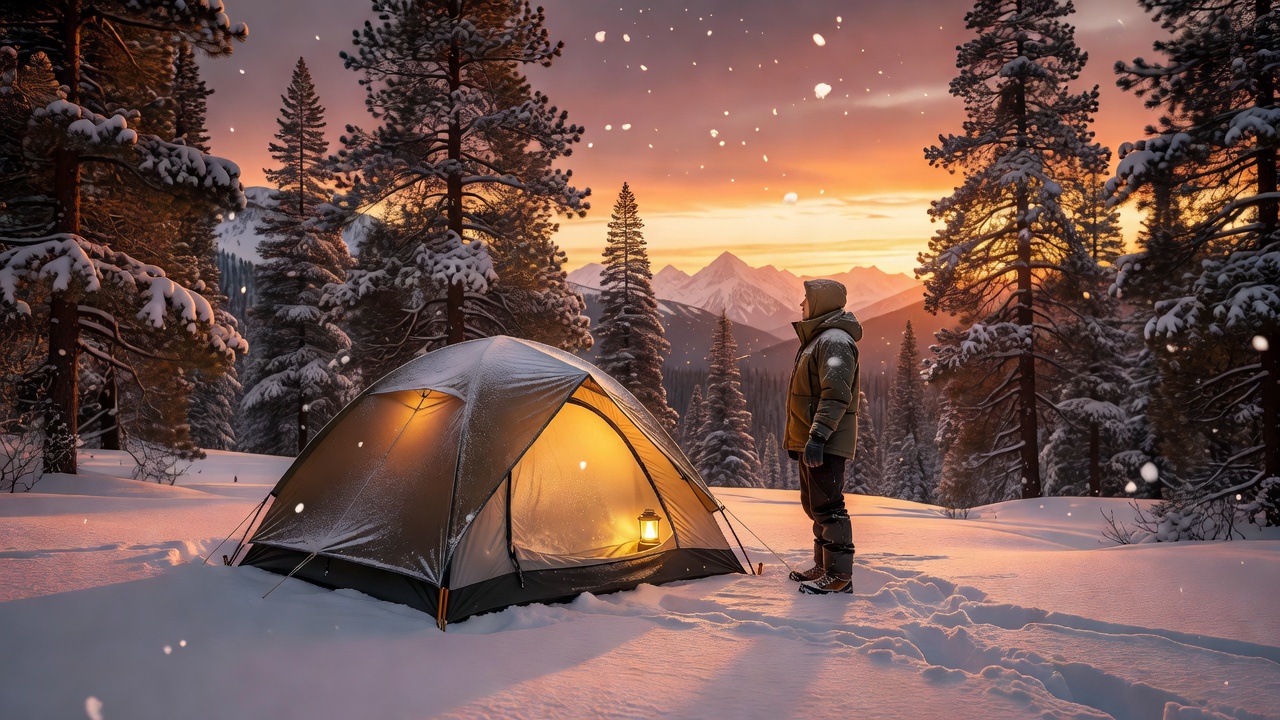
November is a layering month, because a 65°F afternoon and a 32°F night happen on the same trip. Bring a base layer, a fleece midlayer, and a shell — plus a hat, because a shocking amount of heat leaves through your head and neck.
- Columbia Omni-Heat Midweight Base Layer ($49.99, 4.6★) — the reflective-dot lining genuinely helps and it doubles as a pajama top in the bag.
- Columbia Steens Mountain Fleece ($34.99, 4.6★) — 30,000 reviews, cheap, warm, and the layer you'll actually live in at camp.
- Smartwool Merino Beanie ($35.00, 4.7★) — merino doesn't get clammy the way synthetics do.
- Smartwool Merino Neck Gaiter ($32.00, 4.6★) — the most underrated piece of cold-weather camp gear there is.
- Carhartt Insulated Knit-Cuff Gloves ($32.99, 4.6★) — for cooking and firewood, when dexterity matters more than warmth.
- Darn Tough Hiker Micro Crew Socks ($27.95, 4.7★) — merino, cushioned, and famously warrantied. Cold feet in a warm bag almost always means damp socks, not a bad bag.
Heat: the honest conversation about heaters in tents
A tent heater is what makes November genuinely comfortable rather than merely survivable — and it's also the piece with the most serious safety requirements. We cover the rules in full in our camping heater guide, but the short version: only use units rated for indoor use, never in a fully sealed tent, and always with ventilation.
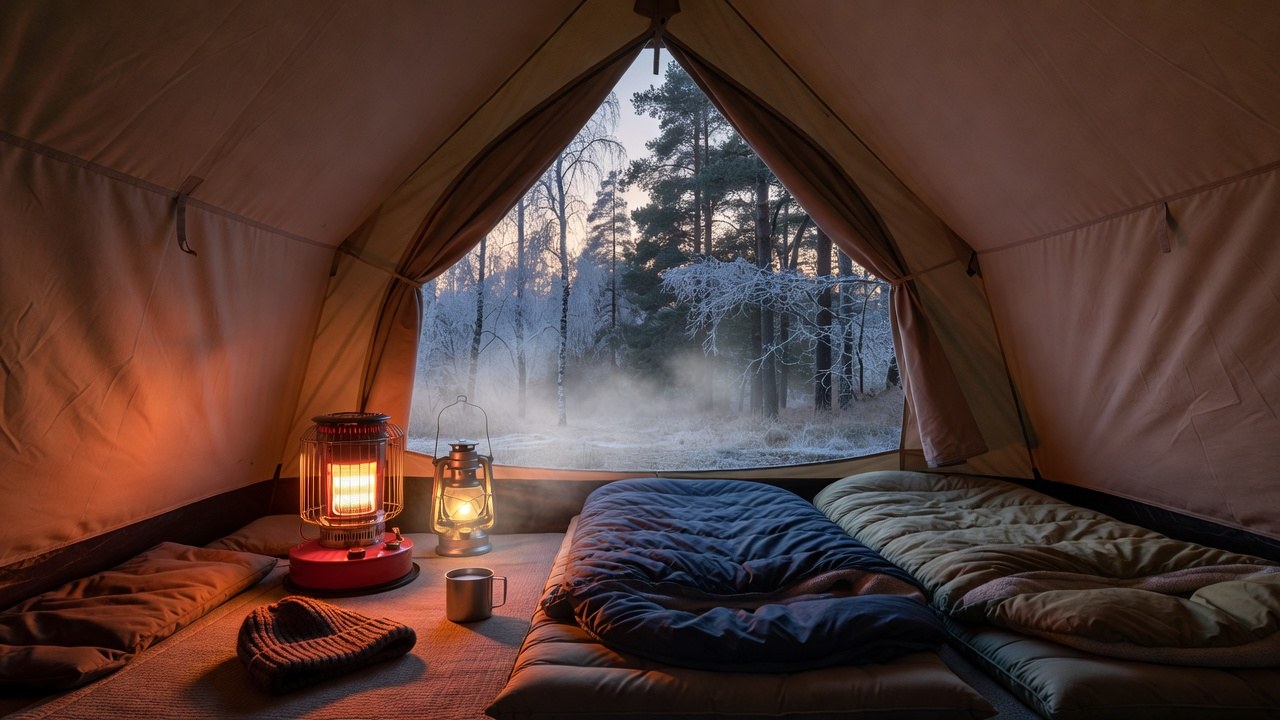
- Mr. Heater Little Buddy ($69.99, 4.5★) — 3,800 BTU, small, and the right size for a tent. It shuts off if tipped.
- Mr. Heater MH9BX Portable Buddy ($74.00, 4.7★) — the standard answer, with a low/high setting and an oxygen depletion sensor. 25,000 reviews for a reason.
- Mr. Heater Big Buddy ($146.48, 4.6★) — for large tents, wall tents, and unheated RVs.
Two accessories that come up every cold-weather trip:
- 10-ft Propane Hose Assembly ($17.99, 4.6★) — lets you run the heater off a bulk tank instead of expensive 1-lb canisters, which is also the fix for cold-weather pressure loss.
- Universal Propane Fuel Filter ($15.97, 4.7★) — required when you run a hose off a bulk tank, and it protects the heater's internal passages.
For off-grid warmth without a fuel canister: HotHands Hand Warmers, 40-pair bulk pack ($29.99, 4.6★) for pockets and sleeping bag footboxes, and the rechargeable Ocoopa Magnetic Hand Warmers ($39.99, 4.5★) which are reusable and can charge a phone in a pinch.
One more piece of warmth worth owning: a real camping blanket. The Rumpl Original Puffy ($139.00, 4.7★) is the one that replaced every cheap blanket in our truck — it's warm, it shrugs off damp, and it drapes over a camp chair properly.
Fuel, food, and light
Cold changes your kitchen too. Bring Coleman 16.4-oz propane cylinders ($64.99, 4.8★) rather than relying on a couple of stragglers, and note that keeping canisters above freezing — in the vehicle cab, not the tent — meaningfully improves performance. For soups and stews that stay hot for hours, the Thermos Stainless King Food Jar ($30.50, 4.6★) is a genuinely great cold-weather camping item.
Camping in November With Kids
November is a wonderful family camping month in the right region — fewer crowds, no bugs, and a campfire that finally makes sense. But it takes more deliberate planning than summer:
- Assume an earlier night. With sunset before 5 p.m., dinner needs to happen early or you're cooking in the dark with tired kids.
- Layer aggressively and bring spares. Kids don't regulate temperature well and they get wet. Two of everything for the smallest ones.
- Own their sleep system. A kid in an oversized adult bag loses all loft. The kids sleeping bag guide covers sizing properly.
- Have an escape plan. If the night turns bad, the difference between a great trip and a miserable one is knowing you can bail without shame.
- Watch the toddler and baby specifics. Little ones have very different cold-weather limits — our camping with a baby or toddler guide is the reference we use.
And if the trip includes the dog, remember November is hunting-season month on many public lands: the dog hunting-season guide covers visibility and where to avoid.
Thanksgiving Weekend: November's Big Trip
If you're only camping once in November, it's almost certainly Thanksgiving — a four-day weekend, everyone off work, and a genuinely great reason to be outside. It's also the single busiest camping weekend of the late fall, so reserving early matters more than usual.
Cooking a full holiday meal outdoors is its own skill, and it deserves more space than we can give it here: the Thanksgiving camping guide covers the Dutch-oven turkey method, sides on a two-burner setup, and the food-safety cold-chain plan in detail.
November Camping Safety
The risks in November are real but manageable, and most of them come from two things: cold and combustion.
Carbon monoxide is the one that kills
Burning propane in an enclosed space produces carbon monoxide. "Indoor safe" heaters have oxygen depletion sensors, but that is not the same as "sealed tent safe." Always leave ventilation — a cracked vent, an unzipped panel, an open tent fly. Never sleep with a heater running in a fully closed tent, and never bring a camp stove inside a tent to warm up.
Hypothermia doesn't require freezing temperatures
This is the trap that catches experienced people. Hypothermia's danger zone is often 40–50°F with wind or wet clothing, not 10°F. If you get soaked on a November hike and the sun goes down, you can be in trouble well above freezing. Stay dry, change out of wet layers before dinner, and watch for the early signs — uncontrolled shivering, slurred speech, fumbling hands.
Frozen water, frozen fuel, frozen locks
Small, mundane, and it ruins mornings. Fill a water bottle and leave it in the sleeping bag to keep it liquid. Keep propane canisters in the cab. Pre-treat door locks and seals with a silicone spray so you're not chipping ice at 6 a.m.
Fire and burn bans still apply
November often means dry fuel and active burn bans, especially across the Southwest and the Southeast after a dry fall. Check the specific ranger district or park rules before you count on a fire — and have a stove as your backup, not the other way around.
For a broader layering of what to bring, see the winter camping gear checklist and our family camping safety guide.
Your November Camping Checklist
The October list plus these additions:
- Sleeping pad with R-value 4+ — the single highest-return upgrade
- Bag rated at least 10–15°F below your expected low — remember ratings are usually limit, not comfort
- A fleece liner — cheapest warmth you can buy
- Base layer + fleece + shell + hat + gloves + merino socks
- Heater rated for indoor use, plus ventilation, plus the correct hose and filter if you're on bulk propane
- Battery lanterns and headlamps with spare batteries — you'll use them at 4:45 p.m.
- Extra water in case the campground's spigots are drained
- Blaze orange if you're on public land during hunting season
- A bail-out plan and a warmer backup option
Camping in November FAQ
Can you go camping in November?
Yes. November camping is completely viable across the southern half of the United States and in any region where you have an RV or camper. In the Desert Southwest, the Southeast, and the Gulf Coast, November is arguably the best camping month of the year — mild days, cool nights, no bugs, and far fewer people. In the northern tier and the mountain West, most established campgrounds are closed for the season by late November, and the ones that remain open often have no water and uncertain road access.
Can you camp in November in a tent?
Yes, with the right region and the right sleep system. The two things that decide whether a November tent night is comfortable or miserable are the sleeping pad's R-value (aim for 4 or higher, and 5+ below freezing) and a sleeping bag rated meaningfully below your expected low — remembering that published ratings are typically limit ratings rather than comfort ratings. Add a fleece liner and a warm hat and most people can comfortably tent camp into the 30s.
Where should I camp in November?
Arizona, southern New Mexico, southern Utah, and the California desert parks are at peak season in November. Florida, coastal Georgia, the Carolinas, and the Gulf Coast are all comfortable. Central Texas, the Ozarks, and the California coast thread the needle nicely. Meanwhile the northern Rockies high country, the northern Midwest, New England, and alpine Pacific Northwest campgrounds are largely closed or snowed in.
Is camping in November too cold?
It depends almost entirely on where. Desert Southwest and Gulf Coast November nights typically run 35–55°F, which is very manageable. Mid-Atlantic and Ohio Valley nights land around 28–38°F, which requires a genuine cold-weather sleep system. Northern tier and mountain West lows of 10–28°F require four-season gear and real experience. Note also that clear, dry November nights routinely run colder than the forecast, and you lose roughly 3–5°F per 1,000 feet of elevation.
What sleeping bag rating do I need for November camping?
Use the common rule of thumb: choose a bag rated at least 10–15°F below the lowest temperature you expect, then add a fleece liner if you sleep cold. For a desert November night around 40°F, a 20–30°F bag is right. For a mid-Atlantic night around 30°F, look at 15–20°F. For a mountain night in the low 20s, you want a 0°F bag. Bear in mind that bag ratings are usually limit ratings measured with a pad of known R-value — so your pad is part of the rating.
Do campgrounds close in November?
Many do, especially in the northern half of the country. Across the northern tier and mountain West, Forest Service and state park campgrounds commonly close between mid-October and the end of November. Campgrounds that stay open often turn the water off and drain the pipes, leaving vault toilets only, and some stop plowing access roads. If you're targeting a specific campground, call and ask two separate questions: "Are you open?" and "Is the water still on?"
Do people go camping in November?
Plenty do — and the number has grown as the Southwest's peak season has become better known. Thanksgiving weekend in particular is one of the busiest camping weekends of the late fall, and southern campgrounds that were empty in August fill up. Weekends in the desert parks and Florida state parks can be fully booked, so reserve ahead. The upside is that November crowds are concentrated in the south; northern campgrounds that remain open are often nearly empty.
The Bottom Line
November is the month camping splits in two. In the right half of the country — the desert Southwest, the Southeast, the Gulf Coast, the California coast, Texas — it's the best month of the year: mild days, cold-but-fair nights, no crowds, no bugs. In the other half, the season is over unless you have a camper or four-season gear and verified road access.
The gear shift is smaller than people think. Fix the pad, get the bag rating honest, add a liner and a warm hat, and deal seriously with your heater and its ventilation. Do those four things and a 35°F November night is genuinely lovely.
And if you're planning the shoulder month on the other side of this one, our October fall camping guide covers the foliage-and-mild-weather version of the same trip — and once you're hooked on cold-weather camping, the winter camping guide for beginners is the logical next step.
<!-- AFFILIATE_DISCLOSURE -->