How to Keep Water From Freezing While Camping (2026)
Keep water from freezing while camping: wide-mouth bottles upside down, body heat, snow banks, hot water bottles, and the RV hose fix that saves a trip.
Quick Answer: keep your water in a wide-mouth bottle, store it upside down, and sleep with it. Ice forms first at the smallest, thinnest, most exposed part of any water system — the cap and threads of a bottle, the last few inches of a hydration hose. Turning a bottle upside down means the ice forms at the base and you can still open and drink it. Add a body-heat pocket during the day, put the bottle inside your sleeping bag at night, and fill it to the top before dark. For a group's water supply, keep the jug in an insulated cooler or bury it in snow, off the tent floor. Everything else — bladders, filters, RV hoses, melting snow — is those same three rules applied to a different container.
That is the short version. The rest of this page is why each piece works, where the failure actually happens, and the specific gear that survives a hard freeze.
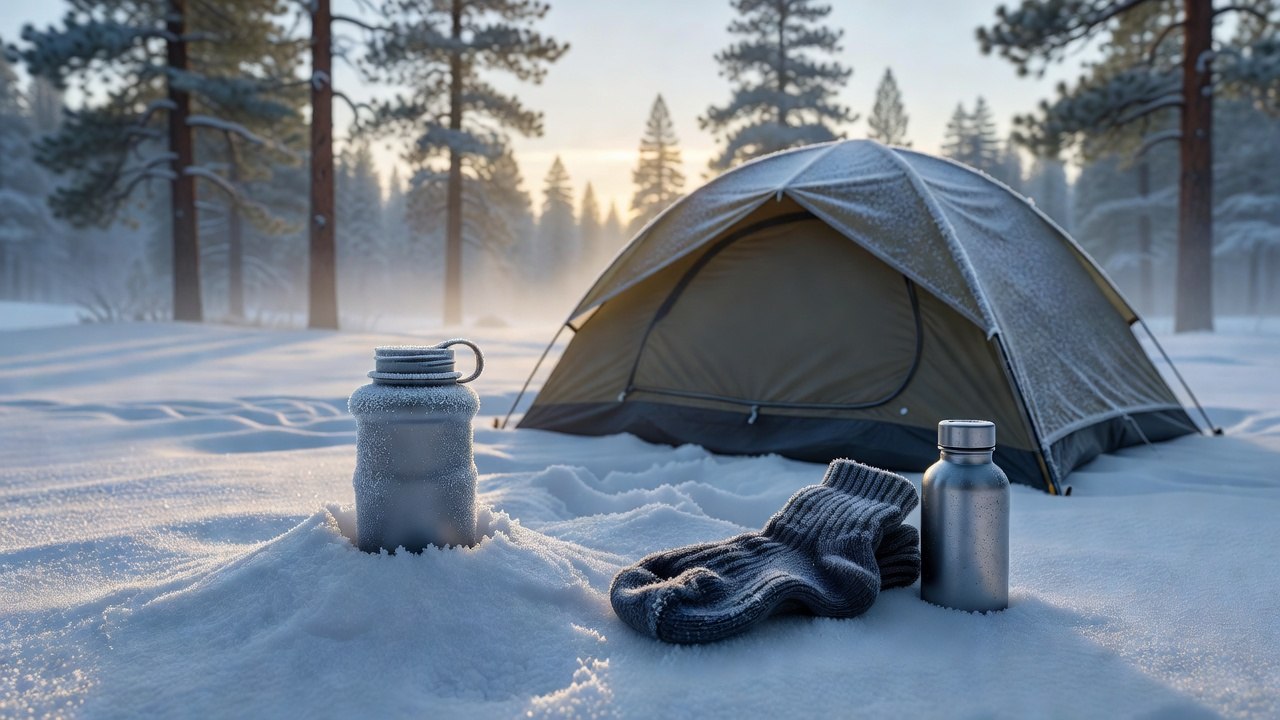
Why Water Freezes Unevenly at Camp
Water does not freeze as one block. It freezes first wherever the ratio of surface area to volume is worst — a thin film, a narrow opening, a small volume hanging in moving air. That is why a bottle can be three-quarters liquid and completely undrinkable: the cap is solid.
| The part that freezes first | Why it goes first | What to do |
|---|---|---|
| Bottle cap and threads | Narrow opening, thin plastic, full air exposure | Store the bottle upside down; dry the threads before closing |
| Hydration hose and bite valve | A few millilitres spread over a long thin tube | Blow water back into the reservoir after every sip |
| Water sitting on the tent floor | The floor is the coldest surface in the tent | Hang the bottle or keep it in the sleeping bag |
| A half-empty container | Less thermal mass, more cold air in contact | Fill it to the top before dark |
Two physical facts drive all of this. Water expands by roughly 9% when it freezes, which is why a rigid bottle filled to the brim and sealed can stress its seams — leave an inch of headspace in metal or glass, and expect plastic to survive but deform. And ice is a good insulator, so the first quarter-inch that forms on the surface slows the rest, which is exactly why the cap can be solid while the middle of the bottle is still liquid.
How to Keep Water From Freezing While Camping: The Bottle Method
This is the routine that handles 90% of cold-weather camping water, using nothing you have to buy.
Pick a Wide-Mouth Bottle
The mouth is the failure point, so the smallest mouth is the worst choice. A 63 mm wide-mouth bottle takes longer for ice to bridge across the opening, and if it does freeze you can still break it up with a spoon handle or a tent stake. The Nalgene 32 oz wide-mouth Tritan bottle ($16.99, 4.8 stars, 65,000+ reviews) is the default answer for cold weather for one unglamorous reason: it is nearly indestructible, it takes boiling water without deforming, and it doubles as a hot water bottle at night. Narrow-neck disposable bottles and soft flasks are the two worst options below freezing.
Store Bottles Upside Down
Ice forms at the top of a bottle, where the water touches cold air through thin plastic. Inverted, that top is the base, so the cap and threads stay clear and you can open it with gloves on. Two habits make this work: close it tight before you flip it, and dry the threads after every drink so water does not collect between the cap and the neck and freeze the cap shut.
Insulate What You Cannot Keep Inside Your Jacket
An insulated sleeve, a spare wool sock, or a foam koozie buys hours — an insulated bottle buys most of a day. If you carry one bottle, make it an insulated one: the Hydro Flask 32 oz wide-mouth ($44.95, 4.6 stars) keeps liquid from freezing overnight in a way a single-wall bottle cannot, and the THERMOS Stainless King 40 oz ($39.99, 4.7 stars, 21,000+ reviews) is the better call if you want hot tea that is still hot at lunch. The RAYMYLO 64 oz insulated bottle ($19.19, 4.6 stars) is the budget version of the same idea for a family's worth of water.
Sleep With Your Water
Put the bottle in your sleeping bag, at your feet or against your core, not beside your head where condensation from your breath lands on it. This solves two problems at once: the water stays liquid, and a bottle filled with hot water before bed is a heat source for the first half of the night.
Keep It Off the Tent Floor
The floor of a tent is the coldest surface you own at night — it is in direct contact with the ground and it collects every drop of condensation. A bottle left on the floor will be the first thing frozen in the morning, insulation or not.
Winter Camping Water Storage: The Jug, the Cooler, and the Snow Bank
Once you are carrying water for more than one person, the bottle rules stop scaling and you need a container with mass.
- Use a real water carrier. The Coleman 5-gallon water carrier ($13.99, 4.7 stars) has a spigot, which means the family fills bottles without opening the whole supply to the cold air every time someone is thirsty.
- Keep the jug in the cooler. A closed cooler is an insulated box. Putting the water jug inside it overnight works even in summer-cold conditions, and it keeps the jug out of the wind, which is what actually pulls heat out of a container.
- Bury it in snow, and mark it. Snow is an insulator — a buried jug stays liquid overnight far better than one sitting in the open. Bury it upside down, pack the snow down with no air pockets, and plant something visible next to it, because hunting for a buried water jug in the dark is its own kind of misery. A headlamp like the Black Diamond Spot 400 ($39.95, 4.5 stars) lives in the same pocket as the marker stakes for exactly this reason.
- Freeze water on purpose. In a cooler, frozen bottles replace bagged ice and then become drinking water as they melt. It is the only ice in camping that improves with time.
Winter Camping Hot Water Bottle: Two Problems, One Answer
A hot water bottle is the highest-value item in cold-weather camping water, because it is both the water supply and the heating system. Fill a bottle with hot — not boiling — water before bed, seal it, wrap it in a spare fleece or a sock, and put it in the sleeping bag twenty minutes before you get in. You get a warmed bag, and in the morning you have liquid water when everything else in camp is frozen.
The FORICOM 2-pack 2L hot water bottles ($16.18, 4.7 stars) are purpose-built for this and come in a two-pack, which suits a couple or two kids. A Nalgene works just as well as long as you are certain the bottle takes hot water — do not put boiling water into a thin disposable bottle or a soft flask, and test any unfamiliar bottle at home with hot tap water first.
Hydration Bladders and Hoses: The Part That Freezes First
The hose is the weakest link in any winter water system. It holds a few millilitres spread across a thin tube in open air, and when it plugs, the three litres behind it are irrelevant.
Blow the water back into the reservoir after every single drink. That one habit is the entire technique. Add an insulated hose sleeve, route the tube under a jacket or inside the pack strap, and tuck the bite valve into a collar between sips. Below roughly 20°F, carry a bottle as well: run the bladder while you are moving, and treat the bottle as the supply that a centimetre of ice cannot block. If the tube does freeze, put it against your skin inside your jacket — it will clear in a few minutes.
How to Keep Water Hose From Freezing While Camping (RV and Travel Trailer)
For anyone camping with a trailer or a motorhome, the water question is not the bottle — it is the hose and the fresh tank. Four things matter:
- Fill the fresh tank and disconnect the city-water hose. A hose left connected in freezing weather is the single most common cold-weather RV failure. A heated hose or a length of heat cable helps, but only if you plan to stay hooked up for the whole trip.
- Treat the water, not the plumbing, as the enemy. Use the onboard tank and pump, and refill from a jug you keep inside. If you do run off a campground spigot, put the filter on the fill hose — like the Camco TastePURE RV filter ($17.99, 4.5 stars, 22,000+ reviews) — not on a hose that will sit outside all night.
- Open the cabinet doors. Sink and shower lines run behind cabinets. Leaving the doors ajar at night lets interior heat reach the pipes, and that one habit prevents most frozen-line repairs.
- Drain what you are not using, and use RV antifreeze in the waste tanks only — never in the drinking-water system. The full sequence is in our RV winterization guide.
If you are in a cabin or a campground with a spigot, the same logic applies: fill everything you need before dark and disconnect before the temperature drops.
Melting Snow and Ice for Drinking Water
When there is no liquid water, melt it — but do it in the right order, because melting snow badly wastes fuel and ruins pots.
- Start with a little liquid water in the pot. A centimetre of water in the bottom before you add snow conducts heat into the snow instead of scorching the metal.
- Add snow gradually, not all at once. Loose snow is mostly air. Expect roughly ten litres of loose snow for a litre of water, which is why snow melting eats fuel.
- Boil to make it safe. Bring the water to a rolling boil for one minute, or three minutes above roughly 2,000 metres (6,500 ft). That is the CDC's guidance and it does not depend on batteries, filters or chemicals.
- Use a stove that works in the cold. Butane canisters lose pressure around freezing and quit; propane keeps vaporising far below zero. Which fuel to bring is a decision, not a detail — our camp stove fuel guide has the temperature ladder. A simple single-burner like the Coleman Classic 1-burner butane stove ($29.99, 4.5 stars) is fine above freezing; below it, bring propane or a liquid-fuel stove.
- Do not eat snow to hydrate. It costs your body more heat than it returns.
Filters and Pumps: The Gear Freezing Actually Destroys
A water filter is not merely less pleasant after it freezes — it can be permanently damaged. Hollow-fibre membranes are made of thousands of tiny tubes, and water expanding inside them can rupture the fibres. There is no way to look at a filter and tell whether that happened.
Keep the filter next to your body during the day and in your sleeping bag at night. If it does freeze, treat it as unreliable and boil instead. The Sawyer Squeeze ($45.95, 4.7 stars) is the most common backcountry filter for a reason — it threads onto a wide-mouth bottle and weighs three ounces — but its hollow-fibre membrane is exactly the kind that freezing ruins, so it belongs in the warm pocket, not the pack's outer mesh.
How to Keep Water From Freezing Without Electricity (Off-Grid and No-Power Camping)
Everything above works with no power at all, which matters if you are camping off-grid, in a cabin with no heat, or in a winter storm that takes the campground's power with it. The passive toolkit is short:
- Insulation, not heat. Wool socks, fleece, foam, a cooler, a sleeping bag — anything that slows heat loss. Heat a bottle once and insulate it; you cannot reheat it at 3 a.m. without getting out of the bag.
- Ground heat. Burying a jug in snow or under a layer of duff and boughs uses the ground's stored warmth. It is slower than burying it in snow and works better in shallow cold than in deep cold.
- Body heat. The most reliable heat source you have is you, and it is free.
- Fill before dark. A full container freezes more slowly than a half-full one, and it is easier to keep liquid than to thaw.
Off-Grid Water in Deep Cold: The Short Version
- How to keep water from freezing off grid — insulate first, then place. Heat one bottle at dinner, wrap it, and never plan to reheat at 3 a.m.
- Keep water from freezing winter camping starts as a packing decision at home: wide-mouth bottles, one insulated bottle per person, and no thin soft flasks in the bag.
- How to stop water freezing camping is fill-to-the-top, dry threads, cap-down storage — three habits, no gear.
- Camping water freezing overnight is expected, not a failure. Plan on the cap icing first and the group jug lasting last.
- Winter camping water bottle — wide mouth, a cap you can open with gloves, and a shape that fits inside a sleeping bag. The bottle is the system.
The Cold-Weather Water Checklist
- Fill every bottle to the top before dark; leave an inch of headspace in metal or glass
- Move water into wide-mouth bottles; leave the narrow-neck and soft flasks at home
- Store bottles upside down, threads dry
- One insulated bottle or thermos per person for the day
- One hot water bottle filled before bed, wrapped, in the sleeping bag
- Blow hydration hoses back into the reservoir after every drink
- Filter in the sleeping bag, never in the pack's outer pocket
- Jug in the cooler or buried in snow, marked with something visible
- RV hose disconnected, fresh tank filled, cabinet doors ajar
- Snow-melting pot, starter water, and a stove you have actually run in the cold
Common Mistakes
Filling bottles in the morning instead of the night before. Water you leave in the open overnight is water you have to thaw. Fill at dinner.
Trusting a hydration bladder below 20°F. The hose plugs and the reservoir becomes dead weight. Carry a bottle as the backup.
Leaving the filter in the pack. Freezing damage is invisible. It is the one piece of water gear where a mistake costs the whole item.
Melting snow in a dry pot. You will scorch the aluminium and taste it in every meal for the rest of the trip.
Assuming a campground spigot means water. Late-season campgrounds drain their lines ahead of the first hard freeze. A campground can be open and still have no running water — call ahead.
<!-- AFFILIATE_DISCLOSURE -->How to Keep Water From Freezing While Camping FAQ
How long does it take for a water bottle to freeze when camping?
It depends almost entirely on temperature and wind, not on time. A single-wall bottle left on a tent floor at 20°F with wind will have an ice cap within a couple of hours; the same bottle inside a sleeping bag will still be liquid at dawn. Treat "overnight" as the planning unit rather than minutes, and assume anything left exposed will have ice on it by morning.
Can you drink water that froze and thawed?
Yes, if the container is safe and the water was clean. Freezing does not make water unsafe, and it does not remove contamination either — if the water needed treating before it froze, it still needs treating after it thaws. Do not refreeze a rigid bottle that cracked, and do not drink from a plastic bottle that split.
Will a Nalgene bottle survive freezing?
A Nalgene will survive being frozen — that is part of why it is the standard cold-weather bottle — but a bottle filled to the brim and sealed puts stress on the threads and seams as the ice expands. Leave an inch of headspace, or fill it fully and accept that the cap may be tight in the morning.
Does boiling water keep it from freezing longer?
Yes. Starting with hot water buys you hours, because the water has to lose all of that heat before it can begin to freeze. It also gives you a hot water bottle for the night. Do not pour boiling water into a thin disposable bottle or a hydration reservoir — use a bottle rated for hot liquids.
What is the best way to keep a hydration hose from freezing?
Blow the water back into the reservoir after every sip, keep the hose under a jacket or inside a pack strap, and use an insulated sleeve. If you stop moving for more than a few minutes, expect the bite valve to be the first thing to freeze.
How do you keep water from freezing in an RV?
Fill the onboard fresh tank, disconnect and drain the city-water hose, keep the cabinet doors open so interior heat reaches the plumbing, and keep a jug of drinking water inside the rig. Use RV antifreeze in the waste tanks, never in the drinking-water lines.
The Rule That Survives Every Trip
Water management in cold weather is not a gear problem, it is a placement problem. The bottle that stays liquid is the one that spent the night in your bag; the filter that still works is the one that was in your jacket; the RV line that did not burst is the one you disconnected before dark. Buy a wide-mouth bottle and one insulated bottle, keep a jug in the cooler, and the rest is habit.
If you are still building the cold-weather kit, our winter camping gear checklist covers the sleep system and shelter side of the same problem, and how to stay warm camping is the companion piece on heat — because a dry, warm camper drinks normally, and a cold one stops drinking and gets colder. Planning the trip itself? The November camping guide covers which campgrounds still have water and which have already drained their lines.