Winter Camping Food: What to Pack, What Freezes, and Hot Meals That Work (2026)
What freezes solid, what survives the cold, and how to cook real hot meals below freezing — the practical winter camping food plan.
The trip that taught me this lesson was a 16°F weekend in a state park with a picnic table, a two-burner stove, and a cooler full of food that had been carefully planned in a warm kitchen. By the second morning the eggs were cracked, the salad was a translucent brick, the olive oil had gone cloudy and weird, and the water bottle in my pack was solid enough to use as a hammer. Nobody starved. But we ate badly, drank less than we should have, and spent an hour of daylight fighting the stove instead of hiking.
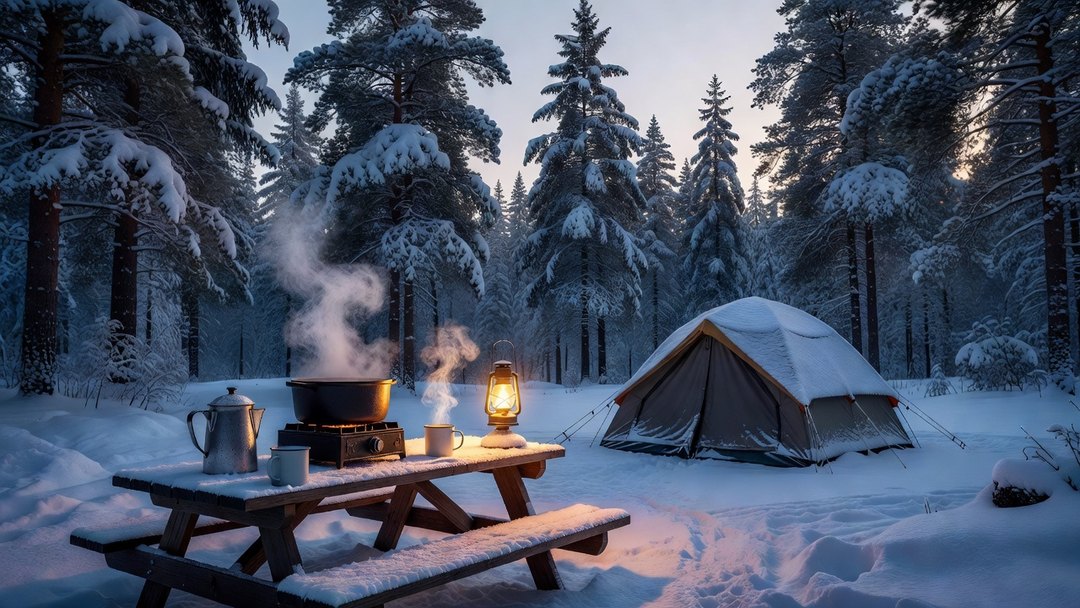
Winter camping food is not summer food with a jacket on. Below freezing, three separate things go wrong at once: water changes state, fuel changes behavior, and your body changes its demand. Plan for those three and cold-weather camping gets genuinely pleasant — hot chili at a snow-covered table, coffee that stays hot in a flask for hours, and a dutch oven doing the work over coals while everyone else is inside the tent.
This guide covers the mechanics first, then the menus, then the gear that actually holds heat.
Quick Answer: What Changes When the Temperature Drops
If you read only one section, read this one.
- Water is the first casualty. A bottle freezes solid overnight and a hydration bladder freezes in the hose line. Carry hot water in a vacuum-insulated bottle like the Hydro Flask 32 oz and keep a spare wide-mouth Nalgene for hot water you can put inside a sleeping bag or wrap in a sock.
- Hot food stays hot in a vacuum food jar, not a bowl. A THERMOS Stainless King 24 oz food jar at $30.50 is the single best cold-weather food purchase most campers never make: chili packed at 8am is still steaming at lunch, with no reheat and no dishes.
- Hot drinks need a 40-ounce flask, not a mug. A THERMOS Stainless King 40 oz beverage bottle ($39.99) keeps tea, cocoa, or coffee hot for a full day of hiking for two people. Mugs at camp are for the ten minutes after you pour.
- Canister stoves lose power as they get cold. Butane stops vaporizing near 31°F, isobutane around 11°F, propane keeps working to −44°F. That is why a liquid-fuel stove like the MSR WhisperLite Universal is the winter default, and why a canister stove needs help (see below).
- A cooler keeps food from freezing. Empty the ice out, leave the lid shut, and a 5-day cooler like the Coleman Xtreme 70-quart becomes insulation against the cold — the cheapest fix on this page.
- One-pot meals beat menus. Below freezing you want fewer vessels, fewer dishes, hotter food. A Lodge 6-quart camp dutch oven ($59.95) plus a 10.25-inch cast-iron skillet covers almost everything in this guide.
The Three Physics Problems Cold Weather Creates
Almost every cold-weather food problem traces back to one of these. Once you see them, the gear list stops being arbitrary.
1. Water stops being water
Water freezes at 32°F. Camp food is mostly water. So the failure mode is not "the food gets cold" — it is "the food changes texture and sometimes breaks its container."
The practical consequences: canned goods can bulge and split if they freeze hard; glass jars are a bad idea anywhere near a winter campsite; leafy greens collapse into slime once ice crystals rupture the cell walls; and anything in a hydration bladder is gone the moment the hose line freezes. If you want a cold-weather drink at hand while moving, insulate the tube or go back to bottles in an insulated sleeve.
2. Fuel stops being fuel
Camp stove fuel is a liquid that has to boil into a gas before it burns. The colder it gets, the less of it vaporizes, and every fuel has a floor:
- Butane boils at about 31°F. A cheap butane canister stove is a summer tool, and above about 7,000 feet it also loses pressure to altitude. See our cold-weather and high-altitude stove guide for the full altitude picture.
- Isobutane blends boil around 11°F, which is why they are the standard for canister stoves — but a canister that has been sitting in 20°F air for an hour is still noticeably weaker than the same canister at 60°F.
- Propane boils at −44°F. It is the fuel that simply does not care about a normal winter. It is also the fuel that comes in the heavy steel cylinders, which is why it dominates car camping and not backpacking.
- Liquid fuels (white gas / multi-fuel) are pumped as liquid and vaporized in the stove, so ambient temperature matters far less.
The fuel chemistry, canister sizes, and cost-per-trip math are covered in depth in our propane vs butane vs isobutane fuel guide.
3. Your body asks for more
Cold air strips heat continuously, you burn energy shivering, and hauling gear through snow costs more than walking a trail. Most winter campers find they want noticeably more food than on a summer trip and, critically, they want it hot — a hot meal is a morale and warmth event, not just calories.
The counter-intuitive failure is hydration. You sweat under layers, you breathe out moisture with every breath, and cold suppresses thirst, so people quietly run dry. Plan to drink in the same deliberate way you eat: a hot drink with breakfast, a full flask on the trail, and water at every stop.
What Freezes, What Survives, and What Ruins
This is the table I wish I had on that 16°F weekend. Below about 25°F, assume overnight freezing unless the item is in a cooler, in a sleeping bag, or in a vacuum flask.
| Food or drink | What happens below freezing | Winter fix |
|---|---|---|
| Water in bottles | Freezes solid, may split a full plastic bottle | Fill bottles only 3/4, carry hot water in a vacuum bottle, sleep with the next day's bottle |
| Hydration bladder | Hose line freezes first, then the reservoir | Switch to bottles for winter, or insulate the hose and blow water back after each sip |
| Salad greens, cucumbers, tomatoes | Cells rupture, collapse to slime | Eat them on day one, or leave them home and use cabbage, carrots, onions, and root vegetables |
| Bananas, soft fruit | Turn to brown mush and then to a brick | Apples and oranges instead; dried fruit if you want zero risk |
| Eggs | Freeze and crack, whites get rubbery | Pre-crack into a sealed bottle, or use them on day one; hard-boil for day two |
| Canned goods | Can bulge or split when the contents freeze | Keep cans in the cooler or the food bin; better yet, use pouches and dehydrated meals |
| Olive oil, some nut oils | Cloudy, semi-solid, pours badly | Keep the bottle in the cooler or inside the sleeping bag; use butter or shelf-stable fat |
| Milk and cream | Freezes, separates, texture changes | Shelf-stable milk, powdered milk, or creamer sachets |
| Bread and tortillas | Tortillas survive fine; sliced bread goes dry and brittle | Tortillas, bagels, and flatbreads for cold trips |
| Hard cheese, cured sausage | Survive well, get firmer | Ideal winter food — cut into pieces before you leave |
| Energy bars | Freeze rock-hard and lose appeal | Keep two in a jacket pocket; the rest can stay frozen |
| Honey, syrup | Thickens to near-solid | Decant into a squeeze bottle or use single-serve packets |
| Coffee grounds | Fine, but brewing water has to come from somewhere | Bring the percolator or AeroPress and budget extra fuel |
| Chocolate | Bloom, then cracks, still edible | Accept it and keep it in a pocket if you want it soft |
The Winter Cooler Trick: Use a Cooler as a Fridge, Not a Freezer
This is the single cheapest fix in cold-weather camping, and almost nobody does it deliberately.
In summer a cooler keeps heat out. In winter it keeps cold out — as long as there is no ice in it. Dump the ice, wipe it dry, and a decent cooler becomes a stable, insulated box that holds food right around freezing instead of dropping to the overnight air temperature. Your eggs do not crack, your oil pours, and your leftovers stay in the safe "refrigerator" band rather than becoming a frozen brick.
Two rules matter:
- Keep the lid shut. Every open-lid minute costs you the insulation you paid for. Pull everything you need for a meal in one go.
- Do not leave it in a locked car overnight if the food must not freeze — a metal car interior at 10°F gets colder than the cooler can compensate for. Into the vestibule or under the picnic table is fine; inside a heated vehicle is unnecessary.
The Coleman Xtreme 70-quart at $79.99 is the value pick for a family, and the RTIC 45 QT Ultra-Tough is the rugged one if you are hauling it into a dispersed site. Bring a couple of arc lighters too: a $10 flameless lighter that works in wind and cold beats ten matches that will not strike when your fingers are numb.
Cooking Real Meals Below Freezing
Cooking, not packing, is where winter trips are won. The goal is a hot, one-vessel meal with minimal exposed-water cleanup.
Canister stoves in the cold
A canister stove still works in winter if you fight the pressure drop instead of ignoring it:
- Keep the canister warm. Sleep with it, or carry it in an inside pocket until you cook. A canister that has been at 65°F all night performs like a summer canister for the first 15 minutes of cooking.
- Use a blend, not pure butane. A $8.95 MSR IsoPro 110g canister or any isobutane/propane blend outperforms the cheap butane four-packs in cold. The GasOne butane 12-pack is a great deal for mild weather and a poor choice at 20°F.
- Warm the canister mid-cook if output fades. A canister sitting in an inch of water, or swapping to a second warm canister, restores pressure.
- Add a windscreen. Wind steals more heat than temperature does. The MSR heat reflector and windscreen is the cheap upgrade — and never fully enclose a canister, because trapped heat is how canisters get dangerous.
- Pick a stove with a wide burner head for real pots. An MSR PocketRocket 2 at $49.95 is the classic lightweight choice; the Jetboil Flash is the fastest way to hot water for one or two people and the easiest system to use with gloves.
Liquid-fuel stoves when it is genuinely cold
Below about 20°F, or above 8,000 feet, a pump-fed multi-fuel stove is the reliable answer. The MSR WhisperLite Universal runs white gas and canister fuel, simmers properly, and does not care about ambient temperature. It is fiddlier to prime and heavier than a canister stove — and it is the stove that lights on the third try, not the twentieth.
One fuel-planning rule that surprises people: melting snow into drinking water costs several times the fuel of boiling the same volume of liquid water. If your winter plan involves snow-melt, budget fuel like you are feeding two extra people, not one extra pot. Our canister safety and disposal guide covers how to know a canister is truly empty before you pack it out.
Propane for car camping
For a family at a drive-in site, propane is the no-drama answer. A Coleman bottle-top single burner at $21.99 is a stove and a canister in one piece, and a Coleman Triton+ two-burner turns the picnic table into a real kitchen. A 12-pack of 1-lb propane cylinders is the sensible winter quantity — cold cooking and hot drinks burn more fuel than you expect, and running out at breakfast is a bad way to learn that.
Fire, coals, and the dutch oven
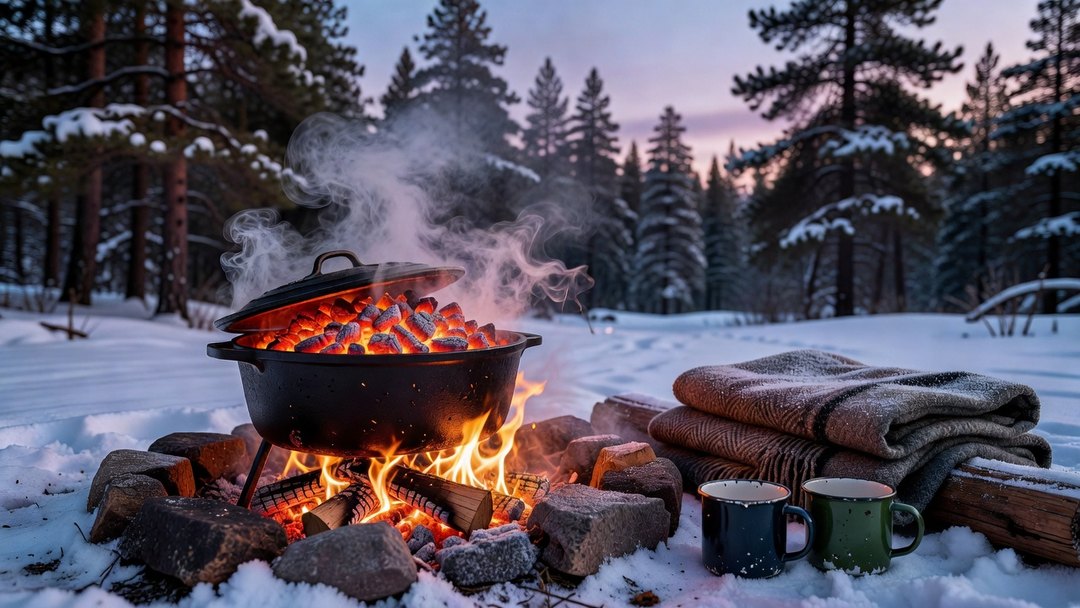
When there is a fire ring and no burn ban, the Lodge 6-quart camp dutch oven is the best winter cooking tool there is: one vessel, cast iron to hold heat, and enough thermal mass that a stew will keep cooking while you add wood. The standard coal rule of thumb for about 350°F is diameter plus 3 coals on the lid, diameter minus 3 underneath — for a 12-inch oven, roughly 15 on top and 9 below.
If you would rather not carry a separate oven, the Lodge Combo Cooker at $49.97 does both jobs: deep pot with the skillet as a lid, or invert it and bake. And when the fire is out and you just want a hot dessert, our campfire dessert recipes include the cobbler that started every argument about who gets the corner piece.
Hot Food That Travels: The Thermos System
The best winter lunch is not cooked at lunch. It is cooked at breakfast and carried hot.
Pack a vacuum food jar with chili, stew, soup, or oatmeal at 7:30am, seal it, and it is still hot at noon on a ridge. No stove, no fuel, no windbreak, no dishes, no frozen fingers trying to open a canister. For a family of four, two 24-ounce jars plus a wide-mouth bottle of hot cocoa cover lunch completely.
The same logic applies to drinks. A 40-ounce vacuum flask of hot tea or coffee for two people is worth more than any camp chair in cold weather. Two habits make vacuum gear work properly:
- Pre-heat the vacuum container with boiling water for two minutes, dump it, then fill with the hot food or drink. A cold jar steals 20% of your heat in the first hour.
- Fill it to the brim. Air space is a heat leak. If you are short on soup, top it up with hot water, not with empty space.
In-catalog picks we actually use: the THERMOS Stainless King 24 oz food jar with a bowl that doubles as the lid, the THERMOS 40-ounce beverage bottle, a STANLEY Everyday 12 oz camp mug for the ten minutes after pouring, and the GSI Infinity backpacker mug at $14.95 for kids who lose things.
A 3-Day Winter Menu for a Family of Four
This is a real plan, not a list of ideas. It assumes a car-camping base with a two-burner stove, a cooler with no ice, one dutch oven or a large pot, and a vacuum flask.
Day 1 — arrive, set up, eat hot without effort
- Breakfast at home, coffee at camp: percolator or AeroPress, GSI 8-cup enamel percolator if you want the full ritual.
- Lunch: sandwiches with hard cheese and cured sausage, apples, hot cocoa from the flask.
- Dinner: one-pot chili in the dutch oven — browned meat, canned beans, tomatoes, onion, chili powder — with tortillas. Cook extra. Deliberately.
- Dessert: dutch oven cobbler if the fire stays lit.
Day 2 — the day you eat tomorrow's lunch
- Breakfast: oatmeal with dried fruit and nuts, hot drinks, eggs if you kept them off the frozen floor.
- Pack lunch while the oatmeal cooks: yesterday's chili into the food jars, plus tortillas and cheese. It will be hot at noon.
- Dinner: loaded baked potatoes wrapped in foil in the coals, or a one-pot pasta with canned sauce; add sausage for the appetite cold creates.
- Backup if the weather turns: a Mountain House freeze-dried meal is boiling water and nothing else.
Day 3 — empty the cooler, eat the good stuff
- Breakfast: pancakes or a breakfast hash to use up the potatoes, onion, and bacon.
- Lunch: fire-grilled cheese in the cast-iron skillet, soup from the flask.
- Last dinner, or the drive home: whatever is left, cooked as one pan — that is the point of a 9-piece nesting cook set like the Stanley Adventure or a GSI Pinnacle camper cookset if you want pots that stack into one bag.
Emergency food, not menu food: keep a Mountain House Expedition bucket at home for the trip where everything goes wrong, or one pouch per person in the car for the drive home. Freeze-dried meals weigh nothing, never freeze badly, and need only boiling water — which is exactly what a winter trip gives you most reliably.
If you are camping with kids in the cold, the winter camping with kids guide covers the warm-hands-and-happy-kids side of the same trip.
Hot Drinks, Hydration, and the Thirst Nobody Notices
Cold suppresses thirst, so winter campers dehydrate quietly. Three habits fix it:
- Start hot, finish hot. A hot drink with breakfast and a hot drink at camp in the evening; plain water in between.
- Carry water warm, not cold. Water at 70°F from a vacuum bottle is easier to drink than near-freezing water from a Nalgene — and it will not freeze.
- Never eat snow for water. It costs calories to melt, and it drops your core temperature. Melt it with fuel, or start from liquid water.
For hot drinks, a percolator is the camp classic; a Snow Peak titanium french press or AeroPress if you care about the coffee; enamel mugs and a 40-ounce flask for the day. Add a mug of hot broth or soup to every trail lunch — it is the cheapest way to feel warm for an hour.
Food Storage, Odor, and Critters in the Snow
Snow does not make food storage easier. It makes it easier to forget, because the campsite looks empty.
- Do not store food in the tent. In bear country in any season, food, trash, and scented items (toothpaste, lip balm, sunscreen) belong in a bear canister like the BearVault BV450 or in the vehicle, not under your sleeping bag.
- Hang or canister, never dangle. A rope over a branch stops raccoons and does nothing about a determined bear.
- Assume small critters are still active. Mice chew through soft bags in cold weather just as happily as in summer. Hard-sided containers earn their weight.
- Pack out everything. Frozen trash does not decompose. A sealed bin keeps the smell out of your cooler and out of your car.
- Know where your site's rules differ. Dispersed camping on public land and national forest sites have different storage requirements from a state park campground — our dispersed camping guide walks through the rules that actually apply.
Cleanup When the Water Is Frozen
The classic camp dishwashing routine fails in winter, because the water in your wash basin freezes between the wash and the rinse.
The winter method is cook in fewer vessels and clean them with heat:
- Plan one-pot meals so you have one pot and four bowls, not seven pans.
- Use a nesting mess kit like the UCO 4-piece so each person owns their bowl, plate, and spork — and licks it clean, which is not a joke in cold weather.
- Wipe everything with a paper towel or a scrap of bread while it is still hot. Grease wipes off easily; chiseled-off cold grease does not.
- Boil a small amount of water for the final rinse and pour it back over the pot lid to sanitize.
- Never dump grey water on the snow. Strain it, bag the solids, and pack it out, or pour it well away from water sources per your site's rules.
If you are melting snow for water, remember the fuel rule from earlier: that pot of grey-water rinse costs real fuel, so use no more water than you need.
Food Safety: Cold Is Not a Freezer
Two food-safety errors are common on cold trips, and they are opposites.
- "It is cold, so it is safe." A jug of chili left on the picnic table at 38°F overnight is in exactly the temperature range where bacteria grow fastest. Keep cold food below 40°F and hot food above 140°F, and treat anything that sat in the 40–140°F danger zone for more than two hours as a gamble. Your cooler-as-fridge setup is the fix.
- "It froze, so it is ruined." Freezing changes texture, not safety. Frozen-then-thawed stew is fine if it was safe before it froze. Frozen-then-thawed salad is a texture disaster, but not a health one.
Also watch the thaw path: do not thaw meat on a sunny picnic table all afternoon and then cook it "later." Thaw in the cooler, cook the same day, and reheat leftovers to steaming.
If you want the broader cold-weather systems picture — sleeping warmth, layers, condensation — the winter camping gear checklist and how to stay warm camping cover the shelter side of the same trip.
Common Winter Camping Food Mistakes
I have made every one of these, usually on the same trip.
- Planning summer food. Cold changes texture, containers, and appetite. Plan for stews, soups, one-pot pasta, chili, foil packets, and hot drinks instead of pasta salad and sandwiches.
- Under-budgeting fuel. You use more fuel when the air is cold, more water when you cook one-pot, and a lot more when you melt snow. Bring a full spare canister or a second 1-lb cylinder.
- Forgetting the cooler is insulation. Without it, everything on the table freezes overnight; with it, you have a fridge.
- Packing a full bottle of water. Water expands as it freezes and splits a full bottle. Fill to three-quarters and leave the neck air space.
- Skipping the pre-heat step. A room-temperature food jar gives up its heat to cold food. Boiling-water pre-heat is a 30-second habit that buys hours of hot.
- No no-cook backup. Weather, a dead stove, or a late arrival happens. One freeze-dried pouch per person turns a ruined dinner into a five-minute one.
- Drinking too little. Bring a flask, drink on a schedule, and count hot drinks as fluid — they are.
Winter Camping Food FAQ
What is the best food to bring winter camping?
One-pot hot meals, hot drinks, and hard food that does not care about freezing: chili, stew, soup, oatmeal, pasta with sauce, hard cheese, cured sausage, tortillas, apples, dried fruit, nuts, and energy bars. Freeze-dried meals are the best no-effort backup because they only need boiling water.
Why does my camp stove not work in cold weather?
Because fuel has to vaporize before it burns, and cold reduces vapor pressure. Butane stops vaporizing near 31°F, isobutane blends around 11°F, and propane keeps working to −44°F. Keep canisters warm, use an isobutane/propane blend, add a windscreen, or switch to a pump-fed liquid-fuel stove for genuinely cold trips.
How do I stop water from freezing while camping?
Fill bottles only three-quarters full, carry hot water in a vacuum-insulated bottle, sleep with the next day's bottle, insulate or skip a hydration bladder, and never leave water in a pot on the table overnight. A cooler with no ice also keeps a small water supply from freezing as fast.
How do I keep food from freezing overnight when camping?
Use a cooler with no ice as insulation, keep the lid shut, store the cooler in the vestibule or under the table rather than in a cold car boot, and move anything that must not freeze — eggs, oils, produce, medicine — into the insulated box or inside your sleeping bag. Vacuum flasks handle the hot side of the same problem.
What can I cook while winter camping with only one burner?
One-pot meals: chili, stew, soup, pasta with sauce, ramen doctored with sausage and cabbage, risotto-style rice, and oatmeal. Boiling water for freeze-dried meals and hot drinks is the other half of a one-burner plan. If you have a fire ring and a cast-iron dutch oven, you can bake, roast, and simmer without using stove fuel at all.
Do I need a cooler in winter?
Yes — as insulation, not as a fridge packed with ice. With the ice removed, a cooler holds food near refrigerator temperature instead of letting it drop to air temperature and freeze. It also keeps smells contained and animals out of your food, which matters more than the temperature in most winter campsites.
The Bottom Line
Winter camping food is a system, not a menu. Keep water liquid in a vacuum bottle, keep food from freezing in an ice-free cooler, cook in one vessel on a stove that still vaporizes fuel in the cold, and carry hot lunch from breakfast instead of cooking it twice.
The gear that does the heavy lifting is unglamorous: a 24-ounce vacuum food jar, a 40-ounce flask, a cooler used as a fridge, a $17 windscreen, and either a liquid-fuel stove or propane for the cold end of the season. Everything else is a preference.
Get those right and the cold stops being the enemy of a good meal. It just becomes the reason the meal tastes so good.
<!-- AFFILIATE_DISCLOSURE -->