Dispersed Camping Guide 2026: How to Camp for Free on BLM and National Forest Land
Dispersed camping explained: BLM and national forest rules, stay limits by state, how to find free sites, and the no-facility gear list for 2026.
Last updated: September 29, 2026
Dispersed camping is camping on public land outside any developed campground — no fee, no reservation, no site number, and no facilities at all. On most BLM land and most national forest land it is legal, it is free, and it is limited by a stay clock and a map. This guide covers what dispersed camping actually is, where it is allowed, how to find a dispersed camping spot you are legally allowed to sleep in, and the gear that changes once there is no water spigot, no bathroom, and no table.
If you have ever typed where can i camp for free into a search bar and gotten nothing but RV resort ads, this page is the honest answer.
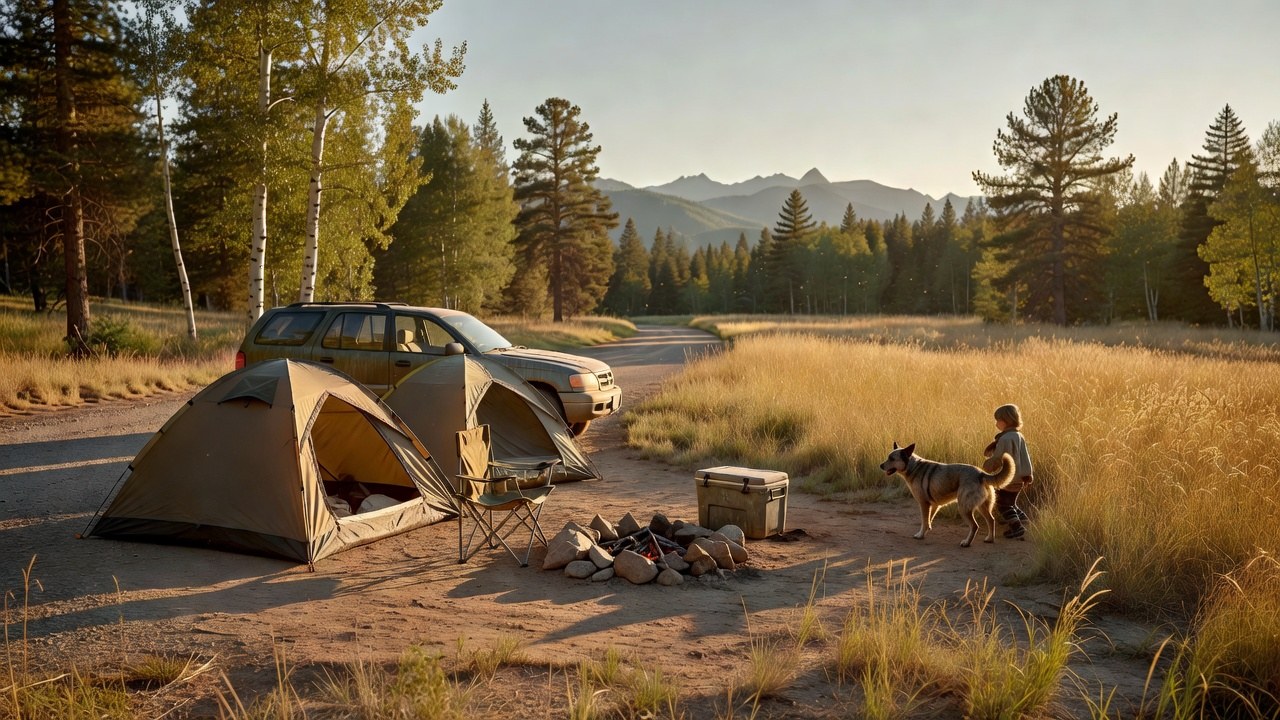
Quick Answer: Dispersed Camping in One Screen
- What it is: camping on federal public land — BLM or national forest — outside a developed campground. Dispersed camping meaning is exactly that: you are spread out, not assigned a site.
- What it costs: nothing. No fee, no reservation, no permit for normal car or tent camping. The paid exception is a BLM Long Term Visitor Area, at $40 for up to 14 days or $180 for the seven-month season (September 15 to April 15).
- How long you can stay: the federal pattern is 14 days, after which you must move on — but the real limit is written by each ranger district or BLM field office, so do not assume 14 days anywhere. Colorado's rule is 14 days in any 30-day period with a 30-air-mile move requirement; Alabama's national forests allow 21 consecutive days with a 10-day wait; Oregon's BLM land is generally 14 days within any 28-day period; New York's Adirondack Forest Preserve allows three nights at one spot.
- What decides where you can sleep: the district's Motor Vehicle Use Map (MVUM), not a website, not a signpost, and not a phone app pin. The map shows which roads you may drive and where you may leave the road.
- The three biggest beginner mistakes: driving past a legal pull-off because it has no sign, carrying no water plan, and lighting a fire during a fire restriction.
- Minimum gear that is not optional: a way to filter or carry water, a legal way to handle human waste, and a real light. Our three cheapest picks are a Sawyer Squeeze filter at $45.95, a Cleanwaste WAG Bag kit at $44.99, and the Black Diamond Moji lantern at $24.95.
What Dispersed Camping Actually Means (and What It Isn't)
What is a dispersed camping area — the answer is less a place than a permission. You are camping on land that is open to camping, off a road that is open to motor vehicles, at a spot that has no development, no host, and no rules about which patch of dirt is "yours."
That is why the honest version of dispersed camping what is it is a short list of negatives:
- No picnic table, no fire ring, no trash can, no vault toilet, no water.
- No reservation, no check-in, no camp host, no quiet hours posted anywhere.
- No guarantee. You can drive an hour up a forest road and find every decent pull-off taken on a Saturday in October.
It is not the same as three things people confuse it with:
- A primitive or "no hookup" campground. Those are developed campgrounds. They have a fee, a site number, and often a reservation.
- Boondocking in an RV. Boondocking on blm land and is boondocking free are the same rule set, but the RV version is dominated by tank math — fresh water in, grey and black water out, battery and solar sizing. If that is your question, our RV boondocking guide for beginners is the right page; it covers the power, water and toilet systems that a tent camper never has to think about.
- Street camping or sleeping in a parking lot. That is generally illegal, and it is what gives free camping a bad reputation with land managers.
Wild camping is it legal is the European version of the same question, and the answer differs completely by country — wild camping scotland is legal, most of England and Switzerland is not, and almost nothing about those rules transfers to the United States. In the US the operator is the land manager: BLM, the Forest Service, or (rarely) a state that owns its own forest land.
Public land use restrictions vary by agency and by field office, and they change — a forest can close a road, a district can impose a seasonal closure, and a fire restriction can arrive overnight. Check the current order before you drive, not after.
Is Dispersed Camping Legal, and Is It Really Free?
Can you camp on public lands — yes, on most BLM land and most national forest land, under dispersed camping rules that are free, permit-free, and time-limited. Camping on blm land rules and national forest camping rules are nearly identical in shape: stay on designated routes, do not camp at a developed site without paying, respect stay limits, pack out your trash, bury human waste, and camp a set distance from water and trails. The distinction people search for as blm camping rules versus national forest campground rules is really free-versus-fee: a national forest campgrounds site is developed, numbered and usually reservable, and it is the paid alternative to the free dispersed corridor on the same road.
Is boondocking free — for normal dispersed camping, yes. There is no fee and no permit. The exceptions are narrow and specific:
The Federal Default: 14 Days, Then Move On
The standard federal pattern is 14 days, after which you must move on, and the move has a distance rule attached in some places — Colorado's BLM specifies moving at least 30 air miles. The important part is that this is a pattern, not a promise. Every ranger district and BLM field office writes its own order, so the two things to check are the district's page and the map for the district you are visiting.
Dispersed camping rules national forest and dispersed camping rules on public land are the two searches that get you there, and the useful answer is that the map is the rule.
BLM Long Term Visitor Areas: the One Paid Exception
BLM's Long Term Visitor Areas are the winter solution for people who want to stay in one desert place for months. The 2026–27 LTVA season opened September 15, 2026 and runs to April 15, 2027, permits went digital, and the price is $40 for up to 14 days or $180 for the seven-month season. LTVAs generally provide water, dump stations and trash service; none provide power. Our Camping in Arizona guide covers the LTVA permit in detail along with the winter desert season.
Where is boondocking allowed is a question with a state-shaped answer, and the table below is the shortest honest version of it.
How to Find a Dispersed Campsite (the MVUM Is the Authority)
How to do dispersed camping in four steps — and where can you dispersed camp is answered by the same four steps, because the permission is what changes, not the routine:
- Pick the land, not the campsite. Choose a national forest or a BLM field office within driving range. Not a park — national parks mostly do not allow it, and the famous exception (Big Sur) is restricted: dispersed camping big sur is not the free pull-off people picture.
- Open that district's Motor Vehicle Use Map. The MVUM shows which roads are open to which vehicles and where dispersed camping is allowed along them. How to find dispersed camping areas is really "read the MVUM," and the map beats every listicle, including this one.
- Identify likely roads before you drive them. Forest roads that climb, branch off a paved road, and have wide shoulders and existing rock fire rings are the classic dispersed corridor. Pull-offs that already have a fire ring are usually already legal: someone else did the homework.
- Have a plan B and C. The 14-day spot ten minutes from a trailhead is taken on a fall Saturday. The spot forty minutes further up the road usually is not.
Maps, Apps, and the Layers That Actually Work
Dispersed camping map overlays are helpful and never authoritative. The layer that matters is the motor vehicle use layer:
- OnX Offroad and Gaia GPS both carry MVUM layers — how to find dispersed camping on onx and how to find dispersed camping on gaia are asked constantly, and the answer is the same: turn on the Forest Service road layer, then confirm the roads on the district's own MVUM before you commit.
- Free campsite finder tools and free campsites app options exist, and they are best treated as lead generators. An app pin is a suggestion; a green road on the MVUM is permission.
- Free campsites map searches almost always return the same three federal layers: BLM, Forest Service, and the handful of state systems that allow it.
A dispersed camping app will not tell you a gate is locked, a road washed out in July, or a fire restriction went up last week. Call the district office or check its alert page the day you leave.
Stay Limits and Free Camping Rules, State by State
This table is built from the rules our own state guides document, and every state name links to the full guide. Treat it as a starting map, then confirm with the district — these change.
| State | Who allows free dispersed camping | The stay rule to know |
|---|---|---|
| Alabama | Bankhead, Conecuh, Talladega, Tuskegee national forests | 21 consecutive days, then a 10-day wait before returning |
| Arizona | BLM and national forest, rules differ by forest | Federal pattern, plus the $180 seven-month LTVA permit |
| California | BLM field-office land, Eastern Sierra national forests | Maps come from BLM field offices and Forest Service MVUMs |
| Colorado | 11 national forests plus BLM | 14 days in any 30-day period, at least 30 air miles apart |
| Florida | Ocala National Forest forest-road grid | Free dispersed sites, dry camping, no hookups |
| Georgia | Chattahoochee and the other national forests | Free dispersed sites, subject to live fire restrictions and the MVUM |
| Louisiana | Kisatchie National Forest | Stricter than the western 14-day standard — check the forest's order |
| Maine | Public Reserved Lands | Free dispersed sites with no facilities |
| Michigan | State forest land | Free dispersed camping rule most visitors never use |
| New Hampshire | White Mountain National Forest backcountry | Not a Colorado-style dispersed state; forest rules and current orders apply |
| New Mexico | BLM land | 14-day BLM dispersed limit, plus six months of state park camping |
| New York | Adirondack Forest Preserve | Free, no permit for small groups, three nights at one spot |
| North Carolina | Pisgah and Nantahala national forests | 14 days in one location; the MVUM, not an app pin, is the authority |
| Ohio | Wayne National Forest and state forests | Free dispersed camping, seasonal closures apply |
| Oregon | BLM land, plus state forests with cheap first-come campgrounds | 14 days within any 28-day period |
| Pennsylvania | Allegheny National Forest | Free dispersed sites off forest roads |
| Tennessee | Cherokee National Forest | Free dispersed camping along Forest Service roads |
| Texas | East Texas national forests | Free dispersed camping, dry sites only |
| Utah | BLM land, notably around Moab | Free and open year-round; the winter desert window is the value month |
| Vermont | Green Mountain National Forest only | State parks do not allow free dispersed car camping |
| Virginia | George Washington and Jefferson national forests | Free dispersed sites off forest roads |
| Washington | National forest and BLM land | Free with the usual stay clock; check seasonal road closures |
| West Virginia | Monongahela National Forest | Free dispersed sites, no facilities |
| Wisconsin | Chequamegon-Nicolet National Forest, county forests | Free dispersed camping in the national forest |
A few of the most-asked state forms, answered directly: dispersed camping california and dispersed camping colorado are the two deepest free-camping states in the country; free campsites oregon usually means BLM land plus a state forest campground; dispersed camping michigan and free camping in michigan mean state forest land, not state parks.
The No-Facility Gear List: Water, Waste, Fire, Power
This is where dispersed camping stops being a campground trip. Four systems change completely, and one of them — waste — is the one people underestimate.
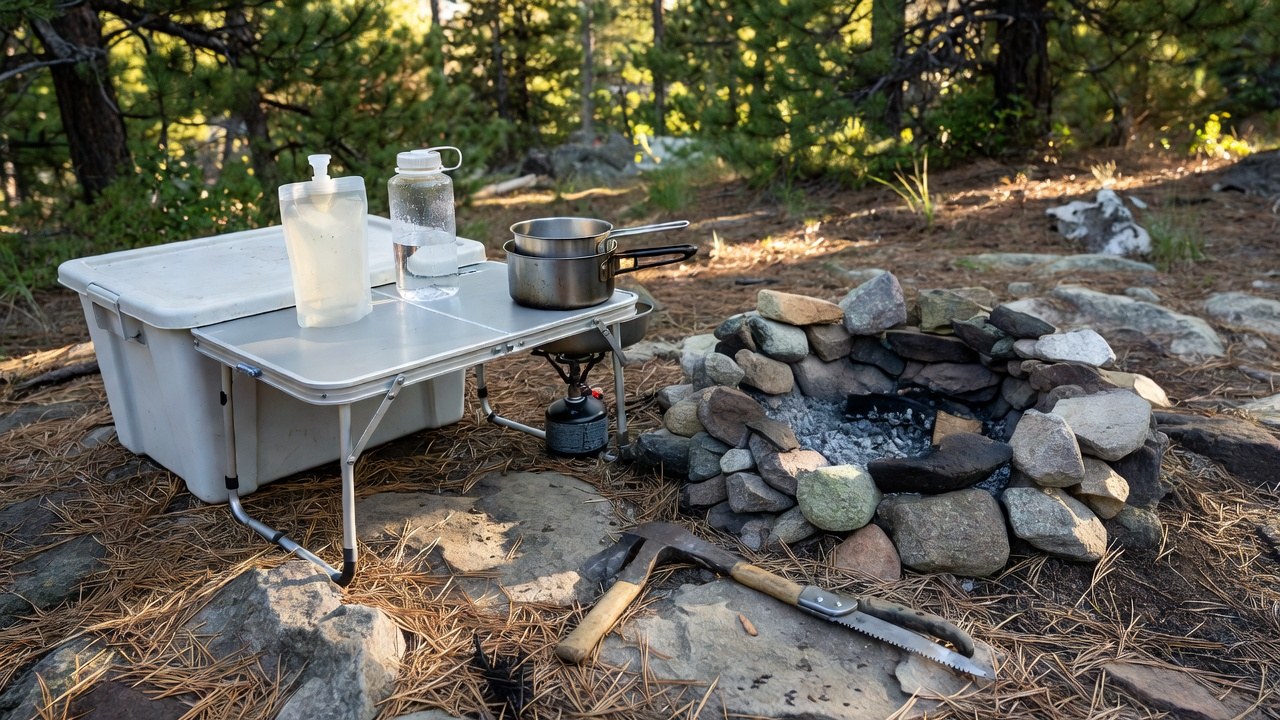
Water: Carry It In, Treat It There
There are no spigots. Either you carry every drop (free camping spots near me with water is a search with a disappointing answer — free sites rarely have water), or you treat what you find.
- Sawyer Squeeze water filtration — $45.95. The 0.1-micron hollow-fiber membrane handles creek and lake water on squeeze or gravity setups, and it weighs three ounces. This is the single most important item in the list.
- RAYYMLO 64 oz insulated bottle — $19.19. A 64-ounce insulated bottle is the practical day container off-grid; it also becomes your hot-water bottle at night.
- Nalgene 32 oz wide mouth — $16.99. Wide mouth matters: it is the bottle that accepts a gravity filter hose and ice.
A workable family rule: one gallon per person per day for drinking and cooking, plus a separate gallon for washing. For the full treatment matrix, see our camp shower and staying-clean guide.
Human Waste: The Rule Is Bury It or Pack It
The standard is bury human waste in a cathole six to eight inches deep and at least 200 feet from water, trails and camp — and in desert or alpine country, where digging a real cathole is impossible, you pack it out. Sites with known heavy use can require a bag system outright.
- Cleanwaste WAG Bag kit (12-pack) — $44.99. The pack-it-out solution, and the correct answer for desert, river corridors, and any area with a waste order.
- Reliance Luggable Loo — $24.99. A bucket with a seat and a lid. Unbeatable for kids at 6 a.m., and it doubles as a trash or gear bucket.
- Camco 5.3-gallon portable travel toilet — $54.99. The version with a real flush valve, worth it for a family of four on a multi-night stay.
Fire: Only Inside the Rules
Check the fire restriction status for the district before you build anything — dispersed camping rules and fire restrictions travel together, and a burn ban is the number one ticket-writing offense in fall.
- Fiskars X7 hatchet — $29.99. Splitting dead-and-down wood into a size that actually burns.
- Outland Living 19-inch propane fire pit — $142.64. The answer during a restriction when a wood fire is banned. Check the district first: some allow propane stoves with a shutoff valve during bans, and some ban everything.
Firewood movement matters too — buy it locally or gather dead-and-down wood on site. Our firewood and fire-building guide covers the pest rules and how to build a fire that burns down to ash you can scatter.
Power and Light: Assume Nothing Is Charged
- Jackery Explorer 300 — $199.00. 292Wh of LiFePO4 runs a family's phones, lights, and a small fan for a weekend.
- EcoFlow River 2 — $169.00. The lighter, cheaper 256Wh alternative with the same job.
- Black Diamond Spot 400 headlamp — $39.95. Every person gets one. Off-grid means there is no light switch, and a phone flashlight at 20 percent battery is not a plan.
- Black Diamond Moji lantern — $24.95. Dimmable light for the table and the tent.
Shelter, Sleep, and the Table You Don't Have
- Teton Sports Celsius 0°F bag — $59.99. Dispersed sites sit higher and colder than the campground you are used to.
- Klymit Insulated Static V pad — $94.99. Ground insulation is what keeps a cold night from ruining the trip.
- Rumpl Original Puffy blanket — $139.00. The evening layer that makes an October sit-outside possible.
- Coleman Pack-Away 4-in-1 table — $99.99. No picnic table means you bring one, and this nests to a briefcase.
- KingCamp aluminum roll-top table — $109.99. The lighter, larger option for a family of four.
- Coleman camp chair with cooler — $39.99. There is nothing to sit on unless you brought it.
- Mac Sports utility wagon — $100.56. The unsung hero of car-based dispersed camping: one trip from the car instead of five.
Cooking Without a Campground
Fire ring, stove, or nothing — those are the three options, and on a fire-restricted day the stove carries the whole trip.
- Coleman Classic 1-burner butane stove — $29.99. Small, cheap, and it simmers, which matters more than a high output when you are boiling water and cooking in the same pot.
- Coleman 70-quart Xtreme cooler — $79.99. Ice has to last the trip; there is no camp store at the end of a forest road.
Fuel questions — how long a canister lasts, propane versus isobutane, and what to do with an empty canister — are all in our camp stove fuel guide. One habit worth adopting on dispersed trips: plan meals that need water and one pot, so the dishwashing problem stays small.
Weather, Season, and Why Late September Is Peak Dispersed Season
Dispersed camping has a season, and it is not the middle of summer in the desert or the middle of January above 8,000 feet. The sweet spots:
- Late September through October — the best window of the year. Developed campgrounds are booked out for foliage weekends while forest roads sit half-empty, and the nights are cold but manageable. Our where to camp in October guide maps the timing.
- November — quieter still, and the month when desert BLM land starts to open up. See Camping in November for what stays open after the fee season ends.
- December through February — desert-only for most of the country. Low-elevation BLM land in Arizona, New Mexico, Utah and the Southern California desert is the winter dispersed circuit; anything alpine is a snow trip.
- Summer — high elevation or coastal only. Cheap dispersed sites at 9,000 feet are pleasant in July; the valley below them is not.
Weather at a dispersed site is worse than the forecast for the nearest town, because the town is usually lower and warmer. Assume five to ten degrees colder at night and add wind.
Road Reality: Your Vehicle Is Part of the Plan
Forest roads are graded in tiers, and the number on the map matters:
- Graded gravel and two-track — any car with reasonable clearance, dry weather only.
- Unmaintained or high-clearance roads — SUVs and trucks. Rain turns these into a decision you cannot reverse.
- 4WD-only with a locked gate or a use restriction — the MVUM will say so.
Two habits: drive in during daylight the first time, and know where you can turn around. A self-rescue on a forest road at dark with a dog and two kids in the car is the story nobody searches for and everybody remembers.
Camping With Kids and Dogs Off-Grid
Dispersed camping is honestly great for families — it is quiet, it is free, and there is no campground host to apologize to when a toddler has a moment. Three adjustments:
- Bring the bathroom. Kids do not schedule catholes. This is the single biggest argument for the bucket toilet.
- Water discipline. Each kid gets their own bottle; you stop rationing arguments instead of water. Our dog-friendly water bottle at $14.98 handles the other family member.
- Dogs stay leashed or under voice control, always — dispersed land shares space with hunters in fall. Our camping with dogs checklist covers the rest, including the bear-country food question.
In bear country, food storage is a practice, not a western ritual. A BearVault BV450 at $89.99 is the simplest version for a car-based setup with nowhere secure to hang.
Common Dispersed Camping Mistakes
- Trusting an app pin over the MVUM. The app is a suggestion; the map is permission.
- Arriving at dusk. You cannot judge a road, a pull-off, or a neighbor at night, and you will settle for a worse spot.
- No waste plan. Packing out is required in more places than people expect, and a cathole needs six inches of diggable soil.
- Camping inside 200 feet of water. The rule exists for a reason and land managers enforce it in heavy-use corridors.
- Leaving a fire ring hot. Cold to the touch means cold; if you cannot put your hand in it, it is not out.
- Assuming "14 days" is universal. Ask the district, because one forest's limit is another forest's violation.
- Bringing wood from home. Moving firewood spreads pests and is illegal in many states.
Dispersed Camping FAQ
Is dispersed camping free everywhere?
On BLM and national forest land it is normally free with no permit, subject to a stay limit. The paid exceptions are BLM Long Term Visitor Areas — $40 for up to 14 days or $180 for the seven-month season — and any developed campground you choose instead. Some state trust land and most state parks charge, and a few states (Vermont is the clean example) allow no free dispersed car camping at all.
How do I know if a spot is legal dispersed camping?
Open the ranger district's or BLM field office's Motor Vehicle Use Map. If the road you are on is green for your vehicle class and camping is allowed along it, you are legal. If the map does not show it, do not camp there — that is the whole test.
How long can I stay at one dispersed site?
The federal pattern is 14 days and then move on, but the binding rule belongs to the district. Measured examples: Colorado 14 days in any 30-day period with a 30-air-mile move; Alabama's national forests 21 consecutive days with a 10-day wait; Oregon BLM generally 14 days within any 28-day period; the Adirondacks three nights at one spot.
Do I need a permit to camp on BLM land?
No permit is needed for ordinary dispersed camping on BLM land. You do need the LTVA permit for a Long Term Visitor Area, and a few specific areas require a free or paid permit year-round — the field office page will say so.
Where can I camp for free near me?
The honest answer is "within about an hour, if there is federal land within an hour." Search the BLM field office or national forest nearest you, download the MVUM, and look for forest roads off a paved highway. Free campsites near me results are usually 80 percent private RV parks — filter for BLM and Forest Service listings only.
Can I dispersed camp in a national park?
Generally no. National parks require designated campgrounds or backcountry permits, and the famous free-car-camping exception on the California coast is restricted. Can you camp on public lands is broadly yes; national park land is the large, notable carve-out.
What is the difference between dispersed camping and boondocking?
Practically, nothing about the land — both mean camping on public land with no fee and no facilities. Boondocking is the term the RV community uses, and the RV version adds utility systems: fresh water in, grey and black water out, battery and solar sizing. Tent campers skip that half of the problem.
What gear do I actually need for my first dispersed trip?
Three systems, in order: water treatment, human waste, and light. Our starter picks are the Sawyer Squeeze filter at $45.95, a WAG Bag or bucket toilet, and a headlamp per person. Add a folding table and a chair if you want comfort, and a propane fire pit if you are travelling in fire season.
Bottom Line
Dispersed camping is the last place in American camping where the price is genuinely zero — and the price of admission is homework. Read the MVUM, respect the stay clock, carry water, take your waste seriously, and know whether you are allowed to have a fire.
Start close: one night, one forest road, one hour from home. Bring the Sawyer Squeeze, something legal to sit on, and a good lantern — the rest you can add on trip two. If you would rather have a bathroom and a picnic table while you learn the rhythm, the state park camping guide and our family camping gear checklist are the easier on-ramps.
<!-- AFFILIATE_DISCLOSURE -->