Camping in Georgia 2026: Where to Camp, What's Open in Fall, and How to Book It
Georgia camping in 2026: the 13-month booking window, the $10 ParkPass, free dispersed sites, fall color timing, and where to camp near Atlanta.
Quick Answer: Where to Camp in Georgia This Fall
- North Georgia peaks first, and it peaks by elevation. Georgia's highest state park — Black Rock Mountain at 3,640 feet — is usually the first place in the state to show real color, while F.D. Roosevelt State Park down on Pine Mountain often peaks in early November. If your weekend is in the next two weeks, aim high; if it is in November, aim south.
- There are 41 state parks with camping and more than 2,700 campsites in Georgia's system, including tent-only areas, RV pull-throughs, walk-in tent sites, backpacking sites, platform ("Squirrel's Nest") sites, paddle-in islands and glamping yurts. camping in georgia state parks is a big system, not a handful of parks.
- The booking window is long — up to 13 months, and 14 months for Georgia residents. Campsites can be reserved until 4 p.m. on the day of arrival; everything else up to 7 a.m. on arrival day. Reservations run through gastateparks.org or 1-800-864-7275.
- Your reservation does NOT include parking. A ParkPass costs $10 per vehicle per day ($70/year), is required for all vehicles, and is bought at check-in. Overnight guests pay it only once per stay. It is also not valid at a specific list of Georgia places people assume are state parks — see the trap section below.
- Campfires are restricted on the national forest right now. The Chattahoochee-Oconee National Forest is under a Stage II fire restriction (effective April 23, 2026, and in place until further notice) that prohibits all campfires, including charcoal, forest-wide. Commercially made gas camp stoves are still allowed. Campground fire rings at state parks are a different jurisdiction — read the fire section before you promise the kids s'mores.
- Weekends have minimums. A two-night minimum applies to weekend reservations, and a three-night minimum on Memorial Day, Independence Day, Labor Day and Thanksgiving weekends. Shorter stays are allowed for reservations made less than 30 days out.
- Georgia has two camping seasons in one state. The mountains are the autumn answer; the coast and south Georgia (Savannah, Jekyll Island, the Okefenokee edge) are the November–February answer, when north Georgia is cold and the coast is mild. camping in georgia in november is a genuinely different trip from camping in georgia in december.
One warning before anything else: Georgia camping puns on the word "park," and half the places people name are not state parks at all. The Chattahoochee River National Recreation Area, Kennesaw Mountain National Battlefield Park, Stone Mountain, the Corps of Engineers lakes, Jekyll Island and Lake Lanier are separate systems with separate fees — and the state ParkPass does not cover any of them. Sort out which system you are booking before you plan the weekend.
What Actually Changed in Georgia Camping for 2026
Four things are worth knowing this year, and every one of them is on the state's or the Forest Service's own pages:
1. The ParkPass is now the pricing question people get wrong. Georgia State Parks charges $10 per vehicle per day, or $70 for an annual ParkPass. Revenue goes to park infrastructure — water and septic systems, boardwalks, docks, bridges, trails and playgrounds. The pass is valid for 12 months, replacement of a lost pass is $20 (call 770-389-7286), and the day pass can be used at more than one state park in the same day. Discounts: 50% off for seniors 62+ and 25% off for active military and veterans, but discounted passes must be purchased in person. Large vans (13–30 passengers) pay $50/day or $90/year; buses and motor coaches $100/day or $275/year — though vehicles carrying overnight guests pay only the regular daily rate.
2. The list of places your ParkPass does not work is longer than most people expect. Straight from the state's own ParkPass page: the Chattahoochee River National Recreation Area, Kennesaw Mountain National Battlefield Park, Stone Mountain, Corps of Engineers lakes, Jekyll Island and Lake Lanier are not state parks and are not covered. The ParkPass is also not valid at Wildlife Management Areas or Public Fishing Areas — those require a hunting or fishing license, or a Lands Pass from the DNR's Wildlife Resources Division. ParkPasses are not valid at state historic sites either, which need their own daily admission.
3. The national forest is under a live fire ban. Two Forest Service orders were issued in April 2026 as north Georgia went into extreme drought: a Stage I restriction on April 17, 2026, then a Stage II restriction effective April 23, 2026. The Stage II order — still in place until further notice — prohibits building, maintaining, attending or using a fire, including charcoal fires, anywhere on the Chattahoochee-Oconee National Forest. Commercially available gas camp stoves for cooking are still permitted. Fireworks are always prohibited on national forest land. Forest Supervisor Judy Toppins framed it plainly: Georgia was in extreme drought with significant wildfires burning across the state. Before any north Georgia trip, read the forest's fire page — not a blog post from last spring.
4. Two parks have construction notices that affect parking and access this season. At Vogel State Park, a new visitor center is under construction and the state's own leaf-watching page warns that parking may be very limited this season — relevant, because Vogel is one of north Georgia's most popular fall stops. At Cloudland Canyon, the entrance road has active road work with one-lane traffic and flaggers during the day, and the visitor center is under construction — the temporary visitor center is at the Group Lodge, following red and white signs. Also worth knowing: campsites at Seminole State Park have reopened with a new comfort station and all-new electric and plumbing for RVs, and Chattahoochee Bend State Park added three cottages with screened porches, fire pits and grills.
For the record on the Georgia-specific wildcard: Tallulah Gorge restricts staircase access on extreme-heat days, issuing gorge-floor permits only at 8 a.m. with everyone out by noon. That is a summer rule, but it tells you the pattern for this park — the gorge floor is a permitted, capacity-limited space all year.
How Georgia's Camping Systems Actually Work
Georgia has five separate camping systems, and they do not share a booking portal. This is the single most useful thing to understand before planning a trip.
1. Georgia State Parks (the main system). 41 parks, 2,700+ campsites, one reservation system, one phone number (1-800-864-7275, Monday–Friday 8 a.m.–8 p.m., Saturday–Sunday 9 a.m.–5 p.m. EST), one site: gastateparks.org. Site-specific camping reservations are available, and there is no separate cleaning fee. Self check-in and balance payment run through the online account or the RA Camping app.
2. National Park Service units. Georgia's NPS camping answer is Cumberland Island National Seashore — five campgrounds, an island you reach by ferry, wild horses, and a permit system with real rules (details below). The Chattahoochee River National Recreation Area and Kennesaw Mountain are day-use: they are the metro Atlanta paddling and hiking answer, not the camping one.
3. Corps of Engineers lakes. Lake Lanier, Lake Allatoona, Hartwell and West Point have Corps campgrounds that are strong family options and cheap — and they are not covered by the state ParkPass.
4. The national forests — Chattahoochee-Oconee. Nearly 867,000 acres across 26 counties, thousands of miles of streams, roughly 850 miles of recreation trails, and dozens of campgrounds and picnic areas. This is where free and dispersed camping lives in Georgia, subject to the live fire restriction above and each district's Motor Vehicle Use Map.
5. Wildlife Management Areas (WMAs). Georgia has a large WMA system, but it is hunting land first: access runs through a hunting or fishing license or a Lands Pass, and camping on WMAs is restricted rather than open. This is the biggest structural difference between Georgia and the western states, where "public land" usually means you can camp on it. If you have been searching for camping in georgia wma, the honest answer is that the WMA system is not a dispersed-camping system — check the specific area's rules with DNR Wildlife Resources before you plan around it.
Which system should you actually book?
| Your trip | The system to book | Why |
|---|---|---|
| North Georgia fall color weekend | State parks (Cloudland Canyon, Fort Mountain, Black Rock Mountain, Vogel, Unicoi, Tallulah Gorge) | Cabins, yurts and full campgrounds at the trailheads; 13-month window means fall weekends go early |
| Atlanta weekend, under an hour out | State parks (Red Top Mountain, Hard Labor Creek, Fort Yargo, Victoria Bryant) + Corps lakes | Closest drive, hookups, lake access; remember the ParkPass exclusion list |
| Beach or island camping | Cumberland Island (NPS), plus Jekyll Island and coastal state parks (Skidaway, Fort McAllister, Crooked River) | Island ferry permits in one system, coastal state parks in another |
| Free / primitive camping | Chattahoochee-Oconee National Forest dispersed sites | No fee, no hookups, and the current fire ban applies |
| Thanksgiving, Christmas, New Year | South Georgia and the coast (F.D. Roosevelt often peaks early November, then the coast takes over) | Georgia's mild half; north Georgia nights get genuinely cold |
| Large group / Scouts | Pioneer campsites and group camps in state parks | Private primitive areas with pit toilets, bookable up to 2 years ahead |
Georgia State Park Camping: Fees, Booking Window, and the Rules Nobody Reads
This is the section that saves trips. All of it comes from the state's own reservation pages.
What it costs. Campsite rates typically run $23–$50 for regular campsites. Cottages and cabins run $75–$250, yurts $75–$100. There is no separate cleaning fee.
The booking window and the deposit rule. Reservations can be made up to 13 months in advance, and Georgia residents up to 14 months. You must be at least 18 to reserve a campsite. If you book 15 days or more before arrival, you pay a 50% deposit with the balance due at check-in; if you book 14 days or fewer before arrival, you pay 100% at booking. Group camps, group lodges and day-use facilities take a one-night or one-day deposit at booking.
The cancellation math — and it is genuinely different from most states. Reservations can be changed once without penalty; additional changes cost a $10 transfer fee. Cancellations made at least 8 days before arrival cost $10. Cancellations made 7 or fewer days before arrival forfeit 50% of the use fee. Cottages follow a 15-day line instead of 8 (cancel at least 15 days out: $10; 14 or fewer: lose 50%). Group camps are their own world: reserved up to two years ahead, cancellations at least 181 days out cost $50, and 180 days or fewer forfeit 50% of the use fee.
The no-show rule catches people every weekend. An overnight reservation is a no-show when it has not been checked in by noon on the day after the arrival date. A no-show is treated as a cancellation, forfeits 50% of the use fee, and the remaining nights are released back into the system.
Minimums, limits and hours.
- Two-night minimum for weekend reservations; three-night minimum for Memorial Day, Independence Day, Labor Day and Thanksgiving weekends. Walk-ins may occupy a site for one night, and shorter stays are allowed for reservations made less than 30 days in advance.
- Six-person occupancy limit per campsite, and tents must sit on designated pads — tents erected off pads are subject to removal, and camping between designated sites is prohibited.
- 14 consecutive nights maximum at any one park; after 14 nights you must leave the park for at least three nights before returning.
- Check-in is 1 p.m. to 10 p.m., check-out is before noon, and most park gates are locked at 10 p.m. Cottage check-in is 4–10 p.m. with 11 a.m. check-out.
- First-come sites are real and they work on an honor system: at parks with first-come camping, you find the lock box with envelopes at the camping area, enclose the fee, drop it in and take your site. Electrical hookups, dump station and comfort station are operational during the camping season.
- Pets are welcome in campgrounds on a six-foot leash, attended at all times. Dogs are allowed only in cottages designated "dog friendly" — reservations required, extra fees apply — and not in or around yurts at all.
Discounts most people never claim. Seniors 62 and older get 20% off campsite rates year-round (and 20% off cottage rates Sunday–Thursday from Dec 1 to Mar 31, plus 20% off yurts). Georgia resident disabled veterans get 25% off individual accommodations and recreation fees under Georgia Code 12-3-9.1, with a Certificate of Eligibility — the discount is reimbursed at check-in when booking online. Friends of Georgia State Parks memberships add camping and cottage discounts on top.
Hookups, by park (this is the fastest way to shortlist)
The state publishes which parks have what, and it is worth quoting because it decides whether your RV trip works:
- Sewer hookups: Crooked River, Don Carter, F.D. Roosevelt, Florence Marina, Fort McAllister, Fort Yargo, General Coffee, Jack Hill, Hard Labor Creek, James H. Floyd, Laura S. Walker, Mistletoe, Red Top Mountain, Reed Bingham, Skidaway, Vogel.
- Cable TV hookups: Black Rock Mountain, Don Carter, Elijah Clark, Florence Marina, Hard Labor Creek, Indian Springs, Red Top Mountain, Reed Bingham, Tugaloo.
And the specialty inventories, which are the actual reason to pick one park over another:
- Backcountry (backpack-in) sites: F.D. Roosevelt, Black Rock Mountain, Cloudland Canyon, Fort Mountain, Mistletoe, Providence Canyon, James H. Floyd, Tallulah Gorge. Don Carter and Fort McAllister have primitive sites that do not require a long hike.
- Platform and "Squirrel's Nest" sites: Fort Mountain, Victoria Bryant and Unicoi — covered platforms where you roll out a sleeping bag, with bathhouses and hot showers a walk away.
- Paddle-in campsites: Reed Bingham and High Falls — you paddle to your own private island campsite.
- Pioneer campsites: private primitive group areas at most parks, with pit toilets and usually a water spigot. These will not take RVs or trailers and usually have no showers.
The North Georgia Mountains: Fall Camping and How the Color Moves
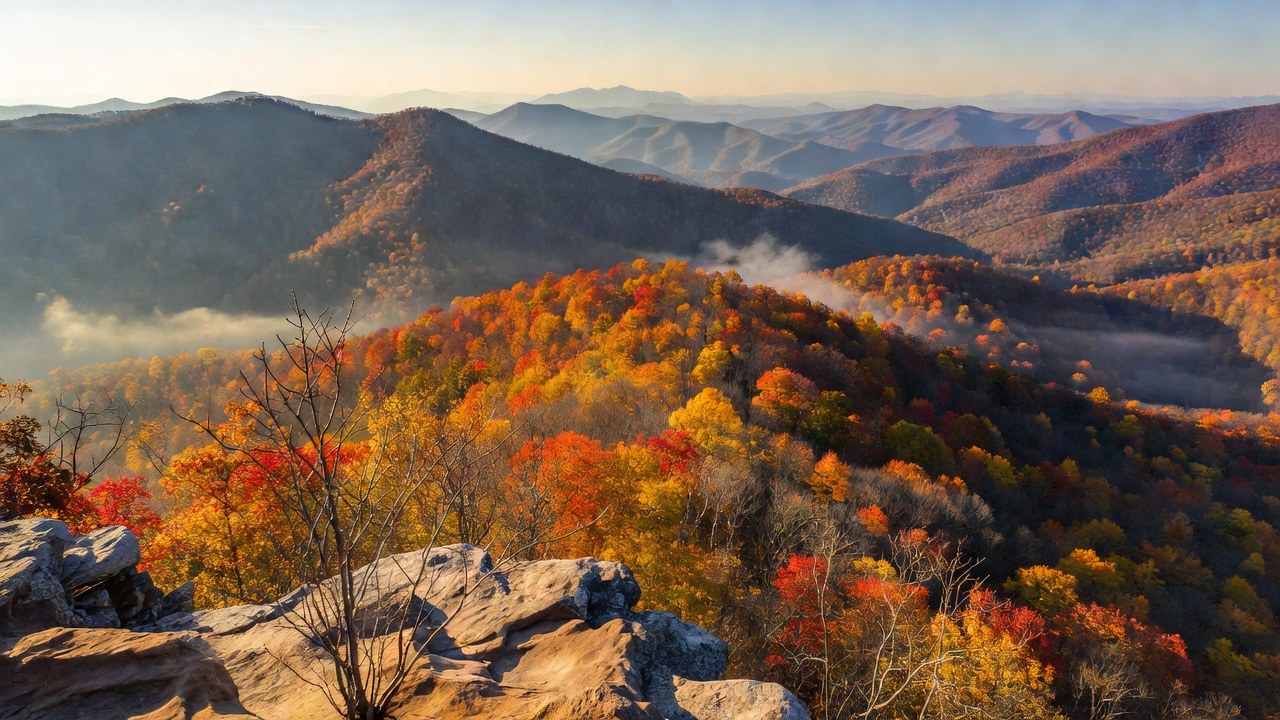
Georgia's own leaf-watching page is the best planning tool in the state, because it names which parks turn first. Here is how the color actually moves, park by park.
Black Rock Mountain State Park — the early one. At 3,640 feet it is Georgia's highest state park and usually one of the first locations in the state to show vibrant fall color. (Brasstown Bald is the state's highest peak; Black Rock is the highest park.) Roadside overlooks and the summit visitor center give sweeping Blue Ridge views. The 2.2-mile Tennessee Rock Trail is the short moderate option; the 7.2-mile James E. Edmonds Backcountry Trail is the all-day one. You can stay on top of the mountain in cabins or wooded campsites — and this is a park with both backcountry sites and cable hookups, which is unusual.
Cloudland Canyon State Park — the one people mean by "north Georgia fall camping." On the western edge of Lookout Mountain, this is one of the largest and most scenic parks in Georgia: thousand-foot-deep canyons, sandstone cliffs, waterfalls and cascading creeks. The Overlook Trail is short, the Waterfalls Trail is strenuous (you descend to two waterfalls and climb back out), and the 5-mile West Rim Loop is the moderate classic. Yurt guests sleep right beside a hiking trail. There are backcountry sites, four pioneer campsites, a group lodge that sleeps 40 and a group shelter that seats 175. Mountain biking runs at the Five Points Recreation Area and along the Cloudland Connector Trail, with bike rental at $35 half day / $55 full day. Current notices: entrance road work with one-lane flaggers during the day, and the visitor center under construction — follow signs to the temporary visitor center at the Group Lodge.
Fort Mountain State Park — the family all-rounder. Sitting at 2,850 feet near the Cohutta Wilderness, Fort Mountain has the 60 miles of recreational trails, a mysterious 855-foot-long ancient stone wall, a CCC stone fire tower, a small green lake with a 1.2-mile loop, the 8-mile Gahuti Trail, and more than 14 miles of mountain bike trails. It is also one of only three parks with platform and Squirrel's Nest sites, has backcountry sites, cottages and a campground, and rents boats on the lake seasonally. The scenic drive on Highway 52 into the park is part of the trip.
Vogel State Park — check parking before you go. Vogel is one of north Georgia's most popular parks. The 4-mile Bear Hair Gap Trail gives a bird's-eye view of the lake; the Lake Loop is the easier walk to a small waterfall below the dam. The twisting roads around Vogel — especially Wolf Pen Gap Road — are some of north Georgia's prettiest fall driving. This season, the new visitor center construction means parking may be very limited; go on a weekday, or have a backup park.
Unicoi State Park & Lodge. Near Helen, with ziplines above the canopy, a 4.8-mile Smith Creek Trail climbing to Anna Ruby Falls if you want a steep hike, plus a lodge and restaurant — useful when half the family wants a bed and the other half wants a tent. It is one of the three platform-site parks.
Tallulah Gorge State Park — the drama stop. Two miles long and nearly 1,000 feet deep, with five waterfalls. You can hike rim trails to several overlooks for free, or get a free gorge-floor permit to descend to the suspension bridge: 100 permits per day, issued at the Interpretive Center with safety briefings at 8 a.m., 10 a.m. and noon, not transferable, not reservable in advance, proper footwear required (no flip-flops or Crocs), and the state says the trail is not recommended for hikers aged 8 or younger — it is roughly 1,000 stairs. Group sizes are capped (20 on weekends, 30 weekdays) and pets are not allowed on the gorge floor, the sliding rock trail or the Hurricane Falls staircase, though leashed pets are fine on rim trails. Camp inside the park or rent cabins at nearby Black Rock Mountain.
Amicalola Falls State Park & Lodge. About an hour north of Atlanta, home to the Southeast's tallest cascading waterfall. A short flat path leads to a boardwalk with the best views, and there is an easy overlook at the top; the tough option starts at the bottom of the falls and climbs the staircase. Note that Amicalola is managed by the North Georgia Mountains Authority and Coral Hospitality rather than as a standard park — reservations run 1-800-573-9656.
James H. Floyd State Park. A quiet northwest Georgia park with five miles of trails, access to the 60-mile Pinhoti Trail, and the moderately easy Marble Mine Trail following an old road to a 35-foot waterfall next to an old mine opening. Backcountry sites and platform-friendly tent camping.
Victoria Bryant State Park. Minutes from I-85, with eight miles of hiking trails, a stream, small fishing ponds, wooden platform tent sites surrounded by hardwoods and an 18-hole golf course in the middle of the fall color — a genuinely good "we only have one night" park.
Smithgall Woods State Park. More than 6,000 acres around Dukes Creek, and the state's fly-fishing and cabin-getaway park: day visitors picnic by the creek, overnight guests hike a private trail to Dukes Creek Falls, a 1.6-mile loop climbs to Laurel Ridge with a view of Mt. Yonah, and it is near the wineries and Helen's Oktoberfest. Its cabins are among the park system's most sought-after.
F.D. Roosevelt State Park — the southern mountains, and the late peak. Many people are surprised to find colorful hardwood forests and rolling mountains south of Atlanta. The 6.7-mile Wolf Den Loop is a favorite section of the longer Pine Mountain Trail, Ga. Hwy. 190 is a pretty driving route through the park, and Dowdell's Knob has a life-size bronze sculpture of President Roosevelt looking out over the valley. This park often peaks during early November — which makes it the answer for the second half of the fall window.
Others worth a spot on the shortlist: Don Carter State Park on Lake Lanier (Georgia's only state park on Lanier, 14+ miles of forested trails, boat ramps, cabins, campsites, equestrian trails); Mistletoe (Georgia's smallest state park, on a deep-green lake, with a 2-mile Hemlock Falls Trail, a 1-mile wildlife-observation trail, and backcountry sites); Hwy. 197 is a particularly pretty road nearby.
October in Georgia: Weather, Crowds, and Fire Rules
Weather splits by elevation, not by month. October in the north Georgia mountains means warm days and genuinely cold nights, while south Georgia and the coast stay mild well into November. Pack a real sleeping system for a mountain weekend and a lighter one for the coast — and if you are camping in georgia in november, expect the mountains to be the cold end and Savannah the mild end of the same state.
Crowds are a parking problem, not a campsite problem. Georgia State Parks actively encourages weekday visits and warns that when parking fills to capacity, access may be limited — that is a real risk at Amicalola, Cloudland Canyon, Tallulah Gorge and Vogel in late October. Campsites book out much earlier than day-use parking: the state's own leaf-watching page says cottages, yurts and campsites often book up a year in advance, and points out that you can book now for next fall. If you want a specific mountain park on a peak-color weekend, this is the year to book next year's weekend.
Fire rules are split by landowner, and this is the section to read twice.
- National forest (Chattahoochee-Oconee): the Stage II restriction effective April 23, 2026 prohibits all fires forest-wide, including charcoal, until further notice. Gas camp stoves are permitted.
- State parks: campfires belong in the site's fire ring or grill, and there are burn bans layered on top when conditions are dry. Ask the park office at check-in — it takes one question and saves a citation.
- Georgia's fall fire risk is the reason both exist. The Forest Service attributed its orders to extreme drought, low relative humidity and multiple active wildfires, and noted that human activity causes an average of 87% of wildfires — usually escaped debris burns and unattended campfires. Its guidance for anyone living or camping near the woods: keep leaves and debris at least 30 feet from structures.
Columbus Day weekend is the pivot weekend. It falls on October 12 in 2026, and in several public campground systems the second Monday in October is a seasonal closing marker. Georgia's own state park page is reserved for the October 10–12 weekend; if that is your trip, book now and expect the standard two-night weekend minimum to apply.
Metro Atlanta and Central Georgia: Camping Within an Hour of the City
If you searched camping in georgia near atlanta or camping near atlanta ga, this is the shortlist — all state parks unless noted.
Red Top Mountain State Park (Lake Allatoona, ~45 minutes north). Georgia's classic close-to-Atlanta park: 12,000 acres of lake, more than 15 miles of trails, boat ramps and nearby marina rentals, a sand swimming beach in a cove, rental cottages, campsites and a lakeside yurt. The 4-mile Iron Hill Trail is open to hikers and bikers and its wide path is fairly easy for smaller children — rare and worth knowing. It also has both sewer and cable hookups. One live notice: the park advises that blue-green algae may be present in the lake, with an algal-bloom information page linked from its site.
Hard Labor Creek State Park (east of Atlanta). A 5,804-acre park with several miles of hiking, mountain biking and equestrian trails and a 1-mile Brantley Nature Trail through mature hardwoods and pines — the easiest family walk on this list. Sewer and cable hookups available.
Fort Yargo State Park. Sewer hookups, lake swimming and a short drive from Atlanta, and a common first-camping-trip park for metro families.
Victoria Bryant State Park (I-85, northeast). Platform tent sites and a golf course at the edge of the hardwoods; an easy one-nighter on the way to the mountains.
Chattahoochee Bend State Park. One of Georgia's newer parks, on the river, with three new cottages with screened porches, fire pits and grills — a strong fall option when you want the river without the mountain crowds.
Don Carter State Park (Lake Lanier). Cabins, campsites, 14+ miles of trails, and equestrian access for autumn views from horseback.
Not covered by your ParkPass, but worth knowing: Stone Mountain, Lake Lanier, Lake Allatoona and the other Corps of Engineers lakes, plus the Chattahoochee River National Recreation Area. These are where a lot of metro families actually paddle and picnic — and they charge their own fees.
The Coast and South Georgia: The Winter Half of the State
Georgia's second season runs from roughly November through February, and it belongs to the coast and the south. camping in georgia coast and campgrounds georgia coast are the searches that matter after the leaves are gone.
Cumberland Island National Seashore — the bucket-list one. Five campgrounds: Sea Camp and Stafford Beach (designated sites) plus the wilderness sites at Hickory Hill, Yankee Paradise and Brickhill Bluff. Camping requires a permit, reservations open up to six months in advance on Recreation.gov, and availability releases six months out to the day. What to know before you book:
- No carts of any kind north of Sea Camp, so campers at Stafford Beach and the wilderness sites backpack everything in. Wheeled coolers are not permitted north of Sea Camp either.
- Campfires only at Sea Camp and Stafford Beach, in designated fire rings. The three wilderness campgrounds allow no fires.
- Drinking water at Sea Camp, Stafford Beach, Plum Orchard and all areas south of Sea Camp — treat water everywhere else.
- No pets; only service animals are permitted in campgrounds. Horses are wild: stay 50 feet away.
- Site maximums: six people per individual site; the Sea Camp group campground takes 20. Children two and under do not count.
- Per-mits print only within 10 days of arrival, and you must bring a printed copy.
- The wilderness area closes during managed hunts held October through January, which is exactly the window most fall visitors are looking at. Check the managed-hunts page before planning a wilderness site.
- Ferry runs around the seasonal schedule — there is no Tuesday or Wednesday ferry from Dec 1 to Feb 28.
- 50% camping discount for Senior and Access passholders, entered on Recreation.gov at booking.
- Propane tanks larger than one gallon are not permitted on the ferry, and hammocks must be free-standing (no tying to trees).
Coastal and south Georgia state parks. Skidaway Island State Park near Savannah has sewer hookups and is the standard base for a Savannah weekend; Fort McAllister and Crooked River have sewer hookups too; Reed Bingham has the paddle-in campsites and sewer hookups; Laura S. Walker and General Coffee carry sewer hookups as well.
The late-season color nobody talks about. In late autumn, cypress trees turn deep orange and reflect off General Coffee State Park's blackwater pond — rent a kayak and paddle under Spanish moss and tupelo trees, and look for the covered bridge built in 1880. And Providence Canyon — Georgia's "Little Grand Canyon" — is best known for its orange-hued soil, but its trees put on a color show too; the state's own tip is to rent a cabin nearby at Florence Marina State Park and hike the canyon for the best late leaf watching.
Jekyll Island is its own system with its own campground and fees (not covered by the ParkPass), and Okefenokee National Wildlife Refuge sits on the Florida line as a day-trip or a permit-based overnight trip — check the refuge's own site for current overnight availability before you plan either.
Camping in Georgia With Dogs
Georgia is a good dog state compared with the northern half of the fall cluster, with a few specific lines to respect.
- State park campgrounds: pets are welcome if kept on a six-foot leash and attended at all times.
- Cabins and cottages: dogs are allowed only in cottages designated "dog friendly" — reservations required and additional fees apply. Service animals are always welcome, and pets are not allowed in or around yurts.
- Cumberland Island: no pets, only service animals in campgrounds.
- Tallulah Gorge: pets are not allowed on the gorge floor, the sliding rock trail or the Hurricane Falls staircase to the suspension bridge; leashed pets are welcome on the rim trails.
- Trails generally: the state's guidance is to keep the leash short and use the designated pet areas; for a longer family-dog planning checklist, our camping with dogs guide covers the trail-by-trail logic, and the dog camping hub collects the gear side.
If you are planning a mountain weekend with a dog and a tent, the honest constraint in Georgia is fire rings, stairs and leash rules — Tallulah and the waterfall-trail descents at Cloudland Canyon are the two places a dog either cannot go or should not.
The Georgia Camping Gear List
Georgia camping has a specific gear profile: warm days and cold mountain nights, dew and rain, stairs and gorge trails, and a camp kitchen that has to work under a burn ban. Everything below is a catalog pick with a current price.
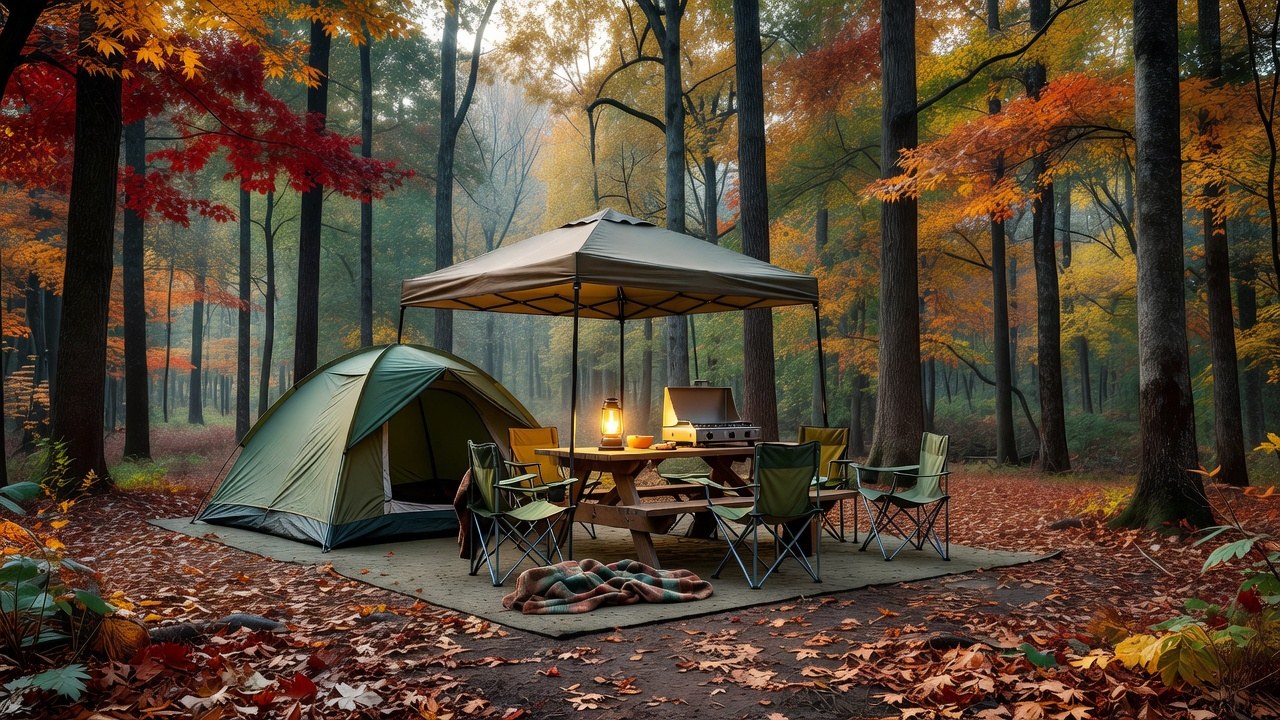
Shelter and sleeping (the north Georgia fall problem). For a family car-camping weekend, the CORE 9 Person Instant Cabin Tent at $299.99 sets up in minutes; for a backpack-in site — and eight state parks have backcountry sites — the Kelty Late Start 2P at $159.95 is the light option, with the Golabs 2-3 person tent at $30.66 as the budget first-tent. On top of that: the TETON Sports Celsius 0° sleeping bag at $59.99 for mountain nights, the Sea to Summit Ether Light XT insulated pad at $219.95 or the plusher Exped MegaMat 10 at $239.95. If you would rather sleep off the ground, the Coleman Trailhead II cot at $54.99 fits a tent footprint neatly, and an air mattress at $149.95 is the car-camping comfort play. Add a Rumpl puffy blanket at $139.00 for the evening drop when the fire is off-limits.
Camp comfort. A Coleman camp chair with a built-in cooler at $39.99 earns its space, a 10x10 pop-up canopy at $139.99 is the rain-and-shade answer Georgia weather actually requires, and a 12.8 x 9.5 ft tarp at $56.98 covers a whole picnic table when the front moves through. If hammocks are in the plan, the ENO Guardian bug net at $39.95 matters here — Georgia has mosquitoes into October.
Camp kitchen. A 70-quart Xtreme cooler at $79.99 holds a long weekend of food; the Coleman Classic 1-burner butane stove at $29.99 matters more than usual this year, because gas stoves are allowed where the fire ban applies. For coffee and a real meal regardless of fire rules: a Snow Peak titanium French press at $65.00, a Lodge cast iron Dutch oven at $59.95 for campfire or grill cooking where fires are permitted, and a Thermos King food jar at $30.50 to keep lunch hot on a cold overlook.
Light, heat and power. A Black Diamond Spot 400 headlamp at $39.95 is the one light per person, and a 4-pack of lanterns at $23.99 lights a whole site. For a late-October mountain weekend, the Mr. Heater Buddy at $74.00 is the difference between a good trip and a cold one — used outdoors or in a ventilated space, per its own instructions. A Jackery Explorer 300 at $199.00 recharges phones, lanterns and a camera for a leaf-photo weekend.
Water, bugs and safety. The Sawyer Squeeze at $45.95 covers backcountry water at James H. Floyd, Black Rock, Cloudland and the other backpack-in parks, and it is what you want if you are treating water anywhere in south Georgia. A Fiskars X7 hatchet at $29.99 is for splitting firewood where fires are allowed — check the rules first this season. For bugs and sun: Murphy's Naturals repellent at $28.49 or picaridin spray at $11.99, and SPF 50 sunscreen at $14.99 — October afternoons in Georgia still burn.
Trails, kids and dogs. A Radio Flyer folding wagon at $109.99 handles campground loops and overlook boardwalks, with a heavy-duty folding wagon at $100.56 as the alternative for gear hauling. The KEEN Targhee 3 at $187.00 or the Salomon X Ultra 4 Mid GTX at $231.81 are the boots for Tallulah's stairs and Cloudland's Waterfalls Trail; Darn Tough hiker socks at $27.95 and a rain shell at $60.00 finish the kit. For the ridge views, a pair of 8x42 binoculars at $166.00 turns a leaf weekend into a hawk-migration weekend. For the dog: a Ruffwear Front Range harness at $44.95, a travel dog bed at $29.99 for the tent floor, and a portable dog water bottle at $14.98 for trail breaks.
Binoculars and maps matter more here than in most states, because Georgia's fall color is a landscape view from an overlook — and because every state park, national forest district and WMA in this state is governed by its own map and rules.
Georgia Camping Planning Shortcuts: Every Way This Question Gets Asked
If you arrived here from a slightly different search, this is the router.
By system, by name. camping in georgia state parks and camping at ga state parks both mean gastateparks.org; camping in georgia national parks means Cumberland Island first and the Chattahoochee River NRA for day use; national parks in georgia with camping and state parks in georgia with camping are the two halves of that question; georgia state campgrounds, campgrounds georgia state parks and georgia state parks campground map are the same inventory seen from different angles. If you are asking where can i camp in georgia, the short answer is that the state park system plus the national forest cover nearly every legal option — and camping in georgia wma is the one that needs a phone call to DNR rather than a booking site.
By region. camping in georgia mountains, camping in the north georgia mountains, north georgia camping sites, north georgia camping spots, north georgia campgrounds, campgrounds georgia mountains and campgrounds in the north georgia mountains all point at the same Blue Ridge corridor: Cloudland Canyon, Fort Mountain, Black Rock Mountain, Vogel, Unicoi, Tallulah Gorge, Moccasin Creek and James H. Floyd. camping in georgia near atlanta, campgrounds near atlanta ga and camping near atlanta ga mean Red Top Mountain, Hard Labor Creek, Fort Yargo, Victoria Bryant and Chattahoochee Bend. camping in georgia coast, camping in south georgia state parks, georgia campgrounds on the beach, campgrounds georgia coast, georgia campgrounds near savannah and georgia state parks camping near savannah mean Skidaway Island, Fort McAllister, Crooked River, Reed Bingham and Jekyll Island. north georgia campgrounds on the river and north ga camping on river point at the Toccoa, the Chattooga and the Chattahoochee Bend stretch. If you are comparing the two mountain systems by name, camping in north georgia state parks and north georgia camping and hiking both describe the same state-park corridor, while north georgia camping and fishing and north georgia camping and trout fishing lean toward Smithgall Woods, Mistletoe and the stocked streams. For the coast side of the same question, savannah georgia campgrounds and georgia campgrounds near atlanta are the two metro hubs people start from, georgia campgrounds map is the fastest way to see how far apart the halves are, and cumberland island camping georgia is the one island trip in the state that needs a ferry reservation before anything else.
By what you bring. tent camping in georgia state parks and tent camping in north georgia mountains are the walk-in and platform inventory; rv camping in georgia state parks, rv camping in north georgia mountains and georgia state parks rv camping reservations are the hookup list above, which is the real reason to shortlist by park rather than by region. camping in georgia with cabins, georgia campgrounds with cabins, campgrounds in georgia with cabins, north georgia camping cabins and georgia state parks camping cabins mean the cottage and cabin tier; camping in georgia with cabins is the same question, just typed quickly. camping in georgia on a lake and georgia power campgrounds point at the lake parks — Red Top on Allatoona, Don Carter on Lanier, Seminole, Florence Marina, High Falls. camping in georgia with fishing, north georgia camping and fishing, north georgia camping and trout fishing point at Smithgall Woods, Mistletoe, James H. Floyd and the trout streams; camping in georgia with swimming points at the lake parks and the Coastal beaches; camping in georgia with dogs and camping with dogs in georgia are covered by the dog section above.
By timing. camping in georgia in october is the leaf window; camping in georgia in november, camping in georgia in december and camping in georgia in january are the coastal and south-Georgia season — and georgia campgrounds open year round is the question that filters for those. If you are asking camping in october near me or can you camp in october, yes: Georgia state parks camp year round at most parks, and the constraint is which systems stay fully open, not whether camping is allowed.
By booking mechanics. georgia state parks camping reservations, camping reservations georgia state parks and georgia state parks camping reservations online are gastateparks.org; georgia state parks camping reservations phone number is 1-800-864-7275; georgia state parks camping fees and georgia state parks camping pass are the rate and ParkPass sections above; georgia state parks camping cancellation policy is the 8-day / 15-day / 181-day ladder; georgia state parks camping discounts, georgia state parks camping senior discount and georgia state parks camping map are all on the state's own site, and the senior discount is the one people leave on the table because discounted passes must be bought in person. georgia state parks camping login and georgia state parks camping near me are account and map questions — the account exists mainly for self check-in and balance payment through the RA Camping app.
By destination name. cumberland island camping, cumberland island camping permit, cumberland island camping reservations, cumberland island camping cost, cumberland island camping ferry, cumberland island camping rules, cumberland island camping map, cumberland island camping sites and cumberland island camping tips are all answered in the island section — with the printed-permit and the October–January wilderness hunt closure being the two that most often surprise people. jekyll island camping is its own system and its own fee schedule. helen georgia campgrounds means Unicoi, Vogel and Smithgall Woods, with the town's Oktoberfest as the reason those weekends fill. places to camp in north georgia mountains and best state park camping in georgia are judgment calls — for a first trip with kids, Fort Mountain and Red Top Mountain; for a first trip with views, Black Rock Mountain.
Booking a Georgia State Park Site: Windows, Fees, and the ParkPass
Georgia runs its campgrounds through more than one door, and that is the first thing that trips people up. Georgia state park camping reservations go through the state's own booking system — one account, one cart, the same login whether you want a tent site, a cottage or a yurt. Georgia state parks camping reservations open on a rolling calendar rather than an annual free-for-all: a date becomes bookable 13 months out, and 14 months out if you live in Georgia. If you have been searching Georgia state camping reservations or the shorthand ga camping reservations, you are looking for that same portal. Georgia campground reservations on federal land are the exception — those run through Recreation.gov — and Georgia dnr camping reservations language belongs to the Wildlife Resources Division side of the state, where camping is a different product with its own license requirements.
Fees are where the surprises live. Georgia state park camping fees are modest per night, but three add-ons decide your real total: the per-vehicle ParkPass, the two-night weekend minimum, and the three-night minimum over Thanksgiving. Georgia state park camping rules are mostly common sense — quiet hours, one vehicle per site, leashed pets — and the practical ones to read before you pay are check-in and check-out times, because they differ park to park. The same is true of Georgia camping rules on federal land, where the 14-day stay limit matters more than any single regulation and the fire restriction is the one rule that actually changes your trip. Georgia camping season in the mountains runs from April through November; on the coast it never really stops.
The Georgia state park camping pass question gets confused with the ParkPass. They are two different things: the ParkPass is the $10-per-vehicle day-use entry and the annual version is $70. Georgia state park camping promo code searches usually come up empty because the system runs on a flat nightly rate rather than discount codes, and the honest answer is that the discounts that exist are programmatic — a Georgia state park camping senior discount for older visitors, a disability pass, a veteran and military pass, and a library-lending pass program. Ask at the gate or the visitor center rather than the website search box.
Cancellations matter in a state where fall weekends sell out. Georgia state park campground cancellation policy and Georgia state park camping cancellation policy are the same policy for sites and cabins, with a sliding refund window; Vogel state park camping cancellation policy is a frequently searched example only because Vogel is a park people book first and cancel last, since its loop sits on Lake Trahlyta. Cancel inside the window and you forfeit the first night, so a same-week change of plans is cheaper as a date move than a cancel-and-rebook. Georgia state park campground host positions are volunteer roles, usually a month at a time — a real way to camp for free if you have the season to give.
Two maps are worth printing, because cell service in the mountains is patchy. A Georgia camping map page that covers the whole state is the state-park locator; Georgia state park camping map, Georgia state parks camping map, Georgia state park campgrounds map and a downloaded Georgia state parks camping map pdf all refer to the same document the department publishes. Georgia state parks camping map free downloads exist, but the file changes when parks add loops, so re-download rather than trusting a screenshot. What the map will not tell you is which parks carry hookups: the shortlist is Georgia state park campgrounds with full hookups, mostly the larger reservoir parks and the coast, and it is much smaller than the map suggests.
Cabins and yurts are the second decision. Georgia state park camping cabins book inside the same window as campsites, carry a two-night minimum, and are the only lodging category where the dog-friendly designation is explicit per unit. Price the specific park rather than the generic term — "a campsite in georgia" returns a list, "Black Rock Mountain walk-in site" returns the one you want. Georgia camping sites on the coast and in the mountains are two different products, and a Georgia camping trip planned in October is really a mountain trip unless you deliberately drive south for the state's second season. Which brings up fire: Georgia campfire rules are the most volatile part of a fall trip, because the Chattahoochee-Oconee National Forest has been under a Stage II restriction since April 23, 2026 — no wood or charcoal fires, gas stoves still allowed — while state parks follow local burn bans. This Georgia camping guide treats that as a live variable rather than a footnote, because the campfire is usually the point of the trip. And for the broad question of what exists, best camping in georgia answers differently by season, while best rv camping in georgia points at the reservoir parks and the coast, where big rigs fit and the water stays warm into November.
Feeding that booking: Georgia's newest and most contested sites are the walk-in and platform sites at the mountain parks, and those are the ones where arriving without a reservation fails on a Friday in October.
Free Camping in Georgia: What Is Actually Free, and Where
The word free carries three different meanings in Georgia, and separating them saves a wasted drive. Free campgrounds in georgia barely exist inside the state park system — every park charges a nightly fee — so free camping georgia almost always means federal land. Free camping in georgia reality number one is dispersed camping in the Chattahoochee-Oconee National Forest: pull off a numbered forest road, use an existing clearing, no fee, no reservation, 14 days. Free camping in georgia map products are usually National Forest motor-vehicle-use maps with district roads highlighted, and they are the honest tool for finding those spots. Free camping in georgia mountains is where most of it lives — the Blue Ridge and Chattooga districts — while free camping in north georgia and free camping in south georgia are very different propositions: the north is national forest, the south is mostly private timber land, WMAs and river swamps where overnight camping is restricted. Free dispersed camping in georgia is legal across most of the forest, but not inside designated wilderness or in posted gaps, and not on a closed timber road.
What about the coast? Free camping georgia coast is close to a myth. Free camping in savannah georgia does not exist inside the city: the nearest legal cheap option is a state park loop, and even the county parks charge. Free camping sites in georgia and free campsites in georgia that show up in listicles are usually overnight parking at a store, which is a different product — no fire ring, no table, no permit. Free car camping in georgia on forest roads is legal and common; free rv camping in georgia is much harder, because RV-sized legal boondocking spots are rare and often gated; and free tent camping in georgia is the category with the most real options. If your search is literally where can i camp in georgia for free or camping in georgia for free, the answer is a short list: dispersed forest sites, WMA camping with the right license, and the handful of free primitive areas some Corps and county tracts still keep open.
Dispersed camping georgia searches actually pull up three distinct rule sets. Dispersed camping in georgia inside the national forest follows the 14-day stay limit and the motor-vehicle-use map. Dispersed camping in ga on WMA land is allowed only in designated areas and only with the correct license or lands pass. A dispersed camping georgia map from the Forest Service names which roads allow it and which are gated seasonally. Is there dispersed camping in georgia is a fair question with a clear answer — yes, and it is the state's best free option — but dispersed camping in georgia map and dispersed camping in north georgia are where the details live, because some gaps close after timber work. Dispersed camping in south georgia is far more limited than the north. Best dispersed camping in georgia picks and best primitive camping in georgia picks are about the same three ingredients: elevation, a creek, and a road you can actually park on without blocking it.
Georgia blm campgrounds and BLM land georgia are a common misconception worth killing outright: the Bureau of Land Management holds essentially no land in Georgia. If you searched blm land georgia looking for free camping, what you actually want is National Forest dispersed camping or a WMA — the search term is wrong, not the state.
Chattahoochee-Oconee National Forest: Camping Rules, Campgrounds, and Dispersed Sites
The Chattahoochee-Oconee National Forest is where a Georgia camping trip stops being a reservation and starts being a bet on forest roads. Chattahoochee oconee national forest camping covers roughly 867,000 acres across two units — the Chattahoochee in the north Georgia mountains and the Oconee further south — and the two behave differently. Start with the developed sites: Chattahoochee national forest campgrounds are small, cheap, first-come-or-reservable loops like Lake Blue Ridge and Morganton Point on the lake, Andrews Cove and Desoto Falls off Highway 129, Cooper Creek and Frank Gross in the Cooper Creek valley, and Lake Conasauga up on Grassy Mountain. Chattahoochee oconee national forest camping map PDFs from the Forest Service list every one of them by district, and they are the only reliable inventory because closures rotate.
The rules are where the searches cluster, so here they are in one place. Chattahoochee national forest camping rules set a 14-day stay limit per site, require you to camp on an existing clearing rather than clearing vegetation, and put the fire question in front of everything else: the forest has been under a Stage II restriction since April 23, 2026, meaning no wood or charcoal fires anywhere in the Chattahoochee unit, gas stoves still allowed. Chattahoochee oconee national forest camping rules add the Oconee unit's own seasonal closures and hunting-season access limits. Chattahoochee national forest car camping is the easy mode — drive to a numbered site, pay a few dollars at the iron ranger, set up — while Chattahoochee national forest dispersed camping and Chattahoochee oconee national forest dispersed camping are the free version: no fee, no table, no water, 14 days, and a real chance of being the only person on the road.
If your goal is Chattahoochee national forest free camping or Chattahoochee oconee national forest camping free, the trade is facilities for flexibility, and the one thing that is never free is the wilderness: Chattahoochee national forest dispersed camping map copies that mark the Cohutta Wilderness show why, because backcountry rules there are stricter than the rest of the forest and group size limits apply. Chattahoochee national forest rv camping exists but is thin — a handful of loops take a trailer, and the ones that do are not the ones with the best views. Chattahoochee national recreation area camping is a different, smaller unit: the Chattahoochee River National Recreation Area north of Atlanta is a day-use park with no camping at all, so if you searched it expecting a campground, the answer is that you want the national forest, not the recreation area.
Finding a Site in the North Georgia Mountains and Along the Blue Ridge
The north Georgia mountains are a single short drive with a dozen different names attached to them, which is why the searches multiply. If you are looking for north georgia camping locations, the honest geography is four corridors: the Highway 129 corridor through Cleveland and Helen, the Highway 515/76 corridor through Blue Ridge and Blairsville, the Highway 441 corridor through Clayton and Mountain City, and the Highway 28 corridor along the Chattooga. A north georgia campgrounds map and a north georgia campgrounds on the river map both exist as Forest Service PDFs, and the river versions are the ones that matter for fishing trips, since the Toccoa, Nottely, Hiwassee, Tallulah and Chattooga are the water. North georgia campgrounds with cabins usually means the state park tier — Vogel, Unicoi, Fort Mountain, Black Rock Mountain — rather than forest land, because the Forest Service does not rent cabins. North ga campgrounds rv and north ga camping sites are both easier in the reservoir parks than in the high gaps, and n ga camping as a search term is just the same list spelled short.
Start with the town, not the mountains: Blue Ridge georgia campgrounds cluster on Lake Blue Ridge and the Toccoa River, Blue Ridge georgia camping sites are the Forest Service loops around Morganton Point and Deep Hole, and a Blue Ridge georgia campsite on the water is the one people are actually hunting when they search that phrase. Blue Ridge georgia rv campgrounds and Blue Ridge georgia rv camping are mostly commercial parks in the valley plus the lake loops that accept a trailer; Blue Ridge lake georgia camping is the reservoir itself, with swim beaches and a paved launch. Push one range south and you get Blue Ridge mountain camping georgia and Blue Ridge mountains camping ga, which are the same trip with the Appalachian Trail and the Cohutta Wilderness in reach; Blue Ridge mountains georgia camp sites, Blue Ridge mountains georgia campgrounds and Blue Ridge mountains georgia camping all resolve to that corridor, and Blue Ridge mountains campgrounds georgia is the same list ordered by county rather than by town, and camping near blue ridge georgia is the question with the most competition for October weekends, so it is the one to book in summer.
Whether you write it as Camping in the georgia mountains or Camping in the north ga mountains, the practical split is the same: state parks for hookups, showers and reservations; national forest for space and quiet. Appalachian mountains georgia camping is that northern tier where the range actually gets mountains — Brasstown Bald, Blood Mountain, Tray Mountain, Rabun Bald — and appalachian trail campsites georgia is a specific answer: the trail's Georgia section runs about 76 miles from Springer Mountain to the North Carolina line, backcountry sites are first-come, and the only fee is at the two developed forest campgrounds near the approach trail. North georgia camping reservations are a state park product, not a forest product; the forest mostly does not take them. Georgia mountain fairgrounds camping reservations is the exception people miss — the fairgrounds on Lake Chatuge in Hiawassee run their own campground with its own booking, separate from the state system.
Helen georgia camping reservations and rv camping in helen georgia almost always mean Unicoi State Park, five minutes out of town, with the alternative being the forest loops up Highway 75. For the reservoir tier, rv campgrounds in georgia mountains, rv camping in georgia mountains and rv campgrounds in georgia as a whole are dominated by the Corps lakes, the TVA-style reservoir parks and the commercial parks in the valleys, and the practical filter is whether you need 50-amp service, because most forest loops stop at 30.
Atlanta changes the math because an hour of driving decides your trip. Camping around atlanta, campsites near atlanta, tent camping near atlanta, rv parks near atlanta and rv parks near atlanta ga all describe the same ring: Red Top Mountain on Lake Allatoona to the northwest, Hard Labor Creek to the east, Fort Yargo and Victoria Bryant along I-85, Chattahoochee Bend southwest on the river, Sweetwater Creek for day use only — no camping there — and Stone Mountain, Lake Lanier and the Corps lakes nearby but outside the ParkPass system. Camping in georgia near atlanta is the highest-demand search in the state, so the answer is almost always a two-night minimum and a booking three months out.
Cloudland Canyon State Park: Camping, Prices, and the Check-In Details
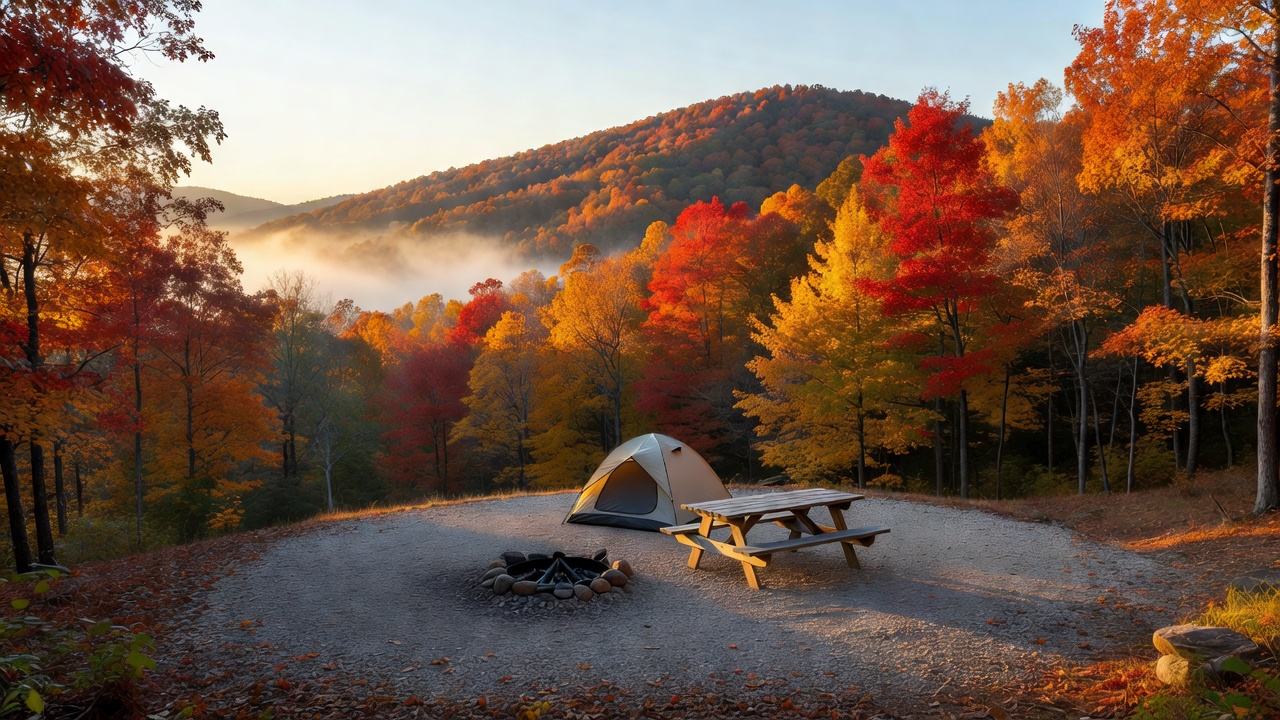
Cloudland Canyon is the park that converts people, and its campground has accumulated its own vocabulary. Cloudland canyon camping reservations are the same state system as any other park, with the quirk that the walk-in tent sites and the yurts sell out first. Cloudland canyon camping prices are per-night with the same ParkPass add-on as everywhere else, but the price differences between a walk-in tent site, a developed site with power and a yurt are large enough to plan around. Cloudland canyon camping sites divide into an East Rim and a West Rim loop plus the walk-in sites, and Cloudland canyon camping spots on the rim edges are the ones with the views; a Cloudland canyon campsite on the west side gets the sunset, which is why that loop is requested by name.
The operating details are what people search at the last minute. Cloudland canyon camping check in and Cloudland canyon camping check in time are the two forms of the same question: check-in is in the afternoon at the campground, and arriving early means parking at the office rather than occupying the site. Cloudland canyon camping map, Cloudland canyon campground map and the printable Cloudland canyon campground map pdf show how far the loops sit from the falls — a detail that matters because the canyon's 600-plus stairs to Cherokee Falls and Hemlock Falls are the reason most people come. Cloudland canyon camp store hours are seasonal and the store carries firewood and ice but not much else, so bring the food you need. Cloudland canyon camping rules are the state standard with one addition worth knowing: the canyon rim trail system and the gorge-adjacent areas have their own access limits, and generators are restricted to certain loops.
One more piece of the Cloudland experience: the park sits in the extreme northwest corner, minutes from the Alabama and Tennessee lines, which means it is a day trip from Chattanooga and a genuine destination from Atlanta — and it is the park where fall color on the rim arrives before it arrives anywhere else in the state.
Vogel, Unicoi, Fort Mountain, Black Rock, Amicalola, Tallulah, and DeSoto: Park by Park
The mountain parks each have their own searchable personality, and the details below are the ones that come up most often.
Vogel state park campground map PDFs and Vogel state park camping map copies are interchangeable — the loop wraps Lake Trahlyta in two arms, and Vogel state park camping sites on the water side are the ones worth requesting. Vogel state park camping map pdf and the campground version are the same document on the department's site, so print either. Vogel state park camping rates are the standard state nightly rate plus the ParkPass, Vogel state park camping rules include the two-night weekend minimum that catches most first-timers, and Vogel state park camping reservations online are the same portal as every other park. Because Vogel is the closest mountain park to Atlanta, Vogel state park camping check in time is a search people run from the car on a Friday.
Unicoi state park campground map versions differ by year, so grab the current Unicoi state park campground map free download rather than a blog screenshot; the Unicoi state park campground map helen ga version is the one to print if you are camping the town side, and the Unicoi state park campground sautee nacoochee ga listings on maps point at the same entrance off Highway 356. Unicoi state park camping map and Unicoi state park camping map pdf show the walk-to-town trail, which is the park's party trick. Unicoi state park camping rates are per night with the usual add-ons, Unicoi state park camping reservations can be made 13 months out, and the scheduling details people actually call about are Unicoi state park camping check in, Unicoi state park camping check in time and Unicoi state park camping check out time — the last one being the one that decides whether you get a morning on the lake. A single Unicoi state park campsite inside the pioneer campground is a very different experience from a developed site, and the park runs both.
Fort mountain state park campground sites sit high above Lake Coolwater, and the unusual product here is the platform: Fort mountain state park platform camping is a raised wooden deck you pitch on, walk-in only, which is why it books out. Fort mountain state park campground map pdf and the Fort mountain state park campground map pdf free version show how the walk-in sites relate to the platform loop, Fort mountain state park camping map covers the trails to the stone wall and the overlook, and Fort mountain state park camping reservations are the state system. Fort mountain state park campsite searches for a specific number are common because the lake-view sites are the draw. Fort mountain state park tent camping is the main mode; Fort mountain state park rv camping is limited to the loops that accept a trailer; Fort mountain state park ga camping is the same park with the state abbreviation; and Fort mountain state park pioneer campsite and Fort mountain state park camping cabins are the two other rental products worth pricing.
The state's highest park has the quirkiest inventory. Black rock mountain state park campground camping is the main loop by the office, while the walk-in sites and the Black rock mountain state park pioneer campground sit higher and quieter. Black rock mountain state park campsite selection matters more here than almost anywhere because the sites are packed into a ridge, and Black rock mountain state park campground camping on the upper loop is what the regulars request. Black rock mountain state park camping map and its Black rock mountain state park camping map pdf show the gap between the campground and the ridge overlooks, Black rock mountain state park camping reservations run through the state system, and Black rock mountain state park campground clayton ga is the location shorthand — the park is minutes from Clayton, which puts it in range of the Chattooga and the Rabun Bald country. Black rock mountain state park ga camping, Black rock mountain state park rv camping and Black rock mountain state park tent camping all describe the same park with different rigs; the weather question is real, because at 3,640 feet the camp is routinely ten degrees cooler than Atlanta, so Black rock mountain state park campground weather is worth checking the week you go.
Amicalola is the Appalachian Trail's front door, and its campground fills with people doing the approach trail to Springer Mountain. The falls are the tallest in Georgia, the camping is a mix of developed sites and lodge rooms, and the park is a day trip from Atlanta that becomes an overnight in October.
Tallulah falls camping and Tallulah falls camping resort both lead to Tallulah Gorge State Park and the private parks around the town of Tallulah Falls. Tallulah gorge campground sites book fast because the gorge's permit system makes an overnight the sane way to see the floor. Tallulah gorge camping map shows the rim trails; Tallulah gorge camping reservations are the state system; Tallulah gorge camping sites and a specific Tallulah gorge campsite are chosen by how close they sit to the gorge trailhead. Tallulah gorge camping cabins are the park's rental units, Tallulah gorge tent camping is the standard mode, and Tallulah gorge rv camping is the trailer-friendly loop. One honest correction: Tallulah gorge dispersed camping does not exist inside the state park — dispersed camping is a national forest product, and the nearest legal version is up Highway 441 in the forest.
Desoto falls camping and Desoto falls camping georgia refer to the Forest Service recreation area on the upper falls of the Chattooga watershed, not to Alabama's DeSoto State Park. The loop is small, there are no hookups, Desoto falls camping map coverage is thin because the area is tiny, and Desoto falls camping reservations, plus Desoto falls georgia camping reservations, are worth checking in the same trip as Vogel or Unicoi, since the three sit within half an hour of each other.
The Georgia Coast: Savannah, Tybee, Jekyll, and What Beach Camping Really Means
Georgia's coast is the state's second season, and it is the reason Campgrounds on the georgia coast keep filling through February while the mountains empty. Georgia coast camping and Camping coastal georgia both mean the same six-mile-wide ribbon: Skidaway Island outside Savannah, Fort McAllister down the Ogeechee, Crooked River at the Florida line, Blythe Island near Brunswick, and Jekyll Island in the middle. Add the county parks and you have the whole Georgia coastal camping inventory, and the reason it matters is temperature — the Atlantic keeps the nights mild while the mountains are freezing.
Savannah georgia state park camping means Skidaway Island State Park, and that is the answer to Savannah georgia camping sites for most people: shaded sites under live oaks, a marsh boardwalk, and twenty minutes into downtown. A Savannah georgia campsite is also available at Fort McAllister, which trades the city proximity for history and a river. Savannah georgia rv camping and Rv camping in savannah georgia are the same search, and both are well served at Skidaway and at the commercial parks off I-95. Savannah ga tent camping is the cheaper tier at the same parks. If you searched savannah georgia beach camping, savannah georgia camping on the beach or savannah georgia campgrounds on the beach, the honest answer is that Savannah's own waterfront has no campground — the beach camping pairs are Tybee and Jekyll, and the city parks are marsh-side rather than oceanfront. Savannah ga free camping does not exist within the city; the closest cheap legal option is a county park with a nightly fee.
Tybee island campgrounds really means one place: the island's own campground, a few blocks off the beach with full hookups, cabins and tent sites, run by the city. That single campground explains almost every Tybee search. Tybee island camping on the beach describes the draw — walk to the sand in minutes — but not the site itself, because Tybee island camping sites are behind the dunes rather than on them. Tybee island tent camping, Tybee island rv camping and a specific Tybee island campsite are all booked through the same office, and Tybee island camping reservations fill for summer weekends months out and for October almost never, which makes it the sleeper fall option. Tybee island camping cabins are the air-conditioned shortcut for families. Two searches to correct: Tybee island camping state park — Tybee has no state park campground, the nearest state park is Skidaway — and Tybee island state park camping reservations plus Tybee island camping state park both lead people to the wrong system; the real reservation is the city's. Tybee island free camping does not exist, and Tybee island car camping is not a thing either, since overnight parking on the island is enforced. Tybee island georgia camping, Tybee island camping map and Tybee island campgrounds are all the same one campground on the south end.
Jekyll island camping state park is the most-searched and least-accurate phrasing on the coast: Jekyll's campground is a large private operation under the live oaks, not a state park camp, which is exactly why it can be so big and so shaded. Jekyll island camping sites run into the hundreds, with Jekyll island camping rv loops, tent areas and Jekyll island camping cabins; a given Jekyll island campsite can be five minutes from the beach or five minutes from the marsh, so Jekyll island camping map matters more here than almost anywhere else on the coast. Jekyll island camping dog friendly is a real advantage — the island is famously bike-and-dog friendly — and Jekyll island camp store sells firewood and ice at the entrance. Driftwood beach georgia camping is a frequent mis-search: Driftwood Beach is a day-use stretch of dead oaks on the north end of Jekyll, beautiful at sunrise and closed to overnight camping, and the place to sleep is the campground on the other side of the island.
St simons island camping is mostly a search with no absolute answer: St. Simons is built out, the beach is day-use, and St simons island camping reservations point most people at Jekyll over the causeway. Little tybee island camping is a different animal — boat access only, no facilities, no reservations, and no legal developed camping, so it is a day-use paddling destination rather than a site. Georgia beach campgrounds, Georgia beach campsites and Georgia beachfront camping are the three phrasings of a short list: Tybee, Jekyll and the county parks at Blythe Island and Crooked River, plus Cumberland Island's permit-only wilderness sites further south. Georgia state parks beach camping is a phrase with only one true answer — there is no state park with a beach campground on the Atlantic — although Fort McAllister and Skidaway get you close to the water.
So: Can you camp on the beach in georgia? Almost never legally. Georgia's barrier islands are a chain of preserves: Cumberland requires a permit and allows camping only at designated sites, Sapelo and Ossabaw are permit-only, and the developed islands — Tybee, Jekyll, St. Simons — put camping behind the dunes. Camping on the beach georgia as a plan means booking one of those permit sites months ahead, or accepting that your "beach camping" is a campground a short walk from the sand. Rv camping on georgia coast is the winter version of the same trip and the easiest reservation in the state, because the season that empties the mountains fills the coast.
Okefenokee Swamp: Canoe Camping, Platforms, and the One Campground
The Okefenokee is the one Georgia destination where camping is a permit rather than a reservation, and the searches show it. The Okefenokee swamp campground is Stephen C. Foster State Park in Fargo — a small developed loop with tent and RV sites, the only drive-in camping anywhere on the swamp — which is also what Okefenokee swamp camping state park and Okefenokee swamp park camping refer to. Okefenokee swamp rv camping exists at that same loop, with a handful of sites and no crowd, and Okefenokee swamp camping reservations run through the Georgia state system like any other park. Okefenokee swamp camping map copies are worth carrying because the swamp's waterways are a maze and the refuge and the state park use different maps.
The real Okefenokee camping is on the water. Okefenokee swamp canoe camping and Okefenokee swamp kayak camping both use the same network of overnight shelters: wooden Okefenokee swamp camping platforms scattered along the canoe trails, each with a roof, a pit toilet and a small fire grate, booked by permit through the refuge or the state park depending on which trail you use. Okefenokee swamp overnight camping on a platform is the experience people come for — alligators calling at night, no lights for forty miles — and it is genuinely advanced: you carry your water, you navigate by map and compass, and the platforms are allocated, so a Friday night in April can be booked out.
Practical notes that save a permit. Platforms are assigned ahead, so Okefenokee swamp camping reservations for a platform are a different transaction from a campsite — call the refuge or the park rather than assuming the online cart covers it. The swamp has no dispersed camping, so the free-camping options that work on national forest land do not apply here. And if you want the swamp without the paddling, the Fargo loop is the only option: a small campground at the edge of the trees with the swamp out the back gate.
October, November, and Winter: Reading Georgia's Two Seasons
Georgia is a two-season state and the calendar does most of the work. Georgia october is the month everyone wants: the mountains hit peak, the coast is still swimming-warm, and the whole state's campgrounds are full. Fall months in georgia as a whole run from late September through the first week of December, with the color moving south and downhill week by week. Is october a good time to visit georgia is not a hard question — it is the best single month of the year in the north and still pleasant on the coast — but it is also the month with the most competition for sites, which is why a Georgia camping trip in October is booked in July.
The late fall question is where the mountains and the coast split. Georgia camping november on the Blue Ridge means bare trees, quiet loops and cold nights; the same month on the coast means comfortable days and the start of the best shelling. Can you go camping in november and Where can i camp in november both have the same answer in Georgia: yes, everywhere, and the pick is whether you want a fire in the mountains or a beach walk at Jekyll. Where can i camp in november on the coast is a much easier reservation than October anywhere.
Winter is the coast's season. Where to camp in georgia in winter points south: Skidaway, Fort McAllister, Crooked River, Jekyll and the county parks hold 50s and 60s while the north Georgia gaps freeze, and the mountain parks stay open but drop to limited loops and reduced services. Where to camp in south georgia is the same coastal and swamp tier, plus the state forest and WMA options further inland; where to camp in ga and Where to camp in south georgia as generic searches both resolve to that southern band in winter and to the mountains in fall. Can you camp in october is yes — the question is not legality but availability.
Then there is water, which is the other axis of the state. Camping in georgia near water is most of the good camping: the reservoir parks at Red Top Mountain, Hard Labor Creek, Fort Yargo, Vogel's Lake Trahlyta, Unicoi, Fort Mountain's Lake Coolwater and Black Rock's ridge, the river campgrounds on the Toccoa, the Tallulah and the Chattooga, and the entire coast. If you are picking a first trip and want water, the reservoir parks are the safe answer in any month and the coast is the answer from October through April.
One gear note that belongs with the season: camping gear georgia for a fall trip means layering for a thirty-degree swing between an Atlanta afternoon and a mountain morning, which is the single most common packing mistake visitors make.
Georgia Camping FAQ
Is camping in Georgia open year round?
Most of the state park system camps year round, and Georgia's mild half — the coast and south Georgia — is at its best from November through February, while north Georgia mountain camping continues into colder weather with real overnight freezes. The seasonal constraints are campground-specific rather than statewide: some parks reduce loops, close comfort stations or run limited facilities in winter, and the state notes that some facilities may not appear online due to renovations or seasonal availability. Check the specific park, and check its live notices before you drive.
Where can I camp in Georgia in October?
October is the north Georgia mountain month. Aim for elevation first: Black Rock Mountain is usually the first park to show color, Cloudland Canyon and Fort Mountain deliver the classic overlook-and-waterfall weekend, and F.D. Roosevelt State Park south of Atlanta often peaks in early November, so it is the good choice for the second half of the window. Reserve early — the state's own guidance is that fall cottages, yurts and campsites often book up a year in advance.
Do I need a reservation to camp in a Georgia state park, or can I just show up?
Both exist. Reservations can be made up to 13 months ahead (14 for Georgia residents) and campsites stay reservable until 4 p.m. on arrival day. Separately, parks with first-come camping use a lock box with envelopes at the camping area: enclose the fee, drop it in, take your site. Walk-ins may occupy a site for one night even when a two-night weekend minimum applies to reservations.
Can I have a campfire when I'm camping in Georgia?
It depends on who owns the land, and this fall the answer is stricter than usual. On the Chattahoochee-Oconee National Forest the Stage II restriction in place since April 23, 2026 prohibits all fires including charcoal, with gas camp stoves still allowed. In state parks, use the site's fire ring or grill, and ask at check-in whether a local burn ban is active — Georgia's dry fall is exactly why these restrictions exist.
What is the ParkPass and is it included in my reservation?
The ParkPass is $10 per vehicle per day or $70 for an annual pass, it is required for all vehicles, and it is not included in reservation fees — overnight guests pay it once per stay, at the visitor center at check-in. It also does not cover Chattahoochee River NRA, Kennesaw Mountain, Stone Mountain, the Corps of Engineers lakes, Jekyll Island or Lake Lanier, and it is not valid at state historic sites, Wildlife Management Areas or Public Fishing Areas.
Where can I camp near Atlanta?
Within about an hour: Red Top Mountain on Lake Allatoona (15+ miles of trails, lake swimming, yurts, cabins, and the easy 4-mile Iron Hill Trail for small kids), Hard Labor Creek to the east (5,804 acres and a 1-mile nature trail), Fort Yargo, Victoria Bryant up I-85, and Chattahoochee Bend on the river. Stone Mountain, Lake Lanier and the Corps lakes are nearby camping and paddling options too — they just are not covered by the ParkPass.
Is camping in Georgia good with dogs?
Yes, with three exceptions to plan around. State park campgrounds welcome leashed dogs on a six-foot leash, dogs are allowed only in cottages explicitly designated "dog friendly" (extra fees, reservations required), and they are not allowed in or around yurts. Cumberland Island allows no pets except service animals, and Tallulah Gorge bars pets from the gorge floor, sliding rock trail and the Hurricane Falls staircase while keeping rim trails leashed-dog friendly.
When do Georgia state parks close for the season?
Georgia's state park campgrounds largely run year-round rather than shutting as a system — the seasonal shifts are loops closing, facilities going limited and some parks reducing winter service. The bigger seasonal clock in Georgia is closing dates on public campgrounds generally and the second-Monday-in-October marker that some systems use; we track that in our when do campgrounds close guide, and the practical move is to call the specific park in the week before a late-fall trip.
Do Georgia State Parks Have Full Hookups?
Mostly no. Georgia state parks split into two tiers: the mountain parks — Vogel, Unicoi, Fort Mountain, Black Rock Mountain, Cloudland Canyon, Tallulah Gorge — run water and 30-amp power at the developed sites and dump stations at the entrance, while the reservoir and coastal parks are where you find the full hookups. If you need sewer, water and 50-amp service in one site, shortlist Red Top Mountain, Hard Labor Creek, Fort Yargo, Skidaway Island and Fort McAllister, and treat any mountain park as a power-and-water trip with a blue tote for the rest. The park pages themselves flag each loop's hookup class, so the reliable move is to open the specific loop, not the park summary.
Is There Really Free Camping in Georgia?
Yes, but almost all of it is federal. Dispersed camping in the Chattahoochee-Oconee National Forest is free, legal and needs no reservation — you use an existing clearing off a numbered forest road, stay no more than 14 days, and bring everything including water. The state park system is never free: every one of the 41 parks charges a nightly site fee plus the per-vehicle ParkPass, and cabin and yurt rentals cost more. The middle tier is WMA camping, which is free-with-license rather than free-without, and Corps of Engineers and county areas that still keep a few primitive sites. What does not exist is free beach camping on the coast, free camping inside Savannah city limits, and free overnight parking that isn't just a store lot with no fire ring and no permit.
Can You Camp on the Beach in Georgia?
Rarely, and never casually. Georgia's barrier islands are mostly preserves: Cumberland Island allows camping only at designated sites under a permit, Sapelo and Ossabaw are permit-only and boat-access, and the developed islands — Tybee, Jekyll and St. Simons — put camping behind the dunes rather than on the sand. Little Tybee is reachable only by boat and has no developed camping at all, and Driftwood Beach on Jekyll is a day-use stretch that closes to overnight use. So the realistic version of beach camping in Georgia is a campground within walking distance of the water: the city campground on Tybee, the big shaded campground on Jekyll, or the county parks at Blythe Island and Crooked River, with Cumberland as the permit-only backcountry answer.
Where Do You Camp Near Savannah If You Want the Beach?
Split the question. For Savannah itself, Skidaway Island State Park is the answer — shaded sites under live oaks and salt marsh, twenty minutes from downtown, with Fort McAllister as the quieter river alternative down the Ogeechee. For the beach, Tybee Island's city campground is the closest sand to Savannah, a few blocks off the water with tent sites, full hookups and cabins; it books out for summer weekends and is wide open in October. Jekyll Island is the third option, roughly ninety minutes south, and it trades city access for the biggest campground on the coast and the live-oak canopy at Driftwood Beach. None of the three is free, and none of them puts a tent on the sand.
Is Dispersed Camping Legal in Georgia?
Yes, on federal forest land and in designated wildlife management areas. In the Chattahoochee-Oconee National Forest, dispersed camping is allowed across most of the property: pick an existing clearing near a numbered forest road, keep to the 14-day stay limit, and follow the motor-vehicle-use map, which shows which roads are open and which gates close seasonally. It is not allowed inside designated wilderness such as the Cohutta, where stricter backcountry rules and group-size limits apply, and it is not allowed on closed timber roads. On WMAs, camping is limited to designated areas and requires the right license or lands pass. What Georgia does not have is BLM land, so any listicle promising BLM dispersed sites in this state is wrong about the agency, not the camping.
How Far Ahead Should You Book a Georgia State Park Campsite?
Georgia's window is generous but the good sites move earlier than the window suggests. Campsites, cottages and yurts open 13 months ahead, and 14 months ahead for Georgia residents, on a rolling daily calendar — so a specific site becomes bookable for the same date next year rather than on a single release morning. In practice, October weekends at the mountain parks, holiday weekends anywhere and the walk-in or platform sites at Fort Mountain, Cloudland Canyon and Black Rock Mountain are gone well before the window closes; the coast in winter is the opposite and often has same-week availability. Campsites stay reservable until 4 p.m. on arrival day, walk-in sites can be taken for one night even when a two-night weekend minimum applies to reservations, and cancellations reopen sites constantly, so check daily inside two weeks of your trip.
Does Georgia Have BLM Land?
No. The Bureau of Land Management manages essentially nothing in Georgia — the agency's holdings are concentrated in the western states — so if you searched for BLM camping here you were looking for the wrong land manager. The free, no-reservation camping you want is on National Forest land: the Chattahoochee-Oconee, where dispersed camping works off numbered forest roads with a 14-day limit. Failing that, wildlife management areas allow camping in designated spots with a license or lands pass, and the Corps lakes and county parks fill in the cheap end of the paid tier. Same camping, different agency — and knowing that saves you from driving to a map pin that isn't public land.
When Is Peak Fall Color in the Georgia Mountains?
It moves up and down the state, so book by elevation rather than by date. The highest ground turns first: Brasstown Bald, Rabun Bald, Black Rock Mountain and the ridge line above Clayton usually peak in the first half of October, often in the first week, and that is also when Cloudland Canyon's rim is at its best in the northwest corner. The mid-elevation parks — Vogel, Unicoi, Fort Mountain, Amicalola, Tallulah Gorge — follow in mid to late October, and the lower valleys and the ridge-and-valley country to the south run late October into the first week of November. The coast peaks later still, but its fall is more about weather than color, which is why the coastal campgrounds stay busy long after the mountains have emptied.
The Bottom Line
If you are comparing destinations, camping in Wisconsin covers the state park system's booking window, its staggered October closures and the sites that stay open all winter.
If you're comparing states for the same fall window, we keep a full West Virginia camping guide too — the one state in the region where the headliner national park takes no reservations at all.
Georgia is one of the most underrated fall camping states in the country, and the reason is mechanical rather than scenic: a 41-park system with 2,700+ campsites, a 13-month booking window that lets you plan a real trip instead of gambling on a cancellation, a $10 ParkPass that keeps day use cheap, and a state that spans two seasons — Blue Ridge color in October, coastal warmth through February.
Three things decide whether your trip works. Book the park you actually want, early — fall weekends at the mountain parks move months out, and the state's own page says a year. Budget for the ParkPass and the minimums — $10 per vehicle on top of the site, two nights on a weekend, three on Thanksgiving. And check the fire rules the week you leave, because the Chattahoochee-Oconee restriction is live and the whole point of a Georgia camping weekend is usually the campfire.
If you want to compare this to the states next door, our North Carolina guide covers the mountains-to-Outer-Banks split, Tennessee covers the Smokies and their backcountry permit changes, and Florida is the winter counterpart to the Georgia coast. For the October timing question specifically, start with where to camp in October and the peak foliage guide.
<!-- AFFILIATE_DISCLOSURE -->Planning a trip the other direction? Our camping in Washington state guide covers the three separate booking portals, the October closing wave and the coast campgrounds that never shut for the season.