Camping in Arkansas 2026: Buffalo River, the Ozarks and the County Burn-Ban Map
How camping in Arkansas really works: the 12-month booking window, the free winter window on the Buffalo, dispersed rules in two national forests, and the live county burn ban.
Arkansas is the state that gives you two completely different camping trips under one name, and then makes you figure out which rules you are standing in. Half of it is Ozark highland — the Buffalo River, sandstone bluffs, water clear enough to see the bottom at twenty feet. The other half is Ouachita and Gulf-plain — pine ridges, quartz crystal country, cypress bottomland. The state park system books twelve months out on one portal, the Buffalo National River books six months out on another and charges nothing to enter, and the two national forests will let you sleep anywhere legal for a month as long as you move five road miles afterward.
Then there is the rule almost nobody checks before a fall trip: in Arkansas, campfires are controlled county by county, by elected county judges, not by a statewide season. On the morning I wrote this, the Arkansas Forestry Division dashboard showed 50 counties under burn bans, with both the Ozark-St. Francis and Ouachita national forests reporting a fire danger of Very High. That single fact reshapes how you pack for an October or November trip here, and it is why this guide leads with a stove rather than a hatchet.
This is the version of Arkansas camping advice I wish existed before I drove down with a tent, a bundle of firewood, and an assumption that "fall" means the same thing in every county.
Driving west instead? Our camping in Oklahoma guide works the same ground against a different set of rules — 33 state parks on a rolling 11-month booking window, plus a federal wildlife refuge and a national recreation area that each keep their own calendar.
Quick Answer: Where to Camp in Arkansas (and When)
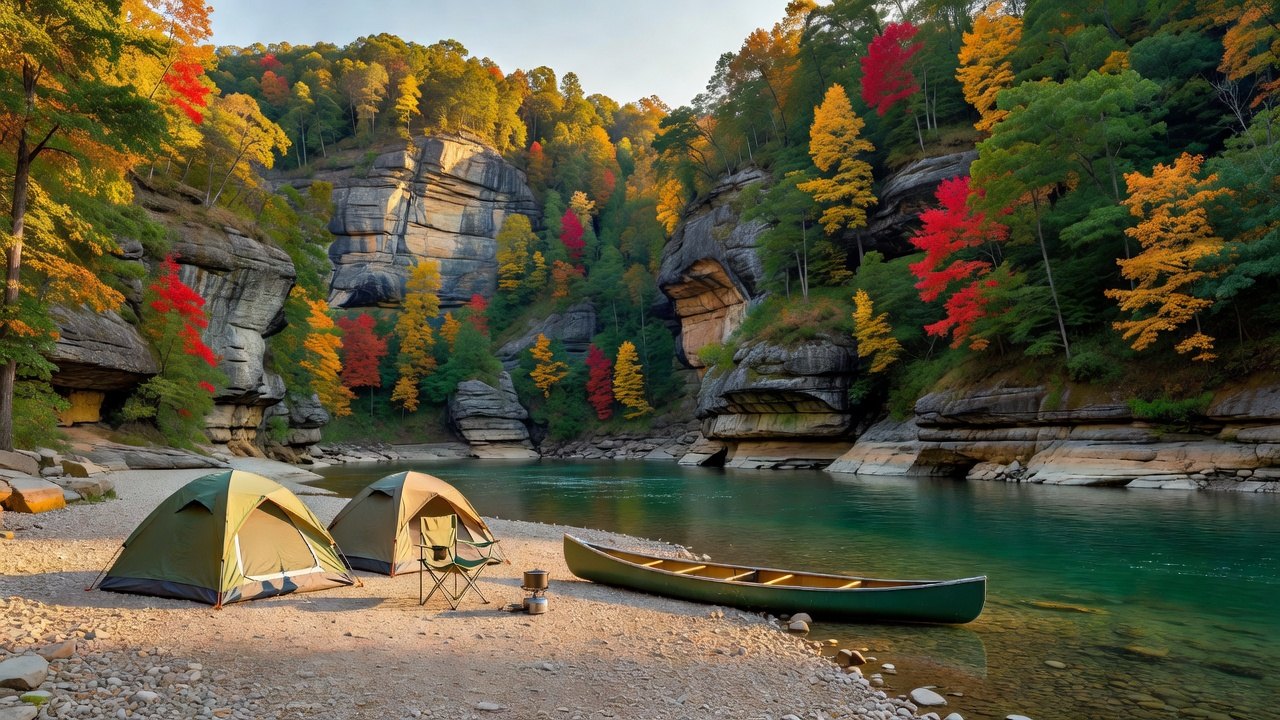
- The Buffalo National River (north-central Ozarks) — Ponca, Jasper, Steel Creek, Kyles Landing, Erbie, Ozark, Tyler Bend, Buffalo Point. America's first national river, no entrance fee, and the best riverside camping in the state. Mid-October for color, and from November 17 the campgrounds go fee-free and first-come.
- The Ozark highlands (northwest and north-central) — Petit Jean, Devil's Den, Mount Magazine, Mount Nebo, Lake Fort Smith, Withrow Springs, Bull Shoals-White River. The fall-color zone, the CCC-era lodges, and the best hiking-to-campsite ratio in the state.
- The Ouachita Mountains (west-central and southwest) — Lake Ouachita, Lake Catherine, DeGray Lake, Queen Wilhelmina, Cossatot River, Crater of Diamonds. Big lake water and the Talimena Scenic Drive.
- The Delta and Crowley's Ridge (east) — Crowley's Ridge, Village Creek, Jacksonport, Delta Heritage Trail, Mississippi River. Flat, quiet, cypress country where you will have the loop to yourself.
- Free and dispersed — Ozark-St. Francis and Ouachita national forests, plus Gulpha Gorge at Hot Springs for full hookups at a national park price.
For a first Arkansas trip, Petit Jean is the on-ramp: flush toilets, hot showers, a lake, a 95-foot waterfall, and a lodge with a restaurant if the weather turns. For the one trip that makes people move here, Steel Creek on the Buffalo in the first week of November. If you are still choosing a tent for a family trip, our tent size guide works through the 2P-to-8P math before you book a loop.
What Just Changed This Week
Three things are live and dated right now, and all three change what you do when you arrive.
The burn-ban map. As of October 9, 2026 at 9:06 a.m., the Arkansas Department of Agriculture's Forestry Division listed 50 counties under burn bans and 75 counties at high wildfire risk. Counties under a ban that week included Garland, Hot Spring, Pulaski, Faulkner, Saline, Pope, Yell, Scott, Montgomery, Polk, Carroll, Madison, Newton and more than thirty others — which is to say most of the camping you are likely to be doing. Burn bans in Arkansas are issued by the county judge, and the dashboard is the only source worth checking, because a ban in one county says nothing about the next one over.
The national forests are at Very High. Both the Ozark-St. Francis and the Ouachita were showing a fire danger status of Very High on the same dashboard, alongside an active alert titled Wildfire Risk Increases in Arkansas and Oklahoma. The Forest Service also carries a standing Be Bear Aware alert — black bears are resident across the Ozarks and Ouachitas, which changes how you store food.
The Buffalo flips to free in November. Camping fees on the Buffalo National River are charged approximately March 13 through November 16, 2026, while the water and flush restrooms are running. From November 17, the water systems are winterized, no camping fees are charged, and every site becomes first-come, first-served until mid-March. That is a genuinely unusual window: a national park campground in the Ozarks, free, inside the best month for hiking it.
Arkansas Is Four Camping Systems, Not One
The single most useful thing to understand about camping in Arkansas is that there is no such thing as "the Arkansas campground system." There are at least four, they share no booking portal, and the cheapest one is run by the federal government rather than the state.
Arkansas State Parks runs the largest one. There are 52 state parks, thirty of which offer camping, holding more than 2,000 campsites from primitive walk-in pads to full water/electric/sewer RV sites. Everything books through a single portal at reserve.arkansasstateparks.com, or by phone at 888.287.2757, and the reservation window is a full twelve months.
Buffalo National River is the National Park Service unit, and it is the odd one in a good way. There is no entrance fee and no day-use fee, there are no fees or permits for backcountry camping, and the developed campgrounds run $16 to $20 a night, or $30 at Buffalo Point's drive-in loops. Reservations are required for every site from mid-March through mid-November, and everything flips to free and first-come in winter.
Hot Springs National Park is the third NPS unit with camping, and it has exactly one campground. Gulpha Gorge holds 40 sites, all with full RV hookups, at $34 a night, and reservations are required for all 40 on a six-month Recreation.gov window. There is no other camping anywhere in the park.
The two national forests are the free option. Ozark-St. Francis and Ouachita together cover most of the western half of the state, and dispersed camping is legal almost anywhere outside developed recreation areas — with the thirty-day rule covered below.
| System | Portal | Window | Typical cost | 2026 hook |
|---|---|---|---|---|
| Arkansas State Parks (30 parks with camping) | reserve.arkansasstateparks.com / 888.287.2757 | 12 months | ~$12–$42 by hookup class | One-night non-refundable deposit on cancellation |
| Buffalo National River (NPS) | recreation.gov / 1-877-444-6777 | 6 months (individual), 1 year (group) | $16–$20, $30 drive-in at Buffalo Point | Free + first-come from Nov 17 |
| Ozark-St. Francis / Ouachita NF | none for dispersed | n/a | free (fees at some developed sites) | Fire danger Very High, county burn bans |
| Hot Springs NP — Gulpha Gorge | recreation.gov | 6 months | $34, full hookups | Only 40 sites, all reservable |
How the Arkansas State Park Booking Window Actually Works
The state park system is the one most families will use, and the money side is where people get caught. Arkansas State Parks charges by campsite class, and the class is printed with the site:
- Class AAA — water, 50-amp and sewer hookups (the top tier).
- Class AA — water, 30-amp and sewer.
- Class A — water and 50-amp.
- Class B — water and 30-amp.
- Class C — water or 30-amp.
- Class D — no hookups and tent sites, the cheapest rung.
In practice nightly rates across the system run roughly $12 to $42, and the spread is almost entirely about hookups rather than location. A no-hookup tent site at a beautiful park often costs a third of a full-sewer site at a lake park with a marina. If you are tent camping, the class system is your friend.
The cancellation rule is the one to read twice. A cancelled campsite forfeits a non-refundable deposit equal to one night's full camping fee per site, plus tax — not a flat fee, but a full night. Cabins, lodge rooms, yurts, Rent-an-RV, Rent-a-Tent and camper cabins are the opposite: cancel before two days prior to arrival and you get a refund less a 10% reservation fee. A no-show is charged the first night, and at 10 a.m. the following morning the site goes back on the market. There is no refund for early departure on a two-day reservation or a three-day holiday weekend.
Dogs have their own line item. Arkansas State Parks keeps a defined set of dog-friendly cabins and charges a non-refundable $40 per dog fee, maximum two dogs, collected at check-in. If you are bringing a dog and a cabin, budget the fee and confirm the specific cabin is on the dog-friendly list before booking. The underlying mechanics are national — our state park camping guide compares the booking windows and deposit rules state by state.
The Buffalo National River, Campground by Campground
The Buffalo is the reason people drive to Arkansas, and its campgrounds are genuinely different from one another. If you are new to national park camping, our national parks camping guide explains why these Recreation.gov windows behave differently from a state system. All of them sit inside the same reservation system but behave differently depending on the loop.
Buffalo Point is the only campground in the park with water and electric hookups (30/50 amp). It has over 80 drive-in sites plus 21 walk-in tent sites for tents only. Drive-in sites are $30 a night; walk-in tent sites are $20. Loops B, C and D plus the group sites and pavilions can be reserved from 3 days to 6 months ahead, while Loops A and E and walk-in sites F through U are strictly first-come, first-served — no reservations, no saving sites. Loops A, B, D, E and the walk-in sites close November 15 through March 14, but Loop B stays open all winter for primitive camping with no electricity and no fee, and it keeps a flush restroom and drinking water. Group sites take 10 to 25 people at $50 a night; pavilions rent for $50 a day.
Steel Creek is the one to book for a first Buffalo trip: 26 walk-in tent-only sites, no RVs, no trailers, no camper vans, each with a picnic table, fire ring and lantern hook. It sits about three miles east of Ponca and it is a short walk from some of the best bluff-line hiking in the state.
Kyles Landing has 33 walk-in tent sites between Ponca and Jasper, and the access road is gravel, steep and rough — the park itself recommends a high-clearance four-wheel-drive vehicle. If you are towing anything, skip it.
Erbie spreads across 13 drive-in sites, 13 walk-in tent sites and 5 walk-in group sites, with group sites at $50 per night. Ozark Campground has 30 sites and a pavilion at $25 a day. Lost Valley takes no fee at all. Tyler Bend is the winter survivor on the middle river: its drive-in loop stays open with water and showers through the winter while the rest of the campground closes.
Two mechanical details matter at every one of them. First, cell service is unreliable at Steel Creek, Kyles Landing, Erbie and Ozark, so make the reservation before you lose signal rather than at the gate. Second, first-come sites are paid at self-pay stations that take cash or checks only, with no change available — bring the exact fee.
The park-wide camping rules are simple and enforced: camp in designated sites only, check-in 1 p.m. and check-out 12 p.m., maximum six people per individual site, 25 per group site, sites must be occupied nightly, fires only in the provided fire rings, generators only between 8 a.m. and 8 p.m., quiet hours 10 p.m. to 6 a.m., pets leashed at all times, and ATV use is prohibited. If you hold a Senior (gray) or Access (blue) America the Beautiful pass, it takes half off your campsite at Buffalo — the Annual, Military and 4th Grade passes do not.
Dispersed Camping in the Ozark-St. Francis and Ouachita National Forests
This is the free option, and it is generous by eastern standards. Both forests publish the same rule set.
You may camp in one dispersed area for up to 30 days. After that you must move at least five road miles to camp in another dispersed area, and you may not return to the same campsite within the calendar year. Put your site at least 100 feet from any stream or water source, and keep it within 150 feet of a roadway so you are not driving across meadows. Groups over 75 people need a special-use permit from the district office.
Two warnings matter at the Ozarks' elevation. First, there is private land inside the national forest boundaries, so know whose ground you are on. Second, the Forest Service's own wording on water is blunt: the same streams that run clear in October can go dry in late summer and early fall, and there is no safe untreated water source — carry a filter or carry water. Heavy local rain of 5 to 10 inches in a few hours is a real event here and floods the tributaries fast, so do not camp in a dry wash because it looks harmless.
Campfires are permitted while dispersed camping unless restrictions are in effect. Given the Very High reading and the county bans, check the Arkansas county burn-ban map the day you leave rather than the day you planned.
Petit Jean, Devil's Den and the Ozark Highland Parks
Petit Jean State Park is Arkansas's first state park — set aside in 1923 — and still its signature one. It is built around Cedar Falls, a 95-foot waterfall, with the Seven Hollows Trail as the headline hike and the CCC-era Mather Lodge as the base. The campground runs about 125 sites across four loops, and Loop A sits directly on Lake Bailey with 35 full-hookup sites — book A if you have a trailer and want to wake up on the water. Petit Jean is also the state park with the odd distinction of an airport campground: if you fly in, you can camp at the strip. Group areas here run $90 a night, and overflow is the cheapest fallback at about $16.
Devil's Den State Park is the backpacker's park, in the Lee Creek Valley south of Fayetteville. The campground holds around 135 sites, including 42 with hookups, 8 hike-in/tent-only sites, 17 cabins with kitchens and fireplaces and 9 camper cabins, plus a separate 42-site horse camp with its own bathhouse. The trail network is the draw: the short Devil's Den Trail for families and the 15-mile Butterfield Hiking Trail for a real overnight. Rigs up to about 44 feet fit the hookup loops.
Mount Magazine State Park sits on the highest point in Arkansas, and it is the park people book for the view rather than the water. Mount Nebo and Lake Fort Smith cover the northwest, Withrow Springs the Buffalo corridor, and Bull Shoals-White River the trout water below the dam.
In the Ouachitas, Queen Wilhelmina State Park perches on Rich Mountain along the Talimena Scenic Drive with a lodge and restaurant on the ridge, Lake Ouachita and Lake Catherine are the big-water parks, DeGray Lake Resort is the one with the resort lodge, and Cossatot River is the rugged whitewater corner. In the east, Crowley's Ridge, Village Creek (with a $23 horse camp), Jacksonport and the Delta Heritage Trail sit on flat ground where a family bike ride is the activity.
Fall Color Timing in the Ozarks and Ouachitas
Arkansas has one of the longest and most reliable fall color seasons in the South, because the state runs two mountain systems on different clocks.
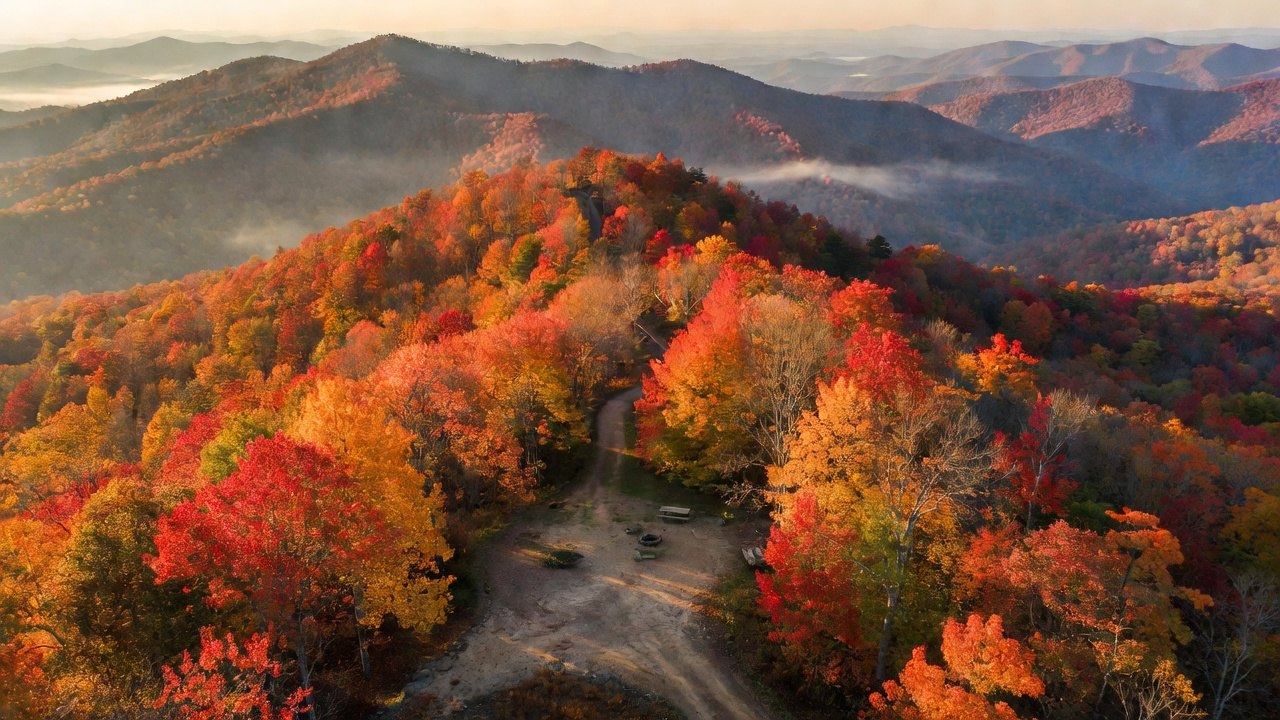
The Ozarks — the Buffalo River valley, Petit Jean, Devil's Den, Mount Magazine — turn first, generally from late October into the first days of November. The Ouachitas and the southern ridges follow, pushing the statewide peak into the first two weeks of November. Foliage trackers were pointing at around November 4 for peak color on the Buffalo National River this season, with the statewide map calling November 4 to November 13 for most of Arkansas. Treat that as the planning band rather than a promise: elevation decides the order inside each region, and the high ridges at Mount Magazine and along the Buffalo's upper district usually run a week ahead of the river bottoms. For the wider regional picture, our leaf peeping guide tracks every state's window on one page.
The practical implication is that the first two weeks of November are the sweet spot for Arkansas camping — you get the color, and on the Buffalo you also get the free, first-come window that opens November 17 if you push your trip a fortnight later.
Camping in Arkansas in October and November
The state's camping season is long, but the shoulder months behave very differently.
October is the most balanced month of the year. Daytime temperatures are comfortable, the water is still running at every developed campground, and the color starts in the north. It is also the month when the burn-ban question first becomes real, because the fuel load is at its driest. If you are routing a season around the calendar, the October fall camping guide and the November camping guide cover the other states running on the same clock.
November splits in two. Early November is peak color and the last weeks of full water service on the Buffalo; November 17 is the hinge, when the water systems winterize, fees stop and primitive camping begins. Late November gets genuinely cold overnight in the Ozarks — the ridges at Mount Magazine and the upper Buffalo see hard frosts — while the Delta and the southern Ouachitas stay milder. This is the month to carry a real sleeping bag rather than a summer one, and to expect the state park lakeside loops to be empty on weeknights. Thanksgiving weekend is the busiest stretch of the fall here, and the Thanksgiving camping guide covers how the reservation calendars behave when a holiday lands on the camping calendar.
Winter camping works best in three places in Arkansas: the Buffalo's Loop B, which stays open with a flush restroom and drinking water; Tyler Bend, whose drive-in loop keeps water and showers; and the year-round state park loops, which stay open even when the water at the less-developed parks is shut off.
Fire, Firewood, Alcohol and the Rules That Actually Apply
Campfires. Arkansas does not run a statewide campfire season like Virginia's February-to-April afternoon rule. Outdoor burning statewide is governed by Arkansas Code 20-22-301 and ADEQ Regulation 18, and the operative wildfire control is the county burn ban, issued by the county judge using fire-danger criteria that include drought indices. The bans are county-specific and change weekly. On October 9 the state listed 50 counties under one. In practice: check the map, assume it can change between Friday and Sunday, and carry a gas stove as your primary cooking method in October and November. A liquid-fuel or propane stove is legal when open fires are not. Our fall camping gear checklist builds a cold-weather kit around exactly that problem.
Firewood. Do not move firewood across county or state lines into the national forests. Buy it where you burn it, or gather only dead and down material on Forest Service land, where no wood permit is required for campfire use.
Water. Treat everything. Giardia is present across the Ozarks and Ouachitas, and the Forest Service's own guidance is that boiling, tablets or a filter are the only ways to make untreated water safe.
Bears. Both forests carry a standing bear alert. Store food in a vehicle or a hang, not in your tent, and keep a clean camp.
Alcohol. Arkansas State Parks permits alcohol in camping areas and designated facilities, but local and county ordinances layer on top, and the parks enforce quiet hours strictly. Assume no glass on gravel bars.
Hunting season. Arkansas runs a long fall hunting calendar, and blaze orange matters on public land in November and December. If you are hiking the Buffalo or the national forests in deer season, put orange on every member of the party, including the dog.
Camping in Arkansas With Kids and Dogs
Arkansas is one of the easier states to bring both, and the reason is the loop design rather than the rules. State park campgrounds put flush toilets, showers and dump stations in most areas, which means a kid-friendly bathroom situation is the default rather than a bonus. Petit Jean, Devil's Den and Lake Catherine all have short, well-marked trails that a five-year-old can finish, and Crowley's Ridge and the Delta Heritage Trail are flat enough to bike.
Dogs are welcome at most Arkansas State Park campgrounds on a six-foot or shorter leash, and the cabin inventory includes a designated dog-friendly set with the $40 per dog fee. On the Buffalo National River, pets must be leashed at all times in campgrounds, but the park restricts pets on some trails, so check the park's pets page before you plan a hike around the dog. In the national forests, standard leash rules apply and the bear awareness alert is the real reason to keep the dog close — a loose dog that finds a bear is the fastest way to turn a good trip into a bad one. Our camping with dogs guide covers the gear and how trail restrictions differ between a national river and a state park.
For the dog gear itself, the essentials that actually earn their space are a collapsible bowl, a harness rather than a collar for hiking, paw protection for the sandstone, and a tick tool — Arkansas is tick country from spring through the first hard freeze.
Arkansas Camping Gear List
Here is the gear that matches the way Arkansas actually camps: a wet, rocky, sometimes-fire-banned state where you carry everything to the site and the weather turns fast. Everything below is a real product page with a current price.
Shelter — tents that handle Ozark rain
- Coleman 4/6/8/10 Person Instant Camping Tent — $180.00, the family base camp that goes up in about a minute.
- Coleman Skydome 4-Person Tent with LED Lighting — $122.99, weatherproof and pre-attached poles.
- CORE 6 Person Instant Cabin Tent — $169.99, for a family that wants standing room.
- EVER ADVANCED 6 Person Blackout Tent — $169.99, dark enough to sleep past sunrise.
- CAMPROS 8 Person Tent with Room Divider — $159.98, two rooms for two families.
- Forceatt 2-Person Backpacking Tent — $57.18, the light option for a Buffalo walk-in site.
- Kelty Late Start 2P Backpacking Tent — $159.95, fast-pitch for a river trip.
Sleeping — the November upgrade
- TETON Sports Celsius XXL 0 Degree Sleeping Bag — $89.99, for the late-November Ozark frost.
- Coleman Oak Point Big & Tall 30°F Sleeping Bag — $74.99, the shoulder-season workhorse.
- Therm-a-Rest NeoAir XLite NXT Sleeping Pad — $209.95, warmth without bulk.
- Klymit Static V Sleeping Pad — $64.95, the value pad for car camping.
- Therm-a-Rest Z Lite Sol Sleeping Pad — $54.95, indestructible closed-cell foam.
- NEMO Fillo Elite Luxury Camping Pillow — $59.95, packs to the size of a fist.
- Wise Owl Outfitters Camping Pillow — $24.99, the cheap one that works.
Camp kitchen — because your campfire may be banned
- Coleman Triton+ 2-Burner Propane Camping Stove — $149.99, the two-burner that runs on a 1 lb canister.
- Coleman Bottle Top Propane Camp Stove — $21.99, screws straight onto a canister.
- MSR PocketRocket 2 Ultralight Backpacking Stove — $49.95, the backpacking standard.
- Gas One Propane Refill Adapter with 4-Ft Hose — $14.99, refill 1 lb bottles from a 20 lb tank.
- GASPRO 20 lb to 1 lb Propane Tank Adapter — $9.98, the brass conversion fitting.
- Lodge Pre-Seasoned Cast Iron Skillet, 10.25 Inches — $19.99, works on any heat source including coals.
- Lodge Cast Iron Deep Camp Dutch Oven — $59.95, for a real camp meal.
- Stanley Wildfare Core 26-Piece Camp Kitchen — $179.00, the whole kitchen in one case.
- AeroPress Original Coffee Press — $39.95, coffee that justifies getting up.
- Coleman 70-Quart Xtreme 5-Day Cooler — $79.99, five days of ice in Ozark heat.
- Stanley All Day Julienne Soft Cooler Bag — $100.00, for the day hike and lunch stop.
- Sawyer Squeeze Water Filtration System — $45.95, mandatory on the Buffalo.
- Hydro Flask 32 oz Wide Mouth Bottle — $44.95, and Nalgene 32 oz Tritan — $16.99, the cheap backup.
- Coleman 5-Gallon Water Carrier — $13.99, for a site with no spigot.
Light and power
- Black Diamond Spot 400 Headlamp — $39.95, waterproof, which matters here.
- Petzl ACTIK CORE Rechargeable Headlamp — $79.95, the rechargeable upgrade.
- Black Diamond Moji Lantern — $24.95, dimmable, hangs from the lantern hook.
- MalloMe Camping Lantern 4 Pack — $23.99, one per kid, cheap.
- Jackery Explorer 300 Portable Power Station — $199.00, for a four-day camp kitchen.
- EF ECOFLOW RIVER 2 Portable Power Station — $169.00, the lighter 256Wh option.
- Garmin inReach Mini 2 — $349.99, satellite messaging where cell service dies.
Layers and footwear
- Columbia Men's Omni-Heat Base Layer — $49.99, for the cold overnight.
- Columbia Steens Mountain 2.0 Fleece — $34.99, the campfire-layer standard.
- Columbia Watertight II Rain Jacket — $60.00, because it will rain.
- Smartwool Merino Reversible Neck Gaiter — $32.00 and Merino Cuffed Beanie — $35.00, the two cheapest warmth upgrades.
- Darn Tough Vermont Men's Light Hiker Socks — $24.95 and the women's hiking sock — $25.95, because wet feet end trips.
- Merrell Men's Moab 3 Hiking Boot — $89.99, the Arkansas trail default.
Moving and camp comfort
- Osprey Talon 22 Men's Hiking Backpack — $139.95, day pack for the bluff trails.
- Osprey Daylite Plus Commuter Backpack — $75.00, the do-everything 20L.
- Osprey Jet 18L Kid's Hiking Backpack — $80.00, so the kids carry their own.
- Cascade Mountain Tech Carbon Fiber Trekking Poles — $49.95, for the descent to Cedar Falls.
- Coleman Pack-Away 4-in-1 Folding Table — $99.99, adjustable to four heights.
- Coleman Portable Camping Chair with 4-Can Cooler — $39.99, the standard.
- GCI Outdoor Compact Camp Table 20 — $45.00, packs flat.
- ENO DoubleNest Lightweight Camping Hammock — $75.00 with the ENO Atlas Suspension System — $29.95, for the trees you came for.
- OneTigris Hideout Hammock Underquilt — $39.98, which is what makes November hammocking possible.
- Fiskars X7 Hatchet — $29.99, for splitting dead-and-down wood only.
Dogs
- Ruffwear Front Range Dog Harness — $44.95, the hiking default.
- Ruffwear Quencher Collapsible Dog Bowl — $19.95, flat in the pack.
- Cibaabo Dog Water Bottle with Food Container — $14.98, one hand, one bottle.
- Musher's Secret Paw Wax — $24.99, for the sandstone.
- HomeSake Tick Remover Tool — $14.39, because Arkansas is tick country.
- Murphy's Naturals Mosquito & Tick Repellent — $28.49 and OFF! Clean Feel with 20% Picaridin — $11.99, the two that actually work on ticks.
Safety
- Adventure Medical Kits Ultralight Medical Kit — $44.95, small enough to always carry.
- Kidde Carbon Monoxide Detector — $23.97, if you heat a tent.
- UCO Stormproof Match Kit — $12.99, because a county ban does not stop a stove.
- KingCamp Instant Shower Tent — $129.99, privacy at a primitive site.
Planning Shortcuts: The Questions People Actually Type
If you found this page by searching camping in arkansas, the answer depends on which of the four systems you are booking, so start with the one that matches your trip. For camping in arkansas state parks the constraint is the twelve-month window and the one-night cancellation deposit. For arkansas state parks camping reservations you want reserve.arkansasstateparks.com, and for arkansas state parks camping fees you want to look at the hookup class rather than the park — the published ladder runs from a no-hookup tent site up to the full water/50-amp/sewer class, and the arkansas state parks camping cancellation policy is the one that costs people a night's fee.
If the river is the point, then camping in arkansas buffalo river means the NPS system: no entrance fee, and the developed campgrounds at buffalo national river camping run $16 to $20, or $30 for a drive-in site at Buffalo Point with hookups. The distinction between drive-in and walk-in is the whole game at buffalo national river — several loops take no RVs at all.
The highland parks are the family play. camping in arkansas ozarks lands you at petit jean state park camping, which is Arkansas's first state park and its best all-round campground; petit jean state park camping reservations should be made as early as you can, and petit jean state park cabins book out further still. devils den state park camping is the backpacker's version, with hike-in tent sites and the Butterfield trail, and devils den state park trails are the reason to go. camping in arkansas with waterfalls is really a Petit Jean question — Cedar Falls is the falls, and places to camp in arkansas with waterfalls almost always means that park or the Buffalo's upper district.
For the lakes, lake ouachita, lake catherine and degray lake are the big-water answers, and camping in arkansas with swimming is easiest at those three plus Petit Jean's Lake Bailey. camping in arkansas with cabins means booking a state park cabin rather than a site — and remember the $40 per dog fee if the dog is coming.
Both free camping in arkansas and dispersed camping in arkansas point at the national forests. ozark national forest camping, ozark national forest dispersed camping, ozark national forest campgrounds and ozark national forest free camping are all satisfied by the 30-day, move-five-miles rule, and ozark st francis national forest camping is the same system under its full name. ouachita national forest camping arkansas, ouachita national forest campgrounds, ouachita national forest dispersed camping, ouachita national forest free camping and ouachita national forest rv camping follow the identical rule book, with the Ouachita's dispersed sites generally more open and easier to reach with a trailer.
At Hot Springs, hot springs national park camping is one campground and nothing else. hot springs national park campground means Gulpha Gorge: hot springs national park camping reservations are required for all 40 sites, hot springs national park rv camping is the reason it exists because every site has full hookups, hot springs national park tent camping is allowed on the same sites, and hot springs national park camping prices are a flat $34. hot springs national park backcountry camping does not exist — there is no backcountry camping in the park.
Tent camping in arkansas is at its best in the Buffalo's walk-in loops, and tent camping in arkansas with electricity is possible at state park Class A through AAA sites and at Buffalo Point's reservable loops. state parks in arkansas with camping number thirty of the fifty-two parks, and national parks in arkansas with camping means the Buffalo, plus Gulpha Gorge at Hot Springs. If you want to be near the capital, arkansas campgrounds near little rock start with pinnacle mountain and lake maumelle, with Petit Jean an hour west. koa campgrounds in arkansas and rv campgrounds in arkansas are the private-network options when the public loops are full, and camping in arkansas with dogs is easy at state parks on a six-foot leash, with the caveat that the Buffalo restricts pets on some trails.
For timing: camping in arkansas in october is the most balanced month and the start of the Ozark color, while camping in arkansas in november is peak color followed by the Buffalo's free winter window on November 17. best camping in arkansas is genuinely Petit Jean or the Buffalo depending on whether you are driving a trailer or carrying a pack, and best camping in arkansas with kids is Petit Jean, Devil's Den and Lake Catherine in that order.
official sources: Arkansas State Parks reservations, Buffalo National River camping, Hot Springs Gulpha Gorge, Ozark-St. Francis NF camping, Ouachita NF camping, Arkansas burn bans and wildfire danger.
Arkansas Camping FAQ
Do you need a reservation to camp in Arkansas state parks?
Not always, but for the parks people want — Petit Jean, Devil's Den, Lake Ouachita, anything on a fall weekend — yes. Arkansas State Parks takes reservations up to twelve months in advance through reserve.arkansasstateparks.com or 888.287.2757, and the popular loop on a mid-October Saturday is gone within days of the window opening. First-come arrivals are possible at some parks through the visitor center during business hours.
How far in advance do Arkansas state park campsites open?
Twelve months from the scheduled arrival date. That is the state park window. The Buffalo National River runs a different clock: individual sites open six months ahead on Recreation.gov, group sites and pavilions up to one year ahead, and Loops A and E at Buffalo Point are never reservable at all.
Is camping on the Buffalo National River free?
Sometimes, and the window is the point. Fees run mid-March through mid-November — roughly $16 to $20 per site, or $30 for the drive-in loops at Buffalo Point. From November 17 the water systems are winterized, no fees are charged, and every site becomes first-come, first-served until mid-March. Loop B at Buffalo Point stays open all winter with a flush restroom and drinking water. There is no entrance fee to the park at any time of year.
How much does it cost to camp in an Arkansas state park?
Roughly $12 to $42 a night depending on the campsite class, with the class printed with the site. Class AAA is water, 50-amp and sewer; Class D is no hookups and tent sites and is the cheapest. Group areas at Petit Jean and Devil's Den run about $90 a night, and a horse camp site at Village Creek runs about $23.
What is the cancellation policy for Arkansas state park campsites?
A cancelled campsite forfeits a non-refundable deposit equal to one night's full camping fee per site, plus tax. Cabins, lodge rooms, yurts, Rent-an-RV, Rent-a-Tent and camper cabins are refundable less a 10% reservation fee if cancelled before two days prior to arrival. No-shows are charged the first night and the site is released at 10 a.m. the next morning, and there is no refund for early departure on a two-day or three-day holiday reservation.
Can you have a campfire in Arkansas right now?
Check the county map, because Arkansas bans are county by county, issued by the county judge. On October 9, 2026, 50 counties were under a burn ban and 75 were rated high wildfire risk, with both national forests at a fire danger of Very High. Campfires inside a designated fire ring at a developed campground are a different question from open burning, but during a county ban plan on a gas stove. The live dashboard is at arkfireinfo.org.
Are bears a problem when camping in Arkansas?
Yes — both the Ozark-St. Francis and Ouachita national forests carry a standing Be Bear Aware alert. Store food in a vehicle or in a proper hang, never in the tent, keep the cooking area away from the sleeping area, and keep dogs leashed. The risk is highest at dispersed sites where food smells accumulate.
Can you camp for free in the Ozark and Ouachita national forests?
Yes, at dispersed sites, with rules. You may camp in one dispersed area for up to 30 days, then you must move at least five road miles, and you may not return to the same campsite within the calendar year. Camp 100 feet from any water source, keep your site within 150 feet of a road, and get a special-use permit if your group is over 75 people. Some developed campgrounds inside the forests charge a fee.
When is the best time to camp in Arkansas?
Early to mid-November for fall color — the Ozarks peak from late October into the first days of November and the Ouachitas follow, putting the statewide peak around November 4 to November 13. October is the most balanced month for weather and water. And if you want the free window on the Buffalo, aim for after November 17.
Is camping in Arkansas good with kids?
It is one of the better states for it. Most state park campgrounds have flush toilets, hot showers and dump stations, Petit Jean has a 95-foot waterfall at the end of a real trail, Devil's Den has a short loop trail for small legs, and Crowley's Ridge and the Delta Heritage Trail are flat enough to bike with a trailer. Book the lakeside loop at Lake Catherine or Lake Ouachita if swimming is the goal.
<!-- AFFILIATE_DISCLOSURE -->The Bottom Line
Arkansas is the rare state where the federal campground is cheaper and freer than the state one, and where the thing most likely to ruin your trip is a legal restriction rather than the weather.
Book state park sites twelve months out, remember that cancelling a campsite costs you a full night, and check the county burn-ban map the morning you leave — half the state was under one this week while both national forests sat at Very High fire danger. On the Buffalo, aim for the first two weeks of November for color, or after November 17 for the free, first-come window when the water shuts off and the fees stop. And in the national forests, take the 30-day rule seriously: five road miles and no return visits inside the calendar year.
For a first trip, Petit Jean in early November. For the trip you will keep talking about, Steel Creek on the Buffalo with a stove instead of a fire. Two neighbours run on the same regional clock, and both guides are worth reading before you pick a weekend: camping in Missouri and camping in Tennessee.