State Park Camping 2026: Reservations, Fees, Rules & What to Pack
Plan a state park camping trip in 2026: how to find campgrounds that take campers, what campsite fees really cost, reservation windows, first-come first-served tricks, and what to pack.
State parks are the underrated middle ground of American camping: cheaper than most private RV resorts, far less crowded than the famous national parks, and usually within a two-hour drive of a major city. The catch is that the system is fragmented — every state runs its own reservation platform, its own fee schedule, and its own rules — so the planning part is where most trips go wrong.
This guide walks through how to find a state park that actually takes campers, what you'll pay, how the reservation windows work, how to snag a first-come, first-served site when everything is booked, which rules surprise people at the gate, and what to pack for both a full-hookup and a primitive site.
Quick Answer: State Park Camping at a Glance
- Typical cost: roughly $15–$35 per night for a basic tent site, $25–$55 for electric or water/electric, and $35–$75 for full hookup — plus a one-time reservation fee (often $5–$9) and sometimes a park entry or vehicle fee.
- Reservation windows: most state systems open bookings 6 months ahead (some 11–13 months, a few 3), often at a specific morning hour — so the popular weekends go in minutes.
- First-come, first-served: still real, but usually limited to a handful of sites per loop. Arrive on a Sunday–Wednesday for the best odds.
- Length of stay: most parks cap stays at 14 consecutive nights in one campground.
- Quiet hours are usually 10 p.m.–6 a.m., and generators are typically restricted to daytime windows.
- Book early, book mid-week, and bring your own shade — the three things that separate a great state park weekend from a stressful one.
If you're new to the whole thing, our first camping trip starter kit covers the absolute basics, and the camping trip planning guide handles the logistics calendar.
Why State Parks Beat the Famous National Parks for a Weekend
The national parks get the postcards, but for a Friday-to-Sunday family trip, state parks usually win on the things that actually matter:
- Distance. There are roughly 10,000 state park units in the US versus 63 national parks. That means a state park is often 45–120 minutes away instead of a flight or a full day's drive.
- Availability. National park campgrounds sell out the minute the rolling window opens. State parks have far more campgrounds feeding the same demand — and mid-week sites frequently stay open even in peak season.
- Cheaper gateway. You skip the $35-per-vehicle national park entry fee in most cases, and nightly rates are typically a third to half of a private RV resort.
- Simpler infrastructure. Picnic tables, fire rings, restrooms with showers, and a camp store are standard. That's all a weekend needs.
- Room to spread out. Many state park sites are generously spaced with real tree cover — you're not parked shoulder-to-shoulder.
The tradeoff is fewer marquee views and less interpretive programming. If you want the icons, our national parks camping guide covers that side of the fence — the two strategies complement each other nicely.
A note on the shoulder season: the state park calendar has two sweet spots. Spring and fall give you comfortable temperatures, thinner crowds, and the same site for the same price. If you're planning a fall trip, the where to camp in October guide and the fall camping gear checklist are the right companions.
How to Find a State Park That Actually Takes Campers
Not every state park has a campground — plenty are day-use only, and a surprising number of "state parks" are really historic sites, trails, or nature preserves with no overnight facilities at all. Filter for the right thing before you fall in love with a photo.
- Start at your state's park agency site, not a third-party app. Search
"[state] state parks camping"and land on the official.govdomain. Every state publishes a campground list with site types, amenities, and nightly rates. - Filter by site type, not by park: tent-only, electric, water/electric, full hookup, primitive/walk-in, group, and cabin/yurt. A "tent site" with no electric is a different trip than a full-hookup pad.
- Check the amenities grid for showers, flush toilets vs vault toilets, potable water spigots, dump station, boat ramp, and a camp store. Vault toilets and no showers are extremely common at primitive loops — decide in advance whether that's acceptable.
- Read the site photos and the site dimensions. Site length matters if you're towing; tree cover matters more than most people think in July.
- Look at the map for the loop position. Sites backing onto woods, water, or a ravine are quieter. Sites beside the bathhouse or the playground are convenient but loud.
- Cross-check recent reviews — not for the park's scenery, but for the specific complaints: noisy highway, coin-only showers, ticks, washed-out access roads, tight turns for trailers.
State-specific quirk worth knowing: campsite fees, reservation vendors, and even the booking window vary dramatically by state. Some states run their own booking engine; others outsource to a national vendor. That's why "camping fees at state parks" has no single answer — you have to check the specific park's page.
What State Park Campsite Fees Really Cost
Here's the part nobody publishes clearly: the nightly rate on a park's website is rarely the number that hits your card. Expect these layers:
| Cost layer | Typical range | Notes |
|---|---|---|
| Basic tent site | $15–$35 / night | Often no electric, shared water spigot |
| Electric site | $25–$45 / night | 30-amp pedestal is standard |
| Water/electric | $30–$50 / night | Best value for a family weekend |
| Full hookup (water/electric/sewer) | $35–$75 / night | Usually an RV loop |
| Reservation fee | $5–$9 per booking | Non-refundable in most states |
| Park entry / vehicle fee | $0–$12 | Daily or annual pass; varies by state |
| Firewood | $6–$12 per bundle | Buy local — moving firewood spreads pests |
| Shower fee | $0–$3 | A few states meter hot water |
Two money-saving patterns hold up almost everywhere:
- Mid-week and shoulder-season stays are cheaper or at least available. Weekend nights are where the demand (and sometimes a premium rate) sits.
- Annual state park passes pay for themselves fast if you plan more than a handful of visits — most states price them at the cost of 5–8 daily entry fees.
Budget-conscious setup? Our budget camping gear under $50 picks show where you can save without wrecking the trip, and the family camping gear checklist covers what a family of four actually needs on site.
Systems differ more than most campers expect. Colorado, for example, opens each arrival date on a rolling six-month window at midnight Mountain Time through CPWshop.com, and the popular mountain parks sell out within hours of the date opening. Our Camping in Colorado guide uses that system as a worked example of how to read any state's window and release time before you plan around it.
Reservation Windows: How to Actually Book the Site You Want
This is the single highest-leverage thing you can learn about state park camping. Most state systems release inventory on a rolling six-month window — meaning the site you want for a Saturday in late September was bookable in late March, to the minute.
How to play it:
- Find the exact release time. Official pages state it (often 8 a.m. or 9 a.m. local, sometimes midnight). Set an alarm for the minute the window opens.
- Have your account created and payment saved beforehand. Cart-fumbling is what loses sites.
- Book a Friday and Saturday even if you only need Saturday — most systems price per night and it keeps the loop tidy.
- Book two weekends out, not one. If you're flexible, the following weekend is often wide open.
- Cancel early if plans change. Most states refund the nightly fee (not the reservation fee) with 3–14 days' notice, and canceling frees the site for someone else.
Where people actually get stuck: not the booking, but the arrival. If you roll in at 9 p.m. in the dark, you're pitching a tent by headlamp and hoping the site number is right. Our how to pitch a tent tutorial exists precisely for that situation — and a bright headlamp is the single most useful piece of gear for a late arrival.
First-Come, First-Served Sites: How to Actually Get One
A meaningful slice of state park campsites are non-reservable, held back for walk-ins. They're not a lottery — they run on a predictable rhythm.
- The turnover is at checkout time, typically 11 a.m.–1 p.m. Be at the campground office or kiosk in the late morning, not at 5 p.m.
- Sunday through Wednesday is dramatically easier. Friday and Saturday walk-in sites are usually gone by mid-morning.
- Have a backup park. If the first one is full, the second-closest has a real chance of having space.
- Self-registration envelopes are common at primitive and remote loops — bring a pen and small bills.
- Ask the camp host. They know which sites regularly open up and which loops stay quiet.
- Off-season walk-ins are the easiest camping in America. Late fall, early spring, and any non-holiday mid-week window means you can often just drive up.
Maine is the current extreme case: the state park system closed online reservations on September 12, 2026 and moved every campsite to first-come, first-served, which is unusual enough that it changes how you plan a fall weekend there. Our Camping in Maine guide covers what that flip means in practice, which parks run longest, and why nearly all of them stop camping around October 15.
State Park Camping Rules That Surprise People at the Gate
Rules are set per state, but these recurring ones catch first-timers:
- Quiet hours, generally 10 p.m.–6 a.m. Music is the most common violation. Bring a lantern and a book instead of a speaker.
- Generator hours are restricted (often 8 a.m.–8 p.m.), and in some parks generators are banned entirely.
- Fire rings only. No dispersed fire building, no moving firewood across state lines or even county lines.
- Maximum occupancy and vehicle limits per site — usually 6–8 people and 2 vehicles. Extra vehicles pay extra or park in overflow.
- Stay limits of about 14 consecutive nights in one campground, with a required break before returning.
- Pets are usually allowed in campgrounds but barred from beaches, swim areas, and some trails. Leashes of 6 feet or less are standard, and never leave a dog unattended. If your dog is coming, the camping with dogs guide covers the etiquette and the gear.
- Check-in/check-out times matter. Arriving early to a site someone hasn't vacated is the most common friction point of the whole weekend.
- Alcohol bans exist in a number of state park systems, including some entire states' park campgrounds.
- Leave no trace is enforced — food storage rules exist for raccoons and bears alike, and the fine for a messy site is real.
What to Pack for a State Park Campsite
Packing depends on one question: hookup, or primitive? A site with a 30-amp pedestal and a water spigot is a car-camping trip with appliances. A walk-in site with a vault toilet is a much simpler (and much more satisfying) setup.
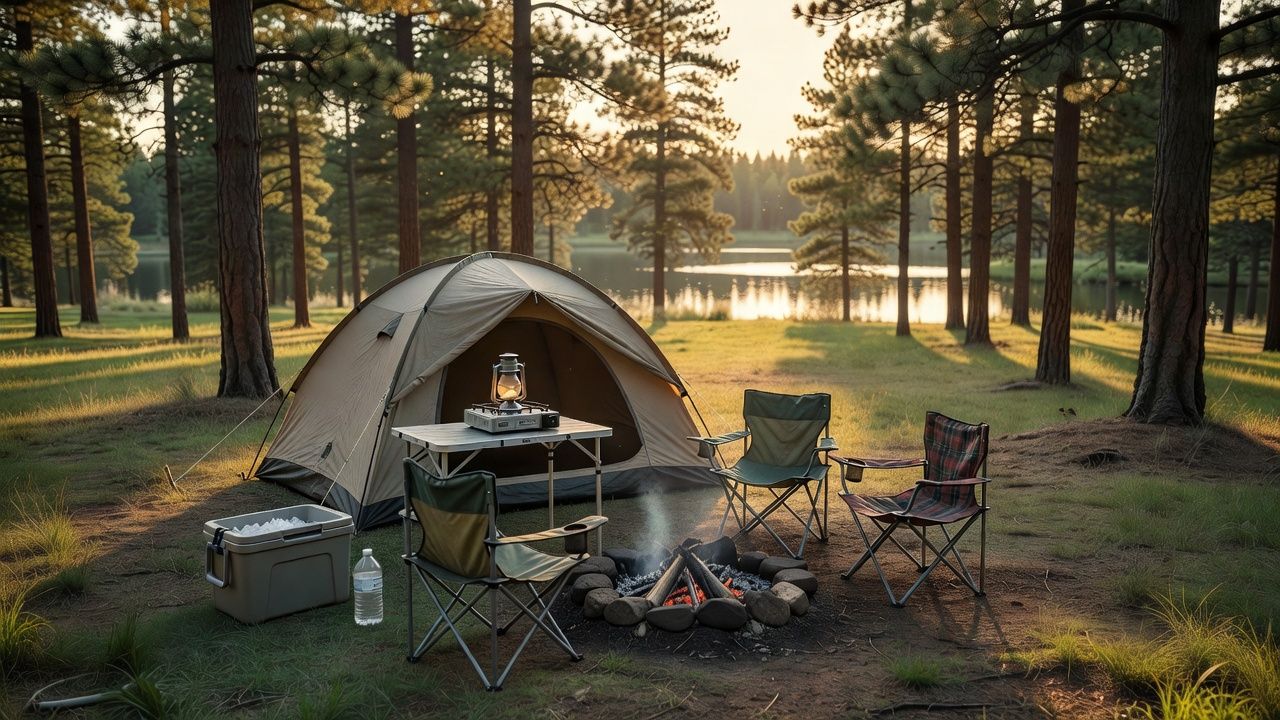
Shelter and sleep
- CORE 6 Person Instant Cabin Tent ($169.99, 4.5★) — 60-second setup makes a difference when you arrive after dark, and the cabin shape gives a family of four real standing room. Add a tarp underneath if the site is packed dirt.
- Therm-a-Rest Z Lite Sol Sleeping Pad ($54.95, 4.7★) — closed-cell foam, so it can't puncture and doubles as a sit pad by the fire. Ideal for rocky or rooty tent pads.
- TETON Sports Celsius Regular 0° Sleeping Bag ($59.99, 4.5★) — a 0°F bag is overkill in July and exactly right for late-fall state park trips.
- Coleman Trailhead II Folding Cot ($54.99, 4.4★) — if you're over sleeping on the ground, this is the cheapest route to a real mattress-height bed in a tent.
Sizing question? The camping tent size guide maps real dimensions to family size so you don't end up with a tent that's technically 6-person and practically 3-person.
Kitchen and water
- Coleman Classic 1-Burner Butane Stove ($29.99, 4.5★) — the simplest possible hot-meal machine. Butane canisters are cheap and the burner lights instantly.
- Stanley Wildfare Core 26-Piece Cook Set ($89.99, 4.7★) — nests into one bundle, which matters when you're hauling gear from a parking lot to a walk-in site.
- Coleman 70-Quart Xtreme 5-Day Cooler ($79.99, 4.6★) — five days of ice retention means you don't buy ice twice on a long weekend.
- Sawyer Squeeze Water Filtration System ($45.95, 4.7★) — many state parks have potable spigots, but a squeeze filter is cheap insurance if yours is a hand-pump or a dry loop.
- Nalgene 32 oz Wide Mouth Bottle ($16.99, 4.8★) — indestructible, and it's the bottle that survives a decade of campgrounds.
Comfort and camp furniture
- Coleman Pack-Away 4-in-1 Folding Table ($99.99, 4.6★) — many primitive loops have no picnic table at all. This one adjusts height and folds into a briefcase.
- Coleman Portable Camping Chair with 4-Can Cooler ($39.99, 4.6★) — cushioning plus a built-in cooler pocket, which is more useful than it sounds on a hot afternoon.
- OneTigris Bulwark All-Season Tarp ($56.98, 4.7★) — the single best upgrade for a primitive site: shade in July, rain shelter in September, and it needs only two trees or two poles.
Light, power, and fire
- Black Diamond Moji Lantern ($24.95, 4.4★) — dimmable, so it lights a picnic table without blinding the whole loop.
- Black Diamond Spot 400 Headlamp ($39.95, 4.5★) — hands-free light for the late-night bathroom run and the dark-arrival tent pitch.
- Jackery Explorer 300 Power Station ($199.00, 4.7★) — only worth bringing if your site has no electric, or if you're running a CPAP or camera batteries.
- Twinkle Star 100 LED String Lights ($19.99, 4.5★) — the fastest way to make a state park site feel like home, and genuinely useful light after sunset.
- UCO Stormproof Match Kit ($12.99, 4.7★) — windproof matches in a floating waterproof case, because a wet fire-lighting session ends the evening early.
Safety
- Adventure Medical Kits Ultralight/Watertight .7 ($44.95, 4.7★) — a 3-person kit that's actually small enough to live in the car. Pair it with the checklist in our camping first aid guide.
State Park Camping With Kids, Dogs, and Grandparents
State parks are the most family-friendly camping tier in the country — paved loops for bikes, real bathrooms, and playgrounds at many parks — and they're also the easiest place to bring a dog or a grandparent.
- Kids: book a site near the playground or the swim area, bring bikes, and check whether the park runs junior-ranger or nature programs. The backyard camping setup guide is a good dry run before the real thing.
- Dogs: allowed in most campgrounds, restricted on beaches and swim areas. A 6-foot leash is the standard rule, and leaving a dog alone at the site is what gets people cited.
- Grandparents and older campers: request a site with a level pad and electric hookup, and consider a cot or an air bed instead of the ground. Our camping for seniors guide covers the adjustments that matter.
- Trailers and RVs: state park pads are often shorter and the loop roads tighter than a private resort. Measure before you book — the RV camping setup guide covers what to check.
Common State Park Camping Mistakes (Learn From Ours)
- Booking the park, not the site. Two sites in the same loop can be completely different trips. Look at the map.
- Forgetting the reservation fee and entry fee. The nightly rate isn't the total; budget $10–$20 extra per trip.
- Assuming there's a picnic table. Plenty of primitive loops have none. Bring the folding table.
- Arriving Saturday afternoon. Prime weekend arrival is the worst possible timing. Friday evening or Sunday mid-morning are the good windows.
- Packing for hookups when you booked primitive. No pedestal means no electric kettle, no space heater, no electric cooler.
- Buying firewood at the last gas station before the park. Often it's the most expensive and the least dry. Buy local bundles at the camp store.
- Ignoring the quiet-hours rule. Rangers enforce it, and one loud group can sour a whole loop.
One system worth studying as a contrast: North Carolina books through ReserveAmerica rather than Recreation.gov, and our North Carolina camping guide breaks down its six-month window, its fee structure and the 2026 closing dates.
State Park Camping FAQ
How much does it cost to camp in a state park?
Most state park tent sites run about $15–$35 per night, electric sites $25–$45, and full hookup sites $35–$75. Add a $5–$9 reservation fee per booking, sometimes a daily park entry or vehicle fee (up to about $12), plus firewood at $6–$12 a bundle. A typical family tent weekend lands somewhere between $50 and $120 all-in.
Do you need a reservation to camp in a state park?
In most states, reservations are strongly recommended and effectively required on weekends and holidays — booking windows typically open six months in advance. That said, nearly every state park system holds back some first-come, first-served sites, and walk-in availability is genuinely good Sunday through Wednesday and throughout the shoulder season.
What time is check-in and check-out at a state park campground?
Check-out is usually between 11 a.m. and 1 p.m., and check-in between 1 p.m. and 3 p.m. — though many parks let you arrive late with a self-registration envelope. The practical rule: don't show up at noon on a Saturday expecting your site to be empty yet.
Can you camp for free in a state park?
Rarely inside a state park campground. Some states allow free primitive camping in designated backcountry zones or wildlife management areas with a permit, but developed campsites almost always carry a nightly fee. Free dispersed camping generally happens on national forest and BLM land instead of in state parks.
Are dogs allowed at state park campgrounds?
Usually yes, in the campground, on a leash of 6 feet or less, with a maximum of one or two dogs per site. Most parks prohibit dogs on swimming beaches, in swim areas, and on some trails, and virtually all prohibit leaving pets unattended. Check the specific park's pet policy before you book — it varies more than you'd expect.
New York is the sharpest example of that split: the DEC runs the Adirondack and Catskill campgrounds while New York State Parks books on a completely different site. Our Camping in New York guide walks through all four systems, including the Brooklyn campground on Recreation.gov.
Virginia is a useful case study because its state parks run their own portal — reservevaparks.com — with an 11-month window instead of Recreation.gov; the camping in Virginia guide explains how that changes when you have to book.
For a worked example of how one state's system behaves end to end, the Tennessee camping guide walks through 56 state parks on their own reservation portal alongside the Smokies and the national forest.
Florida's state park system runs on its own rules — residents book 11 months out, non-residents 10, with new inventory released daily at 8 a.m. Eastern. Our Camping in Florida guide walks through the whole system and the parks worth setting an alarm for.
Reservation windows are what separate one state park system from the next, and Arizona's runs a full 365 days out — our Camping in Arizona guide walks through how it works. Texas is the outlier on booking windows at roughly five months, opening at 8 a.m. Central; the Texas camping guide covers it.
New Mexico is a good test case for all of the above — see Camping in New Mexico 2026 for its six-month state park window, the 14-day BLM dispersed limit, the day-of-only backcountry permit at Carlsbad, and the state trust land exception.
Alabama is one of the clearest examples of a resident-first booking window, at 13 months against 12 for everyone else — see Camping in Alabama.
For a worked example of how a state system can invert every rule you know, Camping in Louisiana covers the 30-day dispersed limit and the no-campground national parks.
One planning trap catches almost everyone: the park's season and the campground's season are not the same thing, and closing dates vary by elevation and by which agency manages the land. We break down what closes when — and how to check your own campground in two minutes — in when do campgrounds close for the season.
For a state-level worked example of how BLM, Park Service, state park, and national forest systems layer on top of each other in one trip, see the Camping in Utah guide.
One state to study as a case: Pennsylvania runs 125 state parks with no entrance fee at any of them — camping in Pennsylvania shows how that system interacts with a separate state forest permit regime.
Camping in California is the state-level companion to this guide: the ReserveCalifornia six-month window, the $8.25 per-transaction fees, and the refund schedule that catches people out — camping in California.
Wrapping Up
For the mechanics that apply everywhere, camping in Wisconsin covers how one state's single reservation system, fee ladder and ground-condition fire rule actually work in practice.
One system worth comparing against this one: our West Virginia camping guide, where the state park rules are identical at every park but the national park campgrounds are free and first-come.
For the system-vs-system version of this question in the Southeast, camping in Georgia walks through five separate booking systems in one state — state parks, Cumberland Island, Corps lakes, the national forest, and the WMAs that are not a camping system at all.
State park camping rewards preparation more than any other kind of camping, because the friction isn't the outdoors — it's the system. Learn your state's booking window, understand what your site type actually gives you, pack for the hookup you booked rather than the one you imagined, and you'll get a cheap, quiet, close-to-home weekend that beats a lot of far more famous destinations.
Start with one state park this fall. Book mid-week, take the primitive loop if you're feeling brave, and bring the tarp. Going solo? Our solo camping guide for beginners covers solo site selection, the check-in habit that actually keeps you safe, and what to do when you're the only person on the loop.
If you want to see how much the rules vary once you leave the generic playbook, our Vermont camping guide is a worked example: an 11-month booking window, a season that ends the second Monday in October, a per-pet nightly fee, and a firewood law that makes out-of-state wood illegal to bring in. New Hampshire is the other worked example worth reading, because it runs two systems at once — our New Hampshire camping guide covers the state park side plus the White Mountain National Forest side, which books on a different site with a 4-day minimum and keeps two campgrounds open year-round.
Michigan is worth reading next as a second worked example, and a very different one: 103 state parks and recreation areas holding about 14,100 campsites, a reservation window that opens six months to the exact day, and a free dispersed-camping rule on nearly four million acres of state forest land that almost nobody uses. Our Michigan camping guide walks through all four of the systems the state runs, including the ones that take no reservation at all.
One state where all four public-land camping systems behave completely differently is Oregon; the Camping in Oregon guide walks the state park portal, the state forests, the national forests and BLM separately.
Ohio is a good example of why state-park systems differ: its six-month window, its $6.50 reservation fee and its first-come state forests are all its own. The camping in Ohio guide breaks down what's bookable when.
<!-- AFFILIATE_DISCLOSURE -->As an Amazon Associate, TrailMapz earns from qualifying purchases. Prices and ratings are accurate as of publication and may change.
Working out whether a specific weekend is free to enter? Public Lands Day and the 2026 fee-free calendar answers the weekend-by-weekend version of that question, including the new residency rule.
Our camping in Washington state guide documents the three booking systems, the state's own winter-schedule table of per-park closing dates, and the burn-ban levels that decide whether you can have a fire.