Camping in Texas 2026: State Parks, Big Bend & Where to Camp in Winter
Where to camp in Texas in 2026 — the five-month state park booking window, Big Bend's winter-only Cottonwood campground, free dispersed camping in the East Texas forests, Padre Island's no-reservations beach rule, the Winter Texan RV coast, and gear for 25°F desert nights.
Texas is the biggest camping state that nobody plans for correctly, because the season runs backwards. Everywhere else in the country, summer is the season and winter is the shutdown. Texas is the opposite. From roughly October through April the state is at its best — 70s on the Gulf Coast, 60s in the Hill Country, and 50s-to-70s in Big Bend, which is the reason that park's busy season is officially January to April. Then June arrives, the humidity and the 100°F afternoons arrive with it, and the state's campgrounds empty out.
That single fact reorganizes every part of planning a Texas trip. The reservation windows are shorter than almost anywhere else, the free-camping answer is not what it is out west, one of Big Bend's campgrounds only exists in winter, and the beach camping rules are the exact opposite of every other park you'll book this year.
This guide walks through all of it: the five separate systems that run camping in Texas, the state park campgrounds worth setting an alarm for, month-by-month timing from October through March, the specific rules that catch people out at Big Bend and Guadalupe Mountains, free dispersed camping in the East Texas forests, the Gulf Coast and the Winter Texan RV economy, dog and kid rules, and the gear that decides whether a 38°F night is pleasant or miserable.
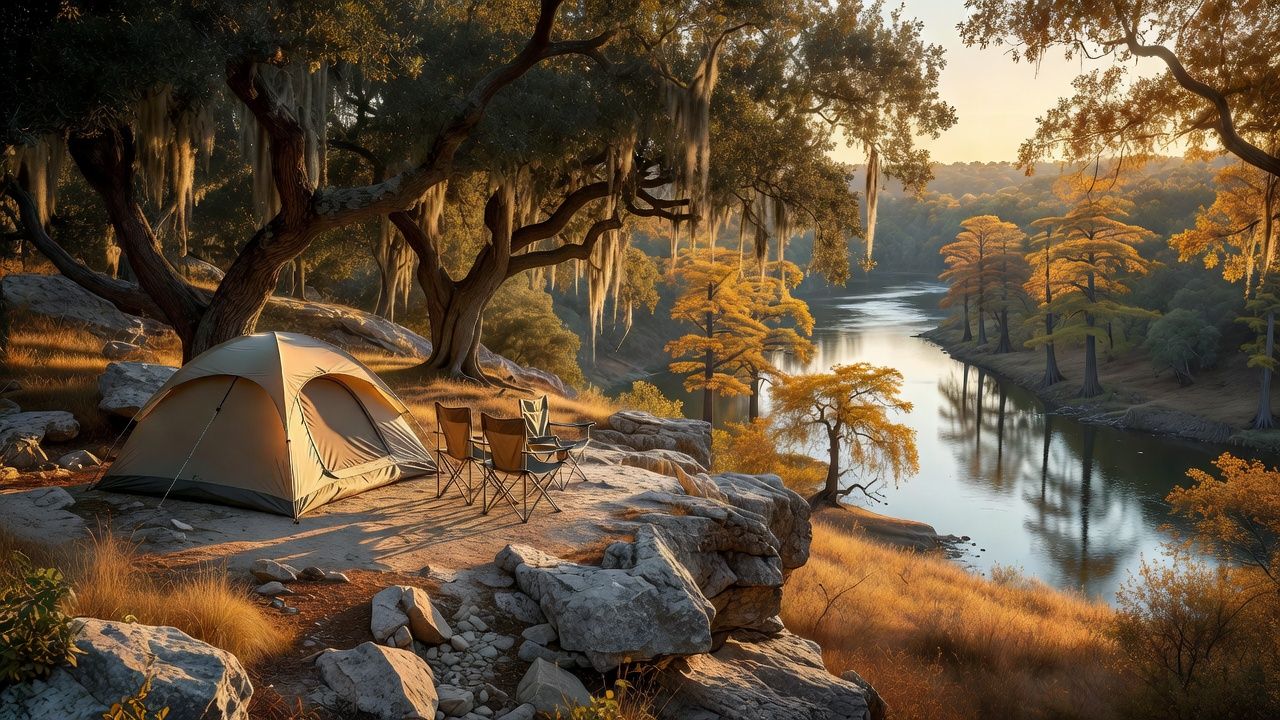
Quick Answer: Where to Camp in Texas in Winter
- Best overall pick for a first Texas trip: Lost Maples State Natural Area in the Hill Country for fall color (mid-October into November), and Big Bend National Park from December onward. Those two cover the two halves of a Texas camping season.
- Best for a family with kids: Garner State Park on the Frio River, or Caprock Canyons State Park in the Panhandle if you want the bison herd and the wide-open version. Both reward booking early.
- Best winter weather: the lower Gulf Coast — Padre Island, Mustang Island, Galveston Island, Sea Rim — where a January afternoon can be 70°F, plus the Rio Grande Valley if you want the full Winter Texan experience.
- Best free camping: the East Texas national forests — Sam Houston, Davy Crockett, Angelina, and Sabine — plus the Caddo and LBJ National Grasslands. Dispersed camping is generally free and legal there. There is essentially no BLM land in Texas, so "free camping" here means pine forest, not desert.
- Best national park: Big Bend in winter. It is a genuinely different park in January than in July, and the January-to-April night cap is real.
- What to skip from November to March: the Panhandle and North Texas high plains (Palo Duro Canyon and Caprock Canyons get genuine blue-norther freezes and ice), and any plan that assumes a Texas winter is always warm.
What Changed for the 2025–26 Season
Four things are different this year, and each one changes a trip plan.
Big Bend backcountry permits are in-person only right now. After a run of heavy rain and the road closures that came with it, the park says all backcountry campsites can only be obtained in person at the Panther Junction Visitor Center until further notice. Sites that would normally show up on Recreation.gov — Chisos backpacking sites, primitive roadside sites, and the remote Maverick Road, River Road, and Old Ore Road sites — are not reliably bookable online this season. If backcountry camping is the point of your trip, plan around a first-morning stop at Panther Junction rather than a website.
Cottonwood Campground is a winter-only campground. Big Bend's smallest and shadiest campground, on the west side of the park near Santa Elena Canyon, is listed as closed for the summer — which means it is a seasonal facility, and the season it opens for is the one you are planning. In practice: Cottonwood is on the table for a winter trip and off the table for a July one.
Guadalupe Mountains moved both of its campgrounds onto a six-month window. Pine Springs and Dog Canyon are reservable up to six months in advance through Recreation.gov, and both are open year-round. That is a longer lead time than Texas State Parks gives you — which is odd, satisfying, and useful.
Nothing has changed about the state park window, and that is the problem. Texas State Parks still run a rolling window of roughly five months, with new dates opening daily at 8 a.m. Central. Compare that to Virginia's 11 months or Florida's 10 for non-residents. Texas has one of the shortest booking windows of any large state park system in the country, which is exactly why Garner fills the moment it opens and why "I'll book it in a couple of weeks" does not work here.
Why Texas Camping Season Runs Backwards
Texas is enormous and it has two separate reasons for hating summer.
The humid half — the Gulf Coast, East Texas, and the eastern Hill Country — gets 90s with dew points to match from June into September. Camping there in July is not dangerous so much as miserable: everything is damp, the mosquitoes are at their worst, and the shade is doing very little. Winter, by contrast, is the payoff. The same coastline that is oppressive in August is mild and bright in January.
The dry half — Big Bend and the Trans-Pecos — has the opposite problem at the same time of year. Summer afternoons there run well past 100°F in the low desert, which is genuinely hazardous, and the park's own advice for summer is to be off the trails by mid-morning. Winter drops that into the 60s and 70s during the day. Which is why Big Bend's official busy season — the stretch where the park limits how long you can stay — starts January 1.
Then there is elevation, which is the part people miss. Guadalupe Peak is the highest point in Texas at 8,751 feet, and the Guadalupe Mountains campgrounds sit at roughly 5,800 feet. That is a completely different winter from Padre Island at sea level. A single Texas trip that runs from the Gulf Coast to the Guadalupes crosses a temperature band as wide as the one between Virginia and Maine.
The practical translation: Texas winter camping is a warm weather with cold nights problem, not a snow-camping problem — unless you are going to the Panhandle or the Guadalupes, in which case it becomes a real cold-weather trip. The gear section below treats both cases separately.
How Texas Camping Actually Works: Five Separate Systems
Nothing wastes more time on a Texas trip than assuming one website covers the state. It does not. Five systems run in parallel, and they have different rules, different windows, and different booking portals.
1. Texas State Parks (TPWD) — the five-month window
This is where most Texas trips actually happen, and the mechanics of booking a state park site are the same across the country's park systems in outline but not in detail. Texas Parks & Wildlife runs the state park system on its own reservation portal (the general state park playbook is here), and the rules are:
- Overnight camping and lodging reservations open up to five months in advance, on a rolling window that advances daily.
- New dates come online at 8 a.m. Central Time each morning. Set your alarm to the correct time zone; if you are booking from the East Coast, that is 9 a.m. your time, and from the Pacific it is 6 a.m.
- Day-use entrance permits can be reserved up to one month ahead, and the department specifically recommends it for weekends and holidays at busy parks. At the most popular parks, a day pass is effectively a reservation to get through the gate at all.
- The Texas State Parks Pass costs $70 for a year and covers entrance fees for you and your guests in the same noncommercial vehicle at 80-plus parks. The pass holder has to be present with valid ID. Camping and activity fees are still charged on top. A second pass for someone at the same address is $25. If you camp even a few nights a year across multiple parks, it pays for itself in entrance fees alone.
- Entrance fees are typically charged per person age 13 and up, with kids 12 and under free — but they vary by park, so do not assume a number.
Why the short window matters: a five-month rolling window means the good weekends for a Park like Garner or Lost Maples get taken the day they appear. The fix is not complicated. Pick your trip date, work out exactly which morning is five months before it, and be on the site at 8 a.m. Central.
2. National Park Service — Recreation.gov, and one enormous exception
Texas has two big camping national parks plus a national seashore, and they do not work the same way as each other.
Big Bend and Guadalupe Mountains are reservation-based on Recreation.gov (the national park camping guide covers how that system differs from state parks). Big Bend's Chisos Basin and Rio Grande Village campgrounds both require reservations. Guadalupe Mountains' Pine Springs and Dog Canyon campgrounds are reservable six months out.
Padre Island National Seashore is the exception, and it is a big one: all camping there is first-come, first-served, and no reservations are accepted at all. That is covered in its own section below, because it changes how you plan the trip.
3. National forests and grasslands (USFS) — where free camping actually lives
This is the system most people skip straight past, and in Texas it is the free-camping answer. The National Forests and Grasslands in Texas cover the Angelina, Davy Crockett, Sabine, and Sam Houston national forests plus the Caddo and LBJ national grasslands, and dispersed camping is generally allowed and free across them.
Three caveats, all of which matter:
- Each ranger district has its own Motor Vehicle Use Map (MVUM) showing which roads you may drive and where dispersed camping is permitted. The map, not your intuition, is the rule.
- Sam Houston National Forest restricts camping to designated areas during hunting season. Outside hunting season it is generally open; during it, you camp where you are told.
- Burn bans are common during dry stretches. Fire rules vary season to season, so check current restrictions before you plan a campfire. In Texas, burn bans are typically decided county by county.
4. The Winter Texan RV economy — private, monthly, and enormous
Texas has a whole layer of camping that is not really camping in the tent sense: the private RV resort, built around winter residents who stay for months rather than nights. The Rio Grande Valley — Brownsville, Harlingen, McAllen, Mission — is the classic destination, with monthly rates, full hookups, laundry, pools, and organized social calendars. The Gulf Coast and the Hill Country have their own versions.
If your Texas winter trip is an RV trip measured in weeks rather than a tent trip measured in nights, this is the system you book, and it sits outside every public reservation portal. Book it early too: warm-winter demand is exactly the demand that fills up.
5. County and city parks — the underrated fifth option
Texas counties and cities run a surprising amount of campground inventory, from lakeside parks to fairgrounds, and most of them are not on the state portal. They are worth knowing about specifically because they are the release valve when the state park you wanted is full — which, given the five-month window, is a situation you should plan for rather than discover.
Texas State Park Campgrounds Worth Booking
Here is the shortlist, organized by what kind of trip each one is actually good for.
Hill Country — the fall-color and river-trip parks
Garner State Park is the most beloved campground in the Texas state park system, sitting on a clear stretch of the Frio River with cypress trees, limestone bluffs, and swimming that is the whole point in warm weather. It fills months out. Book it the morning its window opens or accept a weekday.
Lost Maples State Natural Area, near Vanderpool, is the state's fall-color destination — the one place in Texas where people plan a trip around leaves rather than water. The color window runs roughly mid-October into November, which is precisely the window this page exists for. It is a small park with limited camping, so this is the single hardest reservation on the list.
Pedernales Falls State Park covers 5,212 acres of limestone canyon and river about 30 miles west of Austin, with camping and genuine dark skies for a park that close to a major city. It is the easiest of the Hill Country picks to combine with a city weekend.
Enchanted Rock State Natural Area is the granite dome everyone photographs, with a primitive campground and a separate group primitive camping area. "Primitive" here is real: you are carrying in what you need.
Colorado Bend State Park and Guadalupe River State Park round out the region, and both are quieter alternatives when Garner and Pedernales are full.
Panhandle and North Texas — the cold-weather parks
Caprock Canyons State Park is home to the official Texas State Bison Herd, which is the reason to go, and red-rock canyon country that looks nothing like the postcard version of Texas.
Palo Duro Canyon State Park holds the canyon commonly described as the second-largest in the United States, and it offers both campsites and cabins. It is spectacular — and it is also the park on this list most likely to hand you a genuine freeze and wind in the winter months.
Dinosaur Valley State Park near Glen Rose has dinosaur tracks in the Paluxy River bed, which is a considerably better kid hook than any interpretive sign ever written.
West Texas — the mountain parks
West Texas is the Texas end of the same desert-corridor story that the Arizona winter camping guide tells from the other direction, and the desert camping guide covers the shared kit.
Davis Mountains State Park near Fort Davis sits in the high country of the Trans-Pecos, with the historic Indian Lodge and some of the darkest night skies in the state. It pairs naturally with a Big Bend trip.
Balmorhea State Park is built around a giant spring-fed swimming pool in the desert — one of the largest in the world — which is a strange and wonderful thing to find at the end of a long West Texas drive.
Gulf Coast — the warm-weather parks
Mustang Island State Park, Galveston Island State Park, and Sea Rim State Park are the state-park answer to coastal camping. They are the ones to look at if you want a Gulf trip with showers, electricity, and a ranger station rather than a permit kiosk on a beach.
Brazos Bend State Park near Houston is the alligator park, and it is the best wildlife-viewing campground within an hour of a major Texas city. Huntsville State Park fills a similar role north of Houston.
Camping in Texas in October and November
This is the best shoulder window in the state, and the reason this page exists now.
October is when the Hill Country and East Texas finally become pleasant. Daytime highs settle into the 80s and then the 70s, the humidity drops, and the parks that were empty in August fill up again. Nights are comfortable — 50s and 60s — which means a three-season bag and an insulated pad are plenty. This is a great month for Garner, Pedernales, Colorado Bend, and the East Texas national forests, where the pines finally stop feeling like a sauna.
If you are timing a Trip around leaves specifically rather than around camping, the fall foliage guide and the October camping guide both cover the national picture.
November is when the state's signature fall trip happens. Lost Maples is the marquee, with color usually peaking somewhere in the first three weeks of the month depending on how cold the nights have been. Big Bend becomes genuinely comfortable during the day in November, which is the month to go if you want the park without the January crowds. And Thanksgiving is a real camping weekend in Texas — one of the busiest of the year at state parks, so it is a book-early weekend, not a decide-later one.
What to watch: November is also when the first real cold fronts arrive. A Texas "blue norther" can drop daytime temperatures 30 degrees in a day, and the northern half of the state can get its first freeze. This is the month where the fleece and the rain shell stop being optional.
Camping in Texas in December and January
December is when the Gulf Coast becomes the answer, and it is also the month the national December camping guide is written for. Padre Island, Mustang Island, and Galveston Island are mild in a way that surprises people who think of Texas as one climate — daytime in the 60s is normal, and 70s are not unusual. December is also a genuinely good Big Bend month: cold at night, superb during the day, and much quieter than the January-to-April peak.
January is the start of Big Bend's official busy season, which is the month the park's January 1 to April 15 night limit begins — covered in its own section below. It is also the heart of the Winter Texan season, when the Rio Grande Valley fills with long-stay RVers and monthly rates tighten up.
What to watch in both months: the freeze line. The Panhandle and North Texas can go well below freezing, the Hill Country gets occasional ice, and the Gulf Coast almost never does. Practically, this is the decision point for your sleeping bag: a 40°F bag is right for a coastal January, a 20°F bag is right for Big Bend in December, and if you are camping the Guadalupes or the Panhandle you want to be seriously colder-rated than you think.
Camping in Texas in February and March
February is peak Winter Texan season and one of the best months for the coast. It is also a good month for Big Bend — the days are warming up and the nights are still cold enough to matter.
March is the month Texas stops being a winter state and becomes a spring one. The wildflower season starts, the state parks fill for spring break, and day-use permits at popular parks become something you actually need. March is also the beginning of the end of the comfortable window: by late March, South Texas afternoons are pushing into the 80s, and by April the Gulf Coast humidity is starting to return.
If you can only pick one window: November for the Hill Country and Lost Maples, or February for the coast and Big Bend. October and March are the crowded shoulder months; December and January are the quiet ones.
Texas camping by region at a glance
| Region | Best months | System to book | The catch |
|---|---|---|---|
| Hill Country | Oct–Nov, Mar–Apr | Texas State Parks (5-month window, 8 a.m. CT) | Garner and Lost Maples fill the day their window opens |
| Big Bend / Trans-Pecos | Nov–Apr | Recreation.gov for campgrounds; in-person for backcountry | Jan 1–Apr 15 total stay cap; no ground fires anywhere |
| Guadalupe Mountains | Apr–May, Sep–Oct (cold in winter) | Recreation.gov, 6-month window | 5,800 ft; no hookups; potable water for bottles only |
| Gulf Coast | Nov–Mar | Padre Island: first-come, no reservations | No hookups at Padre Island; very limited cell service |
| East Texas forests | Oct–Nov, Mar–May | USFS dispersed camping (free) | Hunting-season restrictions; MVUM decides where |
| Panhandle | Apr–May, Sep–Oct | Texas State Parks | Genuine freezes and wind Nov–Mar |
Big Bend: The Winter Park That Sets Its Own Rules
If you are planning a Texas winter camping trip, Big Bend is probably the reason, and it is the park where the rules are least like anywhere else.
There is no dispersed camping in the park
Big Bend does not allow dispersed camping or "boondocking" anywhere inside its boundaries. Every camper has to be in a designated site with a permit. This is a park that is surrounded by country where you can camp for free on forest and BLM land, and inside the park that stops being true — so plan your free-camping nights for outside the boundary, not for a pullout inside it.
Campgrounds: two full-time, one winter-only, one RV park
Big Bend has four campgrounds, and they are not interchangeable.
- Chisos Basin Campground — in the mountains in the center of the park. Reservations required.
- Rio Grande Village Campground — on the east side near the river. Reservations required.
- Cottonwood Campground — on the west side near Santa Elena Canyon. Listed as closed for the summer, making it the seasonal, winter-only option and the shady one people ask about.
- Rio Grande Village RV Park — operated by the park concessioner Aramark, 25 sites with full hookups, maximum vehicle length 38 feet. Reservations by phone at 855-765-1324, not through Recreation.gov.
For questions about the developed campgrounds, the park's visitor information line is 432-477-1121.
No wood fires. Really.
Wood fires and ground fires are not allowed anywhere in Big Bend National Park. That includes the campgrounds, and it is a year-round rule, not a fire-restriction order. What is allowed:
- A charcoal fire in an above-ground grill. Ashes must be packed out.
- Liquid-fuel stoves. These are allowed and are the practical answer.
If your camp-cooking plan depends on a campfire, this is the park where that plan dies — the firewood and fire-building guide is useful everywhere in Texas except here. A two-burner stove or a portable propane grill is the correct substitute, and the firewood guide on this site does not apply here at all.
The stay limit, and the January-to-April exception
The standard rule is 14 consecutive nights in a front-country or backcountry site, with a maximum of 28 total nights in the park per calendar year, and campers can occupy a specific site up to 14 total nights in a year.
Then there is the exception: during the busy season from January 1 to April 15, visitors are limited to a total of 14 nights in the park. Not 14 consecutive — 14 total. If you are planning extended backcountry time, this is the rule that decides your dates.
Backcountry: permits, and right now, an in-person line
A backcountry permit is required for all backcountry camping and river trips, and there are two things to know this season:
- Permits for most designated backcountry campsites — Chisos backpacking sites and primitive roadside sites — are normally booked online through Recreation.gov, but until further notice they can only be obtained in person at the Panther Junction Visitor Center because of rain damage and road closures.
- Desert backpacking sites and the primitive roadside sites along Maverick Road, the remote River Road, and Old Ore Road are in-person only at Panther Junction as well.
Group size: an organized group or party may not exceed 15 people. In the Chisos Mountains there is currently only one backpacking campsite that fits a group of 15, and the total number of people allowed in the High Chisos at once is capped at 15 — so large groups split into separate campsites or separate zones, not one big cluster.
The Gulf Coast and the Rio Grande Valley
The Texas coast is the half of the state's winter that gets overlooked, and it has the single most unusual camping rule in the state.
Padre Island National Seashore: no reservations, ever
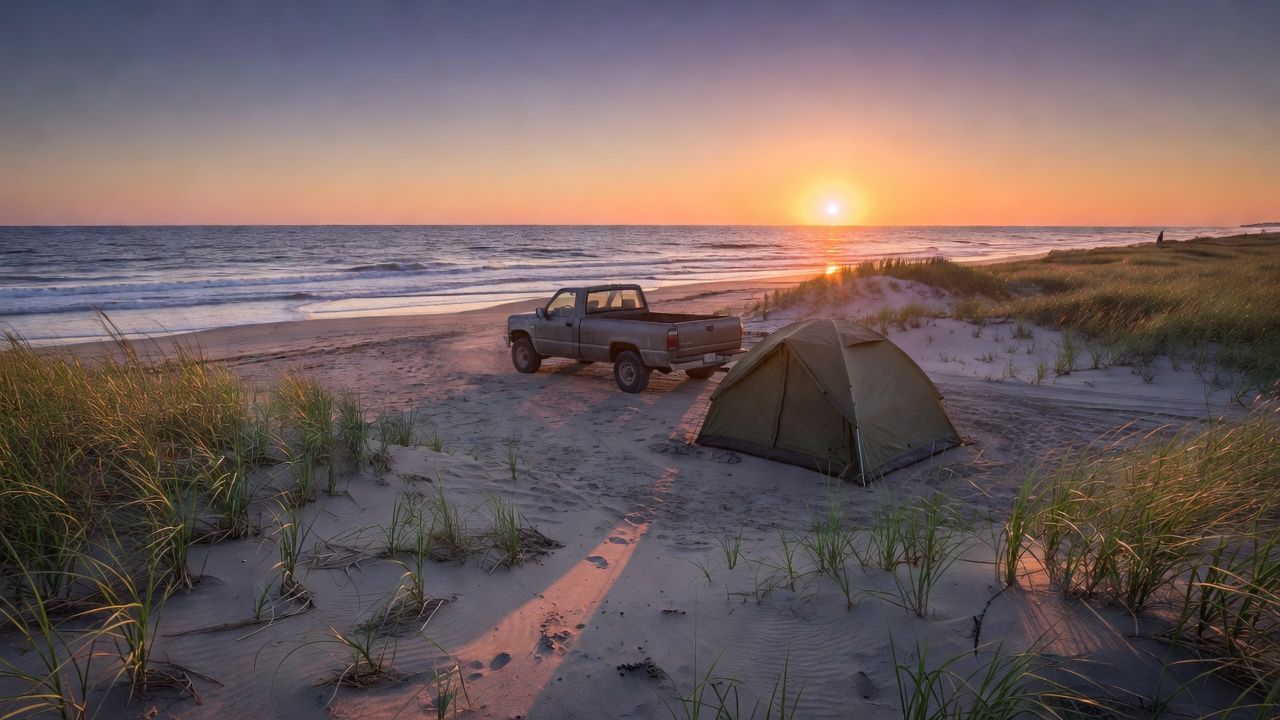
Padre Island National Seashore is the longest undeveloped stretch of barrier island in the world, and its camping rules are the mirror image of every other park on this page:
- All camping in the park is first come, first served. No reservations are accepted. Not on Recreation.gov, not by phone. You show up and you get what is open.
- Park entrance fees are required, and a seven-day or annual pass is required for overnight stays.
- Self-issued camping permits are required at Malaquite Campground and Bird Island Basin — you fill out the permit and pay at the self-registration kiosk at the campground entrance.
- On North Beach, South Beach, and Yarborough Pass, no permit is required at all — though entrance fees still apply. Camping is not permitted on Malaquite Beach.
- There are no electric or water hookups anywhere in the park. An RV dump station and freshwater filling station sit next to the Malaquite Campground entrance and are available to all park visitors.
- There is no firewood, gas, or anything else for sale in the park — those services are 13 miles north of the entrance, so arrive supplied.
- Cellular service is very limited. The park's advice is to tell someone at home when you are going in and when you expect to be out.
Beach driving is the other variable: soft sand, tides, and vehicle capability decide which stretches you can actually reach, and they differ a lot between the north and south ends. Check conditions before you commit a two-wheel-drive vehicle to anything.
The Florida Gulf Coast runs a near-identical winter season on the other side of the Gulf, so the Florida camping guide is the natural companion read — and the beach camping gear checklist covers the sand-specific kit.
The state park alternatives: if first-come camping on sand sounds like a liability rather than an adventure, Mustang Island State Park, Galveston Island State Park, and Sea Rim State Park give you the same coastline with a ranger station, a reservation system, and a shower.
The Rio Grande Valley: the Winter Texan coast-to-border corridor
The Rio Grande Valley — Brownsville, Harlingen, McAllen, Mission — is the other half of the Gulf story and the reason Texas has a "winter season" at all in the camping sense. It is a long-stay destination: private RV resorts with monthly rates, full hookups, laundry, pools, and activities, and a public-land layer on the coast to the east.
Two things make it worth planning rather than improvising:
- It books by the month, not the night. Rates and availability tighten for January and February specifically, because that is when the long-stay population peaks.
- It is one of the country's great birding corridors. If you are bringing binoculars anywhere in Texas, it is here — and it is also a good reason to keep a pair in the truck for the whole trip, because the coast, the Hill Country, and the Trans-Pecos all deliver different birds.
Free Camping in Texas: East Texas Forests, Not BLM
This is the single biggest structural difference between Texas and the western states on this site.
There is essentially no BLM land in Texas. Colorado, Arizona, and Utah trips all have a free-camping answer that routes through BLM and its 14-day rule. Texas does not. What Texas has instead is the National Forests and Grasslands in Texas — Angelina, Davy Crockett, Sabine, and Sam Houston national forests, plus the Caddo and LBJ national grasslands — where dispersed camping is generally allowed at no charge.
Three rules govern whether you can actually camp where you are looking:
- The Motor Vehicle Use Map. Each ranger district publishes its own MVUM showing the roads where motorized use — and therefore dispersed camping — is allowed. Where you may camp is defined by that map, and it differs district by district.
- Hunting season changes the rules in Sam Houston National Forest. Outside hunting season, camping is generally permitted broadly; during hunting season you camp in designated areas. If you are planning an East Texas trip between roughly late fall and early winter, this is the check that matters. If you are on foot or in camp during hunting season at all, wear visible orange.
- Burn bans. Dry stretches are common across Texas, and burn bans are typically county-level decisions. Check the county before you count on a fire — and remember that a ban applies regardless of what the forest rules say.
If you are camping off-grid in an RV rather than a tent, the boondocking guide covers the power and water planning that free sites require.
The other free-adjacent option is the shoulder-season state park primitive site, which is not free but is inexpensive, and the county and city parks described above, which are the most underrated inventory in the state.
Fire, Ants, Snakes, and the Rules Nobody Reads
Texas has a specific set of hazards that are boring to read about and genuinely relevant.
Fire. Big Bend prohibits wood and ground fires entirely, park-wide, year-round. Everywhere else, the governing rule is usually the county burn ban, not the park's preference — Texas counties impose bans during dry periods and they can appear and disappear within weeks. Check the county, not the app.
Water. Texas camping often means dry camping. Guadalupe Mountains' Pine Springs campground has potable water but explicitly for water bottles and hydration packs only — and no shower facilities at all. Discharging dishwater or gray water on the ground is prohibited there; use the utility sink. Many state park sites have water at the site, many do not. A five-gallon carrier is cheap insurance.
Ants, chiggers, and ticks. Fire ants are a real Texas camping problem — they build in disturbed ground and they hurt. Chiggers and ticks are the East Texas and southern-pasture problem. Closed shoes, long socks, a repellent that works on ticks, and a tick remover in the kit are the practical answer.
Snakes. Rattlesnakes are active on warm days in the winter too, particularly in West Texas. Shake out boots, keep your hands out of crevices, and give any snake you meet a wide berth rather than a photo session.
Heat, even in winter. Big Bend's low desert can run hot in the sun while the same day is cold in the shade and colder after dark. A 40-degree day-to-night swing is normal. Year-round sun protection is not a summer item in Texas.
Wildlife at camp. Guadalupe Mountains specifically warns about skunks and other small mammals roaming the campgrounds at night, attracted by food odors — keep campsites free of food scraps. Coastal sites have their own raccoon and gull problems. Store food accordingly.
Hunting season. Texas has a long, busy hunting calendar. If you are hiking or camping in forest country in the fall and winter, the relevant guide is the one on visibility, not the one on gear.
Camping in Texas With Kids and Dogs
Kids. Texas parks are unusually family-friendly in a practical way: junior-ranger style programs, ranger-led walks, and interpretive centers are standard at the larger state parks and at the national parks. The trip-defining picks for kids are Caprock Canyons (bison herd), Dinosaur Valley (real tracks in the river bed), and Padre Island (beach camping is a novelty in itself). For the hardware side, the checklist is the standard one: a kid-rated sleeping bag that is warmer than you think it needs to be, a headlamp they own, a pack they carry, and a wagon if you have a tight cluster of young kids and a long walk-in site.
Dogs. Rules differ by system, and this is the one to check before you pack the dog:
- Texas State Parks generally allow pets on a leash of six feet or less, with restrictions in some areas and some trails — check the individual park's rules before you commit.
- Guadalupe Mountains allows leashed pets in the campground and only on two specific paths: the trail between the campground and the Pine Springs Visitor Center, and the Pinery Trail. Pets are not allowed on the park's other trails. Pets may not be left unattended, and the nearest kennel service is at Carlsbad Caverns.
- Big Bend restricts pets to wherever they are allowed rather than permitting them on trails or in the backcountry — confirm the current policy before you plan a hike around your dog.
- Padre Island is the beach option, where leashed dogs are the norm on the sand; check current rules on where they are not allowed.
The Texas-specific dog gear is what matters on the coast and in the desert: paw protection for hot sand and shell, a raised cot or mat to get your dog off sand and off fire-ant ground, a collapsible bowl, and something reflective for hunting-season visibility. For the full version of that, the camping with dogs guide covers leashes, heat, and campground etiquette system by system.
Texas Winter Camping Gear: What Actually Belongs in the Truck
Texas winter camping is a two-problem trip — warm days, cold nights, plus wind — and the gear follows from that. This is the list I would actually load.
Shelter
- CORE 9 Person Instant Cabin Tent — $299.99. The big-family answer for a car-camping base camp; instant-cabin volume means you can stand up and dress, which matters when the overnight low surprises you.
- CAMPROS CP 8 Person Camping Tent — $159.98. Room divider and rainfly; the room divider is the actual feature that makes a long winter weekend workable with kids.
- Coleman Skydome 4-Person Camping Tent — $122.99. Pre-attached poles and built-in LED lighting; the tent I would take if arriving after dark.
- Coleman 6-Person Dark Room Dome Tent — $149.99. Dark-room fabric, which is worth real money on a Texas winter trip where sunrise is early and the tent gets bright.
- Night Cat 2-Person Backpacking Tent — $53.99. The cheap-and-light option for a Big Bend or Guadalupe Mountains backpacking night.
- NEMO Equipment Kunai 3-4 Season Backpacking Tent — $749.95. Only if you are genuinely winter camping in the Guadalupes or the Panhandle high plains; this is the one that holds up in wind.
- CROWN SHADES 10x10 Pop Up Canopy — $139.99. Shade is not a summer-only item in Texas — a 70°F winter afternoon in full sun still cooks you.
- Gorich Beach Tent Sun Shelter — $49.99. The coastal version: quick shade and wind protection for beach camping days.
- OneTigris Bulwark All-Season Camping Tarp — $56.98. Wind is the Texas problem in both halves of the state; a tarp gives you a windbreak that a rainfly does not.
- A family tent with a screen porch — the underrated Gulf Coast and East Texas pick, where mosquito pressure outlasts the heat and dinner inside mesh beats dinner in the truck.
Sleeping — the part that decides the trip
- TETON Sports Celsius XXL 0 Degree Sleeping Bag — $89.99. The Big Bend in December and Guadalupe Mountains bag. Bigger cut, serious rating.
- Kelty Cosmic Down 20 Degree Sleeping Bag — $169.00. Down, packable, and the right call for a Chisos Basin trip where you are carrying it.
- Coleman Palmetto 40 Degree Sleeping Bag — $44.99. The right rating for a Gulf Coast January night, where a 0°F bag is just sweat.
- Coleman Oak Point Big & Tall 30°F Sleeping Bag — $74.99. The middle of the Texas range — Hill Country November through March.
- Exped MegaMat 10 Sleeping Pad — $239.95. If comfort is the priority and you are car camping, this is the one people never regret.
- Sea to Summit Ether Light XT Insulated Sleeping Pad — $219.95. The packable insulated pad for backpacking trips where the ground is cold and you are counting grams.
- Gear Doctors Oxylus Insulated Self-Inflating Sleeping Pad — $49.99. The budget insulated answer — and in a Texas winter, insulated matters more than thick.
- Therm-a-Rest Z Lite Sol Sleeping Pad — $54.95. Indestructible closed-cell; good as a beach mat at Padre Island where sand and punctures are the enemy.
- Intex Comfort Plush Elevated Airbed (Queen) — $49.99. The family-car-camping move when a bed beats a pad.
- Coleman Trailhead II Folding Cot — $54.99. Off the ground, off the ants, and it fits in a tent.
- Rumpl Original Puffy Blanket — $139.00. The blanket that makes an evening outside last two hours longer.
- KingCamp Inflatable Camping Pillow — $23.99. Cheap, packs small, big improvement.
- Sea to Summit Aeros Premium Inflatable Pillow — $49.95. The upgrade if you want one pillow that lasts years.
Kids' sleeping
- Kelty Woobie 30 Degree Kids Sleeping Bag — $39.95. The standard kid bag for a mild coastal or Hill Country trip.
- TETON Sports Celsius Jr Kids Sleeping Bag (20°F) — $49.99. The right pick if you are heading to Big Bend or the Guadalupes with kids.
- Morrison Outdoors Big Mo 40 Kids Sleeping Bag (Ages 2-4) — $79.95. For the youngest campers, where the bag has to stay on all night to be worth anything.
- Coleman Kids Quad Chair — $37.45. A chair that is their size is what stops them sitting in yours.
Cold-night heating (and the safety piece that goes with it)
- Mr. Heater Little Buddy 3,800 BTU Propane Heater — $69.99. The standard small-tent cold-snap answer for a Texas front that drops 30 degrees overnight.
- Mr. Heater Buddy 4,000–9,000 BTU Heater — $74.00. More output for a bigger tent or a Panhandle trip.
- Mr. Heater Buddy Series 10-Foot Propane Hose — $17.99. Lets you run the heater off a larger cylinder instead of a one-pound bottle.
- Kidde Carbon Monoxide Detector — $23.97. Non-negotiable if a fuel-burning heater is inside your tent. "Indoor safe" is a rating, not an invitation to seal the tent — the tent heater safety guide walks through the ventilation rules properly.
- Sealy 12-Volt Heated Car Blanket — $31.99. Useful for the drive and for a cold tent as a layer, not a substitute for a bag.
- OCOOPA Rechargeable Hand Warmers — $39.99. Kids' pockets, morning coffee, camera battery warmth.
- HotHands Hand Warmers (40 Pairs) — $29.99. The cheap bulk option for a group.
Layers — no cotton, wind first
- Columbia Men's Steens Mountain 2.0 Fleece — $34.99. The mid-layer you will wear every evening in October and November.
- Outdoor Research Men's Helium Rain Jacket — $159.00. The coast and the Gulf both get rain, and a wind-blocking shell is the piece that makes 55°F and breezy tolerable.
- Smartwool Thermal Merino Reversible Beanie — $35.00. Texas winter camping is a hat problem more often than it is a jacket problem.
- Merino.tech Merino Wool Neck Gaiter — $19.99. Wind across a desert campsite at night is the real culprit.
- Darn Tough Men's Hiker Micro Crew Socks — $27.95. Merino, guaranteed for life, and the single easiest comfort upgrade for a long day.
Kitchen — wind, water, and one-burner-vs-two
- Camp Chef Explorer Two-Burner Stove — $127.99. Big output, big footprint; the right call for a base camp with a group.
- Coleman Triton+ 2-Burner Propane Stove — $149.99. The dependable car-camping two-burner.
- Coleman Bottle Top Propane Stove — $21.99. Tiny, and the one I would actually take if the rule is "no wood fires allowed" and I am cooking for two.
- Coleman RoadTrip 225 Tabletop Grill — $199.99. The grill side of Texas camping, which is a real thing here.
- Coleman 70-Quart Xtreme 5-Day Cooler — $79.99. If you are driving to the coast, ice retention is a logistics problem.
- YETI Roadie 24 Cooler — $250.00. Smaller and tougher; the one that survives being strapped into a truck bed.
- Coleman 5-Gallon Water Carrier — $13.99. Many Texas sites do not have water at the site. This is the cheapest piece of insurance you can buy.
- Sawyer Squeeze Water Filtration System — $45.95. For backcountry water in the Guadalupes and the Big Bend high country.
- Stanley Adventure All-in-One Fry Pan Set — $80.49. One pan that nests into a set beats four pans that do not.
- Lodge Pre-Seasoned Cast Iron Deep Camp Dutch Oven — $59.95. Not for Big Bend — no ground fires there — but the standard answer at any park where a fire is allowed.
- AeroPress Original Coffee Press — $39.95. Because a cold morning and no coffee is a bad combination.
Light and power
- Black Diamond Spot 400 Headlamp — $39.95. Dual-fuel means it runs on the batteries you actually brought.
- Petzl ACTIK CORE Headlamp — $79.95. Rechargeable, which matters on a multi-day trip.
- Goal Zero Lighthouse Micro Flash Lantern — $29.95. A tent lantern that does not eat your headlamp battery.
- Jackery Explorer 300 Portable Power Station — $199.00. For a multi-night base camp with phones, cameras, and a heated blanket.
- EF ECOFLOW RIVER 2 Portable Power Station — $169.00. Smaller and faster-charging; the one for a weekend.
- LuminAID PackLite Max Lantern — $49.99. Inflatable, solar, and it charges a phone.
Chairs, tables, and camp comfort
- KingCamp Oversized Padded Quad Arm Chair — $115.39. The chair you can actually sit in for an evening.
- NEMO Moonlite Reclining Camp Chair — $169.95. Reclining, light, and the upgrade people notice.
- GCI Outdoor Compact Camp Table 20 — $45.00. Small, stable, and enough for two.
- Coleman Pack-Away 4-in-1 Adjustable Table — $99.99. Adjustable height, so it works for cooking and for eating.
Kids, dogs, and the beach layer
- KEEN Kids Hightrail Waterproof Hiking Shoes — $74.95. Waterproof matters more than warm in Texas.
- Black Diamond Wiz Kid Headlamp — $24.95. Child-safe, and owning it is half the fun.
- Osprey Jet 18L Kids Hiking Backpack — $80.00. A pack that fits beats a pack you carry for them.
- Radio Flyer 3-in-1 EZ Fold Wagon with Canopy — $109.99. The single most useful thing at a walk-in site with young kids.
- Ruffwear Front Range Dog Harness — $44.95. The harness I would trust on a Texas trail with a leashed dog.
- Musher's Secret Paw Wax — $24.99. Hot sand on the coast, rough rock in the desert.
- Canine Canyon Folding Raised Dog Cot — $49.99. Off the sand, off the fire ants.
- Ruffwear Quencher Collapsible Dog Bowl — $19.95. Texas trips are water trips, for dogs especially.
- SPOT THE DOG Reflective Dog Collar — $18.99. Relevant in a state with a long hunting calendar.
- Plusvivo Pop Up Dog Tent — $69.99. A shade-and-rest shelter for a dog that comes on every trip.
RV and the long-stay coastal winter
- Camco 25-Foot Heated Drinking Water Hose — $134.53. The piece that saves a trip when a Gulf Coast or Hill Country cold front actually freezes a line.
- Camco Power Defender 30-Amp Surge Protector — $69.99. Campground power is the most common way a long stay goes wrong.
- Camco TastePURE RV Inline Water Filter — $17.99. Cheap, and you will notice the difference in South Texas water.
- Camco 40055 Brass Water Pressure Regulator — $16.99. Protects the rig from a campground tap with too much pressure.
- Camco RhinoFLEX 20-Ft Sewer Hose Kit — $60.02. The dependable version of the thing you do not want to improvise.
- RVMATE 12-Pack RV Leveling Blocks — $32.87. Texas sites are rarely level.
- Camco Wheel Chock with Rope (2-Pack) — $12.99. Non-negotiable on any slope.
Safety and tools
- Adventure Medical Kits Ultralight/Watertight .7 — $44.95. Small, waterproof, and enough for a three-person trip.
- HomeSake Tick Remover Tool — $14.39. Texas is tick country for both people and dogs.
- Murphy's Naturals Mosquito & Tick Spray — $28.49. The East Texas and coastal solution.
- Leatherman Signal Multi-Tool — $129.95. For the RV, the tent repair, and everything in between.
- UCO Stormproof Match Kit — $12.99. Remember: this does you no good inside Big Bend, where ground fires are banned outright.
- Celestron Nature DX ED 8x42 Binoculars — $166.00. Texas is a birding state — the Rio Grande Valley especially.
- Occer 12x25 Compact Binoculars — $35.99. Cheap enough to hand to a kid.
Texas Camping FAQ
When is the best time to go camping in Texas?
October through April, and the best single windows are November for the Hill Country and Lost Maples fall color, and February for the Gulf Coast and Big Bend. June through September is the off-season for a reason: the humid half of the state is genuinely oppressive and the dry half is dangerously hot.
How far in advance can you book a Texas state park campsite?
About five months, on a rolling window that advances daily. New dates open at 8 a.m. Central Time. Day-use entrance permits can be reserved up to one month ahead, which matters at busy parks on weekends and holidays. Five months is shorter than most large state systems, so popular parks like Garner fill the morning their window opens.
Can you camp for free in Texas?
Yes, in the National Forests and Grasslands in Texas — the Angelina, Davy Crockett, Sabine, and Sam Houston national forests and the Caddo and LBJ national grasslands — where dispersed camping is generally allowed at no charge. Each ranger district's Motor Vehicle Use Map defines where. There is essentially no BLM land in Texas, so if you are used to free desert camping from a Colorado or Arizona trip, plan differently here.
Do you need a reservation for Big Bend?
For the campgrounds, yes — Chisos Basin and Rio Grande Village both require reservations. The one exception is the Rio Grande Village RV Park, booked by phone with the concessioner at 855-765-1324. For backcountry camping you need a permit, and this season all backcountry sites are being issued in person at the Panther Junction Visitor Center only, because of rain damage and road closures.
Can you camp on the beach in Texas?
Yes — Padre Island National Seashore allows camping on North Beach, South Beach, and Yarborough Pass with no permit required, though park entrance fees still apply and a seven-day or annual pass is required for overnight stays. All camping in the park is first-come, first-served; no reservations are accepted. There are no hookups anywhere in the park, camping is not permitted on Malaquite Beach, and cell service is very limited.
Is it too cold to camp in Texas in winter?
On the coast, no — a January afternoon at Padre Island can be 70°F. In the Hill Country and East Texas, nights commonly drop into the 30s and 40s. In Big Bend, expect a 40-degree day-to-night swing. In the Guadalupe Mountains and the Panhandle, winter is real winter, with freezes and wind. The practical fix is a sleeping bag rated for the coldest place on your itinerary, not the warmest.
Are dogs allowed at Texas state parks and national parks?
It depends on the system, and it varies park to park. Texas State Parks generally allow leashed pets, typically on a six-foot leash, with restrictions in certain areas and on certain trails. Guadalupe Mountains allows leashed pets only in the campground and on two specific paths — not on the park's other trails. Big Bend restricts pets away from trails and the backcountry. Check the individual park before you plan a hike around your dog.
What is the one piece of gear people forget in Texas?
An insulated sleeping pad, and it is not close. Texas nights in the desert and the mountains get cold enough that a bag alone leaves you cold from below, and the ground pulls heat out faster than the air does. The second most-forgotten item is a water carrier — a large share of Texas campsites have no water at the site at all.
Planning a trip on the other side of a state line? The new Camping in New Mexico 2026 guide covers New Mexico's five separate camping systems, its six-month state park booking window, and the stay limit that doubles on October 1.
Alabama is the last state east of Texas with a genuine winter camping season on the Gulf — Camping in Alabama covers it system by system.
If you are chasing warm-weather winter camping, our Camping in Louisiana guide covers the state parks, canoe-in bayou sites and the 13-month booking window that makes Louisiana different from every other state in the snowbird corridor.
For the mirror-image version of this trip — red rock parks that peak in October instead of desert parks that peak in winter — our Camping in Utah guide breaks down the state's five separate reservation systems.
If you're comparing winter-warm options, our guide to camping in California covers the low desert that hits its peak exactly when Texas starts its shoulder season — camping in California.
The Bottom Line
If you are comparing destinations, camping in Wisconsin covers the state park system's booking window, its staggered October closures and the sites that stay open all winter.
If you're comparing states for the same fall window, we keep a full West Virginia camping guide too — the one state in the region where the headliner national park takes no reservations at all.
Next door, camping in Georgia runs on a 41-park state system with its own 13-month booking window and a $10 ParkPass that is not included in the reservation — useful when you are comparing state lines for the same weekend.
Texas camping is a season-flipping, system-splitting state, and once you internalize those two things the trip planning becomes straightforward.
The season runs October through April. Summer is the off-season. Plan your Texas camping for the cool months and you get the state at its best.
Know which system you are booking. Texas State Parks on the TPWD portal with a roughly five-month window opening at 8 a.m. Central. Big Bend and Guadalupe Mountains on Recreation.gov — six months out for the Guadalupes. Padre Island with no reservations at all. Free dispersed camping in the East Texas national forests, not on BLM land.
Book the state park the morning its window opens. Five months is short, and the parks worth going to are the ones that fill first.
Respect the local rule that is not like the others. At Big Bend that means no wood or ground fires anywhere, no dispersed camping anywhere, and a 14-night total cap from January 1 to April 15. At Padre Island it means first-come-only and no hookups. At Guadalupe Mountains it means 5,800 feet, no showers, and water for bottles only.
Then pack for two problems at once — warm days and cold nights — and bring an insulated pad and a water carrier, because those are the two things that ruin a Texas trip.
If you are building out a winter trip, the Gulf Coast version is the companion read, and the desert version is the closest analogue to West Texas. For the gear side, the winter camping checklist is the list to work from, and if you are running a heater inside a tent, the tent heater safety guide is not optional reading.
Planning a trip the other direction? Our camping in Washington state guide covers the three separate booking portals, the October closing wave and the coast campgrounds that never shut for the season.