Camping Heater Guide: How to Heat a Tent Safely (2026)
How to heat a tent safely in 2026: propane radiant heaters, hot tents with wood stoves, the CO and ventilation rules, real fuel math, and the sleep-system fixes that beat a heater outright.
Camping Heater Guide: How to Heat a Tent Safely (2026)
The first cold night of fall camping has a rhythm. Everyone goes to bed happy at 9 p.m. Around 2 a.m. somebody wakes up because their nose is cold. By 5 a.m. the kids are in your sleeping bag and the coffee plan has turned into "let's just drive home for breakfast."
A tent heater is what breaks that cycle. It buys you the hour before bed and the hour before breakfast — the two moments that decide whether your family calls the trip a win. But a heater is also the one piece of camping gear that can genuinely hurt you if you get it wrong, so this guide covers both halves: what to buy, and the three safety rules that are not negotiable.
If you're building a cold-weather kit from scratch, pair this with our winter camping gear checklist for the full packing list and our winter camping for beginners guide for the how-to.
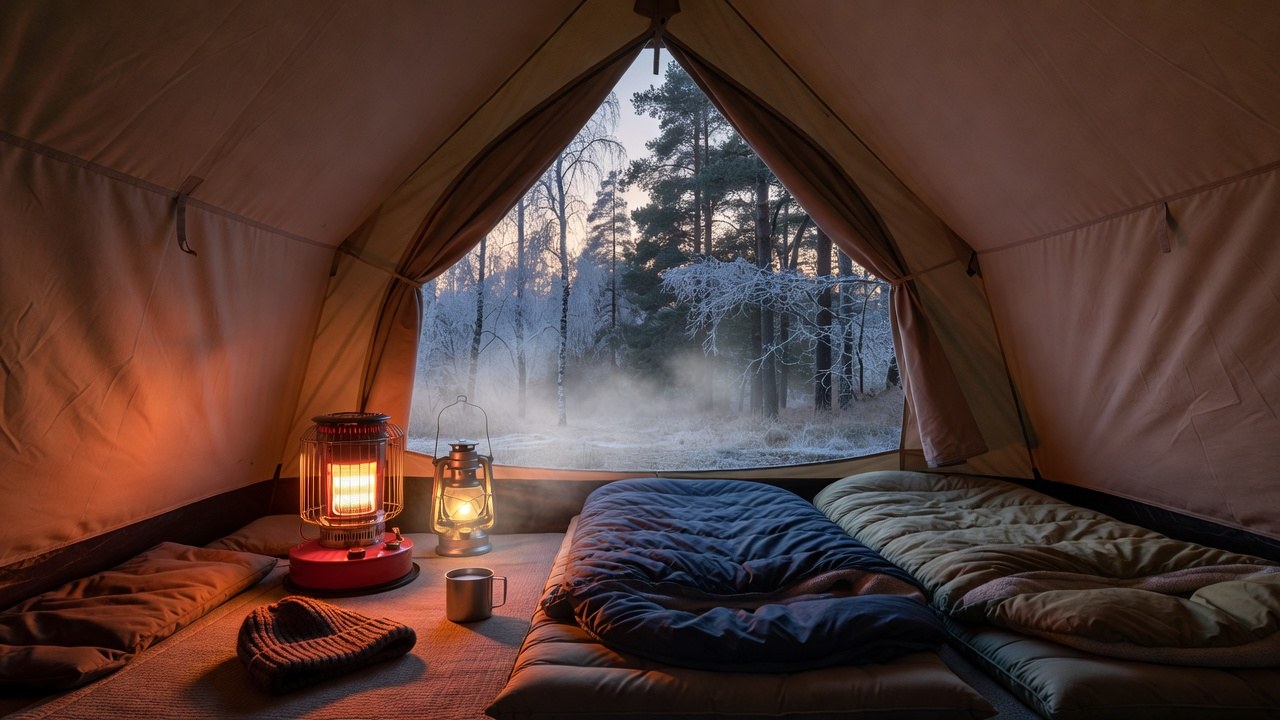
The One Non-Negotiable: Ventilation and Carbon Monoxide
Every propane and wood-burning heater produces carbon monoxide, an odorless gas that kills people in tents every single winter. "Indoor safe" does not mean "sealed up for eight hours" — it means the unit has safety shutoffs.
Three rules:
- Crack a vent, always. Open a vent flap or leave the door zipper down a few inches. Combustion heaters need oxygen on both ends: one for the flame, one for you.
- Never sleep with a heater running unless the manufacturer says you can — and carry a CO alarm anyway. A $20 battery CO alarm in the tent is the cheapest insurance in camping.
- Shut it off before you fall asleep, or keep it on its lowest setting with a vent open and an alarm on. Most families run the heater for the wind-down hour, kill it, then sleep in a properly rated sleep system. That combination is both safer and cheaper on fuel.
One more: never put a heater in a vestibule and close the inner tent. The CO collects in the sleeping space while the flame burns outside it.
Option 1: Propane Radiant Heaters — The Default Answer
For car camping and family tents, a portable propane radiant heater is the most heat per dollar you can buy. It runs on a 1-lb disposable cylinder or a 20-lb tank with a hose, needs no electricity, and starts in seconds.
The 9,000 BTU pick: Mr. Heater Buddy
The Mr. Heater Buddy 4,000-9,000 BTU portable propane heater ($74, 4.7 stars, 25,000+ reviews) is the product most campers mean when they say "tent heater," and it has earned that. Two heat settings (4,000 / 9,000 BTU), a piezo ignition with no matches or batteries, radiant heat that warms what it faces, and up to 225 square feet of coverage — a 4-6 person tent or a small camper. What makes it the safe default is the hardware: an oxygen-depletion sensor that shuts the unit off when oxygen in the space drops, and a tip-over switch that kills the flame if it gets knocked over by a dog or a kid.
It weighs about 9 lb, folds flat, and runs roughly 3 hours on high or 6 hours on low from a single 1-lb cylinder. For a $74 heater, that is the reference point everything else is compared against.
The step-up: Mr. Heater Big Buddy (18,000 BTU)
The Buddy's limitation is headroom. At 9,000 BTU it keeps a small tent comfortable into the low 30s; when the temperature drops into the teens inside a big 8-person cabin tent, it runs out of capacity and you spend the night babysitting it.
The Mr. Heater Big Buddy 4,000/9,000/18,000 BTU heater ($146.48, 4.6 stars) fixes exactly that: three times the output, 450 square feet of coverage, and a built-in fan that turns it into a radiant-plus-convection heater instead of a panel that only warms one side of the tent. It keeps the same oxygen-depletion sensor and tip-over shutoff, and it will idle for up to 216 hours on low on two 20-lb tanks with the optional hose and filter — which is how a lot of cabins and deer camps actually run one all season.
The honest trade-offs: full 18,000 BTU output wants two 1-lb cylinders or a hose setup, the fan runs on four D-cell batteries, and at ~17 lb it is strictly car-camping gear. If you own a 6-8 person tent and camp past October, it is the right upgrade. In a 2-4 person tent, save the money and the weight.
What propane actually costs to run
A 1-lb disposable cylinder holds about 21,600 BTU, so the Buddy on high is roughly 2.4 hours of heat per cylinder, the Big Buddy on high about 1.2. Camping-store 1-lb cylinders run $5-7 each; a 20-lb tank refill is $20-25 for 430,000 BTU — the same as twenty 1-lb cylinders. If you camp more than a weekend or two a year, a hose-and-filter setup pays for itself almost immediately; our guide to refilling 1-lb propane bottles safely covers the adapter math and the DOT rules.
Option 2: A Hot Tent and a Wood Stove
If your cold-weather camping is car-based and you want the tent itself to be the heater, a hot tent is the answer. You're not carrying it, so weight stops mattering, and a small wood stove does the work of three propane heaters while doubling as a cooking surface and a snow-melter.
The Naturehike Massif hot tent with stove jack ($299, 4.2 stars) is the value entry: a 4-season double-wall design with a reinforced chimney opening in the fly, in 2- and 4-person versions. A stove turns a 20°F night into a t-shirt night, but it demands more discipline than propane: stove pipe clearances, a spark arrestor, a fire that is fully out before sleep, and real ventilation or the CO risk is worse than a radiant heater's. If you're buying your first 4-season tent, read our 4-season and winter tent guide first — hot tents and mountaineering tents solve different problems.
For family car camping in real winter, the hot tent is the most comfortable setup on this list. For occasional fall trips, it's overkill.
Option 3: Electric Heat — and Why Most Tents Can't Do It
Electric heaters are cheap, silent, and produce no CO. They also need a 15-amp hookup, which means a powered site or an RV pedestal. Plug a 1,500 W space heater into a campsite pedestal and you'll trip the breaker the moment the site's other loads come on.
What works surprisingly well without hookups: 12V and USB heat. The Sealy 12-Volt heated car blanket ($31.99, 4.2 stars) runs off a car outlet or a battery pack and drapes over a lap or into a sleeping bag. It is not a room heater, but for one cold sleeper it changes the night, and it draws a fraction of what any combustion heater costs to run.
The Truth: Heat the Sleeper, Not the Tent
Here's the part heater shopping pages skip: most people who "need a heater" actually need a better sleep system. Heaters warm air, and air escapes. Your bed keeps heat where it belongs.
Sleeping pads carry the weight of this. In summer, any pad works. On a 30°F night, the ground pulls heat out of you all night. The Klymit Insulated Static V ($94.99, 4.5 stars) at R-4.4 is the price-to-warmth pick; if you're camping in real cold, the NEMO Tensor All-Season ($199.95, 4.6 stars) pushes R-value higher while staying light, and the Therm-a-Rest Z Lite SOL ($54.95) is the indestructible closed-cell backup that never leaks. One thin summer pad undoes a $300 sleeping bag.
Then the bag. Ratings are survival ratings, not comfort ratings — a "20°F" bag keeps you alive at 20°F, not asleep. For fall nights in the 30s, the TETON Sports Celsius 0°F bag ($59.99, 4.5 stars) is the value pick; for backpacking or serious cold, the Kelty Cosmic Down 20 ($169, 4.5 stars) packs small and lofts properly. A Rumpl Original Puffy blanket ($139) layered over a bag adds real warmth for kids, and a fleece liner like the REDCAMP fleece liner ($24.99) adds roughly a season's worth of rating for $25.
And warm the person directly. A Columbia Omni-Heat base layer ($49.99) plus a Smartwool merino beanie ($35) and a merino neck gaiter ($32) is what actually keeps a 40°F night comfortable. For the person who is always cold, HotHands air-activated warmers (40 pairs, $29.99) or rechargeable OCOOPA hand warmers ($39.99) throw 10 hours of heat exactly where it's needed. Cheap gloves and a watch cap belong in the sleeping bag, not the duffel — cold hands and a cold head are what wake people up.
Decision Guide: Which Setup Fits Your Trip
- Fall weekend, 4-6 person tent, car camping: one Mr. Heater Buddy ($74) + R-4+ pads + 0°F bags. Nothing else needed.
- Late fall into winter, 8-person tent, family: Mr. Heater Big Buddy ($146) run on a 20-lb tank with a hose, plus a CO alarm and a cracked vent.
- Snow camping, car-based, comfort first: hot tent with a stove jack ($299) and a small wood stove.
- Powered campsite or RV: a 12V heated blanket or a properly amped electric heater — check the pedestal's breaker first.
- Backpacking: no heater. R-5+ pad, correctly rated down bag, warm hat. That's the whole answer.
Five Mistakes I Made With Tent Heaters
- Bought the heater before fixing the pad. The 2 a.m. wake-ups stopped when I moved from an R-1.3 summer pad to an R-4.4 insulated one — not when I bought a second heater.
- Ran a 9,000 BTU Buddy in an 8-person tent in the teens. It never caught up. Capacity math beats brand loyalty.
- Left the fan off. Radiant heaters warm what they face. A $10 fan pointed up at the ceiling (or the Big Buddy's built-in fan) circulates heat instead of making one warm spot.
- Forgot the CO alarm. I camped a full season without one. Then I read what happened to a family in a sealed tent and bought two.
- Burned through 1-lb cylinders all fall. Twenty cylinders equals one 20-lb tank refill. The hose and filter paid for itself in one trip.
FAQ: Camping Heaters
Can you use a propane heater in a tent?
Yes, if the heater is rated indoor-safe and the tent is ventilated. Radiant propane heaters like the Mr. Heater Buddy and Big Buddy carry oxygen-depletion sensors and tip-over shutoffs for exactly this use. Keep a vent flap or door unzipped, run a battery CO alarm inside the tent, and never seal the sleeping space around a burning heater.
Is it safe to sleep with a tent heater on?
That depends on the heater and how much you trust the ventilation. The safest pattern is to run the heater for the wind-down hour and the morning, then shut it off for sleep and rely on a correctly rated sleep system. If you do sleep with it on, use the lowest setting, keep a vent open, and keep a CO alarm within arm's reach. Never sleep with a wood stove or a catalytic heater in a sealed tent.
How many BTU do I need to heat a tent?
As a rough rule: 4,000-9,000 BTU for a 2-6 person tent, and 12,000-18,000 BTU for a large 8-person tent, cabin, or garage. Add capacity for temperatures below 20°F, for wind, and for tents with mesh-heavy walls, which lose heat fast. If a 9,000 BTU heater can't hold temperature in your tent, the answer is usually a bigger heater or a better-insulated tent — not a second small one.
Will a propane heater keep my whole tent warm all night?
No. Radiant propane heaters warm the space and the objects facing them; they don't create an insulated envelope. On a 20°F night a 9,000 BTU heater will take the edge off and keep a small tent usable, but the sleeping bags and pads are still what keep you warm at 3 a.m. Treat the heater as comfort for the hours you're awake, and the sleep system as the thing that carries you through the night.
How long does a 1-lb propane cylinder last in a tent heater?
About 2.4 hours of heat per 1-lb cylinder at 9,000 BTU, and about 6 hours at 4,000 BTU. A 20-lb tank holds the equivalent of twenty 1-lb cylinders (roughly 430,000 BTU) for $20-25 to refill, which is why most regular fall and winter campers switch to a hose and tank after their first season.
Do tent heaters cause condensation?
Yes — any combustion heater adds water vapor to the air, which is why a tent can feel damp and clammy by morning even when the heater kept it warm. Ventilation fixes both the CO risk and the condensation: crack a vent, and let the moist air out. A fleece or down bag stays warmer when it isn't fighting damp air.
The Bottom Line
A tent heater is the cheapest way to extend your camping season by two months. Buy one sized to your tent, not to your optimism — 9,000 BTU for a family tent in the 30s, 18,000 BTU if you're camping into the teens in a big cabin tent, and a hot tent with a stove if you're going all-in on winter. Then spend your next $100 on the sleeping pad, because that is the upgrade that quietly fixes the 2 a.m. problem a heater only patches.
Safety first: ventilate every enclosed space, carry a CO alarm, and follow the manufacturer's instructions on sleeping and enclosed-space use.
<!-- AFFILIATE_DISCLOSURE -->TrailMapz earns a small commission from qualifying purchases made through links on this page — at no extra cost to you. It's how we keep the gear guides free.