1 lb Propane vs 20 lb Tank: What Each Camping Trip Actually Costs (2026)
1 lb bottle or 20 lb tank? Cost per pound, burn time by BTU, refill vs exchange, adapter break-even, and what a weekend of camping propane actually costs.
You can spend $11 on camp stove fuel for a weekend with 1 lb green bottles, or about $2 with the 20 lb tank already sitting in your garage. Same food, same stove, same trip.
The catch is that switching isn't only about the fuel price — it's about a hose, an adapter, storage, and how many nights you actually cook outside per season. So here is the whole comparison in money, not adjectives.
Quick Answer: Which One Is Cheaper?
- A 20 lb tank is roughly 4x cheaper per pound of propane than 1 lb bottles ($15–25 for a 20 lb refill, versus $5.42 a bottle in our catalog's Coleman 1 lb 12-pack). It holds about 20 times the fuel of one green bottle.
- A 1 lb bottle is the right answer for backpacking, one-pot weekend trips, air travel, and any trip where you don't want to carry or store a 20 lb tank.
- The break-even is embarrassingly short. A $9.98 hose adapter saves about $4.40 per bottle-equivalent, so it pays for itself in under three bottles — often a single weekend.
- The 20 lb tank wins outright once you're cooking two or more meals a day with a two-burner stove, running a propane heater, or doing more than three or four trips a season.
What a 1 lb Bottle Actually Costs Per Trip
A standard green cylinder holds 16.4 oz of propane — effectively 1 lb of fuel. What you pay for that pound depends entirely on where you buy it:
| Where you buy | Typical 2026 price per bottle | Cost per pound |
|---|---|---|
| 12-pack from a big-box store (our catalog: $64.99) | ~$5.42 | ~$5.42 |
| Single bottle, big-box store | $5–7 | $5–7 |
| Campground store or ranger station | $7–10 | $7–10 |
| Butane canister 4-pack (different fuel, similar shelf price) | ~$3 each | — |
Retail prices move with region and season, but the shape of the curve doesn't: the smaller the package, the worse the price per pound. Buying a 12-pack instead of singles is the single easiest saving in this entire article — that is the whole trick of the 1 lb system.
Where the 1 lb system genuinely earns its keep is convenience. No hose to forget, no tank to strap down, no adapters to leak. Screw it on, cook, unscrew it. If your camping is two or three trips a year with a single-burner bottle-top stove, the bottles are not a problem worth solving.
What a 20 lb Tank Costs Per Trip
Here is the part most people get wrong: a "20 lb" tank and a "20 lb exchange" are not the same amount of propane.
| Bulk option | Typical 2026 price | Propane you actually get | Cost per pound |
|---|---|---|---|
| Tank exchange (grocery store, gas station) | $22–30 | Usually filled to 15 lb, not 20 | $1.47–2.00 |
| Refill at a hardware store or propane dealer | $15–25 | A true 20 lb fill | $0.75–1.25 |
| AmeriGas/ferrellgas-style refill program | Varies | 20 lb | $0.75–1.25 |
Two things follow from that table. First, refilling beats exchanging — the exchange cylinder you hand back is half the reason exchanges cost more per pound. Second, even the worse of the two bulk options is still 3–4x cheaper per pound than a 1 lb bottle.
A caveat that matters in the real world: the 20 lb tank itself is a $45–60 purchase unless you already own one, and many households do — it's the spare grill tank in the garage. If you have to buy the tank new, treat it as a one-time cost that the refill savings repay across a couple of seasons.
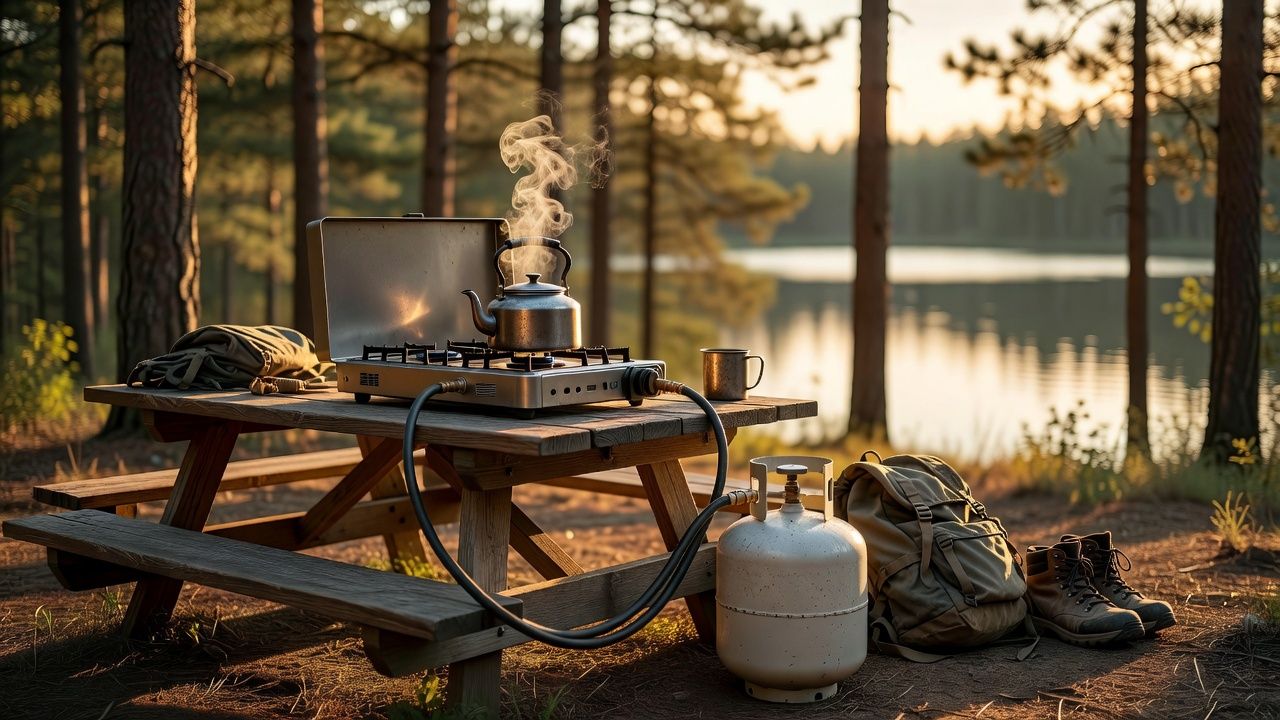
Adding a 20 lb tank to a 1 lb stove is a two-part job, and both parts are cheap:
- GasPro 1 lb adapter ($9.98) — converts a 20 lb tank's QCC-1 valve down to the 1 lb appliance fitting. This is the piece that lets a green-bottle stove run off the bulk tank.
- Mr. Heater 10-foot hose assembly ($17.99) — a longer hose keeps the tank off the picnic table and upright on the ground, which is exactly how it should sit.
The Break-Even Math (It's Not Close)
Take a realistic family weekend: two-burner stove, breakfast and dinner cooked, coffee in the morning.
- Burn time: roughly 2 lb of propane per weekend (the math is in the next section).
- With 1 lb bottles at $5.42: ~$11 per weekend.
- With a 20 lb refill at
$1/lb: **$2 per weekend.** - Saving: ~$9 per weekend.
The $9.98 adapter pays for itself in about one weekend. Over a six-weekend camping season, the difference is roughly $65 versus $12 — and that's before you count the propane you burn in a heater in October and November.
That is why we tell people to do this math exactly once. The 1 lb system is a convenience purchase, not a fuel purchase, and it stops making sense the moment you cook more than a handful of meals outside.
How Long Does a 1 lb Bottle Actually Last?
The useful number is energy, and it's stable across brands: 1 lb of propane contains roughly 21,500 BTU. So divide 21,500 by your stove's output:
| Stove class | Output (both burners on) | Burn time per 1 lb bottle |
|---|---|---|
| Small backpacking single burner | ~8,000 BTU/h | ~2.5–2.7 hours |
| Standard single burner / bottle-top | ~10,000 BTU/h | ~2.1 hours |
| Two-burner family stove, both burners high | ~20,000 BTU/h | ~1 hour |
| High-output two-burner or griddle | ~30,000 BTU/h | ~45 minutes |
Real cooking almost never runs at full blast for an hour straight — simmering and coffee water use far less. In practice a family of four cooking real meals lands around 2 lb per weekend, and a solo camper with a bottle-top stove gets a full weekend out of a single green bottle. Our canister burn-time guide has the per-appliance numbers, and the how much propane for camping guide covers trip-length planning.
The practical translation: a full 20 lb tank is about 20 bottle-equivalents — roughly ten family weekends, or a whole season of cooking plus some heater time in the cold.
Refill, Buy the 12-Pack, or Use a Refillable Cylinder?
There are three legitimate ways to feed a 1 lb appliance, and they cost very differently:
- Buy 1 lb bottles — simplest, worst per-pound price, and the empty cylinders are waste you have to dispose of properly (canister disposal guide).
- Refill your own bottles from a 20 lb tank — the cheapest fuel by far. Gas One refill adapter with hose ($14.99) is the hardware; the rules and risks are covered in our 1 lb refill guide, and the short version is that refilling a disposable cylinder is a grey area you should read about before you do it.
- Buy DOT-compliant refillable 1 lb cylinders — the legal route, and the one I'd pick if you want the small-bottle convenience without the small-bottle price. Flame King's refillable cylinder with refill kit ($59.99) is a 1 lb container built to be refilled, with the CGA600 connection your stove already uses. It costs more up front than 12 disposables and pays that back as you refill it.
Our 1 lb propane tank and stove buyer's guide goes deeper on the refill routes and the stoves that accept them; the hose, regulator and adapter guide covers the plumbing side if your stove wants a regulated hose rather than a direct bottle connection.
When the 20 lb Tank Is the Wrong Answer
This is not a "always go bigger" article. The bulk tank loses in these situations:
- Backpacking and kayak trips. Carrying 20 lb of steel and 20 lb of propane is not a thing. The MSR PocketRocket 2 ($49.95) runs on isobutane canisters, which are a different fuel system entirely.
- Car travel where space is the constraint. A full-size tank takes a real footprint and has to be transported upright and secured.
- Trips where you cook one meal. The adapter adds a connection point that can leak. If you use two bottles a season, skip the hardware.
- Campgrounds and events with their own fuel rules. Some sites restrict bulk propane or require tanks to be shut off and stored a specific way, and some vehicles/tunnels have restrictions on transporting them. Check the specific campground rather than assuming.
The bulk tank also has one honest technical limit: under heavy draw in real cold, propane tanks chill and lose pressure as the liquid boils off. A 20 lb tank actually handles this better than a 1 lb bottle because it has more thermal mass — but if you're running a big burner hard at 20°F, expect reduced output and plan to keep the tank off frozen ground. Propane heaters are a different use case with their own rules; see our tent heater safety guide.
Three Setup Rules People Get Wrong
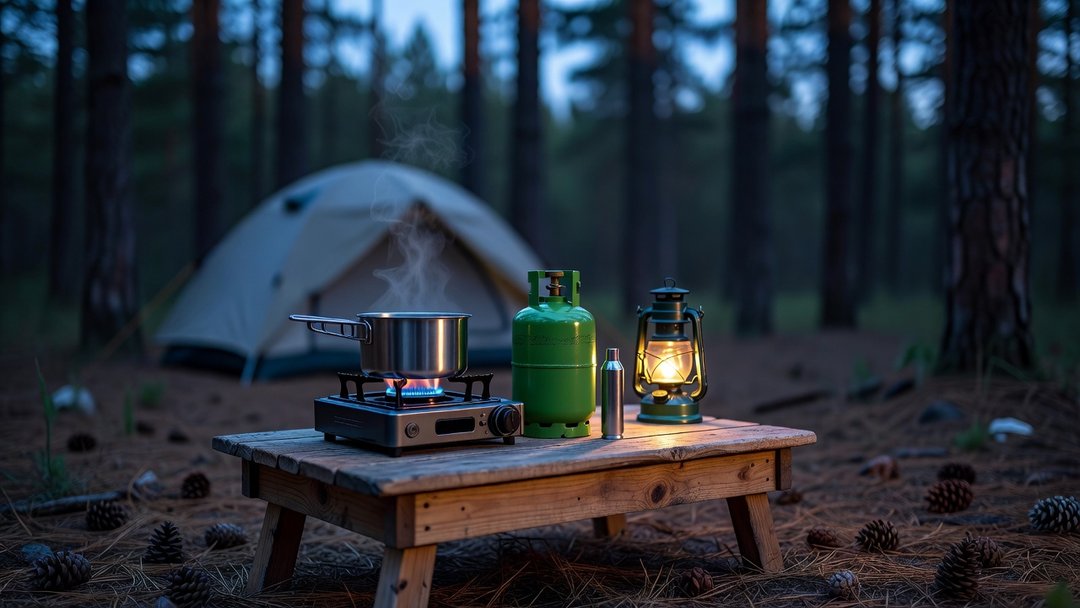
- Keep the tank upright. Liquid propane entering a burner designed for vapor is how you get a fireball, not a flame. Tank upright, on the ground, hose with slack.
- Use a fuel filter when you run a bulk tank into a Buddy-style heater. Mr. Heater requires their universal propane fuel filter ($15.97) with a hose and bulk tank to keep oil residue out of the heater's orifice. Skipping it is the most common way people kill a Big Buddy heater ($146.48), and the fix costs less than a 12-pack.
- Check your connections with soapy water before every first-trip-of-the-season light-up. It takes 30 seconds and it's the only leak test that matters. The propane leak safety guide walks through it.
The complete camp stove fuel guide is the place to start if you're still deciding between propane, butane, and isobutane rather than between bottle sizes.
How Long Propane Actually Lasts, By Cylinder Size
Every cost question on this page reduces to one constant: a pound of propane carries about 21,600 BTU. A disposable green bottle holds 16.4 oz of propane — call it 1.03 lb, or roughly 22,000 BTU — and a 20 lb tank holds 430,000 BTU. Divide either by your burner's rating and you have the runtime. A 10,000 BTU burner running flat out burns a green bottle in about two and a quarter hours; in practice you get two and a half to four hours, because nobody holds a stove wide open for the whole trip. The Coleman bottle-top 1 lb propane stove is rated at exactly 10,000 BTU, which makes it a clean reference point for every number in this section. If you want the burner-by-burner arithmetic in one place, the propane canister runtime guide does it cylinder by cylinder.
| what people search | the short answer |
|---|---|
| how long does a green propane bottle last | 16.4 oz of propane is ~22,000 BTU, so 2.25 hours at 10,000 BTU flat out and 2.5-4 hours in real cooking use. |
| how long does propane last camping | A green bottle covers about a weekend of breakfast-and-dinner cooking for two; a 20 lb tank covers roughly a month of the same trips. |
| how long does propane last camp stove | Depends only on your burner rating: 22,000 BTU per green bottle, 430,000 BTU per full 20 lb tank. |
| how long does propane tank last camping | A 20 lb tank is ~430,000 BTU — about 43 hours on a 10,000 BTU burner, or 21 hours on a 20,000 BTU two-burner stove. |
| how long does a 1lb propane tank last on buddy heater | On the Buddy's 4,000 BTU low setting, about five hours; on the 9,000 BTU high setting, about two and a half. |
| how long does a propane tank last without use | Indefinitely — propane does not degrade in the cylinder, so a stored tank is still full next spring. |
| how many hours does a green propane tank last | Two to four hours on a single burner, or about one long breakfast on a two-burner stove used at full output. |
| how long does a full propane tank last | A full 20 lb tank is roughly 430,000 BTU, so 21 to 43 hours depending on whether you are running one burner or two. |
| how long does a 20lb propane tank last on mr heater | About 24 hours on a Big Buddy at 18,000 BTU, or roughly 48 hours on a Buddy at 9,000 BTU. |
| how long do green propane bottles last | One weekend each for a couple; two bottles if you cook three meals a day and run a lantern off the same fuel. |
| how long does a 1lb propane tank last on little buddy heater | The Little Buddy draws 3,800 BTU, so a green bottle lasts about five and a half hours. |
| how many hours does a 5 lb propane tank last | A 5 lb tank is ~108,000 BTU — about eleven hours on a 10,000 BTU burner, or a full long weekend of two-burner cooking. |
| how many hours does a propane tank usually last | Most family camping trips burn one to two pounds of propane per day, which is four to five hours of runtime on a 10,000 BTU burner. |
| how long does a 20lb propane tank last on blackstone | A 20 lb tank is ~430,000 BTU; a 15,000 BTU griddle plate runs about 28 hours on it across a season of campsite breakfasts. |
How Much Propane a Trip Actually Needs
The honest answer is that most families overpack propane by a factor of two, and the overpacking is not free — it is weight, space, and money carried for nothing. Work from pounds per day, not bottles per trip: a couple cooking two hot meals a day burns roughly one pound per day on a single burner, and closer to 1.5-2 lb per day on a Coleman Triton 2-burner propane stove used for both meals plus coffee. A 20 lb tank therefore covers ten to fourteen days of camping; a green bottle covers most of one weekend. The how much propane for camping breaks this down meal by meal if you want to check your own habits, and the camping trip planning guide helps you map fuel to a specific itinerary.
| what people search | the short answer |
|---|---|
| best propane for camping stove | Standard HD-5 propane in either a 16.4 oz disposable or a refillable 20 lb tank; the fuel is identical, only the packaging and price differ. |
| how many propane tanks for camping | One 20 lb tank per two weeks of trips, or one green bottle per couple per weekend. |
| how much propane needed for camping | Budget one pound per person per day for cooking, plus one pound per night if you run a heater. |
| how much propane do i need for camping | A three-day trip for four people is about four to six pounds — one 20 lb tank with plenty left over, or four to six green bottles. |
| camping propane bottle sizes | 16.4 oz disposables, 1 lb refillables, 5 lb, 11 lb, 20 lb and 30 lb tanks; 20 lb is the standard exchange size. |
| best propane 2 burner camp stove | For fuel economy the Coleman Triton 2-burner propane stove and the Gas One GS-3400P dual-fuel stove both run standard 1 lb or 20 lb propane with no proprietary canisters. |
| camping propane 2 burner | A two-burner stove draws 20,000 BTU an hour at full output, so a 20 lb tank gives about 21 hours of runtime. |
| how many small propane tanks for camping | One green bottle per couple per weekend; add one for every extra day or every extra cooking appliance. |
| how long does one camping propane tank last | One green bottle is one weekend for two people; one 20 lb tank is ten to fourteen days of the same trips. |
| how many propane bottles can i transport | There is no federal limit on how many 1 lb cylinders you may carry, but DOT rules require the cylinder to be upright, secured and valve-closed in transit. |
| what to bring with you when you go camping | Fuel, a lighter that works cold, and a spare bottle: running out of propane at breakfast is the most common camping failure there is. |
| what should you bring when you go camping | At minimum one spare cylinder and a hose long enough to keep the tank out from under the stove. |
What Propane Costs Per Pound, Per Bottle, and Per Trip
This is the number that decides the whole buy-a-tank question, and it is a per-pound number, never a per-bottle number. A twelve-pack of 16.4 oz cylinders sold at around $65 works out to about $5.42 a bottle — and since a bottle holds barely one pound of propane, that is roughly $5.30 per pound. A 20 lb tank refilled at a propane dealer or hardware store typically costs $20-30, which is $1.00-1.50 per pound. An exchange swap is usually $25-35 for a 20 lb cylinder that is only filled to 15-17 lb, so the effective rate lands near $1.75-2.00 per pound. Prices vary by region and season, so treat these as the shape of the market rather than a quote — but the ratio holds everywhere: disposables cost three to five times more per pound than bulk propane. The breakdown of which cylinders and blends to buy is in the 1 lb propane buyers guide.
| what people search | the short answer |
|---|---|
| what does propane cost per pound | Disposables run about $5-6 a pound; a 20 lb tank refill runs about $1.00-1.50 a pound. |
| how much is propane per pound | Bulk refill pricing is the only genuinely cheap propane: $1 to $1.50 per pound in most US markets. |
| how much does it cost to get a 20 lb propane tank filled | Typically $20 to $30 at a hardware store, propane dealer or campground that does refills. |
| how much does 1lb propane cost | A single green cylinder bought loose is $5 to $8; in the 16.4 oz propane cylinder 12-pack the per-bottle price drops to about $5.40. |
| how much does it cost to refill 20lb propane tank | $20 to $30, and the refill should add a full 20 lb of propane, not a partial fill. |
| what does it cost to fill a 20 lb propane tank | Expect $20 to $30 by weight; a fill that costs less usually means the tank was not empty. |
| how much to refill 20lb propane tank | About $1 to $1.50 per pound of propane actually added, so $20 to $30 for a truly empty tank. |
| how much does 30 lbs of propane cost | Pro-rata from the 20 lb rate: roughly $30 to $45. |
| cheapest place to buy camping propane | A refill by weight (not an exchange) at a propane dealer, farm supply or U-Haul, then a hose to run your stove off it. |
| how much propane cost per pound | $5.30/lb for disposables versus $1.00-1.50/lb for bulk — the single biggest cost lever in camp cooking. |
| what does 1 lb of propane cost | About $5.40 in disposable packaging; the same pound costs roughly $1.20 in a refilled 20 lb tank. |
| what is the price of propane per pound | Camping-relevant answer: $1.00-1.50 per pound bulk, $5-6 per pound disposable. |
Refill, Exchange, Buy the Pack, or Go Refillable
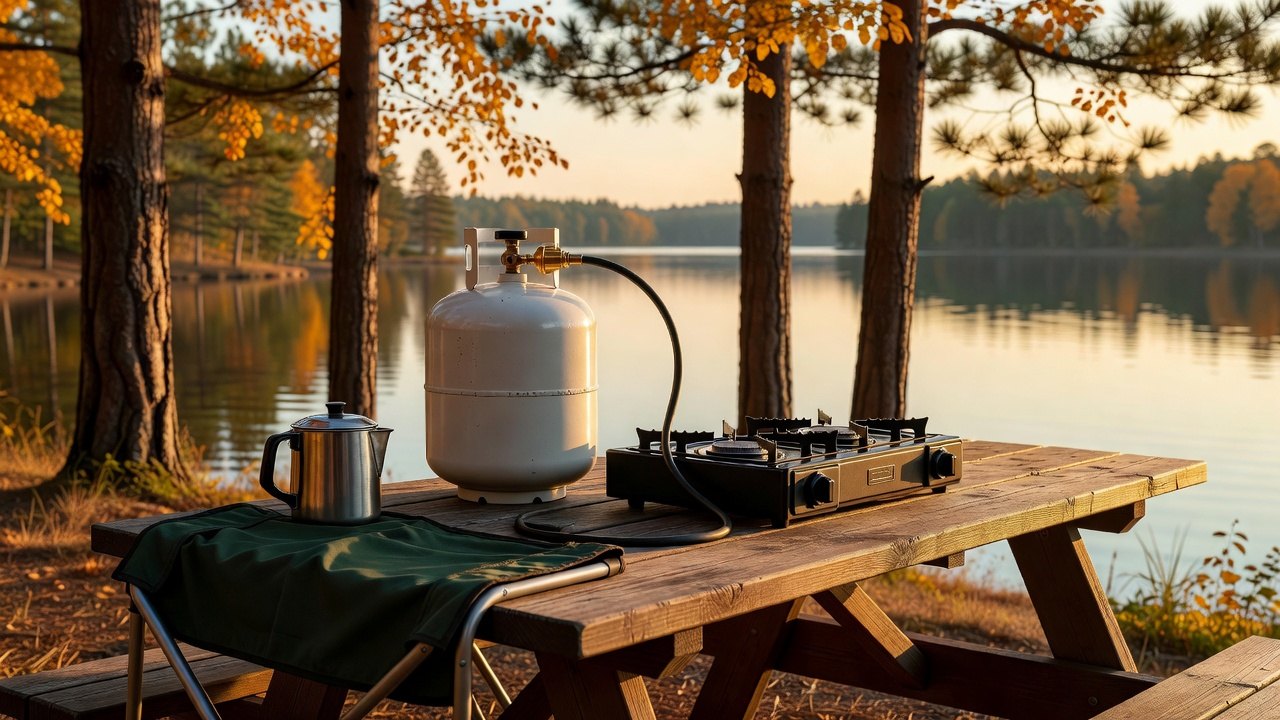
There are four ways to put propane in your stove and they differ by about five dollars a pound. Buying disposables by the dozen is the most convenient and the most expensive. Exchanging a 20 lb tank is quick but you pay for a partial fill. Refilling by weight is cheapest per pound but needs a tank and a dealer. The fourth option is the one most campers never consider: a Flame King refillable 1 lb cylinder with refill kit — a DOT-compliant 1 lb cylinder you refill yourself from a 20 lb tank with the Gas One propane refill adapter with 4 ft hose. It removes the disposable cost entirely while keeping the small-bottle form factor your stove already expects. Whatever route you pick, do the transfer outside and away from ignition sources; the how to refill 1 lb propane bottles safely covers valve technique, overfill and leak checks.
| what people search | the short answer |
|---|---|
| can you refill 1lb propane bottles | Not the disposable kind — they are not designed or legal to refill for transport. Refillable 1 lb cylinders are. |
| propane tank exchange vs refill cost | Exchange is $25-35 for a 15-17 lb fill; refill by weight is $20-30 for a full 20 lb. Refill wins per pound. |
| refillable 1 lb propane cylinders | The Flame King refillable 1 lb cylinder with refill kit is a refillable 1 lb cylinder with a refill kit; it pays for itself in roughly a dozen refills. |
| can you refill 1 pound propane bottles | Only if the cylinder is a refillable type rated for it; a standard green disposable cylinder is not. |
| can you refill 1 lb propane cylinders | Yes for refillable cylinders such as the Flame King, using the Gas One propane refill adapter with 4 ft hose to transfer from a 20 lb tank. |
| is refilling 1lb propane tanks safe | Refilling refillable cylinders outdoors with a proper adapter is safe and routine; refilling disposables is not. |
| propane tank exchange or refill | Refill if you care about cost per pound; exchange only if convenience is worth $10-15 and a partial tank. |
| can you refill 1 lb propane tanks at home | Yes with a refillable cylinder and a 20 lb donor tank — do it outdoors, never in a garage or basement. |
| how do you refill 1 lb propane bottles | Chill the empty cylinder, connect the adapter to the 20 lb tank, invert or pressurise, and fill by weight. |
| propane tank swap vs refill | Swap is the fastest; refill is the cheapest. Swap buyers pay roughly 30-50 percent more per pound. |
| can you refill coleman 1lb propane bottles | Coleman green cylinders are disposable; use a refillable 1 lb cylinder instead if you want to refill small bottles. |
| where can you refill 1lb propane tanks | You cannot refill disposables commercially; you refill refillable 1 lb cylinders yourself from a 20 lb tank. |
1 lb to 20 lb Adapters: Cost, Fit, and Break-Even
An adapter is the cheapest piece of gear in the fuel math and the one with the fastest payback. The Gas One propane refill adapter with 4 ft hose costs about $15 and lets you refill small cylinders as well as run a stove from a bulk tank; the Gaspro 20 lb to 1 lb converter does the opposite job, converting a 20 lb tank outlet down to a 1 lb appliance fitting for about $10. Either part pays for itself inside two weekends. The reason is arithmetic, not opinion: at $5.30 per pound versus $1.20 per pound, every pound you move from disposables to bulk saves about four dollars, so a $10-15 part breaks even after roughly three pounds of propane — three green bottles. Fit is the only real trap: a stove that already has its own regulator behaves differently from one that expects a hose-mounted regulator, and the propane hose, regulator and adapter guide exists specifically to sort that out. Once you have the right hose, the propane leak safety guide checklist is the two-minute habit that keeps it safe.
| what people search | the short answer |
|---|---|
| where to buy propane for camp stove | Hardware stores, farm supply, U-Haul and most campgrounds sell both green bottles and 20 lb refills; refills are the cheap route. |
| propane adapter hose for coleman stove | A standard 1 lb appliance hose with the correct throwaway-cylinder fitting; match the fitting, not the brand. |
| 1lb to 20lb propane adapter with regulator | Use one when your stove has no built-in regulator; appliances with their own regulator need a plain hose instead. |
| how to hook up propane to coleman stove | Screw the hose onto the stove's inlet, connect the other end to the tank, open the tank valve slowly, then light. |
| steak saver propane adapter | The high-output adapter used for searing on a portable grill; same 1 lb appliance thread, wider orifice. |
| propane adapter hose camp chef | Camp Chef and most other brands use the same standard 1 lb appliance fitting, so a universal hose fits. |
| propane grill steak saver adapter | Lets a tabletop grill run off a bulk tank instead of a bottle, which is what makes weekend grilling affordable. |
| propane tank adapter hose for coleman stove | Any 1 lb appliance hose plus the correct tank fitting; there is no Coleman-specific thread on the appliance side. |
| propane adapter hose not working | Almost always a regulator conflict or an over-tightened fitting; check the flow-limiting coupling first. |
| how to connect propane tank to portable stove | Tank upright, valve closed, hose hand-tight plus a quarter turn, then open the valve and leak-test the joint. |
What Your Stove, Griddle, or Grill Actually Burns
Burn rate is a function of the appliance's BTU rating, and the differences between common camp appliances are larger than most people expect. A single 10,000 BTU burner uses a pound of propane in about two hours of hard cooking. A Coleman RoadTrip 225 tabletop grill grills on a much hotter plate and burns proportionally faster. A Outland Living 58,000 BTU portable fire pit rated at 58,000 BTU will drain a 20 lb tank in about seven and a half hours — which is why a fire pit is a bulk-tank appliance, never a bottle appliance. The Coleman tabletop 2-in-1 grill and stove sits in the middle: grill and stove in one unit, so it replaces two fuel-hungry devices with one. If you want to compare outputs before buying, the camp stove BTU guide has the rating table and the camp stove griddle guide covers griddle-specific consumption.
| what people search | the short answer |
|---|---|
| propane for blackstone camping griddle | A 15,000-17,000 BTU griddle plate runs about 28 hours on a full 20 lb tank. |
| can you use camping propane for grill | Yes — the fuel is the same HD-5 propane; only the connector and the BTU draw change. |
| how much propane does a camper stove use | A single 10,000 BTU burner consumes roughly half a pound of propane per hour of cooking. |
| propane can for camping stove | Either a 16.4 oz disposable, a refillable 1 lb cylinder, or a 20 lb tank through a hose. |
| does the blackstone griddle use propane | The portable camping models do; the larger home units also run on propane or natural gas. |
| how much propane does a blackstone griddle use | Budget 15,000-17,000 BTU per hour, so about 1.5 hours of breakfast per pound of propane. |
| how much propane for camp stove | One pound per two hours of single-burner cooking at full output; less if you simmer. |
| does blackstone griddle come with propane tank | No — griddles ship without fuel; plan on a 1 lb cylinder or a 20 lb tank and hose. |
| how much propane for camping stove | A four-person weekend of two-burner cooking lands near three to four pounds of propane. |
| camp stove use propane tank | Any stove with a standard 1 lb appliance fitting can run from a 20 lb tank through an adapter hose. |
Heaters Are the Big Draw: Propane Per Night
Cooking is a rounding error next to heating. A Mr. Heater Buddy 4,000-9,000 BTU on its 4,000 BTU low setting uses about a fifth of a pound of propane per hour; that sounds trivial until you run it for ten hours overnight, which is two pounds — a whole green bottle, every single night. The Mr. Heater Big Buddy 18,000 BTU at 18,000 BTU will empty a 20 lb tank in about a day of continuous running. That is the real argument for bulk propane: a heater turns a weekend into a one-bottle-a-night problem for disposable users. It is also why the hose and filter matter — Mr. Heater's bulk-tank setups use the Buddy series 10 ft propane hose assembly with the universal propane fuel filter for Buddy heaters, and the manufacturer requires the filter on hose connections to protect the heater's regulator. A hot tent like the Naturehike Massif hot tent with stove jack, with its own stove jack, changes the calculus again by heating with a wood stove instead. Safety rules for any of these setups are in the camping heater tent safety, and general cold-weather comfort is covered in how to stay warm camping.
| what people search | the short answer |
|---|---|
| propane for camping heater | A Buddy-class heater draws 4,000-9,000 BTU, so plan on one to two pounds per night of use. |
| how much propane does a mr buddy heater use | About 0.2 lb per hour on low (4,000 BTU) and 0.42 lb per hour on high (9,000 BTU). |
| propane heater for tent trailer | Heaters are for ventilated tents and trailers only; a catalytic or radiant heater needs an air supply. |
| how long does a 1 pound propane tank last in a buddy heater | Roughly five hours on low, two and a half on high. |
| do buddy heaters use propane | Yes — the Buddy series runs on 1 lb cylinders or a 20 lb tank via hose with a required fuel filter. |
| propane heater for tent safe | Safe only with ventilation, away from fabrics, and never with the cylinder inside a sealed sleeping area. |
| best propane heater for camping | Mr. Heater Little Buddy 3,800 BTU for a small tent, Mr. Heater Buddy 4,000-9,000 BTU for a family tent, Mr. Heater Big Buddy 18,000 BTU for a big space or a trailer. |
| camping propane heater for tent | Match BTU to volume: under 3,800 for a two-person tent, 4,000-9,000 for a family tent. |
| how much propane does an rv furnace use | RV furnaces run 20,000-40,000 BTU, so a 20 lb tank lasts roughly eleven to twenty-one hours of runtime. |

The BTU Math Behind Every Number Here
One gallon of propane weighs 4.24 lb and carries 91,500 BTU, which is where the 21,600 BTU per pound figure comes from. That single conversion runs the entire page: multiply pounds by 21,600 to get energy, divide by your appliance's BTU rating to get hours, and divide the price by the pounds to get cost per pound. A full 20 lb tank therefore holds about 430,000 BTU — the same energy as roughly twenty green bottles. Two related traps are worth knowing. First, the ratings printed on appliances are maximum inputs; simmering uses a fraction of them, which is why real runtime beats the calculated figure. Second, altitude and cold cut effective output, so a stove rated at 10,000 BTU at sea level behaves like a smaller stove on a cold mountain morning. The camp stove BTU guide covers output ratings in detail; simmer behaviour and how to use less fuel per meal are in the camp stove simmer and heat control.
| what people search | the short answer |
|---|---|
| how many btu in a 20 lb propane tank | About 430,000 BTU — 20 lb times 21,600 BTU per pound. |
| how many btu in a pound of propane | 21,600 BTU per pound, which is 91,500 BTU per 4.24 lb gallon. |
| how many btus in a gallon of propane | 91,500 BTU per gallon, a standard that has not meaningfully changed in decades. |
| how many btus in a pound of propane | The same 21,600 BTU figure, useful because cylinders are sold by weight, not volume. |
| how many btu can a 20 lb propane tank handle | 430,000 BTU total draw, limited by how fast the tank can vaporise — about 100,000 BTU per hour at mild temperatures. |
| how many btu in 1 pound of propane | 21,600 BTU, or roughly two hours of full-output cooking on a 10,000 BTU burner. |
| how many btus in a 20 lb propane tank | 430,000 BTU; divide by appliance rating for runtime hours. |
| how many btu per gallon propane | 91,500 BTU per gallon, converting to 21,600 BTU per pound. |
| how many btu in a 20 pound propane tank | 20 lb times 21,600 BTU per pound equals about 430,000 BTU. |
| btu per gallon of propane gas | 91,500 BTU — the figure to use when any propane appliance quotes gallons instead of pounds. |
| how many btu in a 40 lb propane tank | About 860,000 BTU, double the 20 lb tank, at roughly double the weight. |
| how many btu are in a 20 lb propane tank | Roughly 430,000 BTU of usable energy when full. |
Weight and Hauling: What a Full Tank Actually Weighs
Propane math has a physical cost as well as a dollar cost, and the 20 lb tank's name is the giveaway. The cylinder itself — the tare weight stamped on the collar — is typically 17 to 18.5 lb empty, so a full 20 lb tank weighs about 37 to 38.5 lb. A green disposable cylinder is far friendlier at roughly 1.6 to 1.9 lb gross, and the refillable 1 lb cylinders stay in that range while cutting the cost. Read the tare weight and the water capacity stamped on any tank before you trust a fill: those two numbers tell you both how much propane is in it now and how much it should hold full. Tank sizing for campers, and when a 5 lb or 11 lb cylinder beats a 20 lb one, is set out in the 1 lb propane buyers guide; the RV boondocking for beginners covers hauling fuel when you are away from hookups.
| what people search | the short answer |
|---|---|
| how much does a 20 lb propane tank weigh when full | About 37 to 38.5 lb: roughly 17-18.5 lb of steel plus 20 lb of propane. |
| how much does propane weigh per gallon calculator | 4.24 lb per gallon, so gallons times 4.24 equals pounds. |
| 20 lb propane tank weight full and empty | Empty (tare) 17-18.5 lb; full 37-38.5 lb. The tare value is stamped on the collar. |
| best propane tank size for camping | 20 lb for a family basecamp, 5-11 lb for tent campers who carry their own, 1 lb for backpacking. |
| propane tank size for campers | A 20 lb tank per two weeks of family trips; an 11 lb cylinder if you must carry it any distance. |
| how much does propane weigh per gallon in pounds | 4.24 lb per gallon at room temperature. |
| what size propane tank for camping stove | A 20 lb tank if you drive to the site; a 1 lb cylinder if the stove is tabletop and the walk is long. |
| how much does 20lb propane tank weigh full | 37 to 38.5 lb, which matters when you are lifting it onto a picnic table in the dark. |
| how much does a 20 lb propane tank weigh empty and full | Empty 17-18.5 lb, full 37-38.5 lb; check the stamped tare weight for your specific cylinder. |
| how much should a full 20 lb propane tank weigh | Tare weight plus 20 lb. If it feels like 32 lb, you bought a partial fill. |
Cold Weather Changes the Numbers
Propane is a liquid that has to boil before it burns, and cold slows the boil. At 70°F a full tank delivers roughly 100 psi; at 0°F the same tank is down near 25 psi, which is why a half-empty tank in December behaves like a much smaller tank. Propane itself boils at about -44°F, so it keeps working long after isobutane — which boils near 11°F — has given up. That is the whole cold-weather story for campers: propane and propane blends outperform isobutane in freezing conditions, and the practical fix for a struggling tank in cold is simple — keep it warmer, keep it fuller, or draw from a bigger tank. The cold weather and high altitude stoves compares stoves for freezing and high-altitude use, and the isobutane vs propane works through the blend question directly. Insulation for the nights these numbers describe is in the winter camping gear checklist.
| what people search | the short answer |
|---|---|
| does propane work in freezing weather | Yes — propane boils at about -44°F, so it still vaporises in normal winter camping temperatures. |
| does propane lose pressure in cold weather | Yes, sharply: roughly 100 psi at 70°F down to about 25 psi at 0°F. |
| do propane tanks work in cold weather | They work but deliver less. A fuller tank and a warmer location keep output usable. |
| isobutane in cold weather | Isobutane boils near 11°F, so it stops vaporising well before propane does — the reason blends exist. |
| do propane grills work in cold weather | Yes, with lower output; expect longer warm-up and less peak heat on a cold morning. |
| is propane good in cold weather | It is the best of the common camping fuels in cold, beating isobutane and butane on vapour pressure. |
| propane pressure in cold weather | About 25 psi at 0°F versus 100 psi at 70°F on the same cylinder. |
| is isobutane hotter than propane | No — it has slightly lower energy per pound and a much higher boiling point, so it is worse in cold. |
| what happens to propane in cold weather | Vapour pressure drops, so burners run weaker and a nearly empty tank may stop feeding entirely. |
| why does propane not work in cold weather | The liquid stops boiling fast enough to replace the vapour the burner is drawing. |
Storage, Transport, and Expiry Rules That Cost You Money
Two rules quietly decide whether a tank is refillable. The first is the requalification date: in the US, DOT cylinders must be requalified twelve years after their manufacture date and every five years after that, and an expired cylinder cannot be legally refilled — the date is stamped on the collar as a month and year, along with the tare weight. The second is that disposable 1 lb cylinders are not legal to refill for transport, which is exactly why refillable cylinders exist as a category. Beyond legality, storage is the money leak nobody sees: a tank left in a hot trunk or a full one stored badly can vent, and a partial fill you paid exchange prices for is money already gone. Transport upright with the valve closed and the cylinder secured. Leak-checking is a two-minute habit — the propane leak safety guide walks it through — and end-of-life cylinder handling is covered in the fuel canister recycling and disposal guide.
| what people search | the short answer |
|---|---|
| what to do with camping propane tanks | Refill and reuse them; dispose of a dead cylinder through a hazardous-waste or cylinder-recovery service, never household trash. |
| where is the expiry date on a propane tank | Stamped on the collar or valve guard as a month and year; that date is the requalification due date. |
| how do you find the expiry date on a propane tank | Read the collar stamp plus the requalification markings added each time the cylinder is tested. |
| propane tank transport rules | Keep the cylinder upright and secured, valve closed; never transport or store it in a sealed hot space. |
| do camping propane tanks come filled | Exchange tanks come partially filled (15-17 lb); new cylinders are sold empty. |
| small camping propane tank storage | Store outdoors or in a ventilated space, upright, out of direct sun, with the valve closed. |
| are camping propane tanks refillable | 20 lb and other DOT cylinders are refillable until their requalification date expires; disposables are not. |
Which Cylinder to Buy for Your Family's Weekend
Match the cylinder to how you actually camp, not to what looks rugged. If you drive to the site and cook two hot meals a day, one 20 lb tank plus a hose is the cheapest fuel you will ever buy, and a second tank is your only real redundancy. If you hike in from the car, an 11 lb or 5 lb cylinder splits the difference between weight and cost. If your stove lives in a tote bag, the 16.4 oz propane cylinder 12-pack keeps you in the familiar bottle format at the lowest disposable price — or better, step to refillable 1 lb cylinders and cross over to bulk pricing without changing your stove. Butane users have the same choice in miniature with the Gas One butane canister 12-pack, though butane's cold-weather limits are real. Whichever route you take, the camp stove fuel guide compares the fuel types side by side, and the single burner vs 2 burner stoves helps you pick the stove the cylinder has to feed.
| what people search | the short answer |
|---|---|
| best 20lb propane tank gauge | Any inline or scale-style gauge is worth it — weighing the tank is the only reliable way to know what is left. |
| best 20lb propane tank to buy | A standard steel DOT cylinder plus a weight scale beats any proprietary gauge-equipped bottle. |
| what is the best 20 lb propane tank | A plain refillable DOT cylinder: it can be refilled by weight anywhere and requalified for decades. |
| where to buy propane tank for camping stove | Hardware stores, farm and ranch supply, U-Haul and most campgrounds; buy a refillable DOT cylinder, not an exchange-only one. |
| small propane tank for camping stove | A 5 lb or 11 lb cylinder for carry-in trips, or a refillable 1 lb cylinder for tabletop stoves. |
| how much propane do you need for a camping stove | One pound per two hours of burner time; a family weekend is three to four pounds. |
| coleman propane tank for camping stove | Coleman appliances take standard 1 lb cylinders; run them from a bulk tank with a universal adapter hose. |
| where to get propane for camp stove | Refill by weight where available, otherwise a green-bottle multipack for the trip and bulk for the season. |
1 lb vs 20 lb Propane FAQ
Is it cheaper to buy a 20 lb tank or 1 lb bottles for a season?
For almost any camper who cooks real meals more than three or four weekends a season, the 20 lb tank wins by a wide margin — roughly 4x cheaper per pound of propane, plus a $9.98 adapter that pays for itself in two to three bottles. The 1 lb bottles only win if you camp rarely, backpack, or value the zero-setup simplicity over the fuel cost.
How long does a 1 lb propane bottle last?
About 2 to 2.5 hours on a 10,000 BTU single burner at full blast, since 1 lb of propane holds roughly 21,500 BTU. On a two-burner family stove running both burners high, expect closer to an hour. Real cooking at simmer uses much less, so most campers get far longer than the full-blast number suggests.
Can I refill a 1 lb bottle from a 20 lb tank?
Yes, and it's the cheapest propane per pound available to a camper, but it's a grey area for disposable cylinders. The safe, legal route is a DOT-compliant refillable 1 lb cylinder with an approved refill kit. Our 1 lb refill guide covers the three legitimate routes, the adapter hardware, and what can go wrong.
Do I need a filter with a 20 lb tank on a Buddy heater?
Yes — Mr. Heater requires their universal propane fuel filter when a Buddy-series heater is connected to a bulk tank by hose. Bulk propane can carry oil residue that clogs the heater's small orifice, and a clogged orifice produces weak or uneven heat. The filter costs about $16 and prevents the failure mode that kills most of these heaters.
Can you use a 20 lb tank with any 1 lb camp stove?
Any appliance that takes a 1 lb cylinder can run from a 20 lb tank with the right adapter or hose — that's what a 1 lb-to-20 lb adapter does. Check that the hose or adapter matches your stove's fitting, keep the tank upright, and use a regulated hose for appliances that expect regulated pressure rather than a direct bottle feed.
Is a 20 lb propane tank allowed at campgrounds?
Most campgrounds allow standard propane tanks, and many campers use them for heaters and RV systems there. Rules vary at some sites and events — a few restrict bulk tanks, some require tanks to be shut off and stored between uses — and some tunnels and ferries restrict tank transport. Confirm with the specific campground before you plan the whole kitchen around a bulk tank.
How long does a 20 lb propane tank last for fire pit
About seven and a half hours on a 58,000 BTU portable fire pit, which is why a fire pit belongs on a bulk tank rather than a bottle. The Outland Living 58,000 BTU portable fire pit draws 58,000 BTU at full output, so the 430,000 BTU in a full 20 lb tank divides down to roughly seven and a half hours of flame. Turn it down and the number improves quickly, because the published rating is a maximum, not a steady draw.
Does camping propane expire
The propane itself does not. It is a stable, single-component fuel with no additive package to break down, so a cylinder stored for three seasons is still full of usable propane. What does expire is the cylinder: the requalification date stamped on the collar, twelve years after manufacture and every five years after that. An out-of-date cylinder cannot legally be refilled even though the fuel inside it is perfectly good.
Where is propane tank expiration date
On the collar or valve guard, in a row of stampings that also includes the tare weight and water capacity. Look for a month and a year in a two-digit format, then check the requalification stamps added each time the cylinder was pressure-tested; the most recent date governs.
Is it better to refill or exchange propane tank
Refill, for cost per pound. A refill by weight adds a full 20 lb for roughly $20-30, while an exchange swap costs $25-35 for a cylinder that is only filled to 15-17 lb. The gap is about 30-50 percent per pound, and an exchange-only habit compounds it across a season of trips.
Are refillable 1lb propane tanks worth it
Yes, if you camp more than a couple of weekends a season. A Flame King refillable 1 lb cylinder with refill kit with its refill kit costs about what a dozen disposables cost, then refills from a 20 lb tank at bulk pricing. It keeps the small-bottle form factor your stove already expects, which is the part disposable users are actually paying for.
How long does propane last in camper
Longer than most people expect, because RV cooking draws far less fuel than RV heating. A 20 lb tank will run a two-burner RV cooktop for about three weeks of normal use, or about eleven to twenty-one hours if it is feeding a 20,000-40,000 BTU furnace instead. The RV boondocking for beginners covers managing fuel when you are off-grid for longer than a weekend.
Do camp stoves use propane or butane
Most car-camping stoves use propane in a 1 lb cylinder or a 20 lb tank; backpacking stoves more often use an isobutane blend in a smaller canister. Dual-fuel stoves like the Gas One GS-3400P dual-fuel stove accept either, which is useful if you already own butane canisters and want to move to propane for cold-weather trips.
What size propane tank do I need
Size it to how you carry it, not to how much you cook. A 20 lb tank for any drive-in basecamp, an 11 lb or 5 lb cylinder when you carry fuel any distance, and a 1 lb cylinder when the stove lives in a tote. The 1 lb propane buyers guide works through the trade-offs cylinder by cylinder.
The Bottom Line
Buy the 12-pack if you want the simplest possible camp kitchen and you camp a couple of weekends a year. Buy the $10 adapter, a hose, and one refillable cylinder if you cook outside more than that — the fuel math isn't close, and the break-even arrives before you finish your first trip's breakfast.
The one thing worth doing regardless: figure out your own per-weekend number once. Two pounds of propane per weekend, at $5.42 a pound versus $1 a pound, is the whole decision in two lines of arithmetic.
<!-- AFFILIATE_DISCLOSURE -->TrailMapz earns a commission on qualifying purchases made through the links above. Prices are approximate as of 2026 and vary by retailer and region.