Camp Stove Griddle Guide 2026: Which Griddle Actually Fits Your Stove
A griddle only works on a camp stove if it actually fits the grate. Compare round cast iron, grill plates, and griddle-ready stoves — with the measurements to check before you buy.
The single most common reason a camp stove griddle gets returned is not seasoning, weight, or price. It's fit. People buy a 17-inch two-burner griddle plate for a two-burner stove, set it on the grate, and watch it rock, tip, or sit so far off the burner that half the surface never gets hot.
That's a five-minute problem to avoid — but only if you know what to measure and which griddle shapes exist. This guide covers the three griddle types that actually work on camp stoves, the fit math for Coleman, Camp Chef, and single-burner stoves, and the picks our readers buy most.
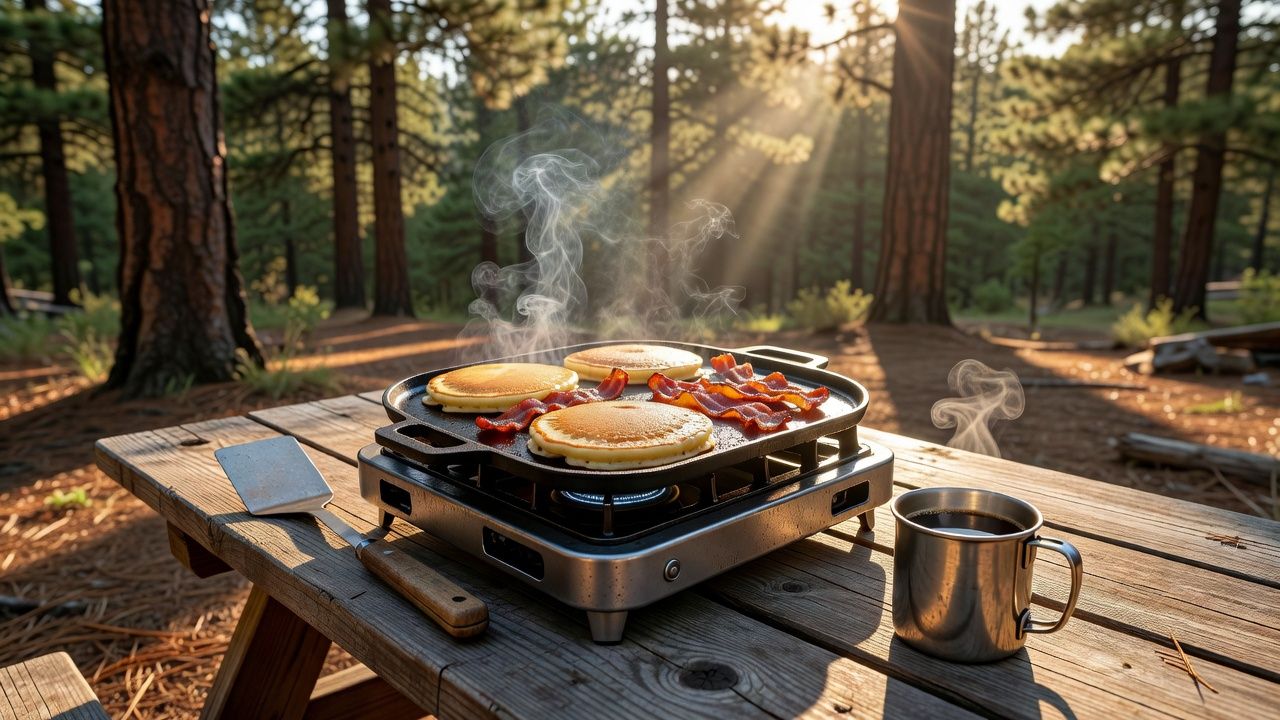
Quick Answer: Match the Griddle to Your Burner Layout
- One burner? Buy a round cast iron griddle (10.5-inch is the sweet spot). Round plates sit flat over a single burner ring and are the most forgiving fit on the market.
- Two burners? You have two options: a rectangular griddle plate sized to your stove's grate, or two round griddles — no, seriously. Two round plates over two burners give you independent heat control and zero rocking.
- Want a griddle built in? A grill-first stove (like the Coleman RoadTrip 225 or the Coleman 2-in-1) gives you a wider cooking box from the start, and you add a plate on top rather than fighting a narrow grate.
- Cooking for a crowd? Step up to a two-burner propane stove with a wide grate — the Camp Chef Explorer and Coleman Triton+ both have enough span to hold a large plate flat.
If you only remember one thing: measure the grate opening before you buy the plate. Details below.
The Three Griddle Types That Work on Camp Stoves
Round cast iron griddles
Round is the shape people skip, and it's usually the wrong call to skip it. A round plate sits on a single burner grate with contact on all sides, so it can't rock the way a long rectangle can when the grate sags in the middle. A 10.5-inch round griddle is wide enough for four pancakes, two eggs, and a row of bacon — enough for a family breakfast if you cook in batches and hold food on a plate.
The tradeoff is batch size. You will not cook twelve pancakes at once. You'll cook four, twice. For most weekend family trips that's a non-issue.
Our catalog pick here is the Lodge Round Seasoned Cast Iron Griddle — 10.5 inches, pre-seasoned, about $24.90 with a 4.7-star average across roughly 8,200 ratings. Cast iron is the right material for a griddle specifically because of thermal mass: it holds heat through the moment cold batter hits the surface, which is exactly where thin nonstick plates fail.
Rectangular griddle plates
A rectangular plate is what you want if your stove is a two-burner propane model with a flat grate running the full width. You get a much larger cooking surface — often double — and you can run a cool zone on one side and a sear zone on the other.
The catch is support. A wide plate needs grate support at both ends. If your stove's grate only supports at the outer edges and the plate spans an unsupported gap in the middle, it will dip toward the burner, and the center third of your pancakes will burn while the edges stay pale. This is the fit failure people blame on the griddle.
Set the plate on the grate in the store or at home before you trust it with breakfast. If you can press the middle down with one finger and feel it flex, return it.
Grill-first stoves and 2-in-1 units
Some stoves come halfway to a griddle already. The Coleman RoadTrip 225 is a tabletop two-burner grill with a domed lid and a wide cooking box — about $199.99, 4.5 stars over roughly 1,079 ratings. The Coleman Tabletop 2-in-1 Grill/Stove stacks a grill section and a stove section in one unit at about $166.01, rated 4.4 over nearly 3,000 ratings.
Buy one of these if you want grill marks and a griddle in one footprint. Buy a plain two-burner stove instead if you mainly want flat-top cooking and better wind protection — a stove's side panels and grate are built for a pot, and a pot-shaped support is not automatically a griddle-shaped support.
Will It Fit? The 30-Second Measurement
Do this before you buy any griddle plate:
- Measure the grate opening, not the stove. Lay a tape across the widest unsupported span between grate bars. If that span is more than about 80% of your plate's width, the plate will rock or dip.
- Check how the grate sits. Wire grates (thin rods) bite into a heavy cast iron plate and stay put. Stamped steel grates with a raised lip in the middle will tip a round plate.
- Confirm your burner spacing. On a two-burner stove, the burners are usually close enough that a single wide plate covers both — which means both burners heat all of the plate. That's great for even heat and terrible for temperature control, because you can no longer run one side cool.
- Weigh it against your stove. A heavy cast iron plate on a lightweight folding stove with thin legs is a tip hazard, especially on a picnic table. Cast iron plus a full griddle of food is a real load.
- Think about wind. An exposed plate on a windy ridge loses heat fast. A windscreen or a stove with folding side panels is worth more than a bigger griddle.
| Griddle shape | Best stove match | Cooking surface | Watch out for |
|---|---|---|---|
| Round cast iron (10.5 in) | Single burner; one burner of a 2-burner | ~4 pancakes + eggs | Small batches |
| Rectangular plate | 2-burner propane stove, full-width grate | Double the round plate | Center sag on short grates |
| Built-in grill box | Grill-first stoves | Wide, covered | Loses the flat-top feel |
Best Griddles for a Camp Stove
These are the setups our readers actually buy. Prices and ratings are from our catalog.
Best universal pick: Lodge Round Cast Iron Griddle
The Lodge 10.5-inch round griddle is the cheapest way to find out whether flat-top camp cooking is for you. About $24.90, pre-seasoned, and it lives on any single-burner stove — including the cheap butane models most first-timers own. Round shape, so it fits a burner ring instead of fighting it.
Best for: single-burner stoves, one-pan breakfasts, anyone who wants to test griddle cooking for under $30.
Best two-in-one: Lodge Cast Iron Combo Cooker
The Lodge Cast Iron Combo Cooker is a 3.2-quart deep pot with a 10.25-inch skillet that doubles as its lid. Flip the skillet over and its face works as a shallow griddle; keep it as a lid and you get a dutch-oven setup for chili or cobbler. About $49.97 with a 4.7-star average over roughly 15,800 ratings — it's the single most versatile piece of camp cookware we sell.
Best for: campers who want a griddle and a pot without packing both.
Best cast iron workhorse: Lodge 10.25-inch skillet
If you'd rather have one pan that does everything than a dedicated griddle plate, the Lodge 10.25-inch skillet is around $19.99 with a 4.7-star average across a staggering review count. A skillet has walls, which makes it worse for pancakes and better for anything with grease or sauce. It's also the pan most people already own.
Best for: one-pan campers who cook as much dinner as breakfast.
Best non-cast-iron option: Stanley Adventure All-in-One Fry Pan Set
Cast iron is heavy, and some people don't want to carry it. The Stanley Adventure All-in-One Fry Pan Set is a 9-piece stainless set that nests into almost nothing, about $80.49 with a 4.5-star average. Stainless heats faster than cast iron and loses heat faster too — preheat longer than you think you need to, and expect the first pancake to be a test pancake.
Best for: backpackers and anyone packing light.
Best systems to build a griddle around
For a full flat-top setup, start from the stove:
- Camp Chef Explorer Two-Burner Stove — about $127.99, 4.7 stars over roughly 9,400 ratings. Two large burners and a wide grate; the most flat-top-friendly stove we carry.
- Coleman Triton+ 2-Burner Propane Stove — about $149.99, 4.7 stars across roughly 21,000 ratings. The default family car-camping stove, with folding side panels that double as wind protection.
- Gas One GS-3400P Dual Fuel Stove — about $34.99, 4.5 stars over 14,000+ ratings. Runs propane or butane, single burner, pairs perfectly with a round griddle.
- Coleman Classic 1-Burner Butane Stove — about $29.99. The cheapest path to a griddle breakfast, with one caveat: butane struggles in the cold.
- Stanley Wildfare Core 26-Piece Camp Kitchen Set — about $89.99. If you're building the whole camp kitchen at once, this covers the tools and utensils.
Cast Iron vs Nonstick on a Camp Stove
Cast iron wins on heat retention, durability, and griddle-specific behavior: it sears, it holds temperature when food goes on, and you can scrape it with a metal spatula — which is the only tool that works on a flat top. It loses on weight and preheat time.
Nonstick plates are lighter and heat faster, and they fail in one specific way on a camp stove: a thin plate over a hot burner develops hot spots, and nonstick coating dislikes hot spots. Worse, you can't use a metal spatula, so you cook with plastic and never get a proper scrape.
Most campers end up with cast iron for the griddle and keep a lighter nonstick pan for the things cast iron is bad at — eggs over easy, delicate fish, anything acidic.
Griddle Cooking Basics at the Campsite
Preheat longer than you think. Five minutes on medium for cast iron before the first pancake. Skip this and the first two batches stick, no matter how well seasoned the pan is.
Use the fat. A thin film of oil or butter across the whole surface, not a puddle in the middle. On an uneven grate, fat pools to one side and tells you exactly how far off level your plate is.
Manage grease deliberately. A flat top produces a lot of fat, and bacon grease running off the edge of a picnic table is how you attract wildlife. A griddle with a grease trough that drains into a cup is worth the extra dollars. If yours doesn't have one, foil-line a small metal cup and park it at the low corner of the plate.
Work in zones. Even on a single burner you can create a hot center and a cooler edge by moving food outward as it finishes. On a two-burner setup, run one burner low as a holding zone — this is the entire advantage of a big plate, and most people never use it.
Cook the same thing together. A griddle is a batch tool. Mixing pancakes, eggs, and bacon on the same surface at the same time means something is always either raw or rubbery. Do the bacon first, hold it, then the eggs, then the pancakes.
Camp Stove Griddle Cleanup
Do this at the campsite, not at home — a greasy griddle tucked into a car for six hours is a smell you don't want.
- Scrape while warm. Push the residue into the grease cup with a metal spatula. Never use the plastic one.
- Wipe, don't soak. Paper towel or a rag, while it's still warm enough to cooperate.
- Hot water and a stiff brush for anything stuck. A little mild soap is fine on modern pre-seasoned cast iron — the old "never any soap" rule is a holdover from when dish soap contained lye. Skip it if you'd rather be traditional, but don't fear it.
- Dry it fully on the burner. Thirty seconds of heat drives off the water. Then a thin wipe of oil.
- Store it dry and separated. Cast iron against cast iron in a bin chips seasoning.
For a full walkthrough, our camp stove cleaning guide covers burners, grates, and the body of the stove itself.
If the question you actually have is how long the fuel lasts rather than what to cook on it: a 22-inch griddle drains a green 1 lb cylinder in under an hour. The propane canister run-time math lists hours per appliance, griddles included.
Common Griddle Mistakes (Learn From Mine)
Buying the plate before measuring the grate. I did this. The plate lived in the garage for a year.
Treating a flat top like a frying pan. A griddle is for surface contact — hash browns, pancakes, smash burgers, bacon. It's a bad pot for sauces, rice, or anything liquid.
Leaving the second burner on high. On a two-burner stove under a wide plate, both burners heat the whole surface. Two high burners means a 600-degree center and a burnt breakfast. Light one, keep the other at a whisper.
Skipping the windscreen. A windy morning turns a griddle into a heat-loss experiment. Our camp stove windscreen and wind protection guide covers the cheap fixes.
Never seasoning a new plate. Pre-seasoned means "has a start on it," not "done." Cook bacon on it the first three times.
Forgetting the fuel math. A two-burner griddle breakfast burns more fuel than a pot of oatmeal. If you're on a 1-pound propane tank, check our 1 lb propane tank buyer's guide before you plan a griddle weekend.
Camp Stove Griddle FAQ
Can you use a griddle on any camp stove?
Any stove with a stable grate that can hold the plate flat, yes. The limitation is fit, not the stove: a plate that spans an unsupported gap will dip and burn food in the middle. Round griddles over a single burner have the fewest fit problems by far.
Do you need a two-burner stove for a griddle?
No. A round 10.5-inch griddle on a single burner handles a family breakfast in two batches. A two-burner stove with a wide plate gives you a larger surface and a holding zone, which matters more for dinner for four than for pancakes.
What size griddle fits a Coleman camp stove?
Measure the grate opening on your specific model first — Coleman stoves range from a single burner to full-width two-burner grates. As a rule, a plate should span no more than about 80% of the widest unsupported gap between grate bars, and a round 10.5-inch griddle fits any single burner.
Is cast iron or nonstick better on a camp stove?
Cast iron for the griddle itself — heat retention, metal-spatula scraping, and no coating to damage. Nonstick stays useful for eggs and delicate food in a separate pan. Most experienced camp cooks carry both.
How do you keep food from sticking to a camp griddle?
Preheat for five minutes on medium, oil the whole surface thinly, and don't crowd the plate. Sticking is almost always a cold-plate problem, not a seasoning problem.
How much fuel does griddle cooking use?
Noticeably more than boiling water, because a flat top radiates heat off a large exposed surface and needs a long preheat. Plan on meaningfully more fuel for a griddle weekend than for a coffee-and-oatmeal weekend, and see our propane vs butane vs isobutane fuel guide if you're deciding which canister to buy.
Griddle cooking is what a camp lunch is built on — camping lunch ideas covers griddle quesadillas, foil packets and the 15-minute hot lunches that fit one pan.
The Bottom Line
Start with a round cast iron griddle and the stove you already own. Measure the grate, preheat properly, oil the surface, and cook one thing at a time. That's a $25 upgrade that changes breakfast more than any other camp kitchen purchase.
Then, if you find yourself wanting more surface, buy the stove before the plate — a two-burner propane stove with a wide grate is what actually unlocks flat-top cooking for a group. Our car camping stove comparison and the single-burner vs two-burner breakdown cover that decision in detail, and the camp kitchen setup guide covers everything else you'd put on the table.
Happy cooking from the TrailMapz team.
Related: Camp Stove Simmer & Heat Control Guide — why cheap burners scorch, the 60-second simmer test to run before you buy, and the cast-iron fix for a stove with no low setting.
Related: Camp Stove BTU Guide: How Many BTU Do You Really Need? — BTU by group size, boil times at 8,000 vs 11,000 BTU per burner, and the fuel-burn math behind why a big flame is not always the better stove.
Related: Camping Table & Camp Stove Station Guide — what a griddle needs from the surface under it, plus locking legs and heat barriers that protect the tabletop.
A wide griddle plate is the classic way to push a small burner rich and get a yellow flame — the camp stove flame color guide explains the pot-size rule behind it.
<!-- AFFILIATE_DISCLOSURE -->TrailMapz is reader-supported. When you buy through links on our site, we may earn an affiliate commission at no additional cost to you. Prices and ratings reflect our catalog at the time of writing.