Camp Stove Simmer & Heat Control Guide 2026: Which Stoves Actually Simmer
Which camp stoves can truly hold a simmer? Real valve behavior, BTU and burner-size limits, a 60-second field test, plus the cast-iron trick that fixes a scorching burner.
A camp stove that cannot simmer turns a $6 steak into a $6 hockey puck and turns "rice in 20 minutes" into a 45-minute, half-burnt science experiment. It is the single most common complaint in camp stove reviews, and almost nobody checks for it before buying.
Quick answer: buy for burner diameter and valve behavior, not BTU. The stoves that reliably hold a low flame are the ones with a wide, multi-ring burner and a valve that keeps moving through the low end of its travel — the Camp Chef Explorer two-burner ($127.99, 4.7★) for a family car-camping setup and the Coleman Triton+ 2-burner ($149.99, 4.7★) if you want push-button ignition and a smaller pack size. High-BTU single-burner stoves — including most backpacking canister stoves and the Coleman Bottle Top ($21.99) — are built to boil water fast, and boil is what they do. If simmering is non-negotiable and your stove is already a torch, the fix is a heat diffuser or a heavy cast-iron vessel, which I cover below.
The rest of this guide explains why burners behave that way, gives you a 60-second test you can run on any stove in a shop or on your own tailgate, and lists the stoves in our catalog that hold low heat well — plus the ones that honestly do not.
Quick Answer: Which Camp Stoves Actually Simmer
- Best low-end control: Camp Chef Explorer Two-Burner — $127.99. The best controllable low flame in the catalog, with two independent burners.
- Best budget simmer: Gas One GS-3400P — $34.99. Holds a real simmer on either butane or propane.
- Solid car-camping pick: Coleman Triton Two-Burner — $149.99. A dependable workhorse, but the low end is coarser than the Camp Chef.
- Fast but not gentle: MSR PocketRocket 2 — $49.95. Boils fast and simmers poorly. Buy it for weight, not for sauces.
- The trick most people miss: Lodge Cast Iron Griddle — $24.90. Cast iron is a heat buffer, and it rescues a stove that runs too hot.
- Finest control of all: MSR WhisperLite Universal — $149.95. Liquid fuel lets you dial the flame down finer than any canister stove.
Why Camp Stoves Scorch (It Is Not Just BTU)
Most people assume a 30,000 BTU burner will scorch and a 10,000 BTU burner will not. In practice, raw BTU tells you how fast a stove heats, not how gently it can cook. Three other things decide whether a simmer is even possible.
Burner diameter and port pattern. A wide burner with dozens of small ports spreads heat across the bottom of a pot. A small burner concentrates the same output into a fist-sized hot spot under the center of the pan — which is exactly where your rice is sitting. This is why a modest 2-burner car-camping stove often holds a better simmer than a high-output backpacking stove with a narrow burner head.
Valve travel at the low end. This is the real bottleneck. On a cheap stove, the first three degrees of valve rotation go from off to full blast, because all the usable needle travel is packed into the first quarter-turn. A better valve spreads that same range across most of its rotation, so you can actually land on "gentle". You cannot see this in a spec sheet, which is why reviewers keep complaining that a stove has "two settings". If you want the underlying fuel and canister mechanics, our propane vs butane vs isobutane fuel guide covers what is actually burning when you open that valve.
Pot material and thickness. A thin aluminum pot responds to flame changes instantly and has no thermal mass, so a slightly too-high flame scorches within seconds. Cast iron and heavy stainless spread and hold that heat, smoothing out a burner's jumpy low end. This is the single cheapest upgrade you can make, and it is why a Lodge combo cooker ($49.97, 4.7★) often out-cooks a stove three times its price.
Wind. A breeze pushes flame sideways and forces you to open the valve further to compensate — then the gust dies and you are boiling. Wind protection is a heat-control feature, not just a fuel-saving one; see our camp stove windscreen guide for what is safe to use around a canister.
The 60-Second Simmer Test (Run This Before You Buy)
You can evaluate almost any stove with a small pot of water and 60 seconds. Do this in the store on a display unit, or on your own stove at home before you trust it with dinner.
- Fill a small pot with about two cups of water — enough to see motion, not enough to take ten minutes.
- Light the burner and turn the valve down as far as it will go while staying lit. Most stoves have a point just above where the flame dies out. Find it.
- Watch for 30 seconds. A good simmer shows a lazy ring of small bubbles climbing the sides, with the surface moving gently. A bad one shows a rolling boil you cannot dial down, or a flame that pops out the moment you touch the valve.
- Try to move the valve through the low range. If a 5-degree turn takes you from barely-lit to boiling, the low end is too compressed and no amount of technique will fix it.
- Lie the lid slightly ajar and check again — many stoves behave differently under a covered pot, and you will be covering your pot when it matters.
Failed the test? You have three honest options: add a heat diffuser plate, switch to heavy cast iron, or buy for burner width next time. All three are covered below.
Camp Stoves That Hold a Real Simmer
These are the stoves in our catalog that owners consistently describe as having usable low-flame control, ordered by how well they handle a genuine family cooking session.
Camp Chef Explorer Two-Burner — Best Simmer Control in a Family Stove
The Camp Chef Explorer ($127.99, 4.7★, 9,400+ reviews) is the pick when cooking quality outranks pack size. Two 30,000 BTU cast-aluminum burners give you headroom for a big pot of chili on one side and a low simmer on the other, and the wide burner heads spread heat across the pan instead of drilling it into one spot. It comes on a stand with a three-sided windscreen, which matters more than most buyers expect: fewer valve adjustments to fight the wind means a steadier low flame all evening. It is a car-camping stove — you are not carrying it anywhere — but for a family cooking real meals at a picnic table, it is the one.
Coleman Triton+ 2-Burner — Best Value Simmer Control
The Coleman Triton+ ($149.99, 4.7★, 21,000+ reviews) is the practical middle ground. Two ~11,000 BTU burners with push-button InstaStart ignition, a compact fold-down footprint, and — the point of this article — a low end that owners describe as genuinely usable for simmering sauces and reheating without scorching. It runs on standard 16.4 oz propane cylinders or a bulk hose, which keeps running costs low on a long trip. If your last stove's problem was "blast or nothing", this is the upgrade that solves it without going to a full camping kitchen.
Gas One GS-3400P — Best Budget Dual-Fuel
The Gas One GS-3400P ($34.99, 4.5★, 14,200+ reviews) is the cheapest way onto this list. It runs on propane or butane, so you can switch fuel with the season, and its two burners have a lower ceiling than a high-output stove — which is a feature here, not a bug. Lower peak output means the first quarter-turn of valve travel is not already past the temperature you wanted. Read the propane vs isobutane cold-weather breakdown if you plan to use it in shoulder-season cold, because butane quits around 31°F.
Backpacking Stoves: Expect Boil, Not Simmer
Be honest with yourself about the category. Canister stoves like the MSR PocketRocket 2 ($49.95, 4.8★, 3,800+ reviews) and the AOTU piezo-ignition stove ($12.99, 4.6★, 6,500+ reviews) are engineered around one goal: boil water as fast as possible for as little weight as possible. The PocketRocket 2 weighs 2.6 oz and boils a liter in about three and a half minutes — spectacular for dehydrated meals, and genuinely difficult to hold at a low simmer because its burner head is small and its valve range is short. If you backpack and also want real cooking control, the MSR WhisperLite Universal ($149.95, 4.7★) and its optional heat reflector and windscreen ($16.97) are the better answer, because liquid-fuel stoves give you a more gradual control range than a pressurized canister.
The Jetboil Flash ($119.95, 4.7★, 20,000+ reviews) is a different animal again: it is a personal boiling system and it is excellent at that, but you are not going to run a twenty-minute simmer in an integrated flux-ring pot. Buy it for fast meals, not for sauces.
BioLite CampStove 2+ — Great, With a Caveat
The BioLite CampStove 2+ ($199.95, 4.3★) burns twigs you gather on site and charges a phone from the fire, which is a genuinely great thing to own. It is also the hardest stove on this list to hold at a low simmer, because wood combustion does not have a valve — you control it by feeding fuel, which is inherently stepped. If you love the concept but want control, treat the wood stove as your fire and move the pot to cast iron over the coals, or keep it for boiling and use a canister stove for anything delicate.
Cast Iron: The Cheapest Fix for a Hot Burner
If you already own a stove with a compressed low end, you do not have to replace it. Heavy cookware is the single most effective heat-control tool at a campsite, and it does three things at once: it spreads the concentrated hot spot across the pan bottom, it stores heat so small flame fluctuations do not translate into temperature swings, and it keeps food warm long after the burner is off.
- Lodge 6-quart camp Dutch oven ($59.95, 4.8★, 22,000+ reviews) — the best simmering vessel in the catalog. Legs and a rimmed lid let you use coals underneath and on top, which gives you oven-like control with zero valve precision required. Stews, chili, and cobblers all work on a burner you cannot dial down.
- Lodge cast iron combo cooker ($49.97, 4.7★, 15,800+ reviews) — a deep pot and a skillet that nest, so the whole set takes one slot in the bin. The deep half is what smooths out a jumpy burner.
- Lodge 10.25-inch skillet ($19.99, 4.7★, 150,000+ reviews) and the small 6.5-inch skillet ($9.38) — for a quick sear or a single serving where you want the pan, not the flame, doing the regulating.
- Lodge round griddle ($24.90, 4.7★) — pancakes and eggs are the classic casualty of a too-hot burner, and a thick griddle is the standard fix. Our camp stove griddle guide covers flat-top cooking in detail.
Thin aluminum and lightweight backpacking cooksets do the opposite — they transfer every flame flicker straight into your food. The Stanley 9-piece fry pan set ($80.49) and the Mallome 17-piece mess kit ($32.99) are great value for lightweight trips, but pair them with a stove you have already tested, not one you are hoping will behave.
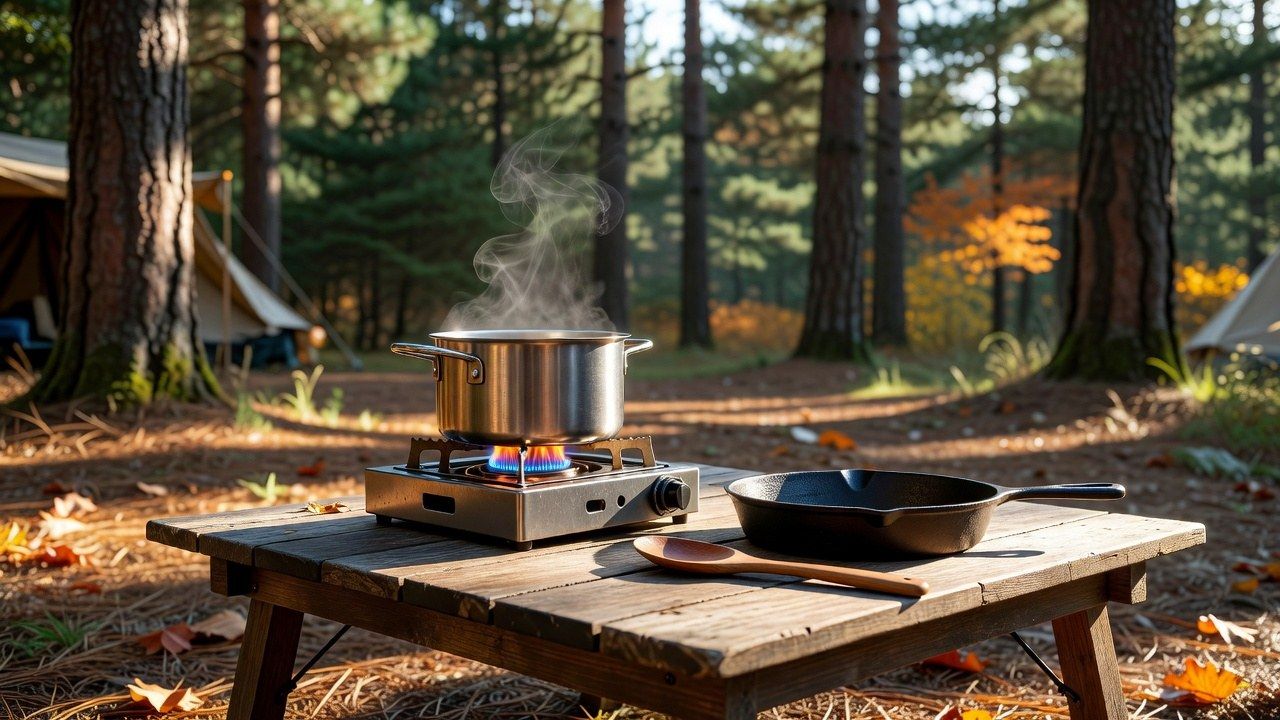
Five Ways to Hold a Simmer Without a Simmer Burner
Even a stubborn stove can be tamed. These are the field techniques that work, in rough order of how often I use them.
- Off-center the pot. Slide the pot so its center sits over the edge of the burner rather than directly on the hot spot. You can drop effective heat by a noticeable margin with zero equipment.
- Use the lid. A covered pot needs far less flame to maintain a simmer than an open one, which means you can run the valve lower than you otherwise could and still keep things moving.
- Pulse the burner. Instead of chasing a setting that does not exist, alternate between just-lit and off, letting the pot's own thermal mass carry the temperature. Cast iron makes this work; thin aluminum does not.
- Add a heat diffuser or a second pan. A diffuser plate between flame and pot spreads the hot spot. A cast-iron skillet used as a spacer does the same job with gear you already own.
- Block the wind. A gusty site forces you to run a higher flame than you want. Correct wind protection — used safely around canisters — buys back your low end. See the windscreen guide before you improvise anything around a fuel source.
And if the flame is not responding to the valve at all — surging, sputtering, or dying at every low setting — that is a maintenance problem, not a control problem. Work through the camp stove troubleshooting checklist before you replace the stove. A dirty burner with blocked ports is one of the most common causes of uneven, scorching heat, and it is free to fix: our how to clean a camp stove guide walks through the burner ports and the venturi tube step by step. If you run a bulk tank, confirm you are on the right hose, regulator, and adapter first — an undersized regulator can make any burner behave badly at the low end.
Low-end control also decides whether your coffee is good. A percolator needs a gentle perk rather than a boil, and cowboy coffee is ruined by a hard rolling boil — both are timing problems that a steady low flame solves. Our camp coffee guide walks through the percolator count-down and the no-heat cold brew alternative for mornings when you cannot light anything.
One Burner or Two? What Control Actually Costs
If you are choosing between a single-burner and a two-burner stove, control is not really the deciding factor — but burner count changes how you cook. A two-burner lets you hold a simmer on one side while boiling water on the other, which is the difference between cooking a real meal and assembling one. Our single-burner vs 2-burner guide breaks down the trade-offs, and the best camp stoves for car camping roundup covers the wider field. If you are still deciding what to cook on whichever stove you end up with, the camp cooking meal planning guide starts from meals that are forgiving of imperfect heat.
Budget also belongs here. A 12-pack of 16.4 oz Coleman cylinders ($64.99, 4.8★, 10,500+ reviews) is the cheapest per-ounce route if you car camp often, and if you are already wondering how far a canister goes, our how long a propane canister lasts guide does the runtime math. For backpackers, a 110 g MSR IsoPro canister ($8.95, 4.8★) is the standard threaded option.
Common Simmer Mistakes (Learn From Mine)
I have scorched rice at three national parks. Every one of these cost me dinner.
- Buying on BTU alone. "30,000 BTU!" tells you it heats fast. It says nothing about whether you can hold 240°F. Shop for burner width and read what owners say about the low end.
- Starting on high and trying to dial down. Once a thin pan is over-heated, turning the flame down does not un-scorch anything. Start lower than you think you need and creep up.
- Cooking in the wind and blaming the stove. Half the "this stove has no low setting" complaints I have read are wind complaints in disguise.
- Using a thin pot for a long simmer. Sauces, rice, and oatmeal want thermal mass. This is the one that repeat-offends me personally.
- Never cleaning the burner ports. A partially blocked burner gives you an uneven ring of heat that no valve setting can smooth out. Ten minutes of cleaning fixes what feels like a design flaw.
- Assuming a backpacking stove will behave like a kitchen range. It will not. Plan dehydrated or boil-based meals when you carry a canister stove, and save real cooking for the car-camping setup.
Camp Stove Simmer FAQ
Can you simmer on a camp stove?
Yes — but not on every camp stove. Two-burner car-camping stoves with wide burner heads and a gradual valve range simmer well; most high-output single-burner and backpacking canister stoves are tuned for boiling and have a compressed low end. If a stove will not hold a low flame, heavy cast iron cookware or a heat diffuser will get you a usable simmer anyway.
What is the best camp stove for simmering?
For a family car-camping setup, the Camp Chef Explorer two-burner is our pick because its wide cast-aluminum burner heads spread heat across the pan rather than concentrating it. The Coleman Triton+ 2-burner is the best value alternative, with a low end owners consistently describe as usable for sauces and reheating.
Why does my camp stove only have high and off?
Because the needle valve's usable travel is compressed into the first small part of its rotation. Cheap stoves often lack the finer machining and longer valve travel that let a burner hold a low flame. It is a design limitation, not a user error — and the practical fixes are a heat diffuser, heavy cast-iron cookware, or off-centering the pot over the burner edge.
How do I keep food from burning on a camp stove?
Three things, in order: use a pot with real thermal mass (cast iron or heavy stainless), protect the burner from wind so you are not forced to run a higher flame, and start at a lower setting than you think you need. If the flame surges or dies at low settings regardless, clean the burner ports — a partially blocked burner is a common cause of scorching.
Do heat diffusers work on camp stoves?
Yes, a diffuser plate placed between the flame and the pot spreads the burner's hot spot and can turn an unusable low end into a workable simmer. A cast-iron skillet used as a spacer under a lighter pot achieves much the same result with gear you likely already carry.
The Bottom Line
Simmer control comes down to burner width, valve travel at the low end, and how much thermal mass is sitting on the flame — in that order. If you are buying, choose a two-burner stove with wide burner heads over a high-BTU single-burner: the Camp Chef Explorer for a family setup, the Coleman Triton+ for value and a smaller pack. If you already own a torch of a stove, do not replace it yet — add a Lodge Dutch oven or a cast iron combo cooker, block the wind, and run the test above. Most "bad" camp stoves are just hot stoves held by people who never got a low setting to work.
Related: Camp Stove BTU Guide: How Many BTU Do You Really Need? — BTU by group size, boil times at 8,000 vs 11,000 BTU per burner, and the fuel-burn math behind why a big flame is not always the better stove.
Related: Camping Table Buying Guide + Stove Station Setup — a level, stable surface is half of heat control. Here's how to build one without wobble.
A burner that will not hold a low blue flame is often the same rich-mixture problem — the camp stove flame color guide explains why a flame goes yellow at low settings and what fixes it.
<!-- AFFILIATE_DISCLOSURE -->TrailMapz earns a commission on qualifying purchases made through links in this article, at no extra cost to you. Prices and ratings reflect our catalog at the time of writing — always confirm current pricing before checkout.