Camp Stove Propane Hose, Regulator & Tank Adapter Guide (2026)
Which propane hose, regulator or 1 lb to 20 lb adapter your camp stove needs - plus freezing, PSI, RV quick-connect and leak-test answers for 2026.
There's a specific moment every car camper hits. You've bought the tabletop stove, you've bought the little green cylinders, and then you do the math: a 1 lb cylinder costs $5–7 at the campground store and lasts one weekend of real cooking. A 20 lb refill costs about $20 and lasts a whole season.
So you start searching for "camp stove propane hose" — and immediately drown in fittings. There's a 1 lb to 20 lb adapter, a 20 lb to 1 lb converter, a 10-foot hose assembly, a fuel filter, and a guy on a forum telling you to just refill the green bottles yourself.
This guide sorts all of it out. No part numbers memorized, no guesswork.
Quick Answer: What You Actually Need
There are three separate jobs, and people constantly buy the wrong part for the wrong one:
- Run your stove from a 20 lb tank all weekend → you need a hose assembly with a regulator made for low-pressure propane appliances. This is the cheapest way to cook on bulk fuel. Our pick is the Mr. Heater 10-Foot Propane Hose Assembly at $17.99.
- Refill your own 1 lb cylinders from a big tank → you need a Gas One 1 lb to 20 lb Refill Adapter with 4-ft Hose ($14.99) or a bare brass GASPRO 20 lb to 1 lb Adapter ($9.98).
- Stay on disposable cylinders but stop overpaying → buy the Coleman 16.4 oz 12-Pack ($64.99) and pay about $5.40 per cylinder instead of $8 at the camp store.
If your stove is a big two-burner like the Camp Chef Explorer or Coleman Triton+, bulk propane is what it was designed for. If it's a pocket-sized backpacking stove, none of this applies — that's a different fuel system entirely (see our butane vs isobutane breakdown).
The Three Fittings, Explained Without Jargon
Here's the part nobody tells you: "adapter" is used for two completely opposite jobs, which is why the search results are useless.
- A refill adapter moves fuel out of a big tank into a small cylinder. Use it at home, before the trip.
- A hose assembly moves fuel from the big tank to the appliance while you cook. Use it at the campsite.
- A filter sits inline on that hose and catches the oily contaminants that some bulk propane carries.
| Job | What you need | Approx. cost | Our pick |
|---|---|---|---|
| Cook all weekend on a 20 lb tank | Hose assembly w/ regulator | $15–25 | Mr. Heater F273704, $17.99 |
| Refill 1 lb cylinders from bulk | 1 lb ↔ 20 lb refill adapter | $10–15 | Gas One refill adapter, $14.99 |
| Cheapest brass option for refilling | 20 lb → 1 lb brass adapter | $9.98 | GASPRO Solid Brass, $9.98 |
| Legal, DOT-compliant refillable bottles | Refillable 1 lb cylinder + kit | $59.99 | Flame King refillable, $59.99 |
| Protect the appliance | Inline propane fuel filter | $15.97 | Mr. Heater F273699, $15.97 |
| Bulk-buy disposables | 12-pack of 16.4 oz cylinders | $64.99 | Coleman 12-Pack, $64.99 |

Option 1: Run the Stove Off a 20 lb Tank (Best for Weekends)
This is the setup that makes the most financial sense for car camping. A 20 lb tank holds roughly 20 times the fuel of a 1 lb cylinder. Even at $20–25 per refill, you're cooking for pennies per meal instead of dollars.
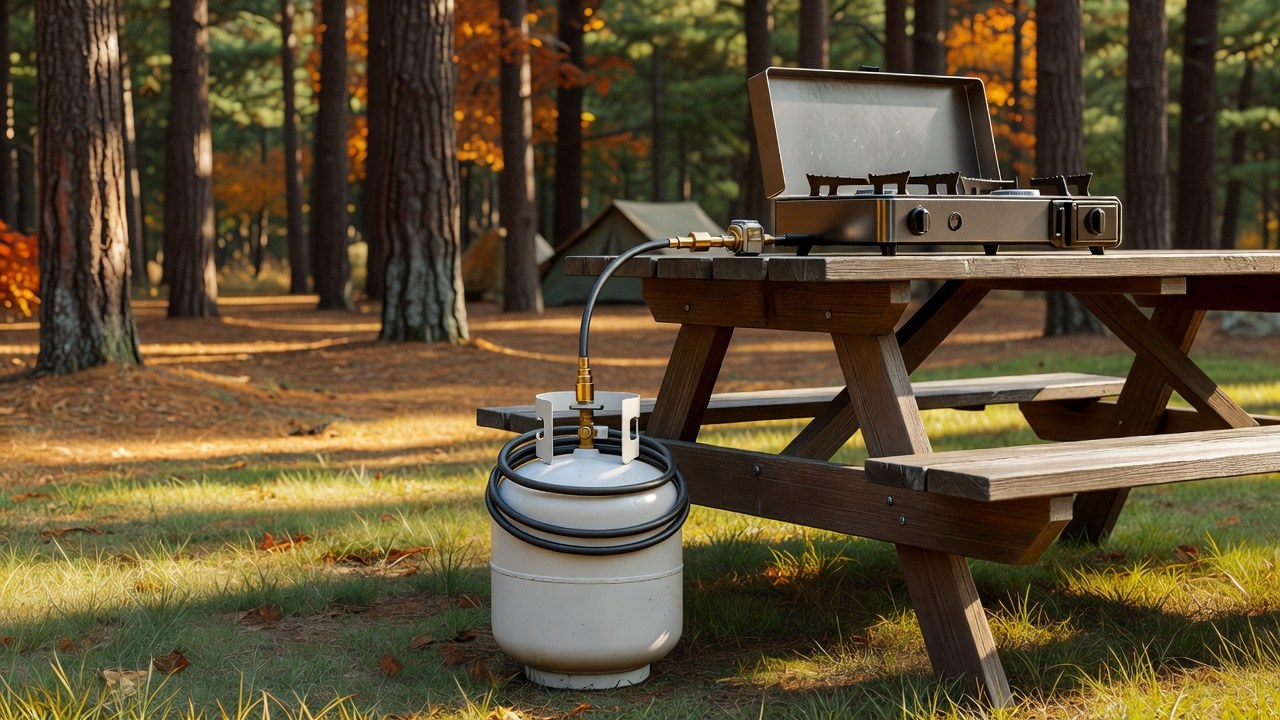
The Mr. Heater F273704 Hose Assembly is a 10-foot hose rated for low-pressure propane appliances, with 6,400+ ratings at 4.6 stars. Ten feet matters more than you'd think — it's the difference between the tank sitting awkwardly under your feet at the picnic table and it sitting safely off to the side of the cooking area.
Two things to check before you buy any hose:
- Does your stove accept a bulk connection? Most two-burner propane stoves (Coleman Triton+, Camp Chef Explorer, the Coleman Tabletop 2-in-1) are built to take a hose and regulator. Many tabletop single-burners that screw directly onto a cylinder are not — they expect the cylinder's own outlet.
- Is a regulator included? Bulk tanks push out high-pressure liquid propane. Your appliance needs it stepped down to low pressure. A hose without a regulator is the wrong part for most stoves.
If you're cooking for a group and want one purchase that solves everything, the Camp Chef Explorer Two-Burner Stove ($127.99, 4.7 stars, 9,400+ ratings) is the classic bulk-tank workhorse. It's the stove you see at every Scout campout, and it's designed from the ground up to run off a big tank.
Option 2: Refill Your Own 1 lb Cylinders
If you love your little tabletop stove and don't want to change it, this is the other path — refill the green cylinders yourself from a 20 lb tank.
The Gas One Refill Adapter with 4-Ft Hose ($14.99, 4.5 stars, 344 ratings) gives you the hose and fitting to transfer propane from a bulk tank into a standard 1 lb cylinder. The GASPRO Solid Brass 20 lb to 1 lb Adapter ($9.98, 4.6 stars, 3,460+ ratings) does the same basic job as a bare brass fitting with no hose, which is cheaper but more fiddly to work with.
Here's the honest safety position, and we're not going to soften it: refilling a disposable cylinder that was manufactured as non-refillable is prohibited by U.S. DOT rules for transportation, and it's genuinely risky — overfilling a thin-walled bottle with no relief valve is how people get hurt. The refill adapters exist and people use them, but the reason they're sold as a niche fitting rather than a mainstream accessory is exactly this.
If you want to refill legally and safely, the correct answer is a cylinder that was built to be refilled. The Flame King Refillable 1 lb Propane Cylinder with Refill Kit ($59.99, 4.6 stars, 2,967+ ratings) is DOT-compliant and ships with the refill kit, so you're using the fuel system the way it was engineered. It costs more up front than a single adapter and pays for itself within a season.
Option 3: Stay on Disposables, Just Stop Overpaying
Sometimes the boring answer is the right one. If you camp four weekends a year and cook one dinner per trip, a 20 lb tank is overkill — now you're storing a large propane cylinder, hauling it, and getting it recertified a decade from now.
Buy the cylinders in bulk instead. The Coleman 16.4 oz Propane Cylinder 12-Pack ($64.99, 4.8 stars, 10,500+ ratings) is roughly $5.40 per cylinder versus $7–8 at a campground store. It's the standard 1 lb cylinder that fits virtually every tabletop camp stove, and buying 12 at once means you're never making a panic purchase at the camp store on a Friday night.
Does Your Stove Need a Propane Filter?
Probably not — but if you've ever had a heater or stove get a clogged jet after a tank swap, you know why these exist.
The Mr. Heater F273699 Universal Propane Fuel Filter ($15.97, 4.7 stars) sits inline between the hose and the appliance and traps the oily residue that can ride along with bulk propane, particularly from tanks that have been refilled many times. It's a $16 part that protects a $130 appliance, which is a trade most people make happily once they've cleaned a gunked-up burner jet.
Regulator Problems: Leaks, Weak Flames, and Yellow Tips
Most "my camp stove isn't working" complaints trace back to the fuel connection, not the stove. Our camp stove troubleshooting guide covers the full diagnostic tree, but three symptoms are specific to hose-and-regulator setups:
Weak flame on a bulk tank but fine on a 1 lb cylinder. The regulator is the usual suspect — either it's a low-output regulator, or it's the wrong pressure class for the appliance. Check that the hose assembly you bought is rated for low-pressure appliances, not for a high-pressure torch or a weed burner.
A roaring, yellow-tipped flame. That's typically a fuel/air problem and often an overpressure or wrong-orifice issue. Yellow tips on propane mean incomplete combustion, which produces carbon monoxide. Stop cooking, shut the tank valve, and don't use it until you've sorted out the regulator.
A faint gas smell at a connection. That's the one you treat as real, immediately. Which brings us to the test nobody does.
The 60-Second Leak Test (Do This Every Time You Swap a Tank)
This is the single highest-value habit in this whole article, and it takes a minute:
- Assemble everything outdoors, away from any flame, with the tank valve closed.
- Mix dish soap and water — about a tablespoon to a cup, in a spray bottle if you have one.
- Brush or spray it on every connection: tank valve to hose, hose to regulator, regulator to appliance. All of them.
- Open the tank valve slowly and watch.
- Bubbles growing at any joint = a leak. Close the valve, re-seat or re-tape the fitting, and test again. No bubbles after 30 seconds = you're good.
The thing people get wrong: they check the tank-to-hose joint and skip the regulator-to-appliance joint, which is where a surprising share of leaks actually are. Test every joint, every time.
RV Quick-Connect and the Propane Camp Stove Regulator Question
The most common reason a camp stove "won't work off my RV" is not a thread mismatch — it is a pressure-class mismatch. An RV's exterior propane outlet and a 20 lb bulk tank deliver completely different pressures, and a stove has to be matched to the right one.
Propane Camp Stove Regulator vs an RV Quick-Connect Outlet
The quick-connect fitting on the outside of an RV (usually a quarter-turn 1/4-inch fitting under the awning or at the rear bumper) sits downstream of the coach's own regulator. In most US RVs that means the outlet is already at low pressure — on the order of 11 inches of water column, roughly 0.4 psi — and it exists to feed low-pressure appliances such as RV stoves, grills, and fire pits designed for that supply.
A 20 lb bulk propane tank is the opposite: full tank pressure, which runs well past 100 psi on a warm afternoon. That is exactly why any appliance hooked to a bulk tank needs its own regulator in the hose assembly.
So the question is not "which adapter fits" but "does my stove regulate its own pressure, or does it expect to be fed regulated pressure?" The Coleman Triton+ 2-Burner ($149.99) and the Camp Chef Explorer Two-Burner ($127.99) are bulk-tank appliances: they expect full tank pressure and come with (or need) a regulator hose.
Propane Camp Stove Adapter Hose: Which End Goes Where
There are two distinct hose families, and mixing them up is where people get hurt or get a stove that won't light:
- 1 lb appliance to QCC1 tank. Regulator built into the hose; the appliance is fed regulated low pressure. This is the standard bulk-tank conversion, and the fitting on the tank end is the large hand-tighten QCC1 nut most families already know from a BBQ grill. The Mr. Heater 10-foot hose assembly ($17.99) is a typical example of a regulator-and-hose assembly.
- RV quick-connect to low-pressure appliance. No regulator in the hose at all — the hose only carries already-regulated gas from the RV outlet. If you put a second regulator in this line you get a weak, sputtering flame, because you have regulated an already-regulated supply.
Add a filter when the appliance is sensitive: the Mr. Heater propane fuel filter ($15.97) traps the oil and debris that bulk tanks and older hoses shed, which is what clogs small orifices and turns a blue flame yellow.
If Your Stove Has Its Own Regulator, the RV Quick-Connect Won't Feed It
A tabletop stove or griddle with a built-in regulator is a high-pressure appliance — it is designed to see full tank pressure and reduce it itself. Fed from an RV's low-pressure quick-connect, it will barely light, and no adapter fixes that, because the problem is pressure, not threads.
Two honest routes, and both work:
- Run the appliance from its own bulk tank, independent of the RV system, with a QCC1 hose and regulator. Simplest, and it keeps your RV's quick-connect free for the grill.
- Buy the low-pressure version of the appliance, or a hose assembly specifically sold as an RV quick-connect conversion — these exist precisely for appliances with no internal regulator, such as RV two-burner cooktops and low-pressure fire pits.
What you should not do is run a bulk-tank hose with a bare adapter straight from the RV's quick-connect outlet and hope the stove's internal regulator sorts it out. Every one of these joints still gets the soapy-water test in the section above — the quick-connect fitting itself is a joint like any other, and it's the one people forget to check.
If you are stepping up from 1 lb disposables to a bulk tank for the first time, the 1 lb tank buyers guide covers what a 20 lb tank actually costs you per trip versus single-use cylinders.
Bulk Propane Safety at the Campsite
A few rules that are worth repeating because the failure modes are serious:
- Never run a propane appliance inside a tent, at all, for any duration. Carbon monoxide is odorless and builds fast in a closed space. Our tent heater guide covers why "just for a few minutes" is how people die.
- Keep the tank upright and off the ground if the ground is soaking wet — a rusted-out tank bottom is a leak waiting to happen.
- Transport bulk tanks upright and secured, with the valve closed, in a ventilated space. Never lay a 20 lb tank on its side in a hot vehicle.
- Store cylinders outside the living space of an RV, in a ventilated compartment — never in a sealed cabinet or under a bed.
- Never use a cylinder past its recertification date. Bulk tanks need requalification; if the collar date is stale, most refill stations will turn you away anyway.
If you're running a bigger setup — a two-burner plus a lantern plus a heater — our fuel canister safety and disposal guide covers what's safe to burn, what's safe to carry, and how to dispose of empties without getting flagged at a transfer station.
How Much Fuel Is This Actually Saving You?
Run the numbers once and the decision makes itself.
A 1 lb propane cylinder holds about 21,000 BTU. A 20 lb cylinder holds 20 times that. At $5.40 per disposable cylinder (bulk-priced, from our Coleman 12-pack pick), 20 cylinders' worth of fuel costs $108. A single 20 lb refill is typically $20–25.
For a season of weekend cooking, that's a savings of roughly $85 — more than paying for the hose assembly, the adapter, and a filter combined, in the first year. The math changes completely if you only camp twice a year, which is exactly why the disposable cylinder still exists.
For a deeper dive on burn times and how long each fuel type actually lasts, see our propane canister duration guide and the 1 lb tank buyer's guide.
Cold Weather Changes the Answer
One caveat that catches people out every fall: propane pressure drops in the cold. A bulk tank that roars in July can run sluggish at 25°F, and small 1 lb cylinders are worse because they have less thermal mass to draw on. If you're cooking into October and November, our cold-weather and high-altitude stove guide covers the workarounds — and if you're cooking in real wind instead, the windscreen guide is the companion piece.
And whatever setup you land on, keep it running properly — the camp stove cleaning guide walks through the burner and jet maintenance that keeps a regulator-fed stove burning blue.
How to Connect a Camp Stove to a 20 lb Propane Tank
If you have ever typed how to hook up a camp stove to a large propane tank at nine at night with the cooler already packed, this is the section you needed. The whole job is two threaded connections and one leak test, and it takes about four minutes once the right parts are on the table.
Start at the tank end. The question how to connect 20lb propane tank to camp stove is really a question about which fitting your stove uses: a 1 lb throwaway cylinder ends in a small threaded disposable valve, while a 20 lb tank ends in a wide QCC1 / Type-1 ACME nut with a handwheel. Between those two standards sits the adapter and hose that make the whole thing work, which is why how to use a 20lb propane tank with camp stove is the same answer every time — adapter, hose, regulator if your stove needs one, then leak test. When people ask how to attach propane tank to camp stove, the honest answer is that you never attach the tank directly: no camp stove threads onto a 20 lb cylinder without a hose.
The order matters more than the torque. To understand how to attach propane to camp stove setups that do not leak, work backwards from the burner. The hose connects to the stove's own inlet first, because that end is the one that has to sit still while you cook. The far end — regulator, then adapter, then tank — gets connected second, and the tank handwheel gets turned only a quarter turn at first, so a leak cannot become a torch. Anyone searching how to connect propane tank to camp stove for the first time usually tightens the tank end first and cross-threads the stove end, which is the single most common way to ruin a weekend.
Practically, how to connect propane tank to camp stove and how to use propane camp stove are the same skill: connect, listen, smell, soap. The same five steps answer how to use propane tank camping stove on a picnic table, and they are exactly what every set of camp stove instructions and camping stove instructions has said for years. The Coleman wordings — how to connect propane to coleman stove, how to connect propane tank to coleman stove, how to connect propane tank to coleman camp stove, how to connect propane to coleman camp stove, how to connect large propane tank to coleman stove, how to use 20 lb propane tank with coleman stove, and connect 20 lb propane tank to coleman stove — describe one procedure with one difference, which is the Coleman inlet thread. There is no shortcut through a lighter — check for leaks with soapy water before you ever click an igniter. Every old hand knows camp stove how to use instructions that came in the box say the same thing, and camping stove instructions from every manufacturer repeat it because the failure mode is fire.
What you are building at the campsite is a camp stove 20 lb tank rig that behaves like a home range. A 20 lb propane tank camp stove setup runs about 20 to 25 hours at a low simmer and roughly 8 to 10 hours with two burners going hard; a 20 lb propane tank stove used for one weekend breakfast and one dinner per day will last most families three to four camping seasons. That is why camp stove converter kits outsell replacement stoves.
Parts you actually need:
- A propane adapter for camp stove sized to your stove's inlet — the common sizes are 1/4 in inverted flare for Coleman-style tabletop stoves and 1/8 in or 1/4 in NPT on many two-burner units.
- A propane tank adapter for camp stove with QCC1 on the tank side.
- A propane adapter hose for camp stove long enough to keep the tank off the table — three feet is fine, five feet is comfortable.
- A propane tank hose for camping stove with a built-in regulator if your stove has none, or a plain high-pressure hose if your stove already has its own regulator.
- A camp stove adapter hose with the right end for your specific stove inlet.
- A camping stove adapter propane fitting, sold as a "bulk tank adapter" in most outdoor aisles.
- A camp stove connector or camping burner adapter for lanterns, griddles, and single-burner burners you also want on bulk fuel.
Two smaller pieces save a trip: a small propane hose adapter (1/4 in inverted flare to 1/4 in NPT) and a camp stove converter wrench so you can snug fittings without rounding them. If you own a backpacking stove, a propane adapter for backpacking stove or a plain backpacking stove adapter lets you run that canister stove from a bulk tank in base camp — it is the same trick at a much smaller scale. The camping stove adapter lpg sold in Europe does the identical job against a different cylinder standard. Two more parts round out the kit and are easy to forget: a camp stove propane hose adapter or camping stove propane hose adapter for stoves whose inlet is a flare rather than an NPT port, and a camping stove hose connector, camping stove hose extension or camping gas stove hose connector if the run needs to be longer or the fitting is a European cylinder standard. A spare camping stove propane tank hose costs less than a ruined breakfast.
Do You Actually Need a Regulator on a Camp Stove?
The honest answer to do you need a regulator for a camping stove is: look at the stove, not the hose. Most tabletop camp stoves — the Coleman two-burners, the Camp Chef Everest, the classic green suitcase stoves — carry a regulator built into the body or into the short pigtail that screws onto a 1 lb cylinder. If yours does, you must not add a second regulator; two regulators in series strangle the flow and you get a lazy yellow flame that looks like a fuel problem but is a plumbing problem.
So do i need a regulator for my propane stove turns into a measurement rather than an opinion. Count the regulator bodies between the tank and the burner. Zero means you need one in the hose. One means you are done. Two means remove one. The same logic answers do i need a gas regulator for camping stove and do i need a regulator for my gas stove: an appliance built for a regulated supply never wants a second stage, and an appliance built for high-pressure supply (a lantern, some single-burner burners, and most griddles) absolutely does.
If you are asking does a gas stove need a regulator because the flames are erratic at altitude or in cold, that is usually a pressure problem, not a missing part. The question why do you need a propane regulator has a two-part answer: to drop tank pressure from a variable 90–200 psi down to a stable 0.5–1 psi at the burner, and to keep that pressure stable as the tank empties and the temperature falls. That second job is the one campers notice.
The mechanical answer to what does a regulator do on a propane hose is a spring-loaded diaphragm that closes a valve the moment downstream pressure rises above the set point and opens it again when the burner draws gas. Understanding what is a propane regulator means understanding that it is a demand valve, not a filter and not a gauge — which is also how does a camp stove regulator work in one sentence.
If you want to know how to use a propane regulator, there is nothing to adjust on a factory camp-stove regulator: it is sealed and preset. Adjustable regulators exist, and they are covered in the pressure section below. If your stove has no regulator, buy a propane hose with regulator for camp stove rather than a tank-side regulator plus a separate hose; one assembly means one fewer threaded joint to leak. A propane regulator for camp stove or propane regulator for camping stove rated at 1 psi (often sold as a "low pressure" regulator) is the correct part for tabletop and two-burner stoves, while propane regulator camping kits sold in big-box stores sometimes ship with a 10 psi or higher unit meant for a turkey fryer — check before you buy.
Three accessories solve most complaints: a propane regulator hose adapter (lets a regulator feed a stove whose inlet is a different-thread flare), a propane hose regulator kit (hose, regulator, and adapter in one bag), and a propane regulator hose for grill if you also run a tabletop grill off the same tank. Nobody regrets carrying a spare — regulators fail at the campsite, not in the driveway.
Why Your Propane Regulator Freezes (and How to Stop It)
A frozen regulator is a physics event, not a manufacturing defect. Propane absorbs heat as it vaporises, the regulator body is where the pressure drop happens, and the moisture in the air condenses and freezes onto it. That is why the search why is my propane regulator freezing up spikes every October, and why the same household types why is my propane tank regulator freezing by December.
The symptom is always the same. You get a good flame for ten minutes, then it drops to a whisper. Someone in the group asks why is my propane regulator icing up, someone else asks why does propane regulator freeze up and why does my propane tank regulator freeze up, and both are describing the same cold, sweating regulator body. Left alone, why is my propane tank regulator freezing gets worse: the frost film thickens, flow falls further, and the burner eventually goes out mid-dinner.
What actually causes it, in rough order:
- A tank that is too small for the draw. A 1 lb cylinder feeding two 10,000 BTU burners will frost itself in twenty minutes. This is the most common reason why is the propane regulator freezing on a family weekend.
- A nearly empty tank. As the ratio of liquid to vapour drops, the surface area for heat exchange shrinks and the tank chills faster — the exact reason why is my propane regulator frozen is often a five-word answer: the tank is empty.
- Cold ambient air. Below about 40 F, propane's vapour pressure falls and the regulator works harder. High altitude makes it worse. This is why the question propane regulator not working in cold weather is really a question about vapour pressure.
- A regulator with a long, exposed body. Cast regulators with more surface area frost first. Insulation helps only if it covers the regulator, not the hose.
Fixes that work, in the order you should try them:
- Feed it from a bigger tank. A 20 lb cylinder solves most why is my lp regulator freezing up and why is my regulator freezing up on my propane tank complaints outright.
- Keep the tank as full as you can before a cold trip, and stand it off the frozen ground on a block.
- Warm the regulator with your hands, not a flame. A hand-warmer taped to the body is the field fix that works.
- Insulate the regulator with a sock or a wool hat — visibly crude, genuinely effective.
- Ask whether the setting itself is the problem. If your unit is a propane regulator 5 psi, propane regulator 10 psi, propane regulator 20 psi or propane regulator 30 psi model, the higher the number, the bigger the pressure drop per unit of flow. The marking on the body is your lp regulator psi or rv propane regulator psi rating — check it before you blame the weather.
Propane Regulator Not Working? Work This List First
When a regulator is genuinely dead, the flame is not weak — it is absent, or it changes height by itself with the tank valve untouched. But before you buy anything, rule out the six things that fake a regulator failure. In our experience, more than half of the searches for propane regulator not working but tank has pressure end at the tank rather than the regulator.
The tank is empty. Sounds obvious; it is the number one cause of propane tank regulator not working.
The excess-flow device tripped. Inside most QCC1 tank valves is a flow-limiting device that closes when it senses a sudden rush of gas — exactly what happens when you open the tank valve fast. The fix is to close everything, wait thirty seconds, and open the tank handwheel slowly. This single habit cures most reports of new propane regulator not working.
The stove's own regulator is competing with a second one. Search reports for camper propane regulator not working, dual propane regulator not working and rv propane regulator not working are all frequently two-regulators-in-series problems, especially when an RV owner adds a camp stove to an RV quick-connect outlet that is already regulated.
A hose has collapsed internally or is kinked. A propane regulator hose not working often reads exactly like a dead regulator: fine at first, starved under load. Bend the hose and watch the flame.
The regulator is not opening at all. A propane regulator not opening usually means a stuck internal seat after storage. Tapping the body gently helps; if it does not, replace it rather than rebuild it.
The valve is stuck or the knob was turned. Before assuming why is my propane regulator not working is a mystery, check propane regulator valve not working symptoms: if the body is integral with a ball valve, the valve may be partly closed.
Common system-level problems worth knowing:
- propane pressure regulator problems are usually flow capacity, not pressure setting, and they show up as browning, sooty flames on the second burner.
- propane pressure regulator valve units sold for welding and fish cookers are the wrong class for a camp stove — high-pressure valves give a roaring flame that scorches cookware.
- propane regulator pressure relief valve chatter is a real symptom: a rapid flutter or hum that means the inlet is over-pressured or the tank is overfilled.
- propane regulator pressure too high usually traces to a regulator whose set point was never meant for a tabletop burner, not to a faulty part.
When to Replace a Regulator (and What the Parts Cost)
A regulator is the cheapest failure point in the whole propane system and the least worth repairing. Sealed camp-stove regulators are not serviceable: if one has frozen twice, chattered, or delivered an unstable flame, replacement is cheaper than diagnosis. The only question is which part you actually need.
Four signs justify replacement rather than another leak test: the flame changes height with the tank valve untouched, the regulator body smells of gas at the seams after a new hose is fitted, a bubbling leak appears at the crimp rather than the fitting, or the unit has been stored outside through a winter. Everything else — one frost event, one weak flame with a full tank — is a field fix.
Start with the cost, because it decides the question. The propane regulator replacement cost for a camp-stove assembly is typically $12–$25 for the hose-and-regulator combo, $20–$40 for a two-stage unit, and $45+ for an RV-style automatic changeover. If you are being quoted more than the stove is worth, you are being sold a system, not a part.
Then order the right parts before you start, because a regulator swap that is missing one fitting strands you at the campsite:
- propane regulator replacement parts for the specific assembly you own, not a generic kit — the thread standards differ.
- A propane regulator replacement hose if the current hose has any cracking at the crimp.
- A propane regulator replacement knob if the valve body is fine but the handle is stripped or lost.
- A propane tank regulator replacement of the same pressure class as the original.
- A propane regulator replacement rv unit if you are working on an RV system with a changeover valve.
- A propane regulator repair kit for high-pressure adjustable units, which — unlike camp-stove regulators — can legitimately be rebuilt with a diaphragm and spring set.
If you own a Weber tabletop grill, a weber propane regulator replacement is a fifteen-dollar part sold by model number, and it is usually the fix for a grill that has gone lazy after three seasons.
Assembly order is what makes the job safe, and it is the same whether you are installing a hose on a stove or on a trailer. To go about propane regulator install correctly, fit the propane hose regulator assembly to the appliance first, hand-tighten, then bring the propane hose regulator to tank end to the cylinder. Understanding the propane hose regulator purpose — reducing tank pressure to a stable appliance pressure — tells you which end needs the support: the tank side always needs a strain relief loop so the weight of the hose never hangs on the fitting. A propane hose regulator with gauge or an adjustable propane hose regulator adjustable unit costs more but gives you a visible pressure reading, which is worth it if you run several appliances from one tank.
One more symptom deserves its own paragraph: propane hose regulator leaking. If the leak appears at the regulator-to-hose crimp rather than at a threaded joint, do not add tape and re-tighten. That crimp is swaged, not threaded, and tightening a swaged fitting destroys it. Replace the assembly.
Propane Regulator Pressure Settings, PSI, and Sizing
Most campers never think about propane regulator pressure adjustment until something burns wrong. Here is the short version: your stove wants a low-pressure supply, generally around 0.5 psi (about 11 in of water column) for tabletop and two-burner units, with RV appliances specified the same way. If the last sentence means nothing to you, the practical rule is this — a factory camp-stove regulator needs no setting, and an adjustable one should be left at the pressure the appliance labels.
So who actually needs to know how to set a propane regulator? Three groups: people running adjustable regulators on griddles and fryers, RV owners balancing a two-stage system, and anyone diagnosing a weak flame. For an adjustable unit, propane regulator pressure setting and propane regulator pressure adjustment are done with a gauge tee'd into the low-pressure side, at the burner, with one burner lit — never with the system closed, because a closed system does not tell you the flowing pressure.
The tools and numbers you want:
- A propane regulator pressure gauge or a dedicated propane regulator pressure tester on the low-pressure side.
- A propane pressure tester with a manometer for RV work, where the target is stated in inches of water column rather than psi.
- A propane regulator pressure chart (or the appliance's data plate) to convert between the two units: 11 in WC equals roughly 0.4 psi, and 27.4 in WC equals 1 psi.
- propane gauge reading values are only meaningful while gas is flowing; a full-flow reading is the one that matters.
- A propane gauge not working fault is usually a gauge fitted on the high-pressure side, where the scale is so compressed it never moves.
- A propane gauge reader or inline propane gauge for tank is otherwise a convenience: it tells you roughly how much liquid is left, not your regulator's health.
- A propane gauge for rv, a propane gauge for camper, and a propane gauge for grill are all the same device with different adapters.
- A propane gauge leak detector or propane leak test gauge saves soapy water and gives a repeatable check.
- A propane gauge for blackstone griddles, and similar brand gauges, are the same 1/4 in NPT fittings under a different label.
Sizing is the other half of the question, and the answer is almost always "one size down from what you think". When asking what size propane regulator do i need, match the appliance's total BTU, not the tank: a 20,000 BTU two-burner stove needs a regulator rated at least 20,000 BTU/hr at the stated inlet pressure, and every propane regulator size chart says the same. A propane regulator for campers and a propane regulator for camping trailer are both low-pressure units rated 40,000–60,000 BTU/hr for a whole small camper, while propane pressure regulator for rv two-stage units are rated far higher because they serve a furnace and a water heater as well as a stove. If your unit is marked as 5 psi, 10 psi, 20 psi, or 30 psi, it is not a camp-stove regulator at all — those are for fryers and high-output burners.
RV Hoses, Quick Connects, and the Camp Stove Question
The RV quick-connect outlet is the single most misunderstood fitting in camping. It is a low-pressure outlet — the RV's own two-stage regulator has already dropped the tank pressure — which means you can plug a griddle or a tabletop stove into it only if that appliance has no regulator of its own. This is why propane quick connect to camp stove questions end in a yellow weak flame so often: two regulators in series.
The plumbing itself is simple once you know the parts:
- Propane quick connect rv fittings are typically 1/4 in quick-disconnect with a shutoff sleeve; camping propane quick connect kits include the male and female halves plus a hose.
- A propane quick connect kit for rv turns an existing low-pressure line into an outlet you can use at the picnic table.
- Adding propane quick connect to rv systems means teeing off downstream of the RV regulator, never upstream of it.
- A propane hose for rv quick connect is a low-pressure hose; substituting a high-pressure rv propane hose here is a common and dangerous mistake.
- The searching phrase how to use rv propane quick connect hides the actual first step — open the outlet's sleeve before inserting the plug, and push until the collar clicks.
- When rv propane quick connect not working, check the appliance's own regulator first, then the outlet's internal check valve.
Hose selection is where RV owners spend money twice. A complete rv propane hose and regulator set for a trailer is different hardware from a camp-stove hose, and the two are not interchangeable:
- Rv propane hose replacement is a five-year item; sun and flex kill the crimps long before the rubber fails.
- Rv propane hoses and fittings for a travel trailer typically use 1/4 in inverted flare or 3/8 in flare, including a rv propane hose 3/8'' male npt tail for hard-line conversions.
- Rv propane hose size matters for pressure drop on long runs: on a 15-foot run to a rear galley, 3/8 in is the minimum.
- A rv propane hose connector or rv propane hose adapter lets you join two lengths without a new hose, and a rv propane hose extension or a propane hose extension for rv solves the "the tank is on the wrong side of the camper" problem.
- The extension family has three answers: propane hose extension male to female extends an existing run, propane hose extension male to male replaces a hose between two female ports, and a propane hose extension with quick connect or a propane hose extension kit does the same job with the fittings included. Add propane hose extension for camper and propane hose extension for grill, and you have the whole set; a propane quick connect camper outlet is the same idea built into a trailer wall.
- For pressure monitoring, an rv propane hose with gauge or a propane regulator hose with propane tank gauge saves you a separate tee, and a propane regulator hose with quick connect pairs a regulator with a detachable outlet.
- Adapters at the appliance end are a separate purchase: a propane tank adapter for grill is a QCC1 adapter with a 1/4 in flare outlet, and a propane hose for rv grill or a coleman grill propane hose is the grill-side hose for that same setup. Measure before you buy — 20 lb propane tank dimensions are about 12.5 in across by 18 in tall with the collar, which is what decides whether the tank slides under your table or into the storage bay.
- A rv propane hose quick connect pair gives you a detachable run to the outdoor stove.
- Propane hose for rv trailer, propane hose for rv tank, and propane hose for rv stove are search phrasings for the same purchase; match the end fittings, not the words.
- Propane adapter for rv covers the common conversions: POL to QCC1, 1/4 in flare to QCC1, and quick-disconnect to 1/4 in NPT.
Where people run into trouble is at the boundary between the RV system and a camp stove. A propane regulator hose for rv used downstream of the RV's own regulator doubles the regulation. Conversely, a propane hose for rv regulator feeding a high-pressure lantern will not deliver enough. If you are asking how to connect rv propane to grill, the rule is one regulator per appliance chain, and check with the appliance maker before adding a second.
1 lb to 20 lb Adapters and Refill Hardware
This is the highest-value fifteen dollars in camping. A propane adapter 1lb to 20lb converter (the classic "steak saver" or bulk-tank adapter) lets a stove designed for throwaway cylinders draw from a 20 lb tank, which cuts fuel cost by an order of magnitude on a long weekend.
The family of parts:
- propane tank adapter 1lb to 20lb — the plain adapter: QCC1 on the tank side, disposable-cylinder thread on the appliance side.
- propane hose adapter 1lb to 20lb with regulator — the same thing plus a regulator, for appliances that have none (this is the version most tabletop griddles need).
- propane hose adapter 1lb to 20lb with gauge — adds a pressure or fuel gauge at the same joint.
- propane tank adapter 20lb to 1lb converter — the reverse direction, used to fill small cylinders from a big one.
- Propane refill adapter 1lb to 20lb — the refill fitting itself, which is a different part from the appliance adapter and is often confused with it.
- propane tank adapter to fill small tanks — the same refill hardware in search phrasing.
- propane tank adapter with gauge — a tank-side adapter with an integrated gauge.
- propane tank adapter pol to qcc1 — the older POL-to-QCC1 conversion for pre-1995 tanks.
- propane tank adapter fittings — the small brass assortment that turns one standard into another.
- A 1 lb propane cylinder adapter, 1 lb propane connector, 1 lb propane converter, 1 lb propane bottle adapter, 1 lb propane refill adapter, 1 lb propane filler adapter, and 1 lb propane adapter hose all describe one side or the other of this conversion; buy by the two threads you are joining.
If you are not sure whether your stove needs one, look at the cylinder connection. A stove that screws onto a green 1 lb cylinder uses the disposable thread and will accept a 1 lb to 20 lb adapter directly. A stove with a short pigtail and no visible regulator usually needs the regulated version of the adapter instead.
Refilling your own cylinders is legal in the United States and saves real money, but it needs the right hardware and a scale:
- The search how to refill 1 lb propane tank describes a four-step job: chill the small cylinder, connect the refill adapter with the tank inverted, open the tank valve, and stop at the weight stamped on the cylinder collar.
- Searching how to refill 1 pound propane tanks and how to fill 1 lb propane cylinders returns the same procedure and the same warning: never fill past 80 percent, and never refill a cylinder that shows rust or a damaged valve.
- A propane refill adapter 1lb to 20lb plus a kitchen scale is the entire kit.
Blackstone and Griddle Adapters on a Bulk Tank
Griddle owners arrive at the same question from a different direction: the 17 in and 22 in Blackstone units ship with a regulator designed for a 1 lb cylinder, and everyone wants to run them from a 20 lb tank so a breakfast of bacon and pancakes does not cost a cylinder.
The parts are the same ones the stove section described, sized for the griddle:
- A propane adapter hose for blackstone griddle replaces the short factory hose and reaches the ground.
- A propane tank adapter for blackstone griddle carries the QCC1 nut on the tank side.
- A propane adapter for blackstone 22 griddle and a propane adapter for blackstone griddle are sold by model, but they are the same standard.
- A propane adapter for blackstone grill and a propane hose for blackstone grill are the same hardware under a slightly different search phrasing.
- A propane hose for blackstone griddle is usually sold as a low-pressure hose with a 3/8 in flare end.
- A propane line for blackstone griddle and a propane line for blackstone grill describe the hose run itself, not a different part.
- An lp gas hose for blackstone griddle is the same hose rated for LP service.
- A propane hose extension for blackstone solves the "tank must sit behind the griddle table" problem.
- A blackstone 1 lb propane adapter is the small brass fitting that lets you keep using the factory regulator off a bulk tank.
- A propane hose for blackstone 22 is the mode.
Two failure modes are worth knowing before you spend money. First, blackstone propane regulator not working on a griddle that suddenly cooks cool usually means the factory regulator is fine and the new hose has an internal restrictor — the adapter, not the regulator, is the culprit. Second, blackstone propane regulator replacement is often unnecessary: the regulator on these griddles is a standard low-pressure unit, and most "dead regulator" reports resolve after a proper excess-flow reset (close everything, wait thirty seconds, open slowly).
Leak Testing at the Campsite and in the Camper
There are two propane systems in this conversation — the camp stove on the picnic table and the propane plumbing in an RV or camper — and the leak test is not identical for either.
At the campsite, the check is soapy water at three joints, plus one habit. Before lighting anything, brush or spray a propane leak test solution onto the tank-to-adapter joint, the adapter-to-hose joint, and the hose-to-stove joint. A propane leak test kit puts the brush, the bottle, and a mirror in one bag, which matters when the fitting you cannot see is the one leaking. Never use a flame, and never a lighter held near a fitting — this is the rule that makes how to test for propane leak outside a two-minute job rather than a headline.
Practically, how to check for a propane gas leak and how to check for a propane tank leak come down to the same three signals: smell, bubbles, and a pressure drop. If you want a number rather than a bubble, a propane leak test manometer on the low-pressure side will show a falling column when a joint is open. For a fast visual check, a propane gauge leak detector (see the pressure section) does the same job at the tank.
In the camper, the test is about the system rather than one appliance:
- Both how to test for propane leak in camper and propane leak test rv are the same procedure: close all appliance valves, pressurise the system, then watch a gauge for ten minutes with everything off.
- How to check for a propane leak in an rv adds one step: check the changeover regulator, which is the joint most often missed because it is behind a cover.
- The single most useful rule for RV owners: a leak that appears only when an appliance runs is a flow problem, not a leak. Spray the joints with everything off, and spray them again with one burner lit.
Propane Tees, Distribution Posts, and Two-Appliance Setups
The moment you want a stove and a lantern — or a griddle and a coffee percolator — running from one 20 lb tank, you are shopping for a tee. This is a small, cheap, and surprisingly confusing category.
Your options, from simplest to most convenient:
- A propane tee fitting, a propane tee connector, and a propane tee adapter are the same T-shaped brass body; the names describe the same part.
- A propane tee valve adds a shutoff on one leg, which lets you kill one appliance without touching the tank.
- A propane tee block and a propane tee for rv are the two variants worth knowing: a block tee accepts two hoses side by side, an RV tee sits inline in a low-pressure run.
- A propane line tee is the inline version used inside a trailer.
- A propane tank tee fitting attaches at the tank side, sometimes with a gauge port.
- A propane tee with quick connect puts the quick-disconnect on one leg.
- A coleman propane tee and a coleman propane distribution post are the branded versions of the same idea for lanterns.
- A propane tank distribution post and a propane tank distribution tree post hold two or three appliances above one tank — the distribution tree of car-camping setups.
- A 3 outlet propane distribution post is the three-appliance version, usually with a post that stakes into the ground.
- A propane distribution post tree, a propane distribution pole, and a propane distribution port are the same family of products sold under slightly different names.
Two rules for tees. First, the tee goes on the low-pressure side (downstream of the regulator) for stoves and griddles, and never between the tank and a regulator. Second, every leg you add is another leak point — after any tee install, run the soapy-water test on all of the joints, not just the new one. Also worth remembering: a propane filter adapter is a separate part from a tee, and it belongs on the appliance side of the hose, not at the tank.
Fittings, Crimps, and Which Thread Goes Where
Propane plumbing is a standards problem, not a mechanical one. Once you can read a fitting, the rest of this guide collapses into fifteen minutes of shopping.
- propane hose fitting types come down to four: CGA 600 (1 lb cylinders), QCC1 / Type-1 (20 lb and larger tanks), 1/4 in inverted flare (camp stoves), and 3/8 in flare or NPT (RV hard lines).
- propane hose fitting sizes are written in eighths and sixteenths of an inch, and a propane hose size chart is the fastest way to convert what you measured into what you can order.
- propane hose fittings and adapters, propane line fittings and propane pipe fittings are interchangeable search phrases for the brass assortment; lp gas hose fittings is the same category with an LP-service rating.
- A propane tubing size chart, a propane line size chart, and a propane pipe size chart all answer the same question — what diameter do I need for this many BTU over this many feet.
- Getting a hose made rather than bought is a legitimate option: a propane hose fitting crimper plus bulk barrier hose lets a shop (or you) build an exact length. Never substitute a non-LP-rated crimp ferrule.
- propane line size calculator btu is the search phrasing for the arithmetic; the same arithmetic appears in every propane line size btu chart and propane pipe size btu table. A propane pipe size calculator will give you a diameter, but on a camping rig the answer is almost always 3/8 in.
- propane line size for stove runs are the same arithmetic in practice: 3/8 in is comfortable up to about 25 ft at typical stove BTU, and 1/4 in is fine for a tabletop run under ten feet.
- A propane line for camp stove or a propane line for coleman stove is what most people mean when they ask about a permanent run instead of a hose. For anything that lives in a house or a trailer, a coleman propane pipe run should be protected where it passes through a frame or wall.
One note on filters, because they get confused with fittings: a propane filter adapter is a short fitting that inserts a filter element in the appliance-side hose, and a propane filter for rv is the same idea built for a trailer's appliance line. Neither is a pressure regulator and neither should be used as one.
Replacement Hoses by Stove Brand (Coleman, Camp Chef, Eureka)
Brand-specific hoses are the last category, and they exist because each manufacturer used its own inlet thread for years. The good news: within a brand, almost every hose is interchangeable.
Coleman first, since the green suitcase stoves and the two-burner tabletop units are the most common camp stoves in North America:
- A coleman propane hose model 5475 (and the equally-common coleman propane hose 5475) is the numbered bulk-tank hose sold for the classic two-burner stoves.
- A coleman propane hose with adapter model 5475 is the same hose bagged with the tank-side adapter.
- A coleman camp stove propane hose and a coleman propane stove hose are the season-current versions of the same part.
- A coleman propane tank hose runs from the tank to a stove that already carries its own regulator.
- A coleman camp stove hose adapter and a propane tank adapter for coleman stove convert a stove that was designed for a 1 lb cylinder.
- A coleman camp stove adapter for propane tank, a propane adapter for coleman stove, and a propane hose for coleman stove all answer the same question.
- A propane hose for coleman camp stove plus a coleman propane hose with regulator completes the bulk-tank conversion for stoves with no built-in regulator.
- A propane regulator for coleman camp stove and a coleman propane regulator for camping grill are the low-pressure replacements; a coleman propane pipe is the hard-line part.
- If you are unsure which of these fits, the answer to how to use propane coleman stove is almost always: match the stove's inlet and nothing else.
Camp Chef is the second family, and it is easier because the fittings have been stable for a decade:
- A camp chef propane hose and regulator assembly is the direct replacement for the factory hose on the Everest, Explorer, and Tundra ranges.
- A camp chef propane hose replacement, a camp chef propane hose extension, and a camp chef propane hose adapter cover the three reasons people buy a second hose.
- A camp chef stove propane hose, a camp chef everest propane hose, a camp chef explorer propane hose and a camp chef oven propane hose are model-specific listings of the same hose, and a propane hose for camp chef everest is simply the phrasing most shoppers type.
- A camp chef propane line and a camp chef regulator replacement round out the range.
- A propane hose for camp chef stove and a propane regulator for camp chef stove are what you order if you are rebuilding a second-hand range.
- A camp chef adapter hose for rv connection — covered in the RV section above — lets a Camp Chef run from a trailer's quick-connect outlet.
Eureka and the rest of the field follow the same pattern: an eureka camp stove propane hose is a low-pressure hose sized for that stove's inlet, and if you cannot find a branded part, a standard 1/4 in inverted-flare hose with the correct tank adapter does the same job. A camp stove connector is the generic term to search when the brand has been discontinued.
Finally, the question everyone asks once: how long does a camp stove propane tank last? A 1 lb cylinder delivers roughly 1.5 to 2 hours of two-burner cooking. A 20 lb tank holds about 4.6 gallons, which is around 20 hours of continuous two-burner use or 40+ hours of simmering — two breakfasts and two dinners a day for a long weekend, four or five weekends in a season. That number is the entire argument for the fifteen-dollar adapter.
Camp Stove Propane FAQ
Can I connect a 20 lb propane tank to any camp stove?
No. The stove has to be built to accept an external hose and regulator. Most two-burner propane stoves (Coleman Triton+, Camp Chef Explorer, Coleman Tabletop 2-in-1) are designed for it. Many small single-burner stoves that screw directly onto a 1 lb cylinder are not, and forcing a bulk connection onto them is how you end up over-fuelling the burner.
What's the difference between a 1 lb to 20 lb adapter and a 20 lb to 1 lb converter?
They're two names for the same category of fitting, and both are used to refill a 1 lb cylinder from a 20 lb tank. The naming tells you the direction the fuel is moving. Neither one lets you run the stove off the big tank while cooking — that's a hose assembly's job.
Do I need a regulator on my propane hose?
For most camp stoves, yes. Bulk tanks deliver high-pressure liquid propane; low-pressure appliances need it stepped down before it reaches the burner. Many hose assemblies include the regulator; some are bare hoses intended for specific appliances. Check before you buy.
Can I refill the disposable green 1 lb cylinders?
Technically people do it, and adapters are sold for it, but refilling cylinders manufactured as non-refillable is prohibited by U.S. DOT rules for transportation and it's a genuine safety risk because those bottles have thin walls and no overfill protection. If you want to refill, buy a DOT-compliant refillable cylinder instead.
How do I test for a propane leak on a camp stove?
Mix dish soap with water, brush it on every connection (tank valve, hose, regulator, and appliance inlet), then open the tank valve slowly and watch for growing bubbles. Bubbles mean a leak — close the valve, re-seat the fitting, and retest. Never use a flame to check for propane leaks.
Is running a camp stove off a 20 lb tank worth it?
If you camp more than a handful of weekends a year, yes. A 20 lb cylinder holds about 20 times the fuel of a 1 lb cylinder and refills for $20–25, versus about $5.40 per disposable. For a full season of weekend cooking that's roughly $85 saved — which covers the hose, adapter, and filter in year one.
Can you use a 20 lb propane tank on a Coleman stove?
Yes, on almost every Coleman camp stove made in the last thirty years. The stove's own regulator is what makes it possible, and the only part you need is a bulk-tank hose or a 1 lb to 20 lb adapter with a QCC1 nut on the tank side. Sit the tank on the ground beside the table, never on the table itself, and keep the hose out of the walking path. The exceptions are a small number of older single-burner units whose regulator is set for the pressure of a disposable cylinder; if the flame runs high and yellow on a bulk tank, that stove wants the regulated adapter version instead. Either way, run the soapy-water test on both joints before you cook.
How do I connect a large propane tank to my camp stove?
Connect the stove end of the hose first, because that is the end that has to hold still while you cook. Then attach the regulator (if the hose has one) and the tank adapter, then bring the assembly to the tank and hand-tighten the QCC1 nut only — these fittings seal on a rubber gasket or an O-ring, not on tape, and adding thread tape to a QCC1 nut is a common mistake that causes leaks. Open the tank handwheel a quarter turn, listen, smell, and brush soapy water on all three joints. If the flame is weak after everything is tight, close the tank valve, wait thirty seconds and open it slowly: you have tripped the excess-flow device.
What size propane regulator do I need for a two-burner stove?
Match the regulator's BTU rating to the stove's total output, not to the tank. A typical two-burner camp stove is 20,000–30,000 BTU/hr, so any low-pressure regulator rated at 40,000 BTU/hr or more and set around 0.5 psi (11 in of water column) is correct. What you should avoid is a high-pressure regulator — the 10 psi, 20 psi, or 30 psi units sold for turkey fryers and fish cookers. Those will light, but they overdrive a camp stove, scorch the cookware, and waste fuel. If your stove carries its own regulator, the answer is simpler still: add none.
Why does my propane regulator freeze up on cold mornings?
Because the pressure drop across the regulator cools the gas, and cold gas plus damp air makes ice. Three things make it worse, and each has a field fix: a tank that is nearly empty (bring a fuller tank), a draw that is too big for the tank (a 1 lb cylinder cannot feed two 10,000 BTU burners forever), and exposed regulator bodies in frost. Warm the regulator with your hands or a chemical hand warmer — never with a flame — stand the tank on a block off the frozen ground, and insulate the body with a wool sock. If freezing is a weekly event, step up to a 20 lb tank and the problem usually disappears.
Do I need a regulator if my stove already has one?
No — and adding one is worse than doing nothing. Two regulators in series strangle the flow: you get a low, yellow, sooty flame that behaves like a fuel shortage but is really a plumbing problem. Count the regulator bodies between the tank and the burner instead. Zero means you need one in the hose. One means you are done and should buy a plain high-pressure hose. Two means remove one, usually the one you just bought. The same rule applies on an RV: the trailer's two-stage regulator has already done the work, so an appliance plugged into a quick-connect outlet must not carry a second regulator of its own.
How do I test for a propane leak outside at night?
With soapy water and a light, never with a flame. Mix dish soap and water in a spray bottle, pressurise the system by opening the tank valve, then spray every joint — tank to adapter, adapter to hose, hose to stove — and watch for bubbles that grow. A leak at a threaded joint means tighten and retest; a leak at the crimp means the hose assembly is finished and should be replaced. Do it before you light anything, every time you swap a tank, and again after the first night when joints have settled. If you want a repeatable check rather than a visual one, an inline gauge or a low-pressure manometer shows a falling reading with everything closed.
How long does a camp stove propane tank last on a weekend?
Long enough that the adapter pays for itself on one trip. A 1 lb disposable cylinder delivers roughly 1.5 to 2 hours of two-burner cooking, which is about one breakfast. A 20 lb tank holds roughly 4.6 gallons of propane, which works out to around 20 hours of two-burner use or 40+ hours at a simmer. For a family doing two breakfasts and two dinners a day, that is a long weekend with margin to spare — and across a season, four or five weekends on one fill. Cold weather cuts those numbers by 20–30 percent, so top the tank off before an autumn or winter trip.
How do I refill 1 lb propane cylinders safely?
Chill the small cylinder in a cooler for twenty minutes, connect a refill adapter to the 20 lb tank with the tank inverted, open the tank valve, and stop when the cylinder reaches the weight stamped on its collar — typically 1.3 to 1.4 lb full. Never fill past about 80 percent of capacity, and never refill a cylinder that shows rust, dents, or a damaged valve. Use a kitchen scale rather than guessing. The classic troubleshooting note applies here too: if nothing flows, the excess-flow device has tripped, so close everything, wait thirty seconds, and open the tank valve slowly.
The Bottom Line
The confusion around camp stove propane fittings comes down to three different jobs sharing the word "adapter." Get the job right and the part is obvious:
- Cooking off bulk fuel all weekend: the Mr. Heater 10-ft hose assembly at $17.99, paired with a stove built for bulk propane like the Camp Chef Explorer.
- Refilling your own small cylinders, legally: the Flame King refillable 1 lb cylinder at $59.99.
- Staying on disposables without overpaying: the Coleman 16.4 oz 12-pack at $64.99.
- Protecting whatever you buy: the Mr. Heater fuel filter at $15.97.
And whichever route you take, the soapy-water leak test on every joint is non-negotiable. It costs a minute and it's the difference between a good trip and a story you don't want to tell.
Related: Camp Stove Simmer & Heat Control Guide — why cheap burners scorch, the 60-second simmer test to run before you buy, and the cast-iron fix for a stove with no low setting.
Related: Camp Stove BTU Guide: How Many BTU Do You Really Need? — BTU by group size, boil times at 8,000 vs 11,000 BTU per burner, and the fuel-burn math behind why a big flame is not always the better stove.
Every one of these fittings can seep after a season of use, so run the soapy-water propane leak test on the whole hose-and-regulator assembly before your first trip each year.
If your rebuilt system still lights yellow, the problem is usually downstream of the fittings — the camp stove flame color guide covers burner, venturi, pot-size, and fuel causes.
<!-- AFFILIATE_DISCLOSURE -->As an Amazon Associate, TrailMapz earns from qualifying purchases. Prices were accurate when this guide was published and may change.