Propane Tank Frosting Up? What It Means and How to Fix It
Frost on a propane tank is normal vaporization, not a leak — unless it covers the whole tank. What the frost line tells you and the fixes that work.
In this article · 10 sections
- Quick Answer: What Frost on a Propane Tank Means
- Why Propane Tanks Frost Up
- The Frost Line Is a Fuel Gauge
- Frost vs. Sweating vs. Regulator Ice
- When Frosting Actually Becomes a Problem
- 7 Safe Fixes, Ranked
- What Not to Do
- Cold-Weather Numbers Worth Knowing
- Propane Tank Frosting: Answer Key
- Propane Tank Frosting FAQ
The first cold morning of a fall trip, someone in camp notices the propane canister is wearing a white beard of ice and asks the obvious question: is this thing about to blow, or is it dying?
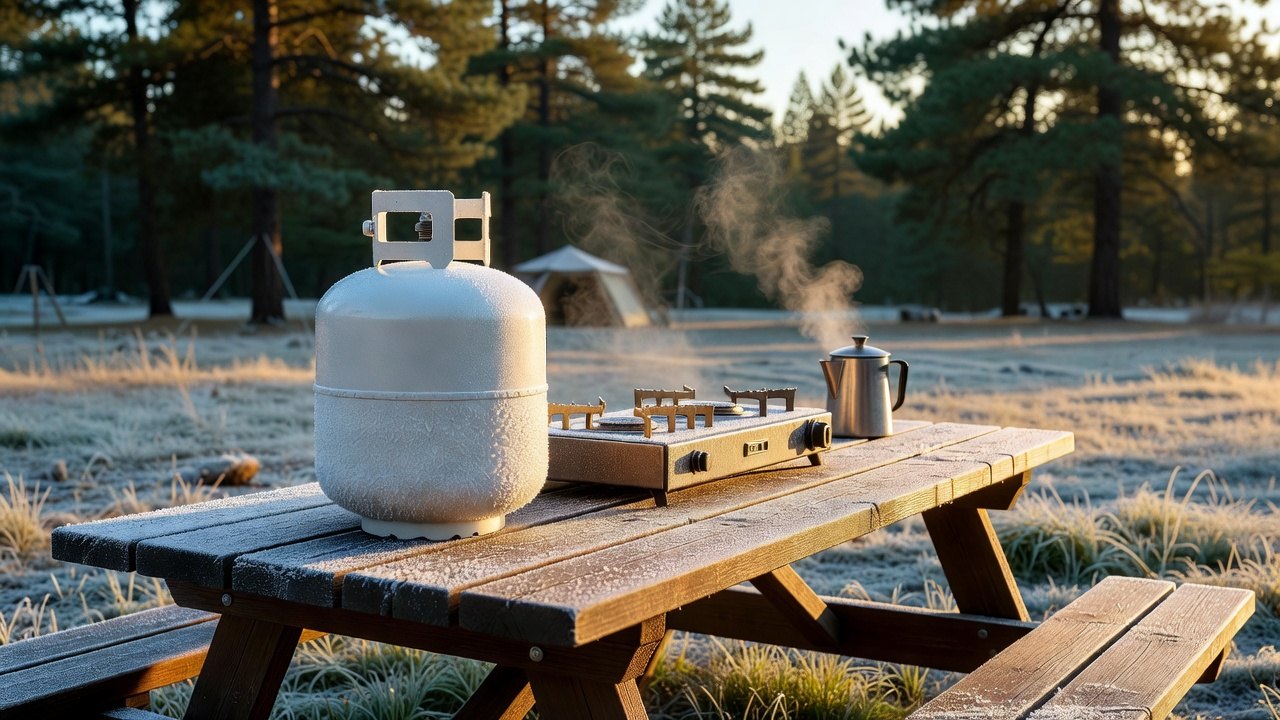
Almost always, neither. Frost on a camping propane tank is normal. It is the visible side effect of liquid propane boiling off, and it happens because vaporizing fuel pulls heat out of the steel walls fast enough to freeze the moisture in the air around them. The tank is not leaking and the fuel is not freezing.
What frost is genuinely useful for is diagnosis. Its height tells you how much liquid is left, and how fast it climbs tells you whether your burner is asking for more gas than the tank can boil off at that temperature. Get those two readings right and you can usually fix a sputtering stove in camp in about two minutes.
Quick Answer: What Frost on a Propane Tank Means
- Thin frost or dew on the lower half — normal. The tank is boiling propane, absorbing heat, and freezing humidity out of the air. Keep cooking.
- Frost climbing to the top of the cylinder — the appliance is drawing gas faster than the tank can vaporize it. Turn the burner down, run one burner at a time, or move up to a bigger tank.
- Ice on the regulator or hose, not the tank — a different failure, and it is a flow problem, not a fuel problem.
- Frost plus a hiss, or frost plus the smell of rotten eggs — stop. Shut the valve off and check for a leak before you light anything.
- Never pour boiling water on it, hit it with a torch, or bring it inside a tent. Those three "fixes" cause the accidents that make propane look scary.
Why Propane Tanks Frost Up
The fuel does not freeze. It boils.
This is the part that trips people up. Propane boils at about −44°F at sea level. A camp cylinder sitting in 20°F weather is nowhere near cold enough to freeze the propane inside it — it is still comfortably above its boiling point, which is exactly why it can still deliver gas at all.
So frost on the outside is not frozen fuel. It is frozen air. As the liquid boils, it absorbs heat — roughly 180 BTU for every pound of propane vaporized — and it takes that heat out of the tank wall. The steel drops below the dew point, water vapor from the surrounding air condenses on it, and if the metal falls below 32°F that condensation freezes into the white crust everyone worries about.
In other words: frost is proof the tank is working, not proof it is broken.
Why a 1 lb canister frosts before a 20 lb tank
Heat has to come from somewhere. It comes through the tank wall, from the air, and from the mass of the tank itself. A 1 lb canister has almost none of that working in its favor: about a pound of steel, a small wetted surface area, and 16.4 ounces of fuel inside.
Run a 10,000 BTU burner like the Coleman Bottle Top propane stove ($21.99, 4.5 stars, 12,600 reviews) and in one hour it wants about 10,000 BTU — call it 0.46 lb of propane, or roughly 7.4 ounces. The canister chills fast because there is so little metal and liquid to absorb that demand, and once the wall drops below freezing the frost appears.
Now compare a 20 lb tank: around 20 lb of liquid and 17 lb of steel, with far more surface area for air to warm it. Same physics, vastly more thermal ballast. That is why a 20 lb cylinder shrugs off a two-burner stove and then frosts hard when you hook up a 58,000 BTU fire pit on a 25°F night.
Cold weather makes it worse twice over
Cold air means lower vapor pressure and a slower heat transfer into the tank, so the two effects reinforce each other. Approximate gauge pressure inside a propane cylinder:
- 0°F — about 20 psi
- 20°F — about 33 psi
- 32°F — about 54 psi
- 50°F — about 77 psi
- 70°F — about 106 psi
- 100°F — about 172 psi
Here is the counterintuitive bit: pressure is almost never your problem. Camp appliances run at about 11 inches of water column at the burner — roughly 0.4 psi. Even a stone-cold tank has 50 times more pressure than the burner needs. What you actually lose in the cold is the vaporization rate: how many BTU per hour the tank can boil off. A 20 lb tank that happily feeds a big burner at 50°F may only supply a third of that near 0°F, and that shortfall shows up as a weak flame, a burner that won't stay on, or a heater that quits long before the tank is empty.
The Frost Line Is a Fuel Gauge
Before propane gauges were cheap, old-timers read tank level off the frost. Liquid propane boils and chills the steel it touches; vapor above the liquid line does not. So the frost stops where the liquid stops.
- Frost on the bottom third — plenty of fuel. This is what you want to see.
- Frost on the top two-thirds — you are low, and you are now asking a small wetted area to feed a big burner. This is the tank that dies at 2 a.m.
- A sharp horizontal line midway up — a textbook level read. Handy when you have no gauge.
If you would rather not guess, a propane tank gauge and level indicator ($15.99, 4.4 stars, 5,954 reviews) sits between the valve and the hose and reads pressure, which tracks level closely enough for trip planning. And a full spare matters more than a clever reading: the Coleman 16.4 oz propane cylinder 12-pack ($64.99, 4.8 stars, 10,500 reviews) is the boring, reliable answer for a weekend.
Frost vs. Sweating vs. Regulator Ice
Three lookalikes, three different causes. Getting the diagnosis right is the whole game.
| What you see | What it actually is | What to do |
|---|---|---|
| Wet band or beaded water on the tank, no ice | Condensation — tank is colder than the dew point but above 32°F | Nothing. This is normal and harmless |
| White frost on the lower half of the tank | Vaporization chilling the steel below freezing | Nothing. Normal operation |
| Frost climbing to the top of the cylinder | Draw exceeds vaporization rate at this temperature | Lower the setting, one burner at a time, or use a bigger tank |
| Ice on the regulator body or the pigtail hose | Pressure drop across the regulator chilling it (Joule-Thomson effect), plus moisture freezing the seat | Get it out of wind and puddles, run one appliance at a time, check hose length |
| Frost only at the valve or connection, plus hiss or smell | A leak, or a bad O-ring / missing hose filter | Shut the valve. Leak-test before use |
That last row is the one to take seriously. Frost concentrated at a joint — rather than spread evenly over the tank body — plus the rotten-egg odorant means gas is escaping at that joint. A portable combustible gas leak detector ($25.99, 4.4 stars, 5,858 reviews) finds it in seconds without a lighter, and the soapy-water test still works fine if that is what you have.
The regulator row is the most commonly misdiagnosed. A frosted regulator is not a frozen fuel line — it is expanding gas refrigerating its own regulator, and the ice physically holds the diaphragm open or shut. Our propane hose, regulator and adapter guide covers the connection-level fixes, including why a short hose in a windy spot is a frost magnet.
When Frosting Actually Becomes a Problem
Frost by itself is cosmetic. It matters when it starts costing you heat.
Your output sags mid-cook
The classic tell: the stove roars for ten minutes, then the flame shrinks to a whisper while the tank goes white. That is vaporization lag, not an empty tank. Turn the burner down to medium and the flame recovers within a minute or two, because lower demand means less chilling. If you are feeding a two-burner like the Coleman Triton+ ($149.99, 4.7 stars, 21,000 reviews), run one burner at a time on cold mornings instead of two at full.
A heater quits before the fuel is gone
This is the single most common cold-weather propane complaint, and the arithmetic explains it. A Mr. Heater Big Buddy ($146.48, 4.6 stars) on high draws 18,000 BTU/hr. One pound of propane holds about 21,600 BTU, so on high it wants roughly 0.83 lb an hour — more than 80% of a 1 lb canister's contents in a single hour. The canister chills, pressure sags, the ODS safety system sees a weak flame, and the heater shuts down with fuel still sloshing inside.
The fix is a hose, not a bigger can. The Mr. Heater 10-foot Buddy series hose assembly ($17.99, 4.6 stars, 6,400 reviews) lets a Buddy run off a 20 lb tank, which has the mass to keep up. If you are on a hose, fit the Mr. Heater universal propane fuel filter ($15.97, 4.7 stars) as the manufacturer requires — skipping it is how hoses shed debris into the orifice. The MH9BX Buddy ($74.00, 4.7 stars, 25,065 reviews) at 9,000 BTU is far gentler on a small canister than the Big Buddy, which is why it is the one most tent campers should own. Overnight heater safety is its own subject — our tent heater guide covers ventilation and CO.
A griddle or fire pit ices the whole tank
High-BTU appliances are the worst offenders because they combine big demand with long sessions. A 22-inch two-burner griddle in the 24,000 BTU range, or a 58,000 BTU fire pit like the Outland Living portable propane fire pit ($142.64, 4.8 stars, 17,700 reviews), will frost a 20 lb tank in cold weather that a camp stove never touches. That is not a defect in the appliance or the tank. It is a demand-versus-surface-area mismatch, and the answer is a full tank, a windbreak, and a lower setting.
7 Safe Fixes, Ranked
- Reduce the draw. Lowest setting that gets the job done, one burner or one appliance at a time. This solves most cases on its own, immediately.
- Start with a fuller tank. Wetted surface area is what boils the fuel. A tank below a quarter full is doing the same work with a fraction of the liquid-to-steel contact, which is why a nearly empty tank frosts hardest.
- Get the tank off the ground. Snow and frozen ground pull heat out of the cylinder bottom. A closed-cell foam pad, a scrap of plywood, or a folded moving blanket restores a surprising amount of vaporization.
- Break the wind. Wind strips the thin warm boundary layer off the tank surface. A windbreak — even the truck's tailgate — is worth several degrees.
- Upsize the tank. A 20 lb to 1 lb adapter ($9.98, 4.6 stars, 3,460 reviews) lets a small appliance drink from a big tank, which is the single most effective structural fix for a weekend of cold-weather cooking.
- Keep spare canisters warm, not hot. Carry them in the cab, not on the roof rack. Warm them inside your jacket before use. Never over a flame, never in boiling water, never in a tent overnight.
- Refill correctly if you run refillables. An overfilled 1 lb cylinder has no vapor space, so liquid can reach the regulator and frost it from the inside while flaring at the burner. Weigh your fills — the Flame King refillable 1 lb cylinder kit ($59.99, 4.6 stars) is DOT-compliant and designed for weighed refills, and the 1 lb refill adapter ($14.99, 4.5 stars) makes the transfer clean. Our 1 lb refill guide is the safety read before your first fill.
What Not to Do
- No open flame on the tank. A torch or a stove aimed at a cylinder is how people turn a cold morning into a burn ward visit.
- No boiling water baths. Even setting aside the burn risk, heating a cylinder raises pressure and can lift the relief valve; on a refillable that was overfilled, it is genuinely dangerous.
- No propane inside the tent. Not for storage, not for warming up a canister. A Buddy heater is indoor-safe rated, but that rating assumes a ventilated space and a functioning low-oxygen shutoff — not a sealed tent overnight.
- Do not "fix" a frosted regulator with a lighter. Melt it with your hands, a warm rag, or by moving it out of the wind.
- Do not ignore a yellow flame. Frost that starves a burner changes combustion. If the flame has gone yellow or orange and the pot is sooting, that is incomplete combustion and a carbon monoxide risk — the diagnosis is in our camp stove flame color guide.
Cold-Weather Numbers Worth Knowing
- Propane boiling point: about −44°F. Cold weather does not freeze it.
- Heat absorbed per pound vaporized: roughly 180 BTU — this is the cooling that makes frost.
- 1 lb of propane: about 21,600 BTU. A standard 16.4 oz canister: about 22,000 BTU total.
- 20 lb tank: about 4.7 gallons, roughly 430,000 BTU of fuel.
- Burner operating pressure after the regulator: about 11 inches of water column, or 0.4 psi. Cold reduces supply rate long before it reduces usable pressure.
- Practical floor: below about 20°F, a 1 lb canister feeding a high-output appliance is living on borrowed time. If the forecast is in the teens, take the 20 lb tank and the hose.
If you want the long version of cold-weather fueling — altitude, butane blends, keeping an RV system alive — our cold weather and high altitude camp stove guide is the deep dive, and how long a 20 lb propane tank lasts does the runtime math per appliance.
Propane Tank Frosting: Answer Key
The questions people actually type, answered in one line each.
| Question as people type it | The answer |
|---|---|
| propane tank frosting | Normal. Vaporizing fuel chills the steel and freezes moisture out of the air. |
| propane tank frosting up | Same thing — the frost is condensation, not frozen propane. |
| propane tank frosting over | The whole tank frosted because draw exceeds vaporization. Turn it down or upsize. |
| propane tank frosting on the outside | Outside frost is the expected place for it — it means the tank is doing its job. |
| propane tank frosting on blackstone | Griddles are high-BTU, long-session appliances; a cold 20 lb tank cannot always keep up. |
| propane tank frosting on outside | Outside frost is exactly where it belongs — the tank is shedding heat and freezing airborne moisture. |
| propane tank cold and sweating | Sweating is condensation without freezing — normal whenever the steel drops below the dew point but stays above 32°F. |
| what does it mean when your propane tank sweats | Nothing is wrong. It means the tank surface is colder than the humid air around it, which is what vaporization does. |
| propane tank freezing on blackstone | A griddle in the 24,000 BTU range pulls hard for a long time; a cold, partly empty 20 lb tank can ice over and throttle. |
| propane regulator frozen | Move it out of the wind, warm it with your hands or a rag, and check the hose — never with a flame. |
| propane cylinder frosting | The small-canister version of the same physics, and it frosts fastest of all. |
| propane tank frost up dangerous | Not by itself. It becomes dangerous when someone tries to heat the tank, or when the frost is at a leaking joint. |
| propane tank frost line | A free fuel gauge: frost stops where the liquid stops. |
| propane tank frost while using | Expected during use. If it reaches the top of the tank, reduce the draw. |
| propane tank freezing | The fuel does not freeze; the vaporization rate drops with temperature. |
| propane tank freezing up | See "frosting over" — it is a rate problem, not a frozen-fuel problem. |
| propane tank freezing while using | Normal at high draw in cold air, and worse as the tank empties. |
| propane tank freezing while using heater | Classic case: an 18,000 BTU Buddy on a 1 lb can. Use a hose and a 20 lb tank. |
| propane tank freezing regulator | The regulator frosts from the pressure drop across it, not from the tank. Move it out of wind and puddles. |
| propane tank freezing point | There is no practical freezing point — propane boils at −44°F. Water vapor in the air is what freezes at 32°F. |
| propane tank freezing temperatures | Below roughly 20°F a 1 lb canister struggles; below 0°F plan on a 20 lb tank. |
| propane tank icing | Same as frosting. Ice is atmospheric moisture, not fuel. |
| propane tank icing up | Same. Check that the frost is not concentrated at a connection. |
| propane tank sweating | Condensation only — the tank is below the dew point but above freezing. Harmless. |
| propane tank condensation | Normal, and more visible on humid days and during long cooks. |
| why is my propane tank freezing up | Because the burner is pulling gas faster than the tank can boil it in cold air. |
| why is my propane tank freezing | The liquid is boiling and absorbing heat. Frost is the result, not the fault. |
| why is my propane tank sweating | Humid air meeting cold steel. No leak, no defect. |
| do propane tanks sweat | Yes, routinely, whenever the tank surface drops below the dew point. |
| propane regulator freezing up in cold weather | A flow problem — one appliance at a time, keep it sheltered, check the hose. |
| propane regulator keeps freezing | Usually an undersized or wet regulator, a long hose in wind, or a tank that is nearly empty. |
Propane Tank Frosting FAQ
Is it safe to keep using a propane tank that has frost on it?
Yes. Frost on the outside of a cylinder is a normal sign that liquid propane is boiling and absorbing heat, which is precisely what a working tank does. Continue cooking, but watch the height of the frost: if it climbs past the halfway mark toward the top, your appliance is outrunning the tank and the flame will start to fade.
Should I pour hot water on a frozen propane tank?
No. It is a burn hazard, it shocks the steel, and on a refillable cylinder it raises pressure enough to lift the relief valve. Warm the tank slowly and safely instead: get it off snow onto foam or wood, block the wind, and reduce the burner setting. If you need heat in a hurry, use a spare canister kept warm in the vehicle cab.
Why did my propane heater shut off when the tank was still half full?
Because the tank could not boil propane fast enough to feed it in the cold. An 18,000 BTU heater on a 1 lb canister wants about 0.83 lb of fuel an hour, which chills the canister until pressure sags and the safety shutoff trips. Moving to a 20 lb tank through a hose assembly fixes it, which is why the manufacturers sell that hose in the first place.
Does frost mean my propane tank is leaking?
Usually not — a leak shows up as frost concentrated at the valve or a hose fitting, together with a hiss or the rotten-egg smell of the odorant. Evenly spread frost over the tank body is normal vaporization. If the frost is localised at a joint, shut the valve off and leak-test with soapy water or a combustible gas detector before lighting anything.
<!-- AFFILIATE_DISCLOSURE -->