How to Refill 1 lb Propane Bottles Safely (and Legally) in 2026
Refilling 1 lb propane canisters can save a family $100+ a season — if you do it right. The adapter, the DOT-compliant refillable cylinder, and the fitting that removes small bottles from your kit entirely.
Three camping trips into the season, we counted the empties rattling around in the garage: nineteen green 1-lb propane bottles. At the $6.50–$8.00 most stores charge, that is somewhere between $120 and $150 of propane — and that was just for a handful of weekend trips with a two-burner and a griddle.
Meanwhile, the 20-lb tank we use for the backyard grill holds twenty times as much propane and costs about $22 to refill at a hardware store. The math is not subtle. A pound of propane from a big tank costs a little over a dollar. A pound of propane in a disposable green bottle costs six to eight.
So the question every car-camper eventually asks is the obvious one: can I just refill the little bottles myself? The answer is yes — but the version of that answer floating around forums and YouTube is the version that gets people hurt or leaves them carrying an illegal cylinder in the trunk. Here is the honest breakdown, plus the three legitimate ways to cut the cost.
The Short Answer: Yes, But Not the Way the Internet Tells You
There are exactly three sensible routes, and they are genuinely different purchases:
- Refill your own bottles with a brass adapter and a 20-lb donor tank. Cheapest entry, works on a warm day, requires care and a kitchen scale.
- Buy DOT-compliant refillable cylinders (the ones stamped and rated for repeated filling). Costs more upfront, is unambiguously legal, and is the long-term answer.
- Stop using 1-lb bottles at all, by running your bottle-top appliance directly off a full-size tank with a converter fitting.
If you are still deciding what fuel type even belongs on your trip — propane for car camping, isobutane for backpacking, butane for fair-weather picnics — start with our complete camp stove fuel guide, which covers compatibility, cold-weather performance, and how much fuel a weekend actually burns. This article picks up where that one leaves off: the 1-lb bottle specifically, and what to do about it.
Why Refilling 1-lb Bottles Is a Grey Area (Read This Before You Buy Anything)
Here is the part the how-to videos skip.
The green bottles you buy at Walmart are DOT-39 non-refillable cylinders. They are manufactured, tested, and certified once. The federal rule that governs them (49 CFR 173.306) frames them as single-trip containers — which is why the common practice of refilling them and hauling them down the highway is a regulatory grey area at best, and why no manufacturer will endorse it.
That does not mean the little canisters are dangerous by nature. It means they were never built to be opened, filled, and resealed repeatedly. The failure modes are real:
- Overfilling. A 1-lb cylinder has almost no headspace. Fill it completely and expanding liquid propane has nowhere to go. On a hot day in a parked car, that is how relief valves vent raw propane into a trunk.
- Liquid in the line. Overfill slightly and the stove starts pulling liquid instead of vapour. You get a flare, a yellow roaring flame, and a burner you cannot turn down.
- Worn valves. Refill a bottle designed for one trip fifteen times and the valve seat is the part that quietly stops sealing.
The commercially refillable cylinders are a completely different product. Flame King-style 1-lb cylinders are stamped and rated for repeated refilling, use a proper refill valve, and are legal to fill and transport. The thread on top — CGA600 — is identical to the disposable bottle, so your existing stove does not know the difference.
That distinction is the whole ballgame. Refilling a rated cylinder is fine. Refilling a throwaway is the thing you should think twice about — and if you do it anyway, understand that you are trading a small regulatory risk and a real safety margin for a few dollars.
Method 1: Refill Your Own Bottles With an Adapter
This is the entry point, and it is what most families end up doing.
The tool is simple: a brass adapter with a QCC1/Type 1 fitting on one end (the standard connector on every household 20-lb BBQ tank) and a CGA600 fitting on the other, so it threads onto a 1-lb cylinder. Our pick is the Gas One Propane Refill Adapter with a 4-ft hose — solid brass, precise threads, hand-tighten only, around $15. The hose version is worth the extra few dollars because it lets the small bottle sit on a kitchen scale while you fill, which is the difference between "roughly full" and "correctly full."
Everything above is written for the worst case — a throwaway bottle. If you have switched to a DOT-rated refillable cylinder, this same adapter is simply the tool you use, with none of the caveats.
The fill, step by step
- Weigh the empty bottle first. The empty weight (tare) is stamped on the collar of every cylinder — usually around 1.4–1.6 lb. Write it down. If you skip this step you have no way to know when to stop.
- Chill the small bottle, warm the big one. Propane moves from higher pressure to lower pressure. Put the empty bottle in the freezer for 20–30 minutes and leave the 20-lb tank in the sun. This is not optional in cool weather; it is the entire mechanism. A cold donor tank and a warm receiving bottle will fill at a glacial pace or not at all.
- Connect the adapter to the 20-lb tank and the hose to the small cylinder. Hand-tighten. Brass threads seal by contact; cranking with a wrench deforms them.
- Open the tank valve slowly and listen. You will hear propane move. Invert the donor tank if your adapter is designed for a liquid draw (check the instructions — some are, some are not).
- Watch for the vent and stop well before full. Most adapters use the small bottle's own valve to bleed vapour. When liquid starts spitting instead of hissing, you are at the limit — close everything immediately. Target a weight of tare + 0.8 lb, not tare + 1 lb. That 20% headspace is your safety margin.
- Disconnect outdoors, away from the stove, and check for leaks. A drop of soapy water on the valve is a 10-second test that catches the one failure mode that actually matters.
The mistakes that cost people a season
- Filling a hot bottle in the sun. Pressure differential works against you; you will under-fill and think the adapter is broken.
- Trusting the hiss instead of the scale. Vapour vents long before the bottle is full — but the vent can also spit liquid the instant it is over. The scale is the only honest instrument.
- Leaving filled bottles in a hot car all day. Even correctly filled, propane expands. Store them in the shade or a ventilated spot, never in a sealed trunk on a July afternoon.
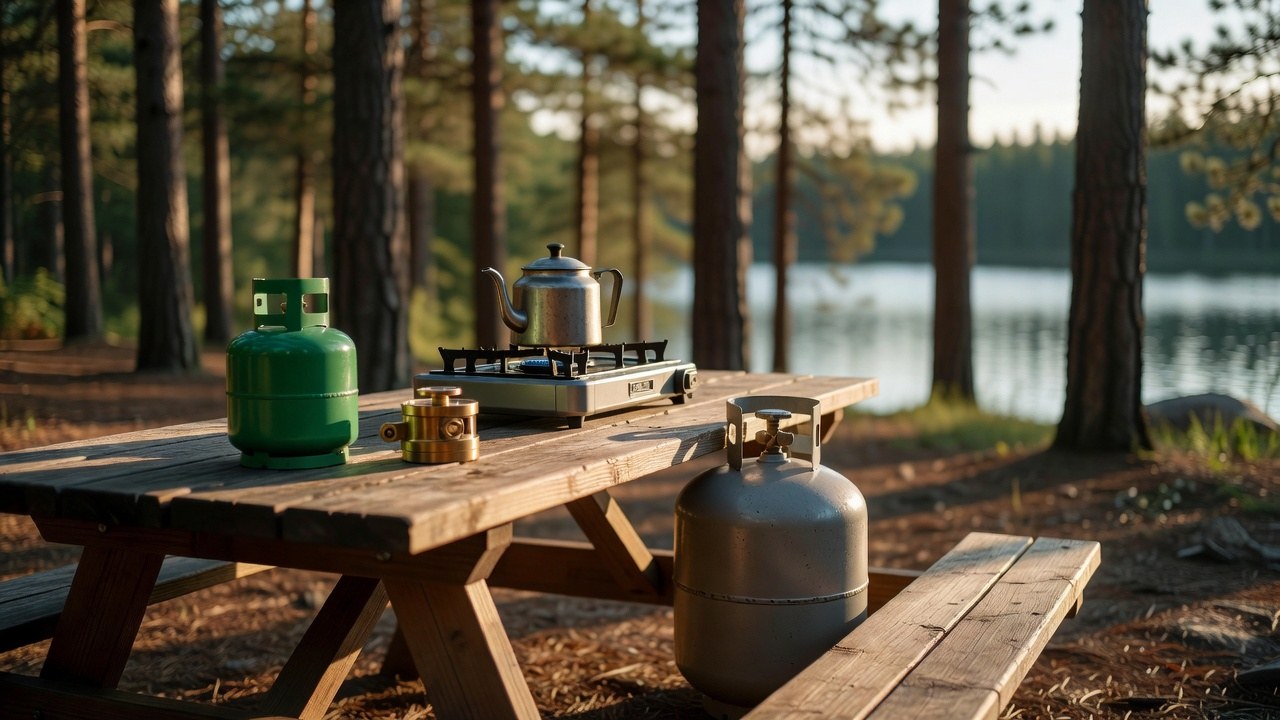
Method 2: Buy DOT-Compliant Refillable Cylinders (The Legal Route)
If any part of Method 1 made you uncomfortable, this is the answer, and it is the one I would recommend to most families.
The Flame King Refillable 1 lb Propane Cylinder and Refill Kit is a 16.4 oz cylinder actually rated for repeated filling, with the refill valve and kit in the box. It uses the standard CGA600 connection, so it drops into the same bottle-top stove or lantern you already own. Nearly 3,000 ratings at 4.6 stars, and the reason is straightforward: it is the same concept as your 20-lb patio tank, scaled down and made legitimate.
You pay more upfront than you would for a single disposable bottle. You then refill it from your 20-lb tank for the next several years, legally, without wondering whether the cylinder in your trunk is a problem. If you camp more than three or four weekends a season, that breaks even fast.
Two rules still apply: weigh it when filling (the 80% limit exists on rated cylinders too), and never fill it somewhere you would not want propane venting.
Method 3: Skip 1-lb Bottles Entirely
The third option is the one people forget, and it is the cheapest of all.
You do not have to refill small bottles if you never use them. Bottle-top propane stoves and propane lanterns screw onto a 1-lb cylinder — but a solid brass converter fitting lets that same appliance run off your full-size 20-lb tank. The GASPRO 20 lb to 1 lb Propane Tank Adapter is under ten dollars, has more than 3,400 ratings, and eliminates the entire canister chore: no refilling, no filling station, no empties piling up in the garage. Screw the stove onto the adapter, screw the adapter onto the big tank, and you are cooking for the whole trip off $22 of propane.
The trade-off is honest: because there is no hose, the appliance mounts directly on the tank, which can feel top-heavy with a large pot, and the burner ends up close to the tank. For a basecamp setup where you are cooking several meals a day at one table, that is a non-issue. For a stove you want to move around, get the hose version instead.
The Math: What You Actually Save
Rough retail numbers, so you can check them against what you pay locally:
- Disposable 1-lb bottle: $6.50–$8.00 for 1 lb of propane, single use.
- 20-lb tank refill: roughly $20–$26 for 20 lb, or about $1.00–$1.30 per pound.
- The refill adapter: about $15, one time.
- A DOT-compliant refillable 1-lb cylinder with kit: about $60, one time.
A family burning two bottles per trip, camping fifteen trips a season, is buying thirty disposable bottles — call it $210. Refilling those same thirty pounds from a 20-lb tank costs somewhere near $30–$39 of propane, plus a one-time $15 adapter. Even accounting for the fact that refills are never perfectly efficient and some bottles get lost, the saving clears $150 in the first season. Buy the refillable cylinders instead of the adapter and the break-even lands inside the same season or the next one.
The propane was never the expensive part of camping. Buying it one pound at a time was.
Which Camp Stoves Actually Take 1-lb Bottles
Not every stove belongs in this conversation, and it is worth knowing where you stand before you buy a refill setup:
- Coleman Bottle Top Propane Camp Stove (~$22, 12,600+ ratings) — screws directly onto a 1-lb cylinder. This is the stove most refill setups are built around, and it is also the ideal candidate for Method 3 if you would rather mount it on a big tank.
- Coleman Triton+ 2-Burner Propane Stove (~$150) — runs from a 1-lb bottle or a hose to a 20-lb tank. Buy the hose and it never touches a small bottle again.
- Coleman RoadTrip 225 (~$200) — a tabletop two-burner grill with the same dual fuel option; the griddle side is where families burn the most fuel.
- Gas One GS-3400P Dual Fuel Stove (~$35) — the budget dual-fuel option that runs butane canisters or propane, useful if you want one stove for both a picnic and a weekend.
- Mr. Heater Buddy (
$74) and the Outland Living propane fire pit ($143) — the two appliances that will drain 1-lb bottles fastest. A fire pit at 58,000 BTU eats a small bottle in under two hours. These are the strongest argument for Method 2 or 3.
One exception worth stating plainly: isobutane canisters for backpacking stoves cannot be refilled at all. The MSR IsoPro and every similar threaded canister is a sealed, single-use pressure vessel. There is no adapter that makes that safe, and anyone selling you one is selling you a hazard. Backpacking fuel is bought per trip; car-camping propane is the fuel you can actually optimise.
Storing and Transporting 1-lb Propane Safely
A few rules that apply no matter which method you chose:
- Never store propane inside a tent, trailer, or sleeping area. Ventilated exterior compartments only.
- Keep bottles upright and out of direct sun. Heat raises pressure; pressure finds the weakest seal.
- Check the date stamp. Disposable bottles have a service date (usually 12 years from manufacture). Beyond it, the steel and valve are the unknown — recycle it instead of refilling.
- Transport in the open bed or a ventilated spot, not sealed in a hot trunk.
- Sniff for leaks every trip. If a bottle or connection smells of propane, stop using it that trip. Mercaptan is added specifically so you catch this early.
Camp Stove Propane FAQ
Can you refill 1 lb propane bottles at home?
Yes, with an adapter and a 20-lb donor tank — but "at home" means outdoors, never in a garage, basement, or kitchen. The process relies on a pressure difference, so chill the empty bottle and keep the donor tank warm. Weigh the bottle against its stamped tare weight and stop at 80% of capacity.
Is it legal to refill disposable propane bottles?
The green bottles sold as single-use are DOT-39 non-refillable cylinders, and the common practice of refilling and transporting them sits in a regulatory grey area with no manufacturer endorsement. Cylinders stamped and rated for refilling — like a DOT-compliant 1-lb refillable — are legal to fill and transport. If legality matters to you, buy the rated cylinder.
How do you know when a 1 lb propane bottle is full?
Two ways, and only one is reliable. The vent method (watching for liquid spitting instead of vapour hissing) tells you when you are at the limit. The scale method tells you where you actually are: find the tare weight stamped on the collar, aim for tare plus 0.8 lb, and stop there. Use the scale; treat the vent as a backstop.
How long does a 1 lb propane bottle last?
A 1-lb bottle holds about 21,600 BTU, which is roughly 45–60 minutes on a 10,000 BTU single burner at full flame — three or four coffee-and-oatmeal sessions in real use. A 58,000 BTU propane fire pit runs a full bottle dry in well under two hours.
Can you refill 1 lb bottles from a 20 lb tank in cold weather?
Only if you fix the temperature difference. Propane only flows from the higher-pressure container, and in near-freezing weather a cold 20-lb tank may sit at the same pressure as your empty bottle. Bring the small bottle inside or into a cooler with a warm water bottle, keep the donor tank somewhere warmer, and give it time.
Do 1 lb propane bottles fit all camp stoves?
Anything with a CGA600 bottle-top connection — which covers most single-burner propane stoves, propane lanterns, small heaters, and the Coleman bottle-top line. Two-burner stoves usually need a hose to a 20-lb tank (or the bottle-top adapter). Butane and isobutane stoves use entirely different fittings and cannot take a 1-lb propane bottle.
The Setup I Would Actually Buy
If you are starting from zero, the order that makes sense is:
- Gas One refill adapter with hose (~$15) if you already own a 20-lb tank and want to test the whole idea cheaply this season.
- Flame King refillable 1-lb cylinder + kit (~$60) if you want the version with no grey area at all, and you plan to do this for years.
- GASPRO 20 lb to 1 lb adapter (~$10) if your stove lives at one basecamp table and you would simply rather not deal with small bottles.
And pack a digital kitchen scale — it costs less than two disposable bottles and it is the tool that makes every one of these setups safe. If your trips run into the shoulder season, pair any of this with our winter camping beginner's guide and the camp stove windscreen and wind protection guide — cold weather and wind are where fuel efficiency stops being a maths exercise and starts being the difference between a hot dinner and a cold one.
<!-- AFFILIATE_DISCLOSURE -->