4 Camp Stoves Under $50 That Actually Cook: Budget Car Camping Picks for 2026
You don't need a $150 camp stove. Compare four real options under $50 from Coleman, Gas One and MSR for budget car camping in 2026.
The first time I camped with a "real" stove, it was a $22 Coleman that screwed onto a propane bottle. I boiled pasta, seared steaks, and made coffee every morning. Nobody complained about the food. Nobody asked how much the stove cost.
You do not need a $150 two-burner to eat well at a campsite. You need BTU output big enough for a pot of water. You need a flame that holds steady in a breeze. You need to set it up in 30 seconds and get cooking. Everything beyond that is nice to have, not need to have.
Here are four current stoves under $50 that deliver. Every one comes from a real brand with a clear use case—not an alphabet-soup Amazon burner that dies on trip three.
Quick Answer: The Four Sub-$50 Camp Stoves Worth Buying
- Cheapest way to cook: Coleman Bottle-Top Propane Stove — $21.99. Screws straight onto a 1 lb cylinder with nothing else to lose.
- Best for warm-weather trips: Coleman Classic Butane Stove — $29.99. Lighter and tidier, and it comes with a carry case.
- Best all-rounder: Gas One GS-3400P — $34.99. Dual fuel means it still lights on a cold morning, which is the whole game in fall.
- Best for trips that start on foot: MSR PocketRocket 2 — $49.95. Under $50 and weighs almost nothing.
- Makes the stove pay for itself: Gaspro 1 lb Adapter — $9.98. Refill your own 1 lb cylinders from a 20 lb tank instead of buying new ones.
- Hose plus adapter in one: Gas One Refill Hose — $14.99. Gets you refills and a remote-canister setup from one kit.
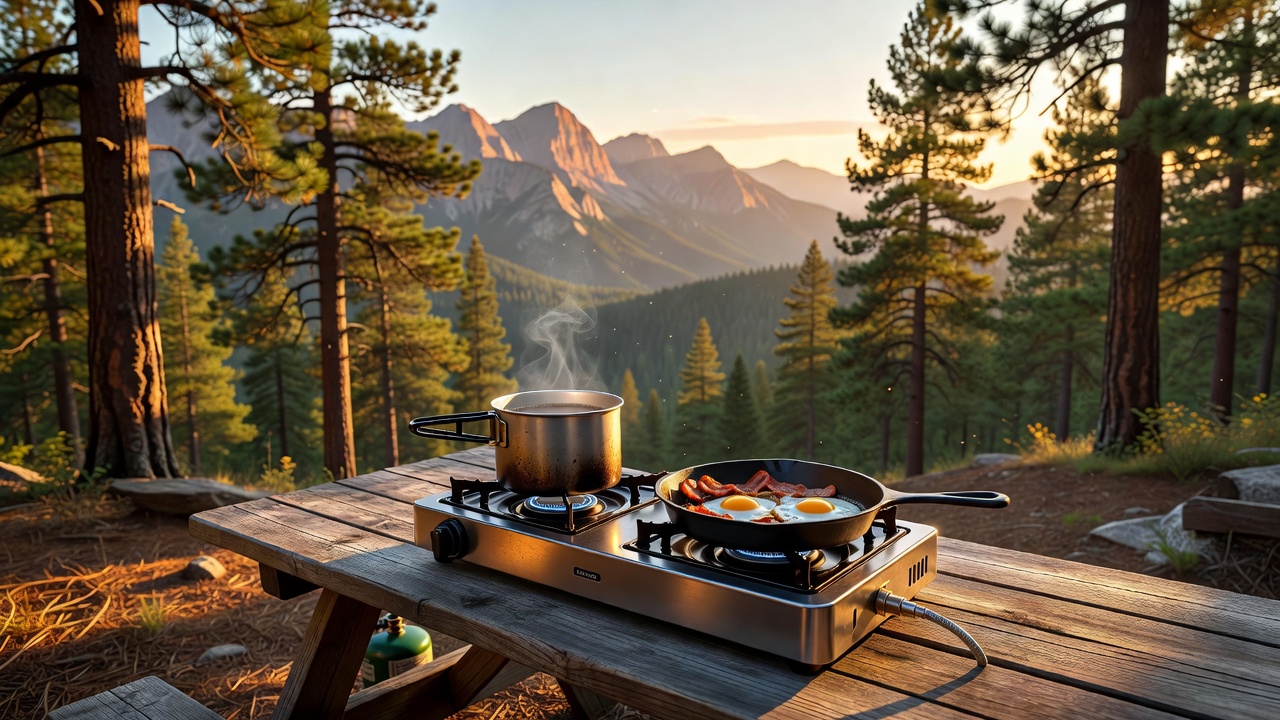
The lineup at a glance
| Stove | Price | BTU | Fuel | Weight | Best for |
|---|---|---|---|---|---|
| Coleman Bottle Top | $21.99 | 10,000 | Propane | 1.5 lbs | Pure budget power |
| Coleman Classic Butane | $29.99 | 7,650 | Butane | 4.3 lbs | Warm-weather simplicity |
| Gas One GS-3400P Dual Fuel | $34.99 | 8,000 | Propane + Butane | 4.5 lbs | Cold-weather flexibility |
| MSR PocketRocket 2 | $49.95 | 8,200 | Isobutane | 2.6 oz | Backpacking backup |
The right fuel matters as much as the stove. Propane is the no-drama choice for cool mornings and easy resupply; butane is convenient only when overnight temperatures stay mild; isobutane wins when packed weight matters. For the temperature cutoffs, compatibility checks, and canister math, read our camp stove fuel guide before you buy fuel.
What Shoppers Actually Type, and the Stove That Fits
Budget stoves get searched a dozen different ways, and most of the pages ranking for those phrases are affiliate listicles that never answer the actual question. Here is the decoder. Find your phrasing in the left column, buy the stove in the right column, and skip the rest of this article if you are in a hurry.
| What you typed | What you actually mean | The pick |
|---|---|---|
| "cheapest camp stove", "best cheap camp stove", "cheap camp stove" | the lowest price that still cooks real food | Coleman Bottle-Top, $21.99 |
| "best budget camp stove", "best value camp stove", "best affordable camp stove" | cheap, but not disposable | Bottle-Top at $21.99, or Gas One GS-3400P, $34.99 if you camp past summer |
| "good budget camping stove", "good budget backpacking stove", "what is a good camping stove" | one recommendation from someone who has used it | Gas One GS-3400P, $34.99 |
| "what is the best stove for camping", "what's the best camp stove" | the one answer for a family car camper | Bottle-Top for power per dollar, GS-3400P for all-season |
| "easiest camping stove", "easiest camping stove to use", "camp stove for beginners" | push-button ignition, no lighter, no assembly | Coleman Classic Butane, $29.99 |
| "best car camping stove 2026", "best single burner car camping stove" | stable on a picnic table, big enough for a family pot | Classic Butane or GS-3400P |
| "best single burner propane stove", "best single burner camp stove propane", "best budget propane camp stove", "best portable single burner propane stove" | propane only, works on cold mornings | Coleman Bottle-Top, $21.99 |
| "best single burner butane camp stove" | butane only, fair-weather trips | Coleman Classic Butane, $29.99 |
| "best dual fuel single burner camp stove" | one stove that takes either canister | Gas One GS-3400P, $34.99 |
| "best compact single burner camp stove", "best portable single burner camp stove", "top rated single burner camp stoves" | small in the trunk, still tabletop-stable | Classic Butane, or the aotu piezo stove, $12.99 if you only boil water |
| "best single burner camping gas stove", "best budget camping gas stove" | any gas canister, lowest fuss | GS-3400P (propane or butane) |
| "best budget backpacking stove", "best budget backpacking camp stove", "best single burner backpacking stove", "best budget lightweight camping stove", "best backpacking stove 2026", "best hiking stove 2026" | under a pound, lives in a day pack | aotu piezo, $12.99, then MSR PocketRocket 2, $49.95 |
| "best budget camping wood stove", "portable camp stoves wood burning", "portable camp stove with chimney" | no canisters at all, burn twigs | BioLite CampStove 2, $199.95 — a different budget bracket, and honest about it |
| "best heavy duty single burner propane stove" | sustained high output, big pots, groups | nobody needs a heavy-duty single burner — step up to a two-burner (Coleman Triton, $149.99 or Camp Chef Explorer, $127.99) |
| "camp stove brands" | which names are actually worth trusting | Coleman, Gas One, MSR, Camp Chef, and BioLite — see the brand note below |
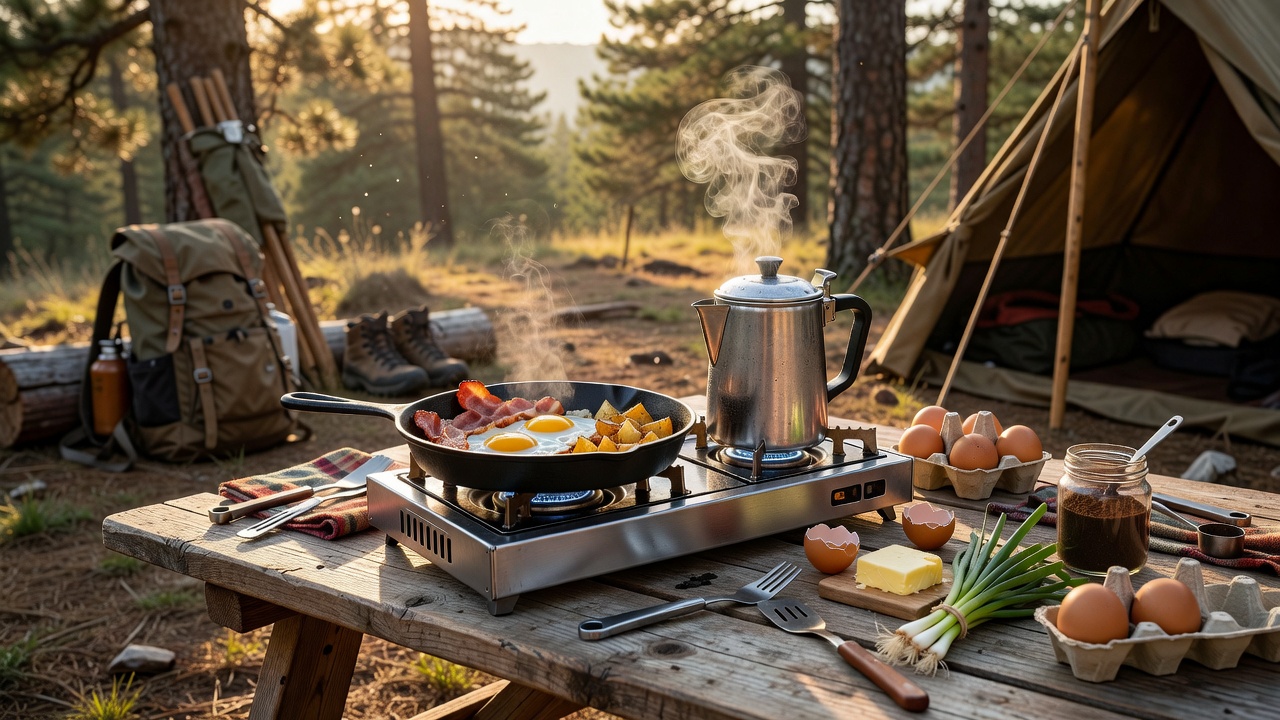
On brands. The budget tier is dominated by three names for a reason. Coleman makes the bottle-top propane burner that has been in production, essentially unchanged, for decades — 12,600 reviews and a 4.5-star average is not a marketing claim, it is a repair record. Gas One owns the dual-fuel and butane-cartridge market and their GS-3400P carries 14,200 reviews. MSR is the backpacking benchmark for people who can spend more than $50 but still want a single burner. Camp Chef is where you go when you want two burners and 60,000 BTUs for a group. Everything else in the $15-30 bracket on Amazon is a white-label burner with a name generated by a spreadsheet, and the failure mode is always the same: the regulator or the piezo dies in year two and there are no parts.
What "budget" should actually mean here. A cheap camp stove is not a stove that costs $15. It is a stove where the total cost of three seasons of cooking stays low: purchase price plus fuel plus whatever you replace when something breaks. A $22 propane burner with a $10 refill adapter beats a $40 disposable-everything burner by the second trip, and it will still be running when the $15 one is in a landfill. That arithmetic is why the Bottle-Top keeps winning this category, and why adding a 20 lb tank adapter is the single highest-value upgrade in the whole budget camp kitchen.
1. Coleman Bottle Top Propane Stove — $21.99
View on TrailMapz · 4.5★ (12,600 reviews)
This is the budget workhorse. It screws directly onto a 1-lb propane cylinder and throws 10,000 BTUs. No hose. No regulator. No parts to lose. The wind-baffle design channels heat up instead of letting gusts steal it, which matters more than you'd think when you are making coffee at 6 AM in a mountain breeze.
The wide plastic base prevents tipping even with a full cast iron pan on top. When detached from the canister, the whole thing is smaller than a Nalgene bottle. I keep one in my trunk year-round. It has made hot coffee at trailheads, cooked lunch at rest stops, and fed four people at campsites.
What's good: Highest BTUs in the test. Dirt cheap. Packs tiny. Simple enough that nothing can break.
What's not: Single burner means cooking one thing at a time. No built-in ignition — bring a long lighter or matches. The height (canister plus stove) makes it slightly tippier than tabletop designs on uneven ground.
Fuel math: One 1-lb propane can runs about 1.5 hours on high. For a weekend trip with three cooked meals, bring 2 or 3 cans. Propane canisters are available everywhere — Walmart, hardware stores, gas stations.
2. Coleman Classic 1-Burner Butane Stove — $29.99
The original Gas One portable-butane listing referenced here is no longer in the current TrailMapz catalog. For a current, similarly priced tabletop-butane option, choose the Coleman Classic 1-Burner Butane Stove ($29.99) below.
The Coleman Classic 1-Burner Butane Stove is the easy, self-contained warm-weather choice: open the hard case, click in a butane cartridge, hit the ignition, and cook. Its 7,650-BTU burner is plenty for coffee, eggs, soup, and a small skillet meal, while the porcelain-coated grate is easier to wipe clean than most bargain burners.
What's good: Durable carrying case, built-in ignition, simple cartridge loading, and controlled low heat for rice or sauces.
What's not: Butane loses pressure below about 40°F. If you camp in shoulder season or at elevation, the flame gets weak. Butane cartridges are slightly less common than propane — you will find them at Asian grocery stores, camping sections, and online, but not at every gas station.
Fuel math: One 8 oz butane can lasts about 1.5 to 2 hours. For a weekend, bring 2 cans. Cans cost roughly $2 to $3 each. Cheaper per hour than propane.
For the temperature cutoffs, canister choices, and a deeper propane-versus-butane breakdown, see our camp stove fuel guide before you buy fuel.
3. Gas One GS-3400P Dual Fuel — $34.99
View on TrailMapz · 4.5★ (14,200 reviews)
This is the one stove here that solves the butane cold-weather problem without costing more than $35. It runs on propane (with the included regulator hose and POL fitting) AND butane (cartridge slot in the body). Pick your fuel based on conditions.
Propane works fine at 20°F. Butane chokes below 40°F. If you camp in spring or fall — or at elevation where mornings dip into the 30s — the dual-fuel capability is not a bonus. It is the difference between hot breakfast and cold granola.
The three-sided wind guards protect the flame better than the other stoves in this roundup. 8,000 BTUs with auto-ignition. The included propane hose means no adapter hunting.
What's good: Propane in the cold, butane when it is warm. No other stove under $50 does both. Three-sided wind guards. Includes hose and regulator.
What's not: Heavier than single-fuel stoves. The plastic case is functional but not as rugged as Coleman's. Still a single burner.
Who should buy this: Anyone who camps outside of peak summer. If your trips span spring through fall, get the dual fuel and stop worrying about whether your stove will light at sunrise.
4. MSR PocketRocket 2 — $49.95
The MSR PocketRocket 2 Ultralight Backpacking Stove ($49.95) is the compact, reliable canister-stove option for day hikes or backpacking. It sits at the top edge of this roundup's budget, but its verified 2.6-ounce build and established fuel system make it a credible choice rather than a disposable backup.
At 2.6 ounces and roughly the size of a small folding tool, the MSR PocketRocket 2 Ultralight Backpacking Stove is the lightweight backup or day-hike companion to keep in your kit. It costs more than the original ultra-budget option, but its 8,200-BTU burner, folding pot supports, and proven threaded-canister design make it a more dependable pick when you are carrying your kitchen.
It uses standard EN 417 threaded isobutane canisters and is best for boiling water, coffee, and simple one-pot meals rather than a wide skillet dinner. Pack a lighter anyway: any piezo igniter can fail when wet or dusty.
What's good: Very light, compact, 8,200 BTU output, and a long track record.
What's not: It is not an under-$50 bargain once fuel is included, its narrow burner can scorch food, and it is not a substitute for a stable tabletop car-camping stove.
Who should buy this: Hikers and car campers who want one credible backup stove for day packs, power outages, or a second cooking station.
How to choose in 30 seconds
Get the Coleman Bottle Top ($21.99) if you want the most power for the least money and do not mind carrying a lighter. 10,000 BTUs is enough to cook anything. It is the stove I reach for most often because it just works and costs nothing to own.
Get the Coleman Classic Butane ($29.99) if you want a tabletop stove with push-button ignition, a carrying case, and easy cleanup. It is the best warm-weather single burner here when convenience matters more than maximum BTUs.
Get the Gas One GS-3400P ($34.99) if you camp in spring or fall and need propane for cold mornings. The dual-fuel flexibility is worth the extra $10.
Add the MSR PocketRocket 2 ($49.95) if a lightweight backup matters more than the absolute lowest price. Toss it in a day pack, but keep the stable tabletop options above for car-camping meals.
Single Burner, Canister, or Wood? Pick the Type Before the Model
Almost every stove question in this price range is really a fuel-system question. There are four systems, and they do not overlap as much as the listings imply.
Bottle-top propane (1 lb cylinder). The stove screws onto a disposable or refillable 1 lb cylinder. Nothing else to lose, nothing to leak, 10,000 BTUs, and it is the only sub-$25 setup that still lights at 20°F. Trade-offs: it is tall and top-heavy on uneven ground, there is no ignition, and the cylinder is the thing you keep buying — until you add a refill adapter.
Tabletop butane cartridge. The stove sits flat on a picnic table and a rectangular cartridge clicks into the body. It is the easiest camping stove to use: open the case, click, push the button, cook. It is also the most weather-limited — butane pressure falls off below about 40°F, so a 20°F morning turns a 7,650-BTU burner into a suggestion. Best for May through September, and best when convenience is the priority.
Threaded isobutane canister (backpacking). The lightest option by a wide margin — the PocketRocket 2 is 2.6 ounces, the aotu piezo is barely more — and it is genuinely good at boiling water fast. It is a poor car-camping primary stove: narrow burner, unstable with a big pot, and the canisters cost the most per day of cooking. Buy it as the pack stove, not the campsite stove.
Wood and twig burners. No fuel to buy, ever, and the BioLite CampStove 2 will even charge a phone off the fire. It is also $200, needs dry fuel, needs watching, and blackens everything it touches. This is a hobbyist or emergency option, not the budget answer — a "budget camping wood stove" mostly exists in searches, not in good products.
The one system that escapes the trade-off is dual fuel: the GS-3400P takes a butane cartridge or a 1 lb propane cylinder through an included hose, so you can pack butane for a July trip and propane for an October one, with the same $35 stove. If your camping season crosses 40°F in either direction, that is the correct purchase and you can stop reading comparison tables.
What to pair these with
A stove needs pots, plates, and something to eat with. TrailMapz has the rest of the budget camp kitchen covered:
- Lodge 6.5-Inch Seasoned Cast Iron Skillet ($9.38) — a compact, pre-seasoned skillet for eggs, quesadillas, and breakfast potatoes. It is heavy for backpacking but ideal for car camping.
- Lodge 10.5-Inch Round Cast Iron Griddle ($24.90) — a wider cooking surface for pancakes or burgers; use it on a stable stove with adequate pot supports.
A stove plus one practical cast-iron piece comes in around $31 to $60 before fuel, making a simple car-camping kitchen far less expensive than a premium two-burner setup.
One thing nobody tells you about single-burner stoves
You will cook sequentially. Boil water first. Make coffee. Then cook breakfast. Then heat dishwater. It takes about 45 minutes from start to clean dishes for two people. With a two-burner stove you could do it in 25.
Is the time savings worth an extra $100? For most weekend campers, no. You are not in a rush. The coffee tastes better when you are not multitasking. But if you regularly cook for four or more people, save up for a two-burner. Our full camp stove guide covers the Coleman RoadTrip 225 and other options above the $50 mark.
Butane Stoves: The Straight Answers
Butane cartridge stoves are the most-searched and least-explained category on the site, so here are direct answers instead of a product grid.
Is a butane stove safe to use indoors? No — not in the way "indoor" is usually meant. These burners are sold for outdoor cooking and for catering setups with real ventilation. Burning a cartridge in a tent, a car, a closed RV, or a garage produces carbon monoxide, which is odorless and kills people every year in exactly that scenario. Campsite cooking belongs outside or under a properly vented awning. If the phrase you searched was "butane stove for indoor use," the honest answer is a portable induction or electric burner on shore power, not a cartridge stove in your living room.
Can you refill a butane canister? No. Butane cartridges are single-use, sealed, and there is no safe home refill. Refilling is a propane story: the Gas One refill adapter with hose tops up 1 lb propane bottles from a 20 lb tank, and the Flame King refillable 1 lb cylinder ships as a DOT-compliant refillable bottle so you are never buying a throwaway again.
Butane stove to propane adapter — does that work? Generally no, and this is the most expensive mistake in the category. Butane and propane stoves use different jets and different regulators, and a butane-only body is not rated for propane pressure. Adapters marketed this way are for specific dual-fuel models, and the stove is the limiting factor, not the fitting. If you want both fuels from one burner, buy a dual-fuel stove — the GS-3400P at $34.99 costs less than the mistakes people make trying to convert a single-fuel one.
Where do you buy butane fuel, and how much? "Butane stove near me" mostly means the fuel, not the stove. Cartridges are cheapest in multipacks: a Gas One 4-pack of 8.8 oz canisters is $12.03 (about $3.01 each), and the 12-pack at $29.99 drops it to roughly $2.50 a canister. You will also find them in the camping aisle at Walmart, at Asian grocery stores, and at restaurant-supply shops — that is the reliable in-person list. What you will not find is butane at most gas stations, which is exactly why propane is the better road-trip fuel.
Searched another way? The answers do not change.
| Other wordings | Same answer |
|---|---|
| "butane stove camping", "butane stove portable" | a flat tabletop cartridge burner — Coleman Classic, $29.99 |
| "butane stove canister", "butane stove fuel", "butane stove refill" | sealed single-use 8.8 oz cartridges; no safe home refill exists — a 4-pack is $12.03 |
| "butane stove vs propane" | butane runs cleaner and costs more per hour, propane works below freezing and refills from a bulk tank — the full fuel comparison |
| "butane stove indoors" | outdoors or a properly vented porch only — carbon monoxide, every year |
| "butane stove near me", "butane stove nearby", "butane stove walmart" | Walmart camping aisle, Asian grocery stores, restaurant-supply shops — usually not gas stations |
| "butane stove with griddle" | a flat-top cartridge burner is the best cheap griddle platform there is — see the camp griddle guide |
How long does a butane cartridge last? One 8.8 oz canister runs about 1.5 to 2 hours on high, which is roughly 2-3 cooking sessions for two people — a weekend, with a spare. If you use one regularly, budget two canisters per trip.
What about a butane stove with a griddle, a wok, or a cover? A flat-top butane burner is a genuinely good griddle platform because the cartridge body is stable and the flame is wide and adjustable, and a wok ring turns the same burner into a stir-fry station. Our camp griddle guide covers the surface and heat-spreading choices. As for a cover: the Coleman Classic butane stove is the one that includes a hard carrying case, which is the practical answer to "butane stove cover" — buy the stove that comes with one instead of hunting an accessory that does not fit.
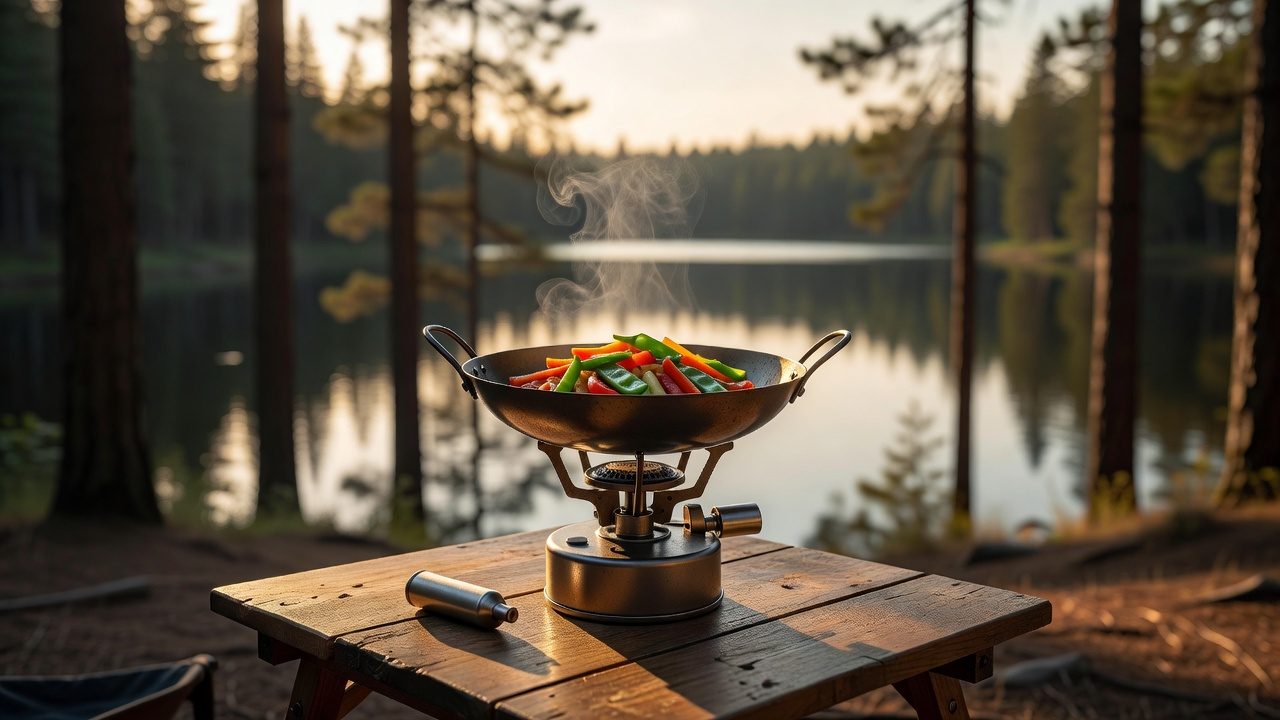
The Coleman Bottle-Top Stove: How to Use It, and What to Buy With It
The Coleman 1-burner bottle-top propane camp stove is the best-selling single burner in North America and it is also the one people ask the most questions about, because the instructions on the box are four pictures and no words. Here is the whole procedure.
- Check the cylinder, not the stove. Make sure the 1 lb cylinder is not dented or rusty at the collar. A cylinder that has been in a hot trunk all summer is fine; one with a corroded valve is not.
- Thread the burner onto the cylinder by hand. Turn the burner, not the fuel, and stop when the collar seats — firm, never forced. A cross-threaded collar is the only way this stove leaks.
- Listen and smell before you light anything. You should hear a faint hiss when the valve opens, and nothing at all when it is closed. If you smell gas with the valve closed, disconnect it and use a different cylinder.
- Light from the side, not over the burner. Long lighter or match at the edge of the burner head, then open the valve. Lighting from directly above is how people singe their forearms.
- Warm the pan before you judge the flame. A 10,000-BTU burner heats a cold cast iron skillet slowly, then holds a boil easily. Give it two minutes instead of cranking the valve.
Two practical notes. The stove has no ignition, so a long lighter lives in the same bag — a $3 lighter that always works beats a piezo that sometimes does not. And "coleman bottle top stove case" is a real question with an unglamorous answer: there is no official hard case for the bottle-top, and it does not need one. It is a stamped metal bracket and a burner head. A mesh stuff sack keeps soot off your other gear and that is the whole requirement. If a carry case is what you actually want, that is the butane Classic, which ships with one.
The stove goes by several listings names — "coleman 1 burner bottle top propane camp stove," "coleman bottletop propane gas camping stove 1 burner," or just the Coleman single burner — and they are all the same $21.99 bracket burner. If you searched "how to use coleman bottle top stove," the five steps above are the complete procedure. If you searched "coleman bottle top stove review," the summary is this: 4.5 stars across 12,600 ratings, reliability complaints are rare, and the two recurring gripes are the missing ignition and the single burner. For "coleman bottle top stove walmart" — yes, it is stocked in the camping aisle at most Walmart stores and in hardware stores, usually for about the same price as online.
What to buy with it. One cylinder of propane is one weekend of two-person cooking, so the pairing that changes the math is a refill setup: the Gaspro 20 lb-to-1 lb adapter at $9.98 or the Gas One refill hose at $14.99, plus a 12-pack of Coleman 16.4 oz cylinders at $64.99 to start (about $5.42 a cylinder, dropping to roughly $1 when you refill them yourself). Add a windscreen and the same burner behaves noticeably better in a breeze. That is a complete, $40-ish camp kitchen that will outlive most two-burner stoves.
You will find this stove at Walmart, hardware stores, and every gas station that sells propane — which is the real reason it is the default recommendation for car camping. Reviews that complain about it are almost always about the missing ignition or about cooking two things at once, not about reliability.
Portable Camp Stove Cheat Sheet
If you searched "portable camp stove" plus a word, here is the short answer to each.
- portable camp stove propane — the bottle-top Coleman; smallest packed volume of anything here once the cylinder comes off.
- portable camp stove butane / portable camp stove gas — the Classic butane or the GS-3400P on butane; flat, stable, push-button.
- portable camp stove coleman — Coleman makes three of the four picks in this article, which is not favoritism, it is what the review counts say.
- portable camp stove fuel — propane for cold and road trips, butane for cheap mild-weather cooking, isobutane only if you are carrying it. The full breakdown is in our camp stove fuel guide.
- cheap camp stove fuel — the cheapest fuel is not a canister at all, it is propane refilled from a 20 lb tank: about $1 per 1 lb bottle, or roughly $0.11 per meal for two.
- portable camp stove grill — a single burner is a poor grill; a flat cast iron griddle on a stable burner does most of the job, and if you want real grilling, that is the Coleman RoadTrip 225 at $199.99, a different product category entirely.
- portable camp stove table — do not buy a stove that needs its own table. Buy a stable tabletop burner (Classic butane or GS-3400P) and use the picnic table already at your site. Our camping tables guide covers the folding-table options if your site has no table at all.
- portable camp stove near me / portable camp stove amazon — the bottle-top and butane models are stocked in Walmart and hardware stores nationwide; the dual-fuel and backpacking stoves are easiest to find online, where the multipack fuel is also cheaper.
- portable camp stove reviews — read the two-star reviews, not the five-star ones. On budget burners, every consistent complaint is about a regulator, a piezo, or a pot support — the three parts that decide whether a cheap stove stays cheap.
The bottom line
You can feed yourself well at a campsite for $22. The Coleman Bottle Top is the best $22 I have spent on camping gear. For warm-weather trips with push-button convenience, the Coleman Classic Butane at $29.99 is the easy pick. If you camp in the cold, spring for the $35 Gas One dual fuel and stop worrying about whether your stove will light.
Any one of these plus a pot and a spatula gets you 90 percent of the way to a proper camp kitchen. The other 10 percent is just practice.
TrailMapz is an Amazon affiliate site. We earn a small commission on qualifying purchases at no extra cost to you. All products featured are independently selected based on real ratings and reviews.
Budget stoves are cheap; the fuel is not — the propane calculator shows your running cost per trip before you buy.
Budget Camp Stove FAQ
What's the cheapest stove that actually works?
A single-burner butane or propane stove — around $25-40 and it will outlast a dozen fancy alternatives. The Coleman Classic 1-burner butane stove lights instantly, simmers predictably, and uses cheap canisters, while the Coleman bottle-top propane stove screws onto a 1-pound cylinder you can refill.
Butane, propane, or dual fuel?
Butane burns hotter and cleaner but struggles below 40F and the canisters cost more. Propane works in cold weather and the 1-pound cylinders are refillable. Dual fuel stoves like the Gas One GS-3400P accept either, which makes them the most flexible budget pick if you camp across seasons.
Can I use a 1-pound propane cylinder on a butane stove?
Not directly — the fittings are different. You need a converter, and the GASPRO 20lb-to-1lb adapter or the Gas One refill adapter lets you run a hose from a bulk tank. That's the cheapest way to cook for a long weekend by a wide margin.
Do I need a windscreen?
Yes, and it's the single biggest performance upgrade on a budget stove — wind is why your "10,000 BTU" burner takes 20 minutes to boil water. The windscreen guide covers folding screens and foil options; just never enclose a fuel canister with one.
How many BTUs do I need for car camping?
Around 8,000-10,000 BTU is plenty for one pot or pan at a campground. Higher numbers mostly mean faster boiling, not better cooking, and they drain canisters faster. A 10,000 BTU single burner will cook for a family of four across a long weekend on one or two canisters.
What can I cook on one burner?
More than you'd think: eggs, pancakes, one-pot pasta, chili, and anything in a cast iron skillet. The limitation isn't the stove, it's that you can't cook two things at different temperatures at once — which is why a two-burner stove becomes the upgrade once you're feeding more than two people.
Which budget camp stove do experienced car campers recommend?
The pattern in the review data is consistent: people who cook at a site recommend the propane bottle-top for power and the dual-fuel GS-3400P for shoulder-season trips, and the most common regret in one-star reviews is buying a $15 no-name burner instead. If you are reading a forum thread where the question was "best budget camp stove reddit" or "best camp stove for car camping reddit," the two names that come up over and over are Coleman and Gas One — the same two that carry the review counts.
Do I need a carrying case for a budget stove?
Only if it makes you use the stove more. The Coleman Classic butane stove includes a hard case; the bottle-top propane stove does not have one and does not need one beyond a stuff sack for soot protection.
Is a butane stove safe indoors?
No. Cartridge stoves are outdoor cookers, and burning one in a tent, car, RV with the windows shut, or garage produces carbon monoxide. Use it outside or on a screened porch, and if you specifically need indoor cooking, that is an electric or induction burner — not a fuel stove.
Budget or not, the $23.97 Kidde AA-battery carbon monoxide detector is the accessory to add before a second canister: it costs less than a 4-pack of butane and it is the only item on this page that reacts to an odourless gas.
<!-- AFFILIATE_DISCLOSURE -->