Best Car Camping Stove 2026: 7 Camp Stoves Compared by Fuel Type, Size, and Budget
Looking for the best car camping stove in 2026? Compare Coleman RoadTrip 225, 2-in-1, Gas One dual-fuel, butane, propane, and ultralight options by budget, fuel type, and cooking style.
The first morning at a campsite has a rhythm all its own. You unzip the tent to crisp air, stretch out the stiffness from a night on the sleeping pad, and immediately start thinking about one thing: coffee. Not instant crystals dissolved in lukewarm water from a plastic bottle. Real coffee, brewed hot, sipped while the forest wakes up around you.
That moment is what separates car camping from backpacking. When weight is not your enemy, you can bring a proper stove, a real coffee maker, and enough fresh food to eat like a human being. So which camp stove delivers?
I tested the two most popular portable propane options under $150. Here is how to build a legit camp kitchen that fits in your trunk.
Why car camping deserves a real stove
Backpacking stoves are engineering marvels: tiny, ultralight, and capable of boiling water in under three minutes. But they are also finicky. Wind blows out the flame. The pot support is barely wider than a soda can. You cook one dish at a time, in sequence, while balancing on uneven ground.
Car camping changes the equation entirely. You have room for a two-burner setup. You can bring a cast iron skillet. You can make pancakes and bacon simultaneously. The camp stove becomes the social center of the site. Everyone gravitates toward the food.
The sweet spot for a quality car camping stove is $100 to $150. Below that, you get flimsy construction and weak burners. Above that, you are paying for features most weekend campers do not need. Or you should buy a full-size grill.
Coleman RoadTrip 225: the gold standard
The Coleman RoadTrip 225 Portable Tabletop Propane Grill ($124.99) has been the go-to car camping stove for years, and for good reason.
What makes it work:
11,000 BTUs of consistent heat, enough to sear a steak or boil a large pot of pasta water without waiting. Two independently controlled burners so you can cook eggs on low while hash browns crisp on high. Matchless Instastart ignition: push a button, hear the click, cook. No fumbling with a lighter at 6 AM. A removable grease tray that slides out and wipes clean in ten seconds. Folds flat with wheels and a handle. Carries like rolling luggage and fits in any trunk.
The real advantage of the RoadTrip is versatility. Swap the grill grate for the optional griddle plate (sold separately) and you are making pancakes, grilled cheese, and fajitas. Swap again for the stove grate and use your own pots and pans. One base platform, three cooking surfaces.
Real-world note: The RoadTrip runs on standard 1-lb propane cylinders (the green Coleman cans). One can lasts about 1 to 1.5 hours on high. For weekend trips, bring 2 or 3 cans. For longer trips, get the Coleman 5-ft propane hose adapter and use a 20-lb tank.
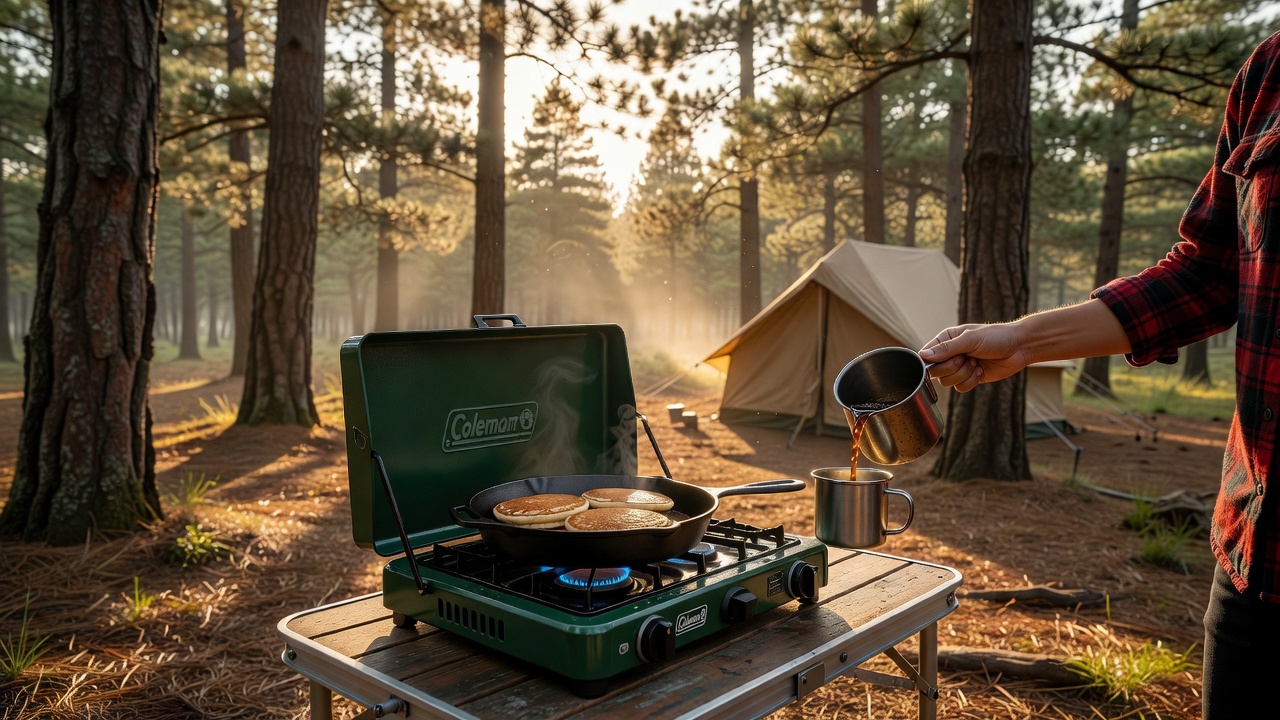
Coleman Tabletop 2-in-1: the space saver
If your gear storage is tight or you camp with a smaller vehicle, the Coleman Tabletop 2-in-1 Grill & Stove ($166.01) packs both a grill and a stove burner into a single compact unit.
How it differs from the RoadTrip:
One grill surface plus one stove burner instead of two. You trade flexibility for space savings. Same 11,000 BTUs, identical cooking power. About 30 percent smaller footprint than the RoadTrip when set up. No wheels, so lighter to carry but less convenient to transport.
This is the better choice if you mostly grill burgers, hot dogs, and kebabs and only occasionally need a pot of boiling water. It is also $10 cheaper, though the price difference is negligible when you factor in the RoadTrip's included wheels and handle.
Which one? If you have the trunk space, get the RoadTrip 225. The two-burner flexibility is worth the extra $10 and slightly larger packed size. If you are in a sedan or hatchback with limited cargo room, the 2-in-1 earns its keep.
Don't forget the coffee
The morning ritual matters as much as dinner. Maybe more. The AeroPress Original Coffee Press ($34.96) is the easiest way to make genuinely good camp coffee without glass, cords, or a bulky drip setup.
- No electricity needed. Heat water on your stove and brew in about two minutes.
- Compact and durable. The plastic brewer rides in a camp kitchen bin without the fragility of a glass press.
- Cleaner flavor than most camp percolators or instant packets, with almost no messy cleanup.
Brew method: Heat water on the RoadTrip until it is nearly boiling. Add fine-ground coffee, pour, stir, wait about 30 seconds, then press slowly. Total time: roughly 2 minutes. Result: better coffee than most office break rooms.
If you want a premium no-paper-filter option for smaller camps, the Snow Peak Titanium French Press keeps weight low and durability high while brewing a richer, more traditional French press cup.
Keeping everything cold
All that fresh food needs to stay fresh until you cook it. The Coleman 316 Series Wheeled Cooler 62QT ($84.99) holds enough food and drinks for a full family weekend while giving you real wheels instead of forcing a two-person carry every time you move campsites.
The wheeled design is the killer feature. Roll it from the car to the picnic table, park it under shade, and stop wasting energy on awkward cooler carries before you've even started cooking. Up to 5-day ice retention at 90°F means it is built for long summer weekends, beach trips, and crowded campgrounds where resupply is annoying.
Pro tip: Pre-chill the cooler with a bag of sacrificial ice the night before. Dump it, then pack your food with fresh ice. The pre-chilled walls extend your ice life by 12 to 24 hours.
Quick camp kitchen setup (no fancy table needed)
You do not need a dedicated camp kitchen stand. The minimalist setup:
- Stove on the picnic table (if your site has one). Put a silicone mat or folded towel underneath to catch spills.
- Cooler under the table. Shaded, easy access, doubles as a footrest.
- Cooking tools in a tote bag. Spatula, tongs, can opener, oil, salt, pepper, foil. One bag you grab and go.
- Wash station: two collapsible buckets. One for soapy water, one for rinse. Hang them from a tree branch or set on the bench.
The whole setup packs into one medium tote plus the cooler and stove. Five minutes to set up, five minutes to break down.
What to cook (beyond hot dogs)
Once you have the gear, the menu opens up. Our campfire cooking gear and recipes guide has detailed instructions for Dutch oven meals, foil packets, and fire-safe cooking setups. Here is the quick-hits menu for a weekend trip:
- Friday dinner: Pre-marinated steak and foil-wrapped potatoes. Throw both on the grill, no pots needed.
- Saturday breakfast: Pancakes on the griddle, bacon on the grill side.
- Saturday lunch: Quesadillas. Tortilla, cheese, leftover steak, grilled until crispy.
- Saturday dinner: One-pot jambalaya. Andouille sausage, rice, bell peppers, all in a single pot on the stove burner.
- Sunday breakfast: AeroPress coffee with oatmeal, dried fruit, and nuts.
The camp stove transforms car camping from "we are surviving outdoors" to "we are living outdoors." And that is the whole point.
Cookware worth bringing
A great stove with lousy cookware is like a sports car with cheap tires. You are leaving capability on the table. Once you have the heat source sorted, these pieces of cookware unlock real camp meals.
Cast iron griddle. The Lodge Round Seasoned Cast Iron Griddle ($24.90, 4.7 stars from 8,200+ reviews) is the easiest way to level up breakfast at camp. Pancakes, tortillas, grilled sandwiches, smash burgers — the wide flat surface gives you more control than a narrow pot and handles camp-stove burners or a fire grate equally well.
Cast iron is heavy, but for car camping that weight becomes a feature. It stores heat, resists warping, and smooths out the hot spots that make cheaper pans burn bacon in one corner while the eggs barely cook in another.
Lightweight skillet backup. The Lodge Seasoned Cast Iron Skillet 6.5 Inches ($9.38) is tiny, cheap, and perfect for side dishes, reheating sausage, or giving one burner its own dedicated pan while the griddle handles the main event.
Complete cook set for the whole crew. The Stanley Wildfare Core 26-Piece Complete Camp Kitchen Cook Set ($89.99, 4.7 stars) is the set-and-forget answer for family trips — a 4-quart pot with lid, an 8-inch fry pan, and four full table settings (plates, bowls, mugs, and utensils) all nest inside one another and pack into a single carry case. One trip from the car to the picnic table and the whole kitchen is set up. It's the easiest way to go from "stove plus random pans" to a full camp kitchen, and it stows in a fraction of the trunk space.
Common camp stove mistakes (learn from mine)
I have made every mistake in this list at least once. Save yourself the frustration.
- Running out of propane mid-cook. One 1-lb can lasts 1 to 1.5 hours on high. For a weekend trip cooking 3 meals a day, you need 3 or 4 cans. Bring one more than you think you need.
- Setting up on uneven ground. A wobbly stove spills hot oil and tips pots. Level it with rocks or stick to the picnic table. If there is no table, bring a folding camp table. Shopping around? Our best camping tables buying guide compares roll-up, aluminum, and family-size options side by side.
- Cooking in the wind without a windscreen. 11,000 BTUs means nothing if the wind steals half of it. Prop the stove against a cooler or vehicle door, or bring a folding aluminum windscreen ($10 to $15). It also cuts fuel consumption by 30 percent or more. Our camp stove windscreen and wind protection guide breaks down which screens are safe with each stove type and the field fixes that save a trip when you forget yours.
- Using cold ingredients straight from the cooler. Cold steak on a hot grill sears unevenly. Charred outside, raw inside. Pull ingredients out 15 to 20 minutes before cooking. Keep the cooler lid shut on everything else.
- Forgetting the can opener. The one tool nobody thinks about until the chili can is staring at them. Keep a manual can opener in your cook kit permanently.
Single-burner alternatives from our catalog
The two Coleman tabletop stoves above are ideal for car camping. But if you are on a tighter budget, want something simpler, or split time between car camping and backpacking, the TrailMapz catalog has solid single-burner options that cost less than takeout for two. Not sure whether one burner is enough for your group? Our single-burner vs 2-burner camp stove guide compares cooking capacity, fuel use, and weight so you can match the stove to how you actually cook.
Need help picking the right fuel before you buy? Our camp stove fuel guide breaks down when propane, butane, and backpacking canister fuel actually make sense so you do not end up with the wrong stove for your style of camping.
Coleman Bottle Top Propane Camp Stove — $21.99, 10,000 BTU
The Coleman Bottle Top screws directly onto a standard 1-lb propane cylinder. No hose, no regulator, no base. The whole setup weighs less than a pound. At 10,000 BTUs, it boils a liter of water in about 4 minutes — fast enough for morning coffee and simple one-pot meals. The flame control knob is precise enough to simmer, not just blast. This is the stove for the camper who wants to eat well without hauling a two-burner rig. Pair it with a lightweight pot and you have a kitchen that fits in a daypack.
Coleman Classic 1-Burner Butane Camp Stove — $29.99
If you prefer the convenience of butane cartridges (self-sealing, no threading, instant on/off), the Coleman Classic Butane is the picnic-table favorite. The carrying case doubles as a windscreen, and butane burns cleaner than propane — less soot on your pots. One 8 oz butane can runs about 1.5 hours. Butane stoves work best above 40°F — if you camp in shoulder-season cold, stick with propane.
Gas One GS-3400P Dual Fuel Camp Stove — $34.99
The Gas One GS-3400P is the easy answer for campers who do not want to commit to one fuel type. It runs on either propane or butane, includes the propane hose, and gives you more cold-weather flexibility than a basic butane stove. If you camp in spring and fall, or you shop wherever fuel is cheapest that week, this is the value play.
MSR PocketRocket 2 Ultralight Stove — $49.95
The PocketRocket 2 is technically a backpacking stove (2.6 oz, folds to the size of a thumb), but car campers should not overlook it. It boils water in 3 minutes flat, simmers with surprising control, and takes up zero trunk space. If your car camping trips sometimes involve a day hike where you want hot lunch on the trail, the PocketRocket does double duty — camp kitchen in the morning, trailside ramen at noon. The small burner head creates a concentrated heat ring on wide pots, so stick to narrower cookware or bring a heat diffuser.
More camp kitchen resources
Building out your camping setup? These guides cover related gear and skills:
- Best Budget Camp Stoves for Car Camping: affordable alternatives under $75
- Sleeping Pad vs Air Mattress Guide: because comfort matters after a big camp meal
- Camp Lighting Guide: Lanterns & Headlamps: light up your camp kitchen after dark
- Winter Camping Beginners Guide: cold-weather cooking takes different gear
- How to Choose a Hiking Backpack: for the morning hike before you fire up the stove
Car Camping Stove FAQ
What is the best stove for car camping?
A two-burner propane stove is the safest default, for two reasons: you can cook two things at once, and propane behaves predictably in cold weather. For solo trips or when space is tight, a single-burner bottle-top stove does the same job with less to pack and clean. The real deciding factor is how many people you are feeding — two burners only matter when someone else is waiting for coffee.
How long does a propane canister last on a camp stove?
A rough rule of thumb: one 1 lb canister covers a couple of hours of cooking on a single burner at medium heat, which is usually a weekend of breakfasts and coffee. Cold weather, high altitude, and wind all cut that down noticeably. Bring a spare canister for any trip longer than two nights rather than planning to ration the last one.
Can I use a camp stove inside a tent?
No — not even in a vestibule. Every fuel-burning stove produces carbon monoxide, which is invisible, odorless, and genuinely dangerous in an enclosed space. You are also putting an open flame and a very hot burner next to synthetic fabric. Set the stove up outside on a stable, non-flammable surface and shelter it from wind instead.
Do I need a windscreen for a car camping stove?
It helps more than most accessories. Wind pulls heat away from the pot, so a burner that boils water quickly in still air can take several times longer in a breeze. Many two-burner stoves fold into their own wind-blocking case already; for bottle-top stoves, a simple clip-on screen is inexpensive and worth the space. Never fully enclose a canister stove — trapped heat can overheat the canister.
How do I clean and store a camp stove?
Let it cool completely, then wipe the grate and burner area and clear food debris out of the burner ports with a soft brush — clogged ports are the usual cause of an uneven or yellow flame. Disconnect the fuel and store it separately, outdoors or in a ventilated space, never inside a hot car or a living area. A five-minute clean at the end of a trip is what keeps a stove lasting for years.
The bottom line
A camp stove is the single biggest upgrade you can make to your car camping experience. More than a better tent, more than a fancy sleeping bag. It turns meal time from a chore into a highlight.
If you want a self-powered stove for campsites, outages, or places where carrying extra fuel gets annoying, the BioLite CampStove 2+ is the most interesting all-in-one option in our catalog. It burns sticks and twigs, gives you fan-assisted combustion for a cleaner burn, and even kicks a little USB power back to your small devices while dinner cooks.
For the simplest budget option, the Coleman Bottle Top Propane Camp Stove stays hard to beat at $21.99. If you want butane convenience in a tabletop format, the Coleman Classic 1-Burner Butane Camp Stove keeps setup and cleanup dead simple.
Either way, round out the kitchen with the AeroPress Original Coffee Press for coffee, the Coleman 316 Series Wheeled Cooler 62QT to keep food cold, and a piece of Lodge cast iron so breakfast actually feels like breakfast.
Total for a solid car-camping kitchen setup: roughly $150 to $250 depending on which stove path you choose. That's enough to cover hot breakfasts, real dinners, and the kind of slow campsite coffee that makes people linger in camp chairs long after the fire has burned down.
Now go make some pancakes in the woods.
<!-- AFFILIATE_DISCLOSURE -->