Sleeping Pad vs Air Mattress for Camping: Which One Actually Works?
Sleeping pad or air mattress for camping? Comfort, R-value, deflation, and cost compared — plus what actually keeps you warm at 3 AM in 2026.
If you've ever woken up on a deflated air mattress at 3 AM with your hip touching cold ground through half an inch of vinyl, you already know: what you sleep on makes or breaks a camping trip. But walk into any outdoor store and you'll see two product categories, sleeping pads and air mattresses, and nobody explains which one you need.
The short answer: sleeping pads are for camping, air mattresses are for guest bedrooms that happen to be in a tent. But the real answer depends on how you camp, when you camp, and what "comfortable" means to you.
Quick Answer: Sleeping Pad or Air Mattress?
Short answer: a sleeping pad for camping, an air mattress for a guest bedroom that happens to be inside a tent. Pads insulate; air mattresses mostly just hold you up while your body heat leaks into the ground.
- The spec that matters is R-value — resistance to heat flow. R 1–2 is summer only (below 50°F you will be cold). R 2–4 is three-season, comfortable down to freezing. R 4+ handles frozen ground and snow. A Walmart air mattress has no published R-value at all, because it is not tested for thermal performance — which is exactly why you wake up cold at 3 AM.
- Best value for car camping: the Gear Doctors Oxylus self-inflating pad — $49.99, R-value 4.3, 1.5 in thick, 5.2 lb (4.5★). Four-season warmth at a three-season price.
- Best cheap backpacking pad: the Klymit Static V — $64.95, 25 oz, inflates in 10–15 breaths, but R-value 1.3, so summer only. Step up to the Klymit Insulated Static V ($94.99, R 4.4, only 6 oz heavier) for three-season trips.
- Best when weight is the only thing that matters: the Therm-a-Rest NeoAir XLite NXT — $209.95, 14 oz, 3 in thick, R 4.5, packs to the size of a 1 L bottle (4.7★ / 3,100+ reviews).
- Best if you refuse to worry about punctures: the Therm-a-Rest Z Lite Sol — $54.95, 14 oz, R 2.0 closed-cell foam that cannot leak or fail (4.7★ / 11,500+ reviews).
- Already own an air mattress? You can make it work for car camping by putting a closed-cell foam pad between you and the mattress. That combination lands around R 3.5–4.0 — enough for comfortable three-season nights. For backpacking, skip it: air mattresses run 8–15 lb and do not pack down.
One rule to remember: at the same R-value, a thicker pad sleeps better but weighs more — side sleepers should target 3 inches or more. Insulation is the one spec you cannot add later.
The Fundamental Difference Most People Miss
A sleeping pad's primary job is insulation, not comfort. When you sleep, your body weight compresses the insulation in your sleeping bag against the ground, rendering it useless underneath you. The ground then pulls heat from your body through conduction, the same physics that makes a tile floor feel colder than a rug even when they're the same temperature.
A good sleeping pad puts a thermal barrier between you and the ground. An air mattress puts an air gap between you and the ground, which does insulate somewhat, but air moves. It creates convection currents inside the mattress that circulate cold air from the bottom surface up toward your body. This is why that queen-size Intex air mattress feels warm when you get in and cold by midnight: your own body heat has been slowly pumped away all night.
R-value is the measure that matters. It quantifies a pad's resistance to heat flow, higher is warmer. Here's what the numbers mean in practice:
- R-value 1.0 to 2.0: Summer only, warm nights above 60°F. You'll feel cold on anything below 50°F
- R-value 2.0 to 4.0: Three-season use. Comfortable down to freezing with a decent sleeping bag
- R-value 4.0+: Four-season. Warm on frozen ground, snow camping capable
That Walmart air mattress you already own? It has no published R-value, because it's not tested for thermal performance. It's designed for indoor use on a carpeted floor where insulation doesn't matter.
Sleeping Pads: The Three Types
Self-Inflating Pads
These combine open-cell foam with an air chamber. When you open the valve, the foam expands and draws air in (hence "self-inflating," though you usually top them off with a few breaths). They're the middle ground: more comfortable and warmer than closed-cell foam, more durable than pure air pads.
The Gear Doctors Self Inflating Sleeping Pad ($49.95) is the value standout in this category. With a 4.3 R-value, it's four-season capable at a three-season price. The 1.5-inch thickness is thinner than premium pads but the foam core means you won't bottom out on your side. It's 5.2 pounds, heavy for backpacking but perfect for car camping where you want reliable warmth without spending $200.
Best for: Car campers who camp in shoulder seasons and want set-it-and-forget-it reliability.

Air Pads (Inflatable)
These are pure air chambers with internal baffles or insulation layers. They pack down to the size of a water bottle and weigh under a pound for ultralight models. This is the backpacking standard.
The Klymit Static V Sleeping Pad ($64.95) is the pad I recommend most for someone's first serious camping pad. The V-shaped baffles cradle your body and limit air movement (reducing that convection problem), it inflates in 10 to 15 breaths, and at 25 ounces it's light enough for backpacking but cushioned enough for car camping. The 1.3 R-value is summer-only territory, but the comfort-to-weight ratio is outstanding.
For backpackers counting ounces, the Therm-a-Rest NeoAir XLite NXT ($209.95) is the gold standard. 14 ounces, 3 inches thick, R-value 4.5, and it packs down to the size of a 1L Nalgene. The Triangular Core Matrix construction uses two layers of triangular baffles that reflect heat back at you while preventing the air-movement chill that plagues cheaper air pads. It's expensive, but if you're sleeping on frozen ground at 10,000 feet, it's the best night of sleep you'll get outside a real bed.
For those who want warmth without weight, the Klymit Insulated Static V ($94.99) adds Klymalite synthetic insulation to the Static V design, bumping the R-value to 4.4 while only adding 6 ounces. I use this pad for three-season backpacking in the Rockies. It handles unexpected freezes without the price tag of the NeoAir.
Ultralight option: The Klymit Static V SL ($59.95) shaves the V-chamber design down to 15.2 ounces. For gram-counters who still want more than a foam mat.
Closed-Cell Foam Pads
These are the indestructible workhorses. No valves to fail, no punctures to patch, and they double as sit pads and wind screens. They're also the least comfortable option. Think yoga mat, not mattress.
The Therm-a-Rest Z Lite Sol ($54.95) is the iconic accordion-fold pad with a 2.0 R-value and reflective ThermaCapture coating. At 14 ounces it's lighter than most inflatables and cannot fail. No punctures, no leaks, no valves. Thru-hikers on the PCT and AT swear by these because a pad failure on day 8 of a 10-day resupply section means five nights of misery.
Best for: Backpackers who prioritize reliability over comfort, winter campers who layer it under an inflatable for extra insulation, and anyone who's ever woken up on a flat pad at 2 AM.
Air Mattresses: When They Actually Make Sense
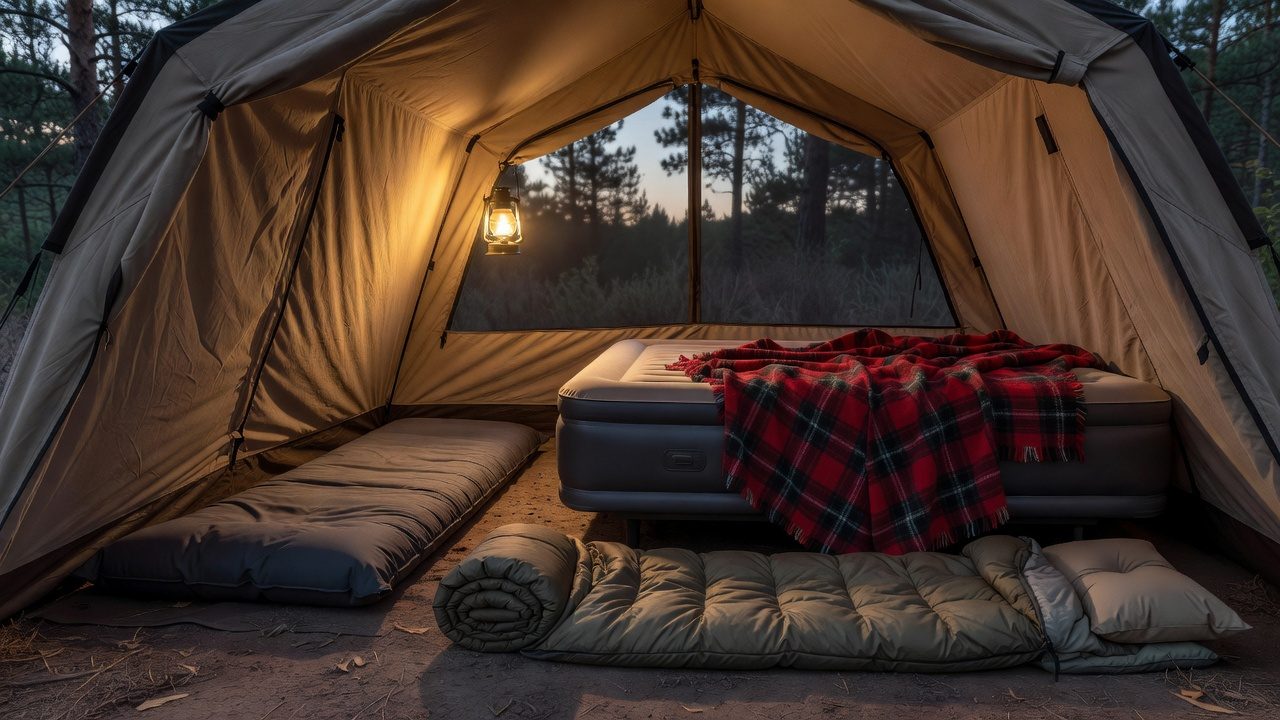
If you're car camping with a significant other who "doesn't do camping," an air mattress might be the difference between them coming back and never speaking to you again. A queen-size air mattress inside a large tent creates a sleep experience that approximates a real bed. For some people, that's the only version of camping they'll tolerate.
Before you buy one, though, check the floor plan: a queen air mattress needs a 4-person tent minimum, and you'll want the extra floor space to spare. Our tent size guide breaks down real floor dimensions for 2P, 4P, and 6P tents so you can see exactly what fits before you haul it to the campsite.
The trade-offs are real. Air mattresses are heavy (8 to 15 pounds), bulky (they don't pack small), require a pump (electric or manual), and offer zero thermal insulation. On a 45°F night, you will feel cold through an air mattress even with a good sleeping bag, because that massive air chamber is circulating cold air against your body all night.
The fix: If you're committed to the air mattress route, put a closed-cell foam pad on top of the air mattress, between you and the mattress surface. This puts the insulation where it matters: directly under your body. Your sleeping bag's insulation still gets compressed, but the foam pad doesn't. Combined R-value of a Z Lite Sol on top of an air mattress: about 3.5 to 4.0, enough for comfortable three-season camping.
If comfort is the whole point — you're an older camper, or you're bringing your parents along — our senior-friendly camping guide walks through the full sleep setup (plus high-seat chairs, lighting, and bathroom logistics) that turns a one-night experiment into a hobby. The same pressure-point physics that wakes you at 3 AM matters even more when joints are older.
Two Air Mattresses Worth the Trade-Off
If you're car camping and an air mattress is the only thing standing between your partner and a good night's sleep, don't grab the cheapest inflatable on the shelf. Two options hold up to regular camping duty:
- SoundAsleep Dream Series Raised Queen — the reliable name in raised air mattresses and a long-time top pick in air mattress roundups. Its ComfortCoil technology limits the internal air movement that makes cheap mattresses feel cold by midnight, the built-in high-capacity pump inflates in about two minutes, and the raised height gets you closer to real-bed territory. This is the pick when "camping" needs to feel like a hotel room.
- Intex Dura-Beam Deluxe Comfort-Plush Queen — the budget workhorse. Fiber-Tech construction resists punctures and abrasions, the built-in electric pump handles setup, and the 18-inch height supports up to 600 pounds. At a friendlier price than the SoundAsleep, it's the sensible choice if you camp a handful of weekends a year.
Whichever you choose, remember the two rules from earlier: put a closed-cell foam pad between you and the vinyl, and check your tent's floor plan first — a queen mattress needs a 4-person tent minimum.
Pillows: The Forgotten Variable
A sleeping pad that supports your back means nothing if your head is at the wrong angle all night. Skip the stuff-sack-full-of-clothes solution. It works for one night, then becomes a lumpy, shifting disaster.
The KingCamp Inflatable Pillow ($24.99) bridges the gap between a foam pillow and an inflatable — the memory foam top layer gives you that real-pillow feel while the inflatable core lets you dial in firmness. It's full adult size, the brushed cover is machine washable, and unlike a pure foam pillow it packs down to about the size of a water bottle. If you are choosing between inflatable, compressible, and memory-foam styles for your own sleep position, our camp pillow comparison guide makes the trade-offs easier to sort before you pack.
For backpacking, the TREKOLOGY ALUFT 2.0 Inflatable Camping Pillow ($16.99) weighs 3.5 ounces and packs to the size of a mandarin orange. The ergonomic curve cradles your head and the TPU bladder doesn't make that crinkly noise that cheaper inflatable pillows make when you move. At this weight and price, there's no excuse for sleeping on a wadded-up rain jacket.
If you want the premium upgrade, the Sea to Summit Aeros Premium Inflatable Pillow ($49.95) is the one backpackers reach for when they stop tolerating bad sleep. The brushed 30D polyester face feels like a real pillowcase against your skin, and the dual-valve system lets you fine-tune height independently from firmness — a trick the cheaper inflatables can't match.
The Sleep System: Putting It All Together
Your sleeping pad doesn't work in isolation. It's part of a system:
-
Sleeping bag + pad: Your bag's temperature rating assumes you're using a pad with adequate insulation. A 20°F bag on an uninsulated pad is a 40°F bag in practice, because you're losing heat to the ground faster than the bag can retain it.
-
Pad + ground cloth: A footprint or ground cloth under your tent protects your pad from sharp objects, but it also adds a micro-layer of insulation by breaking the direct conduction path to the ground.
-
Pad + sleeping bag liner: A fleece or silk liner adds 5 to 15°F to your sleep system for minimal weight. It also creates a second air gap between you and the pad, reducing that convection problem. The REDCAMP fleece liner with hood ($24.99) is the budget way in; the BROWINT mulberry silk liner ($70.99) costs more but adds warmth for almost no packed volume.
The Kelty Cosmic Down 20 Sleeping Bag ($139.95) is a great match for any of the pads above. The 550-fill DriDown stays warm even when damp, and the mummy cut eliminates dead air space that your body has to heat. Pair it with the Gear Doctors 4.3 R-value pad and you've got a sub-$250 sleep system comfortable to 25°F. If you camp into the shoulder season or winter, the TETON Sports Celsius XXL 0 Degree Sleeping Bag ($89.99) is the zero-degree alternative — its oversized cut and full hood trap heat far better than a three-season bag when the temperature drops past freezing.
For pure car-camping luxury, add the NEMO Moonlite Reclining Camp Chair ($169.95) to your setup. It reclines and has a padded headrest, great for stargazing before you crawl into your sleeping arrangement.
Sleeping Pad Comparison: Our Top Picks
Here's how our recommended pads stack up for real-world camping:
| Pad | R-Value | Thickness | Weight | Price | Best For |
|---|---|---|---|---|---|
| Gear Doctors Self Inflating | 4.3 | 1.5" | 5.2 lbs | $49.95 | Car campers who want shoulder-season warmth without spending $200 |
| Klymit Static V | 1.3 | 2.5" | 25 oz | $64.95 | First-time pad buyers — comfort and versatility |
| Klymit Insulated Static V | 4.4 | 2.5" | 31 oz | $94.99 | Three-season backpackers who face unexpected cold |
| Therm-a-Rest NeoAir XLite NXT | 4.5 | 3" | 14 oz | $209.95 | Ounce-counters who refuse to compromise on warmth |
| Klymit Static V SL | 1.3 | 2.5" | 15.2 oz | $59.95 | Summer backpackers who want minimal weight |
| Therm-a-Rest Z Lite Sol | 2.0 | 0.75" | 14 oz | $54.95 | Thru-hiking, winter layering, and anyone who's ever patched a hole at 3 AM |
Two rules of thumb when reading the chart: for a given R-value, a thicker pad is more comfortable but heavier — side sleepers should target 3" or more. And a higher R-value beats a higher price tag every time; insulation is the one spec you can't add later.
If you car camp, the Gear Doctors 4.3 R-value pad is the best value in this lineup. It's warm enough for shoulder seasons and costs less than a tank of gas. If you backpack, the Klymit Insulated Static V hits the sweet spot of warmth, weight, and price. Only go for the NeoAir if you need sub-freezing capability at the absolute minimum weight.
Common Sleeping Pad Mistakes (I've Made Them All)
-
Over-inflating: A rock-hard pad feels supportive for 10 minutes, then creates pressure points on your hips and shoulders. Inflate until firm, then let out enough air that you sink in a bit. Your body should be cradled, not balanced on a drum head.
-
Blowing moisture into your pad: Your breath contains water vapor that condenses inside the pad over time, reducing insulation and encouraging mold. Use an inflation sack or pump bag if you're camping in cold conditions. For summer use, it's less critical but still worth knowing.
-
Not checking for punctures before a trip: Inflate your pad at home the night before you leave. A slow leak that takes 4 hours to go flat is invisible in a 30-second garage test but ruins your second night of sleep. Pinholes are easy to patch, but only if you find them before you're lying on the ground.
-
Layering pads incorrectly: When stacking a foam pad and an inflatable for winter, the foam pad goes on top, closest to your body. This sounds wrong because you want the "softer" pad on top, but the foam pad is doing the insulation work. It needs to sit between your compressed sleeping bag and the cold air inside the inflatable.
-
Using an air mattress without a thermal barrier: If your partner insists on an air mattress, put a closed-cell foam pad on top and a thick wool blanket underneath. The blanket between mattress and tent floor reduces conductive heat loss, and the foam pad on top handles the rest.
Sleeping Pad vs Air Mattress vs Cot: How to Decide in One Pass
Three surfaces show up in every camping sleep conversation, and they are not variations on the same product. A pad is low, quiet, and insulated. An air mattress is tall, wide, and unstructured underneath. A cot is a frame with a pocket of air beneath it. Once you know which of the three your trip actually needs, the rest of the shopping is arithmetic.
Search "sleeping pad vs air mattress vs cot" and you get three different answers because the answer depends on how you arrive at the campsite. If you drive, the tall option wins on comfort. If you hike in, it loses before the comparison starts. The useful version of the question is never the three-way one — it is the two-way one that survives your trip's constraints.
The weight test settles most of it. Ask how far the sleep system has to travel from the vehicle. Under 100 feet, the two heaviest options are both live: sleeping pad vs cot camping is a real argument, camping cot vs air mattress for camping is a genuine toss-up, and so is camping air mattress vs cot. Over a mile, the debate collapses to camping sleeping pad vs air mattress, and even then only the pad side is practical — sleeping pad vs air mattress backpacking comparisons all end the same way, with the frame left in the car. This is the same logic that makes sleeping pad vs cot backpacking a non-question — nobody carries a steel frame up a switchback, and anyone who has tried it once does not try it twice.
Insulation is the second filter. An air mattress has no insulation value of its own: the air inside it circulates, and your body heat rides that circulation to the floor. A closed-cell or insulated pad is engineered to stop that transfer. So when people ask whether inflatable sleeping pad vs foam matters, the real difference is not comfort, it is whether the thing under you has an R-value at all. The same distinction is why self inflating sleeping pad vs air mattress is a comparison of two mechanisms, while self inflating sleeping pad vs inflatable is a comparison of two inflation styles that both rely on trapped air. Put self inflating sleeping pad vs air pad side by side and the only difference that survives is the foam core and the R-value it adds — which is also why inflatable sleeping pad vs air mattress is an insulation question more than a comfort one. And foam sleeping pad vs air is the oldest version of the argument: foam cannot puncture, air cannot be beaten for packed size per inch of thickness.
Height, width, and getting dressed. A cot or a tall air mattress lets you sit on the edge, put on socks, and stand up without using your hands. A pad makes you crawl. That single difference is why air mattress vs camping cot keeps coming up among campers over 50 or anyone who has had knee surgery, and why car camping cot vs air mattress tends to resolve on which one fits the tent. It is the same question as camping sleeping pad vs cot, asked by someone who has realised the height is the only thing they actually want. If your tent is a 6P cabin with vertical walls, a cot fits. If it is a low dome, a cot's legs may push the wall out and wick condensation onto your bag.
Variant by variant, the common pairings are:
- sleeping pad vs cot vs air mattress — the full three-way, decide on weight first, insulation second, height third.
- camping air mattress vs sleeping pad vs cot — same three, asked by people who want the comfortable answer to be affordable, which is where a thick self-inflating pad usually wins.
- air mattress vs cot for tent camping — cot for a cabin or a large dome, mattress for anything with steep side walls.
- sleeping pad or cot for camping — pad if you might ever hike, cot if you never will.
- car camping air mattress or sleeping pad — you can own both: a queen air mattress for two adults, a pair of pads for the kids' tent.
- cot vs pad camping — the cot adds height and a frame; the pad adds insulation and packs to the size of a loaf of bread.
- camping mattress or pad — a "camping mattress" is usually a thick pad with foam inside, so this is often the same purchase under two names.
- air mattress vs camping pad and camping air mattress vs pad — same comparison, and the pad wins on insulation every time.
- car camping air mattress vs foam — foam under an air mattress is the hybrid most cold-weather car campers end up building anyway.
- backpacking sleeping pad foam vs air — foam for the unbreakable base layer, air for the comfort layer, and the two stack.
- foam sleeping pad vs inflatable backpacking — same trade, expressed by weight-conscious shoppers.
- camping sleeping pad vs sleeping bag — not either/or: the bag holds warmth in, the pad stops the ground taking it out, and a 20°F bag on a bare air mattress behaves like a 40°F bag.
What the comparison usually ends with. Two purchases, not one, when there are two kinds of sleepers in the family. Adults who want bed-like height and do not want to hear air moving all night: a thick self-inflating pad, or a queen air mattress with a foam topper. Kids and backpacking teens: something closed-cell, cheap, and puncture-proof. And a foam square under the mattress solves the cold-floor problem for the price of a pizza — which is why so many experienced campers stop optimizing the main comparison and start stacking instead.
If you want to see how the trade-offs play out in practice, our sleeping pad picks walk each style through a real night's use, and the camping cot vs air mattress vs sleeping pad comparison settles the frame question in detail.
Sleeping Pad R-Value Explained: The Number That Decides Your Night
R-value is the only spec on a pad label that predicts whether you will sleep or shiver. It measures thermal resistance: how hard it is for heat to move through the material. Higher is warmer, roughly linearly, and it is additive when you stack layers. If you have ever wondered what is r-value sleeping pad ratings actually telling you, this is the short version — and it is the single number worth memorizing before you buy.
The scale, in plain terms. A sleeping pad r value of 1 to 2 is a summer pad: fine above 60°F, miserable in a cold snap. A sleeping pad r value 3 covers most three-season camping down to about freezing, which is why R-3 is the most common rating on mid-price pads. A sleeping pad r value 5 is the shoulder-season and cold-sleeper zone. A sleeping pad r value 6 is genuine winter camping. A sleeping pad r value 7 and up is snow camping, expedition use, or someone who simply refuses to be cold. The sleeping pad r value scale continues past that, but past R-7 you are paying for grams you may not need.
How to read it next to temperature. Most pad makers publish a sleeping pad r value chart or a sleeping pad r value temperature chart that maps R-value to a comfort range, and those charts are what people are really asking for when they search for a sleeping mat insulation rating. The rule of thumb worth trusting is that the pad adapts the bag: an R-2 pad under a 20°F bag gives you a 40°F system, while sleeping pad r value 4 and above lets the bag perform near its printed number. That is the practical meaning behind sleeping pad r value and temperature rating questions.
Where the number comes from. An inflated pad has no insulation of its own — trapped air moves, and moving air carries heat. Manufacturers add everything from synthetic loft to reflective film to internal baffles to stop that movement. This is why a foam sleeping pad with high r value is so quietly effective: closed-cell foam traps air in thousands of tiny cells that cannot circulate. The most common way people phrase that lookup is sleeping pad r value vs temperature — pick the overnight low, then read off the minimum R-value it demands. It is also why a sleeping pad insulated cover or a sleeping pad insulated cover can add a full point of warmth to a summer pad for very little money; a foam sleeping pad r value of roughly 2 per layer is what makes the trick work.
The vocabulary, decoded:
- sleeping pad r value guide — a table of ratings by intended season; if a guide does not state the assumed ground temperature, treat it as marketing.
- sleeping pad r value explained and sleeping pad r values explained — the same explanation at two levels of depth; both boil down to "resistance to heat flow, additive when stacked."
- sleeping pad r value meaning — what the number denotes, not what it guarantees; a pad rated R-4 on snow performs differently than R-4 on dry ground.
- sleeping pad r value ratings and r value rating sleeping pads — the lab test method (ASTM F3340-18), which standardizes how pads are measured so the numbers are comparable across brands.
- sleeping pad r rating and sleeping pad thermal rating — older or non-standard labels for the same concept.
- sleeping pad warmth rating — a marketing-friendly way of saying R-value, sometimes paired with a temperature guess.
- sleeping pad r value range — the span a manufacturer quotes when a pad's insulation varies across its length or when a pump sack adds to it.
- sleeping pad r value for temperature — the inverse lookup: pick the temperature first, then the R-value.
- what is r-value sleeping pad — the definition question, answered above.
- camping sleeping pad r value — the R-value of your specific pad, which is printed on the stuff sack or the valve side of the pad.
Season-specific guidance. For sleeping pad r value for winter camping, target R-5 or better and expect to stack: a closed-cell foam layer under an insulated air pad is the standard winter setup, and it protects the air pad from puncture on frozen ground at the same time. If you are buying one insulated sleeping pad for camping to cover the widest range of trips, aim for the middle: R-4 to R-5 covers three seasons plus most shoulder-season nights in a tent, and it will not be miserable in July either.
Two cheap upgrades that beat buying a warmer pad: an insulation pad for camping layer of closed-cell foam underneath (about R-2 for a few dollars), and a camping insulation pad cut to the exact footprint of your pad so it does not slide. Add both and your sleeping pad insulation ratings effectively go up a full point or two for less than the price of the pad upgrade. If you want the warmest single purchase we track, the Exped MegaMat 10 is a self-inflating pad with foam core and a price tag to match, while the Gear Doctors Oxylus at $49.99 with a published 4.3 R-value is the budget version of the same idea.
Isolation test you can run at home. Put your hand on a bare inflatable pad and on a foam pad at room temperature. The air pad feels neutral. The foam feels warm within seconds. That is the entire R-value story in one gesture, and it is why experienced campers keep a foam pad in the car even when they bring an insulated air pad as the main event.
Types of Camping Sleeping Pads: Foam, Self-Inflating, and Inflatable
There are only three constructions, and every pad on the market is one of them or a hybrid of two. Knowing which one you are looking at explains the price, the packed size, and the failure mode all at once.
Closed-cell foam. A slab of foam with sealed cells, no valve, nothing to puncture. If someone asks what is a sleeping pad for camping when comfort is not the priority, this is the answer: the indestructible base layer. A foam sleeping mat for camping is also the emergency option — it cannot deflate, it works as a seat, a sit pad, a yoga mat, and a windshield for a stove in bad weather. The trade-off is bulk: it does not compress, so it straps to the outside of a pack. Search foam sleeping pad backpacking and you will meet the same handful of 0.6-inch accordion pads in every result: foam sleeping pad for backpacking duty means accepting that bulk in exchange for zero risk. Two foam pads make a camping mattress pad foam sandwich that gets you to roughly R-4 for very little money, which is why best foam sleeping pad for camping lists exist at all — the category keeps winning on price per night.
Self-inflating pads. Open-cell foam wrapped in an airtight shell with a valve. Open the valve and the foam pulls air in on its own; you top it up with a few breaths. This is the compromise most car campers and casual backpackers should probably buy. If you are unsure what is a self inflating sleeping pad, think of it as a foam pad that got quieter and thinner when packed. A self inflating sleeping pad how to use routine is: unroll, open the valve, wait ten minutes, add two or three breaths, close it. A self inflating sleeping mats for camping pick in the 2-inch range balances cushioning against packed size, and self inflating sleeping pad backpacking versions trade thickness for weight. Two-inch self-inflating pads are also the quietest option in a shared tent — no plastic crinkle, no air movement noise when you roll over.
Inflatable air pads. No foam core, just an airtight shell with baffles and, on insulated models, synthetic fill or reflective film inside. Smallest packed size, best comfort per ounce, and the highest price per night. The catch is the failure mode: a slow leak on night two turns a great pad into a bad night. Bring a patch kit. Ask for inflatable sleeping pad camping options and you get two flavors — uninsulated summer pads that are essentially air mattresses with a valve, and insulated pads that carry real R-values. For a car camping inflatable mattress, the inflatable style wins on packed size but loses on durability to a foam pad used under it. If you want the lightest three-season option we track, the Therm-a-Rest NeoAir XLite NXT is the classic ultralight insulated air pad, and the NEMO Tensor All-Season sits in the same class with a warmer build.
Hybrids and memory foam. A camping mattress pad memory foam construction — memory foam bonded into a pad — is comfortable and heavy, and it loves cold weather less than the marketing implies, because memory foam stiffens as it chills. A memory foam sleeping pad for camping is best treated as a comfort-priority car-camping purchase. A plain foam mattress pad for camping used as a topper on an air mattress is the most common hybrid in practice, and it fixes the two worst air-mattress problems (cold floor, slippery sheets) in one move.
Which of the three should you buy?
- types of camping sleeping pads — three: closed-cell foam, self-inflating (foam core + valve), and inflatable (air + baffles, sometimes insulated).
- best self inflating sleeping pad for camping — look for a 2-inch pad around R-4; that is the year-round compromise.
- air mattress camping self inflating — this phrasing usually means a self-inflating pad that reaches air-mattress thickness; 3-4 inches is the realistic maximum.
- self inflating sleeping mattress camping and self inflating sleeping pad backpacking — the same construction, different thickness targets.
- foam sleeping pad for car camping — if you sleep in a vehicle, a foam pad cut to the bed dimensions is more durable than anything with a valve.
- foam sleeping mats for camping — plural on purpose: stack two for warmth, use one alone in summer.
The question people actually mean. When someone searches what is the most comfortable air mattress for camping, they are usually not asking about construction at all. They are asking which surface they will wake up on without back pain. The honest ranking for comfort is: thick inflatable air pad (3+ inches) beats thick self-inflating pad beats air mattress with a topper beats thin anything. Height and thickness buy comfort; R-value buys warmth; they are separate budgets, and a $200 pad that solves both is cheaper than three $70 pads that solve one each.
Pair the pad to the tent and the bag and the system gets easier: our tent size guide covers the floor dimensions that decide whether a queen mattress or two pads fit, and the sleeping bag temperature ratings guide explains the bag side of the same equation.
Matching the Sleep Surface to How You Camp
The same person should own different sleep surfaces for different trips, and the fastest way to waste money is to buy one pad for everything.
Backpacking. Here the constraint is grams and pack volume, so the search always collapses to the same shortlist. If you want the best sleeping pad for backpacking and camping — one pad replacing two — accept a slight weight penalty and buy an insulated inflatable in the 1.5-to-2.5 inch range. A backpacking sleeping pad comparison almost always ends with an inflatable for comfort and a foam pad as the insurance layer underneath. A backpacking sleeping pad for side sleepers needs thickness, not firmness: side sleepers bottom out on anything under 2 inches when their hip presses through. A most comfortable backpacking sleeping pad for a side sleeper is usually a 3-inch insulated inflatable, which is exactly why how to choose a sleeping pad for backpacking starts with your sleeping position rather than your budget.
Car camping. Weight is irrelevant; space and comfort are everything. The best camping sleeping pad for car camping is thick, wide, and quiet, and it can be heavy. A camping air mattress queen topper over the pad, or a mattress instead of the pad, is the standard two-adult setup. If you are comparing the two, the best camping sleeping pad for backpacking is a different product than the one you want in a tent you drive to, and buying the lighter one for car camping just means sleeping worse for no benefit.
Couples and two-person sleep. An air mattress sized for two solves a problem pads cannot: no gap down the middle. So camping air mattress for couples and camping air mattress 2 person are the same purchase, and best queen air mattress for tent camping is really a tent-fit question — a queen is 60 x 80 inches, which needs roughly a 10 x 8 foot tent floor with room to spare. If you would rather have two individual pads, a camping sleeping pad for two arrangement works, but expect to zip or strap them together or you will both roll into the seam. A camping mattress pad queen used as a topper over the mattress adds insulation and softness cheaply.
Side sleepers. Side sleeping is the single most predictive factor in pad satisfaction, and it is the reason camping sleeping pad for side sleepers and best sleeping pad for camping side sleeper get asked so often. Side sleepers need 3 inches or more, or a hybrid that combines a foam layer with air. Back sleepers can be happy on 2 inches. Stomach sleepers need almost nothing but hate anything with a raised edge, so they tend to prefer flatter self-inflating designs. The same thickness rule applies to camping air mattress for side sleepers — a 9-inch air mattress is comfortable for a side sleeper, a 4-inch one is not.
Bad backs and older campers. The best sleeping pad for camping with bad back is not the softest one — it is the firmest one that still has insulation. A pad with an internal foam layer holds its shape under a hip or shoulder, while a pure air pad lets you sink. Related: camping sleeping pad for back pain is usually solved by an R-4-plus self-inflating pad rather than by adding an air mattress on top.
Dogs and kids. A best sleeping pad for camping with dogs pick has to survive claws, which rules out thin ultralight shells. Foam or a 3-inch+ base with a protective layer is the honest recommendation, and a cut foam square under the pad is the cheap sacrificial layer. Kids can sleep on anything, but they wake up if they roll off the pad, so width matters more than thickness for them.
Cots. A cot changes the geometry: you need a pad that stays put on a fabric deck. camping mattress pad for cot and best sleeping pad for cots both point to a rectangular pad with a non-slip bottom, usually 25 to 30 inches wide, and best sleeping pad for camping cot is the identical question with the identical answer. Our Coleman ComfortSmart cot with mattress pad is the integrated version, while the Coleman Pack-Away Big 'n Tall cot and the MARCHWAY ultralight cot expect you to bring your own. A plain air mattress camping cot setup — a narrow air mattress on a cot frame — is what most people build when they want height and cushioning at the same time.
Cold-weather camping. A backpacking sleeping pad for cold weather should be insulated, full-length, and paired with a foam layer beneath. Short pads save grams and cost warmth at your feet, which is the first place you will notice it.
Inflation logistics. A backpacking sleeping pad inflator — a pump sack, a tiny battery pump, or a hand pump — matters more in cold weather than warm, because inflating a pad with your breath puts moisture inside it, and trapped moisture freezes and degrades the insulation over time. Use a pump sack when the temperature is near or below freezing.
Thickness, Size, and Weight: Getting the Fit Right
Pads are sold in more sizes than tents, and the wrong size is the most common expensive mistake in this category.
Thickness. Two inches is the practical floor for comfort; three inches is where most people stop noticing the ground; four-plus inches is car-camping luxury. Ask about sleeping pad thickness for side sleepers and the answer is three inches minimum, because a hip needs somewhere to go. sleeping mat thickness works the same way in metric-market pads. If you want a thick sleeping pad for camping that still packs small, look for a baffled inflatable rather than a foam-core pad, and accept that camping pad thick versions get noisy and heavy as they grow. At the other end, a sleeping pad thin option — most often a 0.6-inch closed-cell foam pad — exists for weight emergencies and for use as a base layer, not as your only mattress.
Width and length. Standard pads are 20 inches wide; 25 inches is the wide version; 30 inches is luxurious and heavier. Length matters as much: a 72-inch pad fits most adults, 78-inch is the tall version, and short pads (47-66 inches) save weight by leaving your feet on your pack. If you are how to choose sleeping pad length, measure from shoulder to hip first — the pad must at least cover that, and everything past it is optional. A camping mattress pad full size or camping air mattress full size (54 x 75 inches) is the couple-and-dog configuration, and it only fits in a large tent. For one person, an air mattress camping single is 38 x 75 inches and is the closest thing to a real bed for a solo camper.
Frames and bases. A camping air mattress frame — a folding or platform base — raises the mattress to bed height and adds a place to sit, which is a comfort upgrade for people who struggle to get up off the floor. It also stops the mattress from sliding on a slick tent floor. Frame plus mattress plus topper is the heavy end of car camping, and for some campers it is worth every pound.
Weight limits and packability. A sleeping pad weight limit is a real spec on cots and on some inflatable bases, and it is usually stated conservatively. If you are near the limit, prefer a cot with a rated capacity over an air mattress. A camping sleeping pad foldable design (accordion-style foam) packs flatter than a rolled foam pad and stays useful as a sit pad. An air mattress camping lightweight option exists, but expect it to be thin, noisy, and short-lived compared to a thick one — lightweight and air mattress are not natural partners.
Choosing, in one sentence each:
- how to choose a camping sleeping pad — pick the sleeping position, then the season, then the price.
- how to choose a camping pad — same three steps, and never buy thickness you cannot carry.
- how to choose sleeping mat — decide foam, self-inflating, or inflatable first; every other choice follows.
- how to choose sleeping pad size — width for shoulders, length for height, thickness for hips.
- most comfortable sleeping pad for camping — the thickest one you are willing to carry or pack.
- most comfortable sleep pad for camping — same answer, and usually a self-inflating pad with a foam core.
- best sleeping pad for camping comfort — look for 3 inches plus, R-4 plus, and a quiet shell.
- best sleeping pad for camping budget — a two-inch self-inflating pad around $50 covers three seasons; our Klymit Static V sits at that price point.
- sleeping pad temperatures — the temperature range the pad is rated for, which tracks its R-value, not its thickness.
- sleeping pad rating system — the ASTM R-value standard plus the temperature guidance each brand layers on top.
How much does any of this matter? Less than the fit and more than the brand. Two campers on identical pads will sleep differently because one has an insulated layer under the pad and one does not, and because one has a pad wide enough for their shoulders. Buy the right size first.
Why Air Mattresses Deflate in the Cold (and What to Do About It)
If you have ever woken at 3 AM on the floor of a tent, you have met the physics. People search will an air mattress deflate in cold weather every fall, and the answer is yes — predictably.
The mechanism. Air contracts as it cools. Fill a mattress with warm indoor air at 70°F and let it sit in a tent at 35°F and the internal pressure drops enough to make the mattress feel half empty even though nothing leaked. That is why air mattress deflates in cold weather and why air mattress deflate cold describes the same experience. An air mattress camping cold night is not the exception; it is the design. So why does air mattress deflate is the wrong question — a why does my air mattress deflate overnight morning usually has nothing to do with a hole at all. Add the fact that vinyl softens as it cools and stretches under weight, and you get the second half of the mystery.
How to test for an actual leak. Inflate the mattress indoors, let it sit overnight on a hard floor, and mark the corners with tape. If it holds overnight inside, it is temperature, not puncture. If it loses air inside too, look for the leak with soapy water along the seams, valve, and flocking. A can heat deflate an air mattress question is the summer version of the same physics: a hot car or a sun-baked tent over-inflates a mattress, and it will feel firm, then soften as it cools in the evening.
The fixes, in order of effectiveness:
- Inflate it once at camp, then again just before bed, and once more overnight if you wake. Each top-up is normal, not a defect.
- Put a closed-cell foam pad under the mattress. Insulation stops the cold ground from stealing heat through the air, and the foam also protects the vinyl.
- Put a wool blanket, a fitted sheet, or a mattress topper over the mattress. The vinyl surface is the coldest thing in the tent.
- Sleep with the valve accessible and accept the mid-night top-up as part of the routine.
- If you want to skip the routine entirely, switch to an insulated air pad, which is not filled with a large single volume of air and does not change feel with temperature the same way.
What to put underneath. The question what to put under air mattress when camping has three good answers: a closed-cell foam pad (insulation and puncture protection), a tarp or footprint (puncture protection from gravel and twigs), and a rug or blanket (extra insulation and a soft edge so you do not slide off). The cheapest of those three, the foam pad, does the most work.
Deflating and packing. When you leave camp, how to deflate air mattress is simple: open the valve, fold the mattress in thirds from the head end while pressing the air out, then roll it toward the valve. Pushing air out with a deliberate fold beats rolling alone, and it prevents the mildew smell that comes from packing a damp mattress. Do not store any air mattress inflated in a hot garage — heat plus vinyl is how pinholes at the seams begin.
Inflating, Cleaning, and Storing Your Pad or Mattress
Everything in this section extends the life of the thing you just paid for, and every step takes under five minutes.
Inflation. camping air mattress with built in pump models are the easiest to live with at a car campsite — one less thing to remember, and no separate pump to lose. A camping air mattress with pump that runs off a 12V socket or a USB brick still needs compatible power, so check the plug before you buy, and camping air mattress with battery pump versions free you from both the car and the outlet but need charging before every trip. A camping air mattress with foot pump is the analog option: reliable, slow, and completely immune to a dead battery. An air mattress camping with pump bundle is usually cheaper than buying the two separately, and air mattress for camping with pump listings are worth comparing on the mattress dimensions, not the pump.
Cleaning. For pads, damp cloth and mild soap is the whole method. A sleeping pad cleaner should be gentle — no solvents, no bleach, no machine washing for any pad with a valve. Follow sleeping pad washing instructions literally when they exist, because a pad with internal insulation can be ruined by water getting inside. Brand-specific guides are basically the same procedure with different warranty language: exped sleeping pad cleaning, klymit sleeping pad cleaning, nemo sleeping pad cleaning instructions, sea to summit sleeping pad cleaning, and thermarest sleeping pad cleaning instructions all come down to wiping the shell, rinsing the valve area, and drying completely before storage.
Storage. Store foam pads flat or loosely rolled, never compressed. Store self-inflating and inflatable pads with the valve open, in a cool dry place, ideally unrolled or loosely folded under a bed. Compressing a pad for months is what flattens the foam core and shortens its life. If a self-inflating pad stops puffing itself up, leave it with the valve open for a day or two — the foam usually recovers.
Two accessories worth having. A repair patch kit (pads fail at the valve far more often than the field, and a patch takes three minutes), and a pump sack for cold-weather inflation, which keeps your breath — and its moisture — out of the pad.
Do You Actually Need a Sleeping Pad?
Short answer: yes for any tent you sleep in, and the reason is not comfort.
The case for always bringing one. Ground pulls heat out of a sleeping bag roughly twenty times faster than still air does. A sleeping bag's insulation underneath you is compressed by your own body weight, which means the bottom of the bag contributes almost nothing. Without a pad you are lying on the compressed shell of your bag and the cold floor of the tent. So is a sleeping pad necessary for camping is really a question about heat loss, not luxury: a pad is the bottom half of your sleep system. do you need a sleeping pad for camping — yes, unless you are sleeping on a cot, in a hammock, or in an RV bed, all of which replace the ground contact with something else. And do you need a sleeping pad for backpacking is the same answer with a stricter weight budget attached.
When you can skip it. do you need air mattress for camping is the adjacent question, and here the honest answer is no. An air mattress is a comfort purchase, not a warmth purchase, and by itself it makes you colder than a pad because it circulates air under your whole body. If you bring an air mattress, bring a foam pad or an insulated topper with it.
Are air mattresses bad, then? are air mattresses good for camping depends entirely on the setup. On dry, mild nights with a foam layer underneath, an air mattress is comfortable and popular, and for two adults it beats two separate pads. are air mattresses good for tent camping specifically: they are, if they fit the tent and are topped with insulation, and they are a poor choice if the tent is small enough that the mattress touches the walls (condensation wicks onto your bedding). The health question, is sleeping on an air mattress bad for you, has a straightforward answer: short-term use with proper support is fine, but a soft mattress that lets your hips sink out of alignment will leave you stiff in the morning, which is why back-sleepers often prefer a firmer pad and side-sleepers need thickness rather than softness.
The one-line rule. Pad underneath everything, always. Mattress or cot on top of the pad if you want height and width. That order — insulation first, comfort second — is the difference between a system that works in April and one that only works in July.
How to Read Pad and Mattress Reviews Without Getting Fooled
Review content in this category is unusually bad, because the products are hard to test in one night and every site is paid to rank something first. Here is how to read all of it in five minutes.
Separate the categories before you compare. A ranking that mixes categories is useless, so treat self inflating sleeping pad reviews, foam sleeping pad reviews, and inflatable sleeping pad reviews as three separate reading lists. Likewise keep inflatable camping mattress reviews and inflatable air mattress reviews away from pad reviews — an air mattress and an insulated pad are not competitors, as our three-way comparison makes plain. A self inflating camping pad reviews roundup and a self inflating camping mattress reviews roundup are often the same products under two titles, so check the models, not the headline.
Check the test duration. Any review that does not say how many nights the product was used is a spec sheet with opinions attached. Density of use is what surfaces valve failures, seam leaks, and foam breakdown, and none of that shows up in a parking-lot test. A closed cell foam sleeping pad review is one of the few categories where a one-night test is genuinely sufficient — nothing can fail on a foam slab.
Distrust "best" without a use case. best camping sleeping pad reviews, best air mattress for camping reviews, best camping air mattress reviews, and best backpacking sleeping pad reviews all mean different things, and the best car-camping mattress is almost never the best backpacking pad. If a list does not name the trip type in the title, assume you are reading an affiliate sort.
Do the noise and size math yourself. Reviews rarely mention whether the pad crinkles loudly — a real issue for anyone sharing a tent — or how long the pad actually takes to inflate. Both are easy to check in the manufacturer's own materials, and both matter more than the marketing copy. Relatedly, car camping sleeping pad reviews and car camping air mattress reviews should tell you the packed dimensions; if they do not, you will find out in the trunk.
Verify brand-specific claims at the source. A coleman self inflating sleeping pad review or a coleman camping cot air mattress review is worth reading only if it quotes the rated capacity and the R-value. Same for the hiking side: hiking sleeping pad reviews and hiking sleeping mat reviews tend to obsess over ounces and skip warmth, while backpacking sleeping mat reviews at least discuss packed volume. camping sleeping mat reviews and camping sleeping mats reviews are the generic versions and usually the least specific.
Then check the surface forms. Generic roundups — air mattress camping reviews, camping air bed reviews, camping mattress pad reviews, air bed for camping reviews, blow up camping mattress reviews — recycle each other's copy. Look for a review that names a failure ("the valve started leaking on night four") rather than one that lists features.
Six questions that cut through everything:
- what camping mattress is best — best for whom, and for which season; ask that before you trust the answer.
- air mattress camping best and sleeping pads air mattress for camping — two different shopping intents: one wants the best mattress, the other wants to know whether a pad replaces it (it does not, for height).
- sleeping pads best air mattress for camping — the reverse phrasing; the answer is the same queen or full-size mattress with a foam layer under it.
- best sleeping pads for camping 2026 and best sleeping mat for camping — treat the year in the title as a freshness signal, then check whether anything in the list is actually new.
- air bed for tent camping, air mattress for camping tent, and camping air mattress for tents — the fit question: measure your tent floor, subtract six inches per side for condensation, and buy the mattress that fits inside that.
- best air mattress for tent camping — the same fit question first, then thickness, then whether you are willing to top it with foam.
What we do differently here. Every pad and mattress we recommend is linked to a real product page with its current price and rating, so you can compare rather than take our word for it. Our picks in this category: the Klymit Insulated Static V and Sea to Summit Ether Light XT Insulated for insulated three-season pads, the Therm-a-Rest Z Lite Sol as the indestructible foam base layer, and the SoundAsleep Dream Series queen air mattress for couples who want bed height.
FAQ
Can I use a regular air mattress instead of a sleeping pad?
You can, but only for car camping — and only with a thermal barrier. Air mattresses have no published R-value and circulate cold air under you all night, which is why you wake up cold at 3 AM. Put a closed-cell foam pad on top of the mattress, between your body and the vinyl, and you'll get roughly 3.5 to 4.0 combined R-value. For backpacking, skip the air mattress entirely: they weigh 8 to 15 pounds and don't pack down.
What R-value do I actually need for camping?
Match R-value to the coldest night you expect: 1.0–2.0 for summer nights above 60°F, 2.0–4.0 for three-season use down to freezing, and 4.0+ for winter and snow camping. When in doubt, size up — an insulated pad under a 20°F bag is what makes that bag's rating real. A 20°F bag on an uninsulated pad is really a 40°F bag.
Why do I keep waking up cold on an air mattress?
Convection. Air moves inside the mattress, and cold air circulating up from the bottom surface keeps drawing your body heat away all night. Sleeping pads with internal baffles (like the Klymit V-chamber design) or synthetic insulation limit that air movement, which is why a $65 pad can feel warmer than a queen-size air mattress.
Do I need a pump for an inflatable sleeping pad?
No. Most modern pads inflate in 10 to 15 breaths, and many come with a pump sack or stuff-sack inflation system. If you're camping in cold weather, use a pump sack instead of your breath — exhaled moisture condenses inside the pad over time and degrades its insulation.
Should I buy a sleeping pad or an air mattress for family camping?
A mix works best: kids and backpacking-curious teens on self-inflating pads (they're forgiving and hard to puncture), and adults who need real-bed comfort on a thick air mattress with a foam pad on top. The key is matching each sleeper's comfort needs to the insulation math above — and making sure the mattress actually fits your tent before you buy it.
Worth reading before you buy: our sleeping bag temperature ratings explained covers what comfort, limit and extreme actually measure on an ISO 23537 tag, why the printed number runs 10-15F optimistic, and the pad R-value side of the equation.
Is a sleeping pad warmer than an air mattress?
Yes, by a wide margin. A sleeping pad has insulation inside it — foam cells, synthetic fill, or reflective layers — that stops heat moving from your body to the ground. An air mattress is one large volume of air, and air that can move carries your body heat away all night. Put an R-4 pad on cold ground and you are warm; put a queen air mattress on the same ground and you will feel the cold through it no matter how thick it is.
What is the best R-value for fall camping?
For most fall trips, R-4 is the sweet spot and R-2 is the practical minimum once overnight lows dip below about 45°F. October camping in the mountains or the northern states can push lows into the 20s and 30s, so if you camp late into the season, buy for the coldest night you expect rather than the average. If you already own a summer pad, adding a closed-cell foam layer underneath raises the system by roughly R-2 for very little money.
Can you put a sleeping pad on top of an air mattress?
You can, and it is the single best upgrade for an air mattress. A 2-inch self-inflating or closed-cell pad between you and the mattress stops the cold-air circulation that makes mattresses feel freezing at 3 AM, and it also gives your sleeping bag a flat, stable surface. Two cautions: the pad can slide, so look for a textured bottom or put a rug under the mattress, and the stack gets tall, which matters in a low tent.
How do you stop an air mattress from sliding in a tent?
First, put something with grip under it — a cut-to-size rug, a foam pad, or a non-slip shelf liner. Second, deflate it slightly so the mattress contours to the floor instead of sitting on top of it. Third, keep it away from tent walls, since a mattress touching the wall wicks condensation onto your bedding. A footprint or tarp under the tent also helps more than people expect by keeping the floor itself dry and grippy.
Do you need a pillow on a camping pad?
Not strictly, but most people sleep better with one, and the alternative — bunching a jacket under your head — flattens within an hour. What matters on a pad is that the pillow stays put: pad-top pillows with a strap or a silicone grip beat anything loose. If your pad has a raised edge or a baffle at the head end, that edge already does part of the job of keeping a pillow in place.
How long should a sleeping pad last?
A foam pad should last a decade or more, because there is nothing to fail. A self-inflating pad typically gives you five to ten years before the foam core stops pulling air in on its own, and that decline is gradual. An inflatable insulated pad lasts as long as its shell does — three to eight years with normal use is realistic, and valve failure is the most common end. Storing any pad uncompressed with the valve open is the single biggest factor in how long it lasts.
Are expensive sleeping pads worth it?
They are worth it for weight and warmth, not for durability. The premium you pay on a high-end pad buys you fewer ounces, a higher R-value per inch, and quieter materials. If you drive to your campsite, that premium buys you almost nothing — a mid-price self-inflating pad is just as warm and just as comfortable. If you carry your sleep system on your back, the price difference is a real upgrade to every mile of the trip.
What size sleeping pad fits a 6-person tent?
A 6-person tent usually offers around 120 x 120 inches of floor with sloping walls, so count on roughly 100 x 100 inches of usable rectangular space. That fits four standard 20 x 72 inch pads with walkway space, or two wide 25-inch pads plus a queen air mattress. Measure the actual floor plan rather than trusting the person count — tent capacity is based on backpacking-sized pads, and family pads are wider.
Further Reading
For more sleep gear options across every price point, see our Best Camping Sleeping Pads for Side Sleepers guide. Carrying your shelter on your back? Our best ultralight backpacking tents guide pairs each sub-3-pound tent with the pad style that keeps your base weight honest. Pairing a pad with the right bag matters just as much: our Best Camping Sleeping Bags 2026 guide walks through temperature ranges, insulation types, and family-friendly picks. Still deciding between backpacking and car camping? That choice heavily influences which pad category you should be shopping in. And if you are still torn between getting off the ground and sleeping on it, our camping cot vs air mattress vs sleeping pad comparison breaks down when a folding cot beats both — and which ones we would actually buy.
<!-- AFFILIATE_DISCLOSURE -->