Camp Stove Leaking Propane? How to Find, Test, and Fix a Gas Leak (2026)
Camp stove leaking propane? The 5-minute soapy water leak test, the joints that actually leak, and when to tighten vs replace.
You smell it before you see it — that sharp rotten-egg note drifting off the picnic table while the coffee water is still cold. Maybe you tightened the connection and hoped. Maybe you lit it anyway and got a soft yellow flame that popped.
That smell is not a nuisance. On a camp stove, it is the last warning before the failure mode nobody wants to think about: a leak that pools propane under a picnic table, inside a vestibule, or next to a lantern.
The good news is that propane leaks on camping stoves are almost always boring. They happen at three predictable joints, they are found with a spray bottle, and most of them are fixed by reseating an O-ring or replacing a $15 hose. This guide is the whole process — test, read the result, fix it, and know when the honest answer is "replace the stove."
Quick Answer: What to Do If Your Camp Stove Is Leaking Propane
Shut the cylinder valve first. Put out any flame, including lanterns and a campfire nearby. Move the stove outside and away from people. Do not relight it to "test" anything — that is how a smell turns into an injury. Once the stove is off and outdoors, mix a teaspoon of dish soap into a cup of water, spray every connection with the valve open and the burner off, and watch for 30–60 seconds. Growing bubbles mean a leak at that exact joint. A quarter-turn more on a loose fitting, a reseated O-ring, or a new hose assembly fixes the overwhelming majority of cases. If the leak is at the burner valve stem or the stove body itself, replace the stove.
Everything below is how to do that properly, and how to tell which of the three leak points you actually have.
The Smell Is Not Propane — It Is the Warning Label
Propane is naturally odorless. The rotten-egg smell comes from ethyl mercaptan, an odorant added at the refinery specifically so you can smell a leak you cannot see. Two consequences follow from that:
- Never trust your nose as a measurement. You can smell a small leak clearly, and you can also stop smelling a large one if you have been in it for a few minutes (the same nose-blindness that makes mercaptan a warning, not a detector).
- Propane is heavier than air. It does not drift up and dissipate like smoke. It sinks, pools in low spots, and gathers in exactly the places people sit — under the stove, in a tent's floor well, in the vestibule.
That second fact is why a leak that would be a shrug in a driveway is a genuine hazard in camp. It is also why the camp stove troubleshooting guide and any heater article worth reading both lead with ventilation, not with the appliance. If you want the bigger picture on tent heating risks, our camping heater guide covers carbon monoxide and why "indoor safe" on a box still means a ventilated space.
The Three Places Camp Stoves Actually Leak
In practice, a camp stove leak is almost never random. It is one of these:
1. The cylinder-to-stove connection (or cylinder-to-regulator on a bulk tank). On a single-burner stove that threads a 1 lb cylinder straight into the burner body, the seal is a small rubber O-ring at the stove's inlet. On a two-burner stove or a hose-fed setup, it is the fitting where the hose thread meets the appliance, or where the regulator meets the tank. This is the most common leak point by a wide margin, and over-tightening is a leading cause — crank it past snug and you deform or displace the O-ring you were relying on.
2. The hose and its crimped ends. Rubber hose fails quietly: UV light, a season of being coiled too tightly in a tote, a kink at the crimp ring, or a crack where the hose meets the metal fitting. A leak along the hose body or at a crimp cannot be tightened away. It is a replacement, not a repair.
3. The burner valve stem and manifold fittings. The valve you turn to control the flame has a packing or a small seal behind the knob. When that fails, you get a slow seep at the stem whenever the valve is open — often the leak that smells worst with the stove running.
Two more you should rule out before blaming the stove: a cracked or over-torqued regulator on a bulk-tank rig, and a bad seal on a refilled 1 lb cylinder (more on that below — it is the single most common DIY leak source on the whole list).
If you are still figuring out which fitting on your setup is which, the propane hose, regulator, and adapter guide walks through the three fittings people constantly confuse. Read it before you buy a part.
The Soapy Water Leak Test (5 Minutes, Do It Before Every Trip)
This is the standard test, and it is the only leak test you should ever run at a campsite.
- Shut off the cylinder and let any residual gas clear. No flame, no lantern, no smoldering fire within range.
- Mix the solution: about a teaspoon of dish soap in a cup of water, in a spray bottle. Watery and bubbly beats thick and sudsy — you want a film that will stretch into visible bubbles, not foam that hides the joint.
- Pressurize without lighting anything: open the cylinder valve (or thread the 1 lb canister on) with the burner valve still closed. The system is now pressurized and the burner is not flowing.
- Spray each joint and watch for 30–60 seconds. You are looking for bubbles that grow. A single bubble that sits there is usually just trapped air. A cluster that swells is a leak.
- Cylinder or canister connection
- Hose-to-fitting at both ends, plus the whole hose body
- Regulator-to-tank and regulator-to-hose
- Burner valve stem (spray it with the valve slightly open, stove unlit)
- Fix the leak, then test again. A leak test is only finished when the second test shows nothing.
- Wipe the joints dry when you are done. Soap left on brass pulls water and grit, and that is how next season's corrosion starts.
Never use a flame to look for a propane leak. Not a lighter, not a match, not "just a quick flick." The test exists precisely because the failure is invisible — and the last time somebody was sure it was fine is the story you read about.
<figure>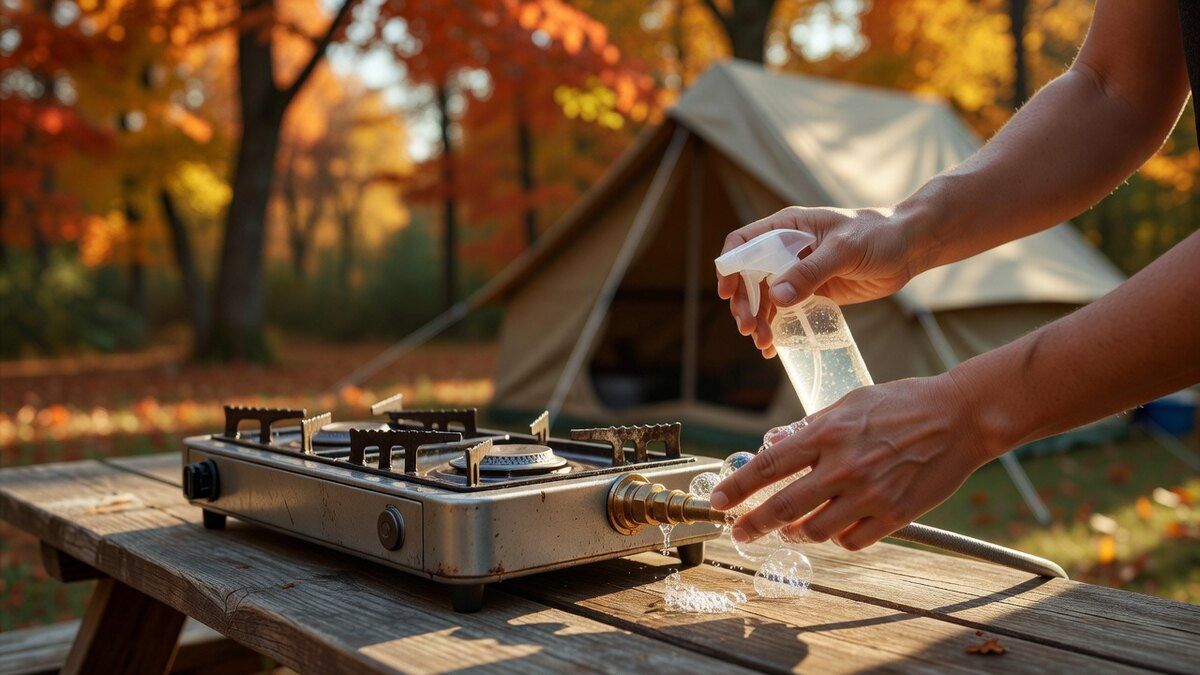
Reading the Result: What Each Bubble Pattern Tells You
- Bubbles at the cylinder or canister joint. The O-ring is missing, pinched, or flattened, or the fitting is cross-threaded. Reseat the O-ring (a light wipe of the surface, no lubricant you cannot verify is propane-safe), thread by hand until it seats, then snug only about an eighth to a quarter turn past finger-tight.
- Bubbles along the hose body or at a crimp. Replace the hose assembly. A crimp leak is not a clamp problem you can solve in camp.
- Bubbles at the regulator body or its seam. Replace the regulator (usually sold as a hose-and-regulator assembly). A weeping regulator is also a performance problem — the flame will run rich and yellow, which is exactly the symptom described in our camp stove fuel guide.
- Bubbles at the burner valve stem. The valve packing has failed. On most consumer stoves this is not a field-serviceable part; treat it as the point to price a replacement.
- No bubbles anywhere, but you still smell gas when the burner runs. Check the flame color and flame behavior first — simmer and heat control issues can smell like a leak, and cold weather changes how a stove behaves entirely (see cold-weather and high-altitude stove performance).
Tighten, Reseat, or Replace? A Decision Rule
Tighten only when the joint was visibly loose and the fitting is metal-on-metal-over-O-ring. Snug it, retest, stop. Persistence past a quarter turn destroys the seal.
Reseat when the O-ring is present but sitting off-center or has debris on it. Clean it, put it back flat in its groove, hand-thread the fitting, retest.
Replace when the leak is in rubber (hose, crimp, regulator seam) or in the valve stem. This is the part that makes leaking camp stoves cheap to fix: a proper hose assembly is under $20, which is far less than a new stove, and it is the right call whenever the symptom points at the hose or regulator rather than the appliance.
Replace the stove when the leak is inside the burner body or the valve stem, or when the stove is a decade-old hand-me-down with rusted jets and a repaired manifold. At that point you are buying safety, not convenience.
Refilled 1 lb Cylinders: The Most Common DIY Leak Source
If you refill the small green 1 lb cylinders instead of buying them — with a 1 lb to 20 lb refill adapter or a brass tank adapter — you have introduced a new set of seals into your system, and they are the ones that fail most often.
Three specific failure modes:
- Overfilling. A 1 lb cylinder refilled by "feel" or by sound routinely ends up with liquid propane where vapour belongs. Liquid in the line means flare-ups, oil in the regulator, and a cylinder whose pressure relief has more work to do. Refill by weight, and follow the step-by-step 1 lb refill safety guide rather than eyeballing it.
- Worn Schrader-style valve seals. Every refill cycles the valve. After enough cycles, the valve seeps — and the leak shows up at the cylinder, not the stove, which sends people hunting for the wrong problem.
- Cross-threading on the adapter. The adapter is small brass and easy to start crooked. That single cross-threaded joint is where the gas goes.
The cleaner answer, if you refill often, is a cylinder actually built for it: a refillable 1 lb cylinder with a proper refill kit is designed to be refilled, holds a real valve, and is DOT-compliant for transport — which an improvised refill of a disposable cylinder often is not. If you would rather skip the whole question, a 12-pack of standard 1 lb cylinders for about $5.40 each is the boring, leak-resistant option.
Why a Small Leak Is a Big Deal: The Carbon Monoxide Connection
Never run a camp stove indoors or inside a tent. Not to take the chill off, not for ten minutes, not with the door cracked. Propane appliances consume oxygen and produce carbon monoxide, and the troubleshooting guide's section on indoor use is right that the narrow exceptions are not ones a family should be improvising against.
A leak makes that worse in two ways: it adds unburned fuel to an enclosed space, and it is a leading indicator that the combustion side of the appliance is not sealing or burning cleanly either.
If you heat or cook in any semi-enclosed space — a big tent with a covered vestibule, an RV awning room, a screen house — buy a battery-powered carbon monoxide detector and treat it as part of the stove kit. It is a $24 item that covers the failure you cannot smell, and it belongs in the same bag as your first aid kit.
Storage and Transport: How to Not Have This Problem Next Season
- Disconnect the fuel. Cylinders off and capped, hose disconnected, stove empty and dry.
- Store the hose uncoiled and loose. Tight coils are how crimps get stressed; UV and heat are how rubber gets brittle.
- Keep cylinders upright, out of the sun, and out of the car's trunk in summer. Heat raises cylinder pressure, and a hot trunk is a hostile place for any propane seal.
- Check the whole system once a year, in spring, before the first trip. The same soapy-water test, five minutes, done at the kitchen table.
- Replace hoses on condition, not on a calendar. Cracked, stiff, or bubbled rubber goes in the bin even if it is only two seasons old.
This is the same maintenance loop covered in our camping gear maintenance and care guide, and it is also most of what how to clean a camp stove is about — dirty burners and neglected seals cause the same class of "it's not working right" complaint.
The Stoves That Make Leak Checks Easy
Nothing about leak safety is brand-specific, but some stoves are easier to check and less likely to be running a hose in the first place.
- Single-burner butane or propane stoves with no hose at all are the simplest systems you can own: one sealed cylinder-to-stove joint, one valve, no crimps. The Coleman Classic 1-burner butane stove is the archetype, and the AOTU piezo-ignition backpacking stove is the $13 version for a day pack.
- Dual-fuel stoves like the Gas One GS-3400P let you run whichever cylinder you can actually buy, which matters when a butane canister is the only thing on the shelf — see isobutane vs propane for the fuel-side tradeoffs.
- Two-burner propane stoves with a hose and regulator are the ones that need this article. The Coleman Triton+ and Camp Chef Explorer are the family-camping workhorses; both are easier to leak-check than to repair at the valve, which is exactly why the hose-and-regulator assembly is the part worth keeping a spare of.
- Bulk-tank users running a Buddy heater or a big stove off a 20 lb tank should add the inline propane fuel filter. Tank propane carries oils and debris that a disposable canister does not, and that gunk is what kills regulators early — a filtered system is a leak-free system for longer.
For the fuel-side arithmetic — how long a canister actually lasts, and which fuel fits which trip — the how long does a propane canister last and BTU guides are the two pages to read next. The same placement rules apply to butane, where the extra hazard is a cartridge close to reflected heat rather than a leaking joint. Our Coleman vs Gas One butane stove comparison covers the butane-specific version: indoor use, canister clearance, and why a windscreen should never wrap the cartridge.
Is Propane Heavier Than Air? The One Fact That Decides Where You Stand
Almost every question in this article collapses into a single number. Propane is heavier than air - its vapour has a specific gravity of about 1.5, so a given volume of the gas weighs roughly half again what the same volume of air does. That is the plain answer behind a whole family of searches: yes, propane is heavier than air; asked as is propane heavier or lighter than air the answer is heavier; even the wordier is propane heavier than air or lighter than air resolves the same way. People also type is propane heavier lighter than air (the compressed version) and is liquid propane heavier than air, which is true as well - though the liquid is the part sealed inside the cylinder, while the vapour is the part that escapes.
Because propane is heavier than air, it does not rise and dissipate the way a smoke plume does. It sinks, pools, and collects in exactly the low places people occupy: the floor well of a tent, the space under a picnic table, the bottom of a vestibule. The vocabulary varies - is propane denser than air, is propane more dense than air, is propane thicker than air, is propane vapour heavier than air, is propane fumes heavier than air - but the physical behaviour is one thing. The LPG-framed phrasings are identical too: is lp gas heavier than air and is lp gas heavier or lighter than air both describe the same gas at the same density. Comparing fuels, is propane butane heavier than air is really a question about butane, which is heavier still and behaves the same way in a cold tent. The one phrasing to retire is is propane exhaust heavier than air - the weight of exhaust is not the risk; unburned fuel settling low and carbon monoxide are. For the record, the textbook phrasing propane is heavier than air with a specific gravity of about 1.5 is the same number stated in full.
The rule that follows: run your leak test and place your detector at floor level, not shoulder level. Propane will be there first.
Indoors, in a Tent, and the Carbon Monoxide Question
The most common follow-up to a leak is really a different question: can I just use the thing inside? Asked as is it safe to use a propane camp stove indoors, or as is it safe to use a propane camping stove indoors, the answer is no - and it is no for a reason that has nothing to do with whether your joints seal. A stove that passes every bubble test still consumes oxygen and still produces carbon monoxide, so using propane camp stove indoors is a combustion question, not a leak question. The shorter form, camp stove safe indoors, carries the same answer.
Anything in this space - a stove, a lantern, a heater - gets the same treatment: propane camp stove safety, propane camping stove safety and camping gas stove safety are one policy, and the policy is ventilation plus a detector, never improvisation. On the combustion side, do camping stoves produce carbon monoxide is a yes, propane camp stove carbon monoxide and camping gas stove carbon monoxide are the same yes at any burner setting, can a stove cause carbon monoxide is yes in any enclosed space, and do stoves have carbon monoxide has no version of no. The acute version of the question - carbon monoxide poisoning camp stove - is the exact outcome this article exists to prevent.
Heaters follow the identical rule, which is why are propane camping heaters safe indoors belongs in this answer too: an "indoor safe" rating means a ventilated, monitored space, never a sealed tent. Our camping heater guide covers the ventilation math, and the troubleshooting guide covers why the narrow exceptions are not ones a family should improvise.
Detectors, Sprays, and the Test Itself: What People Actually Ask For
Search volume in this topic splits cleanly: half of it is "how do I test", half is "what do I buy that beeps". Start with the free answer, because it is the one that works at a campsite.
The field method has a dozen names and one procedure. Asked as how to test for propane leak, as how to tell if propane leak, or as how to check for leaks propane tank, the answer is the same soapy-water pass described above. The phrasing how to check for propane leak on stove and how to check for propane leak outside are the same five minutes at the picnic table; how to check for propane leaks with soapy water, soapy water propane leak test, propane soapy water test, propane leak soap and propane leak soap solution are all names for one teaspoon of dish soap in a cup of water. The formal term, propane leak test procedure, describes exactly the six steps above - pressurise with the burner off, spray, wait, read bubbles, fix, retest. On an RV system, how to check for lp gas leaks is the identical test run at each appliance fitting and at the tank - and the same five minutes at the tank answers how to check for propane leak in rv, how to check for propane leak in camper and how to check for propane leak in travel trailer. If you find one, how to fix a leaking propane line is almost always a fitting reseat or a hose replacement rather than a repair to the line itself.
Then there is the instrument question. As a category, propane leak detector covers three very different products, and propane leak detection is often used to mean any of them. A propane leak detector spray or propane leak detector solution is a formulated fluid (bubble solution in a bottle, sometimes with a brush) - convenient, and functionally the same chemistry as dish soap. An electronic propane leak alarm, propane leak tester, propane tank leak detector or propane leak detector battery operated unit listens for combustible gas at a sensor and is the right choice for a camper, an RV awning room or a screen house where you cannot watch a joint all evening. A propane leak detector plug in model only works where you have shore power, which is why propane leak detector for camper and propane leak detector rv almost always mean the battery-powered kind. Anyone with a grill and a camper in the same driveway is running the same test twice: how to check for propane leak on grill and how to check for propane leaks on bbq are the soapy-water pass at the tank-to-regulator joint, and propane tank leaks when connected to grill is usually that fitting rather than the tank.
Where a Tank Actually Leaks: Symptom by Symptom
Both propane cylinder leaking and propane tank leaking are descriptions, not diagnoses - the useful question is which part of the tank is wet with bubbles. Most reported cases map to one of these:
- propane tank leaking at connection - the fitting where the hose or regulator meets the tank. Reseat, then retest.
- propane tank leaking at valve and the variant propane tank leaking at valve when turned on - the service valve itself. If it bubbles only when open, the valve stem packing is the problem, not the fitting.
- propane tank leaking at valve stem - the same failure seen with the handwheel turned open. Not field-serviceable on a disposable cylinder; retire the cylinder.
- propane tank leaking from back of valve or propane tank leaking from knob - a failed seat or a cracked bonnet. Replace.
- propane tank leaking from top - often the relief device or the valve threads; check both.
- propane tank leaking from pressure relief valve - the safety device venting. This can be legitimate overpressure (a hot trunk, an overfilled tank) or a worn relief spring. Either way, get it out of the vehicle and let it equalise somewhere open.
- propane tank leaking outside - same failure, lower stakes - which is exactly why the leak test belongs outdoors.
- propane tank leaking after refill - the refilled 1 lb cylinder class covered above: worn Schrader-style seals plus a valve worked harder than it was built for.
- propane tank leaks when turned on (or when the burner is opened) - a downstream or valve-stem leak rather than a static seal.
When people write propane tank leak symptoms they usually mean bubbles on the outside. The other symptom class is the one you can smell but not see, covered next.
Symptoms: What Leak Exposure Actually Feels Like
A propane leak is not only a fire question. The health vocabularies people search are consistent, and they describe a mild-to-serious progression depending on concentration and how long you stayed in it.
At low exposure, propane leak symptoms are the ones people dismiss: headache, a light-headed fog, nausea, and irritated eyes or throat, often with the smell still present. The same cluster shows up as propane gas leak symptoms and propane gas leak inhalation symptoms, and the broader label propane leak exposure symptoms covers the whole range; grouped by intent it is the same list whether someone searches propane leak symptoms health or propane leak symptoms in humans. If it progresses, propane leak poisoning symptoms include dizziness, confusion, drowsiness and, at high concentrations, loss of consciousness - remember that propane is an asphyxiant that displaces oxygen as well as a flammable gas, so the danger grows in enclosed spaces even before combustion is in the picture.
Two details worth carrying into camp. First, propane leak physical symptoms are the same in a house, an RV or a tent - propane leak symptoms in house and propane leak in rv symptoms are the same physiology at different air volumes; small enclosed volume is worse, not better. Second, dogs go down first: propane leak symptoms in dogs - drooling, wobbliness, vomiting, unusual lethargy - appear at concentrations that a person may still shrug off, which is a reason to keep pets out of a vestibule where a cylinder is stored. A slow propane leak symptoms picture - a headache that appears every evening in camp and clears the next morning - is the pattern people most often misattribute to altitude or dehydration. If you smell it at all, note it as propane leak smell and stop treating the smell as a nuisance: smell plus symptoms means get outside, ventilate, and ventilate low.
Heaters get their own phrasing, propane heater leak symptoms, because a radiant heater running in a semi-enclosed space adds a combustion source to the exposure. That is the heater guide's territory; treat any symptom list plus a heater as a come-outside signal.
Transporting a Cylinder in a Car, and Getting the Smell Out Afterwards
This is the most-asked block of questions in the whole topic, and it is a safety question rather than a smell question.
Start with how to move propane tanks at all. The short version: valve closed, cylinder upright, secured so it cannot roll, in the most ventilated part of the vehicle, and never in a sealed trunk or a hot cargo area - which is also the answer to best way to transport propane tanks and how to transport propane tanks safely. Asked as how to transport propane tanks in car, the practical answer is a secured upright cylinder with the windows cracked, brief trip, out of the passenger compartment if the vehicle allows it (how to transport propane tank in suv and how to transport propane tank in sedan both end with "and take it out when you get there"). A pickup is easier: how to transport propane tank in pickup truck and how to transport propane tanks in a truck bed are answered by upright, strapped, and ideally in a closed bed with the valve cap on. If you are consolidating multiple cylinders, how to transfer propane tanks is not a thing you should do casually - decanting between cylinders, rather than using a proper refill adapter, is how people overfill. For the camping-specific version, how to transport propane tank for camping and how to transport propane cylinders are the same rules as for a grill tank or a 20 lb tank: how to transport propane tank for grill, how to transport propane tanks in truck - all upright, capped, secured, ventilated.
Then the smell. A faint odour after a trip is normal and fades. If it does not, propane smell inside car and propane smell in vehicle are the common descriptions; when people turn the heat on they write propane smell in car when heater is on, and while driving it is propane smell in car while driving. Some owners blame the AC and search propane smell from car ac, but the mercaptan odour is heavier than air and pools in the cabin's low air, so it concentrates where it was released rather than circulating through the vents. The two diagnostic questions to answer before anything else: why do i smell propane in my car (did a cylinder ride in there recently?) and why does my car smell like propane (was the cylinder stored with the valve open, or is a cylinder still in there?). If a cylinder did ride along, how to get propane smell out of car and how to get rid of propane smell in car are both solved the same way: remove the cylinder, air the vehicle out completely with the windows down, wipe the area where it sat, and do not mask it with an air freshener - masking a persistent odour is how a real slow leak gets ignored.
Storage, Shelf Life, Freezing, and Hookup
The last cluster of questions is about keeping the system healthy between trips rather than fixing it at camp.
Storage first. camp stove propane storage and camping propane storage are one answer: cylinders upright, out of direct sun, out of a hot vehicle, away from the tent floor, and with the stove disconnected. camping propane tank storage adds a pressure cap so the valve cannot be bumped open in a bag. camping propane tank safety is the same list plus one rule people skip - never store a cylinder inside a sleeping area. Shelf life is not really a shelf-life question for the gas: camping propane shelf life is effectively unlimited for a sealed cylinder, and the part that ages is the rubber - hose, O-ring, valve seal - which is why the annual spring leak test matters more than any date code.
Cold is its own question. camp stove propane freezing is a misconception worth correcting: propane does not freeze at any temperature you will camp in, but it does stop vaporising usefully as the tank cools, which is why performance falls off on a 25 °F morning. That is a fuel-behaviour issue, not a leak, and the cold-weather and high-altitude stove guide covers the workarounds.
Hookup and plumbing questions run together. camp stove propane hookup and camp stove propane line both point at the same three fittings - cylinder to stove, hose to appliance, regulator to tank - which the hose, regulator and adapter guide walks through one by one. If you are working out how to use camping propane tank basics for the first time, thread by hand, snug an eighth of a turn, and test before you cook. And when a stove misbehaves without smelling, the phrasing people reach for is camp stove burner not working - a dirty jet, a clogged generator or a cold canister, which belongs with the troubleshooting guide rather than here. Brand-specific phrasing is just the same diagnosis with a logo attached: coleman camp stove leaking propane is the cylinder-to-stove O-ring failure above, and coleman propane camp stove troubleshooting is the same three leak points plus the same three non-leak causes.
Camp Stove Propane Leak FAQ
Can I use soap and water to check for a propane leak?
Yes — it is the standard field method. Dish soap, water, a spray bottle, and a joint that is pressurized with the burner off. Growing bubbles mean a leak. Do not use a flame, and do not use a homemade "sniffer" you cannot calibrate.
How do I know if my propane hose is leaking or just loose?
Spray the joint and the hose separately. Bubbles only at the threaded fitting usually mean a loose connection or a displaced O-ring. Bubbles along the hose body or at the crimp mean the hose is finished and needs replacing, no matter how much you tighten the fitting.
Is it safe to use a camp stove with a small leak?
No. A small leak is an unburned fuel source in a space where propane pools low, and on a stove it also signals that a seal you cannot see has failed. Turn it off, fix or replace the part, and retest. This is not a "camp with it and watch it" problem.
Why does my camp stove smell like gas but the soap test shows nothing?
Three likely answers: the leak is at the burner valve stem (spray it with the valve slightly open), the smell is coming from a refilled cylinder's own valve rather than the stove, or what you are actually reacting to is a poorly burning flame — a rich, yellow, popping flame from a dirty burner or a cold canister. Start with the burner and the cylinder, then work back to the stove.
Is propane heavier than air?
Yes. Propane vapour has a specific gravity of about 1.5, so it is heavier than air and sinks into low spots - tent floors, floor wells, under tables. That is why leak tests and detectors belong at ground level.
Is it safe to use a propane camp stove indoors?
No. A stove can pass every leak test and still consume oxygen and produce carbon monoxide, so indoor use is a combustion hazard regardless of how well its joints seal. "Indoor safe" ratings describe ventilated, monitored spaces, never sealed tents.
Do camping stoves produce carbon monoxide?
Yes, whenever they are burning - and any appliance that burns propane does. A leak adds unburned fuel on top of that, which is why the same rules cover stoves, lanterns and heaters.
How do I transport a propane tank safely in a car?
Valve closed, cylinder upright and secured so it cannot roll, in the most ventilated part of the vehicle, with a pressure cap on the valve, and out of the vehicle as soon as you arrive. Never in a sealed trunk or a hot cargo area.
Why does my car smell like propane after a camping trip?
Because a cylinder rode in it. Mercaptan is heavier than air and pools in the cabin's low air, so the odour lingers where the cylinder sat. Remove the cylinder, air the vehicle out with the windows down, wipe the area, and never mask it with an air freshener - masking a persistent smell is how a slow leak gets ignored.
What does a propane leak smell like, and can I trust my nose?
Rotten eggs, from the added odorant ethyl mercaptan. Treat it as a warning, not a measurement: you can smell a small leak clearly and you can also stop smelling a large one after a few minutes of exposure as your nose desensitises.
Can a propane tank leak after a refill?
Yes, and it is the most common DIY leak source. Refilling cycles the small cylinder valve, overfilling puts liquid where vapour belongs, and the adapters cross-thread easily. Test the cylinder's own valve - not just the stove joint - after every refill.
How do I know if the leak is the tank or the stove?
Isolate by testing separately: bubbles at the cylinder or its valve mean the tank; bubbles at the hose, crimp, regulator seam or burner valve stem mean the appliance side. If the stove bubbles nowhere but the tank does, the tank is your problem, and a refilled 1 lb cylinder is the first suspect.
The Short Version
Shut the valve. Move it outside. Spray soapy water on every joint with the burner off, and believe the bubbles. Tighten a loose fitting a quarter turn, reseat a pinched O-ring, and replace anything made of rubber. Never test a leak with a flame, never run a stove indoors, and treat a refilled 1 lb cylinder as the first suspect whenever the leak is at the tank rather than the stove.
Five minutes at the picnic table, once a season, is the entire cost of never being the family that packed up early.
A poor flame is not a leak — but both are combustion-side warnings worth reading. The camp stove flame color guide covers what yellow, orange, and lifting flames mean.
<!-- AFFILIATE_DISCLOSURE -->TrailMapz is reader-supported. If you buy through the links on this page we may earn a small commission at no extra cost to you. Prices and availability change — check the current listing before you buy.