Camp Stove BTU Guide: How Many BTU Do You Really Need? (2026)
Real BTU numbers for camp stoves: what each stove class actually puts out, boiling speed, propane math, cold-weather derating and brand-by-brand specs.
Quick Answer
Most campers need 8,000–12,000 BTU per burner. A two-person weekend setup runs fine on a single 8,000–10,000 BTU burner, a family of four cooking two pots at once wants roughly 11,000–20,000 BTU per burner (22,000–40,000 total), and group cooking for eight or more is where a 30,000 BTU-per-burner stove like the Camp Chef Explorer actually earns its size.
Three things matter more than the headline number:
- BTU is heat per hour, not "cooking power." A 20,000 BTU burner with a warped pot and no lid will lose to a 10,000 BTU burner with a lid on a calm morning.
- Real output is smaller than rated output. Wind, cold fuel, altitude, and pot-to-burner match all eat into it. A 10,000 BTU stove at 6,000 feet in October is not delivering 10,000 BTU.
- Higher BTU usually means faster fuel burn, not better food. If you mostly simmer, sear, and reheat, an oversized burner just makes flame control harder — see our camp stove simmer and heat control guide.
If you want the one-line version: buy 8,000–11,000 BTU per burner for two to four people, and only go bigger if you're regularly boiling large pots or feeding a crowd.
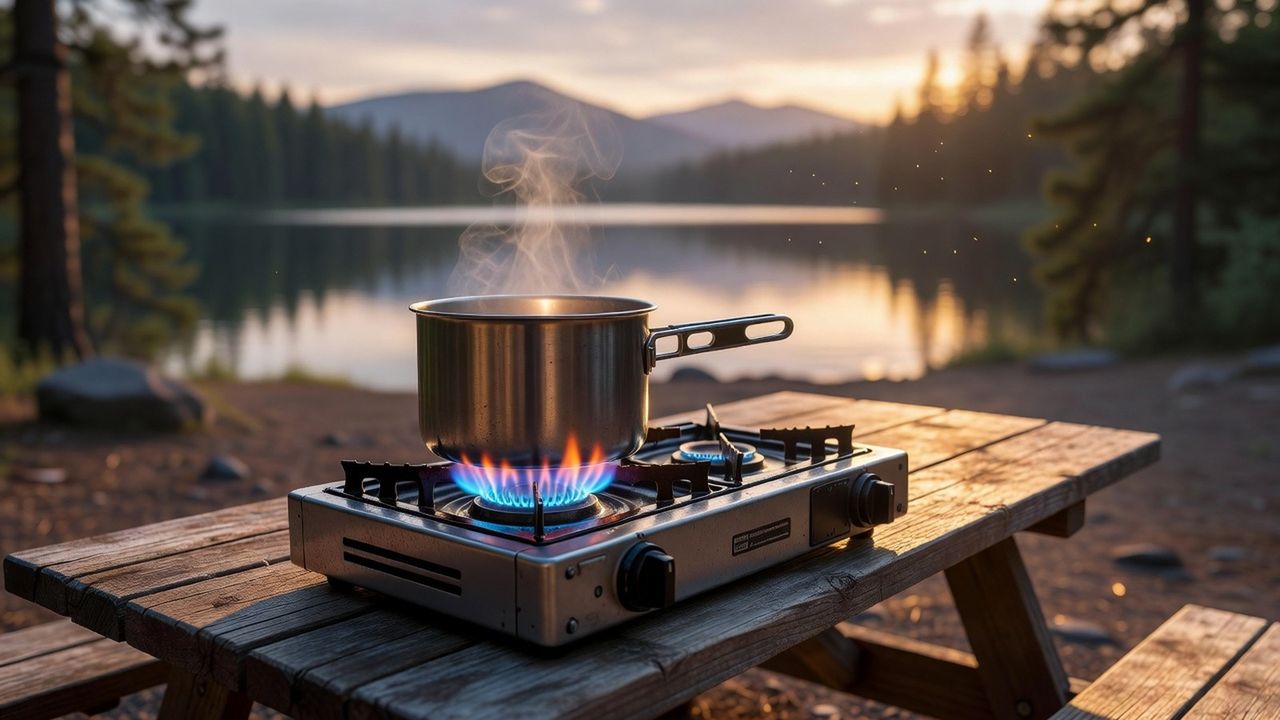
What BTU Actually Measures
A BTU (British thermal unit) is the energy needed to raise one pound of water by one degree Fahrenheit. On a stove label, "10,000 BTU" means the burner can release 10,000 BTU of heat energy per hour at full blast.
What it does not tell you is how much of that heat reaches your food. Open-air camp stoves are exposed on all sides, so a large share of the flame's energy goes sideways into the air instead of into the pot. Practical rule: assume you actually capture somewhere in the 50–65% range on a calm day with a lid on, and considerably less in wind.
That gap is why two stoves with the same BTU rating can feel completely different. It's also why we tell people to read the fuel type before they read the BTU number — propane, butane, and isobutane don't behave the same in cold or at altitude.
The boil test: BTU you can actually feel
Boiling water is the cleanest way to translate BTU into something real. Raising one liter of water (about 2.1 lb) from 60°F to 212°F absorbs roughly 320 BTU of heat. Here's what that means at the burner:
- 8,000 BTU burner — about 4 minutes to a rolling boil for 1 L
- 10,000 BTU burner — about 3–3.5 minutes
- 11,000 BTU burner — about 3 minutes
- 22,000 BTU total / 11,000 per burner — same ~3 minutes per pot, but two pots at once
That's the whole BTU story in one line: past roughly 11,000 BTU per burner you're not buying faster water, you're buying more pots at the same time and more headroom for big vessels.
How Many BTU Do You Need? By Group Size
| Cooking situation | BTU per burner | BTU total | Typical stove |
|---|---|---|---|
| Solo backpacking: boil water, rehydrate meals | 8,000–9,000 | 8,000–9,000 | MSR PocketRocket 2 (8,200) |
| Two people: coffee + one skillet | 8,000–11,000 | 8,000–11,000 | Coleman Bottle Top Propane (10,000), Gas One GS-3400P (8,000) |
| Family of 4: two pots simultaneously | 10,000–12,000 | 20,000–24,000 | Coleman Triton+ (22,000 total) |
| Family of 5–6, real meals, big pots | 15,000–30,000 | 30,000–60,000 | Camp Chef Explorer (60,000 total) |
| Group camp / basecamp, griddle + stockpot | 30,000+ | 60,000+ | Camp Chef Explorer or a three-burner rig |
Two honest notes on that table. First, the per-burner number is the one that matters for cooking — a "22,000 BTU" two-burner stove is 11,000 BTU per side, not 22,000 on one side. Second, if your group is larger than four, the limiting factor is usually burner count and grate size, not total BTU. Two 30,000 BTU burners beat one 60,000 BTU burner every single time.
What BTU You Actually Get, by Stove Class
Backpacking stoves: 8,000–11,000 BTU
Ultralight canister stoves cluster tightly in this band because they're designed around one pot and a fuel canister you have to carry. The MSR PocketRocket 2 lists 8,200 BTU and boils a liter in about three minutes at $49.95. The AOTU backpacking stove claims 11,000 BTU for $12.99 — more raw power, and a good reminder that BTU alone doesn't predict build quality or flame stability in wind.
For cold-weather or high-altitude trips where canister pressure collapses, the answer isn't more BTU, it's a different fuel: our best backpacking stove guide covers liquid-fuel stoves that hold output when a canister would be wheezing.
Single-burner butane and 1-lb propane: 7,650–10,000 BTU
This is the sweet spot for couples and solo car campers. The Coleman Classic 1-Burner Butane runs 7,650 BTU at $29.99 and handles coffee, eggs, soup, and one small skillet; the Coleman Bottle Top Propane screws directly onto a 1-lb cylinder for 10,000 BTU at $21.99. The Gas One GS-3400P splits the difference at 8,000 BTU, and its dual-fuel design is a genuine advantage if you already own butane cartridges.
One caveat that catches people every fall: butane stops vaporizing around 31°F, isobutane around 11°F, and propane keeps working down to about −44°F. A 7,650 BTU butane stove in October can behave like a 4,000 BTU stove. We cover that in depth in isobutane vs propane for camp stoves.
Two-burner car-camping stoves: 22,000–60,000 BTU
The everyday standard is a two-burner propane stove putting out roughly 11,000 BTU per burner. The Coleman Triton+ is exactly that: 22,000 total, 11,000 per side, $149.99, with the flame control to actually simmer rather than blast.
Step up and the numbers get serious. The Camp Chef Explorer does 60,000 BTU total — 30,000 per burner — on a 14 × 32-inch cooking surface, at $127.99. That's the stove you buy when you're boiling a stockpot for six people and still want a second pan going. It's also the stove that will drain a 1-lb cylinder in about 40 minutes of full-blast cooking, which brings us to fuel.
Grill/stove combos and griddles
If your BTU is going into a griddle or grill surface rather than a pot, you need more of it, because you're heating a large slab of metal before the food ever sees heat. The Coleman RoadTrip 225 and the Coleman Tabletop 2-in-1 grill/stove are built for that job, and pairing a stove with a Lodge cast iron griddle or skillet adds thermal mass that has to be paid for in BTU. Our camp stove griddle guide covers preheat times and which surfaces work over which burners.
BTU and Fuel Burn Rate (The Number Nobody Mentions)
BTU is a fuel-consumption spec as much as a cooking spec. Propane holds roughly 21,600 BTU per pound, so the math is simple:
- A 1-lb propane cylinder ≈ 21,600 BTU → about 2.1 hours at 10,000 BTU, or about 2.7 hours at 8,000 BTU
- A 20-lb tank ≈ 432,000 BTU → about 7 hours at 60,000 BTU, or roughly 54 hours at 8,000 BTU
- A 110 g isobutane canister ≈ 5,200 BTU → about 38 minutes at 8,200 BTU
Two takeaways. First, an oversized stove's real cost isn't the purchase price, it's the fuel: a 60,000 BTU burner wide open burns roughly 2.8 lb of propane per hour. Second, those hours assume full blast — real cooking is mostly simmering and reheating, which is why a canister that "should" last 38 minutes easily covers a weekend. Our how long does a propane canister last guide breaks this down by meal plan, and if you're burning through 1-lb cylinders, a refill adapter and a 20-lb tank cuts the cost per BTU by far more than any stove upgrade ever will.
Why a Bigger BTU Number Isn't Automatically Better
This is the single most expensive mistake in camp stove shopping: assuming the highest BTU wins.
- Oversized burners are hard to simmer on. A 30,000 BTU burner turned down to a whisper tends to flutter and hotspot. On a low simmer, flame control matters more than peak output — the simmer and heat control guide explains what to look for.
- A big flame under a small pot wastes heat. If the flame licks up the sides of the pot, that heat is going into the air, not the food. Match burner grate to pot diameter: a 6-inch skillet on a 30,000 BTU burner is mostly a campfire anecdote waiting to happen.
- Wind steals more than an upgrade gives. A stiff breeze can carry off a large fraction of an unprotected flame. A $15 windscreen often beats paying for thousands of extra BTU you won't get in real conditions.
- Extra BTU means extra weight and fuel. The 8,200 BTU MSR PocketRocket 2 weighs 2.6 oz. Nothing in the 30,000 BTU class comes close, and you're carrying every BTU you buy.
Cold Weather and Altitude Cut Your Real BTU
Rated BTU is measured at sea level, on a warm day, with full fuel pressure. Take that stove to a shoulder-season campsite and the number changes:
- Cold fuel = lower pressure. Butane quits around 31°F; isobutane around 11°F; propane keeps going far below freezing. A cold canister in a vest pocket (not in the tent, not in the car) is worth more than 2,000 extra rated BTU.
- Altitude cuts combustion output. There's less oxygen per breath of air, and every 1,000 feet of elevation trims output by roughly a couple of percent. At 6,000 feet you're working with meaningfully less than the label promises, and water also boils at a lower temperature — so "it boiled fast" at altitude is a little misleading.
- Wind multiplies both problems. Cold, thin, moving air is the worst case for an open burner.
If you camp in the cold or above treeline, plan for at least 20–30% derating and lean toward stoves rated higher in the same class, or switch fuel. That's the core of our cold weather and high altitude camp stove guide.
Matching BTU to Your Cookware and Kitchen
BTU doesn't exist in isolation — it has to match what you're heating. Our camp kitchen setup guide covers the full system, but the BTU-specific rules are:
- Light nested cookware (like a 17-piece mess kit with kettle) heats fast on 8,000–11,000 BTU — it's thin, so it responds quickly.
- Cast iron needs sustained high output to preheat, then holds heat beautifully. Great over a 22,000–60,000 BTU stove; frustrating over 8,000.
- Wide griddles want the widest grate and the highest output you can justify, plus a lid or dome to trap heat.
- Two-burner vs single-burner is really a question of whether your meals need two heat sources at once — our single-burner vs two-burner breakdown settles that fast.
Common Mistakes When Choosing a Camp Stove by BTU
Buying the biggest number on the shelf. Peak BTU is the easiest spec to market and the least predictive of good meals. Flame range and grate stability matter more in daily use.
Comparing total BTU against per-burner BTU. A "44,000 BTU" two-burner stove is 22,000 per side. When someone tells you their stove boils water in 90 seconds, they're usually running a single big burner, not splitting the total.
Ignoring fuel burn rate. More BTU per hour means fewer hours per cylinder. A group stove and a 1-lb cylinder is a bad pairing; budget for a 20-lb tank.
Assuming the rating survives October. Cold fuel, wind, and altitude can strip 20–30% off real output right when you need the stove most.
Forgetting the pot. The best 30,000 BTU burner in the world won't help if your pot is wider than the flame ring or you're cooking uncovered in the wind.
Camp Stove BTU Chart: The Ratings People Actually Search
This is the camp stove btu chart most people are looking for — the rating you were about to buy, and what it actually cooks.
- camping stove 10000 btu — the classic single-burner number. Boils a liter in about three minutes and runs coffee, eggs, soup and one skillet. Right answer for one or two people, wrong answer for two pots at once.
- camp stove 12000 btu — entry two-burner territory (about 6,000 per side) or a strong single burner. Enough for a family breakfast if you cook in sequence rather than in parallel.
- camping stove 15000 btu — the middle of the two-burner market. Two 15,000 BTU burners is comfortable family cooking with a real skillet and a pot going at the same time.
- camp stove 20000 btu — read the label: on a two-burner that is usually 10,000 per side, which is why a "20,000 BTU" stove can still feel slow under a stockpot. On a single burner it is genuinely fast.
- camping stove 30000 btu — group-cooking class. That is one burner of a Camp Chef Explorer (60,000 total), and it is overkill for two people by a wide margin.
- camp stove 40000 btu — brew-rig and three-burner basecamp numbers. You are buying speed for very large pots, and a fuel bill to match: a 40,000 BTU burner wide open drinks roughly 1.9 lb of propane an hour.
If your question was the vaguer form — how many btu for camp stove, how many btu for camping stove, how many btu stove do i need, how many btus do i need for my camping stove, or how many btu do i need camping — the answer is the same three numbers: 8,000–11,000 per burner for one or two people, 11,000–15,000 per burner for a family cooking two pots, and 20,000–30,000 per burner only for griddles, stockpots and groups. And what is a good btu for camp stove / best btu for camping stove have one answer between them: 10,000–11,000 BTU per burner with real low-flame control beats a bigger burner you cannot turn down.
Per-burner BTU, stove output, and the words people use for both
- btu per burner camp stove is the number that decides how your cooking goes; camping stove btu output is the number on the box, and it is usually the total for the whole stove. A two-burner rated at 22,000 is 11,000 per side.
- camp stove btus (plural) and camp stove high btu describe the same spec — total rated output at full blast, at sea level, on a full cylinder.
- highest btu camp stove is a search that often ends in regret: the highest-rated burners are group stoves with coarse low-flame control, and our simmer and heat control guide explains why that matters more than peak output.
- backpacking stove btu clusters tightly: 8,200 for the MSR PocketRocket 2 is typical. An integrated system like the Jetboil Flash gets its speed from the pot-and-burner pairing — Jetboil rates the Flash at a 0.5 L boil in about 100 seconds — rather than from a bigger number. When the weather turns, output becomes a fuel question: the MSR WhisperLite Universal burns liquid fuel precisely because canister pressure collapses in the cold.
- butane camp stove btu ratings are honest above 40°F and fictional below it: butane stops vaporizing near 31°F, so that 7,650 BTU butane stove behaves like a much smaller one in October.
- btu meaning camping stove, what does btu mean on a camp stove, how many btu is a stove and how many btus for camp stove are all one question, answered above: 1 BTU raises 1 lb of water 1°F, and a stove's rating is that unit per hour at full blast — measured where the flame is not fighting wind, cold or altitude.
Named stoves: coleman camp stove btu and camp chef btu
- coleman camp stove btu depends entirely on the model, and the model's title usually states it: 7,650 on the Coleman Classic 1-Burner Butane, 10,000 on the Coleman Bottle Top Propane, 22,000 total on the Coleman Triton+. Searching coleman camping stove btu or coleman propane camp stove btu returns the same answer, and how many btus is a coleman camp stove has no single answer — anyone quoting one number for "a Coleman" is quoting the wrong model.
- camp chef btu runs the same way: the Camp Chef Explorer is 60,000 total, 30,000 per side, and how many btu is a camp chef is answered per model, not per brand. Their larger three-burner and flat-top rigs run higher still.
How many BTU to boil water
- how many btu to boil water — physics first: raising 1 L of water from 60°F to a boil absorbs roughly 320 BTU. The stove rating decides how fast, not whether.
- how many btu to boil 1 gallon of water — a gallon absorbs about 1,250 BTU, so on a 10,000 BTU burner with a lid on and no wind you are looking at roughly 10–13 minutes from cold tap water.
- do i need 10000 btu to boil water — no, but it is the comfortable number. An 8,000 BTU burner boils the same liter in about four minutes instead of three, which is why backpacking stoves sit in that band and stay there.
How Many BTU to Boil Water (and How Fast It Really Happens)
Boiling speed and BTU are the same fact told two different ways. A burner that puts out roughly 1,000 BTU per cup will take a quart to a rolling boil in about four to five minutes at sea level; double the BTU and you do not halve the time, because a big share of the heat is lost around the pot rather than into it. That is why the Coleman Bottle Top 10,000 BTU burner and a 60,000 BTU crawfish cooker end up boiling the same one-liter pot within a minute of each other — one is efficient with a small vessel, the other simply overwhelms a large one.
The practical shortcuts: match the pot to the flame, always use a lid, and block the wind before you spend money on more BTU. A windshield or diffuser is worth thousands of BTU on an exposed picnic table.
| what people search | the short answer |
|---|---|
| can you boil water on a camp stove | Yes — every burner above about 7,000 BTU boils a quart; the number only decides how long it takes. |
| how to boil water on camp stove | Lid on, pot matched to burner diameter, wind blocked — those three matter more than the last 3,000 BTU. |
| fastest way to boil water camping | A high-output burner with a heat-exchanger pot, out of the wind, filled with less water. |
| fastest camping stove to boil water | Integrated jet systems first, then 15,000-plus BTU single burners; a wide two-burner is slower per liter. |
| best camp stove to boil water | Two burners at 11,000 BTU each for a family pot; a single 10,000 BTU burner for one or two people. |
| how many btu burner to boil water | Budget about 1,000 BTU per cup for a five-minute boil — 10,000 BTU handles a liter in roughly three. |
| camping stove quick boil | Pot diameter, a lid and a windshield are the cheapest speed upgrades you can make. |
| how long to boil water on camping stove | One liter at 10,000 BTU is about three minutes at sea level, four to five in cold or at altitude. |
| can you boil water over a campfire | Yes, but coals give no flame control and soot on the pot — expect 8 to 15 minutes without a grate. |
| how long does it take to boil water on a campfire | Ten to twenty minutes in a good coal bed, longer with damp wood or wind. |
| stove won t boil water | Almost always wind, a pot wider than the flame, or a near-empty canister losing pressure — in that order. |
BTU by Brand: Coleman, Camp Chef, Gas One and MSR Real Numbers
Brand-level BTU claims are the least reliable numbers on the internet. "Coleman stoves are 20,000 BTU" is repeated everywhere and is wrong for most of the lineup — the actual figure swings from 7,650 BTU on the Classic 1-Burner Butane to 22,000 total on the two-burner Coleman Triton+. Camp Chef publishes its per-burner numbers clearly; MSR quotes output for the WhisperLite at altitude rather than at the lab bench, which is why its number looks low next to a cheap single burner.
The rows below are the brand lookups people actually make, with the number we would plan around.
| what people search | the short answer |
|---|---|
| coleman stove btu | Model-specific: 7,650 on the smallest butane burner, 10,000 on the Bottle Top, 22,000 total on the Triton+. |
| coleman stove btu rating | Coleman rates most current two-burner propane stoves at 11,000 BTU per burner, 22,000 combined. |
| coleman stove btu output | Output is the rated figure at full open; at a simmer you are using a small fraction of it. |
| coleman propane stove btu | Propane models sit in the 10,000 to 11,000 per-burner band; the big green two-burner is the top of it. |
| coleman butane stove btu | The butane single burners are the low end — 7,650 BTU is typical and they are indoor-and-balcony stoves. |
| coleman stove 20000 btu | Treat 20,000 as a class label, not a spec — check the label on the stove body or the manual. |
| coleman 2 burner camp stove btu | Two burners, 11,000 each, 22,000 total on the Triton+; older 425-series liquid-fuel stoves are lower. |
| coleman camp stove 22000 btu | That is the Triton+ combined figure — 11,000 per burner, the number family cooks should plan on. |
| coleman single burner stove btu | Between 7,650 and 10,000 depending on fuel and model; the Bottle Top is the 10,000 case. |
| how many btu coleman stove | Between 7,650 and 22,000 across the catalog; the common answer for a two-burner is 22,000 total. |
| camp chef burner btu | Camp Chef rates its two-burner stoves at 30,000 BTU per burner, well above the Coleman band. |
| camp chef 2 burner btu | 30,000 per burner, 60,000 combined — it will outrun any pot you own before you reach half open. |
| camp chef 3 burner btu | Count on 30,000 per burner again; three burners means 90,000 combined and a serious fuel appetite. |
| camp chef explorer btu | The Explorer two-burner is 60,000 total, matching the box claim. |
| camp chef everest btu | The Everest is a high-output two-burner in the same 30,000-per-burner family. |
| gas one burner btu | Gas One's single burners cluster at 8,000 and 15,000 BTU depending on model and fuel. |
| gas one 15000 btu stove | The 15,000 BTU single is the outdoor wok and big-pot option in that lineup. |
| msr stove btu | MSR quotes the WhisperLite at roughly 11,000 BTU, and it holds more of that at altitude than a canister stove. |
| msr whisperlite btu | About 11,000 BTU on white gas, and it loses less of it in cold than a butane canister does. |
| msr whisperlite btu output | Output is stable across the burn because liquid fuel pressurises itself — no canister pressure drop. |
How Many BTU Are in a Pound or a Gallon of Propane
Fuel math is where BTU stops being a stove spec and becomes a trip-planning number. Propane carries about 21,600 BTU per pound and roughly 91,500 BTU per gallon, so a standard 1-lb canister holds a little over 21,000 BTU and a 20-lb tank holds around 430,000. Divide by your burner's rating and you have run time.
That arithmetic is why a 10,000 BTU burner gets roughly two hours at full blast from a 1-lb cylinder, while the same cylinder feeding a 60,000 BTU camp chef is measured in minutes. Our propane canister lifespan guide walks the same math meal by meal.
| what people search | the short answer |
|---|---|
| propane btu per lb | About 21,600 BTU per pound — the single most useful fuel number for trip planning. |
| propane btu per pound | Same figure: 21,600 BTU. A 1-lb canister is therefore a ~21,600 BTU budget. |
| how many btu per pound propane | 21,600 BTU, minus what you waste heating air around the pot. |
| how many btu per gallon of propane | About 91,500 BTU per gallon, which is 4.24 lb of propane. |
| how many btu gallon of propane | 91,500 BTU — the number home and RV appliance sizing uses. |
| how many btu in a gallon of propane | Roughly 91,500 BTU, or 4.24 pounds at 70 degrees Fahrenheit. |
| how many btus in gallon of propane | 91,500 BTU again; the variance comes from temperature, not from the fuel. |
| how many btu in 20 lb propane tank | About 430,000 BTU — 20 lb times 21,600 — which is why a 20-lb tank runs a camp weekend easily. |
Fuel Type and BTU: Canisters, Liquid Fuel and Multi-Fuel Stoves
BTU ratings assume a fuel that behaves. Isobutane blends lose pressure as they chill, and a cold canister can deliver a fraction of its rated output; liquid-fuel stoves pressurise themselves and hold their rating in the same conditions. That single difference explains most of the "my stove is weak in the morning" reports.
Canister sizes matter too: a 100-gram canister is a weekend of coffee, a 450-gram is a family trip, and the burner's BTU rating means nothing if you run out at dinner on day two.
| what people search | the short answer |
|---|---|
| backpacking stove fuel canister sizes | 100 g, 230 g and 450 g are the standard sizes; 230 g is the weekend default. |
| backpacking stove fuel types | Isobutane blends, propane blends, white gas, alcohol — and the rated BTU assumes warm fuel. |
| backpacking stove canister fuel | Isobutane mixes burn the hottest per gram in warm weather and the weakest in the cold. |
| backpacking stove gas canister | The same threaded canisters fit most major brands, which is why the valve standard matters more than the label. |
| backpacking stove dual fuel | Dual-fuel stoves run canisters and liquid fuel, so a cold morning does not end the trip. |
| backpacking stove multi fuel | Multi-fuel adds kerosene and automotive petrol to the list for international trips. |
| backpacking stove liquid fuel | White gas gives the most BTU per ounce of weight carried, at the cost of priming and soot. |
| camping stove fuel types | Propane, butane, isobutane blends, white gas and alcohol — each with a different cold-weather floor. |
| camping stove fuel canister | Buy the same valve standard your burner uses and check the blend, not just the size. |
| camping stove dual fuel | The right answer for shoulder-season trips where a canister would lose pressure overnight. |
| camping stove liquid fuel | Best cold-weather output per pound of fuel; worst convenience. |
| camping stove butane canister | Cheap and clean-burning, but butane stops vaporising near freezing. |
| camping stove propane canister | Propane keeps working below freezing, which is why the 1-lb green cylinders stay popular in fall. |
| camp stove butane fuel | Great value above 40 degrees Fahrenheit, unreliable below it. |
| camp stove alcohol fuel | Lowest BTU of the group and slow to boil, but silent and simple for ultralight trips. |
| highest btu backpacking stove | Liquid-fuel and high-output canister burners top the category; integrated jet systems trade BTU for efficiency. |
| which is hotter propane or butane | Propane, by a wide margin in cold conditions — it boils at minus 44 Fahrenheit against butane near 31. |
| is there a difference between butane and isobutane | Yes: isobutane boils at about 11 degrees Fahrenheit, so it keeps pressure when plain butane will not. |
| do propane stoves smell | A healthy propane flame is odourless; a smell means a leak or an incomplete burn, so stop and check. |
Single Burner vs Double Burner: What BTU to Look For
A single burner concentrates its BTU into one pot and one flame shape; a double burner splits the budget and gives you two cooking surfaces. For one or two people a 10,000 BTU single is genuinely enough. For four or more, a two-burner with 11,000 to 30,000 BTU per burner is the difference between cooking dinner and waiting for it.
Do not buy the biggest number you can find. A 60,000 BTU burner on a one-liter pot is a waste of fuel and a burnt handle, and a two-burner Explorer run at half open is more capable than most people will ever need.
| what people search | the short answer |
|---|---|
| 10000 btu single burner stove | The standard one-to-two-person size; boils a liter in about three minutes. |
| high btu single burner camp stove | Anything from 15,000 BTU up on one burner — good for woks, canning pots and large groups. |
| highest btu single burner camp stove | 60,000-plus BTU single burners exist for crawfish and turkey frying; they are not camp kitchen tools. |
| single burner propane stove 15000 btu | A useful middle: fast for a big pot, still controllable for eggs. |
| stansport single burner propane stove 10000 btus | A budget 10,000 BTU single that covers couple-sized cooking. |
| single burner cooker 65000 btu | 65,000 BTU is a jet burner for big pots outdoors — plan on a 20-lb tank, not a canister. |
| 60000 btu camp stove | Two burners at 30,000 each; the family and griddle end of the range. |
| 15000 btu stove | The high end of single-burner camp stoves and the low end of two-burner output. |
| 20000 btu stove | Typically a two-burner at 10,000 each, or one strong single burner. |
| 15000 btu butane stove | Butane portables at 15,000 BTU are fast but lose pressure in the cold. |
| high btu camp stove | 15,000 to 30,000 per burner: the band that handles family meals and griddles. |
| high btu stove | Outside camping this usually means a home range; in a camp context it means 15,000 plus per burner. |
| highest btu camping stove | 30,000 per burner from Camp Chef is the practical ceiling for a stove you would carry. |
| high btu portable stove | Look for a regulator that holds pressure at low canister temperatures, not just a big rating. |
| highest btu portable stove | Big single jet burners win on paper and lose on fuel consumption. |
| high btu propane camp stove | Two burners at 30,000 each, 60,000 combined — the family and griddle class. |
| camping stove high btu | High output matters most with wind and a wide pot, not with a small covered kettle. |
| high btu butane stove | Portable butane stoves reach 15,000 BTU and are excellent above 40 degrees Fahrenheit. |
The Low-BTU End: Simmering, Burn Time and Fuel Efficiency
Sub-10,000 BTU burners are not weak, they are precise. Rice, sauces, pancakes and coffee all want a low, steady flame, and a 30,000 BTU burner choked down to a simmer is fighting itself. If your meals are mostly simmering and reheating, a 10,000 BTU burner with good valve feel beats a big flame you have to keep turning down.
Efficiency is the other half of the story: a pot with a heat exchanger captures far more of the flame than a flat-bottom pot, and a lid cuts boil time noticeably. On the 10,000 BTU Bottle Top that combination is what turns one cylinder into a weekend.
| what people search | the short answer |
|---|---|
| camp stove burn time | A 1-lb canister gives about two hours at 10,000 BTU wide open; far longer simmering. |
| backpacking stove that can simmer | Look for a wire or tube-style valve with fine travel, not a click-detent control. |
| backpacking stove with simmer control | A separate flame-adjustment valve is the feature to look for in the spec sheet. |
| low btu stove | Under 10,000 BTU — precise, frugal, and the right tool for one or two people. |
| most efficient propane camp stove | Efficiency comes from pot and wind protection more than from the burner; a heat-exchanger pot wins. |
| are propane stoves efficient | Around 40 to 60 percent of the flame's heat reaches a typical flat-bottom pot outdoors. |
| how hot does a propane camp stove get | Flame temperatures pass 3,000 degrees Fahrenheit; the pan surface is what you control. |
| propane camping stove temperature | Pan temperature, not flame temperature, is the cooking variable — a low flame holds a simmer. |
| jetboil how long does gas last | Roughly 12 to 20 liters boiled per 100-gram canister depending on wind and starting temperature. |
What Cold and Elevation Do to Real BTU
Rated BTU assumes warm fuel, sea level and still air — three conditions a fall campsite rarely offers. A canister at 30 degrees Fahrenheit can deliver a fraction of its rated output until it warms up; at 8,000 feet, propane still lights but the flame needs a windbreak and more patience to reach a boil. Liquid-fuel and propane stoves handle cold better than plain butane, which is why cold-weather cooking is a fuel question before it is a BTU question.
If a canister seems to stop releasing gas on a frosty morning, that is usually pressure, not a fault — warm it against your body, or switch to a blend with more propane in it.
| what people search | the short answer |
|---|---|
| what elevation do propane stoves stop working | Propane keeps working at altitude — the flame just gets less efficient; it is plain butane that gives up. |
| jetboil in winter | Sleep with the canister, use a four-season blend, and accept a longer boil; the burner is not the problem. |
| jetboil not releasing gas | Cold canister pressure, or a valve not fully opened — warm the canister before assuming a fault. |
| liquid propane camp stove | Liquid-draw setups and white gas stoves keep full output in the cold, which canisters cannot. |
| can you use propane with a isobutane stove | Not directly — the valves and pressures differ; use a propane-compatible burner or an adapter made for it. |
Can You Use a Propane Camp Stove Indoors?
No — a propane camp stove is an outdoor appliance, and burning one indoors, in a tent or in a garage risks carbon monoxide build-up with no visible warning. The stoves sold for indoor cooking are butane or induction, not the two-burner propane you use on a picnic table. If the weather forces you inside, cook in a ventilated doorway or under a tarp with the burner outside the sleeping area.
| what people search | the short answer |
|---|---|
| can propane camp stove use indoors | No — carbon monoxide, not flame, is the hazard and it is odourless. |
| can you use propane camp stove indoors | Only with permanent outdoor-grade ventilation; a tent or garage is not that. |
| safe to use propane camp stove indoors | Never in an enclosed space; use it outside or in a fully open, covered area. |
Heat Diffusers, Heat Exchangers and Cast Iron
Beyond a certain point you are not buying BTU, you are buying control. A heat diffuser spreads a hot, narrow flame across a wider pan and makes a 30,000 BTU burner usable for pancakes; a heat-exchange pot captures exhaust heat that would otherwise go past the sides. Cast iron and Dutch ovens sit between the two — heavy enough to smooth out a hot flame, slow enough that you should preheat on low.
Griddle plates change the shape of the question entirely: a flat-top wants steady heat across a large area, which is a two-burner job.
| what people search | the short answer |
|---|---|
| camp stove heat diffuser | A flat metal plate between flame and pan — the cheapest fix for a burner that is too hot to simmer. |
| camping stove heat diffuser | Also worth packing for thin aluminium pots that scorch easily. |
| coleman camp stove heat diffuser | The two-burner Colemans at 11,000 per burner are the classic case for one. |
| best heat diffuser for camp stove | A solid cast or heavy-gauge plate sized to your most-used pan. |
| backpacking stove heat diffuser | Ultralight diffusers exist but add grams; a lower flame setting is often enough. |
| backpacking stove heat exchanger | Integrated pots with fins capture exhaust heat and cut fuel use noticeably. |
| camp stove heat shield | Shields the flame from wind — usually a bigger win than any diffuser. |
| best camping stove for heat | Distinguish cooking heat from warming a space; a cooking stove is not a heater. |
| propane camp stove griddle | A flat-top needs a wide, even flame — plan on two burners, not one. |
| 3 burner propane camp stove with griddle | Three burners at 30,000 each is the full flat-top setup for group cooking. |
| propane camping stove and griddle | Match griddle width to your burner spread or you will cook on one hot spot. |
Jetboil and Integrated Stove BTU Ratings
Integrated jet systems quote lower BTU numbers than they feel like they have, because the pot and the burner are designed together — almost all the heat lands in the water. A Jetboil-class burner rated around 9,000 to 10,000 BTU will out-boil a 15,000 BTU open burner in wind, which is exactly why the ratings mislead.
If you are comparing an integrated system against a classic two-burner for a family trip, you are comparing two different jobs: one boils water fast for two, the other cooks a meal for five.
| what people search | the short answer |
|---|---|
| jetboil btu rating | Integrated jet burners sit around 9,000 to 10,000 BTU and use nearly all of it. |
| jetboil flash btu | The Flash is in that 9,000 to 10,000 BTU band with a fast-boil pot. |
| jetboil zip btu | The Zip is the lower-cost system in the same output class. |
| jetboil minimo btu | The Minimo is a compact version of the same burner, sized for one or two. |
| jetboil basecamp btu | The group-sized systems add regulators and wider pots at comparable per-burner output. |
| jetboil genesis btu | The Genesis two-burner splits its output across two burners for real cooking. |
| jetboil genesis basecamp btu | Same family, group pot and regulator included — the basecamp configuration. |
| jetboil stove btu | Expect roughly 9,000 to 10,000 BTU per burner across the range. |
| jetboil 10000 btu single burner stove | That is the classic integrated rating — high efficiency rather than high output. |
| camp stove jetboil | The comparison people mean is integrated jet system versus a two-burner propane. |
| camping stove jetboil | For boiling water for one or two, efficiency beats a bigger open flame. |
| jetboil fuel canister | Uses standard threaded canisters; the jet system is what makes a small canister last. |
| jetboil gas canister | Same canister standard, different consumption because the burner is open flame. |
| jetboil isobutane canister | A four-season isobutane blend keeps pressure when a plain butane canister will not. |
| jetboil or msr pocket rocket | Both are high-efficiency canister burners; the jet system wins in wind, the pocket rocket wins on weight and price. |
BTU Meaning, Calculators and Quick Conversions
BTU is a unit of energy, and on a stove it is shorthand for energy per hour at full open. That is why a "10,000 BTU stove" is really 10,000 BTU per hour, and why dividing a fuel's total BTU by that rating gives you run time. A burner rated 10,000 BTU fed from a 21,600 BTU cylinder lasts a little over two hours; the arithmetic needs nothing more than division.
If you are comparing an electric appliance, one BTU per hour is about 0.293 watts, so a 10,000 BTU burner is roughly 2,900 watts of heat — fast, and far more than a domestic hot plate.
| what people search | the short answer |
|---|---|
| btu burner meaning | British thermal unit — the energy needed to raise one pound of water by one degree Fahrenheit. |
| btu meaning stove | On a stove nameplate it means BTU per hour at the highest setting. |
| btu stove meaning | The same thing: rated output per hour, measured with a full-open valve. |
| btu stove calculator | Divide the fuel's total BTU by the burner rating to get run hours. |
| burner btu calculator | Same division, applied per burner — handy when a stove has two different ratings. |
| what is btu burner | A measurement of heat output, not of temperature and not of pot performance. |
| what is a high btu burner | In camp gear, generally 15,000 BTU and up on a single burner. |
| how many btu per burner | Divide the stove's combined figure by the burner count; 60,000 total on two burners is 30,000 each. |
| btu camping stove | The rated heat output per hour, which in a camp context is the number that decides boiling speed. |
Sizing Questions: How Many BTU Is a Camp Stove?
The question underneath all of these is "how big does my stove need to be". The working answer: 10,000 to 11,000 BTU per burner for one or two people, 15,000 to 30,000 per burner for a family, and a combined figure above 50,000 only if you are running a griddle or a very large pot. Anything you buy beyond that is fuel burn you will not use.
| what people search | the short answer |
|---|---|
| how many btu is a camp stove | Between 7,650 and 30,000 per burner across what is actually sold; 10,000 to 11,000 is the common middle. |
| how many btu is a propane stove | Similar band — 10,000 to 11,000 per burner on most two-burner propane stoves. |
| how many btu does a propane stove use | At full open it consumes its rating; at a simmer, a small fraction of it. |
| what is a good btu for a camping stove | 10,000 per burner for couples, 15,000 to 30,000 per burner for families. |
| how much btu do i need for camp stove | Roughly 5,000 to 8,000 BTU per person cooking, assuming two burners for a group. |
| best btu for camp stove | The lowest rating that comfortably boils your largest pot — extra BTU only buys fuel consumption. |
| btu for a stove | Match the rating to the pot: a 12-inch pot wants 15,000 BTU or more. |
| btu in stove | The per-hour figure on the label; check whether it is per burner or combined. |
| btu of stove | Combined figures are often quoted to look bigger — divide by the burner count. |
| btu for stove | For a camp stove, pick 10,000 per burner and stop worrying about the number. |
| how many btu is a campfire | A well-built campfire puts out 50,000 to 100,000 BTU — far more than any camp stove. |
| is 10000 btu stove enough | Yes, for one or two people cooking real meals; not for two simultaneous pots. |
| is 12000 btu burner good | Yes — it is the top of the two-person band and boils a large pot quickly. |
| is 15000 btu burner good | Yes, and it is the entry point for woks, canning pots and larger families. |
| coleman lantern btu | Folding lanterns are nominal-output; the BTU figure on a lantern is a fuel number, not a light number. |
| coleman lantern btu output | Useful only for comparing fuel burn between lantern models. |
| solo stove btu output | The smokeless fire pits are wood-burning; their heat output swings with the load and the wind. |
Camp Stove BTU FAQ
How many BTU do I need for a family of 5?
Plan for roughly 11,000–15,000 BTU per burner with at least two burners. A family of five cooking a real meal (a big pot of chili plus a skillet of cornbread) is exactly the case where the 22,000-total Coleman Triton+ works and a single 8,000 BTU backpacking burner does not. If you regularly feed six or more, or want to run a griddle, step up to the 60,000 total BTU Camp Chef Explorer.
Is 10,000 BTU enough for cooking?
For one or two people, yes — comfortably. 10,000 BTU boils a liter of water in roughly three minutes and handles eggs, coffee, pasta, and one skillet at a time. It is not enough for two pots simultaneously or a large stockpot, which is why the two-burner category exists. The Coleman Bottle Top Propane stove is exactly this answer in hardware form: 10,000 BTU at $21.99 for a couple's camp kitchen.
How many BTU is a Coleman camp stove?
It depends entirely on the model — Colemans in our catalog range from 7,650 BTU on the Coleman Classic 1-Burner Butane to 10,000 BTU on the single-burner Bottle Top Propane, up to 22,000 total (11,000 per burner) on the two-burner Triton+. Ignore blanket claims like "Coleman stoves are 20,000 BTU" — check the specific model.
Is higher BTU always better?
No. Higher BTU means faster heating and more capacity for big pots, but also faster fuel burn, more weight, and coarser flame control at low settings. If your cooking is mostly simmering, sautéeing, and reheating, a 10,000–11,000 BTU burner with good control will outperform a 30,000 BTU flame you have to keep choking down.
How long will a 1 lb propane tank last on a 10,000 BTU stove?
About two hours of full-blast cooking. A 1-lb cylinder holds roughly 21,600 BTU, and a 10,000 BTU burner consumes 10,000 BTU per hour at maximum. In practice, weekend cooking almost never runs wide open, so most couples get several meals out of one cylinder — our propane canister lifespan guide works it out meal by meal.
How many BTUs do I need for my camping stove?
Plan on 10,000–11,000 BTU per burner as the default for two to four people, 15,000 per burner for a five- or six-person group cooking real meals, and 30,000 per burner only for stockpots, griddles and basecamps. If what you searched was how many btus do i need for my camping stove or how many btu stove do i need, that range is the entire answer — anything above it is headroom you pay for twice, in fuel and in weight.
What is a good BTU for a camp stove?
10,000–11,000 per burner with genuine low-flame control is the best all-round answer, which is why the 22,000 total Coleman Triton+ is the default family pick here rather than the 60,000 total Explorer. If your search was what is a good btu for camp stove or best btu for camping stove, test the simmer instead of the peak: a burner that holds a low flame without fluttering out-cooks a hotter stove you have to keep choking down.
How many BTU is a Camp Chef stove?
The Camp Chef Explorer is 60,000 BTU total — 30,000 per burner — across a 14 × 32-inch cooking surface, at $127.99. The brand's larger three-burner and flat-top models run higher. Searching camp chef btu or how many btu is a camp chef is the same as asking about Coleman: the answer is per model, and 30,000 per burner is already group-cooking territory.
Is 10,000 BTU enough to boil water?
Yes — comfortably. A 10,000 BTU burner with a lid on boils a liter in roughly three minutes, and the Coleman Bottle Top Propane is exactly that rating at $21.99. You only need more if you are boiling a gallon at a time or running two pots at once, and then the fix is a second burner rather than a bigger one.
What BTU does a Jetboil put out?
Around 9,000 to 10,000 BTU depending on the model, which sounds low next to a 15,000 BTU open burner and is not. The pot and the burner are designed as one unit, so nearly all of that output reaches the water instead of heating the air around it. In wind, an integrated system will out-boil a bigger open flame — the rating measures the flame, not the result.
How many BTU does a Coleman two-burner stove have?
The current two-burner propane models are rated 11,000 BTU per burner, 22,000 total — that is the Triton+ figure, and it is the number to plan family meals around. Older liquid-fuel models and the single-burner butane stoves sit lower, at 7,650 to 10,000 BTU, so treat any blanket "Coleman is 20,000 BTU" claim as a class label rather than a specification.
Does altitude reduce a camp stove's BTU?
It reduces the useful BTU, not the rated figure. At 8,000 feet water boils about 20 degrees Fahrenheit cooler, so it reaches a boil sooner but cooks differently, and the thinner air carries less oxygen to the flame. Propane and liquid-fuel stoves keep lighting and keep their output — plain butane is the fuel that gives up, which is why cold-weather cooking is a fuel-selection question first.
Can I use a propane camp stove in a tent?
No — never. Burning propane in an enclosed space produces carbon monoxide that has no smell and no colour, and camp stoves are outdoor appliances by design. If weather forces you under cover, cook outside the sleeping area with the burner in the open air, and keep the tent for sleeping.
How many BTU per pound of propane?
About 21,600 BTU per pound, and about 91,500 BTU per gallon. That conversion is the whole basis of trip planning: divide the cylinder's total BTU by your burner's rating and you have run time. A 1-lb canister feeding a 10,000 BTU burner is a little over two hours wide open; the canister lifespan guide works it out meal by meal.
What is the most efficient propane camp stove?
Efficiency is a property of the pot and the windbreak more than the burner. A heat-exchanger pot plus a windshield will beat a more expensive stove with a bare pot every time, because 40 to 60 percent of an open flame's heat normally goes around the pan rather than into it. Any well-controlled burner in the 10,000 to 15,000 BTU range, used with a lid, is the efficient answer.
Do I need a heat diffuser for a camp stove?
Only if your burner is too hot for what you are cooking. A diffuser spreads a narrow flame across a wider pan, which is what makes a 30,000 BTU burner usable for pancakes and eggs. If your stove is already a 10,000 BTU single and you cook mostly simmered food, you do not need one — you need a lower valve setting.
Is a 15,000 BTU single burner enough for a family of four?
For one pot at a time, yes — and it will boil faster than most two-burner stoves. The limit is simultaneity, not power: four people usually means two pots and two pans, which is a two-burner job. If your meals are one-pot, a 15,000 BTU single burner is lighter, cheaper and quicker to set up than a two-burner.
The Bottom Line
Match BTU to your group, your pots, and your season — not to the biggest number on the box. Two to four people: 8,000–11,000 BTU per burner. Families and griddles: 11,000–30,000 per burner. Cold weather or altitude: add 20–30% headroom or change fuel. And spend your next upgrade dollar on a windscreen, a lid, and a properly matched pot before you spend it on a bigger burner.
If you're still deciding on the stove itself, start with our best car camping stove comparison for the two-burner field, or the fuel guide if you're not sure whether propane, butane, or isobutane is the right call.
A leak also throws off every BTU calculation, because fuel is escaping instead of burning — test the joints with our propane leak guide before blaming the burner rating.
Related: Camping Tables & Camp Stove Stations — the surface under the burner matters as much as the BTU: heat barriers, standing prep height, and locking legs for a stove that stays put.
One caveat on the numbers: a yellow flame wastes much of the BTU you paid for. If yours is running orange or yellow, the camp stove flame color guide explains the incomplete burn behind it.
<!-- AFFILIATE_DISCLOSURE -->