How Much Propane Do You Need for a Camping Trip? Tank Sizes & Per-Day Math (2026)
How much propane for camping? Run the per-day fuel math, compare 1 lb vs 5 lb vs 20 lb tank sizes, and pack exactly the right amount for a family weekend.
The first time we ran out of propane it was 7:40 a.m., the kids were already asking for pancakes, and our one-pound cylinder had been running on fumes since the night before. The second time I over-corrected and hauled four full cylinders on a two-night trip — a small propane tank for camping that weighed more than the tent.
Both mistakes come from the same gap: nobody tells you how to plan fuel. You can read stove reviews for a week and still have no idea whether your family weekend burns one cylinder or six. "How much propane do I need?" is genuinely hard to answer, because it depends on burner output, how long you actually cook, and the temperature outside.
This guide fixes that with simple math you can do in your head in the parking lot, a camping propane tank sizes comparison, and a packing list that covers a two-night car-camping trip up through a week-long basecamp.
Quick Answer: How Much Propane You Need for a Camping Trip
If you only read one section, read this.
- Propane contains about 21,600 BTU per pound. A standard 1 lb (16.4 oz) disposable cylinder is one pound of propane.
- Hours at full blast = cylinder BTU ÷ burner BTU/hr. So a 1 lb cylinder on a 10,000 BTU/hr burner lasts about 2.2 hours wide open — and roughly 4 to 5 hours at a normal simmer-and-stir cooking pace.
- A family weekend (2 nights, 2 breakfasts + 2 dinners, one burner): about 1 cylinder, plus one spare. Bring two.
- A family weekend with a two-burner stove: 2 cylinders, plus one spare.
- A week-long family trip, two burners: a 5 lb refillable tank, or 4–6 one-pound cylinders.
- A 20 lb tank holds roughly 432,000 BTU — about 20+ hours at full output, which is three to four weeks of family weekend cooking.
- Cold weather changes the answer: butane stops vaporizing near freezing. Below about 40°F, bring propane or an isobutane blend, and double your estimate.
Rule of thumb: plan one pound of propane per burner per three days of two-meal cooking, then bring one spare cylinder. Nine times out of ten that's right, and the tenth time the spare saves breakfast.
The Only Math You Need (BTU ÷ Burner Output = Hours)
Every fuel question reduces to one division. The three camp stove fuel types differ only slightly in energy per pound — what changes dramatically is the temperature at which each one still vaporizes. Here are the numbers to plug in.
Propane: ~21,600 BTU per pound. A 16.4 oz "1 lb" cylinder is 1 pound of propane. Butane: ~21,300 BTU per pound. An 8 oz butane canister is therefore about 10,600 BTU. Isobutane: ~21,600 BTU per pound. A 110 g canister (~0.24 lb) is roughly 5,000 BTU.
Burner output: most single-burner camp stoves are rated 8,000–12,000 BTU/hr, most two-burner stoves 20,000–30,000 BTU/hr total, and high-output expedition stoves go up to 60,000 BTU/hr.
Then:
Hours of full-output burn = cylinder BTU ÷ burner BTU/hr
Worked examples:
- 1 lb cylinder on a 10,000 BTU/hr burner: 21,600 ÷ 10,000 = 2.2 hours wide open
- 1 lb cylinder on a 20,000 BTU/hr two-burner stove (both burners on): 21,600 ÷ 20,000 = 1.1 hours
- 20 lb tank on a 10,000 BTU/hr burner: 432,000 ÷ 10,000 = 43 hours
- 20 lb tank on a 20,000 BTU/hr two-burner stove: 432,000 ÷ 20,000 = 21.6 hours
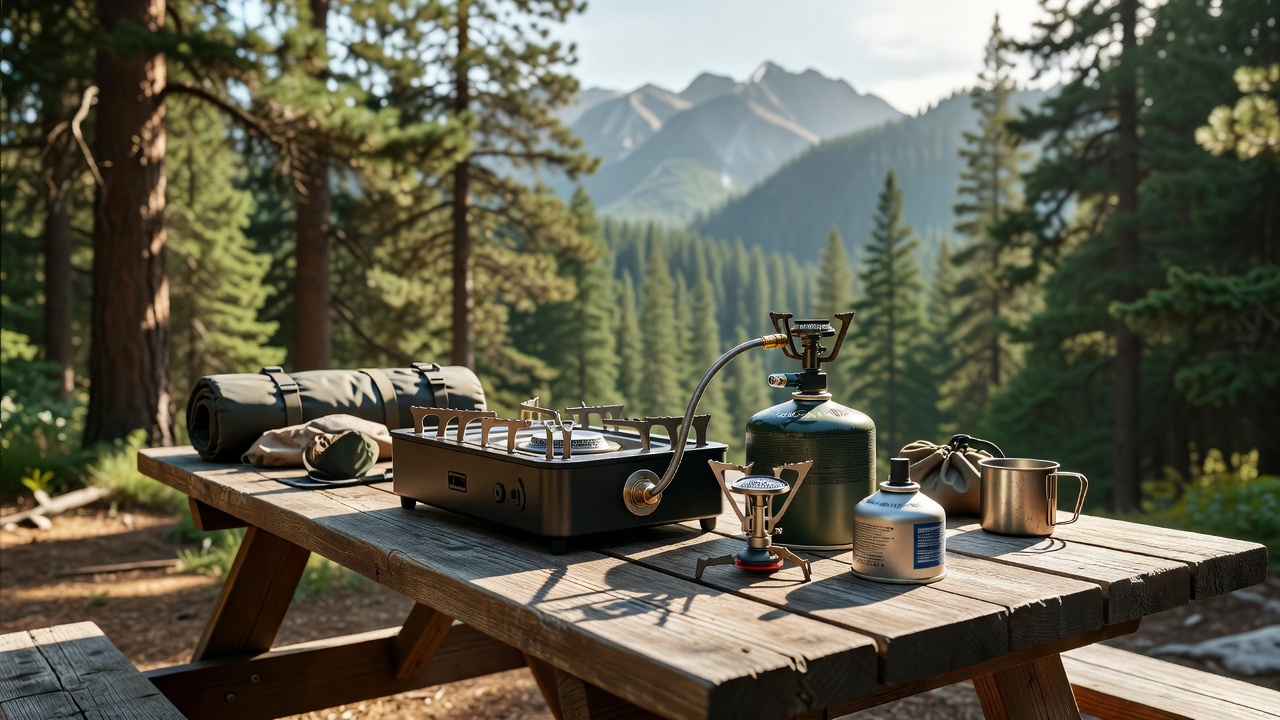
The duty-cycle correction: almost nobody cooks at full output for two hours straight. You light the burner, get water boiling, then turn it down to simmer and cover the pot. Real cooking usually averages 40 to 60% of rated output, which is why a 2.2-hour cylinder reliably gives you 4 to 5 hours of actual cooking. When you're planning a trip, use the full-output number for safety and treat the duty-cycle number as your realistic ceiling.
If you want the reverse question — exact run times and meals per canister — our guide to how long a 1 lb propane tank actually lasts breaks it down meal by meal.
Camping Propane Tank Sizes Compared
Here is every size you'll realistically see at a campground, with what it actually holds. "Hours" assumes full output on a 10,000 BTU/hr burner — double it for realistic simmer-heavy cooking.
| Tank / canister | Propane | Total BTU | Hours @ 10,000 BTU/hr | Best for | Refillable? |
|---|---|---|---|---|---|
| 8 oz butane canister | ~0.5 lb | ~10,600 | ~1.1 h | Picnic meals, single burner, warm weather | No |
| 1 lb / 16.4 oz cylinder | 1 lb | ~21,600 | ~2.2 h | Weekend trips, bottle-top stoves | Disposable (refillable versions exist) |
| 5 lb tank | 5 lb | ~108,000 | ~11 h | Week-long family trips, two burners | Yes |
| 11 lb tank | 11 lb | ~238,000 | ~24 h | Long trips, group cooking | Yes |
| 20 lb tank | 20 lb | ~432,000 | ~43 h | Basecamp, multiple weekends, heaters | Yes |
The one thing the table can't show you is the weight trade-off. A full 20 lb tank weighs about 37 pounds, and it's awkward — the valve is on top, so it wants to tip. A 5 lb refillable tank weighs around 10 pounds full and fits in a milk crate. That single fact is why so many car-camping families settle on the middle: a small refillable tank plus one or two one-pound spares for the bottle-top stove.
Per-Day Fuel Planning for a Family Trip
Math is fine on paper, but the useful question is "how many cylinders go in the car." Here's how a real family trip spends burner time:
- Coffee and hot water: 10–15 minutes
- Breakfast (eggs, pancakes, oatmeal): 20–30 minutes
- Dinner (one-pot, pasta, chili, grilled cheese): 30–45 minutes
- Cleanup hot water: 10 minutes
So a two-meal day runs 60 to 100 minutes of burner time for one pot at a time. That's about 1.5 hours of burner time per day per actively-used burner.
Worked plan — family of four, three nights, two-burner stove:
- 3 breakfasts at ~25 min = 1.25 h
- 3 dinners at ~40 min = 2.0 h
- Coffee, cocoa, cleanup water = ~0.75 h
- Total: about 4 hours of burner time, usually one burner at a time
At a 10,000 BTU/hr burner, 4 hours of realistic cooking consumes roughly 1.5 to 2 pounds of propane. That's two 1 lb cylinders, plus a spare — three cylinders for a three-night trip. If you cook on both burners at once for dinner, bump it to four.
That's the whole answer to how much propane for camping: count your burner-hours, convert to pounds at roughly half a pound per hour of cooking, then round up and add a spare.
Two things that quietly eat fuel: wind (a windscreen can cut consumption noticeably — see our windscreen guide) and cold (a cold tank delivers lower pressure and burns less efficiently, so you use more of it to do the same work).
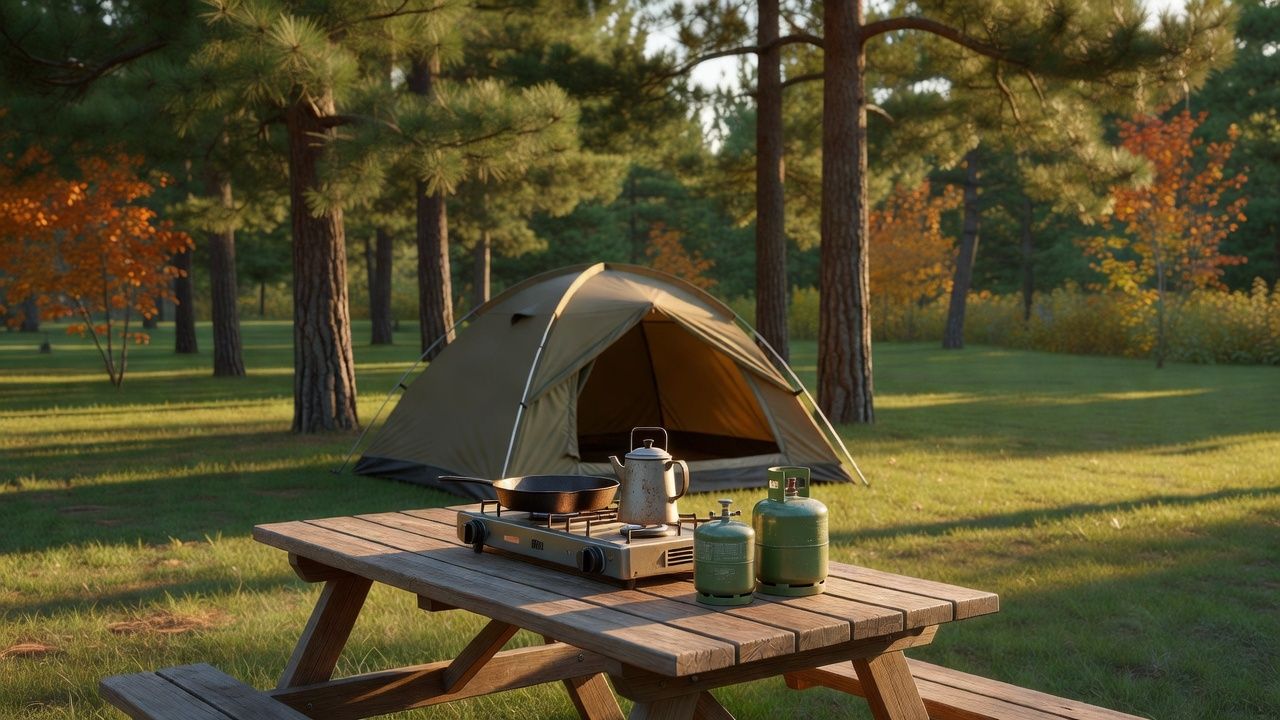
Small Propane Tank for Camping: When 1 lb Beats 20 lb
If you're searching for a small propane tank for camping — a mini propane tank for camping, or the smallest propane tank for camping you can carry legally — you're really choosing between three shapes: the 1 lb cylinder, the refillable mini tank, and the smallest refillable tank that's actually designed to be refilled.
The 1 lb (16.4 oz) cylinder wins on convenience. It screws straight onto a bottle-top stove with no hose, no regulator, and no wrench. It fits in a backpack side pocket, works in any weather propane works in, and costs $4–6. For a two-night trip with a single burner, it is genuinely the right answer.
Its weakness is cost per BTU. At $5 per pound you're paying roughly $0.23 per 1,000 BTU. A 20 lb refill costs about $15–25 for 20 pounds — roughly $0.05 per 1,000 BTU. If you camp more than a few weekends a season, the math turns fast, which is why a refillable cylinder plus an adapter kit pays for itself in one summer.
The refillable 1 lb option is the best of both: it's the same size as a disposable, screws onto the same stoves, and refills from a 20 lb tank at home. You need the cylinder and a refill kit; since you're refilling an engineered refillable cylinder rather than a disposable one, you stay on the right side of transport rules (refilled disposable cylinders are a DOT problem — our refill safety guide explains exactly where that line is).
Transport and storage rules that matter more than tank size: keep cylinders upright, out of direct sun, and not in a sealed hot trunk or a car parked in full sun. Don't leave a tank connected to a stove while driving. Store them outside the sleeping area.
Propane for a Camp Stove: Which Tank Fits Which Stove
Matching tank to stove is the step people get wrong when they buy a big tank and discover it won't connect. A propane tank for a camping stove only has to answer two questions: does the stove take a 1 lb cylinder directly, and does it ship with a hose for a bulk tank?
- Bottle-top single-burner stoves take a 1 lb cylinder directly, screwed into the stove's base. Nothing else needed.
- Two-burner stoves almost always ship with a hose and regulator designed for a 20 lb tank, with the option of running 1 lb cylinders instead.
- To run 1 lb cylinders on a big-tank stove, you need a converter adapter or a hose assembly with the right fitting.
- To run a 20 lb tank on a bottle-top stove, you need a 1 lb-to-20 lb adapter hose.
Two adapters matter more than any other accessory here: a 1 lb-to-20 lb adapter hose ($14.99) and a 20 lb-to-1 lb converter ($9.98). Between them you can run almost any combination of stove and tank you'll meet. If you're feeding a heater or a fire pit instead of a stove, you want a proper 10-foot hose assembly ($17.99) rather than a chain of adapters.
Butane and Isobutane: How Much to Bring When It's Cold
Butane is the cheap, clean-burning fuel that powers picnic stoves — and it's the reason a lot of fall trips get ruined by a stove that won't light.
Butane's problem is temperature. It stops vaporizing near freezing, so below roughly 40°F a butane canister delivers weak flame and then nothing. Isobutane stays usable down to about 11°F, and propane keeps working down to −44°F.
What that means for planning:
- Warm-weather weekend, single burner: one 8 oz butane canister (about 10,600 BTU) per 2 days of light cooking.
- Shoulder-season trip: switch to a propane blend, or accept that you'll burn more.
- Cold trip: double your estimate. Keep canisters inside your jacket or sleeping bag before use so they warm up, and warm the canister in your hands — never with a flame or heater.
For backpacking, a 110 g isobutane canister holds roughly 5,000 BTU, which is about right for boiling water for two people on one overnight. The full breakdown of fuel types, and which stove runs on which fuel, lives in our propane vs butane vs isobutane guide; isobutane vs propane covers the colder-weather trade-off specifically.
Where to Buy Camping Propane (and What It Actually Costs)
You can buy camping propane almost anywhere, but the price per BTU varies by 5x depending on where you shop.
- Big-box stores (Walmart, Home Depot, Lowe's, Tractor Supply): the cheapest place to buy 1 lb cylinders, usually in 2-, 4-, and 12-packs, or individual units near the sporting goods aisle.
- 20 lb refills and exchanges: hardware stores, gas suppliers, and big-box garden centers. Refill is usually cheaper than exchange — an exchange trades a full tank for your tank plus a fee, so you're paying $20+ for about 15 pounds of propane.
- Campground camp stores: convenient, and priced like it. Expect a 30–60% premium on 1 lb cylinders.
- Hardware and farm stores: often the best price on 20 lb refills and the most reliable stock in rural areas near public land.
- Searching "camping propane tanks near me," or wondering where to buy propane for a camping stove? The same three places cover almost everyone — big-box sporting goods aisles, hardware stores, and propane refill suppliers. Campgrounds are the convenient fallback, not the cheap one.
Rough cost per 1,000 BTU: 1 lb cylinders ≈ $0.19–0.28. 20 lb refill ≈ $0.04–0.06. 5 lb refill sits in between. If you're burning a cylinder a weekend, a refillable setup is the single easiest way to cut trip costs.
When the cylinder is empty, camping propane tank disposal is its own small project — don't just guess, because canisters are a specific waste stream and puncturing them is not the free pass the internet claims. Our guide to canister recycling, refills, and safe disposal covers what actually gets recycled and where to take them.
What to Actually Pack (Fuel Edition)
Working down the list from "one weekend" to "week-long basecamp":
- Coleman 16.4 oz propane 12-pack — $64.99. The practical bulk buy: twelve one-pound cylinders, roughly $5.40 each, enough for most families' whole fall season and one reliable spare for every trip.
- Flame King refillable 1 lb cylinder with refill kit — $59.99. Same footprint as a disposable, refills off a 20 lb tank. The cheapest long-run option for anyone who camps more than a few times a season.
- Gas One GS-3400P dual fuel stove — $34.99. Runs propane or butane, which makes it the most flexible single-burner option for shoulder-season trips.
- Coleman bottle-top single burner — $21.99. 10,000 BTU/hr, screws onto a 1 lb cylinder, nothing else to buy. The clean example of the math in this guide.
- Coleman Triton 2-burner propane stove — $149.99. The two-burner workhorse for family trips; pairs with a 20 lb tank for a multi-weekend basecamp.
- MSR PocketRocket 2 — $49.95. If your "family trip" includes a hike-in night, this is the stove your isobutane canister is for.
- MSR IsoPro 110 g canister — $8.95. About 5,000 BTU; the right size for one overnight of boiling water.
- Gas One 12-pack butane canisters — $29.99. Warm-weather picnic and patio cooking in bulk — just don't plan a cold trip around it.
- Mr. Heater Little Buddy propane heater — $69.99. If you camp into October and November, heating is part of your fuel math: this runs off the same 1 lb cylinders and adds real consumption.
- Outland Living portable propane fire pit — $142.64. Worth knowing about because at 58,000 BTU/hr it can empty a 20 lb tank in about seven hours. Fire pits are the biggest fuel draw at a campsite — budget for them separately.
How Long Does Camping Propane Actually Last? Every Version of the Question
This is one question asked a dozen different ways, and every version resolves to the same division: cylinder BTU ÷ burner BTU/hr. A 1 lb cylinder holds about 21,600 BTU; a 20 lb tank about 432,000. The hours below assume a 10,000 BTU/hr burner at full blast — real cooking averages 40–60% of that, so roughly double them for a normal simmer-and-stir pace. Our BTU math walkthrough shows the same arithmetic for other burners.
| Query people type | Short answer |
|---|---|
| how long do camping propane tanks last | A 1 lb cylinder is one pound of propane — about 2.2 hours at full output. |
| how long do propane camping tanks last | Identical to the 1 lb figure; there is no separate “camping” grade of propane. |
| how long do small camping propane tanks last | Small means 1 lb or 5 lb: roughly 2.2 hours and 11 hours at 10,000 BTU/hr. |
| how long does a camping size propane tank last | A camping-size 1 lb cylinder covers one evening of cooking plus breakfast. |
| how long does a coleman camping propane tank last | Coleman’s 16.4 oz cylinder is the standard 1 lb fill — about 2.2 hours wide open. |
| how long does a small propane tank last on a camping stove | About 2.2 hours on a 10,000 BTU/hr bottle-top stove, and 1.1 hours on a 20,000 BTU two-burner. |
| how long does camping propane last | Same as any propane: 21,600 BTU per pound, spent at your burner’s rated rate. |
| how long does propane last for camping stove | One pound per 2.2 burner-hours at 10,000 BTU/hr — four to five hours of real cooking. |
| how long does the average propane tank last | A 20 lb tank is about 43 hours on a 10,000 BTU/hr burner — three weeks of family weekends. |
| how long should a 20 pound propane tank last | About 43 hours at full output, or 21.6 hours if both burners of a 20,000 BTU stove run flat out. |
| how long will a camping propane tank last | About 2.2 hours of full-blast burn; plan on four to five hours of normal cooking. |
| how long will a small camping propane tank last | The same 2.2 hours — small tanks hold less fuel, not less energy per pound. |
| how long does a propane tank usually last | Camping tanks die by refill habit, not by schedule — weigh yours instead of guessing. |
| how long are propane tank good for | Propane does not spoil, so a tank lasts indefinitely as long as the valve and collar stay sound. |
How Much Propane Per Day? (The Family Trip Numbers)
Per-day planning is where vague answers fall apart. A two-meal day for a family of four runs 60–100 minutes of burner time, and at roughly half a pound of propane per hour of cooking that lands at 0.5–0.8 lb per day. If you want the meal-by-meal version, our canister runtime guide breaks it down per breakfast and per dinner.
| Query people type | Short answer |
|---|---|
| how much camping gas do i need | One pound per burner per three days of two-meal cooking, then bring a spare. |
| how much gas do i need for camping | For a two-night family trip: two 1 lb cylinders, plus a spare. |
| how much is propane for camping | $4–6 per 1 lb cylinder, or $15–25 for a 20 lb refill — about $0.05 per 1,000 BTU. |
RV and Camper Propane: What Changes When There Is a Fridge and a Furnace
Trailer and motorhome fuel math is the same division with much bigger burners attached. An absorption fridge sips 1,500–2,500 BTU/hr, a water heater 8,000–12,000, and a furnace 20,000–40,000 — which is why a 20 lb tank that lasts three weekends of cooking can disappear in a few cold nights of heating. If you are still choosing a rig, start with RV vs tent camping.
| Query people type | Short answer |
|---|---|
| do campers use propane | Yes — cooking, the absorption fridge, the water heater and the furnace typically all run on propane. |
| do campers use propane for heat | Almost always: RV furnaces are propane-fired and rated 20,000–40,000 BTU/hr. |
| do campers use propane for hot water | Yes — RV water heaters are propane or propane/electric at roughly 8,000–12,000 BTU/hr. |
| do campers use propane for ac | No. Air conditioning is 120 V electric from shore power or a generator; propane runs heat, not cooling. |
| how much propane does a camper heater use | A 30,000 BTU/hr furnace burns about 1.4 lb per hour of continuous run. |
| how much propane does a camper fridge use | About 1,500–2,500 BTU/hr — call it 0.5–1 lb per day, less in cool weather. |
| how much propane does a camper refrigerator use | Same as the fridge figure: a 20 lb tank runs it roughly two to three weeks. |
| how much propane does a rv heater use | About 1.4 lb per hour at 30,000 BTU/hr, and furnaces cycle — budget 3–5 lb per cold night. |
| how much propane does a rv fridge use per day | About 0.5–1 lb per day, so a 20 lb tank covers two to three weeks of refrigeration. |
| how much are propane tanks for campers | A 20 lb refill runs $15–25; a brand-new full 30 lb tank is typically $60–100. |
Propane Tank Sizes: Every Size You Can Actually Buy
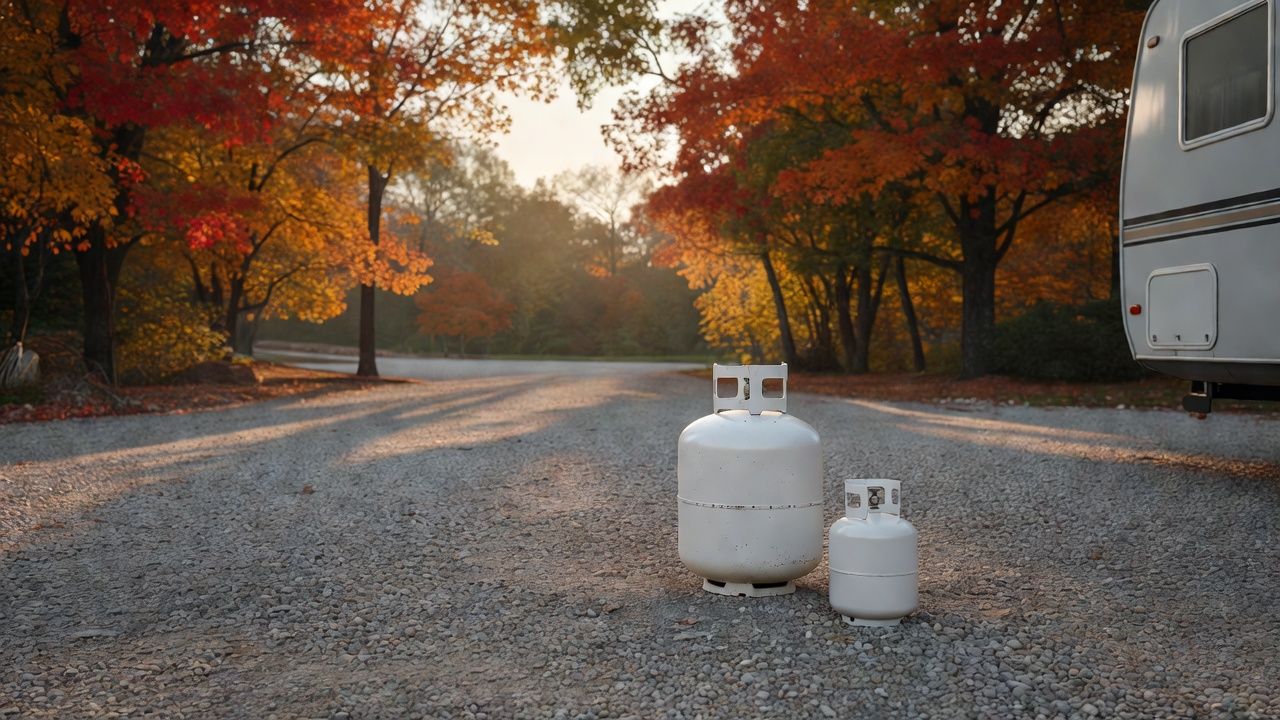
Camping catalogs make this look harder than it is. Five sizes cover almost everything: 1 lb, 5 lb, 11 lb, 20 lb, and the 30 lb cylinder that usually lives on a trailer tongue. Capacity scales linearly, so 5 lb really is five pounds of propane — about 108,000 BTU. The buying-guide version of this list, with fittings and hoses, is in our 1 lb propane tank guide.
| Query people type | Short answer |
|---|---|
| small propane tank sizes | 1 lb (disposable), 5 lb and 11 lb are the small sizes; 20 lb is the standard bulk tank. |
| small propane tank sizes chart | 1 lb = 21,600 BTU, 5 lb = 108,000, 11 lb = 238,000, 20 lb = 432,000. |
| small propane tank sizes and capacities | What matters is pounds of propane, not the exterior size of the tank. |
| what are the different sizes of portable propane tanks | 1, 5, 11, 20, 30 and 40 lb are the portable sizes; larger cylinders are fixed installations. |
| what size propane tanks can you get | From 1 lb disposables up to 100 lb cylinders — for camping, 1–20 lb covers nearly every trip. |
| coleman propane tank sizes | Coleman sells the 16.4 oz (1 lb) cylinder; its larger stoves use standard 5–20 lb fittings. |
| 20 lb propane tank capacity | 20 lb of propane, about 432,000 BTU — roughly 43 hours on a 10,000 BTU/hr burner. |
| 20 lb propane tank for camping | The best cost per BTU for basecamp, but it weighs 37 lb full and wants to tip. |
| 1 lb propane tank camping | The convenience default: no hose, no regulator, $4–6, and about 2.2 hours of full blast. |
| rv propane tank sizes | Trailers usually run 20 lb or 30 lb cylinders; motorhomes carry an ASME tank of 20–100 lb. |
| rv propane tank sizes chart | 20 lb (37 lb full), 30 lb (~55 lb full), 40 lb (~70 lb full) — weight is why trailers use two 20s. |
| rv propane tank sizes and weights | A 20 lb cylinder is about 17 lb empty and 37 lb full; a 30 lb tank is roughly 25 lb empty. |
Choosing Between 1 lb, 5 lb and a Refillable Tank
Trip length decides this one, not brand loyalty. Under three nights a 1 lb cylinder wins on convenience; a week at one site wants a 5 lb refillable; repeated weekends justify a 20 lb tank. The full cost-per-trip comparison is in our 1 lb vs 20 lb breakdown.
| Query people type | Short answer |
|---|---|
| best propane tank for camping | 1 lb cylinder for weekends, a 5 lb refillable for week-long trips, a 20 lb tank for basecamp. |
| best propane tanks for camping | Pick by trip length: 1 lb under three nights, 5 lb for a week, 20 lb for repeated weekends. |
| camping refillable propane tank | A refillable 1 lb cylinder matches disposable footprints and refills from a 20 lb tank at home. |
| best refillable camping propane tank | A refillable 1 lb cylinder with a CGA600 connection is the standard answer for car campers. |
Refilling Camping Propane Tanks: What Works and What Is Legal
Refilling splits into two completely different activities: getting your own 5–20 lb tank filled by weight, and topping up a 1 lb cylinder yourself from a 20 lb tank. The first is routine; the second needs a refillable cylinder, not a punctured disposable. The safety line is spelled out in our 1 lb refill guide.
| Query people type | Short answer |
|---|---|
| camping propane refill | Refill the tank you own: hardware stores and propane suppliers fill 5–20 lb tanks for $15–25. |
| camping gas bottle refill | The same service under a different name — a bulk fill of your own cylinder. |
| camping propane refill adapter | The part you need to fill a 1 lb cylinder from a 20 lb tank; get one with a bleeder valve. |
| camping propane refill kit | A kit pairs a refillable 1 lb cylinder with the adapter and hose — one purchase, ongoing savings. |
| can you refill camping propane tanks | Only the refillable ones — a disposable 1 lb cylinder is not built to be refilled. |
| can you refill small camping propane tanks | Refillable small tanks yes; disposable 1 lb cylinders are a refill-safety problem. |
| can camping propane tanks be refilled | Refillable cylinders can; disposables are single-use by design and by transport rule. |
| can small camping propane tanks be refilled | The refillable 1 lb version can, off a 20 lb tank with an adapter hose. |
| how to refill camping propane tank | Chill the empty cylinder, connect the adapter, invert the donor tank, open slowly, watch the bleeder. |
| small propane refill | Best done from a 20 lb tank at home rather than at a store — no per-fill fee. |
| small propane refill adapter | The fitting that connects a 1 lb cylinder to a 20 lb tank valve for a home refill. |
| where to refill camping propane tank | Hardware stores, farm supply and dedicated propane suppliers — they fill by weight, not by gauge. |
| how long to fill a 1 lb propane tank | One to two minutes if you chill the cylinder first; longer if you rush the pressure transfer. |
Storage and Shelf Life: Does Camping Propane Go Bad?
No, and that surprises people who have been throwing away half-used cylinders every spring. Propane is chemically stable, so “expired” camping propane is a myth — what ages is the cylinder, not the fuel. Storage practice is still what keeps a tank legal and safe, and the canister end-of-life rules live in our disposal guide.
| Query people type | Short answer |
|---|---|
| do small camping propane tanks expire | Disposable 1 lb cylinders do not expire either; rust at the seam is the real retirement signal. |
| do small propane tanks for camping expire | No expiry date applies — retire a cylinder for corrosion, not for age. |
| does propane expire | Propane itself is stable indefinitely: no degradation, no gone-bad date. |
| does propane camping gas expire | No. Sealed propane keeps its BTU value for decades. |
| how long does stored propane last | Indefinitely when stored upright and out of the sun — the fuel does not degrade. |
| how long does an unused propane tank last | An unused tank keeps its fill for years; just confirm the valve does not leak. |
| how long does it take for propane to go bad | It does not go bad. The only loss is a slow leak through a worn valve or seal. |
| how to store propane for camping | Upright, valve closed, out of direct sun, outside the tent and sleeping area. |
| how to store propane tanks for camping | Keep them upright and dry — a damp base is what rusts a cylinder seam. |
| where to store propane for camping | A shaded, ventilated spot: a milk crate in the garage or the truck bed, never a hot trunk. |
| where to store camping propane tanks | Away from sleeping areas and ignition sources, upright, with the valve protected. |
| where to store propane for camp stove | Disconnect from the stove before storage and never leave a burner connected in transit. |
Indoor Use, Transport and Flying With Propane
The three questions here are all safety questions, and the answers are less forgiving than the fuel math. Carbon monoxide is the risk indoors, DOT transport rules govern refilled disposables, and no propane cylinder of any size is allowed on a commercial flight. Wind and cold change consumption too — our windscreen guide covers the first half of that.
| Query people type | Short answer |
|---|---|
| can i use a propane camping stove indoors | Not in an enclosed space without cross-ventilation; a closed garage is unsafe. |
| can propane camping stoves be used indoors | Manufacturers say outdoor use only — any indoor use is at your own risk, even on a screened porch. |
| can you fly with camping propane | No. Compressed gas cylinders cannot go in carry-on or checked baggage. |
| how far away does a propane tank need to be | Ten feet from any flame, heater or generator, and never inside the tent or sleeping area. |
| how many propane tanks can i transport | Carry full refillable tanks upright and secured; federal rules restrict transporting refilled disposable cylinders. |
Where to Buy or Refill Propane for Camping
Where you buy changes the price per BTU by roughly five times, which is the real reason to plan ahead. Refill suppliers are cheapest, big-box multi-packs are the cheapest way to buy 1 lb cylinders, and campground stores are the convenient option priced like it.
| Query people type | Short answer |
|---|---|
| where to buy propane for camping | Big-box sporting goods aisles, hardware stores and propane suppliers; campground stores run 30–60% higher. |
| where to buy propane for camping stove | Anywhere 1 lb cylinders sell in multi-packs — hardware stores, farm supply and big-box. |
| where can i buy propane for camping | Refill suppliers are cheapest per BTU; multi-packs are cheapest for 1 lb cylinders. |
| where can i buy propane for camping stove | The same three channels that sell cylinders: big-box, hardware and propane suppliers. |
| where to get propane for camping | Refills by weight at a propane supplier, or 4- and 12-packs for disposables. |
Stoves, Heaters and Lanterns: Which Propane Appliance for Which Trip
Every appliance on this list spends the same propane at a different rate, and the rate is the number you plan around. A single burner at 10,000 BTU/hr is the family-camping default; a two-burner suitcase stove doubles output; a 58,000 BTU/hr fire pit empties a 20 lb tank in about seven hours. Fuel types and their cold-weather limits are covered in isobutane vs propane.
| Query people type | Short answer |
|---|---|
| best propane camping stove 2025 | Ignore the year tag — the category has not moved: a 10,000–12,000 BTU/hr bottle-top or a two-burner suitcase stove. |
| top rated propane camping stove | Bottle-top single burners in the $20–35 range cover most family weekends with no extra parts. |
| best portable propane camping stove | A bottle-top single burner: no hose, no regulator, screws straight onto a 1 lb cylinder. |
| best propane burner for camping | An 8,000–12,000 BTU/hr burner for one-pot cooking; 20,000+ BTU/hr total for group meals. |
| propane camping cooking stove | Match output to pot size — 10,000 BTU/hr handles a 4-quart pot for four people. |
| propane camping cooking burner | A single high-output burner is faster for water; two burners are better for a real dinner. |
| propane cooking camping | One burner per two people is a reliable rule, and two burners make breakfast genuinely faster. |
| propane camping cooking appliances | Stove, griddle and lantern are the three propane appliances that earn space on a family trip. |
| propane camping cook top | Look for a controlled simmer — pancakes and rice need low flame more than high BTU. |
| propane cooker camping | A dual-fuel propane/butane single burner is the most flexible shoulder-season choice. |
| propane gas for camping stove | Any standard propane works; the difference is the fitting, 1 lb threaded versus bulk-tank hose. |
| propane for coleman camping stove | Coleman bottle-top stoves take 1 lb cylinders directly; Triton two-burners use a hose and regulator. |
| small propane cooker camping | Small burners save space, not fuel — consumption tracks BTU, not physical size. |
| is propane or butane better for camping stove | Propane for cold weather and bulk tanks; butane for cheap warm-weather picnic cooking. |
| should i use propane or butane for camping stove | Below 40°F choose propane; in summer butane is the cheaper canister. |
| best propane camping heater | A 3,800–9,000 BTU/hr radiant heater running off a 1 lb cylinder — budget its fuel separately. |
| best propane griddle for camping | Griddles are fuel-heavy, so a 20 lb tank with a hose beats burning through 1 lb cylinders. |
| best propane lantern for camping | A 1 lb lantern costs pennies per hour next to a stove — light is never the fuel problem. |
| best propane firepit for camping | At 58,000 BTU/hr a portable fire pit empties a 20 lb tank in about seven hours. |
Camp Stove Fuel and Propane FAQ
How much propane do I need for a 3-day camping trip?
For a family of four cooking two meals a day on one burner, plan on about 4 hours of burner time, which is 1.5 to 2 pounds of propane — so two 1 lb cylinders plus one spare. Add roughly one more pound for every additional burner you'll run at the same time.
What size propane tank should I bring camping?
- 1–2 nights, one burner: a 1 lb (16.4 oz) cylinder, plus a spare.
- 3–4 nights, two burners: a 5 lb refillable tank, or 3–4 one-pound cylinders.
- Week-long trips or repeated weekends from one campsite: a 20 lb tank — heavy, but it holds about 432,000 BTU and costs a fraction per BTU.
Is it cheaper to buy 1 lb cylinders or refill a 20 lb tank?
Refilling a larger tank is dramatically cheaper per BTU — roughly $0.05 per 1,000 BTU for a 20 lb refill versus $0.19–0.28 for one-pound cylinders. The catch is weight and portability. The compromise most families land on is a refillable 1 lb cylinder plus a 20 lb tank at home to refill it from.
Can I use a 20 lb tank with a small camp stove?
Yes, with an adapter. Bottle-top stoves need a 1 lb-to-20 lb adapter hose; larger two-burner stoves usually include a hose and regulator for a 20 lb tank already. Never run a hose that's damaged, and always check the connection for leaks before lighting.
Does altitude change how much propane I need?
Yes, modestly. At high altitude you're usually boiling water for longer and running the burner harder against wind and cold, so add 20–30% to your estimate. Note that butane and isobutane canisters perform noticeably worse in cold and altitude together — propane handles both best.
How do I know how much is left in a propane tank?
Weigh it. A 1 lb cylinder weighs about 1 lb empty (total ~2 lb full), a 20 lb tank about 17 lb empty. A luggage scale gives you the remaining fuel far more accurately than shaking it. For 1 lb cylinders, a cheap in-line gauge helps you avoid the classic half-empty-cylinder surprise.
how long does a propane tank last camping
A 20 lb tank runs about 43 hours on a 10,000 BTU/hr burner, while a 1 lb cylinder gives you about 2.2 hours wide open — four to five hours of actual cooking. Weigh your tank before the trip and you are never guessing.
how long does propane last for camping
Figure one pound per 2.2 burner-hours at 10,000 BTU/hr. In practice a family weekend of two-meal cooking burns one to two pounds, so a two-night trip takes two 1 lb cylinders plus a spare.
how much propane per day camping
Plan 0.5–0.8 lb per day for two meals on one burner. Add roughly half again if you run two burners at dinner, and double the whole estimate if the trip is below 40°F.
how much propane does a rv use
Budget 1–2 lb per day in mild weather for cooking and the fridge, and 3–5 lb per day once the furnace is running. A cold night of heating can use more propane than a week of cooking.
how much propane does a camper use
A camper typically burns 0.5–1 lb per day for cooking and refrigeration, rising to 3–5 lb per day in heating season. The furnace, not the stove, is what empties a 20 lb tank.
can you refill a camping propane tank
Yes if it is a refillable cylinder — a 5 lb or 20 lb tank, or a refillable 1 lb cylinder. Disposable DOT-39 cylinders are not designed to be refilled, and refilling them is a transport-safety problem as well as a waste of propane.
do camping propane tanks expire
No. Propane does not degrade and disposable cylinders carry no expiry date. Retire a cylinder for rust at the seam or a damaged valve, not for age.
what size propane tank for camp stove
A bottle-top single burner takes a 1 lb cylinder directly. A two-burner family stove wants a 5 lb refillable tank for a week, or a 20 lb tank with a hose for basecamp cooking.
can you use propane for camping stove
Yes — most camping stoves run propane, either straight from a 1 lb cylinder or through a hose and regulator from a bulk tank. Check that your stove is rated for the fuel and that the fittings match before you light it.
are propane camping stoves safe indoors
Only with real ventilation. Burning propane produces carbon monoxide, so a sealed tent, a closed garage or a cabin without airflow is unsafe regardless of how small the burner is. Cook outside, or under a canopy with the sides open.
Plan the Fuel Before You Pack the Stove
The whole system is two numbers: your burner's BTU rating, and how many hours you'll actually cook. Divide, convert to pounds at roughly half a pound per hour of real cooking, round up, add one spare.
Do that once for your family's typical weekend and you'll never run out before breakfast again — and you'll stop paying $5 a pound for the privilege of hauling four cylinders on a two-night trip. For the full price comparison between 1 lb bottles and a 20 lb tank, including what the adapter costs and when it pays for itself, see the 1 lb vs 20 lb propane cost-per-trip breakdown.
If you're still deciding what to cook on, start with our camp kitchen setup guide, then plan fuel around it. And if you're camping into the cold months, our winter camping guide for beginners covers the gear changes — and the fuel changes — that make it work.
<!-- AFFILIATE_DISCLOSURE -->