Single-Burner vs 2-Burner Camp Stove: Which One Should You Actually Buy? (2026)
Single-burner vs 2-burner camp stove: boil times, simmer control, fuel costs and weight compared, plus which stove suits your trip type in 2026.
Friday afternoon. The cooler's packed, the tent's in the back, and you're staring at two stoves in the garage: the little one-burner you've carried on every hike since college, and the big dual-burner your neighbor swears by. Which one goes in the car?
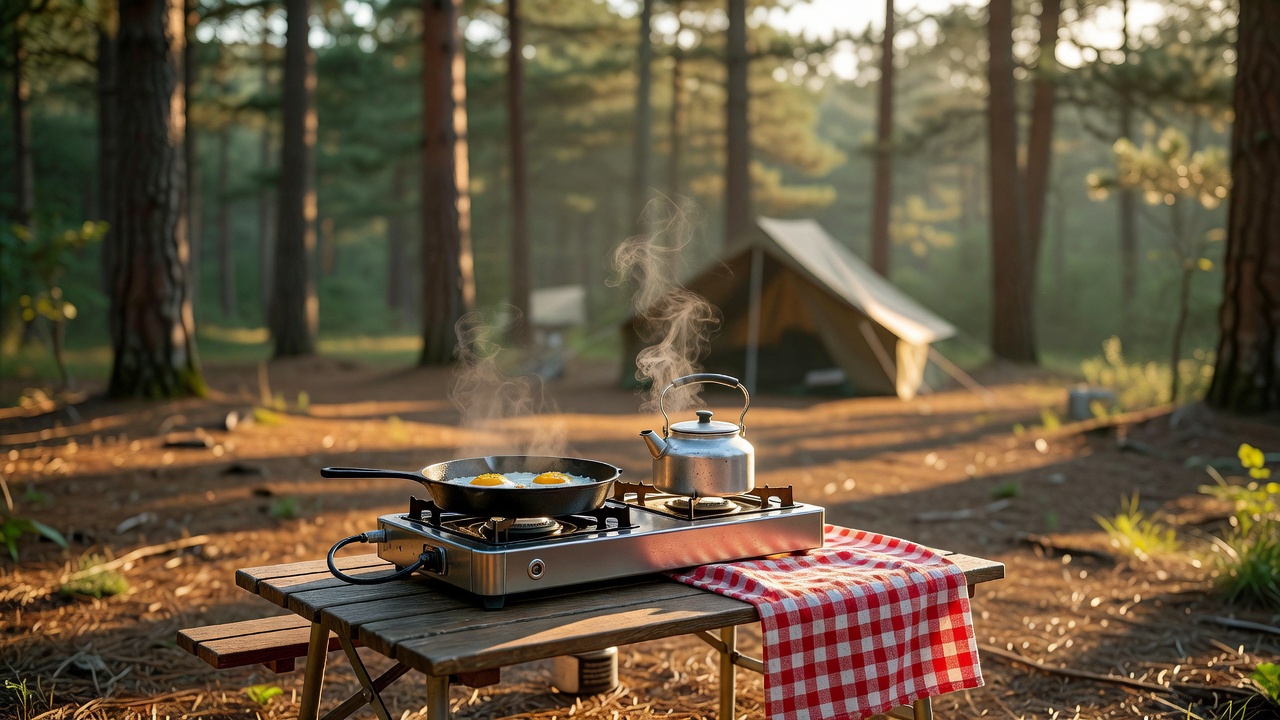
I've cooked on both for years — solo backpacking trips, weekend car camping with kids, and everything between. The honest answer is that neither is "better." Each one is the right tool for a different kind of trip, and buying the wrong one means either hauling 12 pounds you never use or trying to feed a family of four off a stove the size of your palm.
This guide breaks down the real differences — boil times, simmer control, fuel costs, weight — and gives you a straight decision path by trip type.
Breakfast is usually the deciding meal — see camping breakfast ideas for what each stove layout can realistically get on the table.
Lunch is the other one — camping lunch ideas shows which layouts can put a hot midday meal on the table and which can't.
Quick Answer: One Burner or Two?
- Backpacking or solo trips: MSR PocketRocket 2 — $49.95. Barely 2 oz, boils a liter in under four minutes.
- Car camping, one pot at a time: Coleman Bottle Top Propane Stove — $21.99. Screws straight onto a 1 lb cylinder, no fuel line to fiddle with.
- Car camping, cooking real meals: Gas One GS-3400P Dual Fuel — $34.99. Two burners that run on propane or butane, so fuel availability never strands you.
- Feeding a crowd: Coleman RoadTrip 225 — $199.99. Two 11,000 BTU burners plus swappable grill and griddle tops.
- Cheapest way in: AOTU Portable Camping Stove — $12.99. Piezo ignition and a hard case for the price of two lunches.
The One Question That Decides It
Before any spec comparison, answer this: how many people are you cooking for, and how far are you carrying the stove?
- Cooking for 1-2 people, carrying it more than a quarter mile → single-burner, every time.
- Cooking for 3+ people at a drive-up campsite → 2-burner, no contest.
- Anything in between → read the weight and simmer sections below, because that's where the real trade-offs live.
Everything else — BTU ratings, fuel types, wind screens — matters, but it's secondary to that first question.
When a Single-Burner Stove Is the Right Call
A single-burner stove earns its place when weight, pack size, or simplicity matters more than cooking surface.
Backpacking and hiking. If the stove is riding on your back, every ounce is paid for in sweat. The MSR PocketRocket 2 ($49.95) weighs about 2.9 ounces — lighter than a phone — and boils a liter of water in roughly 3.5 minutes with the included heat exchanger. It's been the standard ultralight pick for years for a reason: tiny, reliable, and it simmers well enough for a dehydrated dinner or a cup of pour-over.
The budget camp kit. For casual car campers who just need hot water for coffee and a one-pot dinner, a basic single burner is all you'll ever use. The Coleman Bottle Top Propane Stove ($21.99) screws directly onto a propane cylinder — no hose, no table space, no regulator to fiddle with. It's the cheapest way to get a hot meal at a campsite, and it doubles as a backup for tailgating and power outages.
Solo and weekend trips. The AOTU Portable Camping Stove ($12.99) packs piezo ignition (no lighter needed) and folds down to fit in a pot. Pair it with a MalloMe Camping Cookware 17-piece Mess Kit ($32.99) and you have a complete kitchen that fits inside a daypack.
Dual-fuel flexibility without the size. The Gas One GS-3400P Dual Fuel Stove ($34.99) runs on both butane canisters and propane with an adapter — handy when you're not sure what fuel the corner store will have. And the Coleman Classic 1-Burner Butane Stove ($29.99) is the go-to for indoor-style cooking at the campsite table, with a carrying case that keeps the valve protected.
The rule of thumb: if your whole dinner is "one pot, one burner, one trip to the pot," a single burner saves you pounds and table space you didn't know you needed.
When a 2-Burner Stove Wins
A 2-burner stove pays for itself the first morning you're cooking breakfast for a family: eggs on one side, pancakes on the other, coffee finishing at the same time. That's not convenience — that's the difference between a 15-minute breakfast and a 45-minute relay.
Family car camping. This is the 2-burner's home turf. The Coleman RoadTrip 225 is the benchmark tabletop 2-burner: two 11,000-BTU burners, a built-in wind screen, and an instant-start ignition. It grills and cooks on interchangeable plates, so burgers and a skillet of vegetables happen at the same time. Kids eating at different times (always) means one burner stays warm while the other cooks — a single burner just can't do that.
Big pots and group meals. Chili for six, a pot of pasta for the whole site, or boiling water for dishes after dinner — a 2-burner handles a 12-inch pot without wobbling, and the second burner keeps a side dish warm. If your camp meals ever involve "the big pot," you want two burners.
Cooking with cast iron. A Lodge skillet isn't just a pan — it's thermal mass. Lodge Round Cast Iron Griddle ($24.90) and Lodge Cast Iron Skillet 6.5-inch ($9.38) hold heat beautifully, but they take longer to come up to temperature. A second burner lets one preheat while the other actually cooks — and lets you move the skillet between a high burner and a low one mid-recipe, which is how you get crispy edges without burning the center.
The hidden cost: a 2-burner tabletop stove runs 10-20 pounds and takes real table space. If you're not cooking for a group, you're carrying that weight for nothing.
Boil Times and Heat Output: BTU Numbers, Explained
Here's the spec most people get wrong: a higher BTU rating doesn't mean faster boiling. BTU is raw heat output, but what matters is how efficiently that heat transfers to the pot — pot size, wind, and burner design all matter more.
For reference, a typical single-burner backpacking stove like the MSR PocketRocket 2 puts out about 8,100 BTU and boils a liter in ~3.5 minutes. A full-size 2-burner camp stove puts out 10,000-20,000 BTU total across two burners — meaning each individual burner is often slower than the backpacking stove. Two burners cook two things at once; they don't cook each thing twice as fast.
Practical takeaways:
- For boiling water fast: any stove with 8,000+ BTU and a windscreen does the job.
- For slow cooking (soups, beans, simmering sauces): low-end control matters more than peak output — see the next section.
- Wind is the real enemy. The SUPRUS Electric Lighter ($9.99) helps with ignition, but a wind screen cuts boil times by 30-50% on breezy sites — it's the cheapest performance upgrade you can make.
Camp Stove BTU Output: Per Burner vs Total (and the Numbers That Actually Matter)
Almost every bad camp stove purchase starts with the same misread: someone compares a "60,000 BTU" two-burner against an "8,000 BTU" backpacking stove and assumes the big one boils water seven times faster. It doesn't. When you read a camping stove BTU output spec, check whether the number is quoted per burner or as a total — the per-burner figure is the one that changes how you cook, and even that only tells part of the story.
Camp Stove BTU Output, Decoded
Here is the same class of spec sheet read two ways, using the real ratings from our own catalog:
| Stove | Burners | Rated output | Per burner | What it buys you |
|---|---|---|---|---|
| Coleman Classic 1-Burner Butane | 1 | 7,650 BTU | 7,650 BTU | Coffee, eggs, a small skillet — tabletop cooking with a case |
| MSR PocketRocket 2 | 1 | 8,000 BTU class | 8,000 BTU | A liter in about 3.5 minutes with a heat-exchanger pot |
| Coleman Bottle Top Propane | 1 | 10,000 BTU | 10,000 BTU | The single-burner sweet spot for car campers |
| AOTU Portable Camping Stove | 1 | 11,000 BTU | 11,000 BTU | Hot water and one-pot meals on the cheapest reliable burner |
| Gas One GS-3400P (dual fuel) | 2 | 8,000 BTU rated | check the label | Two burners and fuel flexibility in one small box |
| Coleman RoadTrip 225 | 2 | 11,000 BTU each | 11,000 BTU | Two genuine burners plus swappable grill and griddle tops |
| Camp Chef Explorer Two-Burner | 2 | 30,000 BTU each (60,000 total) | 30,000 BTU | Big pots, group breakfasts, wind-resistant legs |
Two things jump out. First, a Coleman camp stove BTU rating can be lower per burner than a $13 backpacking burner — the RoadTrip's 11,000 per side is barely above the AOTU's single burner, and the Coleman Classic butane stove sits below it. Second, a Camp Chef BTU headline is a total, not a per-burner number: the Camp Chef stove BTU spec on the Explorer reads 30,000 per side for 60,000 BTU overall, a genuinely different class of stove built for stockpots rather than for speed. A backpacking stove BTU rating of 8,000-11,000 is normal for a screw-on canister burner, and it is not "worse" than either.
What "Camp Stove 12000 BTU" and Every Other Number Really Means
| Phrase people type | What it actually describes | The honest answer |
|---|---|---|
| camping stove BTU output | the per-burner figure that decides boil time | Read the per-burner number — totals are marketing |
| camp stove high BTU | usually a group stove, a fire pit, or a heater | High output buys pot capacity and wind resistance, not faster boiling |
| camp stove 12000 BTU | a tabletop 2-burner's per-side figure | Same class as the single burner you were comparing it to |
| camp stove 20000 BTU | often the total of two ~10,000 BTU sides | Still two ordinary burners cooking two pots at once |
| camp stove 40000 BTU | above stove territory | At that output you are describing a propane fire pit or patio heater — our 58,000 BTU fire pit is exactly that |
| how many BTU do I need | the boil-speed question | 8,000-11,000 per burner with wind protection beats 20,000 with none |
How Many BTU Do You Need?
- 7,500-11,000 BTU per burner covers the whole single-burner and tabletop world. With a lid and any wind protection, that boils water as fast as anything in the class.
- 15,000-30,000 BTU per burner is group territory: you are buying the ability to hold a 12-inch pot steady and fight wind, not a faster kettle.
- 40,000 BTU and up belongs to fire pits and radiant heaters, not camp stoves.
- If your complaint is speed, spend the money on wind protection before you spend it on BTU. A windscreen beats a burner swap every time, and it costs under $20.
For the deeper version of this math — BTU by group size and boil times compared at 8,000 vs 11,000 per burner — see our camp stove BTU guide. What this page adds is the single-vs-two translation: two burners give you a second heat zone, not a bigger one.
Simmer Control: The Difference Nobody Talks About
Ask any camp cook what separates a good stove from a great one and they'll say simmer control, not power. A stove that only has "raging" and "off" burns your rice, scorches your oatmeal, and ruins your coffee.
The good news: many single burners simmer better than big 2-burners. The MSR PocketRocket 2 has a genuine adjustable flame range down to a gentle simmer — enough for a proper French press or instant noodles. The Gas One GS-3400P also modulates well on butane, which burns cooler and more evenly than propane.
Cast iron amplifies the difference. A preheated Lodge griddle holds steady heat even when the flame dips, which is why camp cooks love it: the pan becomes your thermostat.
If you regularly cook anything beyond boiling water, test the simmer range before you buy. Crank it to low and see if the flame stays steady and small — that's the control you'll actually use.
Camp Stove With a Griddle: What Actually Fits on One Burner vs Two
Griddle cooking is the one place where burner count changes what is physically possible rather than just how convenient dinner is. A camp stove with a griddle works on one burner, but only in one shape — and that shape is the whole answer.
Griddle questions arrive as near-identical fragments, and each one has a different answer:
| Phrase people type | What it really means | What to buy |
|---|---|---|
| camp stove with griddle top | a stove whose grate accepts a flat plate | Any 2-burner tabletop — check the grate width first |
| camp stove with griddle and burner | one appliance doing both jobs | A 2-in-1 grill/stove, or a 2-burner plus a round plate |
| camp chef with griddle vs blackstone | stove-plus-plate against a dedicated flat-top | Stove plus plate if you ever boil water |
Camp Stove With a Griddle Top: The Two Shapes That Exist
Round cast iron (10-11 inch) — single-burner territory. A round plate sits on one burner ring, so the entire surface is at one temperature. That is fine for pancakes and eggs cooked one batch at a time, and it is why the Lodge Round Cast Iron Griddle ($24.90) is the accessory most single-burner owners should own. Buy a camp stove with a griddle top in this shape and you get one heat zone you control by moving food around the plate, not by turning a knob.
Rectangular (17-22 inch) — needs two burners. A wide plate spanning two burners gives you two real heat zones: a hot side for searing and a cooler side for holding. On a single burner the same plate only heats its middle, so the outer third of a big griddle is decoration. If you want a camp stove with a griddle and burner doing both jobs at once, you want two burners — or a purpose-built 2-in-1.
Best Camp Stove With a Griddle
- Best overall for a family: a 2-burner tabletop with swappable tops — the Coleman RoadTrip 225 ($199.99) or the Coleman Tabletop 2-in-1 Camping Grill/Stove ($166.01). A 2 burner camp stove griddle setup from this family replaces a separate griddle appliance entirely.
- Best on a budget: a single burner plus a $25 round Lodge plate. This is the best camp stove with griddle answer under $60 all in, as long as you accept one batch at a time.
- Is a Coleman camp stove with a griddle a real product? Yes — a Coleman camp stove with griddle tops comes in the tabletop 2-in-1 family, and Coleman's tabletop grates are sized so a 10.5-inch round plate bridges them without rocking.
- Camp Chef with a griddle: Camp Chef sells griddle plates sized to its two-burner footprint, so a camp chef with griddle top setup is a full-width plate on a full-width grate. A Camp Chef stove with griddle plate is not something we stock — check the Camp Chef listing for the plate that matches your model, because widths differ between the Explorer and the bigger three-burner bodies.
Camp Chef With a Griddle vs Blackstone
These are different appliances, and the confusion costs people money. A Camp Chef with griddle is a two-burner stove that can also run a pot, a kettle, or a Dutch oven — the plate is one of several things you can put on the grate. A Blackstone is a dedicated flat-top griddle: one big cooking surface, its own stand or legs, and no pot burner at all.
Buy a stove + plate if you ever boil water, make coffee, or simmer a pot while griddling. Buy a flat-top if nearly every camp meal you cook is on a flat surface and you own a separate way to boil water. Blackstone is not in our catalog, so we are describing the category rather than a model — the honest version is that most family campers get more meals out of a 2-burner plus a round plate than out of a dedicated flat-top they have to store.
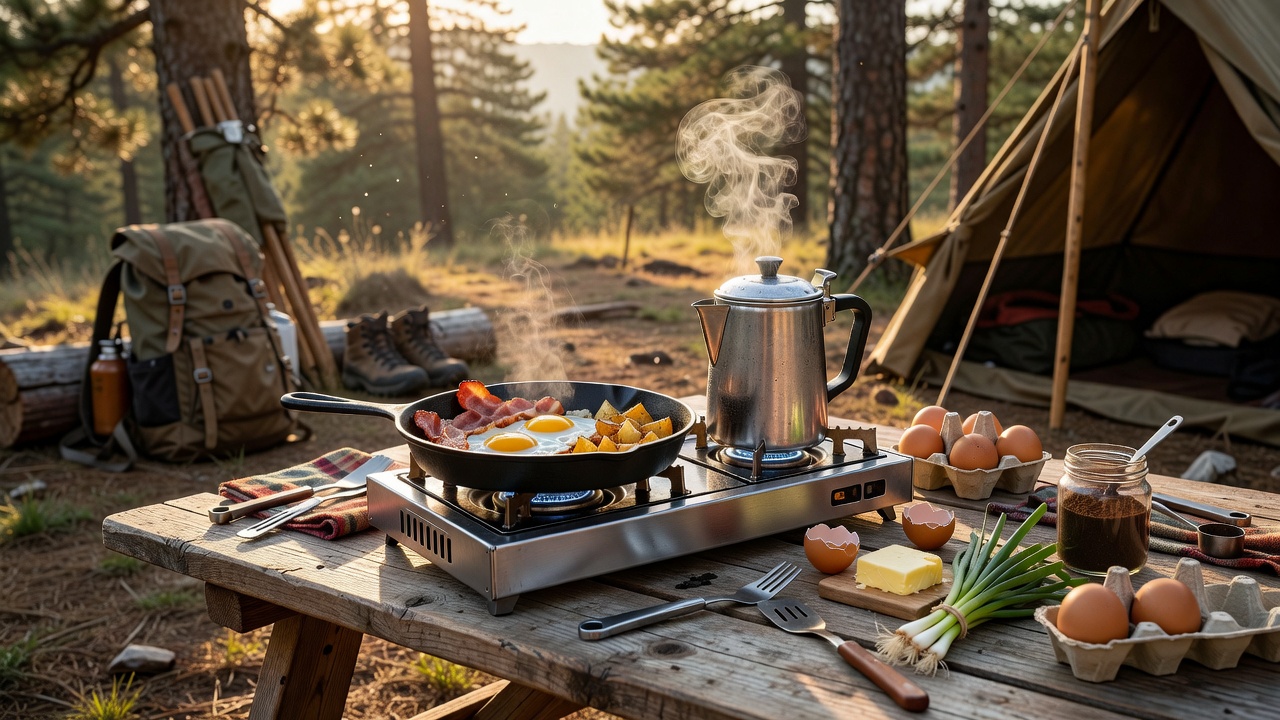
For the full griddle playbook — seasoning, what sticks, and how to run a griddle without a smoker's worth of smoke — our camp stove griddle guide goes deeper than this page needs to.
Fuel Costs: What You'll Actually Spend Per Trip
Fuel choice is where the "cheap stove" illusion falls apart. A $13 stove that burns $5 canisters is not cheaper than a $50 stove that burns $1.50 canisters.
| Fuel | Best for | Cost per trip (4-day, 2 people) | Notes |
|---|---|---|---|
| Propane (16.4 oz) | Car camping, 2-burner stoves | ~$5 (one 12-pack lasts many trips) | Works to freezing, heavy canister |
| Butane (8 oz) | Tabletop single burners | ~$3-4 (2-3 canisters) | Cheap, but stops working below ~40°F |
| Isobutane (110g) | Backpacking stoves | ~$4 (1-2 canisters) | Light, works in cold, pricier per gram |
The Coleman Propane Cylinder 12-Pack ($64.99) is the value play for car campers — a 16.4-ounce cylinder runs a 2-burner stove for roughly 2-3 meals. The GasOne 12-Pack Butane Canisters ($29.99) do the same for tabletop butane stoves. For backpackers, the MSR IsoPro 110g Canister ($8.95) is the reliable cold-weather choice.
The full chemistry — why butane dies in the cold, why isobutane doesn't, and how propane behaves at altitude — is in our camp stove fuel guide. It's the most thorough breakdown we've published, and it'll save you from buying the wrong canister on a cold trip.
Camp Stove Wind Protection: Wind Guards, Windscreens, and Windbreaks
Wind is the number one reason a camp stove will not boil water properly, and it is the cheapest problem on this page to fix. It also carries more names than any other piece of gear: a camp stove wind guard, a camp stove windscreen, a camp stove windshield, windshield for camp stove setups, a camp stove windbreak, a camp stove wind deflector, a camp stove wind block, a camp stove wind protector — that is one product family under eight names, and every one of them does the same job: keep moving air away from the flame.
Nothing on a spec sheet makes a camp stove boil water faster when the burner is sitting in moving air — which is why we keep coming back to wind protection as the highest-value upgrade on any stove, single or double.
What Each Stove Format Already Has Built In
- Bottle-top single burners: a molded wind-baffle around the burner head. The Coleman Bottle Top Propane Stove ships with exactly this, and it is the reason that $21.99 stove holds a flame in light gusts.
- Tabletop 2-burners: a built-in screen in the lid. The RoadTrip 225 has one, which is why it performs better than its per-burner BTU number suggests.
- Backpacking canister stoves: nothing at all — the burner is exposed. A camp stove windscreen DIY fold out of heavy foil is the standard fix. One safety rule: shield the burner, never wrap the canister. Trapping heat around a canister raises its internal pressure, and that is how canister stoves fail dangerously. A three-sided foil wall planted on the windward side is the correct shape.
- Liquid-fuel stoves: a purpose-built option exists — the MSR Heat Reflector and Windscreen ($16.97) clips onto the stove and reflects heat back at the pot as well as blocking air, which both speeds boils and cuts fuel use.
Double Burner Camp Stove Windshield: Why Two Burners Change the Math
A double burner camping stove windshield has a harder job than a single-burner screen, for a structural reason: the stove is wider, so it presents a wider face to the wind, and a screen sized for one burner leaves the second burner exposed. Three practical rules:
- Buy wider than you think. A folding screen should be at least as wide as the stove's collapsed width, or it will sit under the middle of the stove and shield nothing that matters.
- Use the lid you already have. If your tabletop stove came with a lid that latches into a screen position, that is the best wind protection available for it — it is sized correctly by design.
- Turn the stove, don't fight the wind. Facing the back of the stove into the prevailing wind costs nothing and often outperforms a cheap screen.
The 30-50% boil-time difference between a sheltered and an exposed burner is why this matters more than the BTU number on the box. Our camp stove windscreen and wind protection guide covers screen styles, DIY folds, and setup positions in detail.
The Middle Ground: One Burner Plus a Real Cook Set
Here's the setup I actually recommend for most couples and small families: a quality single burner + a nested cook set + cast iron. You get 90% of the cooking versatility with a third of the weight.
The Stanley Wildfare Core 26-Piece Cook Set ($179.99) nests pots, pans, plates, and utensils into one tidy package — it's the kitchen-in-a-box that makes a single burner feel like two, because the cookware does the multitasking. If you're a coffee person, add the AeroPress ($39.95) or the Snow Peak Titanium French Press ($65.00) — both make better camp coffee than anything on a stove's second burner.
The full camp kitchen layout — what to bring, what to leave home, and how to organize the table — is in our camp kitchen setup guide. Fuel is the other half of that cost line, and it is where burner count stops mattering: a butane cartridge and a 1 lb propane cylinder burn at very different rates in the cold. Our Coleman vs Gas One butane stove comparison works through the run-time math, the butane-or-propane decision, and what each fuel really costs per cooking hour.
Camp Stove Weight: What the Spec Sheet Is Not Telling You
When you compare camp stove weight figures, you are almost always looking at the leash weight of the bare stove — the lightest number the brand can legitimately print. The weight you actually carry on a trip is a different figure, and on a 2-burner it is a much bigger number.
The Three Weights of a Camp Stove
| Weight figure | What it includes | Typical class (not a spec sheet) |
|---|---|---|
| Bare stove | the burner body only | A backpacking canister stove is a few ounces — the MSR PocketRocket 2 is 2.6 oz |
| Packed stove | body, case or bag, ignition | Add a few ounces to a pound to a tabletop single burner |
| Fighting weight | stove, fuel, pot, and utensils | A full 110 g canister adds roughly 7 oz; a 1 lb propane cylinder adds about 1.6 lb |
This is why lightweight camp stove means two different things depending on who is reading. For a backpacker it means under about 3 ounces plus a canister. For a car camper it means under about 5 pounds packed, because anything that rides in a trunk is being measured against table space rather than shoulder load.
Comparing a backpacking stove weight figure against a Camp Chef stove weight figure is comparing two different measurements taken by two different marketing departments. One number describes a burner that lives in a stuff sack; the other describes an appliance that lives in a car. Convert both into fighting weight before you compare, or the comparison is meaningless.
Coleman Camp Stove Weight and Camp Chef Weight: Why the Numbers Are Hard to Compare
Coleman camp stove weight and Camp Chef weight figures are quoted inconsistently across listings — one retailer lists the bare body, another lists the body plus case, and a third lists a shipping weight that includes packaging. The same is true of Camping gas stove weight listings in general. The honest move is to weigh your own setup once on a kitchen scale and write it on the stove's case: the number you can trust is the one you measured.
Camp Chef 3 Burner Stove Weight (and Why We Don't Stock One)
A Camp Chef 3 burner stove weight question usually comes from someone planning to feed a crowd. Worth knowing: a third burner moves the whole appliance into a different class — longer body, wider grate, heavier folded package — and it is the point where a stove stops being a one-person carry. That is why we recommend the two-burner formats on this page instead: Camp Chef Explorer legs, a folding suitcase body, or a tabletop 2-in-1 all cover the same family trips at a weight one person can still manage, and a second $30 single burner covers the rare breakfast-for-eight morning far better than carrying a third burner on every trip.
The Verdict: A Decision Guide by Trip Type
Buy a single-burner stove if:
- You backpack or hike to camp (weight is everything)
- You cook for 1-2 people
- Your camp meals are one-pot or boil-water simple
- You want the cheapest reliable way to get hot food outdoors
Buy a 2-burner stove if:
- You car camp or RV with family or friends (3+ people)
- Breakfast for a group is a regular event
- You cook with cast iron or big pots
- You want to grill and simmer at the same time
Still torn? The classic budget combo is a $20-35 single burner for solo trips plus a friend's or borrowed 2-burner for group trips — most people who camp both ways end up owning both eventually. Start with whichever matches your next three trips, not your dream trip.
"Double Burner Camping Stove" and Other Names, Decoded
Half of buying the right stove is knowing that the listing names describe the same appliance. A double burner camping stove is a 2-burner stove — same thing, different words — and the fuel words attached to it are where the real differences hide.
- Double burner camping stove propane — the standard full-size format. It runs on a 1 lb cylinder or, better for families, a 20 lb tank through a hose and regulator, like the Coleman Triton+ 2-Burner ($149.99). Our propane hose, regulator and adapter guide covers those connections.
- Double burner camping stove gas — in US listings "gas" almost always means propane. In UK and Australian listings it usually means a butane or propane cartridge stove, which is a different regulator question entirely.
- Double burner camping stove butane — click-in 8.8 oz cartridges, tabletop only. Great value in warm weather, useless below about 40F, and the whole butane appliance family is covered in our fuel guide.
- Double burner camping stove folding — legs that fold under the body (the Camp Chef Explorer's party trick) or a suitcase-style body that folds in half. Folding is a real feature for car campers because a flat folded stove stores under a cooler.
- 2 burner camp stove propane — the same appliance as the first bullet. If you are choosing between a 2 burner camp stove propane model and a butane tabletop, the fuel question decides it: propane works in the cold, butane is cheaper and lighter in summer.
- Single burner camp stove propane — two very different formats wear this name. A bottle-top stove (the Coleman Bottle Top, $21.99) screws straight onto a 1 lb cylinder. A canister stove (MSR or AOTU) uses a Lindal valve, and you cannot put a 1 lb propane cylinder on a canister stove without an adapter. We covered one: the Gas One Propane Refill Adapter and Hose ($14.99) also lets you refill 1 lb cylinders from a 20 lb tank, which is the cheapest way a 2-burner family ever buys fuel.
Cooking for a Family of Four (or Five): Camp Stove Capacity, Not Burner Count
Look up the "best camp stove for family" and almost every answer leads with a burner count. Burner count is the least useful number in the decision. A family of four that eats one-pot chili every night needs less stove than two adults who want eggs, bacon, and coffee hot at the same time. What actually decides it is how many things have to be hot simultaneously — and whether the pot physically fits the grate.
Looking for a camping stove for family of 4? Skip past the "best camp stove" listicles and answer one question first: how many things have to be hot at the same moment? A camping stove for family of 4 that cooks one-pot chili needs less stove than two adults who want eggs, bacon, and coffee finishing together. The best camping stove for a family is almost always a 2-burner on a bulk tank; the best backpacking stove for family trips is a single canister burner plus real cookware, because nobody carries 12 pounds to a walk-in site. A camping stove for a large family (5-6) is still two burners — the third job is the kettle, not a third burner.
One more phrasing worth answering directly: if you are hunting the best camping stove for large family camping, the answer is still two burners plus a kettle — not a third burner. Past six people the bottleneck is hot water, and a kettle on the second burner solves it for $20.
What Family Size Actually Requires From a Stove
| Household | Typical hot items per meal | Burners that really work | Fuel that makes sense |
|---|---|---|---|
| 2 adults | One pot + coffee | 1 | Canister or 1 lb propane |
| Family of 4 (2 adults + 2 kids) | Breakfast + dinner; kids eat early | 2 | 1 lb propane, or a 20 lb tank for multi-day trips |
| Family of 5-6 | Breakfast + dinner + a kettle running | 2 (3 if coffee is non-negotiable) | 20 lb bulk tank |
| Two families, 8+ people | Full breakfast and dinner service | 2 burners plus a griddle, or two stoves | 20 lb bulk tank |
The jump that matters is one burner to two, not two to three. Two burners let you hold a simmering pot while the other burner does the high-heat work — which is what family cooking actually is: one thing finishing while another starts.
Best Camp Stove for Family Camping: The Three Formats That Work
A hose-fed two-burner on a bulk tank is the family standard for a reason. The Coleman Triton+ 2-Burner Propane Camp Stove ($149.99) runs off a 20 lb tank with a hose and regulator, folds like a suitcase, and gives two independently controlled burners — enough for a pot of pasta and a pan of sauce at once. Our propane hose, regulator and adapter guide covers what you need to connect it to a bulk tank, which is the cheapest way a family of four ever cooks at camp. The Camp Chef Explorer Two-Burner ($127.99) is the budget version of the same idea, with legs that make it a standalone cooking station.
A tabletop two-burner that also grills suits the weekend where dinner is burgers and breakfast is pancakes — the Coleman Tabletop 2-in-1 Camping Grill/Stove ($166.01) does both from one fuel source, so you're not stacking a separate grill on top of a stove on top of a table.
A single burner plus real cookware is the underrated family answer when space, not money, is the constraint. One burner plus a nesting set — the GSI Outdoors Pinnacle Camper Cookset ($159.95), a genuinely four-person set — feeds a family of four with one pot and one pan, because the cookware is doing the multitasking instead of the stove.
Whichever format you pick, the pot has to fit: a family stockpot on a compact burner ring is the most common cause of a slow, yellow-tipped flame, and it's covered in our flame color guide.
Camp Stove Meals for a Family of Four: A Real Weekend Menu
Family cooking at camp fails when every meal needs the one pan. A two-burner setup removes that bottleneck, and cast iron is what makes the second burner worth having — a Lodge 10.5-inch griddle ($24.90) holds heat through a stack of pancakes without a babysitter.
Saturday breakfast — burner 1 holds a pot of water for coffee and oatmeal; burner 2 runs the griddle for pancakes and eggs. Both finish in the same twenty minutes, which is the entire argument for a second burner.
Saturday dinner — burner 1 simmers a one-pot chili or pasta sauce; burner 2 browns the meat or toasts garlic bread. With kids eating early, you serve the first plates off burner 2 while burner 1 keeps going.
Sunday breakfast — clean out the coolers: scrambled eggs and reheated leftovers, one pan, five minutes, one burner, and the other burner dedicated to the coffee or tea that gets everyone loaded into the car.
Two make-ahead tricks that buy back the most time with kids: pre-cut and bag every vegetable at home, and premix the pancake batter in a squeeze bottle. The beginner camp cooking guide walks through the full first-trip menu, and if you want to move past boiling water, the campfire cooking guide covers dutch-oven and grate cooking for the nights the crowd wants a fire anyway.
Family of 5 or 6? The Kettle Problem
At five or six people, the second burner stops being optional and the third job — hot water for drinks, dishes, and hand-washing — becomes the thing that stalls every meal. Two solutions that don't require a bigger stove:
- A 1.1L kettle on one burner the whole meal. The Stanley Adventure All-in-One Fry Pan Set ($80.49) nests a full stainless set including a kettle, so you're not carrying a separate pot for water.
- Give the stove a proper surface. A second pot on a narrow table is how family meals end up on the ground — the Coleman Pack-Away 4-in-1 table ($99.99) adjusts to stove height so the whole two-burner setup behaves like a real kitchen counter.
A honest limit worth knowing: no camp stove boils water for six people and grills at the same time on the same two burners. If breakfast for six is the routine, budget for two stoves or accept staggered seating — that's cheaper and safer than buying a three-burner stove nobody wants to carry.
Common Mistakes (Learn From Mine)
Buying the biggest stove you can afford. A 20-pound, 3-burner monster that lives in the garage because it's "too much setup" is worse than a $30 stove that comes on every trip. The best stove is the one you actually pack.
Ignoring wind protection. The #1 complaint about camp stoves is "mine doesn't boil water fast." Nine times out of ten it's a wind problem, not a stove problem. Our wind screen guide fixes it for under $15.
Assuming BTU = speed. As covered above, burner efficiency and pot fit matter more. Check your pot actually sits on the burner grate before you buy — tiny backpacking stoves and wide pots are a frustrating mismatch.
Forgetting fuel compatibility. Butane stoves won't run on propane canisters without an adapter, and isobutane canisters use a different valve than propane. Decide your fuel first, then your stove — or read the fuel guide before buying either.
Testing at home only once. Stoves misbehave on real trips: cold fuel, wind, altitude. Cook one actual meal on the stove before you leave — it takes ten minutes and prevents the "why won't this light" campsite meltdown.
One more factor in the single-vs-two decision: griddle cooking. The camp stove griddle guide shows why a second burner buys you a holding zone under a wide plate.
Single-Burner vs 2-Burner Camp Stove FAQ
Is a 2-burner stove worth the weight for car camping?
Yes — when you're cooking for more than two people, or making anything with more than one component. Weight only matters when you carry it. If the stove rides in the trunk, the second burner buys you parallel cooking (eggs and coffee at the same time) instead of a queue of hungry people.
How many BTUs do I need to boil water quickly?
More output boils faster in still, warm air — but the number on the box isn't the whole story. Wind, pot width, pot material and whether you use a lid all move real-world performance more than a modest BTU gap does. Buy a stove with decent output and a wind-sheltered burner rather than shopping the biggest number.
Which is cheaper to run — a canister single-burner or a propane 2-burner?
Propane generally costs less per meal because the fuel is cheaper per unit of heat, while canisters cost more but arrive in a lighter, more compact package. For weekend car camping the difference is small either way; fuel cost becomes a real line item when you're cooking three meals a day on longer trips.
Can I cook for a family of four on a single burner?
You can, but you'll eat in courses. One burner means everything happens sequentially — boil the water, cook the main, then reheat the sides. For a family of four, a second burner (or a single burner paired with a real cook set) is the difference between one hot meal together and reheating somebody's portion.
Do 2-burner camp stoves simmer well?
It depends on the burner design, not the burner count. Plenty of inexpensive 2-burner stoves run hot with poor low-end control; the ones worth buying have a genuinely wide valve range. If slow-simmering matters to you, check the low end before you commit rather than trusting the burner count.
Can I use a camp stove inside a tent or a closed vestibule?
No. Every fuel-burning stove produces carbon monoxide, which is odourless and can build to lethal levels in an enclosed space, and an open flame next to synthetic tent fabric is a fire risk on its own. Cook outside, or in a shelter specifically designed and ventilated for cooking.
Is a 2-burner camp stove enough for a family of 4?
Yes, for almost every trip a family of four takes. Two burners cover the real bottleneck — one pot finishing while a pan works — and a family of four's meals are usually one pot plus one pan, not three simultaneous dishes. The failure cases are breakfast for 5-6 people, or a menu that needs an oven, which no two-burner camp stove provides. If you cook for four and want the cheapest capable setup, a hose-fed 2-burner on a 20 lb tank is the standard answer.
How many burners do I need to cook camp stove meals for a family?
Count the things that must be hot at the same moment, not the number of people: coffee plus oatmeal plus pancakes is three jobs, so a 2-burner works only because the kettle and the pot share one burner while the griddle takes the other. As a rule of thumb, families of 2-4 are fine on two burners, families of 5-6 should plan on two burners plus a kettle or a third burner, and groups of 8+ should bring two stoves rather than one large one.
Can you use a camp stove in the house?
No — treat every fuel-burning camp stove as an outdoor appliance. Propane and butane both produce carbon monoxide, which is odorless and can reach dangerous levels in a house, a garage, or a tent. Camp stoves are also built for a picnic table or the ground, not a countertop with cabinets above the flame.
That is exactly why a Kidde AA-battery carbon monoxide detector ($23.97, 4.7★) belongs in the stove bin rather than the house: two AA batteries, no wiring, and it works the same in a garage, a cabin, or the one tent where someone decided the rules did not apply.
If you have seen butane cartridge stoves marketed for indoor tabletop cooking, note that those are sold for a different regulatory context and a different style of indoor kitchen; in the US, run yours outside, on a porch, or in a ventilated outdoor kitchen area.
That question usually comes bundled with a bigger one — "what is the best stove for camping" or "what's the best camp stove" — and there is no single answer. The honest version: a canister single burner for backpacking, a bottle-top propane burner for simple car camping, and a 2-burner for families. The verdict section above picks between them by trip type in about thirty seconds.
What's the best camp stove for simmering?
The best camp stove for simmering is the one with the widest low-end valve range, which is rarely the one with the highest output. Two formats do well here: the MSR PocketRocket 2, whose backpacking stove simmer control goes down to a genuinely gentle flame, and the Gas One GS-3400P ($34.99), which modulates well on butane because butane burns cooler and more evenly than propane.
The quick test is the same one we recommended earlier: light the stove, crank it to low, and watch whether the flame stays small and steady. If camp stove simmer control turns out to be the weak point on a stove you already own, cast iron is the fix — a preheated pan holds steady heat even when the flame dips, so the pan becomes the thermostat. Our simmer and heat control guide covers the 60-second test and the cast-iron workaround in full.
One more buying note on heat control: a camp stove with simmer control that genuinely holds a low flame is worth more day to day than a few thousand extra BTU, because the low end is what you use for rice, oatmeal, sauce, and coffee.
What can you cook on a camp stove? (camp stove recipes for a family)
Simple camp stove recipes follow three shapes: boil (water, pasta, rice, coffee), simmer (soup, chili, sauce), and one-pan (eggs, pancakes, stir-fry). A single burner does all three, one after another. A 2-burner lets two of them happen at once, which is what easy meals to make on camp stove trips with kids really need — eggs on one side, kettle on the other.
The simple camp stove recipes that survive real trips are the ones with one pan and one pot: a one-pot chili and a skillet of cornbread, a pasta with sauce kept warm on the low burner, and a two-burner breakfast of pancakes plus coffee. For easy meals for family camping, start with our camping breakfast ideas and camping lunch ideas, then use the beginner camp cooking guide to plan a full weekend menu.
The Bottom Line
Match the burner count to the trip, not to the marketing. Solo and lightweight trips want a single-burner stove in the 12-50 dollar range; family car camping wants a 2-burner tabletop stove with a windscreen and instant ignition. Get the fuel right (see the fuel guide), add a nested cook set, and you'll eat better at camp than most people do at home.
For more first-trip planning, our car camping stove roundup compares seven real stoves side by side, and the beginner camp cooking guide walks through your first few meals step by step.
Related: Camp Stove Simmer & Heat Control Guide — why cheap burners scorch, the 60-second simmer test to run before you buy, and the cast-iron fix for a stove with no low setting.
Related: Camp Stove BTU Guide: How Many BTU Do You Really Need? — BTU by group size, boil times at 8,000 vs 11,000 BTU per burner, and the fuel-burn math behind why a big flame is not always the better stove.
Related: Camping Tables That Double as Camp Stove Stands — a second burner needs a wider, sturdier surface. Here's how to pick the table that holds it.
Burner format also decides how much air a stove has to work with, which is why an oversized pot on a small ring goes yellow — the camp stove flame color guide covers that tradeoff.
The single-burner story goes furthest in a pack: our best backpacking stove guide covers screw-on ultralight burners, integrated canister systems, and liquid-fuel stoves for trips where one burner has to do everything.
<!-- AFFILIATE_DISCLOSURE -->