Camping Lunch Ideas: 25 No-Cook and Make-Ahead Meals That Actually Work (2026)
Camping lunch ideas that survive a real cooler — 25 no-cook, make-ahead and hot-meal options, plus large-group plans, kid-proof picks and the food-safety rule most people get wrong.
Breakfast gets the gear videos. Dinner gets the campfire. Lunch gets forgotten — and then everyone is standing around at 1pm eating warm string cheese out of a bag while the cooler sits in the sun.
I've done that. So has everyone I camp with. The problem is that lunch is the one camp meal you eat away from camp — at a trailhead, on a lake, halfway up a ridge, or in the car between two stops. It has to survive being packed at 7am and eaten five hours later, in the heat, with no table and no stove.
That constraint changes everything about how you plan it, and it's why camp lunch fails more often than camp breakfast or camp dinner.
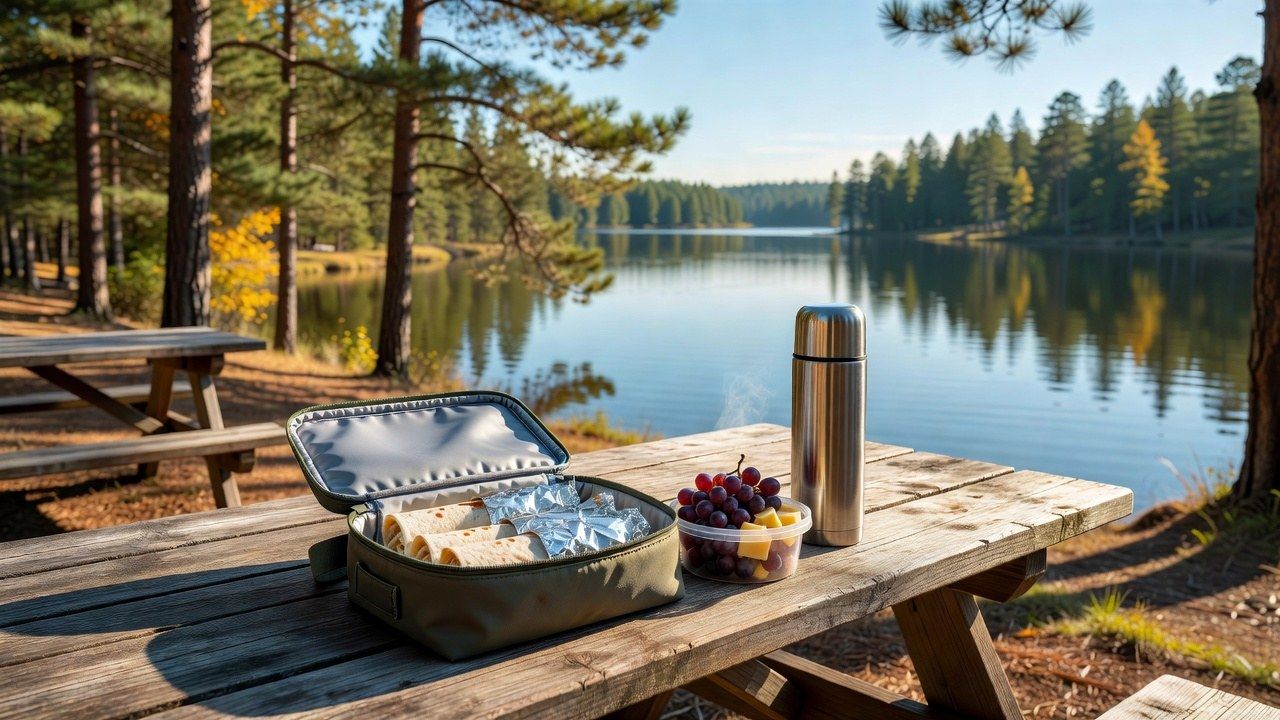
The short answer: the easiest camping lunch is a cold-cut wrap assembled at home and eaten straight from the cooler. If you want zero prep, a charcuterie-style graze box and a soup in a thermos both work. If you're at camp and want it hot, griddle quesadillas or foil-packet lunches take 10 minutes on the two-burner stove. Everything below is sorted by how much work it takes.
Quick Answer: What's the Easiest Camping Lunch?
Match the lunch to where you'll eat it, not what sounds good:
- Eating out on a hike or a lake → no-cook, no-fridge, no-flame. Wraps, graze boxes, jar salads, tuna packets.
- Eating back at camp with a stove → hot lunch is on the table. Griddle quesadillas, skillet grilled cheese, foil packets.
- Feeding 6+ people → one assembly line, one cooler, zero short-order cooking. Do a build-your-own wrap bar.
- Feeding kids → deconstruct everything. Kids eat components, not sandwiches.
One rule covers 90% of camp lunch problems: pack the meal in the order you'll eat it. The first lunch of the trip sits on top; the last day's food sits at the bottom. Most cold-cooler disappointment is a packing problem, not a menu problem.
The 3 Rules of a Camp Lunch That Actually Works
Rule 1: Lunch is a cold meal with a hot option, not the reverse
Dinner is where you commit to a real cook. Lunch is where you don't. Plan lunch around what can be eaten cold and reheated only as a bonus — because the days you plan a hot lunch are exactly the days you get back to camp at 2:30 with everyone starving and no patience for a stove.
Cold-first also means your cooler does the work. A properly packed cooler holds safe food temperature for 5 days, which means lunch can be whatever you put in it on day one and still be fine on day three. See our weekend cooler packing guide for the layered order that makes this work.
Rule 2: Prep at home, assemble at camp
Every minute of knife work you do at the campsite is a minute you're not hiking, swimming, or sitting down. Cut vegetables, portion deli meat, pre-mix dressing, and pre-wrap sandwiches at home on Wednesday. At camp you open a bag and hand it out.
The exception worth making is a build-your-own wrap bar for groups — it's faster to hand eight people a tortilla and let them load it themselves than to pre-make eight wraps that half of them won't want.
Rule 3: Anything with mayo, eggs, or raw meat goes in the bottom of the cooler
Camp lunch food-safety failures are almost always one of three things sitting too warm too long. The USDA guidance is blunt: perishable food left out above 40°F for more than 2 hours (1 hour above 90°F) should be thrown out. That's a much shorter window than most people assume at a hot campsite.
Keep mayo-based salads, egg salad, deli meat, and anything with dairy hard against the ice at the bottom of the cooler, and eat them first. Shelf-stable food — tuna packets, nut butter, hard cheese, jerky, fruit, crackers — can ride on top all day. Our ice retention guide covers why some coolers hold this much better than others.
No-Cook Camping Lunch Ideas (No Stove, No Fridge)
These are the lunches that work when there is no cooler space, no flame, and no table. All of them are edible at trailhead temperature.
The Graze Box
A hard-sided container with hard salami or summer sausage, a block of aged cheddar or parmesan (hard cheeses are safe at room temperature for hours), crackers, almonds, dried apricots, and a handful of grapes. It's a full lunch, it needs no cutting board, and it's the single most reliable camp lunch there is. Pack it in a shallow container so it doesn't turn into a pile.
Tuna or Chicken Packets + a Tortilla
The workhorse. A foil pouch of tuna or chicken, one tortilla, a squeeze packet of mayo or hot sauce, and you have a wrap in 90 seconds with no knife and no plate. Buy the pouches, not the cans — you're not carrying a can opener and you're not washing a can.
Upgrade it: add a single-serve guacamole cup and a handful of crushed chips. It sounds like a joke and eats like a real meal.
Mason Jar Salads (Dressing on the Bottom)
Layer dressing first, then hearty vegetables (chickpeas, cucumbers, cherry tomatoes), then greens on top. Shake when you're ready to eat. The salad stays crisp because the greens never touch the dressing. A wide-mouth jar is the right container — you eat straight out of it, so there's nothing to wash but the jar.
Cold-Cut Wraps
Tortilla, deli meat, sliced cheese, a smear of mustard or mayo, and something crunchy. Roll tight, wrap in foil, and label it with a Sharpie — otherwise you'll spend five minutes at the trailhead playing which-wrap-is-whose. Make them the night before; they hold up better than sandwiches because tortillas don't go soggy the way bread does.
Hummus, Veg, and Pita
A tub of hummus, a bag of carrots and snap peas, and pita bread. Zero cooking, zero utensils, and it survives a hot car better than anything involving meat or mayo. This is the lunch I default to on the last day of a trip when the ice is mostly water.
Nut Butter and Banana Roll-Ups
Tortilla, peanut or almond butter, a banana, a drizzle of honey. Two minutes, no refrigeration needed at all, and it's genuinely filling on a hike. Keep a couple of these in the daypack as the emergency lunch you never plan to eat.
Make-Ahead Camping Sandwiches and Wraps
If you have an hour at home the night before, you can eliminate lunch prep from the entire trip.
Freeze the sandwich, not the bread. For anything with deli meat and cheese, assemble it, wrap it in foil, and freeze it solid. It thaws in the cooler over about 6 hours and doubles as an ice block — which means it's helping keep everything else cold. By lunch on day one it's perfect. By day two it's still fine. Do not do this with lettuce, tomato, or mayo; add those at the trailhead.
Keep wet away from dry. The single failure mode of a pre-made sandwich is sogginess, and it always comes from the same source: tomato, cucumber, or wet lettuce touching bread. Slice tomatoes the morning you eat them, or pack them separately and add at the last second.
Sauce as a barrier. A thin layer of mustard or mayo spread edge to edge on both slices actually waterproofs the bread. It sounds like an old trick because it is one, and it works.
Wrap tight, then wrap again. Foil outside, parchment or plastic inside. The double wrap is what keeps a wrap from unrolling into a bag of loose parts by noon.
Grab-and-go lunches like this pair well with a real insulated bag rather than a big hard cooler — the Stanley All Day Julienne soft cooler and lunch box is $100 and rated 4.8 stars over 2,500 reviews, and it's built for exactly this: one person's lunch, carried to a trailhead rather than left in camp.
Hot Camping Lunch Ideas (Skillet, Griddle and Foil Packets)
Hot lunch is worth the effort when you're at camp with a stove and you've got a cold, wet, or hangry group. Keep all of these to one pan.
Griddle Quesadillas
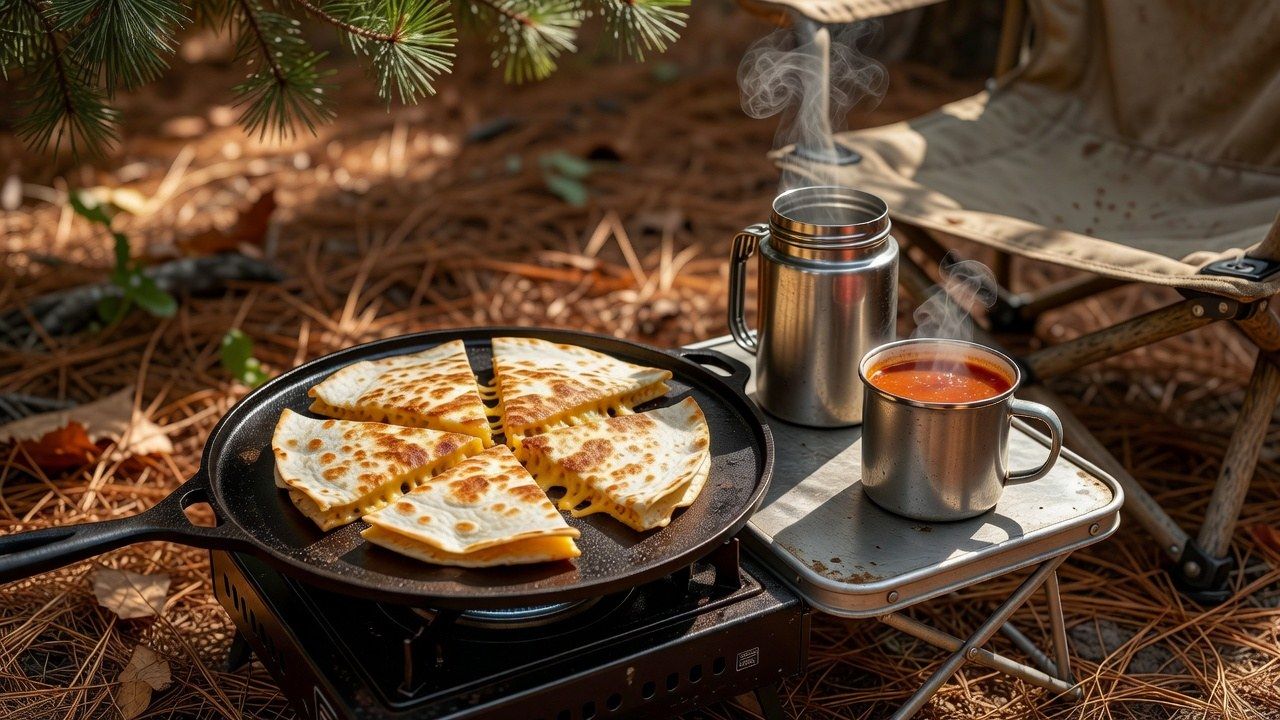
The best hot camp lunch there is. A flat griddle, tortillas, shredded cheese, and whatever leftover protein is in the cooler. Ninety seconds a side. No plating, no utensils, and you can hand them out as fast as you can make them — which matters enormously with kids. The Lodge round cast iron griddle is $24.90 and rated 4.7 stars over 8,200 reviews, and its round shape is genuinely better than a square one on a round burner.
Skillet Grilled Cheese and Tomato Soup
A 10.25-inch Lodge cast iron skillet is $19.99 with 150,000+ reviews and 4.7 stars, and grilled cheese is what it was made for. Pair it with soup heated in a separate pot, and pour the soup into a THERMOS Stainless King food jar — $30.50, 4.6 stars, 7,300+ reviews. That jar is also how you get hot soup to a trailhead, which is the only reliable way to eat hot food away from camp.
Foil Packet Lunches
Ground meat or sliced sausage, potatoes, onion, peppers, a pat of butter, salt and pepper, wrapped in heavy foil, thrown on coals or on a griddle for 20 minutes. Zero cleanup, and it scales: make eight packets, eat eight packets. This is the best large-group hot lunch because everyone eats at the same time.
Ramen, But Make It Lunch
Instant ramen plus a handful of frozen mixed vegetables, a beaten egg, and a sliced green onion is a real meal in six minutes on one burner. A Coleman Classic single-burner butane stove at $29.99 is enough for this, and a MalloMe 17-piece mess kit at $32.99 gives you the pot and the bowls with 4.5 stars over 9,500 reviews.
Backpacking Lunch: Rehydrate in a Bag
If you're carrying lunch on your back, weight beats flavor. A Mountain House Beef Stroganoff 4-pack is $69 with 4.7 stars over 1,188 reviews — add boiling water, wait nine minutes, eat out of the bag, and there's nothing to wash. A bottle top stove at $21.99 or an MSR PocketRocket 2 at $49.95 boils the water in under three minutes.
Fuel choice changes how fast that water boils, and it changes a lot at altitude — our camp stove fuel guide and the BTU explainer both cover which stove does what at what elevation.
Camping Lunch Ideas for Large Groups
Feeding six to twelve people lunch is a logistics problem, not a cooking problem. The rule: one assembly line, no short-order cooking.
The wrap bar. Two coolers, one with tortillas and proteins, one with toppings. Everyone builds their own. You can feed ten people in four minutes flat and accommodate the vegetarian, the picky kid, and the guy who hates mayo without cooking anything separately.
Two 70-quart coolers beat one 120-quart. One for drinks, one for food. It sounds wasteful until you've stood at a single cooler with twelve people's hands in it — drinks go in and out constantly, which kills the ice and warms everything else. A Coleman 70-Quart Xtreme at $79.99 is the value pick, and the RTIC 45 QT at $239 is the step up in ice retention. If the group spans a big site, a wheeled Coleman 316 Series 62QT at $84.99 saves a lot of carrying.
Prep a backup hot option for the whole group. One pot of chili or a big pot of soup made ahead, frozen, and reheated feeds everyone at once with one burner. Keep a Mountain House Expedition bucket at $176.99 for 30 servings as the "we got rained out and nobody wants to cook" insurance policy.
Set up a serving table. Feeding a crowd on the ground or on a cooler lid is miserable. A folding table with one clear line is the difference between a group lunch and a scrum — see our camping tables buying guide.
Camping Lunch Ideas for Kids
Kids reject sandwiches they'd eat at home for no reason other than the setting. Stop fighting it and deconstruct.
Components, not meals. A compartment container with turkey slices, cheese cubes, crackers, grapes, and a couple of baby carrots gets eaten. The same ingredients inside bread get picked apart and half-discarded. It's the same food; the format is the whole difference.
Give them something to dip. Hummus, ranch, peanut butter, yogurt. A vegetable with a dip attached has a completely different success rate than a vegetable alone.
Keep it hand-held. No utensils means nobody loses a fork in the grass. Quesadilla wedges, pinwheels, roll-ups, and skewers all work.
Pack a drink they'll actually finish. Kids drink less when they have to unscrew a cap. A CamelBak Eddy kids bottle with a bite valve is $19.99 and gets drunk from constantly, which matters more than you'd think on a hot hike.
Our full kid-friendly camping meals guide covers breakfast, dinner, and snacks the same way, the fall camp food guide has colder-weather variations for all three meals, and the camping breakfast ideas guide handles the morning before lunch is even a question.
The Camp Lunch Box Setup (Gear That Actually Matters)
You need four things, and only one of them is a cooler.
1. Something insulated for one person. A real soft-sided lunch box with a wipe-clean liner, not a reusable grocery bag. The Stanley All Day Julienne at $100 is the buy-once version at 4.8 stars over 2,500 reviews. For a day cooler you can carry, the YETI Roadie 24 at $250 (4.8 stars, 8,000+ reviews) is the one that holds ice through a genuinely hot day.
2. A thermos that actually keeps heat to noon. Not a mug — a sealed food jar. The THERMOS Stainless King 24 oz at $30.50 is the one that shows up in every "I want hot soup at the summit" conversation.
3. Something flat to cook on. If you're doing hot lunch at camp, one griddle or one skillet does all of it. The Lodge round griddle at $24.90 is the most versatile single piece of camp cookware you can own.
4. Containers that don't leak. A UCO 4-piece mess kit at $17.85 with 4.7 stars over 3,884 reviews covers bowl, plate, and spork for one person. For drinks, a GSI Infinity backpacker mug at $14.95 nests out of the way, and a Hydro Flask 32 oz at $44.95 or a CIVAGO 32 oz at $19.99 keeps water cold enough that people actually drink it.
Skip: a full knife roll, a cutting board bigger than a plate, and anything that needs its own case. Camp lunch is not a cooking project.
If you're comparing stoves specifically for camp cooking rather than lunch only, the beginner meal planning guide walks through stove and cookware selection properly, and the essential campfire cooking gear guide covers the open-flame side.
Camp Lunch Food Safety: The Rule Most People Get Wrong
This is the section that matters most, because camp lunch is the one meal designed to sit warm for hours.
The 2-hour rule is real, and the 1-hour version applies to you. Perishable food must not sit above 40°F for more than 2 hours — and that drops to 1 hour when the ambient temperature is above 90°F. A cooler sitting in a car or in direct sun in July hits that easily.
What that means in practice:
- Mayo-based salads, egg salad, deli meat, and dairy — bottom of the cooler, eaten first, back in the cooler after serving. Never left on the picnic table during the afternoon.
- Hard cheese, salami, jerky, nut butter, fruit, crackers, bread — safe for hours at ambient temperature. These carry you on the days the cooler is struggling.
- Raw meat — never above the ready-to-eat food. If it leaks, it ruins everything below it.
- Leftovers at a hot campsite — when in doubt, throw it out. A $6 sandwich is not worth two days of a trip ruined.
Ice management is the whole game. A cooler that's half air will lose its ice by day one. Fill every gap with frozen water bottles, frozen juice pouches, or frozen pre-made sandwiches — the weekend cooler packing guide has the full layered layout, and our ice retention comparison explains which cooler designs actually hold up over a long weekend.
Add a basic first-aid kit to the lunch bag and you have the whole picture — see our camping first aid checklist.
Common Camping Lunch Mistakes (Learn From Mine)
Planning a hot lunch and hiking until 2pm. You will not light a stove when you're exhausted and everyone is already snacking. Cold lunch is the default; hot lunch is the bonus.
One cooler for food and drinks. Drinks get opened constantly, which drains ice fast and warms everything else. Two coolers, always, for any group over four people.
Pre-making sandwiches with tomato. Soggy by noon, every time. Build wet ingredients at the trailhead or leave them out entirely.
Forgetting the fridge-less day. On day three, ice is water and the cooler is a humid box. Plan the last day's lunch as shelf-stable from the start — tuna packets, nut butter, crackers, hard cheese.
Ignoring utensils until you're eating. Someone always forgets the spork. A mess kit that lives permanently in the camp box solves this permanently.
Cooking a different lunch for each kid. Ten minutes of short-order cooking at a camp table with hungry children watching you is a special kind of stress. Make one thing, hand out components.
<!-- AFFILIATE_DISCLOSURE -->Camping Lunch FAQ
What is the easiest camping lunch with no cooking at all?
A wrapped cold-cut sandwich or a tortilla wrap made at home, eaten straight from the cooler. If you want no prep and no cooler space either, a shelf-stable lunch of hard salami, aged cheddar, crackers, dried fruit, and nuts works at any trailhead temperature and needs nothing but a container.
Can I make camping lunch the night before?
Yes, and you should. Assemble wraps and sandwiches the night before, wrap them tightly in foil, and freeze anything with deli meat — it thaws in the cooler over roughly six hours and acts as an extra ice block. Keep tomato, cucumber, and lettuce out until you eat, and spread mustard or mayo edge to edge on the bread to stop it going soggy.
How long can lunch meat sit in a cooler?
Perishable food must stay below 40°F, and it shouldn't sit above that for more than 2 hours — or just 1 hour if the outside temperature is above 90°F. In practice, keep deli meat, mayo-based salads, and dairy at the bottom of the cooler against the ice, eat them on the first days, and treat day three's lunch as shelf-stable.
How do I keep drinks cold without wrecking the food cooler?
Use two coolers. One for drinks, one for food. Every time someone opens a cooler the cold air spills out, and drinks get opened far more often than the food does. Backing up the drink cooler with a 64 oz insulated bottle at $19.19 also means fewer cooler trips overall.
What can I cook for lunch on a two-burner camp stove in under 15 minutes?
Quesadillas on a flat griddle — 90 seconds a side and no plating. Skillet grilled cheese with soup warming in a second pot. Ramen with frozen mixed vegetables and a beaten egg, which takes about six minutes. Foil packets need around 20 minutes but cook themselves while you set up. See our propane hose and regulator guide if your stove isn't running clean, and the stove cleaning guide if it's been sitting since last season.
What's the best camping lunch for a large group?
A build-your-own wrap bar: tortillas and proteins in one cooler, toppings in another, everyone assembles their own. It feeds ten people in four minutes without any short-order cooking, and it handles dietary preferences without making separate meals.
Final Thoughts
Camp lunch is the cheapest meal on the trip to get right and the easiest to get wrong, because it's the one you eat away from your gear. Plan it cold-first, prep it at home, pack it in the order you'll eat it, and keep the perishables jammed against the ice.
Do that and the 1pm meltdown — the one where everyone's hungry, the cooler's warm, and nobody wants to cook — just stops happening.
<!-- AFFILIATE_DISCLOSURE -->