Camp Stove Flame Yellow or Orange? What Flame Color Means (2026)
A blue flame is healthy; yellow or orange means incomplete combustion. What each camp stove flame color tells you, and the ten-minute fix.
You set the pot on, strike the igniter, and the flame comes up the wrong color — a lazy orange ribbon instead of the crisp blue ring you expect. Nothing is on fire. The stove that worked perfectly three weekends ago still lights on the first click.
So you cook on it anyway, because dinner.
That yellow flame is telling you something specific. A camp stove flame color is a direct readout of how cleanly the fuel is burning, and a sustained yellow or orange flame means the mixture is running rich — too much fuel, not enough air. Rich means incomplete combustion, and incomplete combustion means soot on your pot and carbon monoxide in the air around it.
The good news: on a camping stove this is almost always a maintenance problem, not a broken appliance. Five causes explain nearly every yellow flame we have chased, and four of them are fixed with a toothbrush and ten minutes at the picnic table.
Quick Answer: What a Yellow Flame on a Camp Stove Means
A healthy camp stove flame is blue. A solid yellow or orange flame means the stove is burning rich — too much fuel for the air it is getting — which produces soot and carbon monoxide instead of heat. The five causes, in order of how often they show up: a dirty burner head or clogged ports, a spider web or insect nest inside the air intake (the venturi), a pot wider than the burner ring that traps heat over the flame, low or cold fuel, and altitude above roughly 6,000 feet. Start by cleaning the burner head and clearing the air intake with a soft brush, and use the right pot. If the flame is still solid yellow after both, check the fuel and the altitude before assuming the stove is finished. And regardless of flame color, never run a camp stove indoors or inside a tent.
Everything below is how to read the flame, what each color actually means, and the order to work through the fixes.
What a Healthy Camp Stove Flame Actually Looks Like
A correctly burning propane or butane flame is blue, and mostly quiet. Up close you will usually see a small yellow tip riding on top of each blue cone — that is normal and it is the flame's outer edge, not a problem.
The blue color is not aesthetic. It is the signature of complete combustion: fuel and oxygen meeting in the right ratio, burning hot and clean, leaving almost nothing behind except water vapor and carbon dioxide. When the ratio drifts fuel-rich, the reaction goes incomplete, and you get three visible symptoms at once:
- Color shift — blue turns yellow, then orange, and at its worst a deep sooty yellow.
- Soot — black carbon deposits on the pot bottom and the burner cap. This is literally unburned fuel landing on your cookware.
- Smell and heat loss — a rich flame produces less usable heat for the same fuel, which is why a yellow-flame stove feels strangely weak even with a full cylinder. Our BTU guide covers what the numbers on the box actually mean, but the short version is that you cannot buy your way out of a rich mixture with a bigger stove.
Where the design matters: a stove with a wide, well-ventilated burner ring — the Camp Chef Explorer two-burner at $127.99 or the Coleman Triton+ at $149.99 — tolerates a slightly rich mixture better than a tiny backpacking burner because it has far more air available around the flame. Which is also why the flame-color complaints we see most often come from people running a big family pot on a stove designed for a 1-liter kettle.
Reading the Flame: Blue, Yellow, Orange, and Lifting
Not every off-color flame means the same thing. Here is the field reference we use.
| What you see | What it usually means | First thing to try |
|---|---|---|
| Blue with a small yellow tip | Healthy | Nothing — this is correct |
| Yellow for 5–10 seconds after lighting | Cold burner warming up | Nothing, unless it persists |
| Solid yellow, soot on the pot | Rich mixture: dirt, blocked air intake, or oversized pot | Clean the burner head, check the venturi, smaller pot |
| Orange, flickering, dusty | Particles burning — dust, rust, or moisture | Wipe the burner, dry the stove, relight |
| Yellow only at altitude | Thin air changing the fuel-air ratio | See the high-altitude guide |
| Flame lifts off the burner or pulses | Too much air, or a worn jet and low pressure | Check the jet and reseat the fuel connection |
The startup yellow tip is not a defect. Propane and butane both need a few seconds for the burner metal to reach a temperature where combustion stabilizes. That brief flare of yellow after you turn the valve is normal on every stove we have tested, from a $12.99 AOTU backpacking stove to a $199.99 Coleman RoadTrip 225 grill.
A flame that lifts off the burner is the opposite problem. Instead of too much fuel you have too much pressure, and the flame is being pushed away from the burner surface before it can burn cleanly against the metal. On a liquid-fuel stove that is often a pumping issue; on a canister stove it is usually a nearly-empty cylinder or a jet that needs attention. Either way it is a different diagnosis from a yellow flame, and cleaning the burner head will not fix it.
Is a Yellow Flame Dangerous on a Camp Stove?
Yes — with a caveat that matters.
A yellow flame produces carbon monoxide. Carbon monoxide is colorless and odorless, which is exactly why the flame color is useful: it is a visual warning for a hazard you cannot otherwise smell. It is also why the honest answer changes depending on where you are standing.
- Outdoors, in the open, at a picnic table: a yellow flame is a performance and maintenance problem, not an emergency. You are being diluted by an effectively infinite air supply. Fix it because soot, wasted fuel, and a weak flame are all bad outcomes — not because you are in immediate danger.
- In a shelter, a vestibule, an awning room, or a tent: a yellow flame is a genuine safety problem, and it compounds with every hour the appliance runs in that space. This is the same reason the propane leak safety guide and the camping heater guide both lead with ventilation rather than with the appliance itself.
One practical habit closes most of the gap: if you cook or heat under any kind of cover, put a battery-powered carbon monoxide detector in the kit and treat it like your first aid kit — a small item you buy once and never think about, covering the failure you cannot see.
The other half of the safety answer is about what a yellow flame implies. A burner that is burning rich is often a burner that is partially obstructed, and an obstructed burner in a family stove sits a few inches from a fuel hose and regulator. That is not a reason to panic about your camp stove. It is a reason to stop ignoring it.
The Five Real Causes of a Yellow Camp Stove Flame
1. The burner head and its ports are dirty
This is the number one cause, and it is not close. Burner ports — the little holes and slots in the ring — collect grease, food splatter, ash, and soot from previous cooks. Blocked ports distort the fuel-air mix at exactly the point where it is supposed to be metered, and the flame goes yellow and uneven: strong on one side of the ring, lazy on the other.
The fix: let the stove cool completely, lift off the burner cap, and scrub the cap and ports with a soft brush. A toothbrush is ideal because it is stiff enough to lift carbon and soft enough not to scratch. We keep the full routine in how to clean a camp stove, but if you only ever do one thing, do this one.
What not to do: never poke a burner jet with wire, a needle, or a pin. The jet is a precisely sized orifice; enlarging it by a few thousandths of an inch permanently ruins the stove's fuel-air calibration, and the yellow flame comes back worse than before. Blow it out with canned air instead.
2. Something is living in the air intake
The venturi is the tube that draws air into the burner to mix with the gas, and it is a perfect shelter: dark, dry, and quiet. Spiders love it. So do mud daubers.
A web or nest partly blocking the venturi starves the burner of air, which produces the richest mixture you can get short of a plumbing failure — a solid yellow or orange flame that appears even on a stove that was perfectly clean when you put it away. This is the cause almost nobody checks, because the inside of a burner tube is not somewhere you look.
The fix: with the stove off and cool, look through the air intake opening and the top of the burner tube. If you see anything at all, clear it out with a soft brush, a pipe cleaner, or a blast of canned air. It takes two minutes and it has fixed more "my stove is dying" cases for us than every other remedy combined.
3. The pot is too big for the burner
A pot wider than the burner ring does two bad things. It traps combustion gases and heat in the space around the burner, and it reflects heat back down onto the burner body. The result is a hot, oxygen-starved zone right where the flame needs the most air, and the flame goes yellow and starts licking up the pot's sides.
The fix: match the pot to the burner. On a single-burner stove, a 1 to 2-liter vessel is the sweet spot; a big family stockpot belongs on a two-burner propane stove with a wide ring. If you must use a wide pan, keep the flame inside the pan's footprint and accept that you will need to watch it.
4. The fuel is cold, low, or the wrong type
Two separate issues live here.
Cold. Butane stops vaporizing properly around 32°F, and every fuel loses pressure as the temperature drops. Low pressure changes how the gas leaves the jet and mixes with air, which frequently shows up as a weak yellow flame rather than a clean blue one. Sleeping with your canister, or choosing an isobutane blend like MSR IsoPro at $8.95 that holds pressure at lower temperatures, solves most cold-weather yellow flames.
Wrong or contaminated fuel. A dual-fuel stove like the Gas One GS-3400P at $34.99 can run either butane or propane — and the flame looks different on each, because the two fuels have different pressure curves and energy densities. Our isobutane vs propane comparison walks through the tradeoffs. Separately, refilled 1 lb propane cylinders are a known source of oily residue that can find its way to the jet; if you refill your own, follow the refilling guide rather than improvising.
5. Altitude
Above roughly 6,000 feet the air is thinner, which means the same jet delivers the same fuel into less oxygen. The mixture goes rich, and the flame goes yellow — on a stove that is working exactly as designed. This is physics, not a defect, and it is why the cold weather and high altitude guide treats altitude as its own category rather than a troubleshooting footnote.
The fix: choose a stove rated for your elevation, keep the flame as low as it will usefully go, and shield the burner from wind, which makes thin-air combustion worse.
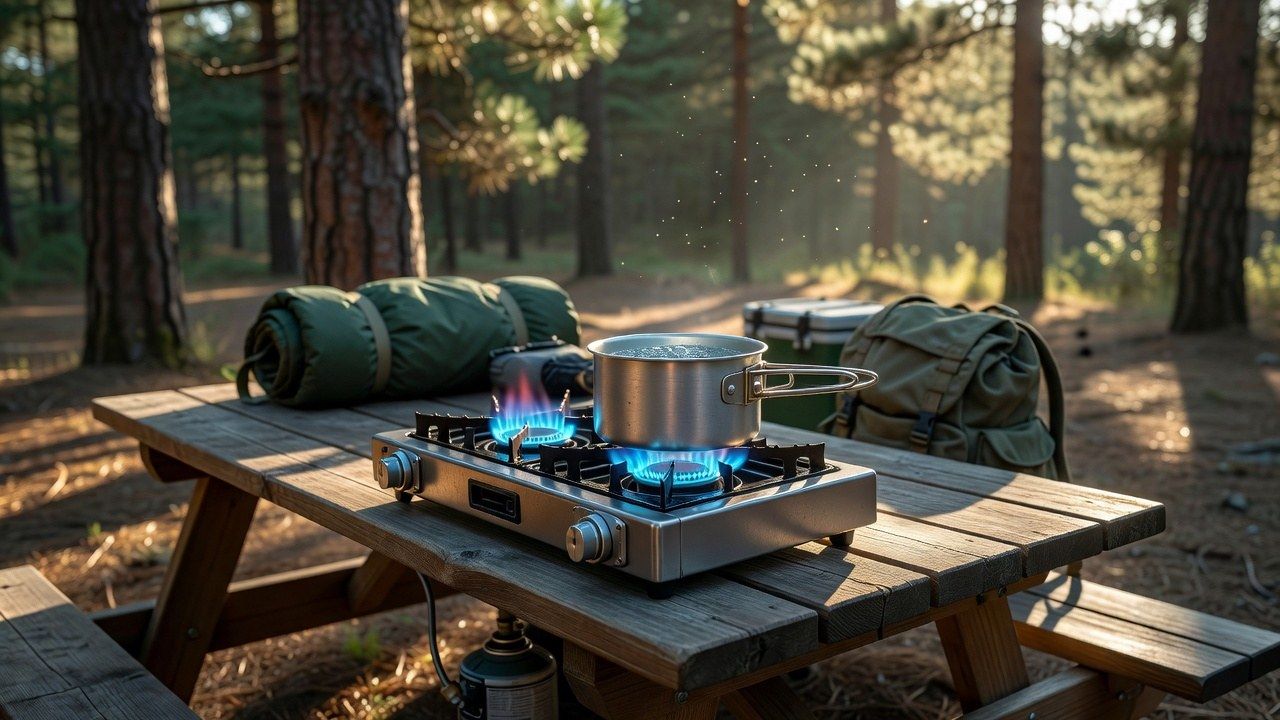
Orange Flame: The Causes You Can Rule Out in Five Minutes
An orange flame is usually not the same problem as a yellow one, and it is often more benign.
Burning particles. Orange almost always comes from something solid burning in the flame: dust in the burner, fine rust particles, or moisture. Sodium from dust and water vapor burns orange, which is why a flame can flare orange for a minute after a stove has sat in a damp garage or a dusty truck bed and then settle back to blue on its own.
Priming a liquid-fuel stove. If you run a liquid-fuel stove like the MSR WhisperLite Universal, an orange flame during priming is expected — you are burning fuel in the open to heat the generator before the stove can run pressurized and clean. It should turn blue once the stove is up to temperature.
Genuinely rich combustion. If an orange flame persists for the whole cook and leaves soot, stop calling it particles and work the five causes above. Persistent orange after a clean burner and a clear venturi means the mixture is rich, and the fuel or altitude item is the one to check next.
The quick field test: wipe the burner cap, let the stove dry if it has been damp, and relight. If the flame is blue within thirty seconds, it was particles or moisture. If it goes straight back to orange, treat it as a rich mixture.
How to Fix a Yellow Flame: The Order That Works
Work top-down. Each step takes minutes, and you usually stop at step two.
- Let it cool, then clean the burner cap and ports. Soft brush, no wire, no needle. Remove every trace of carbon.
- Clear the venturi and air intake. Look inside with a light. A pipe cleaner or canned air removes webs, dust, and nests.
- Right-size the pot. If your pan overhangs the burner ring, that alone can explain the flame.
- Check the fuel. Full cylinder or canister, warm enough to vaporize, correct type for the stove, and — if you refill your own 1 lb cylinders — a clean source.
- Shield the burner from wind. Wind pushes the flame off the burner and disrupts the mix. A windscreen like the MSR heat reflector and windscreen at $16.97 is the cheapest fix on this list, and our windscreen guide covers why blocking wind is not the same as enclosing a burner.
- Add a filter if you run off a bulk tank. Tank propane carries oils and debris that disposable canisters do not, and that gunk is what eventually clogs a jet or kills a regulator. The Mr. Heater inline propane filter at $15.97 is the item that prevents this class of problem rather than repairing it.
- Match the fuel to the season. Cold-weather trips want an isobutane blend; summer car camping is happy on cheap butane like the GasOne 4-pack at $12.03 or bulk propane like the Coleman 16.4 oz 12-pack at $64.99.
If you want the full prevention routine rather than the emergency version, it lives in our camping gear maintenance and care guide — a five-minute end-of-trip habit that prevents most of what this article is about.
When to Stop Fixing It and Replace the Stove
Most yellow flames are maintenance. A few are not.
Replace or retire the stove if: the flame stays yellow after a clean burner and a verified-clear venturi; the burner body is visibly corroded, cracked, or burnt through; the flame is erratic at the valve stem regardless of setting; or the fix would cost more than the stove. Cheap single-burner stoves are effectively disposable — a $12.99 AOTU is not worth shipping a burner assembly for.
If you are replacing a stove that gave you a yellow flame on every trip, buy one with more air around the burner rather than a bigger one. The family workhorses — the Coleman Triton+, the Camp Chef Explorer, the Coleman Tabletop 2-in-1 — are forgiving because they have room to breathe. If you want to stop thinking about flame quality entirely on solo trips, the Jetboil Flash at $119.95 and the MSR PocketRocket 2 at $49.95 are the two systems we have had the least fiddling with, and our single-burner vs two-burner comparison covers which format fits which trip. For wood-burning stove users, a BioLite CampStove 2+ has a completely different flame profile — you are managing a fire, not a jet, and the fuel-air rules do not transfer.
One last note on cooking: if your flame runs rich and low, you will be tempted to compensate with a heavier pan. A cast iron griddle is a great match for a two-burner stove, but cast iron plus a wide footprint on a small burner is the exact combination that produces the yellow flame in the first place. Fix the flame, then cook.
What a Stove Flame Color Actually Tells You
Search the gas stove flame color meaning and you will mostly find gas-utility handouts written for kitchen ranges. The physics is identical on a camp stove, so the short version transfers: flame color is a readout of the fuel-air mixture, and the mixture is either right or it is not.
A blue core with a lighter blue skirt is complete combustion. That is the whole answer to what color should stove flame be, and to the narrower question of what color should propane flame be. Propane, butane, and isobutane all burn blue when they get enough air, which is why the propane stove flame colors on a healthy two-burner are all blue-family, and why gas stove flame colors read deep blue on one model and pale blue on the next. The propane gas stove flame color is set by the burner's air shutter and port condition, not by the fuel brand, and the same is true of propane gas flame color in a canister stove.
Treat the gas flame color meaning as a traffic light. Blue means go. Orange usually means dust or moisture in the burner tube and clears on its own. Yellow means the mixture is rich, and rich means soot and carbon monoxide. Red means something is burning that should not be, usually a blocked port or a flame impinging on the pot. A propane flame color chart drawn honestly has exactly those four rows and no more, which is also the whole of flame color meaning on gas stove guidance written for kitchens.
The propane flame temperature color relationship is not the safety signal most people assume. Yellow is cooler than blue, but the danger of a yellow flame is not its heat, it is the carbon monoxide in what it leaves behind. That is why the same advice appears in every propane flame color meaning write-up you will find: fix the mixture, do not just turn the burner up.
If you are coming from a home kitchen, the color of flame on gas stove questions online are mostly about ranges, and the flame color on propane stove answers are the ones that apply to you. A camp stove has a smaller burner and a bigger air path, so it is more tolerant of a slightly rich tank but less tolerant of a dirty port. Ask what color is propane flame on a cold morning, when a half-empty canister delivers a lazy flame that reads yellow or orange before the fuel warms up, and you have the single most common false alarm on this page.
Two wording notes, because search habits are regional. The what color should a flame be on a stove answer and the what color should a flame be on a gas stove answer are the same sentence: blue, at every burner setting from a bare simmer to full. British handbooks phrase it as what colour should gas flame be, German-made stoves ship with a gas flame color chart in the box, and RV owners usually arrive through what color should the flame be on a gas stove after seeing lp gas flame color change on a cold morning. Owners ask what color should propane stove flame be the moment they have cleaned a burner, and the answer is a fixed target rather than a range. The answer to what color should my propane stove flame be at altitude, in wind, or with a pot on it is still that same fixed target, because altitude and wind change how much air reaches the burner, not what complete combustion looks like.
In plain terms, what does a yellow flame mean: unburned carbon glowing. Physically, what is yellow flame but carbon that should have been CO2 and water instead. Both point at the same fix.
Why a Camp Stove Flame Turns Yellow
The complaint almost always arrives as why is my propane stove have a yellow flame, or why is my propane stove burning yellow after a summer in the garage. Yellow is almost never the fuel and almost always the air.
Start with what causes yellow flame on gas stove in general: a rich mixture. Too much fuel for the air the burner can pull in. Now the camp-specific causes, in the order worth checking. A spider web or mud dauber nest in the venturi, the tube between the valve and the burner, is number one, and it is why why my stove has yellow flame is so often a spring question. A clogged or rusted burner port is number two. A pot wider than the burner ring is number three, because it traps combustion gases and starves the flame. Cold fuel is number four.
If you have ruled out webs and ports, ask why do i have yellow flame on my gas stove only after checking the simplest thing left: is the pot too big. Then why is my flame yellow on my stove becomes a one-minute test, because a bare burner should read blue on the same fuel. If the flame goes yellow only with the stockpot on, the pot is the cause and nothing is wrong with the stove.
The two hardest cases are the ones that make people replace a stove that was fine: why is my stove flame yellow instead of blue on a Coleman Triton+, and why is the flame on my propane stove yellow on the same stove with a different canister. That comparison is the whole diagnostic: if the color follows the canister, buy fuel; if it follows the stove, clean the burner; if it follows the pot, buy a smaller pan.
A common third version of the complaint is why does my propane stove have a yellow flame only when the pot goes on, and it lands on the pot answer every time.
Asking why is my propane flame yellow at a half-empty cylinder and orange at a full one gets you to the place where why is my propane stove flame yellow and why is my propane burner burning yellow end up: low pressure. A canister below roughly a quarter full delivers a weak jet, and the flame reads yellow because the fuel is not moving fast enough to pull air with it. Swap fuel before you take a brush to anything.
Both why does my propane burner burn yellow in the first ten seconds and why is propane flame yellow only on the lowest setting are normal on a cold morning: liquid propane needs to vaporise, and the first minute is vaporisation, not combustion quality. Real propane yellow flame problem cases that survive a warm canister, a clean burner, and a right-sized pot are the rare, genuinely worn ones.
Two questions remain: why is my gas stove burning yellow with a full tank and a clean burner, and why does my gas stove burn yellow only at altitude. A gas stove burning yellow flame at 8,000 feet is the thin-air version of the same rich mixture, and propane gas yellow flame at high altitude needs an air-shutter adjustment, not a new stove. A yellow flame on propane gas stove that clears when you open the shutter a quarter turn is a two-minute fix. A propane burner yellow flame that clears when you crack the valve rather than opening it wide is the same fix from the other direction.
Finally, propane burns yellow when it is fed too fast, so turn the valve down and watch the core go blue. The reason why does propane burn yellow every single time you cook on the lowest setting is a real complaint on badly machined valves, but on most stoves the answer is that the low setting is not a simmer setting. The same thing happens with yellow flames on gas stove burners fed through a partly blocked jet.
If you want one habit from this section: propane flame burning yellow with a cold canister is not a stove fault, and a yard-sale stove that reads blue on the first light is a good stove.
Is a Yellow Flame Actually Dangerous?
Yes, but not in the way the videos imply. Whether is a yellow flame bad because it is hot or because of what it produces is settled quickly: it produces carbon monoxide, and that is the entire risk.
Is a yellow flame hotter than blue is the question that gets asked most, and the answer is no: a yellow flame is cooler. The second question, is a yellow flame hotter than red, is also answered no in most cases. The first one everyone asks, is a yellow flame hotter than a blue flame, is a flat no, which matters because people assume a roaring yellow flame is a powerful one. It is a wasteful one.
The safety conclusion is simple. The short answer to is a yellow gas flame dangerous: yes, in an enclosed space, because incomplete combustion makes CO. The question why is yellow flame dangerous is therefore not about the flame you can see, but about the flame you cannot: the same stove that reads blue at sea level and yellow at altitude makes more CO at altitude with the same burner.
Whether you are asking what does yellow flame on gas stove mean for a weekend camper or what does a yellow propane flame mean for a family cooking dinner in a vestibule door, both mean the stove needs air and the cook needs airflow. Outdoor, with a cross-breeze and a blue core at the centre, is yellow flame on gas stove dangerous: much less so, and that is a fair reading.
The small propane flame yellow tips that fade after a minute are particles or moisture, not a mixture fault. The phrase what does it mean if your stove flame is orange usually deserves a dust answer, which is why an orange flame with no soot is a wait-and-watch and an orange flame with soot is a stop-and-fix. Whether is a yellow flame dangerous in a tent compared with on a picnic table is the distinction that matters, and it is the one that also answers whether your CO alarm belongs on the packing list. Ours does, and the Kidde portable CO detector lives in the stove bag.
Coleman Stove Yellow Flame: What Each Model Points To
Coleman stoves make up a huge share of this site's stove traffic, so the model-specific notes are worth their own section. Yellow flame coleman stove posts are almost always one of three things: spider webs, a low tank, or a generator that needs the lever cleaned.
Coleman stove yellow flame on a Triton+ two-burner with a 1 lb cylinder is the classic low-pressure case. Coleman stove burns yellow flame on a full cylinder points at the air shutter under the burner head, and coleman camp stove yellow flame that improves after five minutes of running is a cold fuel story more than a dirty-stove story.
Liquid-fuel users are a different animal. Coleman dual fuel stove yellow flame and coleman white gas stove yellow flame are usually about generator heat, fuel age, or the wrong fuel mix, and the fix is not the same as on propane. Coleman propane stove yellow flame, by contrast, responds to the same checks as any other propane burner: ports, venturi, pot size, pressure.
The one-word version of coleman yellow flame troubleshooting: air. Coleman stove burning yellow on both burners is a tank or regulator problem. Yellow flame on coleman stove on one burner only is that burner's port or shutter. Coleman stove flame is yellow at the centre while the skirt stays blue is a warm-up smell of the same problem. Coleman camp stove burner adjustment is usually the fix that works, and coleman camp stove orange flame is the same dialogue one color over.
Coleman stove flame too high, coleman stove high yellow flame, and coleman stove big yellow flame are the same complaint under three names: the valve is open past what the air path can support. Turn it down before you take anything apart.
Above the burner, coleman propane stove burner yellow flame that responds to nothing in the toolbox is a dirty mixing tube. Why does my coleman stove have yellow flames on propane is the most common phrasing of that one, and a pipe cleaner through the venturi answers it. Below the burner, coleman stove flame at manifold that is yellow while the burner itself looks fine means the regulator or the hose is the restriction. Coleman stove flame adjustment on a two-burner is a two-part job: the shutter sets mixture, the valve sets volume, and they are not interchangeable. Coleman stove no blue flame anywhere across both burners is the one result on this page that justifies taking the stove out of service until the fuel path is checked.
Camp Chef Stoves: Flame Adjustment and Black Soot
Camp Chef owners arrive with a slightly different vocabulary, so here it is in their words. Camp chef stove yellow flame on an Explorer two-burner is nearly always the air mixer under the burner, which is adjustable and the reason these stoves are forgiving.
Camp chef yellow flame that only shows up with the griddle installed is a surface-area problem, not a mixture problem. Camp chef flame adjustment is done at the burner air ring first and the regulator second, and adjusting flame on camp chef stove in that order saves a lot of back-and-forth. How to adjust flame on camp chef stove, in one line: burner off, air ring open a quarter turn at a time, light, look at the core.
Camp chef black soot is the tell that separates a nuisance flame from a real mixture fault. Black soot means unburned carbon depositing on the pan, and it always means incomplete combustion rather than a dirty burner alone.
Orange Flame on a Camp Stove: Usually Not the Stove
An orange flame stove burner gets blamed on the stove far more often than the evidence supports. Orange is a particle color, not a mixture color, in most cases.
On a windy, dusty afternoon, the honest answer to what does orange flame on a gas stove mean is dust drawn into the burner tube and burning inside the flame. A propane stove burning orange for sixty seconds after a week in the car means fine rust or condensation in the tube. Short orange stove flames that clear as more fuel moves mean moisture. An orange flame on stove burners that persists for a whole cook and leaves soot is not particles, and that one needs the burner cleaned.
The reason why does propane burn orange more on humid days is a real effect, because orange flame in the burner is often sodium from moisture, and the humidity answer explains why the same stove looks different in July and October. That single cause explains orange flame stove humidity complaints, which arrive in the same weather window as mosquito traffic, so a screened vestibule door gets used more and the stove gets run closer to the tent than it should.
If the color changes with the weather rather than the fuel, why is my propane flame orange is a moisture answer. If it changes with the pot, propane stove burner orange flame is a surface answer. If it changes with the setting, why is a gas stove flame orange at low and blue at high is a pressure answer.
RV owners phrase the same thing differently: what does orange flame mean on gas stove in a galley, or orange flame in stove on the second morning of a trip — both are the same three checks. An rv propane stove orange flame in a camper is worth taking seriously, because the galley is a smaller air volume than a picnic table. A propane cooking stove orange flame outdoors in a breeze is the least concerning version of the same signal. If the question is why is my propane stove flame orange instead of blue at altitude, turn the air open before you blame the fuel. And if it is why is my propane burner flame orange with the griddle on, that is a surface-area answer rather than a mixture one.
Soot and Black Smoke: The Feedback Loop That Makes It Worse
The physical evidence is camping stove soot on a pot bottom, and it is worth understanding because it changes the burner as you cook. Carbon deposits on the ports reduce the air path, which makes the mixture richer, which makes more soot.
Ask what causes black soot on a pan and the answer is an over-rich flame touching the cookware. Whether is black soot dangerous on a camp stove is a fair question, and the honest answer is that the soot itself is not, but it is proof that the flame producing it is producing carbon monoxide at the same time. Treat black soot as a CO warning you can see.
Butane Flame Color in Cold Weather
Butane and isobutane stoves have their own flame-color behaviour, and it is mostly about temperature. In a warm room butane burning color is blue; the same canister at 40 F delivers a flame that is partly yellow while the fuel boils off slowly.
A butane stove yellow flame in October and November is therefore a canister-temperature story before it is a burner story. In practice butane gas flame color and butane flame color both shift toward the yellow end at a cold canister pressure, which is why a butane stove that cooked clean in July needs a warmer canister in October. The fix is a canister warmer, a pocket, or a propane/butane dual fuel stove that can run propane when the temperature drops. A butane yellow flame that clears once the canister warms in your hands is the cheapest repair on this page.
Blue Flame, Blue-and-Orange Flame, and the Green One
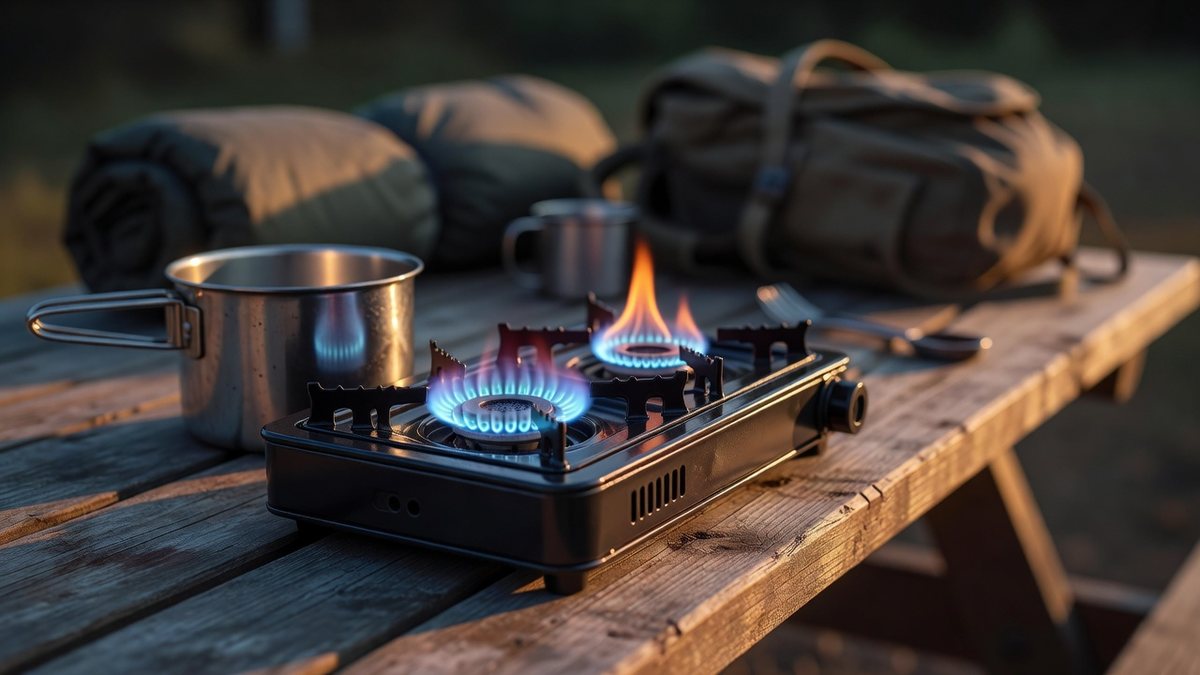
Most people get here looking for the healthy case, and it is worth describing precisely. When someone asks what blue flame stove gas means, the answer is complete combustion with a visible core and a shorter skirt.
The short answer to why does propane burn blue is that propane's carbon-to-hydrogen ratio burns clean when the air shutter is set correctly. A propane flame yellow instead of blue after a fuel swap is a mixture question, not a fuel question, because the new canister may be delivering at a different pressure. A gas stove flame color blue and orange ring pattern, where the inner core is blue and the outer skirt is orange, is normal on a cold morning or in humid air. But a gas stove flame is blue and orange pattern that stays for a whole cook with soot means the skirt is your only clean part.
A propane stove blue flame at full and a propane stove orange and blue flame at the lowest setting is a valve characteristic, not a fault. Why is my gas stove flame green is the one color on this page that is almost never about the fuel: green usually means copper or a chemical contaminant, so treat it as a burner-cleaning job and, if it persists, retire the stove.
Red Flame on a Propane Stove: Rare, and Usually Fixable
Red is the least common flame color and the easiest to misread. The answer to how do you fix a red flame on a gas stove depends entirely on whether the red is at the burner or above it.
A red propane flame at the burner means a blocked port or very low pressure. A red flame propane stove with a full tank usually means a port that is physically obstructed. How to fix red flame on gas stove in that case is mechanical: brush the ports, clear the venturi, check the jet.
A red propane stove that shows red only under a pan is a different problem: the flame is heating the pan's underside unevenly, so check the pot before the stove. The reason why stove flame is red at altitude and not at sea level is a pressure answer, and it is the one that catches out car campers in Colorado and Utah.
How to Adjust a Camp Stove Flame (and What You Can't Adjust)
Everything above assumes you can change the mixture, and on most stoves you can. The question can you adjust flame on gas stove models with an air shutter has a one-word answer: yes. A stove that uses a fixed orifice and a sealed burner head is a different story: not the mixture, only the volume.
The sequence for how to adjust burner flame: light the burner, let it run a minute, look at the core, then open or close the air shutter a quarter turn at a time. The routine for how to adjust flame on propane stove on a two-burner is to do the burners separately, because they rarely match. Knowing how to adjust flame height on gas stove by turning the valve changes volume, not color, and a propane stove flame adjustment that only touches the valve will not fix a yellow core — which is where how to adjust flame on gas stove burner on a two-burner means running the same sequence twice.
The observational signs worth writing down. A gas stove flame color change after switching brands of fuel is a pressure difference between canisters. A yellow flame stove right after you set the pot down is a pot-size answer. A yellow flame on camp stove that starts blue and goes yellow as the canister empties is a pressure answer. Two propane stove flames that read different colors on the two burners mean cleaning, not replacement, and propane stove flame is yellow on one burner with a clean port points at that burner's shutter. A camping stove burning yellow with the lid of a griddle closed is a surface-area answer, and a camping stove yellow flame in a wind is the windscreen doing its job badly: see our windscreen and wind protection guide.
Camp Stove Flame Color FAQ
Why is my camp stove flame yellow instead of blue?
Almost always because the burner is running rich — too much fuel, too little air. The most common causes, in order: a dirty burner head or clogged ports, a spider web or insect nest in the venturi, and a pot wider than the burner ring trapping combustion gases. Clean the burner, clear the air intake, and right-size the pot before blaming the fuel or the stove.
Is an orange flame on a gas stove dangerous?
An orange flame is usually particles burning — dust, fine rust, or moisture — and it typically clears within a minute of relighting. It becomes a concern when it persists for a whole cook and leaves soot, because that is a genuinely rich mixture producing carbon monoxide. As with any off-color flame, the rule does not change: never run the stove indoors, in a tent, or in an enclosed vestibule.
What causes a yellow flame on a propane stove specifically?
On propane, a yellow flame points at the fuel-air mixture rather than the fuel itself. Check the burner ports and the venturi first, then the pot size, then the pressure — a nearly empty or cold cylinder delivers a weak, distorted flame that reads yellow. If you run a bulk tank, add an inline filter, because tank propane carries oils that disposable canisters do not.
Can I use a camp stove indoors if the flame is blue?
No. Flame color tells you about combustion quality, not about whether the space is safe. Every propane and butane appliance consumes oxygen and produces carbon monoxide, and a perfectly blue flame in a sealed space will still deplete the oxygen and accumulate CO. Cook outside, in the open, every time.
What color should a propane stove flame be?
Blue, at every setting from a bare simmer to full. A blue core with a lighter blue skirt is complete combustion. Yellow, orange, or red means the mixture, the burner, or the fuel needs attention before the next cook.
Is a yellow flame hotter than blue?
No. A yellow flame is cooler than a blue one, and it is a worse flame, because the carbon making it yellow is carbon that did not burn into carbon dioxide. Do not read a big yellow flame as a powerful one.
What causes yellow flame on gas stove burners that were blue last season?
In order of likelihood: a spider web or insect nest in the venturi, rust or debris in the burner ports, a pot wider than the burner ring, and low or cold fuel. Clean the air path first, then compare burners, then swap the canister.
Why does my coleman stove have yellow flames only when it is cold?
Cold fuel delivers lower pressure, and lower pressure means the jet does not pull enough air with it. Let the canister warm, or run the second burner briefly to warm the fuel path, and the core will come back to blue.
Why is my gas stove flame green?
Green is almost never a fuel-color issue. It usually means copper or a chemical contaminant is being burned, so clean the burner head thoroughly. If the green returns on the next cook with clean hardware, retire the stove.
What color does butane burn?
Butane burns the same blue as propane and isobutane when the mixture is right. In cold weather a butane canister delivers a weaker jet, so the flame reads partly yellow until the canister warms up.
Why is my propane stove flame orange instead of blue?
Orange is a particle color: dust, fine rust, or moisture burning inside the flame. If the orange clears within a minute or two, nothing is wrong. If it persists for a whole cook and leaves soot, treat it as a rich mixture and clean the burner.
Can you adjust the flame on a gas stove?
The mixture, yes, on any stove with an air shutter or an adjustable air ring. The volume, yes, with the valve. What you cannot do is make a rich mixture look blue by opening the valve wider, which is the most common mistake.
How to fix red flame on gas stove burners?
Red at the burner means a blocked port or very low pressure. Brush the ports, clear the venturi with a pipe cleaner, and check the jet. Red that appears only under a pan is usually a pan or pot problem, not a stove problem.
Why is my propane stove burning yellow when the tank is full?
A full tank rules out pressure, so the cause is air. Check the venturi for webs and the ports for rust, then look at the pot diameter. On stoves with an adjustable shutter, a quarter turn usually brings the core back to blue.
The Short Version
Blue is correct. Yellow means rich — too much fuel, too little air — and rich means soot and carbon monoxide. Clean the burner head with a soft brush, clear the venturi of webs and dust, and stop putting a family stockpot on a one-liter burner. Check whether your fuel is cold, low, or the wrong type before you conclude the stove is finished. And whatever color the flame is, keep the stove outside.
Ten minutes with a toothbrush once a season is the difference between a stove that burns blue for a decade and one you replace every other summer.
<!-- AFFILIATE_DISCLOSURE -->TrailMapz is reader-supported. If you buy through the links on this page we may earn a small commission at no extra cost to you. Prices and availability change — check the current listing before you buy.