How to Stay Warm Camping: 15 Ways to Keep Warm in a Tent (2026)
How to stay warm camping without fire or electricity — 15 field-tested ways to keep warm in a tent, from R-value math to liners, layers and safe tent heat.
It's 2:47 a.m. and you're lying perfectly still, because movement lets the cold air in. Your shoulders ache. Your feet are two blocks of ice that have somehow detached from your body. You paid good money for that sleeping bag, and it is not working.
Here's the thing almost nobody tells you: your sleeping bag is usually not the problem. In most cases the cold is coming from underneath you, or from moisture, or from a pitch you chose at 6 p.m. when it was still 65°F. Fix those and you can sleep warm in a tent at 30°F with the gear you already own.
This guide covers the 15 things that actually work — no fire, no campsite hookups, no gas generator required. It's the guide we wish we'd had on our first frosty October trip with kids and a dog.
The Quick Answer: Three Heat Rules
If you read nothing else, read these three rules. Almost every "I was freezing" story traces back to breaking one of them.
Rule 1 — You lose heat down, not up. Cold air doesn't rob you. Cold ground does. Conduction into frozen soil is far more efficient than convection into air, which is why the underside of a sleeping bag is squashed flat and useless. All the insulation that matters at the bottom comes from your sleeping pad, not your bag.
Rule 2 — Trapped air is the insulation. Loft is just a way to hold still air. Anything that compresses your bag — a tight mummy cut, sleeping on a slope until you slide into the wall, doubling up two people in one bag — destroys the loft and the warmth with it.
Rule 3 — Dry equals warm. Water conducts heat roughly 25 times better than air. A damp base layer, a sweaty fleece, or condensation soaking your bag's footbox will cancel out half the rating you paid for. Ventilation is not the opposite of warmth; on a cold night it is warmth.
A quick sanity table for what you're sleeping on:
- R-1 to R-2 — summer only, above 60°F nights
- R-3 to R-4 — three-season, shoulder months, 35–55°F
- R-5 or higher — winter camping, overnight lows below 30°F
- R-6+ — snow camping, or anyone who sleeps cold
If your pad and your bag are fighting, the pad wins. Upgrade it first.
15 Ways to Keep Warm in a Tent
1. Read your sleeping bag's rating honestly
Bag temperature ratings are limit ratings, not comfort ratings. A bag rated 20°F is designed to keep an average person alive and not hypothermic at 20°F — not comfortable. Most people need 10–15°F of margin.
A TETON Sports Celsius 0°F bag at $59.99 is a genuinely warm rectangular bag with a real-world comfort window closer to 20°F for an adult. The Kelty Cosmic Down 20°F uses 550-fill down and is lighter and more compressible if you're packing in. And a Coleman Palmetto 40°F at $44.99 is a great shoulder-season bag — but treat it as a 50°F bag in October.
2. Put the insulation under you, not over you
This is Rule 1 in practice. A budget sleeping pad with an honest R-value will keep you warmer than a $300 sleeping bag on top of a foam mat.
The Klymit Insulated Static V ($94.99, R-4.4) is the value sweet spot for three-season camping. For a closed-cell backup that cannot puncture, the Therm-a-Rest Z Lite SOL ($54.95, R-2.6) doubles as a sit pad at camp and is the pad we still carry as a second layer on genuinely cold nights. Warmth-focused side sleepers who want plush comfort should look at the Exped MegaMat 10 (R-8.1), which is essentially a mattress that happens to be an expedition pad. For the full pad-vs-mattress breakdown, see our sleeping pad vs air mattress comparison.
3. Stack a second pad on the cold end
R-values don't add perfectly, but stacking is real. A closed-cell foam pad under an inflatable one adds meaningful warmth for the price of a pizza. If you already own an air mattress, put anything closed-cell under it — an uninsulated air mattress is a giant cold balloon that your body has to heat all night.
4. Add a liner instead of buying a new bag
A sleeping bag liner is the cheapest warmth upgrade in camping. A fleece liner like the Redcamp fleece liner with hood ($24.99) genuinely takes the edge off. For the most warmth per dollar, the Litume fleece liner is rated to add up to 27°F — and it's a fraction of the cost of moving up a whole bag tier.
5. Sleep in dedicated dry layers, not the clothes you wore
Sleeping in your daytime hiking clothes is a classic mistake: they hold your sweat, and they compress the bag's loft. Bring one dedicated dry set — a thermal base layer that never leaves the tent. The Columbia Omni-Heat base layer top ($49.99) uses reflective dots to bounce body heat back at you, and a merino bottom like the Smartwool Intraknit thermal bottom regulates temperature without getting clammy. Merino is the right fabric here precisely because it keeps working when it's slightly damp.
6. Wear a hat — but not the one you hiked in
Heat loss from your head is real, and a cold head is what wakes most people up at 3 a.m. A dry merino beanie costs almost nothing and works all night. The Smartwool merino reversible beanie is $35 and doesn't itch, which matters when it's on your forehead for eight hours.
7. Eat fat and protein before bed
Your body generates heat by digesting food — it's called diet-induced thermogenesis. A handful of nuts, a chunk of cheese, or some peanut butter before bed gives your metabolic furnace actual fuel to burn through the night. This is not a myth; it's why a big warm dinner genuinely does help you sleep warmer.
8. Pee before you sleep
Your body spends real energy keeping every ounce of fluid inside you at 98.6°F. A full bladder is a heat sink you're paying for all night. Pee right before bed, and keep a wide-mouth bottle in the tent so you don't have to fully unzip and step into the cold at 3 a.m.
9. Pre-warm the bag before you get in
Crawl into a cold bag and you spend the first 20 minutes warming it with your own body heat. Skip that: put warm hands or a rechargeable warmer in the bag five minutes early. OCOOPA rechargeable hand warmers ($39.99) run up to 16 hours on a charge and double as a heat source inside the footbox. Cheap air-activated HotHands warmers do the same job for a few cents each and add no charging anxiety.
10. Use a hot water bottle — the free one
Fill a leak-proof wide-mouth bottle with hot water before bed, wrap it in a sock, and tuck it in the bag near your feet. It's the oldest trick in cold-weather camping, it costs nothing, and it's still one of the best. Do not use a thin-walled bottle you don't trust.
11. Ventilate — yes, really
The counterintuitive one. Zip your tent up airtight and your breath condenses on the walls, then drips onto your bag and pad. Now you're sleeping in a damp bag, which is a cold bag. Crack both vents a few inches and leave the door's top mesh open. You will be measurably drier and therefore warmer by morning. On a genuinely cold night, a slightly cooler but dry bag beats a warm humid one every time.
12. Pitch for warmth, not for the view
Site selection is the single most underrated warmth lever, and it's free:
- Low ground is cold ground. Cold air sinks and pools in hollows and washes. Pitch slightly upslope, on the flat, never in the dip at the bottom of a meadow.
- Use natural windbreaks. A rock face, dense treeline, or hillside cuts convective heat loss dramatically.
- Avoid the open shoreline. A lake view in October means wind off cold water all night.
- Face the door downwind. A door you can crack for ventilation without the wind blowing straight in is worth more than a nicer view.
13. Add a blanket as a real layer
A puffy blanket over your sleeping bag is genuinely effective, because it adds loft without compressing the bag below it. The Rumpl Original Puffy ($139) is warm, water-resistant, and useful all day at camp too — plus it doubles as a picnic blanket at the fire. For an electric option there is the Sealy 12V heated blanket ($31.99), which runs off a portable power station or car outlet.
14. Get off the ground when it's really cold
A cot raises you off the coldest surface in the camp. The Coleman Trailhead II cot ($54.99) is the budget standard — but note that a cot with nothing on it is colder than the ground, since cold air circulates underneath. Put a closed-cell pad or an insulated pad on top of any cot and it becomes the warmest sleep setup in camp.
15. Heat the tent safely — or not at all
This is where people get hurt, so we're going to be direct. Portable propane heaters designed for indoor use, with an oxygen-depletion sensor (ODS), are the only reasonable option. The Mr. Heater Little Buddy ($69.99) is the right size for a small tent, the Mr. Heater Buddy ($74.00) covers a mid-size family tent, and the Mr. Heater Big Buddy ($146.48) is for large cabin tents and wall tents.
Non-negotiable rules: never use a heater rated for outdoor use only inside a tent; never sleep with a heater running at full output in a sealed tent; keep it away from sleeping bag fabric; and place it so it can't be tipped or covered. We cover the full safety picture — including carbon monoxide, ventilation math, and fuel-runout planning — in our tent heater safety guide. Please read it before you buy a heater.
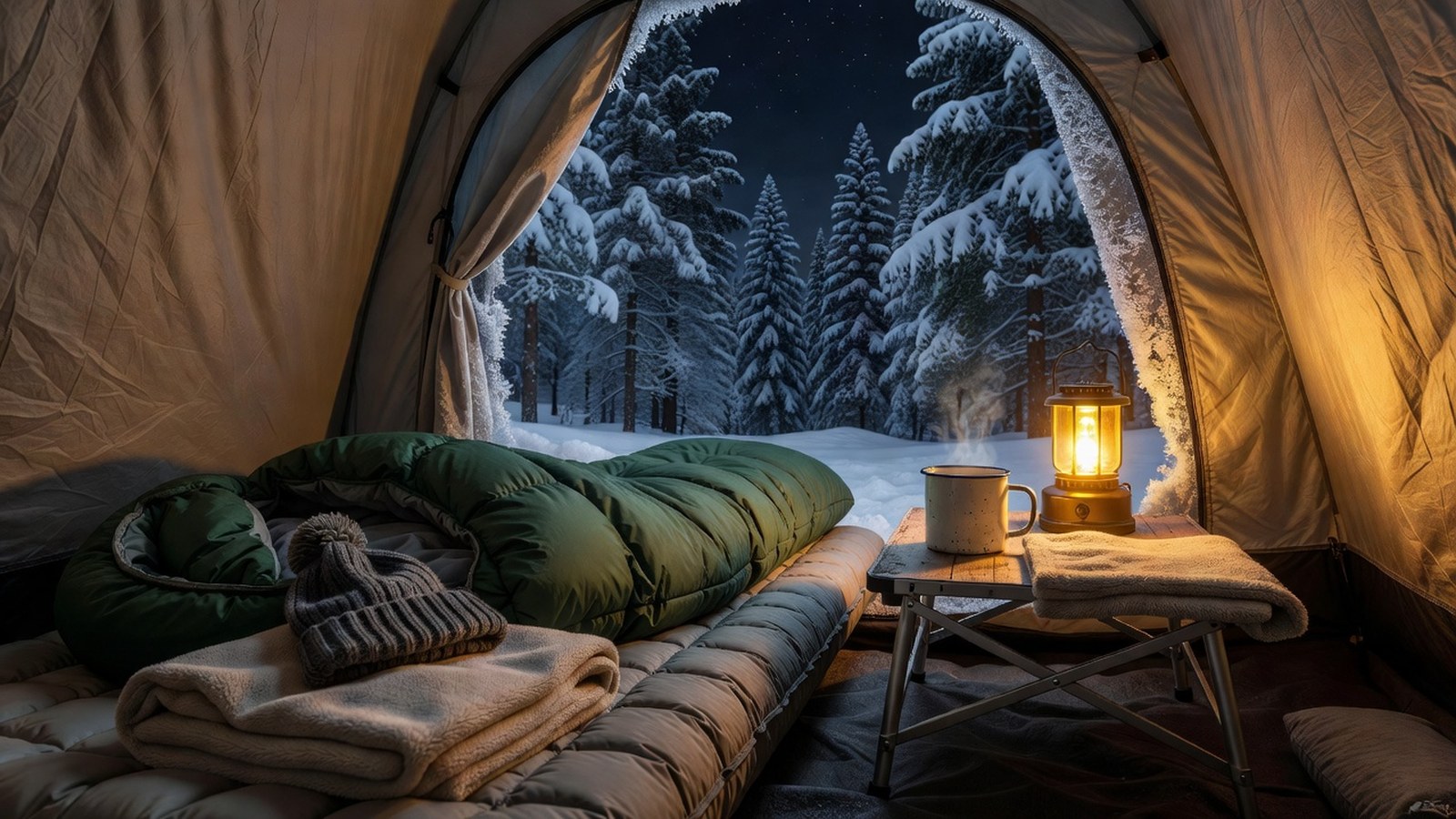
How to Keep Warm Camping Without a Fire
Campfire bans are common in dry fall conditions, and plenty of campgrounds restrict fires outright. You don't need one. Fire is mostly radiant heat that goes up and away from you anyway — it warms your face and front while your back stays cold.
Without a fire, warmth is a two-part problem: reduce the heat you lose, and add whatever body heat or stored heat you can.
- Layers beat proximity. Three thin layers trap more still air than one thick one.
- Close the gap. A hat, a gaiter, gloves, and dry socks close the biggest radiative losses at your extremities. Carhartt insulated knit-cuff gloves ($32.99) are cheap, durable, and genuinely warm.
- Insulate your interface with the world. Pad below, blanket above, and a windproof shell on top.
- Generate heat on purpose. A five-minute brisk walk before bed or 20 bodyweight squats will warm your bag faster than ten minutes of shivering.
- Bring stored heat to bed. Hot water bottle, hand warmers, or a pre-warmed bag.
If you're cooking too, our cold-weather camp stove guide explains why canister stoves fade below freezing and what to do about it.
How to Keep Warm Camping Without Electricity
Many campgrounds have no hookups at all, which rules out anything that plugs into a wall. The good news: the battery-powered options have gotten genuinely good.
- Rechargeable hand warmers are the highest value-per-ounce warmth you can carry. The OCOOPA 2-pack runs 16 hours and doubles as a phone charger.
- 12V heated blankets run off a car outlet or any portable power station. The Sealy 12V blanket has two USB ports, so it's really a small power hub for your tent.
- A power station is the enabling upgrade. A Jackery Explorer 300 (292Wh) will run a heated blanket through the night with room left for phone charging and a lantern; the EcoFlow RIVER 2 (256Wh) is the lighter, cheaper alternative with the same role.
- Do the math first. A 60W heated blanket draws about 60Wh per hour. On a 256Wh station that's roughly four hours at full power — enough for the pre-sleep and coldest-hours window if you run it on a timer or a low setting, not all night at maximum.
Battery heat is a supplement to insulation, never a replacement for it. A dry, well-insulated sleeping system with a hand warmer in the bag outperforms an electric blanket over a bad pad every single time.
How to Keep Warm Camping at Night: The 2 a.m. Protocol
If you wake up cold, do these in order:
- Put on a dry hat. Most cold wake-ups are a cold head.
- Pee if you need to — it's genuinely worth getting up for.
- Eat something. A snack restarts heat production.
- Add a layer inside the bag, not outside of it, so it holds the still air your body warmed.
- Check for damp. If the foot of your bag is wet, you have a condensation problem — crack the vents now.
- Do 20 crunches or leg raises in the bag. It feels ridiculous. It works.
How to Keep Warm Camping in October
October is the most deceptive camping month in the US. You book the trip at 4 p.m. in 68°F sunshine and it drops to 34°F by 3 a.m. — a swing that no gear quiver covers by accident.
- Assume a 30–35°F overnight drop from the daytime high on clear fall nights.
- Bring the 0°F bag, not the 40°F bag, even if the forecast says 50°F. Forecasts at elevation and near water are routinely optimistic.
- Expect dew to become frost. Anything left out overnight will be wet at dawn.
- Fall camping without a fire is common — burn bans peak in October. Plan your warmth for no-fire camping from the start.
- Recheck your fuel. Propane works fine in the cold; isobutane canisters fade noticeably as temperatures drop, and if you're running a 1 lb heater cylinder, know how to refill 1 lb propane bottles safely or plan how many you'll burn.
Our fall family camping guide covers the rest of the trip-planning side, and the winter camping gear checklist is the right gear list to borrow from once October nights start hitting freezing.
Keeping Kids and Dogs Warm in a Tent
Kids lose heat faster than adults — smaller body mass, more surface area per pound, and they will absolutely not tell you they're cold until they're crying. Some specific fixes:
- Give each kid their own bag sized to them. A small child in an adult bag is sleeping in a cold, unlofted tube. The Kelty Woobie 30°F ($39.95) and the TETON Celsius Jr 20°F ($49.99) are the right call for school-age kids. For toddlers and babies, the Morrison Big Mo (ages 2–4) and Little Mo (6–18 months) are cut for small bodies and don't compress into nothing.
- Do not co-sleep inside one bag with a small child. You'll compress the loft for both of you and add a suffocation risk. Side-by-side bags on one wide pad is the right setup.
- Kids need the same R-value pad as you do — arguably more, since they're closer to the ground and have less insulation of their own.
- Dress them in a dry merino base layer and a hat, and check them once before you sleep.
- For babies specifically, our camping with a baby and toddler guide covers the sleep-system and safe-co-sleeping details that deserve more space than we can give here.
- Dogs — short-coated and senior dogs get cold fast on cold ground. Give them a raised bed with a blanket, and don't expect a dog to generate enough heat for two.
Warmth Gear That Earns Its Space
If you're rebuilding a sleep system for cold weather, this is the order that gives you the most warmth per dollar:
- A pad with R-4 or better — the biggest single upgrade most people can make.
- A sleeping bag with honest margins — a 0°F bag for October nights.
- A fleece liner — the cheapest warmth-per-dollar item in camping.
- A dry merino base layer and a hat — dedicated sleeping clothes.
- Rechargeable hand warmers — warmth that follows you.
- A puffy blanket — a layer above the bag that adds loft without compressing it.
- A carbon monoxide detector — a $20 item you should own before you ever run a heater in a tent.
For a more complete kit across the season, see our winter camping beginner's guide and the best camping blankets guide. If you're camping in serious cold or snow, the 4-season tent guide explains why a three-season tent stops being enough.
FAQ
How cold is too cold to camp in a tent?
There's no hard limit — it depends entirely on your gear and experience. With a properly rated sleeping bag, an R-5+ pad, dry layers, and a safe heat source, comfortable tent camping down to 20°F is realistic for most adults. Below that, you need genuine winter gear and winter skills. The practical cutoff is not the temperature; it's whether your sleep system has more margin than the forecast. If the low is forecast at 30°F and your bag is rated 30°F, you are already under-geared.
Can you use a propane heater inside a tent?
Only a heater explicitly rated and certified for indoor use with an oxygen-depletion sensor, and only with ventilation. The Mr. Heater Buddy series is designed for this. Never use an outdoor-only patio heater, a charcoal grill, a camp stove, or a generator inside a tent — all of them produce carbon monoxide, which is odorless and can be fatal in an enclosed space. Always keep a vent cracked, keep the heater clear of fabric, and consider a battery carbon monoxide detector for your gear box.
How do you stay warm camping without a fire?
Focus on retention before generation. Use a pad with a real R-value, add a liner or a puffy blanket, sleep in dedicated dry layers including a hat, eat a fat-and-protein snack before bed, and pre-warm the bag with hand warmers or a hot water bottle. That combination will keep you warm at temperatures where a campfire would have only warmed your face.
Do sleeping bag liners actually work?
Yes, and they're the cheapest real warmth upgrade available. A fleece liner typically adds 10–15°F of usable comfort, and a liner rated to add up to 27°F — like the Litume fleece liner above — meaningfully extends a three-season bag into shoulder and early-winter camping. They also keep your bag clean, which preserves its loft and its rating over years of use.
<!-- AFFILIATE_DISCLOSURE -->