Camping in 50 Degree Weather: What to Wear & Sleep In
Camping in 50 degree weather is the easiest cold night of the year — if you handle the moisture. What to wear, which bag, and what changes at 2 a.m.
In this article · 17 sections
- Camping in 50 Degree Weather: The Short Answer
- What 50 Degrees Actually Feels Like
- Is 50 Degrees Too Cold to Camp?
- Camping in 50 Degree Weather at Night
- Camping in 50 Degree Weather by Setup
- Camping in 50 Degree Weather With a Baby
- What to Wear Camping in 50 Degree Weather
- Sleeping Bag for 50 Degree Weather
- Camping in 45 Degree Weather
- Camping in 55 Degree Weather
- Camping in 60 Degree Weather
- Camping in 40 50 Degree Weather and 50 60 Degree Weather
- 50 Degree Camping Gear Checklist
- Common Mistakes at 50 Degrees
- Camping in 50 Degree Weather: The Answer Key
- Camping in 50 Degree Weather FAQ
- The Bottom Line
Fifty degrees is the temperature that fools people. It is too warm to trigger winter-camping instincts, so nobody swaps gear — and then the family wakes at 3 a.m. with a wet sleeping bag, a damp pillow, and the conviction that camping is miserable.
It isn't the cold that gets you at 50°F. It's the moisture. A 50-degree night in September or October usually comes with high humidity, a low dew point spread, and a slow drip of condensation that runs down the inside of the tent fly and onto whoever is sleeping closest to the wall. Camping in 50 degree weather is genuinely the most comfortable night of the shoulder season — cool enough to sleep well, warm enough that nothing freezes, no bugs, no crowds — but only if you treat it as a moisture problem instead of a temperature problem. This guide is the gear swap list, the bag math, and the setup-by-setup differences that decide whether 50°F is the best night of your fall or the one your kids remember as "the wet one."
Camping in 50 Degree Weather: The Short Answer
Yes, you can camp at 50°F, and it is the easiest cold-weather camping there is — no freezing water, no fuel problems, no heater required. The short version: bring a 40°F-comfort sleeping bag rather than a summer bag, put an insulated pad under it (the ground is already stealing heat at 50°F), sleep in dry dedicated layers with a warm hat, and ventilate the tent so your breath leaves instead of condensing on the ceiling. Do those four things and 50°F is a t-shirt evening and a genuinely good night's sleep. Skip them and you will be wet, which feels colder than 35°F.
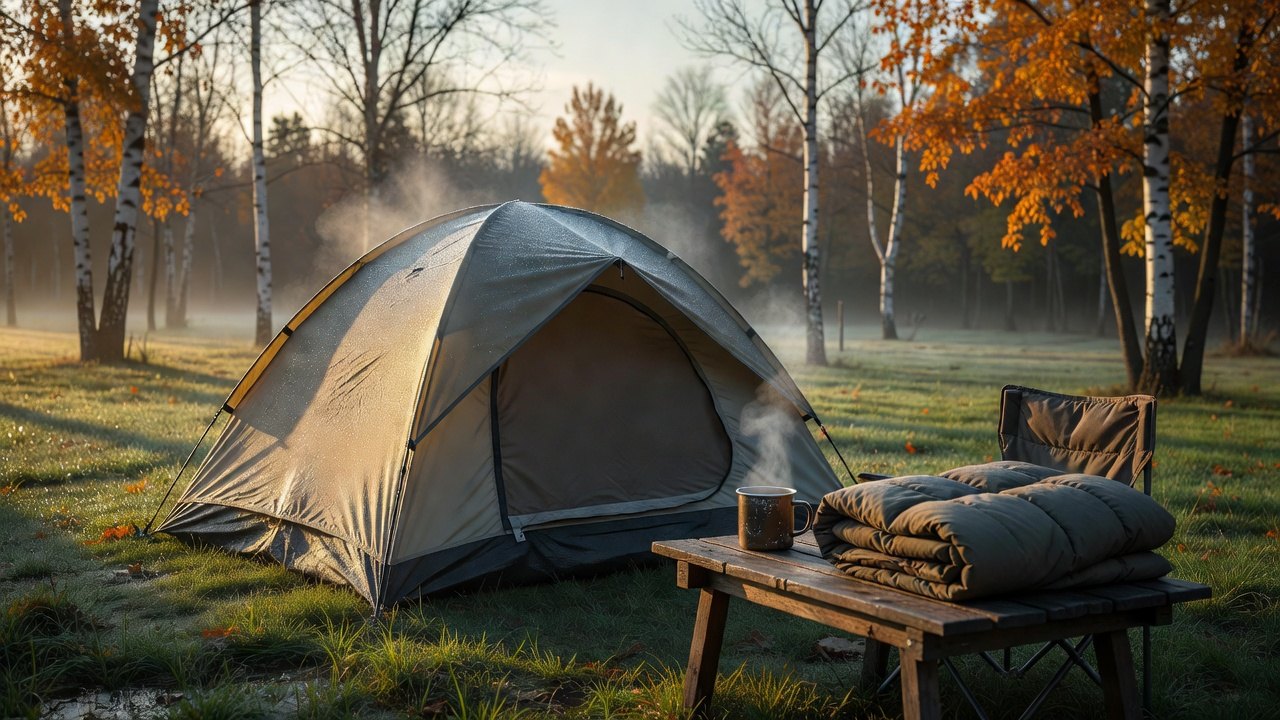
Everything below is the detail behind those four sentences: what 50°F actually feels like hour by hour, which sleeping bag rating is right, what to wear during the day versus in the bag, and how tent, car, hammock, and RV setups each fail differently at this temperature.
What 50 Degrees Actually Feels Like
Daytime 50°F is hiking weather. With a pack on and a hill in front of you, you will be in a base layer and wishing you had brought shorts. That is the trap: the same trip that feels mild at 2 p.m. is a completely different night at 2 a.m., and the gap between those two moments is where most 50-degree camping goes wrong.
Two things drive how cold 50°F actually feels:
- Humidity and dew point. Dry 50°F air is comfortable in a light fleece. Humid 50°F air pulls heat off you steadily, and — more importantly — the closer the overnight low gets to the dew point, the more water condenses out of the air. That water lands on your tent's inner wall, your bag's shell, and any clothing you left out.
- Radiant loss to the ground and sky. On a clear fall night, the ground and the sky both pull heat from anything exposed. This is why your back gets cold before your face does, and why a pad matters as much at 50°F as it does at 30°F.
A dry 50°F night with a little wind is comfortable in a 40°F bag. A humid 50°F night in a river-bottom campsite, in a single-wall tent, with a summer bag, is a genuinely cold night. Same thermometer reading, completely different experience.
Is 50 Degrees Too Cold to Camp?
No — 50°F sits right in the sweet spot of the camping year, and for a lot of families it is the best weekend of the fall. What is true is that 50°F is the first temperature where inexperience costs you comfort rather than just style points. Above 60°F, almost any gear works. Below 50°F, the gear you brought starts to matter more than the forecast.
Here's the honest threshold map for a family trip:
- 60°F and above: summer rules. Ventilation and bug protection matter more than insulation.
- 50-60°F: the sweet spot. A 40°F bag, a decent pad, and a hat are enough. Watch condensation, not cold.
- 40-50°F: still comfortable with the same bag, but the margin is thinner and the overnight low, not the daytime high, is what you plan around.
- 30-40°F: a genuinely cold night. See our camping in 30 degree weather guide — at that point butane stoves, water bottles, and batteries all start failing, and a heater or a much warmer bag becomes part of the plan.
The practical takeaway: 50°F is safe for kids, dogs, and first-timers. It is not the temperature to test a brand-new summer bag in a humid valley.
Camping in 50 Degree Weather at Night
The number that decides your night is not the daytime high, it's the 4 a.m. low — and it is usually 8 to 15 degrees below the evening temperature you felt while cooking dinner. Three things matter more at 50°F than at any other temperature:
- Site selection beats gear. Cold air and moisture both drain downhill. A campsite at the bottom of a meadow or beside a creek will be several degrees cooler and dramatically damper than the same site 50 feet up the slope. Pick the slight rise, not the pretty flat spot by the water.
- Ventilation is insulation at this temperature. Your body puts roughly half a liter to a liter of water vapor into the tent air overnight, mostly through breathing. In a sealed tent at 50°F, that vapor condenses on the coldest surface — the fly — and then drips. Leaving the top vent open and cracking the door an inch keeps the inside of the tent drier and, counterintuitively, warmer, because dry air insulates better than humid air and a wet bag insulates almost not at all. Our tent condensation guide covers the mechanics in more depth.
- Sleep dry, on purpose. The clothes you wore while cooking have sweat and cooking moisture in them. Change into dedicated dry sleep layers — that single habit is worth more than an extra 10 degrees of bag rating.
Camping in 50 Degree Weather by Setup
Every setup fails at 50°F for a different reason. Here is where each one needs attention.
Tent Camping in 50 Degree Weather
A double-wall tent is your friend at this temperature: the inner tent stays dry while the fly takes the condensation. Pitch it so the fly isn't touching the inner wall, use the footprint so ground moisture doesn't wick up through the floor, and leave the vents open. A roomy family cabin tent like the CORE 6 Person Instant Cabin Tent ($169.99) has enough air volume that one family's breathing doesn't saturate it, and enough mesh that you can vent without creating a draft. A smaller two-person tent like the Kelty Late Start 2P ($159.95) works fine too — you simply have to be more deliberate about leaving the door cracked, because two adults in a small sealed tent will wet the walls by morning.
Car Camping in 50 Degree Weather
Sleeping in a car or SUV at 50°F is warm but wet: the metal and glass are the coldest surfaces around, so every breath you exhale condenses on the windows and, if you're not careful, on your bag. Crack a window on the downwind side an inch or two, and expect a film of water on the glass by morning even so. Getting off the floor with a cot like the Coleman Trailhead II Folding Cot ($54.99) also keeps you out of the cold air that pools at the bottom of the vehicle.
Hammock Camping in 50 Degree Weather
Hammocks lose heat by convection, not conduction — cold air flows under you and carries heat away continuously. A sleeping pad in a hammock slides and bunches, so the honest answer at 50°F is an underquilt, which wraps the underside and traps a layer of still air. If you don't have one, a pad plus a wind-blocking layer underneath will get you through a mild night, but 50°F is roughly the temperature where a hammock stops being a warm-weather toy.
RV Camping in 50 Degree Weather
This is the easiest setup at 50°F: the furnace barely cycles, the water system is nowhere near freezing, and no winterizing is needed. The two things to watch are condensation (run the vent fan while cooking and showering, and crack a roof vent overnight) and the fact that a 50°F night often follows a 75°F day, which means the rig's interior will feel stuffy long before it feels cold. See our RV winter camping guide for what changes when the low drops toward freezing.
Camping in 50 Degree Weather With a Baby
Fifty degrees is a workable temperature for an infant camping trip, and it is also the temperature where the sleep setup matters most, because you cannot simply add another blanket. Two rules carry most of the weight:
- Layers and a sleep sack, not loose blankets. For an infant, dress them in a base layer plus a wearable sleep sack rated for the temperature, plus a hat, and check the back of the neck rather than the hands to judge whether they're warm. Overheating is a bigger risk than being slightly cool, and loose bedding in a tent is a suffocation risk regardless of temperature.
- No fuel-burning heater inside a closed tent with a baby. A propane heater in a sealed tent produces carbon monoxide, and an infant cannot tell you they have a headache. If you must take the chill off, heat the tent before the baby goes in, then shut the heater off — or skip it entirely, because 50°F does not require one.
Toddlers and older kids have the opposite problem: they kick off covers and then get cold at 3 a.m. A hooded sleeping bag sized for them, or a sleep sack, holds the insulation in place in a way that a blanket never will. Our camping with baby and toddler guide walks through the full setup, and the best kids sleeping bags guide covers sizes and ratings.
What to Wear Camping in 50 Degree Weather
Fifty degrees is the one temperature where you need two separate wardrobes on the same trip: what you wear while moving, and what you wear while sleeping.
- Hiking and camp chores: a synthetic or wool base layer with a light fleece over it. Skip the insulated jacket while you're moving — at 50°F with a pack, you will sweat, and sweat is what makes you cold four hours later.
- Evening at camp: add the puffy or fleece back on the moment you stop moving. Sitting still at 50°F is where people get chilled, because the body stops generating heat the instant the hike ends.
- Sleeping: dry base layer, dry socks, and a beanie. A hat is the single highest-value item in a 50°F sleep system, because a large amount of heat leaves through an uncovered head.
- Never cotton. Cotton holds moisture against your skin, and at 50°F damp cotton is worse than no layer at all.
If you want the full three-layer breakdown for the shoulder season, our fall hiking clothes guide covers it layer by layer.
Sleeping Bag for 50 Degree Weather
Here is where most 50-degree trips are won or lost, because bag ratings are widely misunderstood. A bag's number is not "the temperature at which you will be comfortable." The EN/ISO testing standard produces a comfort rating (what a cold sleeper, typically a woman, can use comfortably) and a lower limit (the edge for a warm sleeper in a baselayer). A "50 degree bag" is a summer bag whose comfort rating sits around 50°F — meaning a 50°F night is its limit, not its sweet spot. Our sleeping bag temperature ratings explainer breaks down the standard in more detail.
Practical rules for a 50°F night:
- A 40°F-comfort bag is the right choice for most adults. That gives you roughly 10 degrees of margin, which is what absorbs a humid night, a cold sleeper, and a 4 a.m. low that came in below forecast. The Coleman Palmetto 40 Degree Cool-Weather Sleeping Bag ($44.99, 4.4 stars) is the value pick here — a rectangular bag with enough room to move, which matters more at 50°F than at 20°F.
- A 0°F bag is overkill and actively uncomfortable. A TETON Sports Celsius 0 Degree bag ($59.99) at 50°F means you will sweat, then unzip, then get cold when the sweat cools. Over-insulating is a real failure mode, not a safety margin.
- Do you need a sleeping bag at all? For car camping, a bag plus a puffy blanket can substitute for a heavier bag: the Rumpl Original Puffy Blanket ($139.00) layered over a light bag handles a mild night and doubles as a camp blanket. For kids, a bag is still better than blankets because it stays on.
- The pad is half the system. Insulation under you is what stops the ground from draining heat, and it matters at 50°F. A closed-cell foam pad like the Therm-a-Rest Z Lite Sol ($54.95) is about R-2 and enough for a mild night; an insulated air pad like the Klymit Insulated Static V ($94.99) adds margin for cold sleepers; and if you're car camping with a partner, the Exped MegaMat 10 ($239.95) is the closest thing to a real bed. An uninsulated air pad is the one choice that will make a 50°F night feel like 35°F, because air mattresses circulate your body heat straight into the ground.
Camping in 45 Degree Weather
At 45°F the same 40°F-comfort bag still works for most adults, but the margin is gone — this is the temperature where a liner or a puffy layer worn inside the bag starts earning its place. Watch two things: the overnight low (45°F forecast often means 38°F at 4 a.m. in a valley) and your stove. Propane is fine, but butane canisters get lazy as you approach 40°F, so a butane-only stove is a liability on a 45°F morning.
Camping in 55 Degree Weather
Fifty-five degrees is arguably the most comfortable camping temperature that exists: cool enough to sleep deeply, warm enough that a summer bag and a sheet work, and dry enough most nights that condensation is a non-issue. The only real work at 55°F is ventilation during the day — a closed-up tent in the 70s becomes an oven by noon — and shade for the afternoon.
Camping in 60 Degree Weather
At 60°F you are back to summer rules: bugs come back at dusk, condensation stops being the problem and heat becomes it, and the gear that matters shifts from insulation to ventilation and lighting. If your trip straddles 60°F days and 45°F nights — which is most of late September — plan the sleep system for the night and the clothing for the day, separately.
Camping in 40 50 Degree Weather and 50 60 Degree Weather
When the forecast reads "40s to low 50s" or "50s to low 60s," you're camping across a band, not a point, and the band is what you pack for. A 40-50 band is a 40°F-comfort bag plus an insulated pad plus a hat. A 50-60 band is a summer bag plus a light blanket you can throw off at 2 a.m. The mistake in both cases is packing for the daytime number, which is 10 to 20 degrees warmer than the number your body actually sleeps in.
50 Degree Camping Gear Checklist
The full kit, in the order it matters:
- 40°F-comfort sleeping bag — the core of the system. Coleman Palmetto 40, $44.99.
- Insulated or closed-cell pad, R-2 or better. Z Lite Sol, $54.95, or Klymit Insulated Static V, $94.99.
- Dry sleep layers plus a beanie — synthetics or wool, never cotton.
- A tent with a real fly and working vents — CORE 6P for families, Kelty Late Start 2P for two.
- A puffy blanket for sitting around the fire after dark. Rumpl Original Puffy, $139.00.
- A dog bed with some loft — cold ground pulls heat from a dog's belly too. Chuckit! Travel Pillow Dog Bed, $29.99.
- A dry bag or trash bag for damp clothes, so wet gear doesn't climb into the sleep system.
No heater is on that list, and that's deliberate. At 50°F a heater solves a problem you don't have while creating a carbon-monoxide risk you don't want. If you want the heater conversation for colder trips, start with our tent heater safety guide.
Common Mistakes at 50 Degrees
- Packing for the daytime high. The forecast says 58°F; you sleep at 42°F. Always plan around the overnight low, and shade another 5 degrees off for valley floor sites.
- Bringing a winter bag. A 0°F bag at 50°F means sweating, unzipping at midnight, and waking up cold in a damp bag. Match the bag to the night.
- Sealing the tent up tight. The instinct to close everything at the first chill is exactly wrong at this temperature — it turns your tent into a terrarium, and the fly rains on you from the inside.
- Sleeping in the clothes you cooked in. Damp baselayers at 50°F are a guaranteed 3 a.m. wake-up.
- Trusting an air mattress. Uninsulated air is a heat exchanger. If the family bed is an air mattress, put a foam pad or a blanket between you and it.
- Storing gear outside the tent. Dew soaks everything at 50°F, and a damp bag in the morning is a cold second night.
Camping in 50 Degree Weather: The Answer Key
If you came here with one specific question, the answers are below, phrased the way people actually search them.
| Question as people type it | Answer |
|---|---|
| camping in 50 degree weather | Comfortable for families — 40°F-comfort bag, insulated pad, dry layers, vented tent |
| camping in 50 degree weather at night | The 4 a.m. low runs 8-15°F below the evening temperature; plan for that number, not the daytime high |
| camping in 50 degree weather with baby | Layers plus a wearable sleep sack, hat, check the neck for temperature, no fuel heater in a closed tent |
| tent camping in 50 degree weather | Double-wall tent, fly not touching the inner, vents open, footprint under the floor |
| car camping in 50 degree weather | Crack a downwind window, sleep off the floor on a cot, expect window condensation |
| hammock camping in 50 degree weather | Underquilt is the honest answer; a pad slides and bunches at this temperature |
| camping in 40 50 degree weather | 40°F-comfort bag, insulated pad, hat, and a dry change of layers for sleeping |
| camping in 50 60 degree weather | Summer bag plus a light blanket you can kick off; ventilation matters more than insulation |
| is camping in 50 degree weather safe | Yes — it is one of the safest and most comfortable camping temperatures, with no freezing risk |
| what to wear camping in 50 degree weather | Base layer plus light fleece while moving; dry layers plus a beanie for sleeping; no cotton |
| Question as people type it | Answer |
|---|---|
| is 50 degrees too cold to camp | No. 50°F is the shoulder-season sweet spot — cool enough to sleep well, no bugs, no crowds |
| is 50 degrees too cold to tent camp | No. A double-wall tent with a 40°F bag is comfortable at 50°F |
| is 50 degrees at night too cold to camp | Not cold — but watch the dew point. A humid 50 feels colder than a dry 35 |
| is 50 degrees cold for camping | It's cool, not cold. It only feels cold if you're wet or under-insulated underneath |
| camping in 55 degree weather | The most comfortable camping temperature there is — summer bag, sheet, and a vented tent |
| camping in 45 degree weather | Same 40°F bag, but no margin left — add a liner if you sleep cold, and watch butane stoves |
| tent camping in 45 degree weather | Same as 50°F with less margin: insulate underneath, sleep dry, vent the fly |
| can you camp in 45 degree weather | Yes — it's ordinary fall camping as long as the overnight low stays above freezing |
| what to wear camping in 45 degree weather | Base layer plus fleece in the day, dry sleep layers plus a hat at night |
| camping in 60 degree weather | Back to summer rules: bugs at dusk, heat in the afternoon, ventilation over insulation |
| what to wear camping in 60 degree weather | Base layer plus a light fleece for the evening; shorts and sun protection by afternoon |
| Question as people type it | Answer |
|---|---|
| sleeping bag for 50 degree weather | A 40°F-comfort bag gives roughly 10 degrees of margin for a 50°F night |
| best sleeping bag for 50 degree weather | Coleman Palmetto 40 Degree — a rectangular 40°F-comfort bag at $44.99 |
| what temp sleeping bag for 50 degree weather | 40°F comfort rating for most adults; 30°F if you sleep cold or the low dips into the 40s |
| what kind of sleeping bag for 50 degree weather | Rectangular or semi-rectangular three-season bag with a hood, not a winter mummy |
| backpacking sleeping bag 50 degree weather | A lightweight 40°F down or synthetic bag plus an insulated pad — the pad matters as much as the bag |
| do you need a sleeping bag for 50 degree weather | For car camping, a light bag plus a puffy blanket works; for kids, a bag keeps the insulation on |
| what does a 50 degree sleeping bag mean | It's a summer bag whose comfort rating sits near 50°F — its limit, not its sweet spot |
| is a 40 degree sleeping bag warm enough | For a 50°F night, yes, for most adults in dry baselayers on an insulated pad |
Camping in 50 Degree Weather FAQ
Is 50 degrees too cold for a tent?
No. Fifty degrees is comfortable in any double-wall tent with a 40°F-comfort bag and an insulated pad. The thing that makes a 50°F tent night feel cold is condensation — a sealed-up tent wets the bag, and a wet bag stops insulating. Vent the fly and sleep in dry layers.
What should I wear sleeping in 50 degree weather?
A dry synthetic or wool base layer, dry socks, and a beanie. Change out of whatever you wore around the fire, because that clothing is carrying moisture. At 50°F you do not need insulated sleepwear — you need dry sleepwear.
Can kids and babies camp at 50 degrees?
Yes. For infants, use a wearable sleep sack plus a hat, check the back of the neck for temperature, and never run a fuel-burning heater in a closed tent with a baby. For toddlers and older kids, a hooded sleeping bag holds the insulation in place better than blankets do.
Do I need a heater at 50 degrees?
No. A heater solves a problem you don't have at 50°F and introduces a carbon-monoxide risk in a closed tent. Heat the person — dry layers, a hat, a properly rated bag, and an insulated pad — instead of heating the air.
Why is my sleeping bag wet at 50 degrees?
Condensation. Your breath puts water vapor into the tent air, and it condenses on the coldest surface, which is the fly or the tent wall. If your bag touches that wall, it wicks the water in. Vent the tent, keep the bag off the walls, and pitch on slightly high ground away from creeks and meadow bottoms.
Is 50 degrees warm enough for a summer sleeping bag?
A 50°F bag is at its limit on a 50°F night, so there is no margin for humidity, a cold sleeper, or an overnight low that comes in below forecast. Go one rating warmer — a 40°F-comfort bag — for the same trip.
The Bottom Line
Camping in 50 degree weather is the best-value night of the outdoor year: no crowds, no bugs, no freezing gear, and sleeping temperatures that most people would pay for in a hotel. The whole trick is refusing to treat it as a summer trip. Bring the 40-degree bag, insulate underneath, sleep in dry layers, ventilate the tent, and plan around the 4 a.m. low instead of the 2 p.m. high. Do that and 50°F becomes the temperature you start looking for in the forecast.
<!-- AFFILIATE_DISCLOSURE -->