How to Store a Sleeping Bag: Why the Stuff Sack Ruins It (2026)
The stuff sack is for the trail, not the closet. How to store down and synthetic sleeping bags so they keep their loft — and what ruins them.
Quick Answer: Store your sleeping bag loose, dry, and uncompressed. Take it out of the stuff sack the moment you get home. Hang it from a wide hanger or lay it flat under a bed, or put it in a breathable cotton or mesh storage sack that lets it expand to roughly its natural loft. Keep it somewhere dry and out of temperature swings — a closet shelf, not a hot attic, a damp garage floor, or a sealed plastic bin. Wash it only when it's actually dirty, and never put it away damp.
That's the whole method. Everything below is the reasoning, the down-versus-synthetic difference, and the storage spots that quietly destroy bags — which matters more than most gear advice, because a sleeping bag is one of the few pieces of camping gear that gets worse every time you handle it wrong.
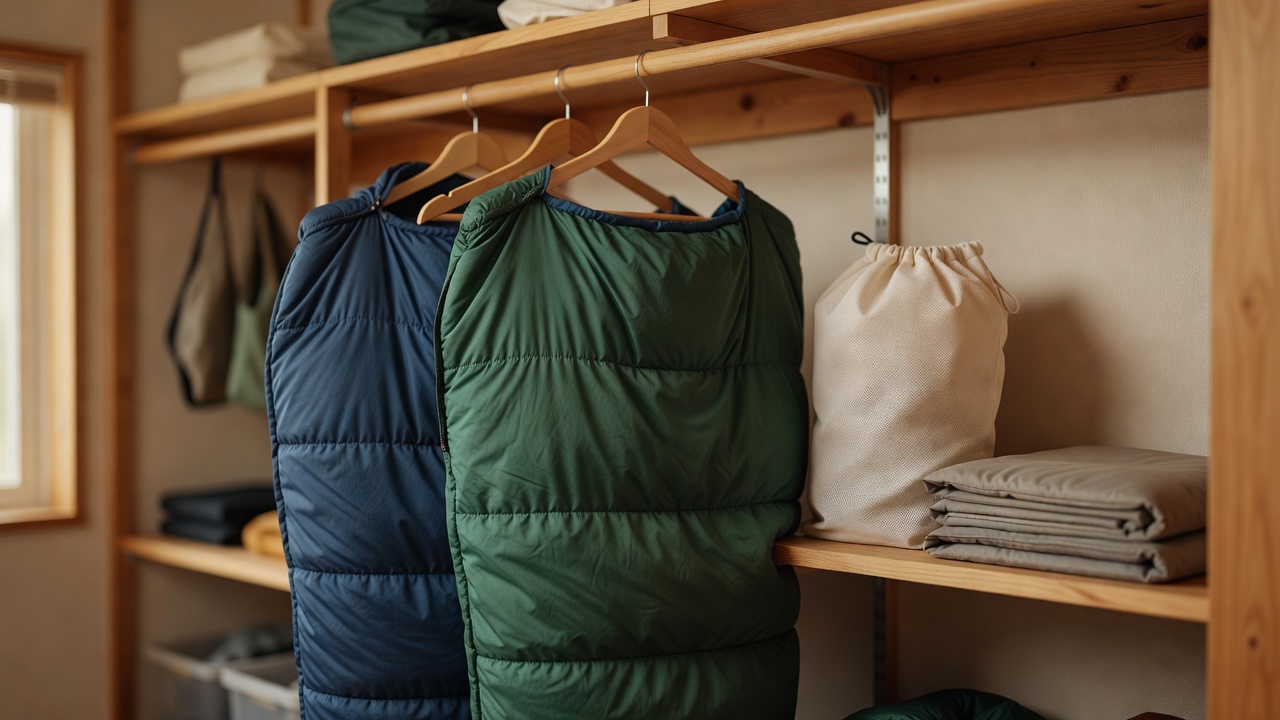
Why the Stuff Sack Is the Wrong Home
A sleeping bag is not a bag. It's a stack of trapped air.
The insulation — whether it's down clusters or synthetic fibers — works by holding still air against your body. Your body heats that air, the shell keeps it from blowing away, and you sleep warm. Loft is the physical height of that trapped air. Lose loft and you lose warmth, permanently, and no amount of layering fully gets it back.
Compression is how loft dies. When you crank a bag down into a stuff sack and leave it there for eight months, the insulation spends eight months flattened. Down clusters that are crushed for months lose some of their ability to re-expand — the filaments bent, the clusters smaller. Synthetic fibers are worse: they take a "set" in the compressed position and simply never come back to full height.
Manufacturers know this. That's why most sleeping bags ship with two bags: a stuff sack for carrying, and a larger cotton or mesh sack for storing. The second one is not a spare. It's the one that's supposed to be doing the work for the 50 weeks a year you're not asleep in the bag.
If your bag only came with a stuff sack — common on budget and kids' bags — a cotton pillowcase, a mesh laundry bag, or an old cotton duffel does the same job for free.
What Actually Happens to Down vs Synthetic in Storage
The two insulations fail differently, and that changes what "stored properly" means for your bag.
Down (goose or duck clusters, rated by fill power — 550, 650, 800 and up) is the most compressible and the most recoverable. A good down bag that's been stuffed for a season will usually re-loft within a day of being shaken out. Its real enemies are moisture and dirt, not compression: damp down clumps and loses loft, and body oils break down the cluster structure over years. Down also attracts moths if it's stored dirty.
Synthetic (polyester and recycled blends) is more forgiving of damp and cheaper to replace, but it's the insulation that genuinely degrades under long compression. A synthetic bag stored compressed for a full off-season can lose a noticeable slice of its warmth rating, and it doesn't come back.
The practical translation:
- A down bag deserves the cotton storage sack, a dry closet, and a wash before it goes away for the season.
- A synthetic bag deserves the same, but the priority is getting it out of the stuff sack immediately — every month compressed costs it loft it won't recover.
The Three Ways to Store a Sleeping Bag
All three work. Pick by how much closet you have, not by which sounds most professional.
1. Hanging (best if you have the rod space). Loop the bag over a wide, padded hanger — or through its hang loops if it has them — and let it hang full length. A narrow wire hanger will crease the shell at one point and stress the baffles; a wide wooden or padded hanger spreads the load. Hanging keeps the bag fully expanded, lets air move through it, and makes it obvious when it needs a wash.
One caveat worth knowing: hanging a heavy expedition down bag by its hood for years puts the entire weight of the insulation on a small seam. Hang from the foot end or across a padded hanger instead, and if your bag is a big, heavy rectangular model, flat storage is the gentler option.
2. Loose in a breathable storage sack (the manufacturer default). Cotton or mesh, no compression straps, no valve. Loosely coil the bag in, don't fold it on the same creases every time, and leave the sack open at the top if you can. This is the standard recommendation for long-term storage because it protects the bag from dust and mice while still letting it breathe.
3. Flat under a bed or on a shelf. Spread the bag out, loosely folded, in a guest-room closet or under the bed in a low-traffic room. Dust is the trade-off, so put it in a cotton pillowcase first. This is the best option for heavy bags and for households where a hanging bag would get knocked down.
Whichever you choose, the one non-negotiable is that the bag goes away dry and uncompressed.
How to Store a Down Sleeping Bag Specifically
Down is the case where the details pay off, because a good down bag is the most expensive thing in most people's sleep kit.
- Dry it completely before storage. A down bag that feels dry on the shell can still hold moisture in the clusters. Air it for a few hours, or tumble it on low heat with no heat boost, then let it cool before it goes into the sack.
- Wash it when it's dirty, not on a schedule. Body oils transfer into the shell and then into the clusters, where they reduce loft and attract moths. Most families need one wash a season at most — front-loading machine, down-specific detergent, two rinse cycles, low heat with three clean tennis balls to break up clumps.
- Never store it in a vacuum bag. Vacuum storage is tempting in a small apartment and it is the single most reliable way to flatten down for months at a time.
- Keep it away from cedar chests and mothballs. The oils and vapor leave a smell that's very hard to get out of down, and both can degrade the shell fabric over years. A clean, dry closet is better than a scented one.
How to Keep a Sleeping Bag Dry in Storage
Moisture is the failure mode that does permanent damage, and it usually doesn't come from rain. It comes from the storage spot.
- Off the concrete. Garage and basement floors wick moisture into anything sitting on them. A shelf at chest height is the minimum.
- Out of the attic. Attics routinely swing past 100°F in summer and near freezing in winter. Heat cycles age shell coatings and seam tape, and condensation forms as temperatures drop.
- Not in a sealed plastic bin. Airtight containers trap whatever humidity was in the bag — and in the air — when you closed the lid. If you must use a bin, leave it cracked, or drill a couple of vent holes.
- Away from exterior walls. The inside of an exterior wall is the coldest surface in a closet and the first place condensation appears.
- Somewhere you'll see it. The real reason bags get ruined is that they go into a garage corner in October and are discovered in May, still damp. A spot you walk past is a spot you'll notice a problem in.
How to Keep a Sleeping Bag Clean Between Trips
Storage problems are usually cleaning problems in disguise. Three habits cover almost all of it:
- Use a liner. A fleece or silk liner takes the body oils instead of the bag does, and it's washable in a normal machine. For families this is the highest-value accessory in the sleep system, because it turns "wash four bags" into "wash four liners."
- Air the bag every morning of the trip. Twenty minutes draped over the tent or a chair before you pack up drives out the night's condensation. Bags that are packed damp every morning are the ones that smell by August.
- Never store it with food, fuel, or damp gear. A stuff sack next to a half-empty fuel bottle in a car trunk is how a bag picks up a smell it never loses.
Storing Sleeping Bags for a Family
Four bags, four sizes, and a house with no spare closet is the actual situation most of our readers are in. It still works:
- Keep every bag loose, even the kids' bags. Children's bags are the ones most often jammed into a stuff sack for months because they're small enough to fit on a shelf that way. Same rules apply.
- Label by person, not by size. Kids outgrow bags and hand them down; a luggage tag on the storage sack prevents the annual "whose bag is this" inventory.
- Store the current-season bags accessible and the off-season bags high. Rotate twice a year rather than digging through everything in June.
- Don't stack heavy gear on top of a stored bag. A cooler or a box of cast iron on a loosely stored sleeping bag is compression by another name.
- Keep a repair kit where the bags live. A spare stuff sack, a patch, and a spare liner mean a mid-season problem gets fixed instead of shelved.
If you're still building the kit, our best camping sleeping bags guide covers temperature ratings and shapes, and the winter camping gear checklist covers what changes when the bag has to perform below freezing.
Off-Season and Long-Term Storage (Six Months or More)
For a bag that won't be used until spring:
- Wash it if it was used hard, dry it completely, then store it loose.
- Leave the storage sack open at the top rather than cinched.
- Skip the compression sack entirely — pack it back into the stuff sack only on the morning of the first trip.
- Check it once mid-winter. Pull it out, shake it, feel for damp, and let it breathe for an hour. Two minutes in January prevents a nasty surprise in May.
- If you're storing multiple bags together, don't stack them in one compressed pile. Side by side on a shelf, each one loose, is the point.
Long Term, Between Trips, and "When Not in Use"
Every version of the question has the same answer, so here it is in the words people actually use:
- How to store a sleeping bag when not in use. Out of the stuff sack, loose in a breathable sack or on a wide hanger, somewhere dry. If a bag is going to sit for more than two or three weeks, treat it as long-term storage and stop thinking of the stuff sack as its home.
- How to store a sleeping bag long term. Loose in a cotton or mesh storage sack, uncompressed, in a closet that doesn't swing through temperature extremes. Pull it out once mid-winter, shake it, and let it breathe for an hour.
- How to store a sleeping bag between trips. This is the case people get wrong most often, because three weekends in a row still counts as storage. Air it for a day, then hang it or leave it in the storage sack until the next trip. The one thing not to do is store a sleeping bag in a stuff sack "because you'll be using it again soon."
- The best way to store a sleeping bag is also how to properly store a sleeping bag: loose, dry, uncompressed, and out of the heat. The rest of this page is a variation on those four words.
- How to keep a sleeping bag warm between trips. You can't add warmth to a stored bag — you can only stop it losing loft. Warmth lives in the loft, and storage is what preserves it.
- Down sleeping bag storage is the same rule with two additions. Dry it completely and wash it before the season ends, because oils and moisture do more damage to down than compression does.
- A sleeping bag storage sack is not a stuff sack. Stuff sack vs. storage sack is the distinction the rest of this page turns on: the storage sack is the cotton or mesh bag that lets a bag breathe and stay at full loft, and the stuff sack is the compression bag for carrying it.
What NOT to Store a Sleeping Bag In
- The compression sack it came with. Fine for the hike in. Wrong for the closet.
- A vacuum storage bag. Flattens down for months and crushes synthetic fibers past recovery.
- A sealed plastic tote. Traps humidity; the bag sweats.
- A damp garage floor or a hot attic. Both are worse than a bedroom closet.
- Anything with mothballs or cedar oil. The odor bonds to down and doesn't wash out easily.
- A car trunk for the season. A trunk swings 60 degrees a day and condenses moisture inside the bag.
Gear That Makes Sleeping Bag Storage Easier
You don't need much, but a few cheap items solve the problem permanently.
A real storage sack. If your bag only shipped with a stuff sack, a breathable cotton or mesh sack is the single best $10 you'll spend on gear care. Buy one slightly larger than you think you need — the bag should look under-filled in it.
A liner that takes the wear. The Litume Fleece Sleeping Bag Liner ($57.98, 4.6★, 810 ratings) is a mummy-cut fleece liner that adds warmth and absorbs the oils that would otherwise go into your bag's shell. The REDCAMP Fleece Sleeping Bag Liner ($24.99, 4.6★) is the budget version with a hood, and the BROWINT Silk Sleeping Bag Liner ($70.99, 4.4★) packs smallest for travel and hostel nights.
Compression sacks — for the trail, not the closet. Worth having if you're backpacking, and worth understanding so you don't leave a bag in one. The Frelaxy Compression Sack ($16.99, 4.5★, 6,469 ratings) is the cheap, tough option; the Sea to Summit Ultra-SIL Compression Sack ($34.95, 4.8★) is the light one that survives a wet weekend, and the Sea to Summit Lightweight Compression Sack 20L ($39.95, 4.6★) is the size most two-person trips actually need.
A dry bag for the car and the boat. If your bag travels in a truck bed or a canoe, a roll-top dry bag is the difference between a damp night and a ruined bag. The Earth Pak Waterproof Dry Bag ($34.31, 4.7★, 33,242 ratings) is the widely tested pick.
Bags worth storing properly. The Kelty Cosmic Down 20 ($169.00, 4.5★, 1,200 ratings) is a 550-fill down bag where proper storage genuinely extends the life of the insulation. The TETON Sports Celsius Regular 0 Degree ($59.99, 4.5★, 18,000 ratings) is the synthetic workhorse most families start with, and the Coleman Palmetto 40 Degree ($44.99, 4.4★, 9,500 ratings) is the mild-weather bag that gets stuffed into a car trunk and needs the most care. For bigger sleepers, the TETON Sports Celsius XXL 0 Degree ($89.99, 4.5★, 3,200 ratings) is the same bag in a larger cut.
Kids' bags, stored the same way. The Kelty Woobie 30 Degree ($39.95, 4.5★, 1,500 ratings) and the TETON Sports Celsius Jr ($49.99, 4.5★, 4,500 ratings) are the two kids' bags we link most often — and the two most likely to be found compressed on a shelf in July. Same rules.
Pads need the same treatment. A self-inflating or foam pad stored compressed loses rebound memory. Leave the valve open on a self-inflating pad, and store a closed-cell pad flat or loosely rolled rather than strapped tight. The Therm-a-Rest Z Lite Sol ($54.95, 4.7★) is closed-cell and nearly indestructible, but even it shouldn't live under a stack of boxes.
Our camping gear maintenance and care guide covers the washing, reproofing, and repair side for every other piece of kit.
Common Sleeping Bag Storage Mistakes
- Leaving it in the stuff sack "just until next weekend." Next weekend is in April. Take it out the day you get home.
- Storing it slightly damp. The shell feels dry long before the insulation does. Air it a full day, not an hour.
- Hanging it on a wire hanger. One crease, one stress point, one weak spot in the shell.
- Putting it in a vacuum bag to save space. You saved six inches of closet and cost yourself a season of warmth.
- Storing it dirty. Oils and food smells attract moths and break down down clusters over years.
- Forgetting it exists. A bag that's checked once in six months is a bag you'll find mildewed instead of ready.
How to Store a Sleeping Bag FAQ
Should I store my sleeping bag in a stuff sack or a storage sack?
A storage sack — the larger, breathable cotton or mesh bag. A stuff sack is for carrying the bag to the campsite. If your bag only came with a stuff sack, use a cotton pillowcase or a mesh laundry bag for storage and keep the stuff sack for the trail.
How long can a sleeping bag stay compressed before it's damaged?
Days, not months. A weekend in a stuff sack is fine. A full off-season compressed will cost a synthetic bag real loft it can't recover, and it takes a down bag longer to re-loft. Treat the stuff sack as travel packaging, not a home.
Can I store a sleeping bag in a plastic bin?
Only a vented one, and only if the bag is completely dry. Sealed plastic traps humidity, which is what causes mildew. A cotton storage sack on an open shelf or a cracked bin is safer than an airtight tote.
Is it OK to hang a sleeping bag for long-term storage?
Yes, with a wide padded hanger, and better for short-term or between-trip storage than for years. Very heavy down and rectangular bags put stress on the hood seam when hung, so long-term storage in a loose cotton sack is the gentler default.
Can I store a sleeping bag in the garage or attic?
A garage works only if the bag is off the concrete, in a breathable sack, and away from heat extremes. An attic usually doesn't work at all — summer heat cycles age shell coatings and seam tape, and winter condensation forms inside the bag.
Do I need to wash a sleeping bag before storing it for the winter?
Wash it if it's been used for several nights or feels greasy at the collar. Body oils degrade insulation and attract moths. If it's clean and dry, airing it out is enough — a wash every season is plenty, and over-washing shortens the shell's life.
How do you store a sleeping bag in a small apartment?
Hang it in a closet from a padded hanger, lay it flat under the bed in a cotton pillowcase, or use a storage sack on the top shelf. The rule that doesn't bend: uncompressed and dry. Under-bed storage is usually the best answer in a small space.
What about storing sleeping bags for kids?
The same way, in the same sacks. Kids' bags are smaller and easier to jam onto a shelf in their stuff sacks, which is exactly how they end up flat and cold. Give each child a cotton storage sack and a luggage tag with their name.
The Bottom Line
Store your sleeping bag the way the manufacturer intended when they packed a second, bigger sack in the box: loose, dry, and uncompressed. Your stuff sack is a hiking accessory, not a home. A closet shelf, a wide hanger, or under the bed all work — what doesn't work is eight months of compression in a hot garage.
Do that, and a $60 bag lasts a decade and a $170 down bag earns its price. Skip it, and you'll be buying warmth you already owned.
<!-- AFFILIATE_DISCLOSURE -->