Tent Fans for Camping: How to Stay Cool in Your Tent (2026 Guide)
How to pick and run a camping fan for your tent — real airflow and battery math, the best rechargeable tent fan, overnight power options, placement tricks, and safety rules for family campers in 2026.
Nobody sleeps well in a tent that's 84°F at 10 p.m. And after a summer of camping with kids, we've learned that the fix is rarely a new tent. It's moving air.
This guide covers what actually works: how much airflow you need, the battery math nobody does before buying, how to run a fan all night without a generator, and the placement tricks that make a small fan feel like a breeze. It's written for family campers doing weekend trips — car camping, state parks, backyard sleepovers — not ultralight thru-hikers counting grams.
Quick Answer
- A tent gets hot for two reasons: the sun bakes the fly all afternoon, and once people are inside, body heat and exhaled moisture have nowhere to go. Fans fix the second one almost completely and help with the first.
- Buy airflow, not speeds. A fan's real spec is CFM (cubic feet per minute). Anything under ~150 CFM feels like a suggestion; 200+ CFM in a 4–6 person tent is a real breeze.
- For a rechargeable fan, battery math is simple: mAh ÷ 1,000 = Ah; Ah × volts ≈ watt-hours. A 24,000 mAh (88 Wh) fan on low draws a few watts — that's 20+ hours. On high, expect 5–8 hours.
- Best all-round pick for a family tent: the FRIZCOL 3-in-1 Camping Fan — fan + LED lantern + power bank, hanging hook built in, around $30.
- If you already own a power station, skip the giant battery fan and buy a cheap 12V/USB fan — it'll run for days off a Jackery Explorer 300 or EcoFlow RIVER 2.
Why Your Tent Turns Into a Sauna After Sunset
The sun is only half the problem.
A tent fly is a heat trap by design. Dark fabric, low ventilation, and a footprint that blocks ground moisture all mean the interior can run 10–15°F above outside air through the afternoon. That part is solar gain, and shade or a better-ventilated tent is the answer — our tent size guide covers ventilation differences between cabin, dome, and blackout designs.
The part that surprises people is what happens after the sun goes down. Two adults and two kids exhale roughly a liter of water overnight. That moisture raises humidity inside an already-warm tent, and humid air feels dramatically hotter than dry air at the same temperature. This is why a tent can feel muggy at 9 p.m. while the outside air feels pleasant — and why "just open a window" often isn't enough, because still air doesn't move itself.
A fan does two jobs at once: it increases convective cooling on your skin, and it flushes that humid air out through your vents. That's why a $30 fan routinely beats a $400 tent upgrade for sleep quality.
What Actually Matters in a Tent Fan (Specs That Aren't Marketing)
Airflow: CFM beats "3-speed"
CFM (cubic feet per minute) is the only airflow number worth comparing. Manufacturer claims vary, but the practical bands are:
- Under 100 CFM — a personal fan. Fine pointed at your face, useless for a whole tent.
- 150–250 CFM — the sweet spot for 2–4 person tents. You can feel it across the tent.
- 300+ CFM — genuinely moves air through a 6–9 person cabin tent.
If a listing doesn't state CFM, treat the fan as a personal fan. Some sellers inflate the number, so cross-check reviews for phrases like "can feel it from the other side of the tent."
Battery math: mAh vs runtime
Battery capacity is listed in mAh, which means nothing without volts. The conversion:
watt-hours (Wh) = mAh ÷ 1,000 × volts
A 24,000 mAh fan at 3.7V is about 88 Wh. If the fan draws 4W on low, that's roughly 20 hours; on high (10–12W) it's 7 hours. So a big-capacity fan can genuinely run dusk-to-dawn on medium and still have charge for the next night.
Two things to watch: mAh ratings are sometimes quoted at 3.7V and sometimes at 5V (inflating the number), and cold nights reduce lithium capacity. In shoulder-season camping you'll get noticeably less runtime than in July.
Hanging, clipping, and mounting
A fan on the floor does almost nothing — it just stirs the warmest air, which is near the ground in a tent. You want it high and angled down, or clipped near a vent to push air out.
That means the mounting hardware matters more than the fan blade. Look for a built-in hook, a clip, or a magnetic base. Ceiling gear loops are standard on most family dome and cabin tents, and that's the best spot in the house.
Noise
Anything above roughly 45 dB will keep light sleepers up in a tent, where there are no walls to absorb sound. Most decent camping fans land in the 30–40 dB range on low, which doubles as white noise. It's a real benefit — many parents report kids falling asleep faster with a fan running.
| Fan type | Rough airflow | Runtime on medium | Best for |
|---|---|---|---|
| Personal USB fan | 60–100 CFM | 4–6 hrs | Solo, backpacking |
| Rechargeable fan + lantern | 150–250 CFM | 8–20 hrs | 2–6 person family tents |
| Power-station + 12V fan | 200–400 CFM | Days (rechargeable) | Long trips, RV, multi-night |
| Misting fan | 100–200 CFM | 4–8 hrs | Dry heat, desert camping |
Our Top Tent Fan Pick (and What We'd Buy Instead)
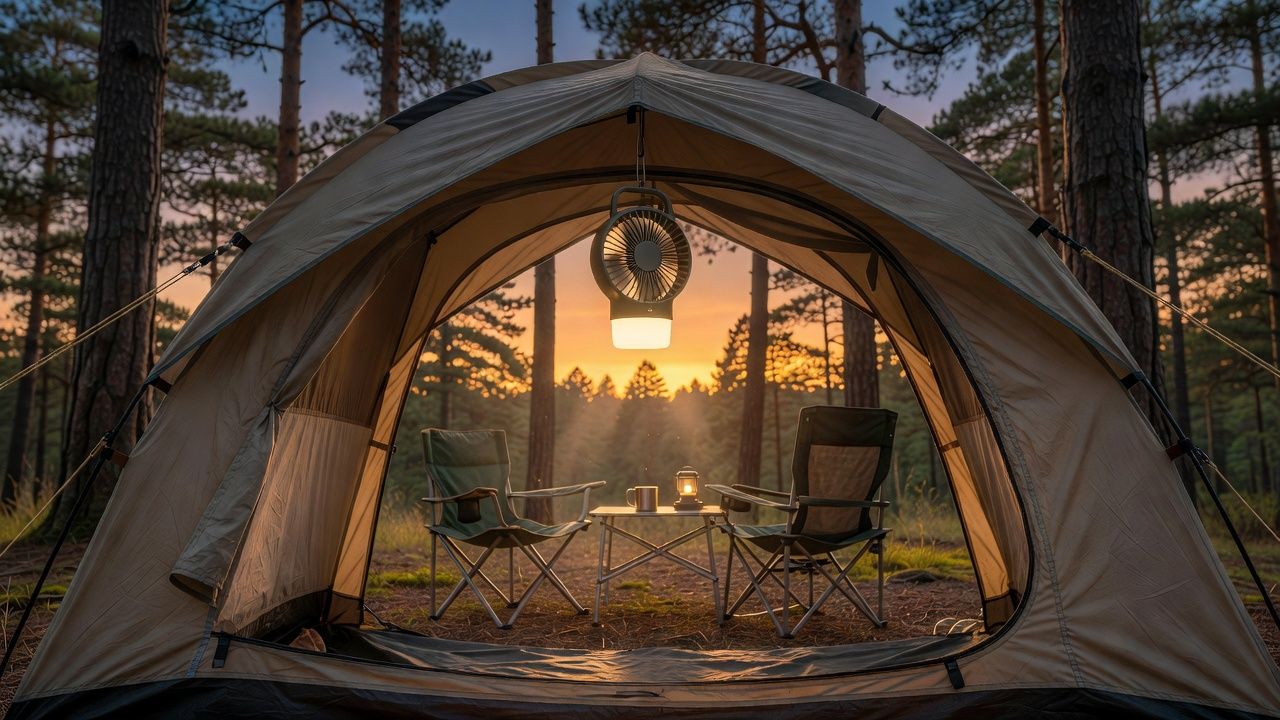
Best all-rounder: FRIZCOL 3-in-1 Camping Fan — about $30, 4.3 stars from roughly 3,800 ratings. It's a fan, a dimmable LED lantern, and a power bank in one body, with a folding hook that hangs straight from a gear loop. The 24,000 mAh cell means medium speed runs all night. For a family tent where you also need light after dark, combining two jobs into one device means one less thing to pack, charge, and lose in the car.
Its honest weaknesses: it's louder on high than a dedicated fan, it's not something you'd carry backpacking, and the lantern is ambience-grade rather than task-grade — if you want a real headlamp for late bathroom runs, pair it with something like a Petzl ACTIK CORE or see our camp lighting guide.
Better if you already own a power station: buy a cheap USB or 12V fan and run it off your battery. You'll get more airflow, unlimited runtime, and the ability to recharge phones and tablets on the same battery. That's the setup we use on longer trips — details in our portable power station guide.
Powering a Fan All Night Without a Generator
This is where most people overthink and overspend. Three workable setups, cheapest first:
1. The all-in-one fan (simplest). Charge it at home, run it 2–3 nights on medium. No cables, no planning. Best for weekend trips.
2. Fan + small power station (most flexible). A Jackery Explorer 300 (292Wh) or EcoFlow RIVER 2 (256Wh) will run a 12V fan for days, plus charge every phone in the family. Both are LiFePO4, which handles heat better than older lithium chemistries — a real consideration when the battery sits in a hot tent.
3. Add solar (best for long trips). A folding panel like the BigBlue 28W tops up a power station in a day of decent sun, which turns a 3-day trip into an indefinite one. Panel placement matters more than panel size — see our solar and off-grid charging guide for the angles that actually work.
One warning on cords: never run a charging cable through a closed zipper. It pinches the cable, creates a gap for mosquitoes, and on a rainy night it wicks water inside. Run cables through the tent's designated cord port, or leave the battery inside the tent and charge it during the day.
Placement and Airflow Tricks That Double a Fan's Effect
- Hang it high, angle it down. Hot air stratifies at the ceiling. Moving it down mixes the whole tent instead of just the floor layer.
- Aim with the vents, not against them. Point the fan toward your mesh door or window so it pushes humid air out. Fighting the airflow just recirculates it.
- One fan, two people: hang it centrally and point it slightly upward at the ridge — the air deflects off the ceiling and comes down on both sides.
- Wet a bandana, drape it over the fan's intake (never the motor) for a genuine few-degree drop in dry climates. It works, it's cheap, and it's the same principle as a swamp cooler.
- Open the fly. A fan can only circulate the air you let it pull in through vents; a fully zipped fly with the rain cover down is a sealed box.
- Cool your bedding first. A cooling gel pillow plus a damp towel over the sleeping bag liner makes the first 20 minutes — the hardest part of falling asleep hot — noticeably easier.
Shoulder-Season Bonus: Fans Kill Tent Condensation
Here's the part most fan guides skip: this isn't only a summer tool.
On cool fall nights, warm humid air from sleeping bodies hits the cold tent fabric, and the inside of your tent rains. Parents wake up to damp sleeping bags and wet kids — and the sneaky cause is that damp sleeping bag has almost no insulation value left.
The fix is the same as the summer fix: move air. A fan on low, running against the wall fabric, keeps the interior dew point in check and dramatically reduces condensation. We've had better results from a fan on medium-low than from any number of "ventilation" claims on a tent. If you're camping into October, it's the cheapest comfort upgrade you can make — pair it with the thermal advice in our fall camping checklist and the layering notes in our stay-warm guide.
Tent Fan Safety: Five Rules
- Never leave a lithium battery in a hot car. A parked car in the sun can hit 130°F+, and that's where lithium cells fail. Fans and power stations travel inside the vehicle, not in the trunk.
- Charge during the day, unsupervised only if you trust the gear. Cheap cells, fast chargers, and hot tents are a bad combination. Charge while you're awake and around the campsite.
- Keep blades away from kids and pets. Most camping fans have grilles designed for adult hands in mind, not toddler fingers. Hang them out of reach.
- Don't hang a heavy power station. Hook the fan; set the station on the floor or on a table. Gear loops are rated for a few pounds, not 15.
- Watch for swelling. Any puffiness in a battery is a stop-use signal. Retire it — never "just one more trip."
When You Don't Have Power: Cooling Without a Fan
If your battery dies, or you're camping somewhere with no fan at all, these still work:
- Pitch for shade and orientation. Afternoon shade is worth more than any device. Pitch so the tent's back faces the late sun.
- Use the cross-breeze. Most tents have two mesh panels; open both and align them with the prevailing wind.
- Sleep low in the tent. Cooler air settles. Sleeping pads on the floor beat cots in the heat.
- Skip the extra layer earlier. Put kids to bed in lighter sleepwear with a sleeping bag they can unzip as the tent cools.
- Take the hottest hour elsewhere. That's what hammocks, shade sails, and a swim are for — come back at dusk.
For the full warm-weather playbook — including why winter is Florida's best camping season and how the state's reservation window works — see our Camping in Florida guide.
A fly that wets out instead of beading is the first sign a tent needs re-proofing; the tent waterproofing and repair guide shows the four-step fix.
Tent Fans FAQ
Do tent fans actually work?
Yes, for the problem they solve. They don't cool air — no fan does — but they dramatically increase convective and evaporative cooling on your skin and they flush humid air out through the vents. That combination is what makes a stuffy tent comfortable. What they can't fix is a tent baking in direct sun with the fly fully closed.
How long does a rechargeable camping fan last on one charge?
Do the math: watt-hours = mAh ÷ 1,000 × volts. A 24,000 mAh (about 88 Wh) fan drawing 4W on low runs roughly 20 hours; on high (10–12W) expect 7. Real-world runtime is 20–30% lower in cold weather, and lower again if you also use it as a lantern.
Can I leave a camping fan running all night?
Yes — that's what it's for, and most people find the white noise helps. Use the lowest speed that keeps air moving, set the light to its dimmest setting or off, and make sure the fan is securely hung so it can't fall on someone.
What size fan do I need for a 6-person tent?
Target 250–300+ CFM, or two smaller fans placed at opposite ends. Cubic footage grows fast: a 10×9 tent with a 6-foot peak is roughly 400–500 cubic feet, and you want the fan to turn that volume over several times an hour.
Can I run a tent fan off a power station?
Absolutely, and it's the best setup for multi-night trips. A 300Wh station like the Jackery Explorer 300 runs a 12V fan for days and still charges phones. Add a solar panel and you can camp indefinitely.
Are fans safe to use inside a tent?
Yes, with basic care: hang them so they can't fall, keep them out of reach of toddlers, keep batteries out of hot cars, and never run a power cable through a closed zipper. If you're using an extension cord from a campground pedestal, use one rated for outdoor use and keep the connection off the ground.
<!-- AFFILIATE_DISCLOSURE -->