Camping in Florida 2026: State Parks, the Keys & Where to Camp in Winter
Florida winter camping guide 2026 — the 11-vs-10-month reservation window for residents vs non-residents, the state parks worth booking, the Keys, springs, and why free dispersed camping isn't a thing here.
Florida is the one state in the country where the camping season runs opposite to the rest of the map. Summer here is the off-season — 95°F afternoons, daily thunderstorms, and a hurricane window that stays open through November. Winter is the season: dry air, 70s on the coast, 40s at night in the Panhandle, and every good campsite booked solid from Thanksgiving to Easter.
That flip is exactly why Florida is confusing to plan. The booking rules are different, the free-camping rules are the opposite of what they are out west, and the gear list has almost nothing in common with a Colorado or Tennessee trip. This guide covers all of it — the five separate systems that run camping here, the reservation window that trips up first-time visitors, the state parks worth setting an alarm for, and the specific gear that decides whether your trip is pleasant or miserable.
Quick Answer: Where to Camp in Florida
- Best overall winter pick: a Florida State Park full-facility site — water, electric, hot showers, and a real reservation system. Book the day the window opens.
- Hardest reservation in the state: Bahia Honda in the Keys. Reservation-only, no walk-ups, and winter books out close to a year ahead.
- Best "wild but legal" option: Ocala National Forest, which is the rare Florida place where dispersed camping is genuinely allowed.
- The rule that surprises everyone: on Water Management District land — millions of acres of it — dispersed camping is prohibited. Primitive tent camping only, at designated sites, with a free permit.
- Best booking window for visitors: aim for January or February if you want the best weather, and start looking 10 months out if you live outside Florida.
- The gear question that matters most: insects, shade, and rain — not warmth. Most Florida packing lists fail on no-see-ums, not on cold.
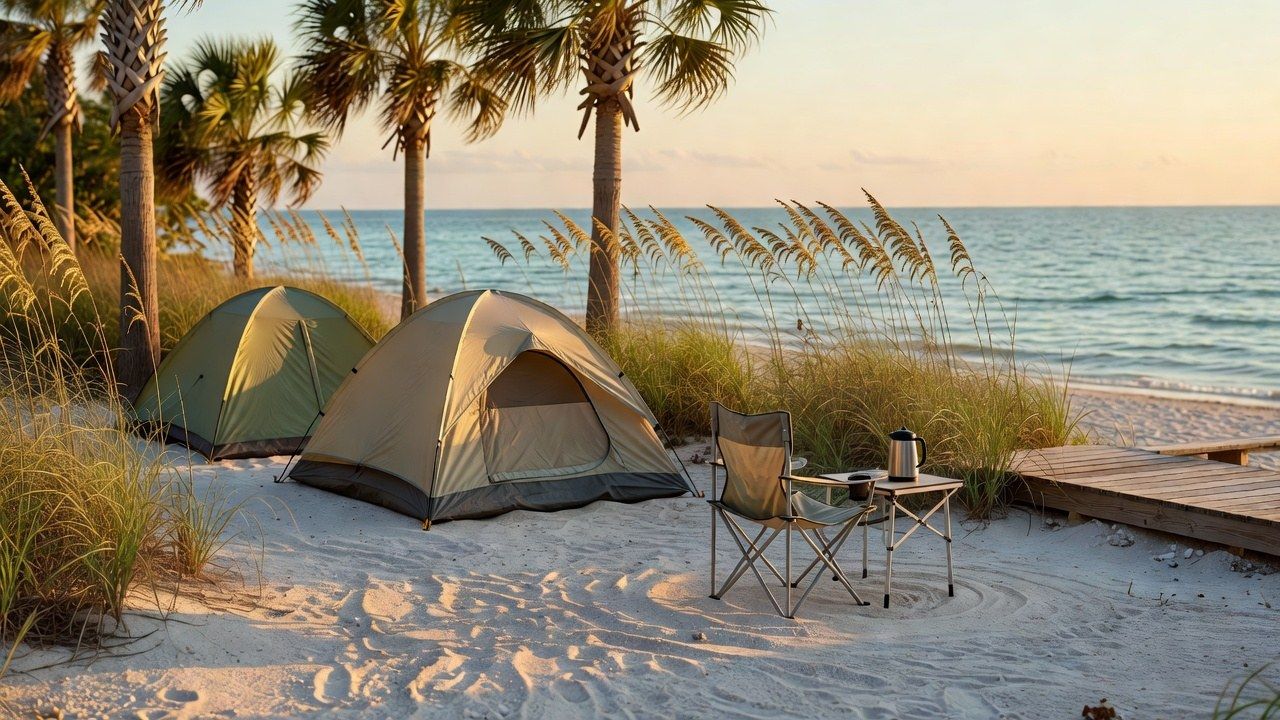
What Changed for the 2025–26 Winter Season
Three booking-system facts drive every Florida camping decision right now, and two of them are the reason people show up and get turned away.
1. Florida residents can book 11 months ahead. Non-residents get 10 months. This is the single most important line on this page. Florida State Parks deliberately gave in-state residents a one-month head start on their own parks, and for in-demand winter dates — Bahia Honda, Grayton Beach, Fort De Soto, Anastasia — that month is the difference between a site and a waitlist. If you live out of state and you want a prime February weekend in the Keys, your window opens roughly a month after the locals' window, and by then the premium sites are gone.
2. New campsites are released daily at 8 a.m. Eastern — not on the first of the month. This is the mechanics that most guides get wrong. The 11-month (or 10-month) window rolls every single day: at 8 a.m. ET, one new arrival date's worth of inventory appears. So the correct behaviour is not "log in on November 1." It's "log in at 7:55 a.m. ET on the exact day your target arrival date enters the window, and be clicking at 8:00."
3. Same-day reservations are possible, but only before 1 p.m. If you're already in Florida and feeling spontaneous, Florida residents can book same-day campsites or cabins before 1 p.m. on the day of arrival — which is a genuinely useful escape hatch for a road trip, as long as you're flexible about which park.
For anything in the Everglades or on federal land, reservations run through Recreation.gov instead — a completely separate system with a separate window.
Why Winter Is Florida's Real Camping Season
If you're coming from a state where summer is camping season, this is the mental flip you have to make.
November through March is the good window. Daytime highs settle into the 70s across central and south Florida, humidity drops, and the afternoon thunderstorm machine switches off. It is, not coincidentally, when the state fills with snowbirds and when every campsite is contested.
Summer is the survival season. June through September brings 90s and up, brutal humidity, and a reliable late-afternoon storm. If you camp in Florida in July, you do it in the water or under shade, and you plan around a 3 p.m. evacuation of anything that shouldn't get wet.
Hurricane season runs June 1 through November 30. That overlap with early-season camping is real and not theoretical — November trips can be cancelled by a storm, and Florida park systems close campgrounds ahead of landfall. If you book a November trip, buy trip insurance or accept the odds, and check the storm forecast in the week before you leave. Take that seriously: the entire reason November is cheaper than December has nothing to do with the weather being worse and everything to do with the risk window still being open.
Cold snaps are real — in the north. This is the part that catches visitors off guard. Florida's Panhandle and north-central counties sit at the same latitude as southern Georgia, and they get genuine winter. Overnight lows in the 30s happen, and a hard freeze will end a night fast if you packed as if you were going to Miami. South Florida is a different climate altogether: Fort Lauderdale and the Keys rarely drop below the 60s. So the same state needs two different sleep systems depending on whether you're camping near Pensacola or near Key West.
How Florida Camping Actually Works: Five Separate Systems
There is no single "Florida camping reservation." There are five, they don't talk to each other, and picking the wrong one is the most common planning mistake.
1. Florida State Parks — the flagship system, and where most families end up. Full-facility sites include water, electricity, a grill and picnic table, plus centralized showers, restrooms, and a dump station. Booked through the state's reservation portal or by phone at 800-326-3521. This is the 11-month/10-month system described above, released daily at 8 a.m. ET.
2. National Park Service sites — Everglades, Biscayne, Canaveral National Seashore, Gulf Islands National Seashore, and Dry Tortugas. These sit on Recreation.gov with their own windows and rules. Everglades is the big one for a family trip: it runs Flamingo Campground for frontcountry camping plus a wilderness backcountry permit system for the paddling and chickee routes.
3. National Forests — Ocala National Forest is the standout: 383,000 acres spread across four counties in north-central Florida, with roughly a dozen developed campgrounds plus free dispersed camping off its forest-road grid. Juniper Springs, Alexander Springs, Salt Springs, and Silver Glen Springs are the marquee recreation areas, with rates running roughly $10–$69 per night depending on site type and season. Because the cooler months are when everyone wants to be there, book ahead rather than assuming you'll roll in.
4. Water Management District lands — the Southwest, St. Johns River, and Northwest Florida districts manage enormous tracts, and camping on them is free but strictly primitive. This is where the rules diverge hardest from western public land, and it gets its own section below.
5. County and municipal parks — Florida's county park systems (Pinellas, Hillsborough, Brevard, Miami-Dade) run some genuinely excellent waterfront campgrounds, usually with their own portals. These are worth checking when the state parks show full.
Florida State Park Campgrounds Worth Booking
Florida's state park system is the best-value camping in the Southeast. Nightly rates typically run about $16 for a primitive site and $24 for a standard site with electric, topping out around $42 for premium and full-hookup sites; an additional vehicle adds roughly $6 per night. Compare that to a Keys hotel in February and the value argument makes itself.
These are the ones that reliably justify the alarm-clock reservation:
Bahia Honda State Park (Big Pine Key) — the famous one. Beaches on both the Atlantic and Gulf sides, a historic bridge, and sites that sit essentially on the water. All sites are reservation-only with no walk-up option, and winter inventory is the hardest in the state to get. If you want this one, you're booking the moment the window opens for your dates.
Grayton Beach State Park (Santa Rosa Beach) — the Panhandle's showpiece: sugar-white sand, dune lakes, and a campground set back in the pines a short walk from the beach. Peak demand runs spring through fall, and winter here means cooler nights than south Florida, so bring the warmer sleep system.
Fort De Soto Park (Pinellas County) — a county-run park that out-camps many state parks, with a huge campground, kayak launches, and Gulf-front beaches. Its location near St. Petersburg makes it the easiest Florida camping trip to combine with a city weekend.
St. Andrews State Park (Panama City Beach) — jetties, lagoon, and some of the clearest water in the Panhandle, with camping right at the pass.
Anastasia State Park (St. Augustine) — dunes, a coquina-quarry trail, and an easy pairing with the historic district, which matters if you're travelling with kids who need a break from the tent.
Jonathan Dickinson State Park (Hobe Sound) — the largest state park in southeast Florida, with the Loxahatchee River and a genuinely wild feel for how close it is to populated coast.
Blue Spring State Park (Orange City) — winter is manatee season here. When the river runs cold, manatees pile into the park's constant-temperature spring run, and the park becomes one of the best manatee-viewing sites in the state. It's a completely different kind of camping trip — you're there for wildlife, not for the beach.
Myakka River State Park (Sarasota) — one of the oldest and largest parks in the system; oak hammocks, a canopy walkway, and airboat country. A good pick for a family that wants alligators-at-a-distance and actual hiking.
A word on firewood and fuel, because it differs from state to state. Every state we've written about has its own version of this rule, and the safe habit is to buy firewood locally near the campground rather than hauling it across a state line or across the state. Moving untreated wood spreads invasive pests and diseases, and park staff will stop you.
Camping in Florida in November
November is the value month, and it's also the most misunderstood.
The weather is genuinely excellent. By mid-November the humidity has broken, days sit in the mid-70s to low 80s in central Florida, and nights drop into the 50s and 60s in the south, the 40s in the north. For a family that wants to swim and hike on the same trip, this is the sweet spot.
The crowd hasn't fully arrived. The snowbird surge really lands in January and February. November sits just before it, which means state park sites are obtainable with normal planning rather than a military operation.
But two things bite. First, hurricane season is still open until November 30 — so a November trip carries a genuine, if small, chance of cancellation. Second, Thanksgiving week behaves like peak season anyway. The four days around Thanksgiving book out fast at every decent park, especially in the Keys and the Panhandle. If your trip is that week, treat it as a February date and book accordingly.
If you're building a late-fall trip and want company, our Thanksgiving camping guide covers the food and crowd logistics, and the general camping in November guide covers what the rest of the country is doing that month.
Camping in Florida in December and January
December is the most reliable month for weather and the worst month for availability. The storm risk is finally gone, daytime temps are close to perfect, and every park in the state is full. This is also when rates at private RV resorts spike highest, which is the argument for staying inside the state park system.
January is peak snowbird season and peak cold-snap risk in the north. Expect the state parks to be fully committed, expect traffic on I-75 and I-95, and expect genuinely cold nights if you're anywhere north of Ocala. Central Florida in January can run a 75°F afternoon and a 45°F night in the same 24 hours — a 30-degree swing that's harder to pack for than a steady cold.
That swing is the practical problem with winter camping in Florida. Your tent has to handle a mild evening and a damp cold morning, and your sleep system has to be adjustable rather than fixed. A 40°F sleeping bag handles the south and most of central Florida; a 0°F bag is not overkill for a January night near Tallahassee or a cold front in Ocala. If you're choosing one, read our sleeping bag guide before you commit — the comfort rating on the label is not the temperature you'll actually be warm at.
The winter camping gear checklist is a good cross-check, with the caveat that a lot of it is written for snow camping and Florida needs only half of it.
Camping in Florida in February and March
February is the best month of the year to camp in Florida. The weather is at its most stable, the mosquitoes are at their least aggressive, and the days are long enough to actually do things. It's also, predictably, the hardest month to book.
March brings spring break, and with it a sharp jump in crowds, traffic, and noise at any campground within reach of a beach. If you want a quiet March trip, go inland — the springs and the state forests are far calmer than the coast that month.
One planning note for both months: spring is Florida's peak burn-ban season. Dry winter and early spring with low humidity is exactly when local burn bans appear, and a ban can prohibit campfires entirely, including in fire rings. It's not a park-wide conspiracy; it's local fire conditions. Check the county's status the week you leave, and carry a propane alternative so a ban doesn't cancel dinner.
The Florida Keys: The Hardest Reservation in the State
The Keys are their own project. There are only a handful of public campgrounds across the whole 100-mile chain, and demand is driven by a completely different market — boaters, divers, and people escaping northern winter.
Bahia Honda is the crown jewel and the hardest get, and the mechanics matter: all sites are reservation-only with no walk-up or first-come option at all, so there's no "show up early and hope" play. Rates are set through the state system, and winter weekends are effectively gone the month the window opens for non-residents.
A few things nobody tells you about camping in the Keys:
- Reserve the moment the window opens for your dates, and set a phone reminder for 7:55 a.m. ET on that day. Appointments at 8:00 a.m. are the whole game.
- Cancellations are the realistic second chance. Have your dates ready before the window opens; because the site is competitive, set alerts and be willing to check repeatedly in the last 30 days.
- Everything in the Keys is more expensive than the mainland — fuel, groceries, ice. Fill your cooler and your tank before you cross onto US-1.
- Water matters. Freshwater is at a premium and some sites have no hookups, so a 5-gallon solar shower and a collapsible water container do real work here.
- Cell service is patchy, especially on Big Pine Key and toward Key West. A satellite communicator isn't overkill if you're paddling or boating; the Garmin inReach Mini 2 is the established option.
If you're bringing a dog, check before you book. Florida state park pet rules are tighter than they look, and the Keys are one of the places where the answer genuinely varies by park.
Florida Springs, the Panhandle, and the Emerald Coast
Florida's interior springs are the best-kept camping secret in the state, and they're the reason to ignore the beach for one trip.
The springs are 72°F year-round. That's cool in January — genuinely bracing — and perfect in July, which is why locals flip the calendar and swim in winter. Ichetucknee Springs and the Ocala National Forest's spring group (Juniper, Alexander, Salt, Silver Glen) are the accessible ones for campers, and several have campgrounds attached. A spring trip is a swim trip: pads, snorkels, and river floats.
The Panhandle is a different Florida. This is the "Emerald Coast" — Destin, Fort Walton, Grayton Beach, St. Andrews — with sand so white and water so green it looks edited. It's also the coldest part of the state in winter, with real 30s overnight. Camp there in November and you'll want a fleece and a warm layer for the morning, not just a t-shirt.
North-central Florida (Ocala, Gainesville area) is the best compromise — inland enough that storm risk and crowds are lower, close enough to the springs and the Gulf to do both.
Free Camping in Florida: The One Big Myth
Here's the thing that trips up everyone who learned to camp in the West.
In Arizona, Utah, Colorado, or on BLM land generally, "dispersed camping" is a right. You find a legal spot on public land, you camp, you leave no trace. Florida does not work that way — and this is the single biggest misconception about Florida camping.
On Water Management District land, dispersed camping is explicitly prohibited. The districts are governed by Florida Administrative Code Chapter 40C-9.300, and the rule is blunt: only primitive tent camping is allowed, and only at designated locations. You cannot pick a spot. You cannot drive off the road and set up. There is no Florida equivalent of the BLM 14-day rule on these lands.
What you can do on district land:
- Camp at a designated primitive site with a free reservation — and the reservation is not optional. On Southwest Florida Water Management District lands, a reservation or Special Use Authorization must be in hand before you arrive, and reservations must be made no later than the day before your start date. Arrival time is 3 p.m. on the first day.
- Expect primitive as a literal term: no water, no power, no dump station, often no toilet. Pack accordingly — that means a portable toilet setup or a bucket toilet, your own water, and a way to carry out everything.
- Check hunting season first. During general gun season, camping on the national forests is restricted to designated campsites only under Florida Fish and Wildlife rules — and district lands close sections too. This is a hard rule, not a preference. Hunting-season dates and closures are listed on the managing district's calendar, and it's worth a two-minute check before you drive.
Ocala National Forest is the exception worth knowing. It's the one place in Florida where dispersed camping is genuinely available to backpackers — the forest's grid of forest roads gives legitimate access, and primitive and dispersed sites are often free. Even there, generator rules and length-of-stay limits apply, and the general-gun-season restriction still kicks in.
So the practical version: Florida's free camping exists, but it is legal only at specific designated sites, on a permit, and with a calendar check. Plan for that and the system works well. Assume you can pull off a forest road and set up, and you'll be moving at midnight.
Alligators, No-See-Ums, and the Rules Nobody Reads
Florida's wildlife and insect rules are not the same as the rest of the country's, and a few of them are non-negotiable.
Alligators are everywhere there's fresh water. That includes the lake at a state park campground, the canal at a Water Management District site, and the pond behind the trailhead. The rules are simple and they work: don't swim in fresh water unless it's a designated swimming area, don't feed anything, and don't let dogs or small kids near the water's edge. Alligators are ambush predators and the danger zone is the shoreline, not the middle of the lake. Swimming in Florida means springs, pools, and the ocean — not rivers and ponds.
Snakes and ticks are more of a real-world issue than alligators. Florida has both venomous snakes and heavy tick pressure in brush, and tall grass near water is where you'll meet them. Closed-toe footwear matters — water sandals for the kids solve the "they want to swim but also walk through the grass" problem — and a tick removal tool belongs in the kit permanently.
No-see-ums are the actual enemy. Sand gnats and biting midges are tiny enough to pass through ordinary tent mesh, they're worst at dawn and dusk, and they are far more effective at ruining a coastal Florida evening than mosquitoes. This is the insect that sends families into the car at 7 p.m. Our bug protection guide covers prevention in depth; the short version is a picaridin repellent rather than a DEET-only one, closed clothing at dusk, and a screen shelter you can retreat into.
Fireants. Barefoot in a Florida campsite is a gamble. Fire ant mounds look like small, loose sandy domes, and standing on one is memorable. Keep shoes on and teach kids to look before they kneel.
Do not swim in fresh water, and do not swim alone in the ocean. Rip currents are the leading cause of beach drownings in Florida, and they are strongest exactly where the swimming looks calmest.
Camping in Florida With Kids and Dogs
Florida is genuinely one of the easiest states to camp in with kids — short drives between the beach, the springs, and the campground, and facilities that don't require you to be self-sufficient — provided you solve three problems.
Shade. There is often very little of it at coastal sites, and Florida sun is unforgiving. This is the single most valuable piece of gear you can bring. A 10x10 pop-up canopy turns a bare site into a usable base camp; a beach sun shelter does the same on the sand. Pair it with a UPF 50 hat for each kid and a sun shirt — Florida sun protection is real sun protection, not marketing.
Heat and insect relief inside the tent. A battery fan is the highest-value, lowest-cost upgrade to a Florida trip. The FRIZCOL 3-in-1 camping fan runs on a big internal battery, doubles as a lantern, and keeps air moving through a tent on a warm January afternoon. Our tent fan guide covers placement and the airflow tricks that actually help.
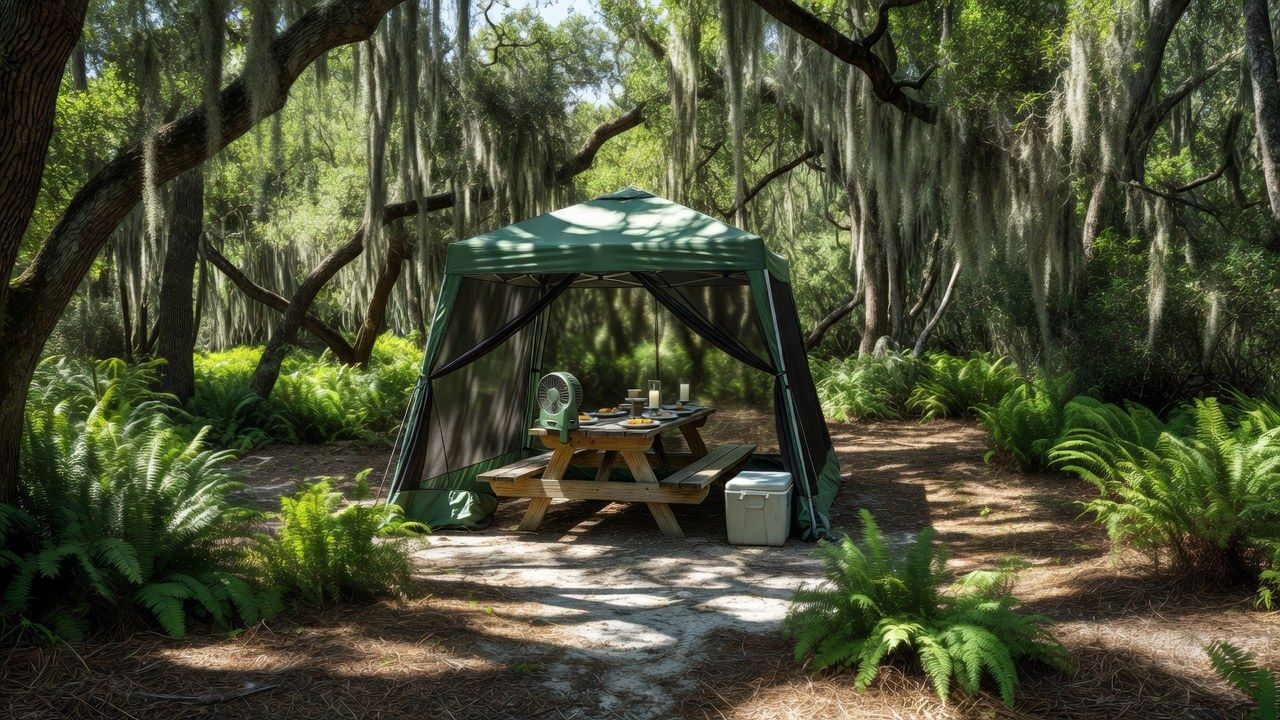
A screen space. A screen canopy or tent with a screen porch gives you somewhere to eat dinner after the bugs come out. That's the difference between a trip and an ordeal.
For gear hauling, a folding wagon or a wagon with UV shade is standard equipment in Florida — the walk from parking to a beach site is usually longer than the map suggests.
Dogs: read the rules before you book. Florida state park pet policy bars pets from buildings, cabins, and cabin areas, requires pets be confined or leashed at all times, and requires a hand-held leash no longer than six feet with the dog under physical control. Dogs are generally welcome in campgrounds and on many trails, but beach and swim rules vary park to park and several coastal parks restrict dogs on the sand. Our camping with dogs guide walks through how to check a specific park, and the beach dog water safety guide covers the saltwater-and-dog specifics that matter on a Florida coast. Pack a collapsible bowl and extra water — Florida heat dehydrates dogs faster than you'd expect — and on a boat or near the water, a dog life jacket is not optional.
One dog note specific to Florida: hot sand and hot pavement. Midday sand can burn paw pads, and a parking-lot walk in July is worse than any trail. Go early or late, and check the ground with the back of your hand.
Florida Winter Camping Gear: What Actually Belongs in the Car
Here's the counterintuitive part of a Florida gear list: the biggest failures here are heat, bugs, and rain — not cold. Most people over-pack insulation and under-pack shade, repellent, and rain protection. This section is organized by the problem each item solves.
Bug defense (the Florida priority)
The insect toolkit matters more here than anywhere else we've written about. Layer three things: a repellent you'll actually reapply, physical barriers, and a screen space.
- OFF! Clean Feel Insect Repellent with 20% Picaridin — $11.99 — picaridin-based, less harsh on gear and skin than DEET-heavy formulas, and the one that actually works on no-see-ums.
- Murphy's Naturals Mosquito & Tick Repellent — $28.49 — the plant-based option when you want something gentler for younger kids.
- Cliganic Mosquito Repellent Bracelets — $9.99 — not a substitute for spray, but they help on ankles and wrists and kids will actually wear them.
- HomeSake Tick Remover Tool — $14.39 — proper removal matters; the old "burn it off" method is how people get infections.
- ENO Guardian Bug Net — $39.95 — turns any hammock into a bug-proof bed.
- Wise Owl Outfitters Hammock Bug Net — $27.99 — the budget version of the same idea.
- Plusvivo Pop Up Dog Tent — $69.99 — a mesh-shaded spot for the dog at a buggy site.
Shade and shelter (the second priority)
- CROWN SHADES 10x10 Pop Up Canopy — $139.99 — one-push setup, and the single best thing you can bring to a shade-less coastal site.
- Gorich Beach Tent Sun Shelter, UPF 50+ — $49.99 — light, packs small, and ideal for the beach portion of the trip.
- OneTigris Bulwark All-Season Camping Tarp — $56.98 — the rain answer. Florida afternoon storms arrive fast; a tarp rigged over the table saves the evening.
- Coleman Sundome Camping Tent with Rainfly — $153.49 — the reliable family dome; the rainfly is the point when a storm rolls through.
- CAMPROS CP 8-Person Tent with Room Divider — $159.98 — for a larger family that needs two rooms.
- EVER ADVANCED 6-Person Blackout Tent — $169.99 — the blackout fabric is genuinely useful in a state where the sun comes up like a light switch.
If you're not sure what size you need, our tent size guide does the space math properly, and the family tent buying guide covers the current picks. For hot months specifically, hot-weather camping gear is the companion read.
Sleep that handles a 30-degree swing
- Coleman Palmetto 40°F Sleeping Bag — $44.99 — the right bag for south and central Florida.
- TETON Sports Celsius 0°F Sleeping Bag — $59.99 — for January in the Panhandle or north-central Florida.
- Coleman Trailhead II Folding Cot — $54.99 — off the ground, which matters on damp sand and after rain.
- Therm-a-Rest Z Lite Sol Sleeping Pad — $54.95 — a closed-cell pad under a cot or bag is real insurance against a cold floor.
- Klymit Insulated Static V Sleeping Pad — $94.99 — insulated, which is the difference between sleeping and shivering on a 45°F night.
- Rumpl Original Puffy Blanket — $139.00 — the layer that makes a 55°F evening outside genuinely good.
- Trekology ALUFT 2.0 Pillow — $16.99 — small thing, disproportionate effect on how you sleep.
- scuddles Extra Large Picnic Blanket — $24.99 — waterproof backing means it works on wet sand, which is most Florida sand.
Rain and layers for a warm, wet state
- Columbia Watertight II Rain Jacket — $60.00 — a packable shell is the Florida jacket. It rains in 20 minutes and clears in 20 minutes.
- Outdoor Research Helium Rain Jacket — $159.00 — the ultralight upgrade, for trips where space is the constraint.
- Columbia Steens Mountain Fleece — $34.99 — the January and February layer, north of Ocala.
- Columbia Women's Benton Springs Fleece — $39.99 — the matching women's cut.
- OAKI Kids Rain and Trail Suit — $32.99 — a one-piece suit is the only way a small kid stays dry in an afternoon storm.
- Columbia Youth Watertight II Rain Jacket — $40.00 — the older-kid version.
- Columbia Silver Ridge Convertible Pants — $69.99 — zip-off legs are ideal when the afternoon is 20 degrees warmer than the evening.
- Baleaf UPF 50 Sun Hoodie — $26.99 — long sleeves in Florida heat sound wrong and work better than sunscreen alone.
- Trendoux Winter Gloves — $19.99 — you'll feel silly packing them, and then you'll be in the Panhandle in January.
- Our rainy-day hiking and camping guide covers the storm plan in detail — in Florida, "afternoon storm" is a scheduling problem, not a trip-ending one.
Sun
- Connectyle UPF 50+ Wide Brim Hat — $16.99 — the everyday option, and it actually blocks the back of the neck.
- Sunday Afternoons Ultra Adventure Hat — $135.01 — the premium version with a neck cape for long exposed days.
- Sunday Afternoons Kids' Ultra Adventure Hat — $34.00 — the kid version, because hats with chin straps are the only ones that stay on.
- Coolibar Kids' Long Sleeve Sun Shirt — $32.00 — UPF 50 fabric does more than reapplying lotion every hour.
- Sun Bum Original SPF 50 — $14.99 — reef-conscious formula, which matters if you're swimming near the Keys.
- Banana Boat Sport SPF 50 — $8.95 — the sweat-resistant workhorse for hiking and paddling.
- Babiators Baby Navigators Sunglasses — $19.99 — for the smallest kid in the car, who can't be reasoned with about glare.
Camp kitchen for warm-weather cooking
Florida cooking is about ice retention and shade, not about heat output. Your cooler is the single most important kitchen item.
- Coleman 70-Quart Xtreme 5-Day Cooler — $79.99 — the value pick for a family week; five-day ice retention is real in shade.
- RTIC 45 QT Ultra-Tough Hard Cooler — $239.00 — the mid-tier rotomolded option.
- YETI Roadie 24 — $250.00 — smaller, heavier, and the one people hand down. Our cooler ice-retention guide breaks down which size you actually need.
- Coleman Classic 1-Burner Butane Stove — $29.99 — cheap and easy, but note this: standard butane canisters lose pressure in the cold, so this is a warm-weather stove. Fine for Florida's warm months, unreliable on a 40°F north-Florida morning.
- Coleman Bottle Top Propane Stove — $21.99 — propane, which behaves far better in the cold than butane. The better cold-morning choice.
- MSR PocketRocket 2 — $49.95 — for backpacking the Ocala forest or kayaking to a chickee site.
- Lodge Pre-Seasoned Cast Iron Skillet, 10.25" — $19.99 — one pan that works on a fire ring, a grate, or a two-burner stove.
- Stanley Wildfare Core 26-Piece Camp Kitchen Set — $89.99 — nesting set for a family, so you're not inventing a kitchen from five loose pots.
- Coleman Pack-Away 4-in-1 Folding Table — $99.99 — adjustable height earns its keep when you're also using it as a prep surface.
- Coleman Chair with 4-Can Cooler — $39.99 — the camp chair that also keeps a drink cold, which in Florida is a two-in-one.
- SUNNYFEEL Low Beach Chair, 2-Pack — $67.99 — low-slung so you can actually sit on the sand without a wall of sand in front of you.
On fuel specifically: butane, isobutane, and propane are not interchangeable in the cold, and the canister you buy matters more in January than in July. Our camp stove fuel guide is the reference — the number-one traffic page on this site for a reason, because the fuel is the thing that fails first. Our cooler packing guide covers the ice math for a warm-weather trip.
Light, power, and water
- Jackery Explorer 300 Power Station — $199.00 — runs a fan, charges phones, and covers a primitive site with no hookups. Our portable power station guide covers sizing.
- EF ECOFLOW RIVER 2 — $169.00 — the lighter alternative with similar capacity.
- Black Diamond Spot 400 Headlamp — $39.95 — waterproof matters more here than elsewhere; Florida rain finds every gap.
- Petzl ACTIK CORE Headlamp — $79.95 — rechargeable, with red light for reading without waking the tent.
- Black Diamond Moji Lantern — $24.95 — small, dimmable, and enough for a picnic table.
- SUPRUS Electric Lighter — $9.99 — arc lighters don't get wet and stop working like a soaked flint does.
- Advanced Elements Solar Shower, 5 Gallon — $35.99 — the hot-shower answer at primitive and district sites, and useful at the beach for rinsing sand.
- Camco TastePURE RV Inline Water Filter — $17.99 — Florida campground water can taste strongly of sulfur; an inline filter fixes it.
- Hydro Flask 32 oz Wide Mouth — $44.95 — insulated bottles matter in a state where a car in the sun hits 130°F.
- Nalgene 32 oz Tritan Wide Mouth — $16.99 — the unbreakable one for kids.
- Our water filtration and hydration guide covers how much water a family actually goes through in heat — the honest answer is more than you think.
Safety kit that reflects Florida's actual risks
- Adventure Medical Kits Ultralight/Watertight .7 — $44.95 — watertight case, which is the point in a state that rains sideways.
- Occer 12x25 Compact Binoculars — $35.99 — genuinely useful for manatees, dolphins, and the birds that make Florida worth watching.
- Celestron Nature DX 8x42 Binoculars — $166.00 — the serious version for a wildlife-focused trip.
- Mr. Heater Buddy — $74.00 — for a January cold front in north Florida, when a fire ban rules out the fire.
- Outland Living Portable Propane Fire Pit — $142.64 — the fire-ban workaround, and often allowed when open fires aren't.
- Fiskars X7 Hatchet — $29.99 — for splitting bought firewood, not for cutting standing wood.
- Lightning safety is a real category here — if you can hear thunder, you're within striking distance. Florida leads the country in lightning deaths, and the rule is the 30-30 rule: when the gap between flash and thunder is under 30 seconds, get inside a hard-roofed building or a vehicle.
Working north along the coast from Florida, the season narrows instead of opening: the North Carolina camping guide covers where the year-round campgrounds actually are, and why the Outer Banks ones are the exceptions.
Camping in Florida in October: The Last Quiet Month Before the Snowbirds
October is Florida's hinge month. The summer survival window — 90s and a reliable late-afternoon storm — is closing, but the snowbird surge that makes January and February a reservation fight has not arrived. That gap is the entire reason camping in florida in october is a better trip than most people expect.
The state is not uniform about it. The Panhandle and north-central counties sit at the same latitude as southern Georgia, cool first, and can touch the 30s overnight later in the month. South Florida and the Keys are a different climate altogether. So the first decision is not which park — it is which half of the state you mean.
The October questions people actually type
| What people are searching | The short answer |
|---|---|
| camping in florida in october | Yes — warm days, the first comfortable nights, and the last un-crowded month before the winter rush |
| florida camping in october | Book the state park system; residents can reserve 11 months ahead and non-residents 10, with one new arrival date released every day at 8 a.m. Eastern |
| where to camp in florida in october | Ocala National Forest if you want dispersed camping, a full-facility state park if you want water, power and showers |
| where to go in florida in october | North first — the Panhandle cools soonest, while the Keys and the spring runs stay warm longest |
| is florida nice in october | Yes, with one real caveat: hurricane season is still open until November 30 |
| is florida busy in october | No — this is the last quiet window. The winter residents arrive in January and February |
| can you swim in florida in october | Yes, especially on the Gulf coast and in the spring runs, which hold a constant temperature year round |
| where to camp in october | Statewide the mechanics do not change — only the competition gets easier |
The one risk that defines an October trip
Hurricane season runs June 1 through November 30, so October sits inside the risk window even though the weather is pleasant. Florida park systems close campgrounds ahead of a landfall, which means a booked site is not a guarantee. Check the storm forecast in the week before you leave, and if you are driving a long way treat trip insurance as part of the budget rather than an upsell.
This is also why November is priced the way it is: the reason November is cheaper than December has nothing to do with the weather being worse — it is that the risk window is still open.
Where October actually goes, north to south
North Florida and the Panhandle cool first and reward an early-October trip. Grayton Beach and St. Andrews are still swim-ready, and the dune lakes are at their best before the November drop. Pack as if a 30°F night is possible later in the month, because it is.
Central Florida — Blue Spring, Myakka River, Jonathan Dickinson — is the compromise pick: warm days with nights finally dropping out of the 70s. Blue Spring's constant-temperature spring run is exactly why it becomes one of the state's best manatee-viewing sites once the river itself turns cold.
South Florida and the Keys are still summer in air temperature. Bahia Honda is reservation-only with no walk-up option, so treat October as one of the last months to get it without a year of lead time.
Booking October: the mechanics, minus the winter fight
Nothing about the system changes in October, only the competition. New inventory for a given arrival date appears every day at 8 a.m. Eastern — not on the first of the month — and same-day reservations close at 1 p.m. on the arrival day. Nightly rates run roughly $16 primitive, $24 standard with electric, and up to $42 for premium hookups, with a second vehicle around $6 per night.
On Water Management District land — millions of acres of it — dispersed camping is prohibited; it is primitive tent camping only, at designated sites, with a free permit. Ocala National Forest is the exception most people are looking for, with roughly a dozen developed campgrounds and genuine dispersed camping off its forest-road grid, generally $10–$69 per night.
What to pack for a Florida October
Insects, shade and rain — not warmth. A Baleaf UPF 50 sun hoodie with a face mask and a Gorich beach tent sun shelter handle the midday sun far better than a jacket handles the evening. Bring Sun Bum SPF 50 and reapply, and carry water in something that does not sweat: a Nalgene 32 oz wide mouth for the adults, a CamelBak Eddy kids bottle for anyone small. If a dog is coming, the Ruffwear Quencher collapsible bowl packs flat and the Coleman 5-gallon water carrier solves the whole campsite's supply in one trip.
For the season on either side of this one, the camping in November guide covers the value month, the October national guide covers what the rest of the country is doing, and if your trip lands on Halloween weekend the Halloween camping guide covers the kid logistics. Georgia runs a similar season on a different calendar — the camping in Georgia guide is the one-state-over comparison.
Florida Camping FAQ
When is the best time to camp in Florida?
November through March. That's the dry, comfortable stretch — 70s by day across most of the state, low humidity, and far less afternoon storm activity than summer. February is the most reliable single month. Avoid June through September unless you're planning the trip around swimming; the heat, humidity, and daily thunderstorms make it a different kind of undertaking.
How far in advance can I book a Florida state park campsite?
Florida residents can book 11 months ahead; non-residents can book 10 months ahead. The window rolls daily, and each day's new inventory is released at 8 a.m. Eastern — not on the first of the month. Same-day reservations are possible before 1 p.m. for residents. Book through the Florida State Parks reservation portal or by phone at 800-326-3521.
How much does it cost to camp in a Florida state park?
Roughly $16 per night for a primitive site and $24 per night for a standard electric site, with premium and full-hookup sites up to about $42. An additional vehicle is around $6 per night. Full-facility sites include water, electricity, a grill, and a picnic table, plus centralized showers and restrooms. Prices vary by park and season — the authoritative figure is always the one shown at booking.
Can you camp for free in Florida?
Sometimes, but the rules are stricter than out west. Free camping exists on Water Management District land and in Ocala National Forest, but on district land dispersed camping is prohibited — you must camp at a designated primitive site with a free reservation, made no later than the day before arrival, with arrival at 3 p.m. Only primitive tent camping is permitted, and hunting-season closures apply. Ocala National Forest does allow genuine dispersed camping for backpackers. Do not assume you can pull off a road and set up; in Florida, that's the rule most likely to get you moved.
Are dogs allowed at Florida state parks?
Generally yes, with conditions. Florida state park pet policy requires pets be confined, leashed, or otherwise under physical control at all times, and where allowed, a hand-held leash no longer than six feet. Pets are not allowed in buildings, cabins, or cabin areas. Dogs are typically welcome in campgrounds and on many trails, but beach and swim-area rules vary park to park and several coastal parks restrict dogs on the sand — check the specific park before booking. Service animals are welcome in all areas of the parks.
Do I need a reservation, or can I just show up?
For any park you actually want, assume you need a reservation. Bahia Honda is reservation-only with no walk-up option at all, and most in-demand Florida state park campgrounds have nothing available on arrival during winter. Same-day bookings are possible for residents before 1 p.m., and cancellations do appear — but planning on a walk-up site in February is a plan to sleep in the car.
Is it cold enough to need a real winter sleeping bag in Florida?
In north and central Florida, yes — January and February night temperatures in the 30s and 40s are normal in the Panhandle and north-central counties. In south Florida and the Keys, not really; 50s and 60s are more typical, and a 40°F-rated bag or a good blanket is plenty. The harder problem is the daily swing: central Florida can run a 75°F afternoon and a 45°F night on the same trip, so bring layers you can adjust rather than one fixed system.
Can you swim while camping in Florida?
In designated swimming areas, springs, and the ocean — yes. In fresh water that isn't a designated swimming area — no. Alligators live in Florida's lakes, ponds, rivers, and canals, including the water at many campgrounds and trailheads. Swim only where swimming is officially sanctioned. On the coast, be aware that rip currents are the leading cause of beach drownings and are strongest on the calmest-looking days. Never swim alone.
What should I do about hurricanes?
Hurricane season runs June 1 through November 30, which overlaps with the front end of the good camping season. If you book a November trip, watch the forecast in the week before you leave and accept that a storm can force a cancellation — Florida park systems close campgrounds ahead of landfall. Trip insurance is cheap relative to a cancelled week, and November pricing is lower largely because of this risk rather than the weather itself.
What's the biggest mistake first-time Florida campers make?
Packing for cold and ignoring insects, shade, and rain. The gear that determines whether a Florida trip works is a screen shelter, a picaridin repellent, a canopy for shade, and a tarp for the afternoon storm — not an extra blanket. The second-biggest mistake is assuming the free-camping rules look like the rest of the country's. They don't.
Florida and Arizona are the two halves of the American winter camping map — if you want the desert version of the same November-to-March season, our Arizona camping guide covers it. Texas runs a near-identical winter season on the other side of the Gulf, and the Texas camping guide covers the state park window, Big Bend's winter rules, and Padre Island's no-reservations beach camping.
Planning a trip on the other side of a state line? The new Camping in New Mexico 2026 guide covers New Mexico's five separate camping systems, its six-month state park booking window, and the stay limit that doubles on October 1.
Alabama is the next state up the same snowbird run, and its coast follows the identical rhythm — see Camping in Alabama for the Gulf Shores side of the trip.
If you are chasing warm-weather winter camping, our Camping in Louisiana guide covers the state parks, canoe-in bayou sites and the 13-month booking window that makes Louisiana different from every other state in the snowbird corridor.
January planning across the whole map, not just Florida, is in the Camping in January 2027 guide, which puts the warm-winter states' weather and booking windows side by side.
For the mirror-image version of this trip — red rock parks that peak in October instead of desert parks that peak in winter — our Camping in Utah guide breaks down the state's five separate reservation systems.
For the other winter-warmer option, our guide to camping in California breaks down which desert campgrounds reopen October 1 and how the state books sites — camping in California.
Is October a good time to camp in Florida?
Yes, for most of the state. October is past the summer heat and storms but ahead of the snowbird surge, so sites are obtainable with ordinary planning rather than an alarm clock. The exception is the far south, where air temperatures are still summer-like and the payoff is warm water instead of cool air.
Do Florida state parks fill up in October?
Far less than in January or February. Reservations still matter — inventory is released one arrival date at a time, daily at 8 a.m. Eastern — but October demand is normal-park demand, not the winter scramble. Thanksgiving week is the one October-adjacent exception: the four days around the holiday book like a February date.
What should I pack for camping in Florida in October?
Think insects, shade and rain rather than insulation. No-see-ums and mosquitoes are the gear problem that actually ruins trips here, sun exposure is a real midday issue through October, and afternoon rain does not stop just because the month changed. One light layer covers the handful of genuinely cool nights in the north.
The Bottom Line
If you are comparing destinations, camping in Wisconsin covers the state park system's booking window, its staggered October closures and the sites that stay open all winter.
If you're comparing states for the same fall window, we keep a full West Virginia camping guide too — the one state in the region where the headliner national park takes no reservations at all.
Next door, camping in Georgia runs on a 41-park state system with its own 13-month booking window and a $10 ParkPass that is not included in the reservation — useful when you are comparing state lines for the same weekend.
Florida is one of the most rewarding camping states in the country if you accept that it runs on its own rules. The season is inverted — winter is the good part. The reservation system has a resident-first window that catches visitors flat, and new inventory lands daily at 8 a.m. Eastern rather than at the start of a month. Free camping is real but narrow, and the western habit of pulling off a forest road and setting up will get you moved on Water Management District land.
For a family weekend trip, the reliable play is a Florida State Park full-facility site booked the day your window opens, aimed at November for value or February for weather, with a canopy, a screen shelter, a fan, and a repellent that works on no-see-ums. Add a state park in the Keys only if you're willing to plan a year ahead — and if you get it, take it, because Bahia Honda is worth the effort.
If you're mapping out the rest of the shoulder season, our fall camping gear checklist covers the autumn trips further north, and the state park camping guide covers how state park systems differ across the country.
<!-- AFFILIATE_DISCLOSURE -->Planning a trip the other direction? Our camping in Washington state guide covers the three separate booking portals, the October closing wave and the coast campgrounds that never shut for the season.