Sun Protection for Camping & Hiking: UPF Hats, Sport Sunscreen & Sunglasses (2026 Guide)
How to stay sunburn-free: UPF 50+ sun hats, sweat-proof sunscreen and polarized hiking sunglasses compared, with reapplication and UV-index rules.
I learned about sun damage the dumb way — a "quick" four-mile ridge hike in late July with a baseball cap and no sunscreen. By the time I got back to the trailhead, the back of my neck was the color of a cooked lobster and my ears were peeling in sheets. I drink water now, I wear real sun protection, and I haven't had a serious burn since. The difference wasn't one magic product. It was stacking four cheap, boring layers in the right order.
This guide is the system I wish I'd had that day. We'll cover the four layers — hat, sunscreen, sunglasses, and timing — what to actually buy for each, the difference between UPF and SPF (it matters more than you think), and the mistakes that catch even experienced hikers. If you're planning a summer camping trip or a hot-weather camping weekend, this is the sun checklist that goes with it.
Quick Answer: The 4-Layer Sun System
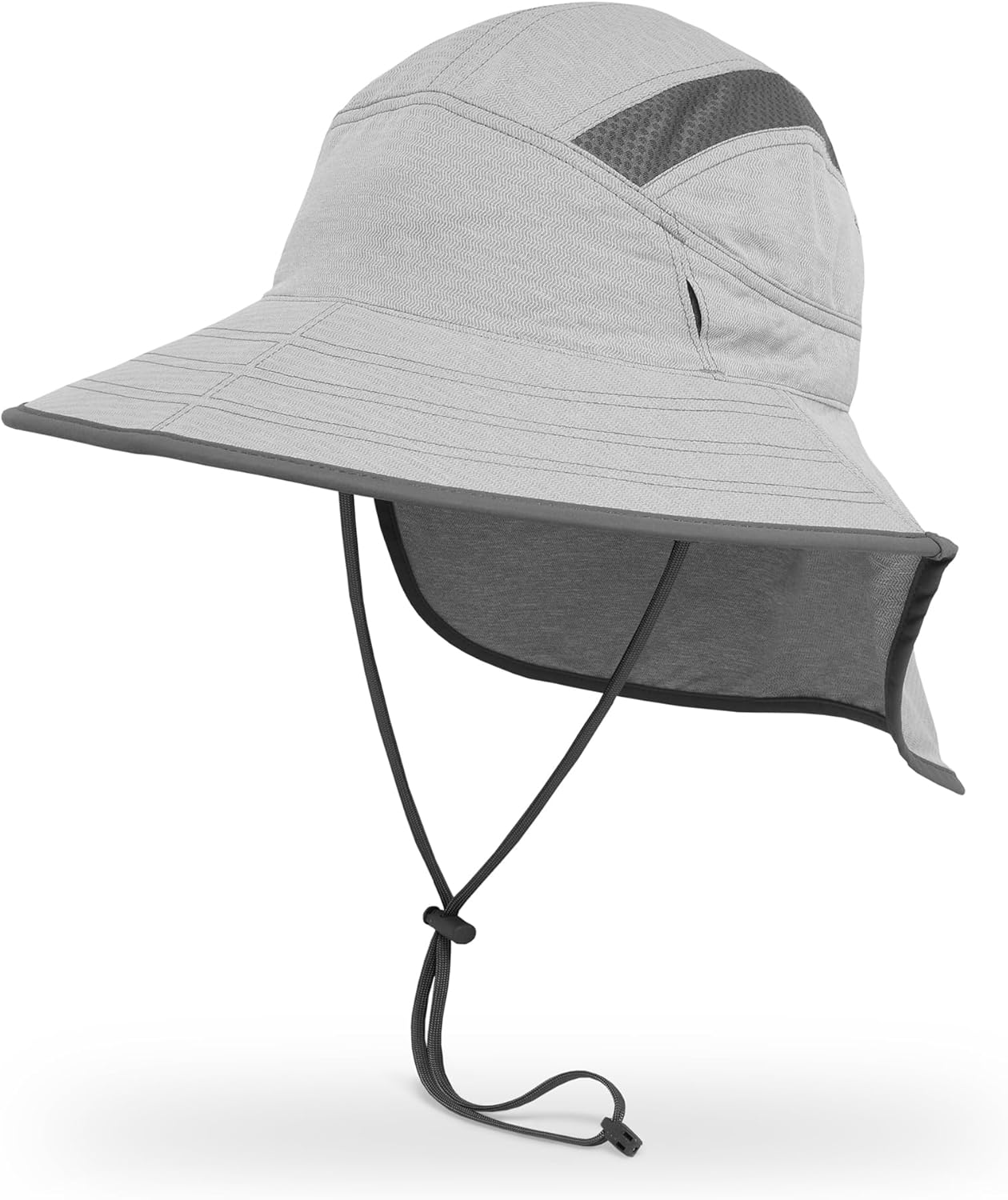
- Layer 1 — hat: the Sunday Afternoons Ultra Adventure hat at $135.01 covers ears and neck; the cheaper Connectyle wide-brim at $16.99 works for calmer days.
- Layer 2 — sunscreen: Sun Bum SPF 50 at $14.99.
- Layer 3 — clothing: Baleaf UPF 50 sun hoodie at $26.99 — long sleeves beat reapplying.
- Layer 4 — eyes: goodr Circle G polarized at $30.00.
- Building the rest of the day: day hike essentials.
Why Sun Protection on the Trail Hits Different
Trail sun is not beach sun. Three things make it worse, and most people only think about one of them.
You're at altitude. UV radiation climbs roughly 10–12% for every 1,000 meters of elevation gain. A hike starting at 2,500m exposes you to the equivalent of a much lower-latitude sun. The air is thinner, there's less atmosphere filtering UV, and you can burn in 15 minutes on a "cloudy" alpine day because clouds block visible light far better than they block UV.
You're moving and sweating. Sweat doesn't just rinse sunscreen off — it changes how your skin absorbs it. A sunscreen rated for 80 minutes of water resistance is gone in 40 minutes of hard uphill hiking in heat, because the sweat-and-rub cycle from your pack straps and hat band wears it away faster than swimming does.
Reflection adds a second source. Snow reflects up to 80% of UV, water 10–30%, sand 15–25%, and even light rock and dry grass bounce a meaningful amount back up at you. On a reflective surface you get hit from above and below, which is how people burn under their chin and inside their ears — places you'd never think to protect on flat ground.
The takeaway: the casual "I'll just put on sunscreen at the trailhead" approach fails on exactly the long, exposed hikes where a burn is most miserable and most dangerous. You need a system, layered and reapplied, not a single product.
Layer 1: The Sun Hat (Your First Line of Defense)
A real sun hat does more work than any other single piece of sun gear. It covers your scalp (where sunscreen is greasy and runs into your eyes), shades your face and ears, and — if it has a neck flap — protects the strip of skin between your collar and hairline that burns first and peels longest.
The key spec is UPF (Ultraviolet Protection Factor), not SPF. UPF measures how much UV radiation passes through a fabric. A UPF 50+ hat blocks 98% of UV — only 1/50th of the radiation gets through. UPF 30 blocks about 97%. A regular cotton baseball cap has a UPF around 5–8, which means it's barely doing anything for the fabric itself; it's only shading by casting a shadow.
Two hats cover most campers and hikers. For a do-everything trail hat with serious coverage, the Sunday Afternoons Ultra Adventure Hat is the benchmark — UPF 50+, a full neck cape that folds up when you don't need it, a wide brim, and a chin strap so it doesn't blow off on an exposed ridge. It's the one I reach for on any hike with real exposure. For women who want a wider-brim bucket style that doubles as a beach and fishing hat, the Connectyle UPF 50+ Wide Brim Sun Hat is a solid, well-reviewed alternative with a packable brim and a neck flap of its own. And if you're hiking with kids, the Sunday Afternoons Kids' Ultra Adventure Hat is the same coverage scaled down — same UPF 50+ rating and neck cape, plus an adjustable chin strap so it actually stays on a wiggly kid's head.
How to choose a sun hat
- Brim width matters more than UPF rating past 50. A 4-inch brim shades your whole face, ears, and neck; a 2.5-inch brim leaves your neck and jawline exposed. If you're choosing between a UPF 50 hat with a narrow brim and a UPF 30 hat with a wide brim, take the wide brim and reapply sunscreen to your neck.
- Get a neck flap if you hike above treeline or in open desert. The back of the neck is the #1 burn spot on hikers because it faces the sun directly when you're walking uphill. A cape costs you nothing in weight and saves you days of peeling.
- Chin strap, always. Wind on an exposed ridge will take a brimmed hat off your head and down a scree slope before you can grab it. A simple cord chin strap is the difference between a hat you keep for years and one you lose on day two.
- Light color = cooler. A white or tan hat reflects heat and keeps your head measurably cooler than a dark hat in direct sun. This sounds trivial until you're two hours into a no-shade traverse and your head is cooking.
A hat is also the cheapest insurance against the most common sun mistake on the trail: forgetting that your scalp part-line burns. If you have thinning hair, a center part, or short-cropped hair, your scalp will burn before your face does, and scalp sunburn is uniquely miserable under a pack. A UPF hat solves this in one piece.
Layer 2: Sunscreen — Sport, Sweat-Proof, and Reef-Safe
A hat covers maybe a third of your skin. Sunscreen covers the rest — your arms, the back of your hands, your calves if you're in shorts, your nose and ears if your hat brim isn't wide enough, and the back of your neck above your collar.
For hiking and camping you want a sport sunscreen, not a beach or daily lotion. Sport formulas are engineered to hold up to sweat and water, and they're tested for it — a "water-resistant 80 minutes" claim means something specific in a sport formula. The classic choice is Banana Boat Sport SPF 50 Sunscreen Lotion: broad-spectrum UVA/UVB, sweat- and water-resistant, rubs in clear, and it's the cheapest part of your kit. An 8-oz bottle lasts a full season of day hikes. If you'd rather skip oxybenzone and octinoxate from the start, the Sun Bum Original SPF 50 Sunscreen Lotion is a reef-friendly sport lotion with Vitamin E that holds up for 80 minutes in the water and dries down without the greasy film — the bottle the whole family shares on lake and beach weekends.
The reapplication rule (the one almost everyone breaks)
Sunscreen works for a fixed window, not all day. The rule that actually works on the trail:
- Apply 20 minutes before you start. Chemical sunscreens need time to bind to your skin; if you slap it on at the trailhead and immediately start sweating, you lose a chunk of it before it's effective.
- Reapply every 2 hours, or after 80 minutes of heavy sweating. Whichever comes first. Set a phone timer on long hikes — it's that easy to forget, and a missed reapplication is how a 6-hour hike turns into a week of pain.
- Reapply after toweling off. If you wipe sweat with your shirt or a bandana, you've just wiped off a stripe of sunscreen. Reapply to anything you wiped.
- Don't skip cloudy days. Up to 80% of UV passes through cloud cover. The worst burns happen on overcast high-altitude days because you don't feel the sun and forget you're being irradiated.
Mineral vs chemical (the short version)
Mineral sunscreens (zinc oxide, titanium dioxide) sit on top of the skin and reflect UV — they're reef-safe, great for sensitive skin, and work immediately, but they leave a white cast and can feel heavy when you're sweating. Chemical sunscreens absorb UV and convert it to heat; they rub in clear, feel lighter, and are what most sport formulas use. For trail use, I use a chemical sport formula for body coverage (it's cheap, light, and reapplication is the real variable) and a small mineral stick for my nose and ears, where the extra physical barrier matters and the white cast doesn't bother me.
If you're swimming in a lake or a reef-protected coastline, check the reef-safe label — oxybenzone and octinoxate are banned in places like Hawaii and Key West because they damage coral. Most modern sport formulas now offer a reef-friendly version.
Layer 3: Sunglasses — Polarized and UV400
Eyes get sun damage too — UV exposure accumulates and contributes to cataracts, photokeratitis (sunburn of the eye, which is as bad as it sounds), and macular damage over years. A hat doesn't protect your eyes from reflected UV coming off water, snow, or rock. You need real sunglasses with two specs: UV400 (blocks 100% of UVA and UVB) and polarized (cuts glare so you can actually see the trail).
The Goodr Circle G Polarized Sunglasses are the pragmatic pick for hiking and trail running — UV400, polarized, lightweight, no-slip grip that stays put when you sweat, and cheap enough that losing them on a river crossing ruins your afternoon but not your month. You do not need $200 sunglasses to hike. If you prefer a classic aviator that pulls double duty on the trail and at the wheel, the J+S Ultra Sleek Polarized Aviator Sunglasses pack the same UV400-plus-polarized spec into a lightweight metal frame for about the price of a tank of gas — comfortable for a full day on the water, and cheap enough that losing them is a shrug.
What to look for in hiking sunglasses
- UV400 is non-negotiable. "UV protection" without a number is marketing. UV400 means it blocks wavelengths up to 400 nanometers — all of UVA and UVB. Cheap drugstore sunglasses with UV400 protect your eyes better than expensive fashion shades without it.
- Polarization cuts glare, not UV. Polarized lenses reduce reflected glare off water, snow, and rock, which is genuinely helpful for seeing the trail on a bright alpine traverse. But polarization alone doesn't block UV — make sure the lenses are both UV400 and polarized.
- Coverage matters. Wrap-around or larger lenses block side and reflected UV better than tiny fashion frames. On snow or water, side exposure is real.
- Don't wear them in dense woods. Polarized lenses can make it harder to see ice patches and can darken a forest trail too much. I carry mine on my hat or pack and put them on for exposed sections.
One honest note: if you wear prescription glasses, get prescription sunglasses with UV400 or use fit-over sunglasses that block side UV. A hat brim over clear glasses doesn't protect your eyes from reflected UV — the light comes in from below and the sides.
Layer 4: Timing and Behavior (The Free Layer)
The fourth layer costs nothing and does more than the other three combined. It's just not being in the worst sun.
- Hike early or late. UV peaks between 10am and 4pm. A hike that starts at 6am and ends at noon gets you off the trail before the worst window. A hike that starts at noon and ends at 6pm bakes you through the peak. Same miles, wildly different sun exposure.
- Check the UV index. Any weather app gives it. UV index 0–2 is low, 3–5 moderate, 6–7 high, 8–10 very high, 11+ extreme. At index 8+, you can burn in under 15 minutes unprotected — that's the range where you don't skip any layer and you reapply on schedule.
- Use natural shade on breaks. Take your rest stops under trees, rock overhangs, or on the shaded side of a ridge. Ten minutes in shade every hour measurably reduces your cumulative dose.
- Cover up with clothing when the sun is brutal. A lightweight long-sleeve UPF shirt — like the Baleaf Men's UPF 50 Sun Hoodie, with its attached face mask and thumb holes — protects your arms, neck, and face for the whole hike without reapplication. In truly extreme sun (desert, high altitude, all-day exposure), clothing is more reliable than sunscreen because it doesn't wear off.
This is also where foot care and sun protection overlap: a hot, exposed hike is the exact scenario where you need both sun layers and blister prevention, because sweat and sun compound each other. Pack the day hike essentials and you'll have room for all of it.
Common Sun Protection Mistakes (Learn From Mine)
- Trusting a baseball cap. A standard cap has a UPF around 5–8 and leaves your neck and ears fully exposed. It feels like protection and isn't. Upgrade to a brimmed UPF 50+ hat for any hike over an hour in the open.
- Putting sunscreen on once at the trailhead. This is the #1 mistake. Sunscreen is a 2-hour product, less if you're sweating hard. If your hike is longer than 2 hours, you must reapply or you will burn on the back half.
- Forgetting your lips, ears, and the part in your hair. These three spots burn first, burn worst, and are the easiest to miss. Use an SPF lip balm (yes, separate product — lips don't hold lotion sunscreen), and dab sunscreen behind your ears and along your part if your hat doesn't cover them.
- Using last year's sunscreen. Sunscreen loses potency after about 3 years, and a bottle that's been in a hot car or a freezing pack may degrade faster. If it's separated, smells off, or is past the printed date, replace it. It's a $10 mistake to find out the hard way.
- Assuming a cloudy day is safe. I burned worst on an overcast ridge day in my life. Clouds block the light you can see, not the UV that burns you. Apply and reapply on cloudy days at altitude.
- Skipping sunglasses because "it's not that bright." UV isn't brightness. Your eyes accumulate UV damage you can't feel, and it doesn't wash off like a sunburn does. Wear UV400 shades on any exposed hike, bright or not.
The Sun Protection Kit, by Trip Type
Day hike, low altitude, shaded trail: Hat + one application of sport sunscreen + UV400 sunglasses. You can get away with less here, but don't skip the hat.
Day hike, exposed ridge or above treeline: Full UPF 50+ hat with neck flap + sport sunscreen applied before the trailhead and reapplied at 2 hours + polarized UV400 sunglasses + a UPF long-sleeve shirt (the Baleaf sun hoodie covers face and arms too) if you'll be out past noon. Check the UV index before you leave.
Beach or lake camping: Wide-brim UPF hat + reef-safe sport sunscreen reapplied after every swim + polarized UV400 sunglasses + a rash guard or UPF swim shirt for long sessions in the water. Reflection doubles your exposure here, so reapply more often than you think. See our beach camping gear checklist for the full kit.
Multi-day backpacking, varied terrain: A packable UPF hat + a 3-oz travel sport sunscreen + UV400 sunglasses + one lightweight UPF long-sleeve shirt you can wear for the whole trip without reapplying. The shirt is the high-leverage item on a multi-day trip because you'll get tired of reapplying sunscreen to your arms by day three.
Camping with dogs: Don't forget the dog — light-coated and short-nosed breeds sunburn too, especially on the nose and belly. There's pet-safe sunscreen (never use human zinc oxide on a dog — it's toxic if ingested). If you're bringing a pup, the camping with dogs guide covers the full canine kit.
Bottom Line
You don't need a drawer full of products. You need four layers — a UPF 50+ hat with a neck flap, a sport sunscreen you actually reapply, UV400 polarized sunglasses, and the habit of hiking outside the 10am–4pm window when you can. Get those four things right and you'll come back from every trip with a tan line instead of a burn, and with your eyes and skin intact for the next one. The cheapest layer (timing) does the most work, and the most expensive layer (a $135 hat) is still cheaper than a single urgent-care visit for a severe burn.
Start with the hat. Add the sunscreen. Wear the shades. Move your hours. That's the whole system.
Sun shirts, hats, and sunscreen are ranked in our Best Sun Protection guide.
Florida is where sun protection stops being optional, and our Camping in Florida guide pairs the sun list with the canopy and screen-shelter setup that makes a shade-less coastal site workable.
Desert sun is the hardest test of everything in this guide, and our Camping in Arizona guide shows how it plays out across a February trip at 2,000 feet.
Sun Protection Camping FAQ
What SPF do I actually need for a day outdoors?
SPF 30 is the practical floor and SPF 50 is what most dermatologists recommend for all-day exposure — the difference between them is only about 1% of UVB blocked, so the bigger variable is how often you reapply. A broad-spectrum lotion like Sun Bum SPF 50 or Banana Boat Sport SPF 50 covers both UVA and UVB, which matters more than the number on the bottle.
Do sun shirts really beat sunscreen?
For long exposures, yes. A UPF 50 fabric blocks roughly 98% of UV and doesn't wash off, sweat off, or need reapplying every two hours. A Baleaf UPF 50 sun hoodie covers the neck and face, which is where most hikers burn without noticing.
What is the best hat for hiking in the sun?
Look for a wide brim plus a neck cape — that combination shades the ears, neck, and jaw, all high-burn zones that a cap leaves exposed. The Sunday Afternoons Ultra Adventure Hat is the benchmark for adults, and the Connectyle wide-brim bucket hat is a lighter, packable alternative.
How often should I reapply sunscreen while hiking?
Every two hours, and sooner if you're sweating hard or swimming. Sunscreen degrades with moisture and friction — a backpack strap rubbing on a shoulder will strip it faster than the clock will expire it. Put the bottle in a hip-belt pocket, not the bottom of your pack.
Do kids need different sun protection?
Kids burn faster and get far more cumulative lifetime exposure, so kid-specific gear earns its keep. Babiators polarized kids sunglasses protect eyes that are still developing, the Sunday Afternoons kids Adventure Hat stays on because of the chin strap, and a Coolibar UPF 50 kids sun shirt means one less reapplication fight on the trail.
Is a shade shelter worth carrying to camp?
For beach, desert, and exposed lakefront sites, a shelter changes the trip — it's the difference between retreating into a hot tent at noon and staying outside. A Gorich UPF 50 beach tent covers a small family, while a Crown Shades 10x10 pop-up canopy shades a whole picnic table.
<!-- AFFILIATE_DISCLOSURE -->