Camping in South Carolina 2026: Mountains, Congaree and the $99 Park Passport
How camping in South Carolina really works: the 13-month state park window, Congaree's tents-and-hammocks-only rule, and the coast-vs-mountains fall call.
South Carolina is the state that quietly runs one of the best state park systems in the country and then tells almost nobody how it works. There are 47 parks, more than 3,000 campsites and 220 cabins and villas, spread across three completely different landscapes — a mountain escarpment in the northwest, a sandhill-and-swamp midlands, and 180 miles of coast. One phone number books all of it, thirteen months ahead, and the same $99 pass gets your whole vehicle into every one of them.
It is also the state where the rules are eccentric in ways that matter. You cannot consume or even display alcohol in public in a South Carolina state park. Congaree, its only national park, does not have a single RV or trailer site. Devil's Fork rents backcountry campsites that you can only reach by boat. And Table Rock, the park most people picture when they think of South Carolina camping, prohibits camping anywhere inside its trail system.
This guide is the version I wish someone had handed me before I drove I-26 with a tent in the trunk. It covers which of the three zones you actually want in October, how the state park system books, what Congaree's two campgrounds really cost, where the coast is still warm enough to sleep outside, and which rules catch first-timers every single fall.
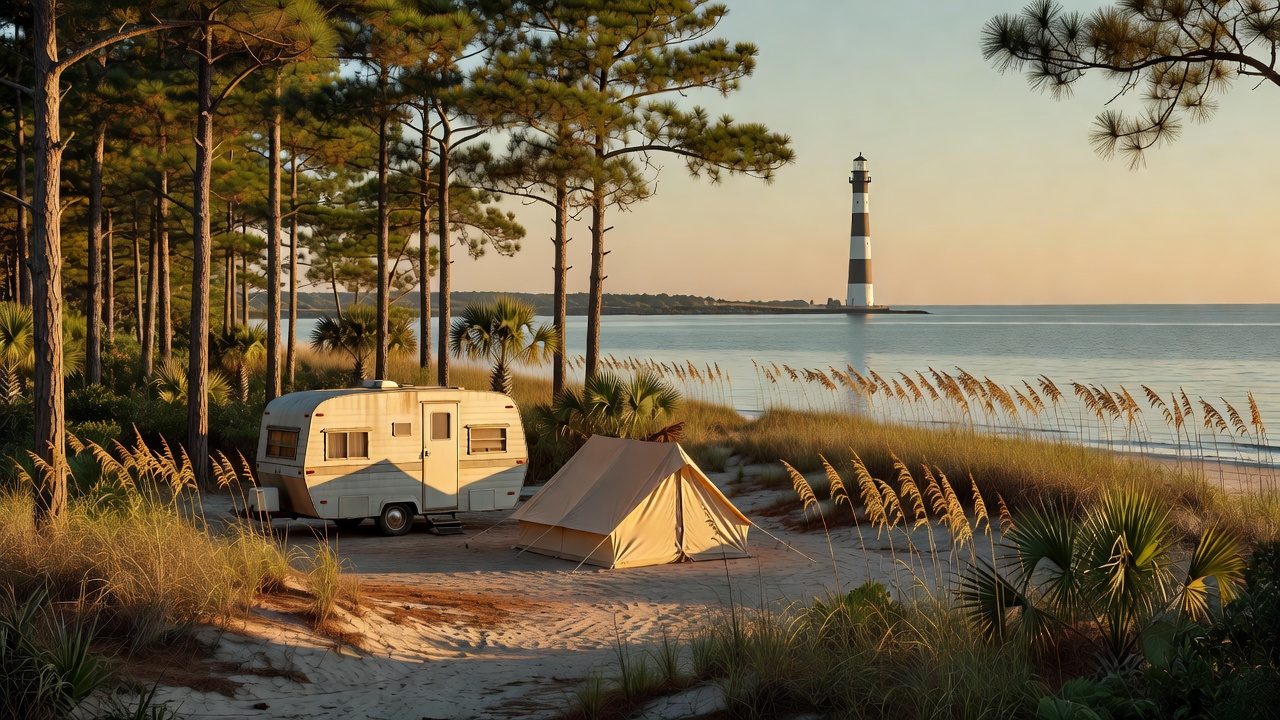
Driving west instead? Our camping in Oklahoma guide works the same ground against a different set of rules — 33 state parks on a rolling 11-month booking window, plus a federal wildlife refuge and a national recreation area that each keep their own calendar.
Quick Answer: Where to Camp in South Carolina (and When)
- Upstate mountains (Blue Ridge escarpment) — Table Rock, Devils Fork, Oconee, Caesars Head, Jones Gap, Keowee-Toxaway and Paris Mountain. This is the fall foliage zone and the one you want in mid-to-late October. Water and electric hookups at most sites; RVs to 40 feet at the bigger parks.
- Midlands and sandhills — Congaree National Park (free entry, tents and hammocks only, $15 at Longleaf / $10 at Bluff), plus Santee, Poinsett, Aiken, Dreher Island and Hickory Knob for lake camping and winter warmth.
- Coast — Hunting Island (102 electric sites plus 25 walk-in tent sites), Edisto Beach, Huntington Beach and Myrtle Beach. October and November are the sweet spot: the summer heat and the worst of hurricane season are behind you, the water is still swimmable, and the campgrounds are empty on weekdays.
- Free dispersed camping — the Francis Marion and Sumter National Forests cover four ranger districts with dispersed camping outside developed areas. Fire danger was Low in the mountains and Moderate in the Piedmont and on the coast at the time of writing.
- Book it through one portal: call 1-866-345-PARK (7275) or reserve online, up to 13 months in advance. Group camps and primitive camping still have to be booked by phone through the park.
- Comparing the Southeast? Our neighbouring guides cover camping in North Carolina, camping in Georgia, camping in Tennessee and camping in Kentucky, with camping in Virginia, camping in West Virginia and camping in Alabama as shoulder-season alternatives.
What Changed for the 2026 Season
- The state park service began publishing weekly fall foliage reports on October 1, 2026. The October 7 report from Table Rock — written by Ranger Ashley Audette — reads "still plenty of green," with the first pops of red and gold on Red Maples, Dogwoods, Sweetgums and Tulip Poplars. That is your cue to plan the Upstate for mid-to-late October, not the first weekend of the month.
- Hunting Island is dealing with king tides. The Marsh Boardwalk was scheduled to close 8:00–10:00 a.m. on Saturday 10/10 and 9:00–11:00 a.m. on Sunday 10/11, and the bridge to Little Hunting Island and Boneyard Beach was temporarily closed for visitor safety after forecast high tides. Call the park before you drive out for the beach walk.
- Table Rock is under construction. The Nature Center deck and the Carrick Creek Falls access project started July 27, 2026. The Nature Center and trailhead restrooms are closed; hikers now follow arrows through the parking lots to the Concessions Area to register and find the temporary trail access point.
- The national forest has live closures. As of this writing the Litchfield Bridge on the Francis Marion, Forest Service Road 301 (Worthys Ferry) and an emergency bridge closure off FS Road 251H were all in effect, and the Candy Branch Rifle Range was closed until further notice. Check the forest alerts page before a dispersed-camping trip.
South Carolina Is Three Camping States, Not One
The single biggest planning mistake people make here is treating "South Carolina camping" as one thing. The state is 260 miles across and 3,500 feet of elevation apart, and the three zones have different seasons, different booking pressure and different rules.
The mountains. The Blue Ridge escarpment in the northwest corner gives you granite domes, waterfalls and the state's only real elevation. Table Rock is the marquee park — the 3,124-foot granite face that gives the state its most photographed summit. Devils Fork sits on Lake Jocassee, the clearest lake in the state and the only public access to it. Oconee, Keowee-Toxaway, Jones Gap and Caesars Head fill out the ridge. This is where fall arrives first and leaves first.
The midlands and sandhills. Flatter, warmer, and built around lakes and rivers — Lake Murray at Dreher Island, Santee on the state's biggest lake, Poinsett in the high sandhills, and Congaree National Park outside Columbia, which protects the largest old-growth bottomland hardwood forest left in the United States.
The coast. Hunting Island near Beaufort, Edisto Beach, Huntington Beach at Murrells Inlet, and Myrtle Beach state park. The coast is the reason South Carolina has a genuine second camping season: while the Upstate is heading toward freezing nights, the barrier islands are sitting in the 60s well into November.
How the South Carolina State Park System Actually Works
This is the part almost nobody explains, and it is where first-timers get burned.
- One system, 47 parks, one booking channel. Reservations open up to 13 months in advance by phone at 1-866-345-PARK (7275) or online. Group camps and primitive camping must still be booked through the park directly — they are not in the online inventory.
- Two-night minimum, usually. Cabin and campsite rentals are typically accepted for a two-night minimum, and the state notes that during busier periods the minimum may be increased at some parks. Devil's Fork and Table Rock both state it explicitly.
- Check-in is 2 p.m., check-out is noon for camping at all parks. Cabins and villas are different: check-in 4 p.m., check-out 10 a.m., at every park except Hickory Knob.
- Inside one day, you call the park. Reservations requested less than one day before check-in must be made directly through the park — the same-day online window closes.
- Per-site limits are enforced. One trailer/RV plus one tent, or two tents, per site. No more than six people or one family per site. Maximum stay on a particular site is 14 nights.
- Two accessible campsites are designated for disabled campers at every state park family campground, and SC state park offices keep limited hours — 11 a.m. to noon at minimum, with busier parks open 9 to 5.
- Reservations require full payment at the time of booking for campsites, and you cannot transfer or shorten a reservation more than 12 months ahead of arrival.
That last detail — the 13-month window with a two-night minimum — is why the good coastal weekends in April and the foliage weekends in October fill up in the previous winter. If you want Hunting Island on a Saturday in October, you are competing with people who booked it last September.
The $99 Park Passport Math (and the Free Tuesday)
South Carolina charges per-visit admission, and the daily rates vary by park. The ones I checked: Hunting Island is $8 per adult, $5 for SC seniors, $4 for children 6–15; Devils Fork is $8 / $5 / $4; Table Rock is $6 / $3.75 / $3.50. Children five and under are free everywhere.
That adds up fast if you are camping a week. The state's answer is the All Park Passport:
- $99 for one year from the date of purchase, and it gets unlimited entry for everyone in the pass holder's vehicle — not just the pass holder.
- The hangtag is transferable from one vehicle to another.
- It includes free admission to the historic lighthouse at Hunting Island (up to four people per visit) and free admission to Atalaya castle at Huntington Beach (also up to four).
- Break-even is about 13 visits at $8 a head, or ten visits if you are buying for two adults at the cheaper parks. For a family doing a spring beach trip plus a fall foliage trip plus a summer week, it pays for itself in one season.
- There is a seven-day All Park Passport for $65, but it can only be bought in person at a park — not online.
- Passports are half price for South Carolina residents who are 65 or older, legally blind, or 100 percent disabled, and for active SC National Guard members. The half-price version also has to be bought in person or by calling 803-734-0156 with documentation.
- The catch: a passport does not guarantee entry if a park is full. The state says so on its own passport page, and Devils Fork in particular posts on its site when the park hits parking capacity.
And one genuine loophole people miss: admission to Devils Fork State Park is free every Tuesday. If you are camping there anyway, Tuesday is the day to arrive or to take the family in for the day.
Congaree National Park: Free Entry, Tents and Hammocks Only
Congaree is the only national park in South Carolina, it protects the largest remaining tract of old-growth bottomland hardwood forest in the country, and it costs nothing to enter. It is also the park that breaks every expectation people bring from other national parks.
There are no RV or trailer sites. None. Only tents and hammocks are allowed in the campgrounds, and you cannot sleep in your vehicle overnight — you must be in a reserved campsite or, with a permit, in the backcountry. Congaree's own page points RV campers at South Carolina's state parks instead.
There are exactly two frontcountry campgrounds:
- Longleaf Campground — $15 per night for a regular tent site, $25 for a group site. Ten individual sites and four group sites. Individual sites hold up to 8 people and 3 tents; group sites require a minimum of 9 and no more than 24 people, with a maximum of 10 tents. Each site has a fire ring and a picnic table, and there are two vault toilets at the front of the campground. There is no running water at the campground — you fill up at the Harry Hampton Visitor Center, where water is available 24 hours a day, but note that the large-container spigot is cut off in below-freezing weather while the fountains stay on. Sites are walk-up only: you park in the gravel lot and carry your gear, and the furthest sites are about 100 yards away.
- Bluff Campground — $10 per night. Six individual sites, each holding up to 8 people and 3 tents, with a fire ring and picnic table. It sits on the Bluff Trail about one mile from Longleaf, there is no vehicle access, and there are no restrooms and no water at all. You park at Longleaf or the visitor center and carry everything.
Senior and Access Pass holders get 50 percent off both campgrounds.
Backcountry camping is free — but you need a permit, and this is the part that catches people. Permit requests are handled by email to the park, and applications must be submitted at least 72 hours in advance. Requests inside that window are not considered. There are no designated backcountry sites: you pick a spot, but you must stay 100 feet from Cedar Creek, Tom's Creek, Bates Old River and Wise Lake, your site is limited to 6 campers and 3 structures, and it has to be at least 300 feet from the next closest site. Hammocks do not count as structures, which makes Congaree one of the best hammock parks in the East.
Two more rules worth knowing before you go:
- Fires are allowed only in the fire rings at Longleaf and Bluff. Open fires are prohibited in the backcountry, where a backpacking stove is the only cooking heat allowed.
- Firewood has to be bought locally and you have to be able to prove it. Congaree allows firewood only if it was purchased from a local supplier and you still have the proof of purchase and the packaging material, or if it is USDA-certified pest-free with the packaging. Dead and downed wood can be collected inside the campgrounds; cutting live trees is never allowed.
Stay limit: 14 consecutive days, and no more than 28 days in any six-month period.
Reservations for both campgrounds go through Recreation.gov or 1-877-444-6777, and you cannot pay in person at the park — you must have the reservation before you set up. Free Wi-Fi works inside and immediately outside the Harry Hampton Visitor Center, which is handy because cell signal in the bottomland is unreliable.
Hunting Island, Edisto Beach and the Coastal Window
Hunting Island State Park near Beaufort is the flagship of the South Carolina coast, and it is the park most people mean when they say they want to camp on the beach.
- 102 standard sites with water and electric hookups — 102 of them offer 20/30 and 50 amp service, and some accommodate RVs up to 40 feet while others top out at 28 feet.
- 25 designated tent sites in a walk-in tent camping area with tent pads, fire rings, picnic tables, no power and centralized water, plus a dedicated vehicle parking lot a short walk from the ocean. Standard campsites can also be used by tent campers.
- A primitive group area for organized groups at $80 per night for up to ten campers, rising by $8 for each additional person, capped at 30 people per site. Group bookings are made with the park directly at 843-838-2011.
- Generators are prohibited in the tent area, a maximum of two tents is allowed per site and they must sit on or touching the tent pad, and only one vehicle may park at the tent site itself. Alcohol rules apply here like everywhere in the system.
- Admission is $8 per adult, $5 for SC seniors, $4 for children 6–15, free for five and under.
- The live advisories matter. Beyond the king-tide closures, the bridge to Boneyard Beach — the ghost-forest stretch that made this park famous on Instagram — has been shut on and off as tides move sand. Check before you plan the walk.
For dogs, Hunting Island is generous with a catch: pets are welcome in most outdoor areas on a leash no longer than six feet, but they are not allowed on the pier, inside the lighthouse complex, or in the cabin and cabin area, and they are not permitted on the tip of North Beach past the posted markers, which protects critical shorebird habitat.
Edisto Beach, Huntington Beach and Myrtle Beach state parks round out the coast. Huntington Beach is worth the extra drive for campers because the All Park Passport includes free admission to Atalaya castle, the 1930s Moorish-style ruin on the park's grounds.
The coastal season is the reason to look at South Carolina at all in the shoulder months. The Upstate will be flirting with frost while the barrier islands sit in the 60s, which is why November is quietly the best-value month on this coast: campgrounds that were full in July are half-empty on weekdays, and the water is still warm enough for a swim.
Devils Fork and Lake Jocassee: the Boat-In Sites
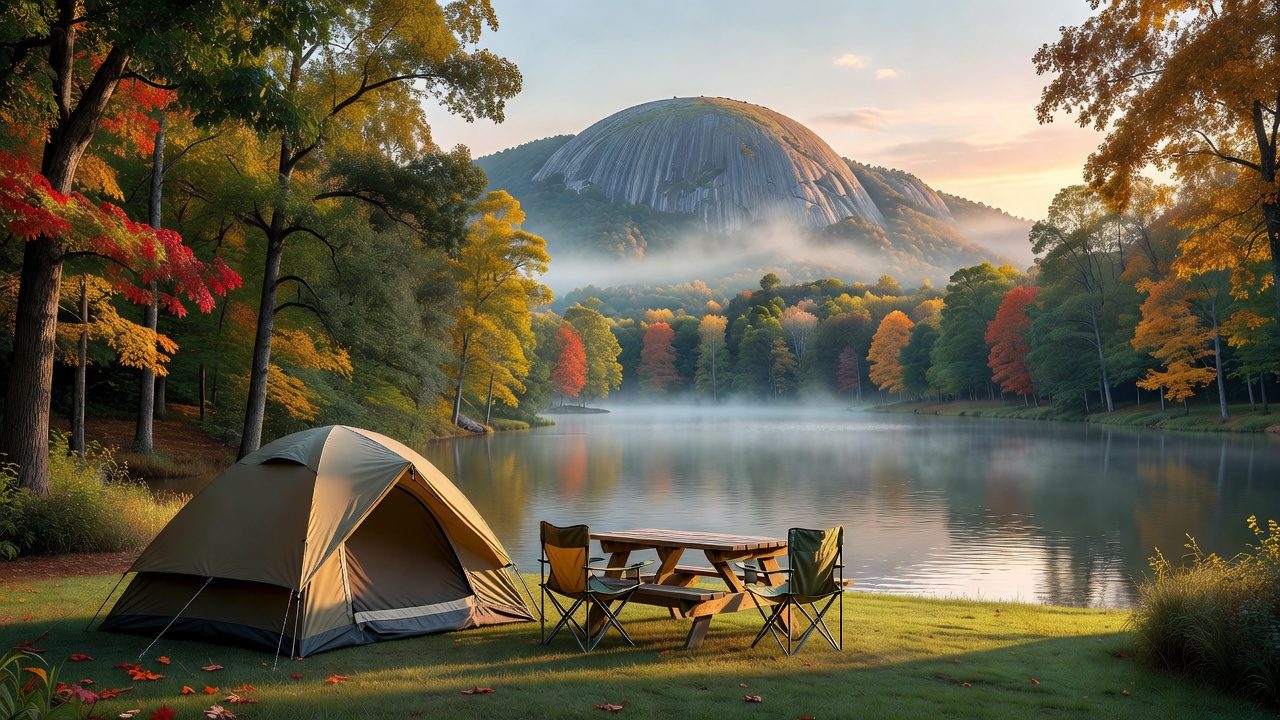
Devils Fork State Park exists for one reason: it is the only public access to Lake Jocassee, the 7,500-acre reservoir in the Blue Ridge escarpment that people describe as the cleanest lake in the Southeast. Jocassee is fed by four mountain rivers and stays startlingly clear, and because the state controls access, it has never been crowded the way a public lake would be.
The camping has three completely different flavors:
- The main lakeside campground: 59 paved sites with water and electrical hookups, some accommodating RVs up to 40 feet. Each site also has a 12-by-12-foot tent pad, and a maximum of two tents may sit on the pad or the paved surface. No tents may be placed on the ground, and every camper, vehicle and trailer has to stay on a paved surface. Each site has a picnic table and a fire ring, and there is a central dump station and trash and recycling.
- A walk-in rustic tent area: 25 elevated tent pads, one per campsite, a short walk from a central parking lot. One tent per pad, no tents on the ground, no water or electric at the site, with water spigots and restrooms next to the tent parking area.
- Boat-in backcountry sites: 25 campsites on the northern shore of Lake Jocassee at the base of Musterground Mountain, reachable only by boat and open seasonally, each with a combination fire ring and grill pit. They require a short moderate hike from the water and are booked by phone at 1-866-345-7275. This is one of the genuinely unusual camping experiences in the eastern United States.
Practical notes: check-in is 2 p.m. and check-out is noon, reservations carry a two-night minimum, two vehicles are permitted per campsite but only one vehicle per designated tent and boat-in site, and extra vehicles pay $20 per day to park in the overflow area. Laundry facilities exist but close December through February. Pets are allowed in the main campground and in villas 1–5, the park's designated pet-friendly units.
And that Tuesday loophole again: Devils Fork admission is free every Tuesday. On weekends, expect the entrance line to run long, especially between 11 a.m. and 4 p.m. — the park posts on its own site when it reaches parking capacity.
Table Rock, Caesars Head and the Upstate Foliage Window
Table Rock State Park is the park South Carolinians name when you ask where the mountains are. The 3,124-foot granite face above the Piedmont is the state's signature summit, and the park is also the state's fall foliage headquarters — the park service's weekly foliage reports are written from here.
The camping is bigger than people expect: a 69-site camping area near the park entrance and a 25-site area near the White Oaks picnic area, both with individual water and electrical hookups and picnic tables, with some sites taking RVs up to 40 feet and both convenient to restrooms with hot showers. That is 94 standard sites in total. There is also a primitive walk-in area near Lake Oolenoy with central water, and six primitive tent sites at Pine Point — no flush toilets and no power, and the hike in is 880 yards. Three primitive group areas take organized groups: Fox Hill (six tent pads), Owl Tree (eleven pads) and Bobcat Creek (seven pads).
Three things about Table Rock that surprise people:
- Camping anywhere inside the park's trail system is prohibited. The park gates lock each night and hikers must be off the trails before the gates close. Overnight hiking here means the Foothills Trail outside the park boundary, and only after the blaze marks change from yellow and white to white only.
- Dogs are welcome in four cabins only — cabins 4, 9, 10 and 11 — and not in any other cabin, indoor area or on the swim beach. Everywhere else in the park, pets must stay leashed, including on the hiking trails.
- The 2026 construction is real. With the Nature Center and trailhead restrooms closed since late July, you now register for hiking at the Concessions Area.
For foliage, the state's own foliage page names 13 parks as the best viewing, and the Upstate dominates the list: Caesars Head, Devils Fork, Jones Gap, Keowee-Toxaway, Kings Mountain, Oconee, Oconee Station, Paris Mountain, Table Rock — plus Chester, Lee, Musgrove Mill and Poinsett outside the mountains. Caesars Head and Jones Gap are the ridge-top drives; Table Rock is the one with the webcam and the weekly report. Plan mid-to-late October and check the report the week you go, because the 2026 season was running green into the second week of October.
Camping in South Carolina in October and November
October is the month the state splits in half. In the Upstate around Table Rock and Devils Fork, nights drop into the 40s and the hardwoods turn — this is the peak window, and it is why the mountain campgrounds fill on the first three weekends of the month.
November flips the priority. The mountains get genuinely cold at night, some seasonal facilities wind down, and the coast becomes the best camping in the Southeast: Hunting Island, Edisto Beach and Huntington Beach sit in the 60s during the day with far fewer people than in summer. It is also the month when the 13-month booking window starts working against you for the following spring — if you want a coastal weekend in April, November is when to book it. For the wider Southeast picture, our peak foliage window guide and where to camp in October cover the neighbouring states, and camping in November tracks which regions are still open.
Thanksgiving is the single busiest camping weekend of the South Carolina year outside of summer. The state parks run a two-night minimum that frequently stretches to three or four over the holiday, and the good sites are gone four to six months out. If that is your plan, book it now rather than in October.
Fire, Alcohol and the Rules That Actually Apply
These are the rules that generate the most surprised messages from people who camp in other states.
- Firewood. Buy it locally. South Carolina's forest health authorities ask that firewood come from within 10 miles of the park where possible, and say under 50 miles is acceptable. Neighbouring states including North Carolina, Virginia and parts of Tennessee and Georgia are under quarantine for pests like Emerald Ash Borer, Thousand Cankers Disease and European Gypsy Moth, and it is illegal to move regulated items such as firewood from a quarantined zone into South Carolina.
- Alcohol. It is unlawful to consume or display in public any beverage of alcoholic content, including beer and wine, in a South Carolina state park, except where specifically authorised by the department. That is not a park-by-park policy — it is state law, Title 51, Chapter 3, Section 145 of the 1976 Code. A visible cooler of beer on an otherwise quiet campsite is the kind of thing that turns into a ticket.
- Fires must be confined to designated grills or fire rings. In Congaree's backcountry there is no fire at all — stove only.
- Dogs must be on a leash or other physical restraint no longer than six feet at all times, and pets are not allowed in or around lodging facilities unless you have one of the designated pet-friendly cabins or villas.
- Golf carts need a valid permit displayed at all times and a licensed driver.
- Parking: roadside parking is prohibited and parking on an unoccupied campsite is prohibited.
- Campground setup: one trailer/RV and one tent, or two tents, per site — and no more than six people or one family.
- Quiet: creating noise that annoys others is on the state's list of unlawful acts. Generators are flatly prohibited at Hunting Island's tent area.
If you would rather skip reservation systems altogether, our dispersed camping guide covers the free national-forest nights, and the camping with dogs guide goes deeper on pet rules for the coast and the bottomland. Planning the November holiday instead? Thanksgiving camping explains why the two-night minimum stretches that weekend.
Camping in South Carolina With Kids and Dogs
South Carolina is an unusually good family camping state, mostly because the state park system was built for it. Two accessible campsites are reserved at every park, the restrooms at significant parks have hot showers, and most of the big parks run junior ranger and interpretive programs.
For families, the three best setups I have found:
- Hunting Island's walk-in tent area — tent pads, fire rings, picnic tables, a real parking lot a short walk from the ocean, and no generators. It is the closest thing in the state to beach camping with training wheels.
- Devils Fork's elevated tent pads — level, paved, drain in a storm, and no tents on bare ground, which matters after a Jocassee rain.
- Table Rock's 94-hookup-site main campground — hot showers, laundry and a dump station, with a swim beach and the Carrick Creek trail for younger kids.
For dogs, the state's rules are uniform and easy to remember: six-foot leash, always, pets welcome in most outdoor areas. The parks with designated pet-friendly lodging are Devils Fork (villas 1–5), Table Rock (cabins 4, 9, 10 and 11), Oconee (cabins 14–20), Santee (cabins 11–20), Dreher Island (camper cabins 2–5), Lake Hartwell (camper cabins 1, 2 and 5) and Barnwell (cabin 2). Everywhere else, pets are not allowed in or around the lodging.
On the coast, remember the two dog-specific closures: the tip of North Beach at Hunting Island is off-limits past the markers for shorebird habitat, and the pier and lighthouse complex are closed to pets. At Congaree, trail and boardwalk rules for pets are posted at the visitor center and can change with conditions — ask when you arrive rather than assuming.
South Carolina Camping Gear List
South Carolina in October asks for two gear kits, and knowing which one you are packing is half the battle. The mountains need a real three-season sleep system and rain layers. The coast needs shade, bug protection and a way to keep sand out of everything. Everything below is in the TrailMapz catalog.
Shelter and sleep
- Coleman 4/6/8/10 Person Instant Camping Tent with 1-Minute Setup ($180.00) — the one-minute-setup tent that made instant cabins the default for families; the 6-person version is the sweet spot for a family of four who want room for gear.
- CORE 6 Person Instant Cabin Tent | Portable Large Pop Up Tent with Easy 60 Second Camp Setup for Family Camping ($169.99) — a blackout-lined instant cabin that keeps the Upstate's early sunrise out of your tent at 7 a.m.
- Coleman Skydome 4-Person Camping Tent with LED Lighting | Weatherproof Pre-Attached Poles, 5-Minute Setup ($122.99) — Coleman's four-person dome with built-in LED lighting, which is genuinely useful when the park gates lock at dark.
- CAMPROS CP 8 Person Camping Tent with Room Divider and Rainfly ($159.98) — an eight-person, two-room tent with a divider, the right call if you are bringing kids who need a wall between them.
- Kelty Late Start 2P Backpacking Tent ($159.95) — a two-person backpacking tent for the Congaree backcountry permit trip.
- Forceatt 2-Person Camping Tent — Waterproof Windproof Lightweight Backpacking Tent with Aluminum Poles ($57.18) — a budget two-person tent if you are flying in and buying gear on arrival.
- Therm-a-Rest Z Lite Sol Sleeping Pad ($54.95) — a closed-cell pad that cannot puncture, which matters on Congaree's pine duff.
- Therm-a-Rest NeoAir XLite NXT Sleeping Pad ($209.95) — the ultralight insulated pad for shoulder-season mountain nights.
- Klymit Static V Sleeping Pad ($64.95) — a good-value inflatable pad for three-season state park camping.
- Coleman Oak Point Big & Tall 30°F Sleeping Bag ($74.99) — a 30°F big-and-tall rectangular bag, which is about right for an Upstate October.
- TETON Sports Celsius XXL 0 Degree Sleeping Bag ($89.99) — the wider 0°F version if you are camping Table Rock in November.
Hammocks and hammock camping
Congaree is one of the best hammock parks in the East — hammocks do not count against the three-structure limit in the backcountry, and they are explicitly allowed in the frontcountry campgrounds.
- ENO DoubleNest Lightweight Camping Hammock (1-2 Person) ($75.00) — the two-person hammock that most people start with.
- Wise Owl Outfitters Camping Hammock – up to 500lbs Portable Hammock with Tree Straps ($43.91) — a budget hammock with straps, good for a first Congaree trip.
- ENO Atlas Suspension System - Tree Strap for Hammock ($29.95) — tree straps that protect the bark, which is what the park is actually protecting.
- Wise Owl Outfitters Hammock Bug Net – Mosquito Net for Hammock ($27.99) — a bug net, non-negotiable in the bottomland from spring through fall.
- OneTigris Hideout Hammock Underquilt (Full Length, 4-Season) ($39.98) — an underquilt for the cold snaps that roll into the Upstate in late October.
Kitchen
- Coleman Triton+ 2-Burner Propane Camping Stove ($149.99) — a two-burner propane stove that handles a family breakfast, and the standard for state park camping.
- Coleman Bottle Top Propane Camp Stove — Single Burner, 10,000 BTU ($21.99) — a single-burner bottle-top stove for a quick coffee and eggs before a trailhead.
- MSR PocketRocket 2 Ultralight Backpacking Stove ($49.95) — the lightweight canister stove for Congaree's backcountry stove-only rule.
- GASPRO Solid Brass 20 lb to 1 lb Propane Tank Adapter ($9.98) — the adapter that lets you run a one-pound appliance off a 20-pound tank, which is how you stop buying disposables.
- Gas One Propane Refill Adapter with 4-Ft Hose (1 lb to 20 lb) ($14.99) — the refill adapter for topping one-pound cylinders off a bulk tank.
- Coleman 70-Quart Xtreme 5-Day Heavy-Duty Cooler ($79.99) — a 70-quart five-day cooler that survives a November coastal weekend.
- Lodge Pre-Seasoned Cast Iron Deep Camp Dutch Oven with Lid, 6 Quart ($59.95) — a six-quart cast-iron Dutch oven that is at its best over a fire ring in 50-degree weather.
- Lodge Pre-Seasoned Cast Iron Skillet, 10.25 Inches ($19.99) — the everyday 10.25-inch cast-iron skillet.
- Stanley Wildfare Core 26-Piece Complete Camp Kitchen Cook Set ($179.99) — a 26-piece nesting camp kitchen if you want one box for everything.
- AeroPress Original Coffee Press — Manual Single-Serve Brewer ($39.95) — the manual coffee press for people who will not drink camp coffee.
Water
- Sawyer Squeeze Water Filtration System — 0.1 Micron Absolute Hollow Fiber Membrane, 3 oz, 100,000-Gallon Capacity ($45.95) — a 0.1-micron filter that makes Congaree's Cedar Creek water drinkable, which matters on the backcountry permit trip.
- Coleman 5-Gallon Water Carrier, Blue ($13.99) — a five-gallon carrier for a campsite with no water at all, like Longleaf.
- Nalgene BPA-Free Tritan Wide Mouth Water Bottle, 32 oz, Gray with Black Lid ($16.99) — the reliable 32-ounce bottle.
- Hydro Flask 32 oz Wide Mouth Insulated Water Bottle with Straw Lid ($44.95) — an insulated 32-ounce bottle, the one thing that actually helps on a warm November coast day.
- Stanley All Day Julienne Soft Cooler Bag and Lunch Box | Insulated Travel Bag with Zipper | BPA-Free ($100.00) — a soft cooler bag for trail lunches.
Light and power
- Petzl ACTIK CORE Headlamp — Powerful, Rechargeable 625 Lumen Light with Red Lighting for Hiking, Climbing, and Camping ($79.95) — a rechargeable 625-lumen headlamp, enough for a night walk back from the beach.
- Black Diamond Spot 400 Headlamp — 400 Lumen Waterproof Dual-Fuel Camping Light ($39.95) — the dual-fuel 400-lumen headlamp, which takes AAAs when you forget to charge it.
- MalloMe Camping Lantern Multicolor 4 Pack ($23.99) — a four-pack of lanterns to light a picnic table and a tent for a family.
- Black Diamond Moji Lantern — Compact 200 Lumen Dimmable Camping Lantern ($24.95) — a compact dimmable lantern for a two-person site.
- EF ECOFLOW RIVER 2 Portable Power Station, 256Wh LiFePO4 300W Solar Generator ($169.00) — a 256Wh power station for charging phones and running a small fan.
- Jackery Explorer 300 Portable Power Station, 292Wh LiFePO4 Battery Solar Generator ($199.00) — the 292Wh version if you are also charging camera batteries and a laptop on a work-from-camp week.
Layers and footwear
- Columbia Men's Watertight II Rain Jacket ($60.00) — a packable rain shell; the mountains of the escarpment get rain that the coast never sees.
- Columbia Men's Steens Mountain 2.0 Full Zip Fleece Jacket ($34.99) — a fleece mid-layer for a 45-degree Upstate morning.
- Columbia Men's Midweight Stretch Omni-Heat Base Layer Top — Thermal-Reflective Crew ($49.99) — a thermal base layer top for the cold snap weekends in November.
- Smartwool Unisex Thermal Merino Reversible Cuffed Beanie ($35.00) — a merino beanie, the cheapest warmth you can pack.
- Smartwool Thermal Merino Reversible Neck Gaiter ($32.00) — a merino neck gaiter for wind at Caesars Head.
- Merrell Men's Moab 3 Waterproof Hiking Shoe ($129.95) — a waterproof hiking shoe for the Table Rock granite and the Congaree mud.
- Merrell Men's Moab 3 Hiking Boot ($89.99) — the boot version for heavier loads on the Foothills Trail.
- Darn Tough Vermont Men's Light Hiker Micro Crew Lightweight Hiking Socks ($24.95) — merino hiking socks that survive a wet day in the bottomland.
- Darn Tough Vermont Hiking Socks for Women - Merino Wool Women's ($25.95) — the women's cut of the same sock.
Comfort and camp furniture
- Coleman Portable Camping Chair with 4-Can Cooler, Cushioned Seat & Back ($39.99) — a camp chair with a built-in four-can cooler, which is the correct state park accessory.
- SUNNYFEEL Folding Low Beach Chair 2 Pack - Lightweight Portable Lawn Chair with Mesh Back & Cup Holder ($67.99) — low beach chairs for a Hunting Island weekend.
- GCI Outdoor Compact Camp Table 20 Outdoor Folding Table ($45.00) — a compact camp table that folds flat into the trunk.
- Coleman Pack-Away 4-in-1 Adjustable Height Folding Camping Table ($99.99) — an adjustable-height four-in-one table that works as a prep surface and a dining table.
- NEMO Fillo Elite Luxury Camping Pillow ($59.95) — a luxurious packable pillow, which is the difference between sleeping and not.
- Wise Owl Outfitters Camping Pillow ($24.99) — a budget camp pillow that packs to nothing.
- EVER ADVANCED 6 Person Camping Tent, Blackout Design Tent for Camping Instant Cabin Tents for Family with Rainfly, 60s Easy Setup, Water-Resistant ($169.99) — a blackout six-person tent for families who sleep past dawn.
- KingCamp Instant Shower Tent, Portable Superior Stable Privacy Shelter, Large Room Outdoor Toilet Tent with Floor ($129.99) — a privacy shelter, which doubles as the answer to a campground with no showers.
Moving gear
- Osprey Talon 22 Men's Lightweight Hiking Backpack ($139.95) — a 22-liter daypack for day hikes out of a base camp.
- Osprey Daylite Plus Commuter Backpack, Black ($75.00) — the slightly larger version with a better laptop sleeve if you are driving, not flying.
- TrailBuddy Trekking Poles — Lightweight 7075 Aluminum Hiking Poles (Pair) ($44.91) — aluminium trekking poles for the Table Rock and Jones Gap descents.
- Cascade Mountain Tech Carbon Fiber Trekking Poles (Quick Lock) ($49.95) — carbon poles for the weight-conscious.
- Osprey Jet 18L Kid's Hiking Backpack, Green ($80.00) — an 18-liter kids' pack so the children carry something small.
Safety
- Adventure Medical Kits Ultralight/Watertight Medical Kit .7, (3 Person) ($44.95) — a compact three-person medical kit made for wet, humid trips.
- UCO Stormproof Match Kit with Waterproof Floating Case — 25 Windproof Matches + 3 Strikers ($12.99) — stormproof matches in a floating case, which work after a Jocassee soaking.
- Fiskars X7 Small 14" Hatchet Axe with Sheath — Forged Steel Head, Shock Absorbing Handle for Camping & Firewood ($29.99) — a small hatchet for splitting locally purchased firewood to size.
- Leatherman Rev Multi-Tool — 10-in-1 Stainless Steel Pocket Tool ($39.95) — a ten-in-one multi-tool for the usual campground repairs.
- OFF! Clean Feel Insect Repellent Aerosol with 20% Picaridin - Long-Lasting DEET-Free Protection from Mosquitoes, Fragrance-Free Pest Control For Ticks ($11.99) — picaridin repellent; Congaree's mosquito reputation is earned between spring and fall.
- Murphy's Naturals Mosquito & Tick Bug Repellent Spray, 6 fl oz (Pack of 2) ($28.49) — a DEET-free repellent spray for kids' skin.
- HomeSake Tick Remover Tool for Dogs, Cats and Humans (3 Pack) ($14.39) — a tick removal tool, essential for the maritime forest and the bottomland alike.
- Garmin inReach Mini 2, Lightweight and Compact Satellite Communicator, Hiking Handheld, Black ($349.99) — a satellite communicator for the Congaree backcountry, where cell signal is unreliable.
- Kidde Carbon Monoxide Detector, AA Battery Powered, Portable for Travel or Home ($23.97) — a battery carbon monoxide detector if you are heating a tent.
Dog kit
- Ruffwear Front Range Dog Harness ($44.95) — a front-clip harness for a six-foot leash rule.
- Ruffwear Quencher Collapsible Dog Bowl (Medium) ($19.95) — a collapsible bowl, because Longleaf has no running water.
- Musher's Secret Paw Wax, 200g ($24.99) — paw wax for the oyster-shell beaches and the granite slabs.
- Cibaabo Dog Water Bottle Portable with Food Container & Filter ($14.98) — a water bottle with a built-in bowl for day hikes.
- Dog Paw Cleaner, Clean Paws, No Rinse Foam Cleaner with Brush, 5 fl oz | Dandylion Dog Paw Washer, Fragrance Free, pH Balanced, Waterless, Foaming Was ($17.99) — a paw cleaner for the pluff mud that Edisto and Hunting Island are famous for.
For the newest state in the family — the Ozarks, three trout parks and a twelve-month booking window — see our Missouri camping guide.
Planning Shortcuts: The Questions People Actually Type
If you are searching for camping in south carolina state parks, the short answer is one booking system: 1-866-345-PARK, thirteen months out, two-night minimum. For camping in south carolina on the beach, that is Hunting Island's walk-in tent area, Edisto Beach or Huntington Beach, and November is the value month. camping in south carolina mountains means Table Rock, Devils Fork, Oconee and Caesars Head, with mid-to-late October as the foliage window, while camping in south carolina coast and camping in south carolina with cabins both point at the same 220-unit cabin and villa inventory, bookable in the same portal. If you want a campsite in south carolina or just campgrounds in south carolina that take a big rig, the state park system is your friend — 40-foot sites at Devils Fork, Table Rock and Hunting Island — but Congaree is not.
For the booking questions: south carolina state parks camping reservations open up to 13 months ahead with full payment at booking, south carolina state parks camping map and the park finder on the state's own site cover all 47 properties, south carolina state parks camping with full hookups describes the standard water-and-electric sites at Devils Fork, Table Rock, Hunting Island and most lake parks, south carolina state park camping fees run $6–$8 per adult per day for admission on top of the site fee, and the south carolina state park camping senior discount is real — SC residents 65 and older get reduced admission, camping and passport rates, and out-of-state visitors get the same break at six parks.
On Congaree: congaree national park camping costs $15 at Longleaf and $10 at Bluff with free backcountry camping, congaree national park camping reservations go through Recreation.gov or 1-877-444-6777 with no in-person payment, congaree national park camping free is exactly right for the backcountry permit — free, but emailed at least 72 hours ahead — and congaree national park backcountry camping means no designated sites, 100 feet off the water, 300 feet between sites, six people and three structures per site, and no open fires.
For the two parks people search by name: hunting island state park camping is 102 electric sites plus 25 walk-in tent sites with the king-tide caveat on Boneyard Beach, hunting island state park camping reservations fill fastest for spring weekends so book in the previous autumn, table rock state park camping is 94 hookup sites and a primitive area where camping inside the trail system is prohibited, and devils fork state park camping is 59 paved lakefront sites plus 25 elevated tent pads plus 25 boat-in sites on Lake Jocassee — free admission on Tuesdays.
And for the month question: camping in south carolina in october splits the state — mountains for foliage, coast for warm days — while November pushes everyone to the coast and books out the following spring.
South Carolina Camping FAQ
Do I need a reservation to camp in a South Carolina state park?
Yes. South Carolina state parks run on a reservation system and reservations can be made up to 13 months in advance by calling 1-866-345-PARK (7275) or booking online. Campgrounds are typically two-night minimums, and during busy periods the minimum may be raised. Reservations requested less than one day before check-in must be made directly through the park. Campsite reservations require full payment at the time of booking.
What time is check-in and check-out?
For camping at all South Carolina state parks, check-in is 2 p.m. and check-out is noon. For cabins and villas, check-in is 4 p.m. and check-out is 10 a.m., at every park except Hickory Knob. Late arrival instructions are emailed when you book.
Can I bring alcohol to a South Carolina state park?
No — and this surprises people who camp in other states. It is unlawful for any person to consume or display in public any beverage of alcoholic content, including beer and wine, except where specifically authorised by the department. That is state law rather than a park policy, so it applies across all 47 parks.
Does Congaree National Park allow RVs?
No. Congaree permits only tents and hammocks in its two campgrounds, Longleaf and Bluff. There are no RV or trailer sites, and overnight sleeping in a vehicle is not allowed — you must have a reserved campsite or a backcountry permit. Congaree's own page directs RV campers to South Carolina's state parks, where Devils Fork, Table Rock and Hunting Island all take rigs up to 40 feet.
How much does it cost to camp at Congaree?
Longleaf Campground is $15 per night for a regular tent site and $25 for a group site. Bluff Campground is $10 per night. Backcountry camping is free with a permit. Senior and Access Pass holders get 50 percent off. Entrance to the park is free, and reservations must be made through Recreation.gov or 1-877-444-6777 — you cannot pay in person.
How far in advance do I need a Congaree backcountry permit?
At least 72 hours. Backcountry permits are free but must be requested by email to the park, and the park states that requests made inside the 72-hour window will not be considered. Once you are out there, the rules are no designated sites, stay 100 feet from Cedar Creek, Tom's Creek, Bates Old River and Wise Lake, a maximum of 6 campers and 3 structures per site, and 300 feet between your site and the next.
Can I bring firewood into a South Carolina campground?
Buy it locally. South Carolina's forest health guidance is firewood from within 10 miles where possible, and under 50 miles acceptable — and wood from North Carolina, Virginia and parts of Tennessee and Georgia, which are under pest quarantine, cannot legally be brought into the state. At Congaree the rule is stricter: firewood is allowed only with proof of purchase and the original packaging from a local supplier, or USDA certification that it is pest-free.
Is South Carolina good for camping in November?
Yes — it is arguably the best month. The Upstate mountains get cold, but Hunting Island, Edisto Beach and Huntington Beach sit in the 60s during the day with far fewer people than summer. Book early anyway: the 13-month window means the following spring's coastal weekends start disappearing in November.
Crossing into the Ozarks next? The camping guide for Arkansas covers the Buffalo River and the county burn-ban map.
The Bottom Line
South Carolina is the most underrated camping state in the Southeast, and the reason is that it refuses to be one thing. You can sleep under hammocks in an old-growth swamp at Congaree for ten dollars, camp on a barrier island with a lighthouse for eight, paddle your gear to a backcountry site on Lake Jocassee, and watch the Blue Ridge turn gold from a granite dome at Table Rock — all inside a single system that books thirteen months out and covers your whole vehicle for $99 a year.
The three rules that will save you a wasted trip: book early and accept the two-night minimum, pack for the zone you actually chose rather than the state as a whole, and buy your firewood within ten miles of where you plan to burn it. Do those three things and the rest is just the drive.
<!-- AFFILIATE_DISCLOSURE -->If you are mapping a fall or early-winter trip and Maryland is on the shortlist, the Maryland camping guide covers the four land systems, the closure dates, and the wild-horse rules in one place.