Camping in Colorado 2026: State Parks, Aspen Season & Where to Camp in the Rockies
Where to camp in Colorado in 2026 — the four separate camping systems (CPW state parks, national forest dispersed camping, BLM, and the national parks), which state park campgrounds are worth booking, the 6-month reservation window on CPWshop.com, RMNP timed entry through October 12, the 14-day dispersed camping rule, the aspen window by elevation, fire restrictions, and the gear that holds up at 9,000 feet.
Colorado is the state where the elevation is the destination. You can leave Denver at 5,280 feet in a t-shirt, drive ninety minutes, pitch a tent at 9,400 feet among a grove of aspens that have just gone gold, and eat dinner in a fleece while the temperature drops through 35°F before dark.
That is the good version. The version families run into is a trip planned against the wrong assumption — that Colorado camping is one thing you book one way. It is not. Colorado runs at least four separate camping systems, each with its own reservation portal, its own booking window, and its own closing date in the fall. Get the system wrong and you will either be shut out of the site you wanted or drive home a day earlier than you planned.
This guide covers all four systems, the state park campgrounds actually worth booking, the reservable national park campgrounds, the free dispersed camping rules, what "fire restriction" means in practice, the aspen timing by elevation, and the gear that makes a 9,000-foot September night comfortable instead of miserable.
Quick Answer: Where to Camp in Colorado
- Colorado State Parks are the reliable family option. 4,000+ campsites and 58 cabins and yurts across the system, all booked through CPWshop.com, with a six-month advance reservation window where each new date opens at midnight Mountain Time.
- Most state park campgrounds stay open into October, and several are open year-round. Front Range parks like Chatfield, Cherry Creek and Boyd Lake run all year; the mountain parks start closing loops as the snow arrives.
- Rocky Mountain National Park needs a timed entry reservation from 9 a.m. to 2 p.m. daily through October 12, 2026. Outside those hours you can drive in without one.
- Camping in the national forest is free on most U.S. Forest Service and BLM land — no reservation, no fee, no facilities — under a 14-day limit in any 30-day period.
- Nights at altitude are cold even in September. Plan on 28–35°F at 9,000 feet after a clear night, and bring a bag rated well below the air temperature you expect.
- Check fire restrictions the week you go, not the month you plan. Colorado's county-by-county restrictions change with every dry spell.
What Just Changed for Fall 2026: Early Aspens and the End of Timed Entry
Two timing notes matter if you are reading this in late September 2026.
The aspen color is running early. After a dry summer in the high country, the color change at the top elevations arrived roughly a week ahead of the historical pattern, with the strongest gold showing in the 9,000–11,000-foot band in mid-to-late September. The practical consequence: if you were planning to aim for the first weekend of October at high elevation, you may already be late. Move the trip down in elevation instead of cancelling it — the mid-elevation and foothill groves run a week or two behind the high passes and hold their color longer.
Rocky Mountain National Park's timed entry season ends October 12, 2026. From May 22 through October 12, a timed entry reservation is required between 9 a.m. and 2 p.m. daily to drive into the park. Before 9 a.m. and after 2 p.m., you can drive in without a reservation. There are two permit types — a general timed entry permit, and a separate one that also covers the Bear Lake Road corridor — and both are booked on Recreation.gov. That October 12 end date is also the last week of the park's busiest fall window, which means the permits you want are the ones with the least availability.
One more seasonal note worth knowing: mid-to-late September is the elk rut, and the bugling peaks around now. Moraine Park and Horseshoe Park at dawn are the classic listening spots — and the reason the park is busiest at the exact hours the timed entry permit is required.
How Colorado Camping Actually Works: Four Systems in One State
Before you pick a place, decide which system you are booking inside. They do not share a portal and they do not share rules.
1. Colorado Parks and Wildlife (CPW) state parks. This is the largest bookable system: 4,000+ campsites plus 58 cabins and yurts, spread across the state's park system from the Front Range reservoirs to the Western Slope. Everything goes through CPWshop.com with a six-month rolling reservation window — a given arrival date becomes bookable exactly six months out, opening at midnight Mountain Time. That midnight detail is not trivia: for holiday weekends and peak-aspens weekends, the desirable sites in the mountain parks are gone within minutes of the date opening. If you want a specific site, you book at 12:00 a.m. six months ahead, not "sometime that week."
2. U.S. Forest Service dispersed camping. Colorado has 11 national forests and a great deal of them allow free dispersed camping outside developed campgrounds. No reservation, no fee, no fire ring, no toilet. You drive a forest road until you find a legal pull-off, camp, and leave no trace. The limits are spelled out below.
3. Bureau of Land Management land. Mostly on the Western Slope and the high desert — think red rock canyon country rather than alpine. Same free-dispersed model, same 14-day structure, different landscape.
4. National Park Service campgrounds. Rocky Mountain National Park, Great Sand Dunes, and Black Canyon of the Gunnison all have developed campgrounds, and all of them book on Recreation.gov rather than CPWshop.com. These are the ones people discover too late.
One practical cost note: Colorado residents can add the Keep Colorado Wild Pass to a vehicle registration for a small annual fee, which covers state park entry for that vehicle. Out-of-state visitors pay a daily or annual parks pass instead. Either way, the pass is separate from the campsite fee — budget for both.
Colorado State Park Campgrounds Worth Booking
Not all state park campgrounds are equal, and a few are genuinely worth planning a trip around. These are the ones families come back to:
- Golden Gate Canyon State Park — about 45 minutes from Denver, up in the foothills. Aspen groves, a creek, and the closest real mountain camping to the city. Reservable sites go fast on fall weekends.
- Staunton State Park — granite domes and ponderosa pine southwest of Denver. Newer park, excellent trails, and a small campground that books out far ahead.
- Mueller State Park — on the Pikes Peak side, with aspen and a good chance of seeing the color from your site. Electric sites and a handful of cabins.
- Eleven Mile State Park — big-sky reservoir country west of Colorado Springs. Windy, open, superb fishing, and one of the best dark skies you can camp under close to the Front Range.
- Ridgway State Park — the San Juan Mountains near Ouray, which makes it the best base camp for the Ouray and Crested Butte aspen drives. Dutch Charlie and Pa-Co-Chu-Puk loops have electric and full-hookup sites.
- Steamboat Lake State Park — Hahn's Peak reflected in the lake, north Colorado. Quiet in September, cold at night, and a genuinely beautiful place to wake up.
- State Forest State Park — Cameron Pass country, remote and high, with moose in the willow bottoms and yurts you can rent instead of tenting.
- Chatfield and Cherry Creek State Parks — the Front Range defaults. Reservoir camping 30 minutes from downtown Denver. Useful for a shakedown trip or a late-season weekend when the mountain parks have closed. Chatfield's rules are typical of the system: check-in at 1 p.m., check-out at noon, a maximum of two sleeping units per site (two tents, or one hard-sided unit plus one tent), and a maximum of six people per site.
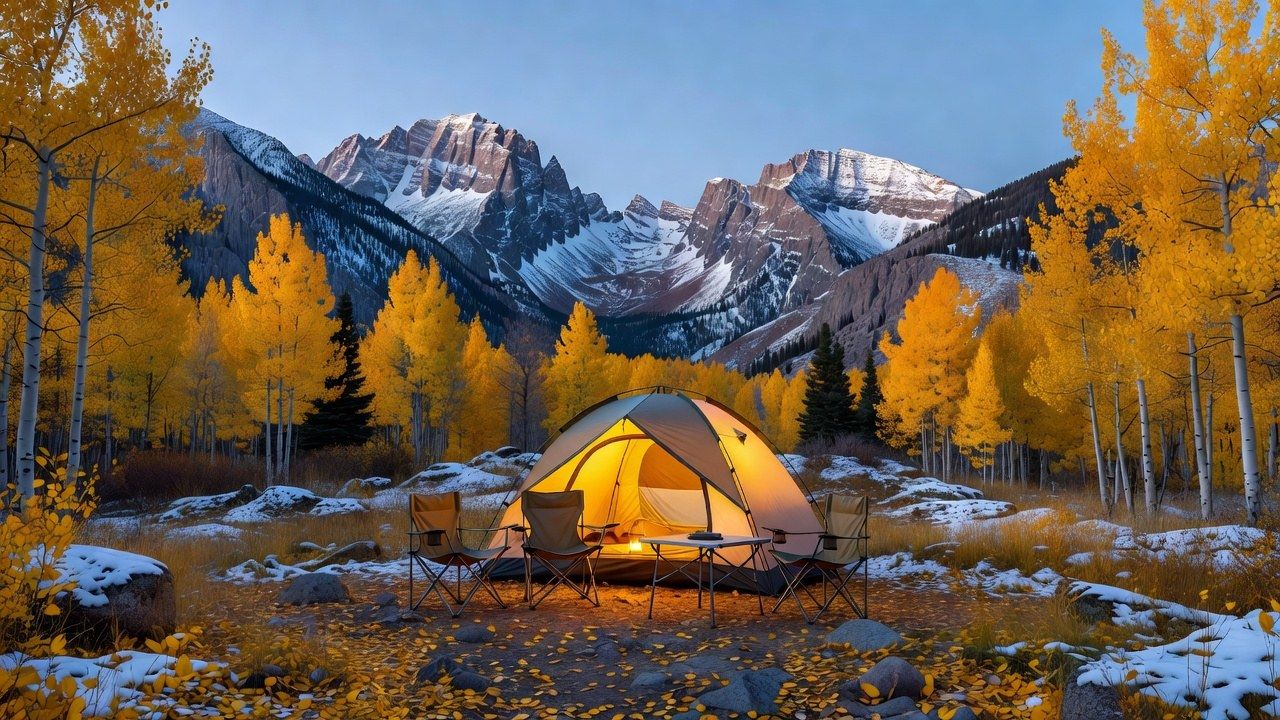
If you are pulling a trailer or driving a longer rig, check the specific loop — hookup availability and site length vary enormously between parks, and the mountain parks fill their electric loops first.
Camping in Colorado in September
September is the best month to camp in Colorado, and it is not close. The monsoon pattern has broken, the afternoon thunderstorms stop being a daily event, the crowds thin the moment school starts, and the aspens begin turning at the top of the state before anywhere else.
What to expect:
- Temperature: 70s°F by day at 8,000–9,000 feet, dropping to the low 30s at night. At 10,000 feet, expect the mid-20s after a clear night.
- Color: high-elevation aspen groves (9,000–11,000 feet) turn from the third week of September, and in a dry year like 2026 they turn early.
- Availability: dramatically better than July. State park sites that were impossible to book in summer open up midweek, and dispersed sites that were full every night in August start to empty.
- Wildlife: this is the elk rut. Bugling carries a long way at dusk, and it is the single best wildlife experience available to a family camped in Colorado in the fall.
The one September risk is a fast cold front: a system can drop six inches of snow on a pass overnight and close it, which is exactly how a beautiful camping weekend turns into a rerouted drive. If your plan depends on a specific high pass, have a lower-elevation backup.
Camping in Colorado in October
October splits Colorado in two. Below 8,000 feet — the Front Range parks, the foothills, the Western Slope canyons — October is prime camping weather: sunny days, crisp nights, no bugs, no crowds, and the best light of the year. In the high country, October is the beginning of the end of the season.
- Front Range reservoirs (Chatfield, Cherry Creek, Boyd Lake): open year-round, and October and early November are some of their best weeks.
- Mountain state parks: many keep main loops open into mid-October, then close water systems and loops as the freeze sets in. Confirm before you drive.
- Rocky Mountain National Park: timed entry runs through October 12, then ends for the year; campground availability narrows as seasonal campgrounds close. Moraine Park is the one that stays open the longest — but confirm on Recreation.gov before basing a trip on it.
- Aspen at lower elevations: the foothills and the valleys below 7,500 feet hold color into the second and third week of October, which is the recovery plan if the high country has already gone bare.
- Mountain passes: Independence Pass and the highest mountain roads typically close for the winter with the first significant snow, often in early November. Do not plan a through-route over a high pass after mid-October without checking Colorado's road conditions first.
If you are weighing an October trip against the Columbus Day long weekend, note that it is the single busiest fall weekend in the Colorado high country, and it is also the tail end of the aspen window at altitude. Our where to camp in October guide covers the cold-night decision in detail, and the Columbus Day weekend camping checklist walks through the long-weekend logistics.
Camping in the Colorado Mountains: Elevation Is the Whole Game
The single most useful thing to understand about camping in the Colorado mountains is that the temperature you see in the forecast for the nearest town is not the temperature at your campsite.
Temperature drops roughly 3.5°F for every 1,000 feet of elevation gain. So a forecast low of 42°F in a town at 6,000 feet becomes roughly 32°F at 9,000 feet and 29°F at 10,000 feet. Add a clear, dry night with no cloud cover to trap heat, and the ground radiates away whatever warmth the day left behind. This is why September camping at altitude feels colder than the calendar suggests.
The three practical consequences:
- Sleeping bag ratings are survival ratings, not comfort ratings. A bag rated to 30°F will keep you alive at 30°F. It will not keep you comfortable. For a 32°F night, you want a bag rated near 15–20°F, plus an insulated pad with real R-value underneath you.
- The ground steals more heat than the air. An uninsulated air mattress at 9,000 feet is a cold-sink; you will be cold from below no matter how good the bag is. An insulated pad — or a cot with a pad on top — fixes it.
- Altitude changes cooking and hydration. Water boils at a lower temperature up high, so rice and pasta take longer and never quite soften the way they do at home. Everyone also dehydrates faster than they notice, which is why altitude headaches usually start as a water problem.
Altitude sickness is real above roughly 8,000 feet, and the honest advice is the one nobody follows: gain elevation gradually, sleep the first night lower than you want to, and treat a headache that will not quit as your signal to go down. Kids adjust faster than adults, but they also dehydrate faster.
Camping in Colorado National Parks: Rocky Mountain, Sand Dunes, Black Canyon
Three national park units in Colorado offer developed camping, and each works differently.
Rocky Mountain National Park is the marquee one. Campgrounds including Moraine Park, Glacier Basin and Aspenglen book on Recreation.gov, and the fall pattern is that the seasonal campgrounds close as the weather turns while the year-round ones stay open. Timed entry applies to day use from 9 a.m. to 2 p.m. through October 12, 2026, so if you are camping inside the park and want an early start, you can beat the permit window by being on the road before 9 a.m. — which is also when the elk are bugling.
Great Sand Dunes National Park has exactly one developed campground: Piñon Flats, tucked among piñon pines below the Sangre de Cristo range. Reservations are through Recreation.gov and must be made at least four days in advance; check-in is not available before 2 p.m. on arrival day, and there is no early check-in. In September, expect the dunes themselves to be pleasant in the morning and hot in the afternoon — sand surface temperatures run well above air temperature in direct sun.
Black Canyon of the Gunnison runs a campground on the South Rim with remarkable views over the canyon and no services to speak of. It is a genuinely dramatic, quiet place to camp in the fall, and it pairs naturally with a Western Slope loop through Ridgway and Ouray.
If you have kids and are choosing one, the honest ranking for a fall family trip is Sand Dunes for the novelty, Rocky Mountain for the wildlife and the timed-entry structure that keeps crowds manageable, and Black Canyon for the scenery if your family is past the "need a playground" stage. Our national parks camping guide covers the broader planning side.
Free Dispersed Camping in Colorado and the 14-Day Rule
Colorado's national forests and BLM land allow free dispersed camping, and it is the reason a lot of people camp here at all. There is no reservation system, no fee, and no campground. You find a legal spot, you camp.
The rules that actually matter:
- 14 days in any 30-day period at one location, after which you must move on — BLM's rule specifies moving at least 30 air miles away before you can camp on public land again in that window.
- Stay on existing pull-offs and established sites. Do not drive off-road to make a new one, and do not camp in a meadow.
- Setbacks are the usual public-lands ones: keep well away from water sources and out of sight of the road where possible. Practical rule of thumb is at least 200 feet from lakes and streams and 100 feet from trails.
- No facilities means no facilities. Bring water, bring a way to pack out human waste, and know that there is no trash service.
- Fire rules follow the forest, not the state. A dispersed campfire is the first thing banned when restrictions go up.
- Some areas require a free permit or are closed to dispersed camping entirely — the popular corridors near Denver, Boulder, Colorado Springs and Fort Collins have restricted it in places. Check the specific forest's motor vehicle use map and current orders before you go.
Dispersed camping is the best value in Colorado and the worst choice for a first family trip: no toilet, no water, no picnic table, and a legally required judgment call about where your vehicle may leave the road. Do it once at a designated site to learn the rhythm.
Timing the Aspens: Colorado Fall Color by Elevation
Colorado's fall color is almost entirely aspens — huge, single-species stands of them, which is why the color arrives as a wave of gold rather than the mixed reds and oranges of New England. The whole event is elevation-driven.
| Elevation band | Typical peak window | Where to look |
|---|---|---|
| 9,500–11,000 ft | Mid to late September | High passes: Guanella Pass, Independence Pass, Hoosier Pass, the high country above Leadville |
| 8,500–9,500 ft | Late September to October 5 | Kebler Pass near Crested Butte, Maroon Bells above Aspen, the San Juans around Ouray and Ridgway |
| 7,000–8,500 ft | Early to mid October | Foothills, lower mountain valleys, the Western Slope canyons |
| Below 7,000 ft | Mid to late October | Front Range foothills, canyon country, Grand Junction and the Colorado National Monument area |
Kebler Pass, west of Crested Butte, holds one of the largest contiguous aspen stands in the state and is the classic drive. Guanella Pass above Georgetown is the shortest drive from Denver to serious aspen color. Maroon Bells is the postcard, but vehicle access is restricted during peak season — you will need a shuttle or a parking reservation — so check the current rules before you build a trip around it.
Two practical warnings. First, aspen color is fragile: a hard freeze below 28°F or a wind event can strip a stand in a day, which is why the shoulder of peak is a better bet than the exact peak weekend. Second, Colorado aspens turn and drop fast — the whole event at any one elevation band is a 7–10 day window. Check the current statewide report and Colorado's own fall color resources the week before you go rather than trusting a date you read in August.
Our leaf peeping guide breaks the whole country down state by state if you are comparing Colorado against New England, and the fall camping gear checklist covers the cold-weather base camp.
Fire Restrictions: The Rule That Ends Campfires
Colorado's fire restrictions are set by county, by national forest, and by park — and they change with the weather, sometimes within the same week. What they mean in practice:
- Stage 1 restrictions typically ban campfires outside of permanent, constructed fire grates in developed campgrounds. So a campfire in a metal ring in a state park campground is usually still allowed; a fire ring you build in the national forest is not. Smoking and chainsaw use are also usually restricted.
- Stage 2 restrictions ban open flames entirely — no charcoal grills, no wood fires anywhere. What generally remains legal is a liquid-fuel or propane camp stove with an on/off valve, which is why a stove is the one cooking method that survives every restriction level.
The practical takeaway: if you are camping in Colorado in the fall and you want fire, book a developed campground with a fire ring rather than planning a dispersed campfire, and carry a propane stove so a mid-trip restriction change does not end your hot meals. Check the county sheriff's page and the relevant forest's order for the days you are actually camping.
The other fire rule everyone should know: buy firewood locally. Moving firewood across state lines or long distances is how invasive insects and disease spread, and there are checkpoints and quarantines in place. The $8 bundle at the campground entrance is not a ripoff; it is the rule.
Camping in Colorado With Dogs
Colorado is one of the better states for camping with a dog, with one important catch that people miss: national parks and state parks have different rules.
- State park campgrounds generally allow leashed dogs — the standard is a leash of six feet or less — in campgrounds and on most trails. Swim beaches and some developed areas are off-limits.
- National parks are much stricter. In Rocky Mountain National Park, leashed pets are allowed in campgrounds, in parking areas, and along roads, but not on trails. That single rule is what makes a lot of people leave the dog at home for an RMNP trip.
- Dispersed camping on national forest land is generally the most dog-friendly option: fewer rules, more space, and no leash requirement in many areas, though a leash is still the right call near other campers and wildlife.
- Altitude affects dogs too. A dog that is happy on a sea-level walk will tire faster at 9,000 feet, and the granite scree on high trails cuts pads. Bring water for the dog; there is not much on the trail.
- Elk and moose are not scenery. During the rut, bull elk are aggressive and will charge a dog from a long way off. Keep the dog close during September and October, and give moose in the willow bottoms a wide berth.
Our camping with dogs checklist and the dog camping hub go deeper on trail-specific gear if the dog is coming along.
Cold Nights at Altitude: The Gear Setup That Works
This is where a Colorado fall trip is won or lost. The gear list is short, but the specific choices matter more at altitude than they do anywhere else.
Shelter. A three-season family tent is the right call for September and early October below treeline. For a big family, the CORE 6 Person Instant Cabin Tent ($169.99) sets up in about a minute and handles a real family of four or five with room to move, and the CAMPROS CP 8 Person Tent ($159.98) adds a room divider if the kids want their own space. If you want to sleep in past sunrise, the EVER ADVANCED 6 Person Blackout Tent ($169.99) blocks the early light, which at 9,000 feet in September arrives earlier and brighter than anyone expects. And for a small group or a couple, the Coleman Skydome 4-Person Tent ($122.99) is the dependable cheap-and-dry option. If you are deliberately chasing late-season cold — an October hunt camp, a snowy weekend — a hot tent with a stove jack changes the math entirely; the Naturehike Massif Hot Tent ($299) is the entry point to that world.
Above treeline it is a different conversation. Late-October and November snow camping in the high country wants a genuine 4-season shelter, and the MSR Access 2 ($727.95) is the lightest true mountaineering tent in our catalog — roughly 5 lb 6 oz, which splits comfortably between two packs on a long approach.
Sleeping. Buy a bag rated at least 15°F colder than the night you expect. Our picks: the TETON Sports Celsius 0° Sleeping Bag ($59.99) is the value answer, and the XXL version ($89.99) fits taller campers. The Kelty Cosmic Down 20 ($169) is the one to take if you want a real down bag that packs small. For kids, the TETON Sports Celsius Jr ($49.99) is rated to 20°F and is the single most common upgrade for families whose kids were cold last fall. Adults who run cold should add a liner — the REDCAMP fleece liner ($24.99) adds real warmth for almost nothing.
Under you. This is the part people skip. The Exped MegaMat 10 ($239.95) is the most comfortable car-camping pad made and insulates well enough for a hard freeze. The Klymit Insulated Static V ($94.99) is the lighter, cheaper insulated option, and the closed-cell Therm-a-Rest Z Lite Sol ($54.95) is the unkillable backup you can also use as a sit pad by the fire. If you sleep on a cot, remember a cot alone is not insulation — pair it with a pad, and the Coleman Trailhead II cot ($54.99) is the classic.
Layers. Colorado fall camping is a layering problem, not a coat problem. The Columbia Steens Mountain fleece ($34.99) and its women's counterpart ($39.99) are the mid-layer baseline; the Columbia Omni-Heat base layer top ($49.99) is what makes a 29°F morning survivable before coffee. Boots matter more than usual because aspen groves are often muddy and the trails get icy above treeline: the Merrell Moab 3 ($89.99) is the do-everything choice, and the KEEN Targhee 3 Low ($187) is the wider, more cushioned alternative for long days.
Kitchen. One stove that works in a fire ban and one good cooler. The Coleman Classic 1-Burner Butane Stove ($29.99) is cheap, small, and unstoppable. For a family doing real cooking, the Stanley Wildfare 26-Piece Cook Set ($89.99) nests an entire kitchen into one bag, and a Lodge 10.25-inch cast iron skillet ($19.99) over a fire ring is still the best breakfast in Colorado. Keep food in a hard cooler — the Coleman 70-Quart Xtreme ($79.99) is the value pick, and it is bear-aware enough for front-country sites. Coffee: the AeroPress ($39.95) weighs nothing and works at altitude.
Light and power. Nights are long in the fall, so headlamps get used more than in summer. The Petzl Actik Core ($79.95) is the rechargeable standard, and the Black Diamond Wiz Kid ($24.95) is what actually stays on a seven-year-old's head. A lantern plus a power station covers a cold evening in camp: the LuminAID PackLite Max ($49.99) is solar and inflates, and a Jackery Explorer 300 ($199) or an EcoFlow River 2 ($169) keeps phones and heated blankets alive.
Moving gear. At 9,000 feet you will want the wagon. The Mac Sports collapsible wagon ($100.56) hauls firewood, water and a cooler in one trip, and the Radio Flyer 3-in-1 EZ Fold Wagon ($109.99) doubles as a kid carrier with a shade canopy. If you are hiking into a grove rather than camping in it, the Osprey Daylite Plus ($75) is the right size for a family day out.
For a comparison with a state whose fall season ends earlier and harder, the North Carolina camping guide covers a lower-elevation version of the same October peak — plus a coast that stays open a month longer.
Colorado Camping FAQ
When is the best time to camp in Colorado?
Late September. The summer monsoon has ended, the crowds have thinned, the high-elevation aspens are turning, and the elk rut is at its peak. Daytime temperatures at 8,000–9,000 feet are comfortable in the 60s and 70s°F, and the nights are cold but manageable with the right sleeping bag.
Do you need a reservation to camp in Colorado?
Only for developed campgrounds. Colorado state park campsites, national park campgrounds and most private campgrounds require a reservation — state parks through CPWshop.com with a six-month window, national parks through Recreation.gov. Dispersed camping on national forest and BLM land requires no reservation and costs nothing, but is subject to the 14-day stay limit.
How far in advance can you book Colorado state park campsites?
Six months. Each arrival date becomes bookable exactly six months ahead, and it opens at midnight Mountain Time. For peak fall weekends and holiday weekends in the mountain parks, the best sites are usually gone within hours of the window opening.
Can you camp for free in Colorado?
Yes — on most U.S. Forest Service and BLM land, outside developed campgrounds. It is free, first-come, and primitive: no water, no toilet, no fire ring, no trash service. The limit is 14 days in any 30-day period at one location, and some popular areas near the Front Range have restricted or closed dispersed camping entirely.
What is the elevation limit for camping in Colorado?
There is no legal limit, but above treeline (roughly 11,500 feet) you are in exposed alpine terrain with no shelter from wind or lightning, and camping there is an expert activity. For a family trip, stay between 7,500 and 9,500 feet — high enough for real mountain scenery and aspen color, low enough that the night is survivable with normal three-season gear.
Do you need a timed entry reservation for Rocky Mountain National Park in October?
Yes, through October 12, 2026. Timed entry is required between 9 a.m. and 2 p.m. daily. Outside those hours you can drive in without a reservation, which makes an early-morning elk-and-sunrise drive a genuinely good workaround.
Are campfires allowed when camping in Colorado?
It depends on the week and the county. Under Stage 1 restrictions, fires are usually limited to permanent fire grates in developed campgrounds; under Stage 2, open flames are banned entirely and only propane or liquid-fuel stoves with an on/off valve are permitted. Always check the county and national forest restrictions for the specific days you are camping — and buy firewood locally.
Can you camp in Colorado in November?
Yes, but the options narrow sharply. Front Range reservoir parks like Chatfield and Cherry Creek are open year-round, and some state park campgrounds keep sites open through the winter with reduced services. Most high-mountain campgrounds and forest roads close with the first heavy snow, and high passes such as Independence Pass typically close for the season in early November.
If your fall plans are flexible, Virginia peaks three to four weeks after Colorado's high country — the camping in Virginia guide covers the Blue Ridge window by region.
A damp-cold counterpart to Colorado's dry cold: the Tennessee camping guide covers what 35°F at 3,000 feet in the Appalachians does to a cheap sleeping bag.
If you want the low-elevation, warm-weather counterpart to Colorado's summer season, our Arizona camping guide covers the state where November through March is the season. Texas is the mirror image of the Colorado dispersed-camping story: there is essentially no BLM land there, so the Texas camping guide routes free camping through the East Texas national forests instead.
Planning a trip on the other side of a state line? The new Camping in New Mexico 2026 guide covers New Mexico's five separate camping systems, its six-month state park booking window, and the stay limit that doubles on October 1.
For a Gulf Coast winter instead of a high-country autumn, Camping in Alabama has the booking windows and the snowbird monthly rule.
If you are chasing warm-weather winter camping, our Camping in Louisiana guide covers the state parks, canoe-in bayou sites and the 13-month booking window that makes Louisiana different from every other state in the snowbird corridor.
Where the foliage window closes earlier, Utah's red rock country is just hitting its stride in October; the Camping in Utah guide covers the booking windows, the in-park campgrounds, and the 30°F nights.
The Bottom Line
If you are comparing destinations, camping in Wisconsin covers the state park system's booking window, its staggered October closures and the sites that stay open all winter.
If you're comparing states for the same fall window, we keep a full West Virginia camping guide too — the one state in the region where the headliner national park takes no reservations at all.
Next door, camping in Georgia runs on a 41-park state system with its own 13-month booking window and a $10 ParkPass that is not included in the reservation — useful when you are comparing state lines for the same weekend.
Colorado camping in the fall is a timing problem more than a gear problem. Pick the right elevation band for the week you can travel — high country in late September, foothills and valleys in October — book inside the system you actually want (CPWshop.com for state parks, Recreation.gov for the parks, nothing at all for national forest land), and sleep warm enough that the 29°F morning is a story instead of a reason to leave early.
Get the elevation right and Colorado delivers the best autumn camping in the country: gold aspens, bugling elk, and a night sky that makes the drive worth every hour of it.
Comparing autumn camping states? Michigan is the other half of the argument: it turns color a full three weeks later than the Rockies, moves north to south from the western Upper Peninsula to the Detroit corner, and pairs the color with the cheapest camping access in the Midwest. Our Michigan camping guide covers the fall color timeline by region and the state forest dispersed-camping rule.
If your fall trip is heading one state over, our Camping in Oregon guide covers the coast, the Cascades and the high desert with the same booking mechanics — including why Oregon's window is only six months.
<!-- AFFILIATE_DISCLOSURE -->TrailMapz earns a small commission from qualifying purchases made through links on this page, at no extra cost to you. Prices and availability change — always confirm the current details on the retailer's page.
If your plans land on the very last weekend of September, National Public Lands Day 2026 explains which federal lands are genuinely free that Saturday — and which ones quietly stopped waiving entrance fees this year.
Planning a trip the other direction? Our camping in Washington state guide covers the three separate booking portals, the October closing wave and the coast campgrounds that never shut for the season.