Camping in Louisiana 2026: State Parks, Bayou Campsites & the 13-Month Booking Window
Camping in Louisiana for 2026: the 21 state parks on Go Outdoors Louisiana, the 13-month booking window nobody tells you about, canoe-in bayou sites, free camping in Kisatchie National Forest, and why October–April is the only season that makes sense.
Quick Answer: Camping in Louisiana in 2026
- The window is 13 months, and it's the longest of any state system we've covered. Louisiana State Parks take reservations up to 13 months ahead to the day through the Go Outdoors Louisiana portal — longer than Florida's 10–11 month split, longer than Virginia's 11. If you want a bayou campsite on a fall weekend, you need to be booking it around now for autumn 2027.
- The season is inverted. Louisiana camping runs October through April. Summer isn't "hot" so much as unusable — humid heat plus the June 1–November 30 hurricane window. Snowbirds on the Gulf Coast are the peak crowd, and the state parks know it.
- Nineteen of the twenty-one state parks are not on the coast. The Louisiana camping move is inland water: cypress lakes, bayous, and the Atchafalaya basin. The state booking system literally has a "Campsite Canoe-In" inventory type.
- Free camping means Kisatchie National Forest, not BLM. There is no BLM land in Louisiana. The state's dispersed-camping analogue is Kisatchie, and its rules are stricter and stranger than the western 14-day standard.
- Cold is rarely your problem; water is. Louisiana averages well over 50 inches of rain a year, thunderstorms deliver 5–10 inches in a few hours on the forest, and the bug pressure is year-round at the coast.
What Just Changed for Louisiana Campers in 2026
Three things are different this year, and each one changes a decision.
Poverty Point is now a National Monument, not just a state historic site. The 3,400-year-old earthworks in the northeast corner of the state — a UNESCO World Heritage Site and the product of what the Park Service describes as five million hours of labour — is managed as Poverty Point National Monument. The state facilities alongside it (Poverty Point Reservoir State Park and Poverty Point Marina) are still bookable on the Go Outdoors Louisiana system, and that's where you actually sleep. The monument itself has no campground.
Kisatchie's fire danger is elevated, and it publishes the number. When we pulled the forest's alert page this week, Fire Danger Status read "Very High." That is not a forecast you find on most camping blogs — it's a live reading, and it matters because Louisiana burn bans are managed at two levels: the state (the Louisiana Department of Agriculture and Forestry runs the state burn-ban map) and your parish or city, which may be stricter. Kisatchie also carries two live forest orders right now: FS Road 518 is closed on the Winn Ranger District for road reconstruction, and the Enduro Multiple-Use Trail is closed after hurricane damage.
The state reservation system consolidated onto a single branded portal. Everything — the 21 parks, the cabins, the lodges, the group camps, the equestrian sites, the Tentrr glamping sites — now runs through Go Outdoors Louisiana (reservations.gooutdoorslouisiana.com). That matters because the 48-hour minimum is enforced by the system, and so is the age gate.
How Louisiana's Camping Systems Actually Work
Louisiana looks like a single system from the outside. It's at least four, and they don't share rules, fees, or booking windows.
| System | Where it is | Booking | Cost shape |
|---|---|---|---|
| State Parks (21) | Statewide, 13 on water | Go Outdoors Louisiana, 13 months | Site fee + entrance fee; 50% discounts available |
| Kisatchie National Forest | Central/north Louisiana | Only Beaverdam on Recreation.gov; everything else first-come | Mostly free; no cabins at all |
| National Park Service units | Poverty Point NM, Jean Lafitte NHP, Cane River Creole NHP | N/A | None of them has a campground |
| National Wildlife Refuges & WMAs | Scattered | Varies; often closed to camping | Free where allowed |
The single most important structural fact for anyone coming from the West: Louisiana has no BLM land. The 14-day-in-any-30-days dispersed-camping rule that underpins every Colorado, New Mexico, and Arizona camping guide simply doesn't exist here. Your free-camping options are the national forest and a scattering of refuge and WMA land with its own rules.
The second: the state parks charge an entrance fee on top of your campsite fee. If you're renting a day-use facility, entrance fees still apply to you as the renter. Budget for both.
Booking a Louisiana State Park Campsite (Go Outdoors Louisiana)
This is where Louisiana differs most from its neighbours, so it's worth doing properly.
The window is 13 months. Reservations can be created up to 13 months in advance online, and they must be made at least 48 hours prior to the arrival date. You must be at least 21 years old to reserve a campsite or a group shelter. Changes and cancellations go through the reservation centre at 1-833-609-0686.
The cancellation rule has a two-tier trap that catches people out. If you booked 10 to 13 months ahead and then cancel, you pay a one-day rental charge for every facility you reserved — no grace period, no $10 option. Once you're inside the 9-month window, the rule flips and softens: cancelling 15 days or more before arrival costs $10 per facility; cancelling within 14 days costs one day's rental. So a far-future booking is more expensive to cancel than a near one. Book the 13-month-out trip only if you're confident.
The deposit is one day's rental. A security deposit equal to one day is required when you make the reservation. There is no separate fee schedule to memorise beyond that.
Check-in is 2 p.m. for campsites, 3 p.m. for group camps. Weekend stays carry a two-night minimum. The maximum stay is 15 consecutive days, after which you must vacate the site for 7 consecutive days before you can resume occupancy — a real constraint for long-stay winter visitors who assume they can simply renew.
Two 50% discounts exist and most people claim neither:
- America the Beautiful passholders — the federal interagency passes are honoured for overnight discounts, entitling the holder to 50% off camping fees at Louisiana State Parks.
- 62PLUS — a 50% discount off campsite stays for anyone age 62 and older.
Inventory types you'll see in the system, which is a useful map of what's actually available: Cabin Deluxe, Cabin Standard, Campsite Improved, Campsite Premium, Campsite Unimproved, Campsite Primitive Tent Only, Campsite Backpack, Equestrian Campsite, Tentrr Site, Lodge, and Group Camp. The portal also has a Pets Allowed / Pets Allowed – Domestic / Pets Allowed – Domestic and Horse / Pets Not Allowed filter — the cleanest way to find a pet-friendly cabin without calling.
The Louisiana State Park Campgrounds Worth Booking
Chicot State Park is the flagship and the one to book first. It sits on a 2,000-acre lake with 198 campsites (water and electrical hookups), 18 cabins, lodge rooms, and a separate seven-site equestrian campground. It's also the park for backpackers: more than 20 miles of trails circle Lake Chicot, linking the interpretive paths of the Louisiana State Arboretum to six designated backcountry campsites. Cabins run roughly $150–$175 per night. The park is open 365 days a year — one of the few that never closes.
Bogue Chitto State Park is the bluffs-and-cabins park, with tent camping, RV camping, and cabins perched over the bluffs, plus that seven-site equestrian loop.
Grand Isle State Park is the only Louisiana state park sitting directly on the Gulf beach — the sand, the surf fishing, the winter birding. It's the state's coastal answer, and it books out for the good winter weekends.
Cypremort Point State Park puts you on Vermilion Bay, a launch point for the coastal marsh and one of the best wind-and-water sites in the system.
Bayou Segnette State Park and St. Bernard State Park are the two that solve the "I want to camp near New Orleans" problem — Bayou Segnette is on the west bank within easy reach of the city, St. Bernard is downriver toward the delta. If you're flying into MSY and renting a car, one of these two is your base.
Lake Fausse Pointe State Park is the Atchafalaya-edge park — cypress swamp and canoe trails rather than open water.
Fontainebleau State Park sits on the north shore of Lake Pontchartrain on the old sugar-mill grounds, and it's the most-visited day-use park in the system. Its beach and trails make it the family default within an hour of New Orleans.
Lake D'Arbonne, North Toledo Bend, South Toledo Bend, Lake Bistineau, Lake Claiborne, and Lake Bruin cover the northern lakes. Jimmie Davis and Chemin-A-Haut fill in the northeast. Sam Houston Jones and Palmetto Island handle the southwest. Tickfaw and Fairview-Riverside are the close-to-Baton-Rouge options. Poverty Point Reservoir pairs with the national monument.
Water Camping: Louisiana's Real Speciality
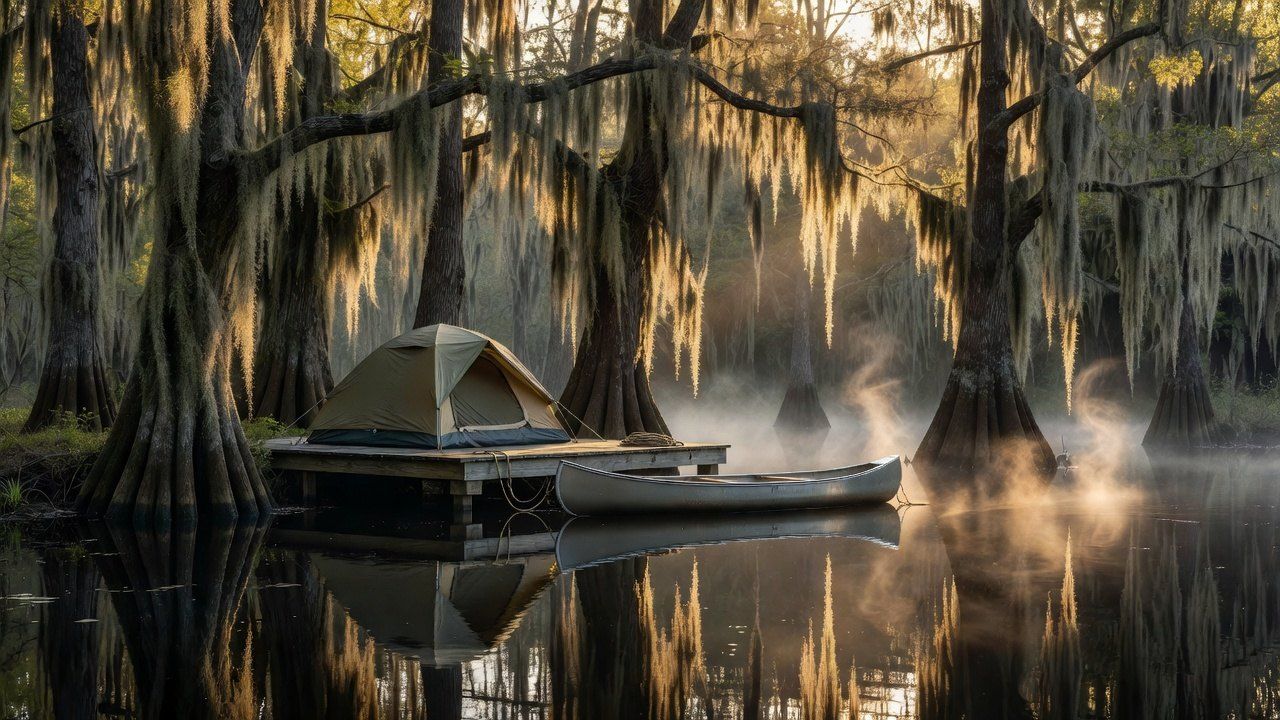
Here's the thing no national guide gets right: Louisiana camping is vertical — it's about water, not mountains. The state booking system has a "Campsite Canoe-In" inventory type and a "Boat Camping" category. That's not a novelty; it's the point.
The pattern that works:
- Paddle in. Load a canoe or kayak with a waterproof roll-top dry bag ($34.31) and paddle to a primitive site. Lake Fausse Pointe, Chicot, and the Atchafalaya edges all offer it.
- Pack for humidity, not altitude. A quick-dry microfiber towel ($24.95) and a roll-top dry bag ($34.31) matter more here than a down jacket. Everything you own will get wet at some point.
- Treat your own water. Kisatchie's own guidance is explicit: streams that carry 5–10 inches of rain in an afternoon are bone dry in late summer and early fall. Carry water or a filter. A Sawyer Squeeze ($45.95) weighs three ounces and handles 100,000 gallons.
- Bring the bug net — always. This is not optional in Louisiana. An ENO Guardian bug net ($39.95) for a hammock, or a standalone hammock mosquito net ($27.99), is the difference between a good night and a bad one.
If you would rather not spend every evening inside a hammock net, a family camping tent with a screen porch moves the whole bug fight into a screened living room — useful when the pressure lasts from April through November.
- Hammock over tent where you can. Between the humidity, the uneven ground, and the drainage, the ENO DoubleNest ($75.00) plus an Atlas suspension system ($29.95) is often the smarter call than a ground tent.
If you're car camping instead, the Crown Shades 10x10 pop-up canopy ($139.99) earns its space in a way it doesn't in Colorado — rain shade is the amenity you'll actually use.
Free Camping: Kisatchie National Forest and the 30-Day Rule
Kisatchie is Louisiana's only national forest, and it is the state's free-camping system. Two facts up front, both from the Forest Service's own pages:
There are no cabins at all. The "Camping & Cabins" tab is a nationwide template. Kisatchie has campgrounds, not rentals.
Beaverdam Campground is the only reservable campground. It books on Recreation.gov. Every other campsite in the forest is first come, first served.
The dispersed-camping rules are where Kisatchie diverges hard from the Western model:
- On foot or horseback, you may camp almost anywhere outside a designated recreation area.
- From a vehicle, you may pull off most any road and camp up to 100 feet from the centreline, unless the Motor Vehicle Use Map for that district says otherwise. The MVUM is the governing document — not a general rule.
- Camp up to 30 days in a dispersed area. After 30 days you must move at least 5 road miles to camp in another dispersed area — and you may not return to the same campsite within the calendar year.
- Campsites must be at least 100 feet from any stream or water source.
- Groups of more than 75 people need a special use permit from the district office.
- Two carve-outs to know: dispersed camping is not allowed in the Catahoula National Wildlife Management Preserve (Grant and Winn Parishes, on the Catahoula and Winn Ranger Districts). It is allowed from a vehicle on specified roads in the Red Dirt National Wildlife Management Preserve (Natchitoches Parish, Kisatchie Ranger District).
- Fire: campfires are allowed unless restrictions are in effect, no wood permit is needed for use on the forest, but you must know the current fire danger before you go — and right now it's elevated.
There's also private land inside the forest boundary. Stay off it. The Forest Service says so plainly, and it's the most common mistake visitors make.
Camping in Louisiana in October, November and Winter
Louisiana's calendar is the inverse of every other state page on this site, so here's the honest version.
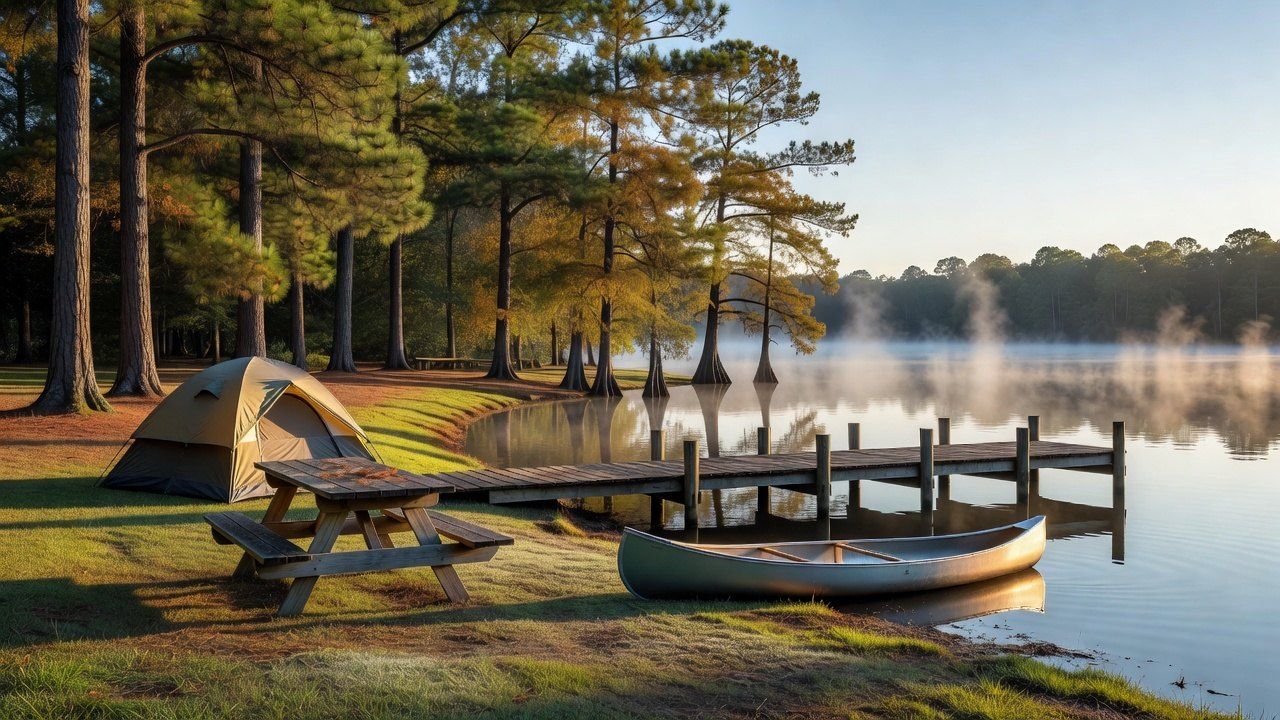
October. The switch flips. Humidity breaks, nights drop into the 50s and 60s, and the state parks fill. This is the single best camping month in Louisiana. It's also when the north Louisiana lakes — D'Arbonne, Bistineau, Claiborne, the Toledo Bends — are at their most pleasant.
November. Still excellent, and noticeably quieter after Thanksgiving. Kisatchie's hardwoods turn. Expect a hard cold front to push through at some point; a Coleman Oak Point 30°F bag ($74.99) is the right single-bag answer for most of the state, with a Kelty Cosmic Down 20° ($169.00) if you run cold or plan to backpack.
December through February. This is coastal Louisiana's prime season. Grand Isle, Cypremort Point, and the Gulf-side parks are at their best while the rest of the country is frozen. Inland it gets genuinely cold — north Louisiana sees freezes — but nothing that a three-season setup can't handle. If you're snowbirding, this is your window, and the 15-day-then-vacate-7 rule is the constraint to plan around.
March and April. The second peak. Wildflowers, comfortable nights, and the last good camping before the heat.
May through September. We're not going to pretend. Daytime highs in the 90s with high humidity, afternoon thunderstorms most days, and the hurricane season running June 1 through November 30 with the front edge overlapping the end of camping season. If you camp in this window, camp on water where you can swim, camp with shade, and camp with a 3-in-1 rechargeable fan and lantern ($29.98) rather than without one. A mister-friendly shaded chair ($39.99) is a real quality-of-life upgrade down here.
National Parks and Monuments in Louisiana (None Have Campgrounds)
This surprises people, so let's be blunt: not one National Park Service unit in Louisiana has a campground.
- Poverty Point National Monument — a UNESCO World Heritage Site. Day use only; camp at Poverty Point Reservoir State Park next door.
- Jean Lafitte National Historical Park and Preserve — six unique sites across South Louisiana, including the Barataria Preserve just 17 miles from New Orleans. All day-use. There is no camping.
- Cane River Creole National Historical Park — day use only, no camping.
So if your Louisiana trip is built around a national park visit, your camping base is a state park, not the park itself. For Jean Lafitte and New Orleans, that means Bayou Segnette or St. Bernard. For Poverty Point, the reservoir park.
Dogs, Fires and the Rules That Catch Visitors Out
Dogs. Louisiana State Parks require any pet to be on a leash no longer than 6 feet, or caged or crated. Pets are only permitted inside designated buildings or enclosed structures, service dogs excepted — so verify the individual cabin's pet status before you book, and use the portal's Pets Allowed filter to do it. Pets may not run free anywhere on park property. If your dog is coming, pack a portable dog water bottle with a food container ($14.98) and a travel dog bed ($29.99); for a dog that needs its own shade, the mesh pop-up dog tent ($69.99) keeps the bugs off — see our dog camping hub for the full checklist.
Fires. All campfires in state parks must be kept in designated areas and never left unattended. In Kisatchie, campfires are allowed unless restrictions are in effect, and you're responsible for knowing the current fire danger. Burn bans are declared by the LDAF at state level and by parishes and cities underneath — and the parish rule is often stricter. Check both before you rely on a fire ring for dinner.
Alcohol is permitted only within a reserved campsite or reserved group shelter. Not on the trails, not at the beach, not at the day-use pavilion.
Tents off designated sites are subject to removal, and camping between designated campsites is prohibited — the state enforces site limits, and when an area reaches stated capacity no further campers are admitted.
Carbon monoxide is the quiet one worth mentioning because Louisiana winter camping means heaters. If you're running a propane heater in a tent, a portable carbon monoxide detector ($23.97) is non-negotiable. See our tent heater safety guide for the ventilation rules.
What to Pack for a Louisiana Camping Trip
Grouped by what actually fails in Louisiana conditions — water, bugs, and heat — not by the generic camping-list order.
Shelter and sleeping
- CORE 6-Person Instant Cabin Tent — $169.99. The family default; instant setup matters when a storm is rolling in.
- Coleman Skydome 4-Person with LED Lighting — $122.99. Built-in light and a fast pitch.
- Coleman Sundome with Rainfly — $153.49. The tested-in-the-rain budget option.
- CAMPROS 8-Person with Room Divider — $159.98. Two rooms, one tent.
- Amazon Basics 3-Season Dome, 4-Person — $41.99. The cheap-and-fine starter.
- Kelty Late Start 2P — $159.95. For paddle-in or backpacked sites.
- Coleman Oak Point Big & Tall 30°F Bag — $74.99. The right single bag for October–April.
- Kelty Cosmic Down 20° — $169.00. For cold runs and backpacking.
- Coleman Palmetto 40°F Bag — $44.99. Mild-weather, mild-price.
- TETON Sports Celsius Jr 20°F — $49.99. Kids' bag that actually fits.
- Exped MegaMat 10 — $239.95. The comfort ceiling.
- Klymit Insulated Static V — $94.99. Insulated, packs small.
- Marchway Ultralight Folding Cot — $66.99. Off the ground, away from the damp.
- Coleman ComfortSmart Cot with Mattress Pad — $99.96. The car-camping cot.
Bugs and bite protection (this is the section that matters most)
- Murphy's Naturals Lemon Eucalyptus Spray — $28.49. DEET-free, plant-based, works.
- OFF! Clean Feel with 20% Picaridin — $11.99. Picaridin is the right active for Louisiana's mosquitoes.
- Cliganic Mosquito Repellent Bracelets, 10-Pack — $9.99. For the kids.
- ENO Guardian Bug Net — $39.95. Mandatory if you hammock.
- Wise Owl Hammock Mosquito Net — $27.99. The alternative.
- Plusvivo Pop-Up Mesh Dog Tent — $69.99. Somewhere bug-free for the dog.
- ENO DoubleNest Hammock — $75.00 and ENO Atlas Straps — $29.95. The humidity-proof sleep system.
Water and weather
- Earth Pak Roll-Top Dry Bag — $34.31. Non-negotiable on the water.
- Sawyer Squeeze Water Filter — $45.95.
- PackTowl Personal Microfiber Towel — $24.95.
- Nalgene 32 oz Wide Mouth — $16.99.
- Hydro Flask 32 oz Wide Mouth — $44.95.
- Columbia Watertight II Rain Jacket — $60.00. You will use this.
- Outdoor Research Helium Rain Jacket — $159.00. The light option.
- Crown Shades 10x10 Pop-Up Canopy — $139.99.
- Coleman Portable Chair with 4-Can Cooler — $39.99.
- Scuddles XL Picnic Blanket — $24.99.
Kitchen
- Coleman Triton 2-Burner Propane Stove — $149.99.
- Gas One GS-3400P Dual-Fuel Stove — $34.99. Cheap insurance against a low tank.
- Coleman 70-Quart Xtreme 5-Day Cooler — $79.99.
- Coleman 316 Series Wheeled Cooler, 62 qt — $84.99.
- Lodge 6-Quart Camp Dutch Oven — $59.95.
- AeroPress Coffee Press — $39.95.
- UCO Stormproof Match Kit — $12.99. Beyond useful in wet weather.
Power, light and safety
- Jackery Explorer 300 — $199.00. Runs a fan all night in a Louisiana August.
- EcoFlow River 2 — $169.00.
- Frizcol 3-in-1 Camping Fan with Lantern — $29.98.
- Black Diamond Moji Lantern — $24.95.
- Goal Zero Lighthouse Micro Lantern — $29.95.
- Black Diamond Spot 400 Headlamp — $39.95.
- Adventure Medical Kits Ultralight .7 — $44.95. Louisiana first-aid means bites, stings, and heat.
- Garmin inReach Mini 2 — $349.99. Cell coverage is thin in the basin and the marsh.
Kids and dogs
- Radio Flyer 3-in-1 EZ Fold Wagon with Canopy — $109.99.
- Coleman Kids Quad Chair — $37.45.
- Babiators Baby Navigators — $19.99.
- KEEN Youth Newport H2 Sandals — $55.00. Closed-toe and made for water — the right Louisiana kid shoe.
- Ruffwear Dirtbag Car Seat Cover — $119.99.
Footwear for adults
- Merrell Moab 3 Hiking Boot — $89.99.
- KEEN Targhee 3 Low Waterproof — $187.00.
If you're bringing the RV
- Camco Power Defender 30-Amp Surge Protector — $69.99. Non-negotiable in thunderstorm country.
- RVmate 12-Pack Leveling Blocks — $32.87.
Louisiana Camping FAQ
When is the best time to go camping in Louisiana?
October and November, then March and April. The state's camping season runs roughly October through April, which is the inverse of most of the country — the humid summer plus the June 1–November 30 hurricane season makes May to September the off-season for camping. Coastal parks peak in the winter snowbird window.
How far in advance can you book a Louisiana state park campsite?
Up to 13 months in advance to the day, online through Go Outdoors Louisiana. Reservations must be made at least 48 hours before arrival, and you must be 21 or older to reserve. Changes and cancellations go through 1-833-609-0686.
What happens if you cancel a Louisiana state park reservation?
It depends on how far out you booked. Cancel a reservation made 10 to 13 months in advance and you pay a one-day rental charge per facility. Inside the 9-month window, cancelling 15+ days before arrival costs $10 per facility, and cancelling within 14 days costs one day's rental. A security deposit equal to one day is required at booking.
Is there free camping in Louisiana?
Yes, but not the Western kind. There is no BLM land in Louisiana. Free dispersed camping means Kisatchie National Forest, where you can camp up to 30 days, then must move at least 5 road miles and may not return to the same campsite within the calendar year. Vehicle campers may pull off most roads and camp within 100 feet of the centreline unless the district's Motor Vehicle Use Map says otherwise. Dispersed camping is banned in the Catahoula National Wildlife Management Preserve.
Do you need a reservation at Kisatchie National Forest?
Only for Beaverdam Campground, which books through Recreation.gov. Every other campground in the forest is first come, first served. There are no cabins to rent on the forest at all.
Can you camp in a Louisiana state park cabin with a dog?
Some cabins are designated pet-friendly — the Go Outdoors Louisiana booking portal has a Pets Allowed filter that shows exactly which. Everywhere else, pets must be leashed (6 feet maximum) or caged/crated, are only allowed inside designated buildings, and may not run free on park property. Confirm the individual unit when you book.
Is there any camping at Jean Lafitte or Poverty Point?
No. Neither Jean Lafitte National Historical Park and Preserve (six sites across South Louisiana, including Barataria Preserve 17 miles from New Orleans) nor Poverty Point National Monument has a campground. Both are day-use. Camp at a nearby state park instead — Bayou Segnette or St. Bernard for New Orleans, Poverty Point Reservoir State Park for the monument.
Do Louisiana state parks offer senior or passholder discounts?
Two 50% discounts. Holders of the America the Beautiful federal passes get 50% off camping fees, and the 62PLUS programme gives a 50% discount off campsite stays for anyone 62 and older. Neither is automatic — ask or select it when you book.
How long can you stay at a Louisiana state park?
A maximum of 15 consecutive days. After 15 days you must vacate the site for 7 consecutive days before you can resume occupancy. The minimum for a weekend stay is two nights, and check-in is 2 p.m. for campsites.
For the mirror-image version of this trip — red rock parks that peak in October instead of desert parks that peak in winter — our Camping in Utah guide breaks down the state's five separate reservation systems.
The Bottom Line
If you are comparing destinations, camping in Wisconsin covers the state park system's booking window, its staggered October closures and the sites that stay open all winter.
If you're comparing states for the same fall window, we keep a full West Virginia camping guide too — the one state in the region where the headliner national park takes no reservations at all.
Next door, camping in Georgia runs on a 41-park state system with its own 13-month booking window and a $10 ParkPass that is not included in the reservation — useful when you are comparing state lines for the same weekend.
Louisiana is the state on this site where the standard advice inverts hardest. You don't camp here in summer — you camp from October through April. You don't camp on a mountain — you camp on water. You don't rely on BLM land, because there isn't any; you learn Kisatchie's 30-day, move-5-miles, don't-come-back-this-year rule instead.
And you book early. The 13-month window is the longest of any state system we've written up, and the two-tier cancellation rule means an impulsive far-future booking is the expensive kind. Know the window, know the season, know the bugs — and Louisiana rewards you with the best winter camping on the Gulf.
If you're building out the rest of the winter camping map, our Florida, Arizona, Texas, New Mexico and Alabama state guides cover the rest of the snowbird corridor, and the state park camping guide covers how reservation systems differ across the country.
<!-- AFFILIATE_DISCLOSURE -->Planning a trip the other direction? Our camping in Washington state guide covers the three separate booking portals, the October closing wave and the coast campgrounds that never shut for the season.