Family Camping Tent With a Screen Porch (2026): 3 Ways to Get Bug-Free Space
A family camping tent with a screen porch ends the evening bug retreat. Compare three real setups — mesh-wall cabins, canopy screen rooms, and two-tent basecamps — with 2026 prices.
Family Camping Tent With a Screen Porch: How to Get Bug-Free Space (2026 Guide)
The mosquitoes arrive about twenty minutes before dinner. Every family camper knows the sequence: the food comes off the stove, the bugs find you, the kids retreat to the car, and the evening you drove three hours for turns into a battle for the picnic table. A family camping tent with a screen porch is the single most effective fix — but most families shop for one, discover how few tents actually have an integrated screen room, and give up.
You don't have to give up. There are three workable routes to bug-free space at camp, and two of them cost less than a single premium tent. This guide covers what a screen room genuinely buys you, which setups deliver it, and how to place one so it becomes the room your family actually lives in after dark.
What a Screen Porch Actually Buys You (And What It Doesn't)
Before you spend anything, be clear about the job. A screen room solves four problems that a sleeping tent cannot:
- Bug-free dining. A screened enclosure over the picnic table means dinner happens sitting down instead of pacing. This is the reason most families want one.
- A place to put gear that isn't the tent floor. Wet rain jackets, damp towels, muddy boots, the cooler, the camp kitchen bin — all of it lives outside your sleeping space but protected from dew and bugs.
- Containment. A dog on a long lead inside a screen room stays put and calm. So do toddlers. That matters most during the hour when you're cooking and cannot watch both.
- Shade and light rain. A screened shelter gives a shaded lunch spot at midday and a dry place to wait out a passing shower without cramming everyone into the tent.
What it does not buy you:
- Sleeping space. A screen room is a living room, not a bedroom. It has no floor insulation, no wind protection worth trusting, and no privacy.
- A weather-proof room. Screen walls block insects, not sideways rain or cold. A screen room is a three-season living space, full stop.
- Standing height in every case. Some canopy shelters clear six feet at the center; a few budget models only clear the table.
With the job defined, here are the three ways to get one — cheapest first.
Option 1: A Cabin Tent With a Big Mesh Wall (Closest In-Catalog Match)
Here's the honest truth about "family tent with screen porch" searches: genuinely integrated screen-porch family tents are rare, and the ones that exist are heavy, pricier than a comparable cabin tent, and often sold out. What most families actually buy instead is a large-mesh cabin tent — a cabin with near-vertical walls, multiple big mesh windows, and a mesh roof panel that turns the whole interior into a breezy, bug-free room.
The trade-off is real: mesh walls do not give you a covered outdoor porch, they give you a bright, airy, insect-sealed interior. For families who eat inside the tent or under a separate shade, that's the practical answer.
If that's your direction, these are the strongest options in the current catalog:
- CORE 9 Person Instant Cabin Tent ($299.99, 4.6 stars, 7,000+ reviews) — 14 x 9 feet of floor with an 84 square foot sleeping area, a 78-inch center height so adults stand fully upright, a room divider, H20F rain protection with taped seams, and an E-Port for running an extension cord to a fan or light inside. It pitches in under a minute with pre-attached poles. At 39 lb it is strictly a car-camping tent, and it's built for mild-to-moderate weather rather than winter storms.
- CAMPROS CP 8 Person Tent ($159.98, 4.4 stars, 5,700+ reviews) — the budget route to a two-zone cabin with five large mesh windows and a double-layer design that keeps air moving on warm nights. The 14 x 9 foot floor splits with a removable room divider, and 72 inches of center height means most adults stand. The rainfly coverage is basic — seam-seal it if you expect sustained downpours — and six people is the realistic comfortable ceiling, not eight.
- EVER ADVANCED 6 Person Blackout Tent ($169.99, 4.4 stars) — 90 square feet of floor, a 72-inch peak, near-vertical walls edge to edge, and blackout fabric that blocks about 90% of outside light so kids sleep past sunrise. Instant setup with a pre-attached pole hub. Two queen air mattresses fit with gear room to spare. Single door on the 6P model.
- Coleman 4/6/8/10 Person Instant Tent ($180, 4.5 stars, 23,500+ reviews) — the tent that made one-minute pitching mainstream, with WeatherTec's tub floor, welded corners, and inverted seams handling pooled ground water. Mesh roof panels and a ground vent give real airflow. Capacity claims are optimistic: the 6-person version is a comfortable four-person tent once pads and duffels are inside.
- CORE 6 Person Instant Cabin Tent ($169.99, 4.5 stars, 5,200+ reviews) — 99 square feet and 72 inches of center height with adjustable ground vents, large windows, and ceiling mesh for warm nights. Four people plus gear is the honest comfortable use case.
Not sure which size actually fits your family? Our tent size guide with real dimensions breaks down 2P vs 4P vs 6P, and what size tent fits 2 adults, 2 kids, and a dog answers the question most families are really asking. For the full field of options, see the best family camping tents roundup.
Option 2: Build a Screen Room From a Canopy (Cheapest Real Bug-Free Space)
This is the setup experienced family campers use, and it costs less than most people expect.
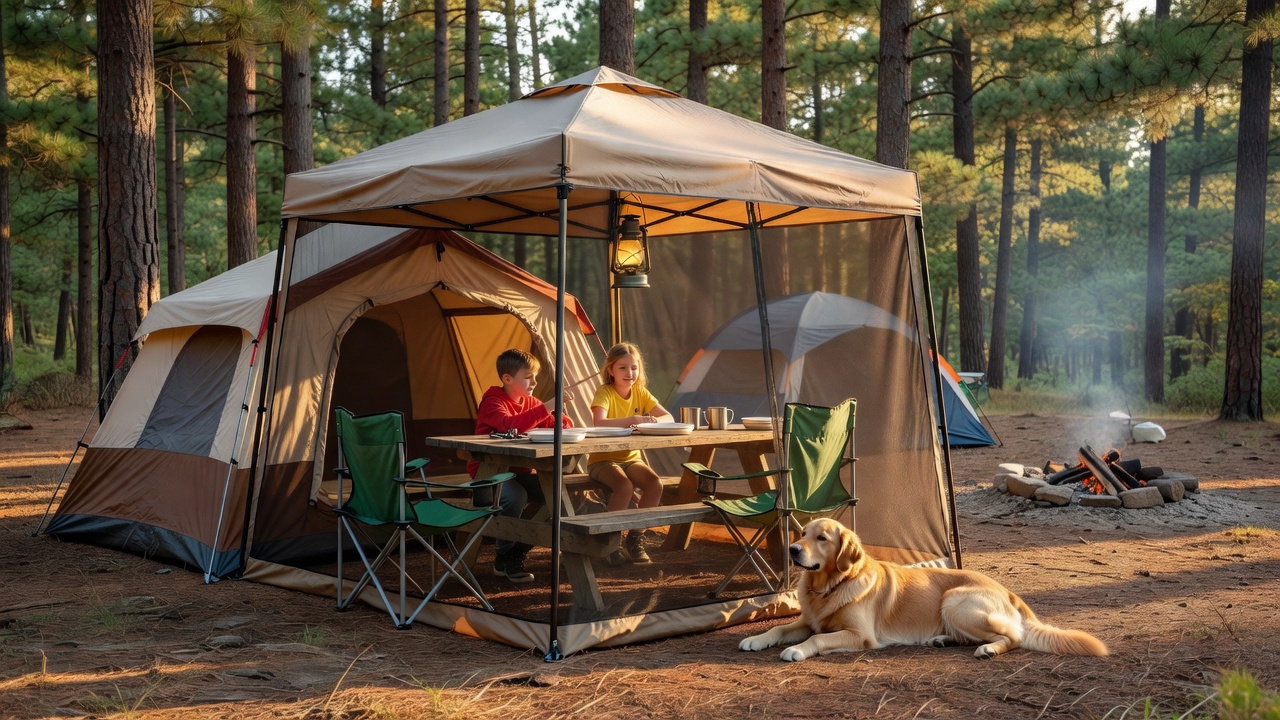
A 10x10 pop-up canopy plus a set of mesh side walls gives you a genuine screened room — one you can stand in, put a picnic table inside, and eat dinner in while the mosquitoes work the outside of the mesh. The walls attach to the canopy frame with velcro or clips and run about $30-50 for a four-wall mesh set, sold separately by the canopy maker or as a universal fit.
The canopy to build it around:
- CROWN SHADES 10x10 Pop Up Canopy Tent ($139.99, 4.6 stars, 11,300+ reviews) — the most proven canopy on Amazon, with a patented CenterLok one-push system that one person can raise in under a minute. The silver-coated top blocks UV and sheds light rain, and the 10x10 footprint covers a picnic table plus two camp chairs with room to spare. It folds into a wheeled STO-N-GO bag. Note two things honestly: side walls are not included (buy the mesh set separately), and at roughly 40 lb it's a car-camping item.
Why this beats an integrated screen porch for many families: you get more screened space per dollar, the canopy doubles as a shade structure on trips when you don't need walls, and if the canopy frame eventually dies you replace a $140 shelter instead of a $400 tent.
Setup tips that make the difference:
- Stake all four corners first, then extend the legs. A canopy that walks in a gust will tear the mesh walls at the attachment points.
- Hang the mesh walls on the windward side first. Two walls (windward + one side) is often enough; four walls turn it into a greenhouse on a hot afternoon.
- Put the table in, then adjust. You want the table centered with a walkway on the cooking side — not pushed into a corner where the mesh presses against your back.
- Add a ground tarp under the table. It keeps the screen room usable after rain and stops chairs from sinking.
Option 3: Base Cabin Tent + Separate Screen Shelter (Best for Families of 4+)
Once your family is four or more, the two-structure setup starts winning for a different reason: the sleeping tent and the living room have opposite requirements.
Your sleeping tent wants to be cool, dark, and sealed. Your living space wants to be open, breezy, and shaded. Trying to get both from one tent means compromising on both. Splitting them solves it:
- Sleep here: UNP 4-Person Cabin Tent ($115.99, 4.5 stars) — 72-inch center height with near-vertical walls (most adults stand and dress inside), a full-coverage top rainfly over a taped, welded waterproof floor, hub-style pre-attached poles that go up in about five minutes, and dual doors. It fits two adults plus two kids on pads with gear room to spare. At under $120 it's roughly half the price of a brand-name instant cabin. It has no cord port, so powered sites need a cable through the door seam.
- Or sleep here: Coleman Skydome 4-Person Tent with LED Lighting ($122.99, 4.5 stars) — pre-attached poles and color-coded corners for a five-minute one-person pitch, near-vertical walls that give about 20% more headroom than a traditional dome, and a built-in LED system running on 3 AA batteries for late arrivals and bedtime reading. PFAS-free materials. The 4-person rating is honest for two adults plus gear or a small family.
- Eat and hang out here: the CROWN SHADES 10x10 canopy with mesh walls from Option 2.
You can also start with the most proven family dome tent on the market if budget is the constraint: the Coleman Sundome ($153.49, 4.6 stars, 23,000+ reviews) is available in 2/3/4/6-person sizes so the same tent grows with your family. It's slower to pitch (about 10 minutes) and you crouch in the 4-person size — choose the 6-person if you want standing room. Pair it with a canopy screen room and you've built a full two-room camp for under $300.
Where to Put the Screen Room: Placement Rules That Matter
Placement is where most families lose the benefit they just paid for. Five rules:
- Face the opening away from the fire pit. Smoke follows the sitter. Put the mesh walls between your table and the fire ring, and keep one opening on the upwind side for airflow.
- Sit downwind of the campfire, upwind of the trash. Two separate problems, two separate directions.
- Check for widow-makers and dead limbs before you set a canopy under a tree. A ten-pound branch ends the trip.
- Pick high, drained ground. A screen room with a picnic table inside becomes a wading pool in a low spot. Look for the spot where water would run past, not through.
- Keep the sleeping tent 10-15 feet from the screen room. Close enough to hear the kids, far enough that cooking smells and lantern light stay out of the bedroom.
Two small items make the whole camp flow better: the Radio Flyer 3-in-1 EZ Fold Wagon ($109.99, 4.8 stars, 12,000+ reviews) hauls kids, the cooler, and the camp kitchen bin in one trip instead of five, and it folds to 7 inches for the trunk. And for the kids' own seat inside the screen room, the Kelsyus Youth Canopy Chair ($37.99, 4.6 stars) has an adjustable shade canopy and a 100-lb capacity for ages 3+.
Keeping the Screen Room Bug-Free and the Tent Dry
A screen room only works if the mesh stays intact and nothing inside draws insects through the door.
- Zip it, every time. A screen room left open for ten minutes at dusk fills with mosquitoes. Teach the rule early and it becomes automatic.
- Never store food inside overnight. Eat in the screen room, then move everything sealed into the car or a locking bin. Crumbs on a picnic table are an invitation.
- Keep a citronella or Thermacell ring just outside the mesh, not inside. Airflow carries the repellent across the opening.
- Treat the tent fly before the season. UV and repeated wet-dry cycles break down the durable water repellency that makes rain bead, and a fly that's "misting" is a fly that's about to soak you. Nikwax Tent & Gear SolarProof ($19.95, 4.6 stars) restores DWR and adds UV protection in one water-based treatment — wash the tent first so it bonds, and let it cure between trips.
- Re-proof the screen room frame's fabric top too if it's a canopy you've owned for a few seasons.
For the full bug strategy — ticks, mosquitoes, repellent choice, and what to do about bites — see our camping bug protection guide. And if standing up a new tent and screen room at the same time sounds like chaos, our tent pitching tutorial walks through the stakes-first order that saves the most time. Two more things worth packing: a camp lighting setup so the screen room works after sunset, and comfortable camping chairs for the hours you'll spend in there. If you're planning the trip around this setup, start from our camping trip planning guide.
What Three Screen-Room Setups Cost in 2026
| Setup | What you get | Approx. cost |
|---|---|---|
| Canopy + mesh walls only | Screened living/dining room, sleeps nobody | $140 + $30-50 walls |
| Budget cabin tent + canopy screen room | Separate bedroom + screened living room | ~$115 + ~$180 |
| Instant cabin tent + canopy screen room | Fastest pitch, two-room camp, sleep-in dark option | ~$170-300 + ~$180 |
If your family already owns a tent and only lacks bug-free dining, the canopy-plus-mesh-walls route is the clear winner — the lowest price, the most space, and the least commitment. If you're buying both anyway, splitting the bedroom from the living room is the setup you'll still be using in three seasons.
Family Camping Tent With a Screen Porch FAQ
Do any family tents come with a built-in screen porch?
A few do, but they're far rarer than the search volume suggests and usually cost more than a comparable cabin tent. Integrated screen-porch family tents tend to be heavy (35-50 lb), sold in limited sizes, and frequently backordered. That scarcity is exactly why most experienced families build the screen room separately from a canopy and mesh side walls — same function, more screened space per dollar, and the canopy is useful on its own for shade.
Is a screen room worth it for a family of four?
Yes, if you eat dinner at camp. At four people, the alternative is everyone balancing plates on their knees inside the tent or eating while swatting. A 10x10 screen room fits a picnic table, two to four chairs, and the camp kitchen bin — the whole evening in one bug-free space. If your family mostly eats out or goes to bed right after sunset, spend the money on a bigger sleeping tent instead.
Can I put a screen room over a campsite picnic table?
Almost always, and it's the best use of one. Most developed campsites have a picnic table on a level gravel or dirt pad, which is exactly the footprint a 10x10 canopy wants. Measure before you commit at an unfamiliar campground — some tables sit under low branches or on a slope. Canopies with a one-push setup, like the CROWN SHADES 10x10, can be raised by one adult in under a minute, so you can set up, check the fit, and reposition without a second pair of hands.
How do I keep bugs out of a screen room?
Seal the gaps and remove the attractants. Attach mesh walls so the edges meet the frame with no open seams, keep the door zipped except when people are walking through, and never leave food or unsealed drinks inside overnight. Because the mesh blocks insects but not scent, a repellent device placed just outside the screen wall works better than one inside. At dusk — the peak hour — close up before the bugs arrive rather than after.
<!-- AFFILIATE_DISCLOSURE -->TrailMapz is a participant in the Amazon Services LLC Associates Program. As an Amazon Associate we earn from qualifying purchases at no extra cost to you. Prices and ratings reflect the catalog at the time of writing — always confirm current pricing on the product page.