Camping in Alabama 2026: State Parks, Gulf Shores, Cheaha & Winter Camping Guide
Where to camp in Alabama in 2026 — the 13-month Alabama Residents reservation window, the $5.25 fee and 72-hour cancellation rule, Gulf State Park's 496 campsites and its November–March monthly season, Cheaha and DeSoto in the Appalachians, the national forests where almost nothing takes reservations, the 14-day vs 21-day stay limits, and Alabama's burn-permit law that has no calendar window at all.
Alabama is the state that quietly fixed its own booking problem, and almost nobody wrote it down. In 2024 the state park system introduced something called the Alabama Residents Advanced Reservation Window — residents book 13 months out, out-of-state visitors 12. That single sentence changes how you plan a Gulf Shores winter trip, because the campgrounds that matter most on the coast are the ones that fill on the first morning the calendar opens.
This guide is the version I wish existed when I started driving I-65 south every October. It covers where Alabama's campgrounds actually are, who gets to book them first, what the stay limits are, why the state's camping season runs backwards from the rest of the country, and the fire law that trips up visitors who arrive expecting a seasonal burn ban.
Quick Answer: Where to Camp in Alabama (and When)
- Best overall for a family weekend, any season: a north Alabama state park — DeSoto for waterfalls and easy trails, Cheaha for the highest ground in the state.
- Best for winter, hands down: Gulf State Park in Gulf Shores. 496 improved campsites, 11 bathhouses, and monthly reservations available only from November through March.
- Best for a lake-and-boat trip: Joe Wheeler (116 sites, 110 full hookup, on a 69,700-acre reservoir) or Lake Guntersville (295 modern sites).
- Best for a quick Mobile-area weekend: Meaher State Park, sitting on the edge of the Mobile-Tensaw Delta — the second-largest river delta in the contiguous United States.
- Best for free or nearly free camping: the four National Forests in Alabama — with the caveat that almost none of them take reservations.
- Best months: October through April. June through September is the off-season on the coast, and it is genuinely dangerous in the middle of the day further south and west.
- The one thing to do first: decide whether your group counts as Alabama residents. That determines whether your booking window is 13 months or 12 — a full month of head start.
What Changed for the 2026–27 Season
Three things are worth knowing before you open a booking tab.
1. The resident window is now the norm, not a pilot. Since August 1, 2024, Alabama residents can make online reservations 13 months in advance for traditional campground accommodations — RV, modern, and primitive — at any of the state's 21 parks. Everyone else books 12 months out. The state calls it the Alabama Residents Advanced Reservation Window, and it works exactly the way Florida's 11-month-versus-10-month split does: the best sites on the best weekends are gone before out-of-state visitors can even see them.
2. Cheaha is getting a hotel. The old Cheaha Hotel was torn down along with the pool and much of the restaurant building, and a new hotel opens in 2026 at Alabama's highest point. For campers this mostly matters as a signal — the summit area is being invested in, the Mountain Store remains the check-in desk, and day-use traffic on the Talladega Scenic Drive will keep climbing.
3. The national forests dropped their camping permit. The U.S. Forest Service's Alabama page now states plainly, for Tuskegee National Forest, that "camping permits will no longer be required." If you read an older guide that tells you to stop at a district office for a free permit, that advice is out of date.
One more current datum worth carrying: as of this writing the Forest Service fire danger status for Alabama's national forests reads Low. That is the number to check the morning you leave, not a forecast you can trust a month out.
Why Alabama Has Two Camping Seasons, Not One
Most state guides assume one season. Alabama genuinely has two, and they run in opposite directions.
The coast (Gulf Shores, Orange Beach, Mobile Bay, the Delta) peaks in winter. November through March brings dry, mild days and cool nights, and the entire economy of Gulf Shores reorganizes around snowbirds. Summer is the opposite: brutal humidity, afternoon storms, and hurricane season running June 1 through November 30, with the statistical peak in September and October — right at the start of the good camping weather. That overlap is the single most important planning fact on this page. You can camp beautifully on the Alabama coast in October; you just have to watch the tropics while you do it.
The mountains (Cheaha, DeSoto, Lookout Mountain, the Tennessee Valley) peak in autumn and spring. Fall colour in the northern ridges typically runs from the second half of October into early November, later than the Smokies and much later than New England. April and May bring wildflowers — DeSoto is famous for them — and reliable water in the falls. Deep winter up there means nights in the 20s and occasional ice, which is a real gear decision rather than a comfort preference.
So the useful mental model is: coast = winter, mountains = shoulder seasons, and the middle of summer belongs to air conditioning. If you are planning a single trip and you have flexibility, October and early November give you both halves of the state at their best in the same window.
How Alabama Camping Actually Works: Four Separate Systems
Alabama does not have "state campgrounds." It has four systems that behave differently, and mixing them up is why people show up expecting a reservation and get a first-come site — or the reverse.
Alabama State Parks: 21 parks, one portal, and a one-month head start for residents
Everything books through reserve.alapark.com (or by phone through the individual park). The system covers 21 parks offering camping, lodging, tours, and day-use areas. Two numbers matter:
- Residents: 13 months ahead. Non-residents: 12 months.
- A non-refundable $5.25 reservation fee applies, and reservations may be changed or cancelled up to 72 hours before midnight on your scheduled arrival date, with a refund of everything paid except that $5.25.
That 72-hour rule is unusually tight and unusually clean — no sliding scale, no partial forfeits. Know your plans before you book, or accept the $5.25 as the cost of a change of heart.
Nightly campsite fees in Alabama state parks typically run $25 to $45 depending on site type (tent versus full-hookup), season, and residency, with exact rates shown at booking. If you are weighing a long winter stay against a hotel, that band is the number to build the comparison on.
One quirk worth knowing about Cheaha specifically: its annual passes — Senior and Disability $55, Individual 12+ $105, Family up to 6 $155 — are not valid at other state parks. They are a Cheaha-only product. Day use at Cheaha is $5 for ages 12 and up, $2 for ages 4–11 and for seniors 62+, and free for ages 0–3 and for veterans and active military through the Parks for Patriots program.
The park inventory, and how big the sites actually are
Alabama's camping inventory is lopsided in a way that should drive your planning: the coast has one gigantic campground and the rest of the state has a long tail of mid-sized ones.
| Park | Region | Camping inventory | The reason to pick it |
|---|---|---|---|
| Gulf State Park | Gulf Coast | 496 improved sites + a new 104-site RV Resort | 11 bathhouses, paved pads, beach and 900-acre Lake Shelby on site |
| Wind Creek | Lake Martin | 586 modern sites | The largest single inventory outside the coast, on a big reservoir |
| Lake Guntersville | Tennessee Valley | 295 modern sites + glamping | Golf, dining room, and the best bass lake in the state |
| Lakepoint | Lake Eufaula | 192 modern sites | Big-lake camping on the Georgia line |
| Joe Wheeler | Tennessee Valley | 116 sites, 110 full hookup | Resort lodge, marina, 69,700-acre Wheeler Lake |
| Meaher | Mobile Bay | 108 RV sites + 10 improved tent sites | Delta access, 30 minutes from Mobile |
| DeSoto | Lookout Mountain | 94 full-hookup improved sites + primitive + 2 backpacking sites | Waterfalls, 35+ miles of trails, town of Mentone |
| Cheaha | Talladega Mountains | Improved camping + primitive near the summit + CCC primitive near Cheaha Lake | Alabama's highest point at 2,407 ft |
Beyond those, Alabama has a deep bench of smaller parks that offer primitive camping only — Bladon Springs, Blue Springs, Chewacla, Chickasaw, Monte Sano, Paul Grist and others. Chickasaw, for example, runs just three RV sites with water and 30-amp connections plus primitive sites with water and electricity, and no showers at all. That is not a flaw, it is the trade for near-empty campgrounds in the shoulder season. Just read the park page before you commit, because "primitive" in Alabama sometimes means a water spigot and sometimes means nothing but a clearing.
National Forests in Alabama: mostly first-come, and two different stay limits
This is the part that surprises people most. The U.S. Forest Service manages four national forests in Alabama — Bankhead, Conecuh, Talladega, and Tuskegee — and of all their campgrounds, only Bankhead's Corinth and Clear Creek sites take reservations on Recreation.gov. Every other Forest Service site in the state is first come, first served.
That is the exact inverse of the state park system, where nearly everything is reservable and the good stuff is gone a year out. If your plan depends on certainty, book a state park. If your plan depends on spontaneity, the national forests are where Alabama rewards you.
The stay limits are also different from the western rules most campers carry in their heads. Per the Forest Service's Alabama camping rules page (last updated February 20, 2026):
- Developed recreation areas: 14 consecutive days, with a 24-hour waiting period before you can return.
- Dispersed areas and hunt camps: 21 consecutive days, with a 10-day waiting period before returning to the same area.
Compare that to the BLM's familiar 14-days-in-28 out west and you can see the shape of it: Alabama is more generous on dispersed camping and much stricter about cycling through the same developed site. Also on the list: leaving camping equipment unattended for more than 24 hours in a developed area is prohibited, campers and trailers on national forest land must be properly licensed or registered, and campfires must be attended at all times and completely extinguished when you leave.
A couple of practical notes on the forests themselves. Tuskegee National Forest prohibits ATV and OHV use, and the Forest Service wants you checking the district's Motor Vehicle Use Map for which roads are actually open — that map, not a general rule, governs where you can drive and therefore where you can camp. And the pass math is worth understanding: America the Beautiful passes cover standard amenity fees (picnic areas, developed trailheads, visitor centres) but not expanded amenity fees like campgrounds, hookups and dump stations. Senior and Access pass holders do get a 50% discount on single family campsites, which is the discount that actually applies to campers.
Named Forest Service campgrounds worth knowing: Open Pond in Conecuh National Forest (developed and primitive sites), Brushy Lake (a 33-acre lake with 13 campsites and a bathhouse), Corinth Recreation Area on Lewis Smith Lake in Winston County, Clear Creek, Owl Creek Horse Camp (primitive, first-come, with a roughly 26-mile equestrian trail system), McDougal Camp (primitive hunt camp), and Blue Lake, a day-use picnic and swimming area near Open Pond.
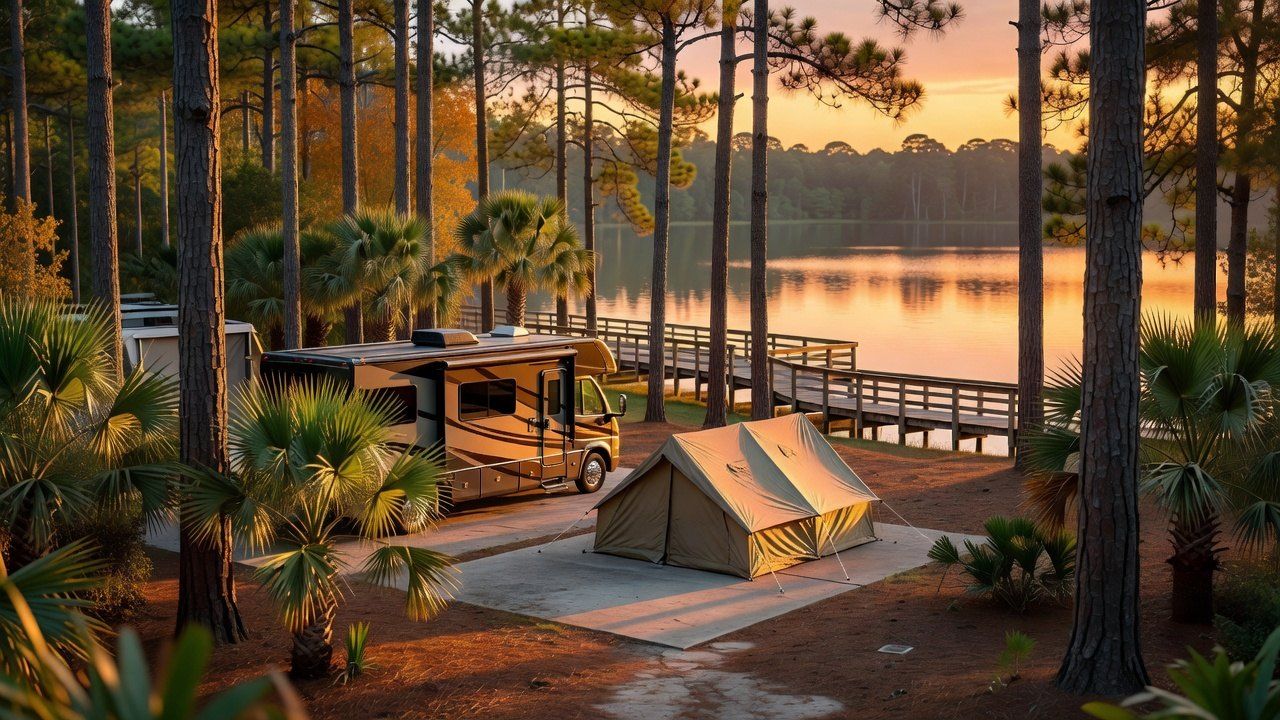
Gulf State Park: The Winter Engine of the Alabama Coast
If you are reading this because you want warm-ish winter camping within a day's drive of the Midwest or Southeast, Gulf State Park is the answer, and it is not close.
The park sits at 20115 State Park Road in Gulf Shores, and it runs two distinct camping operations:
- The traditional Campground: 496 improved campsites, spanning full-hookup RV sites, waterfront sites, ADA-accessible sites, primitive campsites, and glamping units, served by 11 modern bathhouses with paved pads, picnic tables and grills.
- A newer RV Resort: 104 spacious full-hookup sites with concrete pads, fire pits, pedestal grills, and access to a clubhouse, playground, and a direct connection to the Backcountry Trail.
The best detail is that guests at either campground can use the amenities, pools and playgrounds at both locations. It is effectively one big campground with two characters, and it means you are not locked out of the pool because you booked the cheaper pad.
The monthly rule is the one to plan around
Gulf State Park offers nightly, weekly, and monthly camping. Nightly and weekly reservations can be made online. Monthly reservations are available only for the months of November through March — and those have to go through the park's reservationists at 251-948-7275 ext. 1.
Read that twice, because it is the single most useful sentence for a snowbird. Alabama's coast does not sell winter by the month outside that five-month block. If you want December, January or February on the Gulf, you are calling a human, and you are doing it early — earlier still if you are not an Alabama resident, because of the 13/12-month split.
The rest of the park is a genuine destination rather than a parking lot. There is a 900-acre freshwater lake (Lake Shelby), a fishing and education pier, miles of the Backcountry Trail for biking and birding, a nature centre, the Learning Campus, an interpretive centre, a butterfly garden, and a beach pavilion. Trail and picnic areas are open sunrise to sunset; headquarters offices run 8:00 a.m. to 4:00 p.m. Monday through Friday. The park also runs The Lodge, 20 cabins and the Eagle Cottages if part of your group would rather not sleep outdoors — which is a genuinely useful escape hatch for a multi-generation trip.
For context on scale: the system-wide Alabama State Parks camping table lists Gulf State Park at 599 modern campsites, which reflects the campground plus the RV Resort. Either way, it is the largest camping operation in the state, and in January it is one of the largest concentrations of RVers anywhere east of the Mississippi.
North Alabama: Cheaha, DeSoto and the Appalachian Corner
The northern third of Alabama is Appalachian, and it is where the state's best hiking-camping weekend lives.
Cheaha State Park — Alabama's highest point
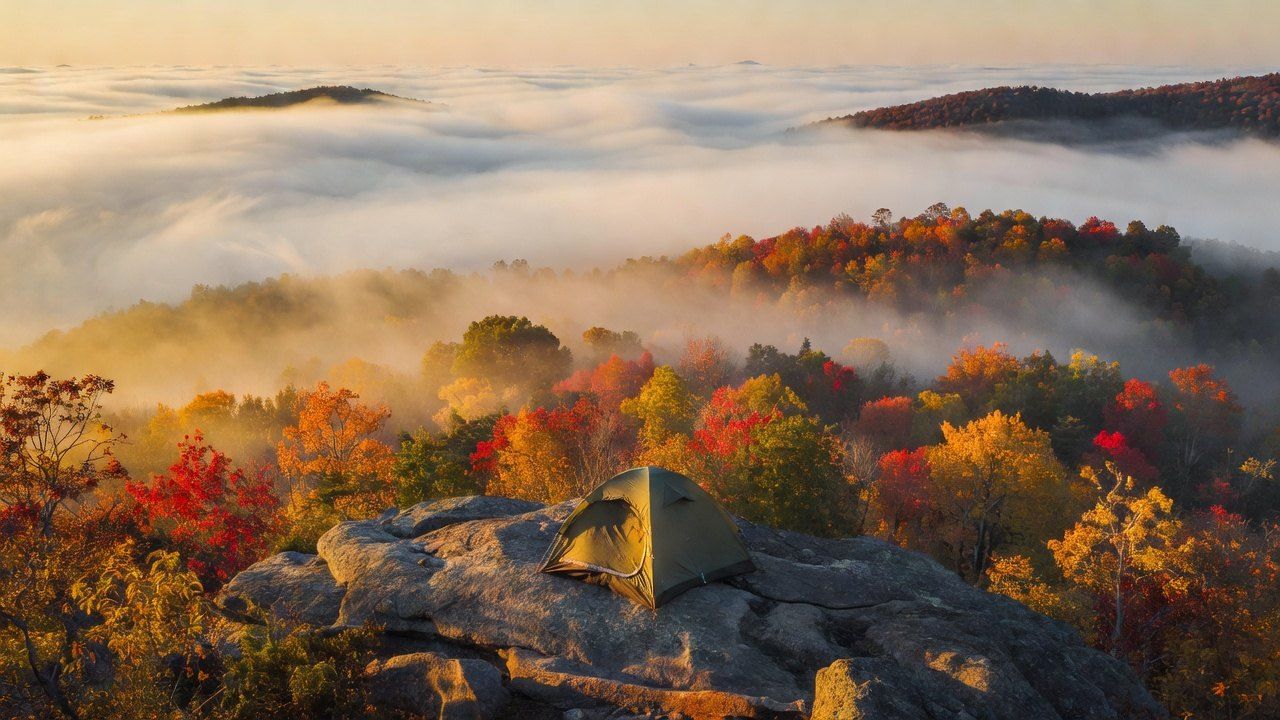
Cheaha sits at 19644 Highway 281 in Delta, and it is Alabama's oldest state park (established 1933), its highest point at 2,407 feet, and — this is the detail I like most — a 2,799-acre island of granite and wind-warped trees completely surrounded by 392,567 acres of the Talladega National Forest, including the 7,245-acre Cheaha Wilderness. The park is the southernmost tip of the Appalachian chain, and on a foggy morning it genuinely looks like a mountain island.
Camping comes in three flavours here, and the distinction matters: improved camping in the park, primitive camping near the highest point, and CCC primitive camping near Cheaha Lake. If you want to wake up at the summit, you want the primitive option — and you should check the gate and check-in procedure, because the reservations desk is inside the Mountain Store, and campers who receive a gate code are asked to return to the store after setting up to check in.
Mountain Store hours shift seasonally, and this is a real planning factor because it is where you check in and buy what you forgot:
- Winter (roughly November 17 – March 1): 8 a.m.–5 p.m. Sunday–Thursday, 8 a.m.–9 p.m. Friday–Saturday.
- Summer (roughly March 1 – November 16): 8 a.m.–7 p.m. Sunday–Thursday, 8 a.m.–9 p.m. Friday–Saturday.
Cheaha has no restaurant, and dining options are 12 to 24 miles away, so pack food. The trade is everything else: a dog park, accessible and extreme trails, museums, an interpretive centre, and the historic CCC Bald Rock Lodge with 12 bedrooms for group retreats.
Getting there is part of the decision. The park recommends the Talladega Scenic Drive (Alabama Highway 281) from the north — wide, well-maintained, and fine with a large RV. Alabama 49 also connects to 281. Cheaha Road (County Road 42) out of Munford is the pretty route through the forest, and the park explicitly does not recommend it for large recreational vehicles. Take the boring road with the trailer.
DeSoto State Park and the Little River Canyon
DeSoto is the waterfall park, sitting atop Lookout Mountain about eight miles northeast of Fort Payne at 7104 DeSoto Parkway NE. It covers 3,502 acres and offers the most varied camping in the state:
- An improved campground with 94 full-hookup tent and RV sites.
- Primitive campsites for tents.
- Two backpacking campsites with shelters — the only ones in the state park system I would specifically plan a trip around.
On top of that: more than 35 miles of hiking trails, 11-plus miles of mountain biking, an ADA-accessible boardwalk trail, an Olympic-size swimming pool, the Benefield Interpretive Center, a CCC museum with tours, and the Mountain Inn Restaurant, plus chalets, cabins, lodge rooms, a pioneer camping cabin and a wall tent campsite.
The geography is why this is the anchor of a north-Alabama weekend. DeSoto is adjacent to the Little River Canyon Nature Preserve — a National Park Service unit where the river runs for most of its length atop Lookout Mountain, past forested uplands, waterfalls, canyon rims, pools and sandstone cliffs. Nearby you also have the 104-foot DeSoto Falls, the Walls of Jericho Forever Wild Tract, and the small mountain town of Mentone.
Two operational notes. First, the park warns that GPS directions are not reliable for DeSoto and asks visitors to use its written directions — take that seriously, because Lookout Mountain's roads do not behave the way mapping apps assume. Second, Little River Canyon is a day-use destination; plan to camp at DeSoto and drive over. The preserve does run a BARK Ranger program, so dogs are welcome on the visitor side with the usual rules.
The Tennessee Valley Lakes: Guntersville, Wheeler, Wind Creek and Lakepoint
Alabama's Tennessee River reservoirs are the state's quiet strength for camping families, mostly because the water is warm, the fishing is exceptional, and the campgrounds are built for boats and long stays rather than tents-only minimalism.
Joe Wheeler State Park in Rogersville is the resort model: a 2,550-acre park on the Tennessee River where the river forms 69,700-acre Wheeler Lake. The campground has 116 sites, 110 of them full hookups with water, electricity and sewer, bathhouses in each section, and most sites able to take any size of camping unit. Tents are welcome, and every site gets a picnic table and a fire grill. There is a marina with overnight docking slips, an 18-hole golf course, and a lodge. The one date to know if you like boats: every fall Joe Wheeler hosts the Fall Rendezvous of Great Loop boaters, with as many as 250 vessels in the marina at once. Lodge front desk runs 7 a.m.–11 p.m.; the campground office is 9 a.m.–5 p.m.
Lake Guntersville State Park at 1155 Lodge Drive in Guntersville is the biggest of the valley parks with 295 modern campsites plus primitive sites and glamping, on a lake that is routinely called the best bass fishery in the country. Day-use areas run sunrise to sunset, the Pinecrest Dining Room serves 7 a.m.–9 p.m. seven days a week, the Eagle's Nest Golf Course runs 8 a.m.–4 p.m., and there is a campground store and the Town Creek Fishing Center on site.
Wind Creek State Park on Lake Martin, with 586 modern sites plus primitive and glamping, is the largest single camping inventory in the state outside the Gulf Coast. Lakepoint State Park on Lake Eufaula adds 192 modern sites on the Georgia line. Both are at their best from spring through fall, and both reward a boat.
For the RV-specific chores that go with a reservoir trip, the small stuff is what breaks a weekend: a Camco TastePURE inline water filter at $17.99 keeps campground water from tasting like a garden hose, RV leveling blocks at $32.87 stop the fridge from fighting you on a sloped pad, wheel chocks at $12.99 are cheap insurance on a lake-side site, and a 30-amp circuit analyzer at $54.99 tells you whether the pedestal is wired correctly before you plug in a $500 appliance.
Mobile Bay and the Delta: Meaher State Park
Meaher State Park is the sleeper of the system. It sits at 5200 Battleship Parkway East in Spanish Fort, on 1,327 acres of wetland in the north end of Mobile Bay, and it is the best public access point to the Mobile-Tensaw Delta — roughly 20,323 acres of water formed where the Alabama and Tombigbee Rivers meet, and the second-largest river delta in the contiguous United States.
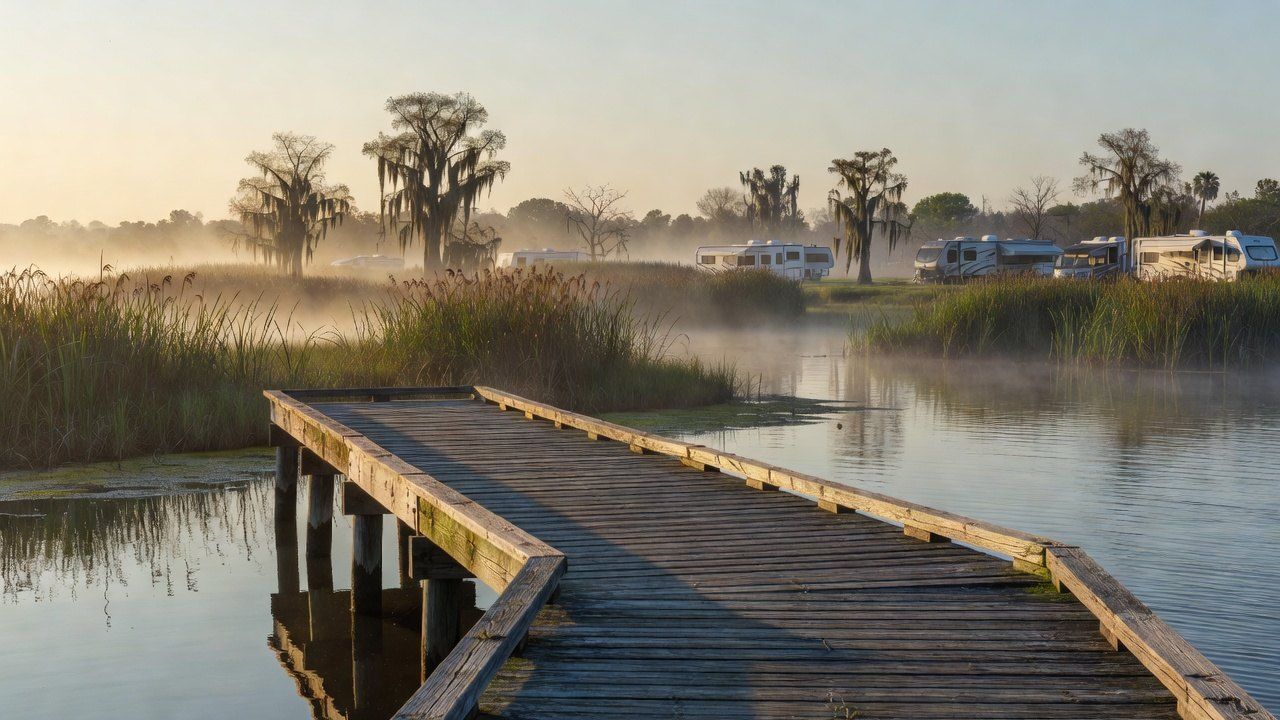
The camping is straightforward and RV-oriented: 108 RV campsites with 50-amp electrical connections plus water and sewer hookups, and 10 improved tent sites with water and 20-amp electrical. There are two modern bathhouses and a laundry facility, and eight bay-side cabins if you want to bring people who do not camp.
Costs are a little different here than elsewhere in the system. Meaher charges a $3 gate fee per person, plus a $5 boat launch fee if you are launching. The park is open daily 7 a.m.–7 p.m. (or sunset), the office runs 7 a.m.–3 p.m., and day use is permitted while the gate is open, 7 a.m.–5 p.m. There is a 300-foot pier with a 200-foot "T" for fishing, boardwalk access along the delta, paddling launches, and kayak and canoe rentals. It is a stop on the Alabama Coastal Birding Trail, which is the reason a lot of people go. Alabama's white-sand Gulf beaches are about an hour away, and the nearby Mobile-Tensaw, W.L. Holland and Upper Delta Wildlife Management Areas add hunting and wildlife viewing.
For context on wildlife management areas generally: public WMA land in Alabama is hunting land first, and camping there is generally restricted. Treat WMAs as day-use unless the specific area's rules say otherwise, and do not assume a WMA is a free campground.
Alabama State Park Campgrounds Worth Booking
If you want a shortlist rather than a table, these are the ones I would spend a booking window on, grouped by what they are actually good at.
For a beach-and-bike winter: Gulf State Park. Nothing else in the state is comparable, and the Backcountry Trail network makes it a cycling destination, not just a place to park.
For waterfalls and a first backpacking trip with kids: DeSoto State Park. The 94 full-hookup improved sites mean you can car camp and day-hike, while the two backpacking sites with shelters give you a genuine overnight without committing to a full pack trip.
For the highest ground and the best views: Cheaha. Take the primitive site near the summit if you can check in early enough, and take Alabama 281 to get there.
For boats, bass, and long hookup stays: Joe Wheeler (116 sites, 110 full hookup), Lake Guntersville (295), Wind Creek (586), Lakepoint (192).
For a delta weekend near a city: Meaher. Thirty minutes from Mobile's restaurants, an hour from the beach, and a pier at the door.
For isolation on a shoestring: the primitive-only parks — Bladon Springs, Blue Springs, Chewacla, Chickasaw, Monte Sano, Paul Grist. Expect few facilities and near-empty loops outside summer.
For a big group or a family reunion: the group facilities matter. Cheaha's CCC Bald Rock Lodge sleeps 12 bedrooms' worth; Joe Wheeler has a rustic group lodge and a full convention setup; Lake Guntersville and Wind Creek both take large parties. Book those through the park, not the online portal.
Free and Cheap Camping in Alabama
Alabama is not a state where free camping is the headline, but it exists and it is well distributed.
The four national forests are the main answer. Dispersed camping in Bankhead, Conecuh, Talladega and Tuskegee is generally free, with the 21-consecutive-day limit and 10-day waiting period already described. The rule that actually determines where you sleep is the district's Motor Vehicle Use Map — not a website, not a signpost. Download the map for the district you are visiting before you leave service.
Developed Forest Service campgrounds are cheap rather than free, and mostly first-come. Standard amenity fees are covered by an America the Beautiful pass; expanded amenity fees like campgrounds and dump stations are not, though Senior and Access pass holders get 50% off single family campsites. If you camp more than a couple of weekends a year, that discount is the clearest financial argument for the pass outside the national parks.
State park camping is the budget mid-tier, typically $25–$45 a night depending on site type, season and residency, with a $5.25 non-refundable booking fee. Primitive sites at the smaller parks sit at the bottom of that band.
What is not free, and should not be treated as free: Alabama Wildlife Management Areas. These are hunting lands, and camping is generally restricted. There is no equivalent to the wide-open BLM grazing land that anchors free camping out west, which is a structural difference worth stating outright — Alabama's public land is mostly forest, mostly managed for timber and hunting, and mostly regulated per district.
Camping in Alabama in November and December
This is the sweet spot for most of the state and the reason this page exists.
November gives you the coast at its best and the mountains at their peak. Gulf Shores in November means daytime temperatures you can hike in and nights cool enough to sleep well, with the campground quiet before the December snowbird wave. Up north, the fall colour window is closing but not closed — the last leaves hang on in the lower elevations through mid-November, and Cheaha and DeSoto are beautiful in the bare-branch phase that follows. DeSoto's pool is seasonal, so check before promising it to kids.
The November calendar item nobody should miss: Gulf State Park's monthly booking window opens with November, so this is the month the winter inventory is being allocated. If you want a spring stay, November is when you should be thinking about it.
December splits the state cleanly. On the coast you are into peak snowbird season — mild days, cool nights, and a campground that fills with the same people who come back every year. In the mountains, expect real winter: nights in the 20s are normal at elevation, ice is possible on the trails, and the Mountain Store at Cheaha switches to winter hours, which means shorter days for check-in and supplies. December is also when a Mr. Heater Buddy propane heater at $74.00 earns its place in the vehicle rather than the garage. Read our tent heater safety guide before you run one overnight.
If you are chasing foliage specifically, our leaf peeping guide has the peak weeks by state, and the winter camping guide for beginners covers the gear decisions in more depth than I can here. For a late-November trip that mixes camping with a holiday, the Thanksgiving camping guide is the better starting point.
Camping in Alabama in January, February and March
January and February are the coast's prime months and the mountains' coldest. That inversion is the whole trick to planning an Alabama winter.
On the Gulf, January and February deliver the best combination Alabama offers: dry air, mild afternoons, cool nights, minimal bug pressure relative to summer, and a campground full of friendly long-stayers. This is also when the 108-site Meaher campground and the 496-site Gulf State Park campground are at their most social. If you want a winter that feels like a community rather than a trip, this is it.
Two things to watch. First, north Florida and coastal Alabama both get cold snaps — a hard front can push temperatures into the 30s and even the high 20s on the coast, which is exactly why our camping in Florida guide argues one state needs two sleep systems. The same applies here: bring a 40-degree bag for the normal nights and something with real insulation for the front. Second, the hurricane season overlap ends November 30, so by January that concern is behind you — a genuine argument for January over October on the coast.
In the mountains, January and February are for people who mean it. Cheaha at 2,407 feet gets ice and occasional snow, DeSoto's trails can be slick, and the camping rewards are solitude and long views through bare trees. A 20-degree or 0-degree sleeping bag is not optional at elevation, and a closed-cell foam pad at $54.95 under an inflatable is the cheapest warmth upgrade in camping.
March is the transition month and, honestly, one of the best. Water is high in the waterfalls, wildflowers start in the mountains, the coast is still cool enough to be comfortable, and the snowbird wave is beginning to thin so sites open up. Cheaha's Mountain Store returns to summer hours around the start of March.
For the December-to-March planning sequence generally — what to book when, and how to hold a site through a bad-weather week — our camping in November guide and the December/winter camping guide both cover the mechanics, and the state park camping guide is the national picture if you are comparing Alabama against other states' systems.
Fire, Permits and the Law: What Actually Applies in Alabama
This section exists because almost every out-of-state guide either ignores Alabama's fire law or imports a rule from somewhere else.
Alabama does not have a seasonal burn-ban calendar like Virginia's. Virginia's 4 p.m. burning law runs February 15 through April 30 and catches visitors every spring. Alabama has no equivalent date window. Instead, Alabama regulates fire through a permit system for land management plus a Fire Alert mechanism that the State Forester can invoke when conditions get dangerous.
The statute is Section 9-13-11 of the 1975 Code of Alabama, enforced by the Alabama Forestry Commission. What it actually says:
- You need an AFC permit to conduct a prescribed burn for silvicultural and agricultural purposes.
- If the proposed fire is less than one-quarter of an acre, a permit is not necessary. That is the threshold that matters for most campers, and almost nobody publishes it.
- Permits are issued through the AFC dispatch centre at (800) 392-5679. Certified Prescribed Burn Managers can obtain permits online at Burnpermits.Forestry.Alabama.Gov.
- When you request a permit you will be asked for the location in latitude and longitude, the approximate size, what is being burned, and the purpose. You must have adequate tools, equipment and manpower to stay with and control the fire, and you may not leave it unattended until it is dead out.
- Burning tires, construction material, household garbage and other ADEM-prohibited material is not allowed, permit or not.
- The State Forester can declare a Fire Alert for any district, at which point permits are issued only at the Forester's discretion — and an issued permit can be revoked if conditions change or the burn creates smoke hazards.
- Penalties are graded and serious: a Class C felony for wilfully burning someone else's forest, grass or woodland; a Class B misdemeanour for letting a fire escape and damage another's property, or burning without taking reasonable precautions; a Class A misdemeanour for reckless burning on land you do not control without the owner's permission.
- County and city ordinances add their own restrictions, and the AFC is explicit that burners are responsible for checking with local government.
So what does this mean for a campfire at a campsite? Practically: the permit regime is aimed at land clearing and prescribed burning, not at a fire ring in a designated campground. Your real constraints are three — the campground's own rules, any Fire Alert the State Forester has declared for the district, and whatever your county has on the books. Check the Forest Service's Alabama fire danger status page before a dispersed trip; it publishes a current level, and as of this writing it reads Low.
A note on dispersed camping fires specifically: in the national forests, campfires must be attended at all times and completely extinguished when you leave. Bring a means of actually putting a fire out — water, not just dirt. And if you are camping anywhere in the Bankhead or Talladega country, understand that Alabama has a resident black bear population, so food storage is a real practice, not a western ritual. A bear canister at $89.99 is the simplest version if you are in bear country with a car-based setup and nowhere secure to hang.
Bugs, Heat and Weather: The Alabama Rules Nobody Warns You About
Alabama's camping hazards are not the ones in the brochures. They are insects, humidity, and storms.
Mosquitoes on the coast and in the Delta are a genuine planning factor. The Mobile-Tensaw Delta is a vast, warm, tidally influenced wetland — which is exactly what mosquitoes want. Meaher State Park, for all its virtues, sits in the middle of it. Come prepared rather than annoyed: a 20% picaridin spray like OFF Clean Feel at $11.99 works on the bugs that bite, and Murphy's Naturals oil of lemon eucalyptus at $28.49 is the plant-based option that actually has evidence behind it. If you are hammocking, a hammock bug net at $39.95 turns a miserable night into a good one.
Ticks are a year-round reality in the South, not a spring phenomenon. Check after every hike, including short ones, and check dogs. A tick removal tool at $14.39 costs less than a sandwich and does the job properly.
Humidity is the reason the coast's good season is winter. It also means your clothing plan is different: cotton is a mistake, quick-drying layers matter, and a rain shell earns its place. Our sun protection guide for camping and hiking covers the UV side, which people underestimate on overcast Gulf days. A wide-brim UPF 50 sun hat at $16.99 is the cheap version; the Sunday Afternoons Ultra Adventure Hat at $135.01 is the one with a neck cape that people who burn easily end up loving.
Afternoon thunderstorms are a summer feature and a shoulder-season risk. In Alabama, a clear morning does not mean a dry afternoon. Have a plan for where you go when a cell comes through — a vehicle, a bathhouse, the lodge — and know that tents in exposed lake-front sites take wind seriously. A all-season camping tarp at $56.98 over a picnic table or a hammock area is the single most useful cheap upgrade in a storm-prone state.
And if you are camping the coast in summer anyway, or camping the Tennessee Valley in July, air movement is everything. A rechargeable camping fan at $29.98 with a built-in lantern is the item people buy after their first bad July night.
Camping in Alabama With Kids and Dogs
Alabama is a genuinely good family camping state, for a boring structural reason: the state parks are built around amenities, and the coast has the beach. Both work with children in a way that primitive mountain camping does not.
With kids. Gulf State Park is the easiest sell in the state — beach, pool, nature centre, boardwalk, and 11 bathhouses within a short walk. DeSoto is the best "first real hike" park because the trail network includes an ADA boardwalk and a pool as a bribe. Cheaha is the best "first summit" park because the summit is a parking lot away and the views do the convincing. On the logistics side, a Radio Flyer 3-in-1 folding wagon with canopy at $109.99 carries beach gear, a toddler, or both, and a kid-sized camp chair with a canopy at $37.99 solves the shade problem that kids never complain about until they are sunburnt.
For sleep, match the bag to the season rather than the child's age. Alabama summer coastal nights need almost nothing; winter in the mountains needs a real bag. The Kelty Woobie 30-degree kids sleeping bag at $39.95 and the Teton Sports Celsius Jr 20F at $49.99 cover most of it, with the Morrison Outdoors Big Mo 40 at $79.95 for the 2-to-4-year-old range where a sleeping bag is really a wearable blanket. For trails, waterproof kids hiking shoes at $74.95 beat sneakers in wet Alabama clay, a kids hiking backpack at $80.00 makes the walk their job rather than yours, and the Black Diamond Wiz kid headlamp at $24.95 is the single highest-value purchase for camping with children.
With dogs. Alabama state parks are broadly dog-friendly, which is a real advantage over the northern state parks where dogs are barred from trails. Leash rules apply everywhere. On the coast the beaches are the draw, and the Ruffwear Float Coat at $99.99 is not optional for a dog in Gulf surf — currents are real. The Outward Hound Granby splash life jacket at $24.99 is the budget version for calm water. For hiking, a Ruffwear Front Range harness at $44.95 is the standard for a reason, and a raised dog cot at $49.99 gets the dog off hot sand and wet ground at the same time. Our camping with dogs guide and the dog camping checklist cover the rest, and the dog camping hub is the index if you want to go deeper. For a coastal trip specifically, the beach camping gear checklist is the right companion piece.
One dog note that matters at elevation: Cheaha and DeSoto sit on granite and rock, and Alabama summer rock gets hot enough to burn pads. Hike early.
Alabama Camping Gear List
Below is the kit I would actually load for an Alabama trip, grouped by function, with current catalog prices. Buy for the season you are actually camping — a January Gulf trip and a July Cheaha trip share almost nothing except the headlamp.
Shelter and sleep
The tent decision in Alabama is really a rain-and-humidity decision. You want full-coverage rainflies and real ventilation.
- Coleman Skydome 4-Person Tent — $122.99. The default family tent: weatherproof, five-minute setup, integrated lighting.
- CORE 6-Person Instant Cabin — $169.99. Sixty-second setup, which matters when you arrive at a Gulf campground at dusk.
- CAMPROS CP-8 Person Tent — $159.98. Room divider plus rainfly for a two-family or multi-kid setup.
- UNP 4-Person Cabin Tent — $115.99. A cheaper cabin-style alternative with good headroom.
- Klymit Insulated Static V — $94.99. The three-season pad that covers Alabama's mountains from March to November.
- Sea to Summit Ether Light XT Insulated — $219.95. If you are camping Cheaha in January, this is the pad that keeps the cold out.
- Therm-a-Rest Z Lite SOL — $54.95. Closed-cell, indestructible, and the cheapest way to add warmth.
- Teton Sports Celsius 0-Degree Bag — $59.99. The north-Alabama winter bag.
- Teton Sports Celsius XXL 0-Degree — $89.99. Same rating, big-and-tall cut.
- Coleman Palmetto 40-Degree Bag — $44.99. The Gulf Coast winter bag — that is the whole coastal season in one product.
- Rumpl Original Puffy Blanket — $139.00. Water resistant, packs down, and the right answer for a coastal night that starts warm.
- Coleman Trailhead II Cot — $54.99. Off the ground when the ground is wet — which, on the coast, it often is.
- Marchway Ultralight Folding Cot — $66.99. Lighter cot for a smaller vehicle.
- Trekology Aluft 2.0 Pillow — $16.99 and KingCamp memory-foam-top pillow at $23.99. Pick by weight versus comfort.
Layers, footwear and rain
Alabama rain is warm rain, and Alabama winter rain is the worst kind — cold and persistent.
- Columbia Steens Mountain fleece — $34.99 (men's) and Benton Springs fleece at $39.99 (women's). The layer you will wear every morning and evening.
- Columbia Watertight II rain jacket — $60.00. The value shell that handles Alabama's frequent, brief rain.
- Outdoor Research Helium rain jacket — $159.00. The upgrade if you want something that disappears into a daypack.
- KEEN Targhee 3 Low WP — $187.00. Wide toe box, waterproof, and the best Alabama-trail shoe for wet clay.
- Merrell Moab 3 Waterproof — $129.95 and the non-waterproof Moab 3 boot at $89.99. The budget-and-breathability alternative.
- Ocoopa rechargeable hand warmers — $39.99. December-to-February mornings at Cheaha and on the coast.
- Sealy 12V heated car blanket — $31.99. RV and car camping answer to a cold snap.
- TrailBuddy trekking poles — $44.91 and Black Diamond Trail Cork poles at $109.88. Waterfalls mean wet rock, and wet rock means poles.
Kitchen, food storage and water
- Coleman Triton 2-Burner Stove — $149.99 and Camp Chef Explorer Two-Burner at $127.99. The car-camping workhorses.
- Coleman bottle-top propane stove — $21.99. The emergency/fast-coffee burner.
- MSR PocketRocket 2 — $49.95 and GasOne butane canisters at $12.03. For the backpacking sites at DeSoto.
- Coleman 16.4 oz propane cylinders — $64.99. Buy the multipack before the trip; buying single cylinders at a park store is how trips get expensive.
- Stanley Wildfare 26-Piece Cook Set — $89.99. Everything nests, which matters in a vehicle packed for five.
- Lodge 10.5-inch cast iron griddle — $24.90. Breakfast on a two-burner.
- Snow Peak Titanium French Press — $65.00 and the AeroPress Original at $39.95. Two good answers to camp coffee; see our camp coffee maker guide for the rest.
- Coleman 70-Quart Xtreme 5-Day Cooler — $79.99 and RTIC 45 Ultra-Tough at $239.00. Five-day ice retention is what a Gulf trip actually needs.
- Nalgene 32 oz — $16.99 and Hydro Flask 32 oz at $44.95. See the filtration and hydration guide if you are filtering rather than hauling.
- Cleanwaste WAG Bag kit — $44.99 and Luggable Loo at $24.99. For dispersed sites where "primitive" means what it says.
Bugs and shade — the Alabama essentials
This block is the one that does not appear in most gear lists, and in Alabama it is the one that decides whether the trip was good.
- OFF Clean Feel 20% picaridin — $11.99. The default coastal repellent.
- Murphy's Naturals lemon eucalyptus spray — $28.49. Plant-based alternative.
- ENO Guardian bug net — $39.95. Hammocking in the Delta without one is a mistake.
- OneTigris Bulwark all-season tarp — $56.98. Rain, sun, wind, and a dry spot to eat.
- Crown Shades 10x10 pop-up canopy — $139.99. The Gulf beach-day base camp.
- Gorich beach sun shelter — $49.99. Lighter, cheaper shade for three to eight people.
- Sun Bum SPF 50 — $14.99. Broad spectrum, and it does not wreck your hands.
- Nikwax SolarProof — $19.95. Re-proof the fly before a rainy-season trip.
- Gear Aid Tenacious Tape — $14.39. Because a torn rainfly on day one is a trip-ending event.
Light, power and safety
- Black Diamond Spot 400 headlamp — $39.95 and Petzl Actik Core at $79.95. The two headlamps I would actually recommend.
- Goal Zero Lighthouse Micro — $29.95 and Mallome 4-pack lanterns at $23.99. One for the table, four for the kids.
- Jackery Explorer 300 — $199.00 and Anker SOLIX C300 at $329.99. Power for a winter trip where daylight is short. Our portable power station guide covers sizing.
- Jackery SolarSaga 100W panel — $179.00. Worth it on a week-long coastal stay.
- Adventure Medical Kits Ultralight .7 — $44.95. See the camping first aid checklist for what to add to it.
- Fiskars X7 hatchet — $29.99. Splitting, kindling, and giving a fire a chance in damp Alabama wood.
- Garmin inReach Mini 2 — $349.99. Cell coverage in the Talladega backcountry is not something to bet on.
- BearVault BV450 — $89.99. Alabama has black bears; treat food storage seriously in the Bankhead and Talladega country.
- Mr. Heater Buddy — $74.00 and Outland Living propane fire pit at $142.64. Two ways to stay warm when a fire ring is not available or a burn restriction is in force.
Alabama Camping FAQ
Can you camp for free in Alabama?
Yes, but it is limited. Dispersed camping in the four national forests — Bankhead, Conecuh, Talladega and Tuskegee — is generally free, subject to a 21-consecutive-day limit in dispersed areas and a 10-day waiting period before returning to the same location. The binding rule is each ranger district's Motor Vehicle Use Map, not a general policy. Alabama has no large free-camping equivalent to western BLM land, and Wildlife Management Areas are hunting land where camping is generally restricted — do not treat a WMA as a free campground.
How far in advance can you book an Alabama state park campsite?
Alabama residents: 13 months. Everyone else: 12 months. The Alabama Residents Advanced Reservation Window has been in effect since August 1, 2024 and covers traditional campground accommodations (RV, modern and primitive) at all 21 participating parks. Booking is through reserve.alapark.com.
Is there a fee to book, and what is the cancellation policy?
Yes — a non-refundable $5.25 reservation fee. Reservations may be changed or cancelled up to 72 hours before 12:00 a.m. on your scheduled arrival date, with a refund of everything you paid except that $5.25. Inside 72 hours, the policy is unforgiving.
What do Alabama state park campsites cost per night?
Typically $25 to $45 per night depending on site type (tent versus full-hookup), season and residency. Exact rates appear at booking, and primitive sites at the smaller parks sit at the bottom of the range. There is also the $5.25 non-refundable booking fee on top.
How long can you stay in an Alabama national forest campground?
Two different limits, and mixing them up is common. Developed recreation areas: 14 consecutive days, then a 24-hour waiting period before returning. Dispersed areas and hunt camps: 21 consecutive days, then a 10-day waiting period before returning to the same area. Leaving equipment unattended for more than 24 hours in a developed area is prohibited.
Do you need a reservation at Alabama national forest campgrounds?
Mostly no. Of all the Forest Service sites in Alabama, only Bankhead National Forest's Corinth and Clear Creek campgrounds take reservations (on Recreation.gov). Everything else is first come, first served. This is the opposite of the state park system, where nearly everything is reservable and the best sites go a year ahead.
Is camping in Alabama good in winter?
It is arguably the best time of year, for two different halves of the state. The Gulf Coast — Gulf Shores, Orange Beach, Mobile Bay — peaks November through March, with dry, mild days and cool nights. The mountains (Cheaha, DeSoto) peak in autumn and spring and get genuine winter, with nights in the 20s at elevation. Gulf State Park's monthly reservations are only available November through March, which tells you the season is real.
Can you camp at Gulf State Park in the winter by the month?
Yes — but only for November through March, and monthly stays must be arranged by phone with the park's reservationists at 251-948-7275 ext. 1 rather than online. Nightly and weekly stays can be booked online. Remember the 13-month resident window when you are trying to line up a specific winter.
Do you need a permit for a campfire in Alabama?
For a campfire in a campground fire ring, no. Alabama's permit requirement under Code of Alabama §9-13-11 applies to prescribed burning for silvicultural and agricultural purposes, and no permit is needed for a fire under one-quarter of an acre. Permits come from the Alabama Forestry Commission at (800) 392-5679, and the State Forester can declare a Fire Alert that restricts or suspends burning in a district. County and city ordinances add their own rules, so check locally. Alabama has no seasonal date-window burning law like Virginia's February-to-April 4 p.m. rule.
Are Alabama state parks dog-friendly?
Broadly yes — dogs are welcome at most Alabama state parks and on many trails, which is a real advantage compared with northern state parks that bar dogs from trails entirely. Leash rules apply, and national forest rules require leashed pets and proper food storage in bear country. On the Gulf, a dog life jacket is a genuine safety item rather than an accessory, because surf and currents are real.
If you are chasing warm-weather winter camping, our Camping in Louisiana guide covers the state parks, canoe-in bayou sites and the 13-month booking window that makes Louisiana different from every other state in the snowbird corridor.
For the mirror-image version of this trip — red rock parks that peak in October instead of desert parks that peak in winter — our Camping in Utah guide breaks down the state's five separate reservation systems.
The Bottom Line
If you are comparing destinations, camping in Wisconsin covers the state park system's booking window, its staggered October closures and the sites that stay open all winter.
If you're comparing states for the same fall window, we keep a full West Virginia camping guide too — the one state in the region where the headliner national park takes no reservations at all.
Next door, camping in Georgia runs on a 41-park state system with its own 13-month booking window and a $10 ParkPass that is not included in the reservation — useful when you are comparing state lines for the same weekend.
Alabama is the state that gets overlooked because it sits between Florida and the Smokies, and it does not deserve the omission. What it actually offers is a genuine two-season camping state — a Gulf Coast that peaks exactly when the rest of the country is frozen out, and an Appalachian corner that peaks exactly when the coast is too hot — plus a state park system large enough to absorb a winter's worth of snowbirds and cheap enough that nobody has to justify it.
Three things to take away:
- Decide your residency status before you plan. It is the difference between a 13-month booking window and a 12-month one, and the difference between getting the Gulf site you want and watching it fill.
- Match the half of the state to the season. Coast in winter, mountains in shoulder seasons, and pull the monthly Gulf booking by phone between November and March.
- Plan for bugs, rain and fire rules rather than for mountains. Alabama's hazards are insects, humidity and afternoon storms, and its fire law has no calendar window — the risk is a drought-driven Fire Alert, not a date on a sign.
If you are building a Gulf Coast winter out of this, our camping in Florida guide is the natural companion, because the two states' coasts are one continuous snowbird run. If you are heading the other way along the Gulf, the camping in Texas guide picks up where this leaves off. And if you would rather camp somewhere colder, the Tennessee guide and the New Mexico guide both cover systems where the rules run the other way.
Wherever you land, check the fire danger status the morning you leave, call ahead if you are rolling in after dark, and give yourself one extra night. Alabama camping is better when it is not scheduled to the hour.
For a northern counterpoint to Alabama's reversed season, Michigan runs the opposite calendar entirely: a short window from late September through October, roughly 34 year-round state park campgrounds after that, and free dispersed camping on state forest land once the parks close. Our Michigan camping guide lays out all four systems.
<!-- AFFILIATE_DISCLOSURE -->Planning a trip the other direction? Our camping in Washington state guide covers the three separate booking portals, the October closing wave and the coast campgrounds that never shut for the season.