Cabin Camping With Kids 2026: What's Included, What to Pack, and How to Book a State Park Cabin
Cabin camping with kids in 2026: what state park cabins include, a packing checklist, easy cabin meals, pet fees, and how the booking windows work.
Tent camping with young kids is a commitment. Someone wakes up cold at 2 a.m., the toddler treats the tent floor as a trampoline, and by morning you've spent more energy managing the shelter than enjoying the trip. Cabin camping is the version of family camping that actually survives a six-year-old — a real door, real beds, a heater, and a place to hang wet clothes.
But cabins come with a specific set of traps, and almost all of them live in the fine print of the reservation system: bedding that isn't provided, cabins with no bathroom, parks where you cannot cook indoors at all, minimum stays that change as the date gets closer, and pet rules that vary within the same state.
This guide covers what a state park cabin really includes, how the booking windows and minimum stays work, a packing checklist built for kids, a three-day meal plan that runs out of one cooler, and where to go when the whole family — dog included — needs a weekend.
Quick Answer: Is Cabin Camping With Kids Worth It?
- Yes, for shoulder season. A cabin is the cheapest way to extend family camping into cold, wet, unpredictable weather, because you are no longer betting the weekend on the forecast. Fall and winter are exactly when cabin availability improves and tent camping stops being fun.
- Expect to bring more than you think. In the Virginia state park system, linens have not been provided since June 2020 — guests must bring sheets, pillowcases, blankets, towels, a bath mat, and kitchen towels. Alabama's camping cabins at Wind Creek park don't provide bed linens, bath linens, pillows, or any cooking and eating utensils.
- Check the bathroom before you book. Texas's Inks Lake cabins sleep four on two sets of single bunks with mattresses, but the cabins have no bathrooms — restrooms with showers are a walk away. That single line changes what a midnight potty run looks like with a four-year-old.
- Check whether you're allowed to cook inside. The same Inks Lake cabins prohibit cooking of any kind indoors. Bring a stove and a plan for cooking outside — this is one of the most common surprises for first-time cabin renters.
- Budget for fees beyond the nightly rate. Real examples: a $25 cleaning deposit in Texas, a $20 per pet, per night fee in Virginia, and in Alabama a 14% lodging tax plus a 4.25% resort fee plus a $5.25 reservation fee on top of the cabin rate.
- Book in the right order. Peak-season minimums are longest when you book earliest (6 nights more than three months out in Virginia) and shrink as arrival approaches (4 nights inside three months, 2 nights inside one month). Off-season, a 2-night minimum applies year-round.
What a State Park Cabin Actually Includes (and What It Doesn't)
State park cabins are not hotels and they are not Airbnbs. They sit somewhere in between: a solid roof, heat, and beds, with the expectation that you supply the rest. The variation between states is enormous, which is why the single most useful thing you can do before booking is read the park's own amenities list line by line.
| Line item | What we found, with the park that says it |
|---|---|
| Heating / A/C | Almost universal. Virginia describes nearly 300 "climate-controlled" cabins; California state park cabins are described as sleeping 6–9 people with some having kitchens. |
| Bathroom | Varies wildly. Virginia cabins have kitchens and bathrooms; Inks Lake, TX cabins do not — restrooms with showers are nearby. |
| Kitchen gear | Virginia cabins include a microwave, refrigerator, oven, dishes, cooking utensils, silverware, and glassware. Alabama's Wind Creek camping cabins include none of it. |
| Bedding | The default is not provided. Virginia stopped providing linens in June 2020; Texas and Alabama both tell guests to bring their own. |
| Pillows | Not guaranteed anywhere. Alabama explicitly lists pillows as something renters must bring. |
| Cooking inside | Sometimes banned outright. Inks Lake, TX: "No cooking of any kind is allowed inside cabins." |
| Outdoor cooking | Often provided. Wind Creek, AL cabins each come with a picnic table and an outside grill. |
| Heat source indoors | Virginia cabins nearly all have fireplaces (Smith Mountain Lake's have wood stoves). Many cabins advertise heating/AC as standard. |
| Cleaning deposit | Texas Inks Lake requires a $25 cleaning deposit. |
| Pets | Park-by-park. Virginia charges $20 per pet, per night; Kansas allows pets only in cabins designated pet-friendly, with a paid pet fee; Inks Lake, TX permits no pets in the cabin area at all. |
| TVs / phone / internet | Usually absent, sometimes by policy. Kansas states plainly that there are no televisions, telephones, or internet hookups. |
| Smoking | Prohibited indoors in Kansas's cabins, and that is typical. |
| Check-in / check-out | Virginia: check-in 4 p.m., check-out 10 a.m. Alabama's Wind Creek: check-in 4 p.m., check-out 11 a.m. Both are later than a hotel's. |
Two practical takeaways from that table. First, "cabin" tells you almost nothing — the difference between a deluxe cabin with a full kitchen and linens and a bare camping cabin with bunk mattresses and a shared bath is bigger than the difference between a cabin and a tent. Second, the amenity list is the reservation decision, not the price. A $55 cabin with no bathroom and no indoor cooking can be a worse family trip than a $110 cabin with both.
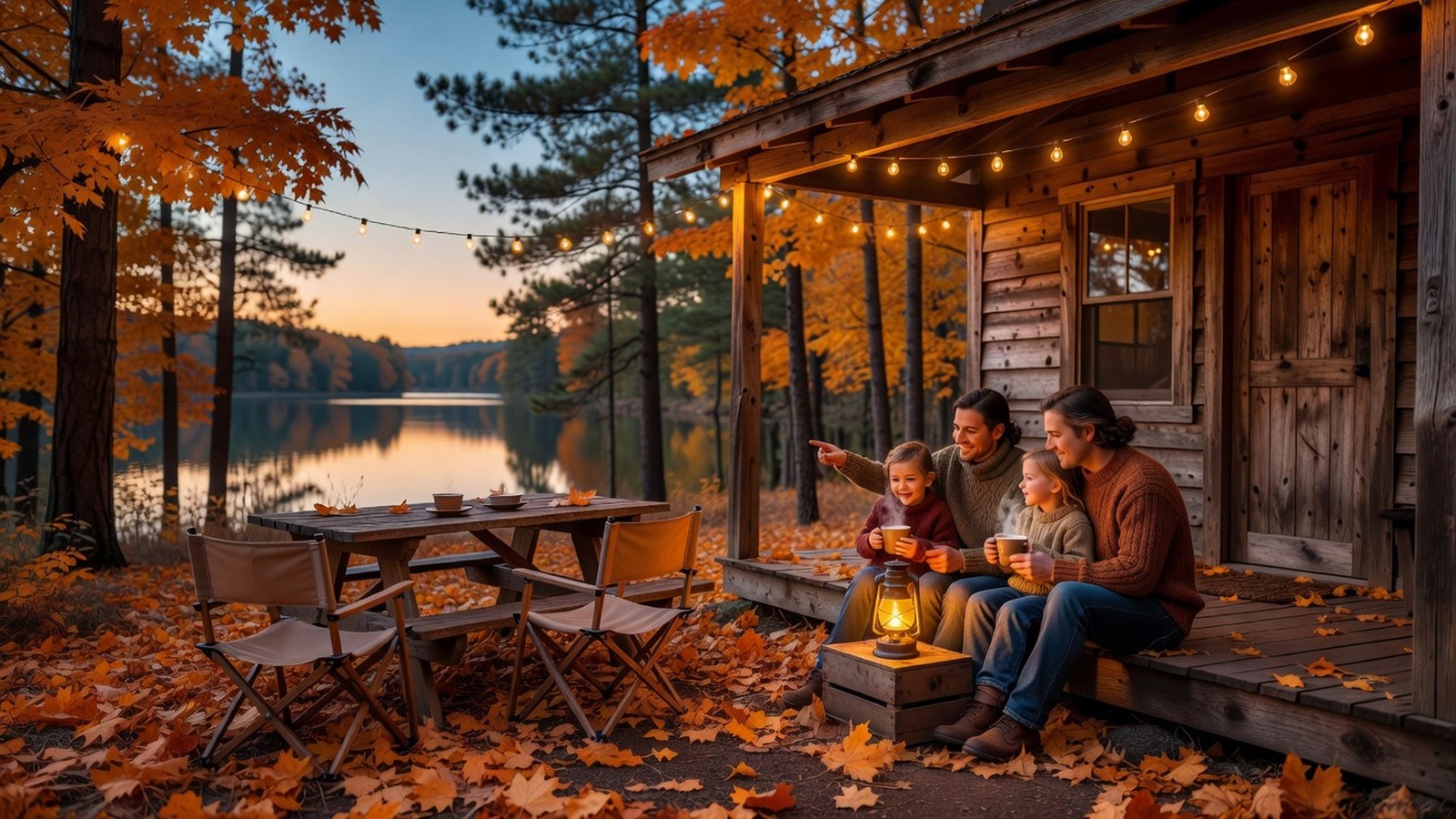
The Three Kinds of Cabin Camping (and Which Fits Your Family)
1. State park "camping cabins." The cheapest tier, usually one room with bunks, electricity, and heat, often a shared bathhouse. Best for families who want a bed and a dry night but are still basically camping. Expect to carry everything in from the car and to cook outdoors.
2. State park deluxe cabins and family lodges. Full kitchens, bathrooms, bedrooms, sometimes fireplaces and lake views. Virginia's system spans this range inside one agency, from Civilian Conservation Corps-era log cabins built in the 1930s to two- and three-bedroom cabins and six-bedroom family lodges designed in the 2000s. This is the tier to target if you're traveling with grandparents or two families.
3. Private cabin rentals and yurts. More expensive, more consistent, usually with linens and Wi-Fi, and sometimes with a two-night minimum and a cleaning fee that erases the savings on a short trip. The advantage is availability: private cabins rarely sell out 11 months ahead the way the best state park sites do.
A quick rule of thumb we use: if the kids are under five or the forecast is uncertain, book the tier that has a bathroom and a real door between you and the weather. If the kids are school-age and the trip is about the fire and the hike, the cheap camping cabin plus a good cooler is the better value.
How to Book a State Park Cabin: Windows, Minimum Stays, and Real Fees
The minimum-stay ladder is the thing nobody plans for
Minimum stays are not fixed — they loosen as your arrival date gets closer. Virginia publishes the clearest version of this ladder we found:
- Peak season (Memorial Day weekend through Labor Day weekend), more than three months out: a 6-night minimum, or a 13-night stay.
- Within three months of arrival: the minimum drops to 4 nights.
- Within one month of arrival: it drops to 2 nights.
- Non-peak season, the rest of the year: a 2-night minimum applies across the board.
That structure rewards two different strategies. If you want a specific holiday weekend cabin, you book early and you accept a longer stay — the six-night minimum is the price of admission. If you want a two-night fall weekend, you wait until inside a month of arrival and book then, when two nights becomes legal.
Also check for blocked arrival days. Virginia requires guests to arrive on a set start day — Friday, Saturday, Sunday, or Monday — depending on the cabin and the park. Some systems also build in a rest day between rentals so the cabin can be cleaned: in Virginia, all cabins, lodges, camping cabins, yurts, and bunkhouses are rented with a rest day between each rental. That's why a cabin can look "unavailable" for a single night between two open blocks.
The fees that don't show up in the headline rate
A cabin advertised at $55 a night is not a $55 weekend. What we found across four state systems:
- Texas (Inks Lake): $55 nightly, $330 weekly, plus a required daily entrance fee per person in addition to the facility fee, plus a $25 cleaning deposit, plus a 2-night minimum on weekends and every major holiday from New Year's through Christmas.
- Alabama (Wind Creek): 14% lodging tax per night, a 4.25% resort fee per night, and a one-time $5.25 reservation fee.
- Virginia: pet fee of $20 per pet, per night, if you're bringing the dog.
- Kansas: a paid pet fee for pet-friendly cabins, and no guarantee your preferred cabin accepts pets.
Add the per-person entrance fee to your math before you compare cabins across states — it's the line that most often flips the answer on a big family.
Booking-window discipline
Windows differ by agency, and the popular parks are effectively lottery-like: sites open at a fixed morning hour and the best weekends are gone in minutes. The habits that work:
- Decide the weekend first, then the park. Pick three parks that would each work and chase all three.
- Know the release hour in the agency's own time zone and be at the keyboard a few minutes early with payment saved.
- Scan for cancellations inside two weeks. Deposits and minimums make cancellations common, and a two-night hole opening up at 10 days out is exactly the trip you want.
- Look at "rest day" gaps. A cabin blocked for cleaning can still be bookable either side of it — try shifting your arrival by a day before assuming the park is full.
Our wider camping trip planning guide covers the reservation checklist and gear staging, and where to camp in October covers the fall weekends that book out fastest.
Cabin Camping With Kids: The Packing List
This is the section people actually come for, so here's the version that assumes the cabin gives you nothing but beds and a roof. If your cabin includes linens, cross those off — but call or check the park page, because inherited assumptions are exactly how families end up sleeping under towels.
Sleeping and bedding (the biggest failure point)
- Sheets that fit the actual bed. Cabins have bunks, twins, doubles, and full-over-full configurations. Bring flat sheets and fitted sheets in both twin and full if you're unsure.
- A pillow per person. Pillows are the item most often missing entirely.
- Sleeping bags as bedding, not as a backup. A TETON Sports Celsius Regular 0°F sleeping bag at $59.99 unzips into a quilt that works on a cabin bunk, and a Coleman Palmetto 40°F bag at $44.99 covers a mild-weather weekend for a kid who kicks blankets off. For two adults in a double, the TETON Celsius XXL 0°F at $89.99 is the roomier option.
- An extra blanket that lives on the couch. A Rumpl Original Puffy Blanket at $139.00 handles drafty nights and doubles as a picnic blanket. If the cabin has no heat or you're in a cold snap, a Sealy 12-volt heated car blanket at $31.99 plugs into a power station or a car outlet.
- A sleeping pad if the mattress is old. State park mattresses vary from excellent to "you can feel the springs." A Klymit Insulated Static V at $94.99 or, for adults who want to sleep like they're at home, an Exped MegaMat 10 at $239.95.
- A cot for the kid who refuses the top bunk. The Coleman Trailhead II cot at $54.99 is a safe, low-to-the-ground option.
Kitchen and cooking (assuming no indoor cooking)
- A two-burner or one-burner stove for the porch. The Coleman Classic 1-Burner Butane Stove at $29.99 is the smallest thing that will boil water and cook eggs; if you're feeding four, the butane canisters run out faster than you expect, so see our camp stove fuel guide before you commit to a fuel type.
- A cook set that replaces the cabin's missing utensils. The Stanley Wildfare Core 26-Piece Camp Kitchen Set at $89.99 covers plates, bowls, utensils, and cookware in one bag — the exact gap Alabama's cabins leave you with.
- One pan that does everything. A Lodge 10.25-inch cast iron skillet at $19.99 works on a camp stove, over a grill, and in an oven if the cabin has one.
- A cooler sized to your trip length, not your groceries. A Coleman 70-Quart Xtreme 5-Day cooler at $79.99 for a three-day family trip; the wheeled Coleman 316 Series 62QT at $84.99 if you're parking far from the porch. The YETI Roadie 24 at $250.00 is the right call only if you're also using it at home.
- Dish soap, a sponge, a drying towel, and a plastic bin. Cabins with kitchens usually expect you to leave them clean; the bin doubles as a wash tub and a toy container.
Light, heat, and power
- Two light sources minimum. Cabin lighting is often one dim ceiling fixture. A Black Diamond Moji Lantern at $24.95 for the table, plus a MalloMe 4-pack of lanterns at $23.99 so each kid has one.
- Headlamps for the bathroom walk. The Black Diamond Spot 400 at $39.95, or the Goal Zero Lighthouse Micro Flash at $29.95 which works as a lantern and a flashlight.
- A power station if the cabin is short on outlets. One outlet and four phones is a losing battle. The EF ECOFLOW RIVER 2 at $169.00 or the Jackery Explorer 300 at $199.00 will run lights, charge tablets, and power a small heater's fan overnight. If you'll be off-grid, our solar charging guide covers panel math.
- Hand warmers for cold-morning hikes. A pack of rechargeable OCOOPA hand warmers at $39.99 ends the "my hands are cold" meltdown before it starts.
Kids, comfort, and the porch
- A chair per kid, sized to the kid. The Coleman Kids Quad Chair at $37.45 or the Kelsyus Youth Canopy Chair at $37.99 for sun cover.
- An adult chair that holds a drink. The Coleman Portable Camping Chair with 4-can cooler at $39.99.
- A wagon for hauling. Parking-to-porch distances at state parks are usually short but rarely flat, and a Radio Flyer 3-in-1 EZ Fold Wagon at $109.99 carries bedding, firewood, and a tired four-year-old in one trip.
- Water bottles with names on them. A Nalgene 32 oz at $16.99 for adults, a CamelBak Eddy Kids 12 oz at $19.99 for small hands.
- Binoculars. Kids who can look at something are kids who don't complain about the walk. The Occer 12x25 compact binoculars at $35.99 are built for small faces.
- A solar shower bag if the cabin has no shower. The Advanced Elements 5-gallon summer shower at $35.99.
The boring stuff that ends trips
Printed reservation confirmation, park gate codes and check-in times, a headlamp per person, a basic first-aid kit, kids' pain reliever, trash bags (many cabins are pack-in/pack-out for trash), paper towels, a lighter and fire starter, and a printed list of the park's quiet hours. See our fall camping gear checklist for the seasonal layer on top of this.
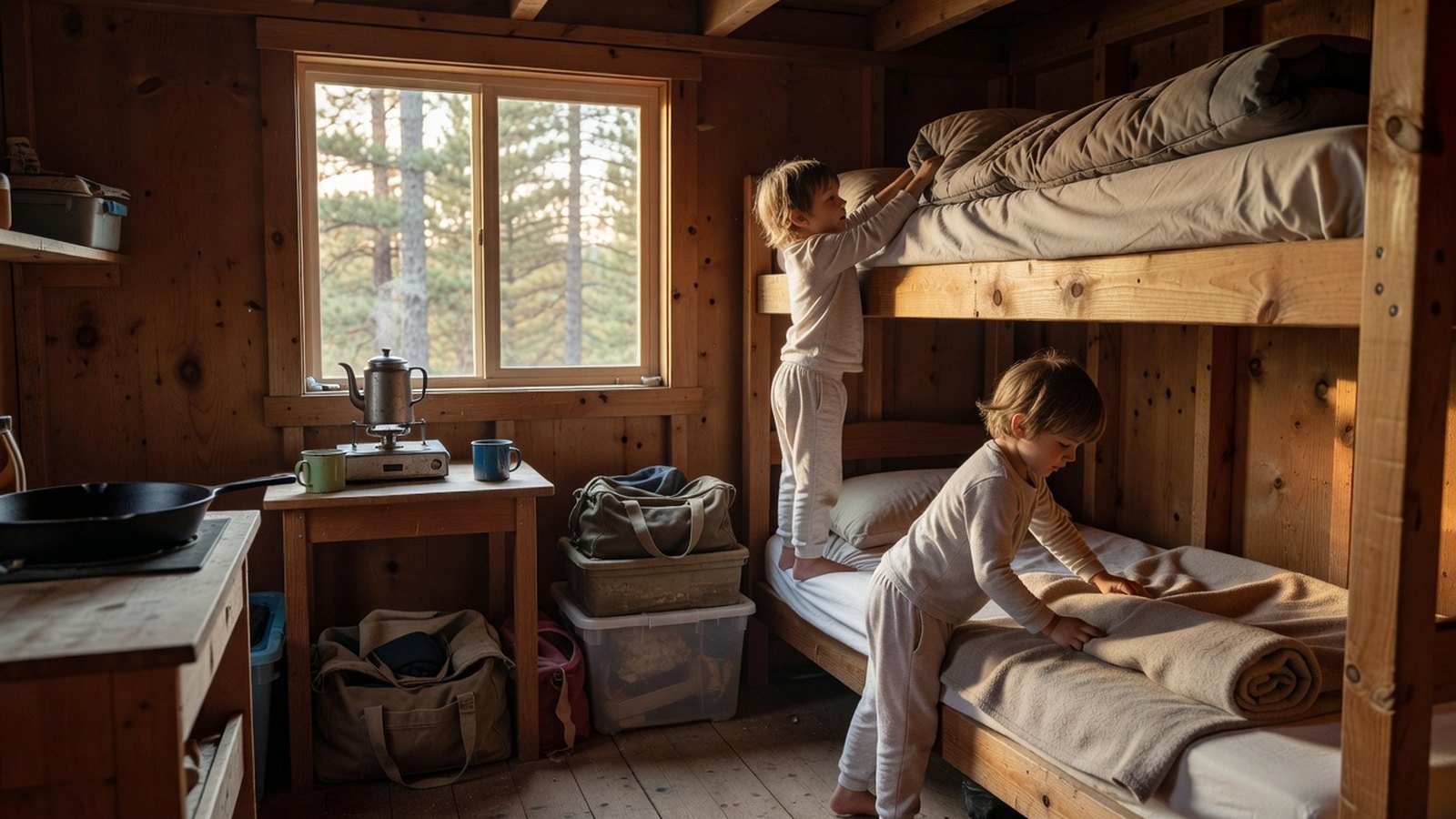
Cabin Camping Meals: A Three-Day Plan That Runs Out of One Cooler
Cabin meals have a different constraint than tent meals: you often have a fridge, a counter, and a real table, but you may not be allowed to cook indoors. So plan for outdoor cooking with indoor assembly.
Day 1 — arrive late, eat fast. Arrival is usually 4 p.m., which means dinner happens in the dark with hungry kids. Pre-make a pot of chili or a tray of baked ziti at home, freeze it, and reheat it on the camp stove. Add bread and a bagged salad. Zero cooking skill required at the cabin.
Day 2 — the big outdoor breakfast. This is the meal that makes cabin camping feel like a vacation. One-burner stove, one cast iron skillet: bacon first, then eggs in the fat, then toast in the same pan. Serve with fruit and coffee. Cook outside on the picnic table even if the cabin has a kitchen — it's the whole point, and in parks like Alabama's Wind Creek the outside grill is provided for exactly this.
Day 2 dinner — foil packets. Ground beef or sausage, potatoes, onions, carrots, butter, and seasoning in heavy foil, 25–35 minutes over coals or on the grill. No pans, no dishes, and kids can build their own. This is the highest-return dinner in family camping.
Day 3 — clean out the cooler. Quesadillas, grilled sandwiches, or a pasta salad built from whatever's left, then a campfire dessert if the park allows fires.
Simple cabin dinner ideas that work with almost no equipment: walking tacos, grilled cheese and tomato soup, sheet-pan sausages with peppers, burgers on the park grill, pancakes-for-dinner, and a big pot of ramen upgraded with leftover meat and vegetables. If you want a deeper menu, our fall camping food guide has a full weekend of family meals.
What not to bring: anything that needs a blender, a full oven, or four burners; glass containers for a cabin with a concrete floor; and more food than your cooler holds — the classic cabin mistake is arriving with three days of food and two days of cold storage.
Cabin Activities for Families (Rain or Shine)
The honest advantage of a cabin is that a rainy Saturday doesn't ruin the trip. Split the plan in two.
Outdoor, 90 minutes or less: a trail the youngest can finish, a lake or creek to throw rocks into, a park Visitor Center if there is one, a self-guided nature walk with a printed scavenger list, and a bike loop if the park has paved paths. Bring the binoculars and a small field guide. State parks with cabins almost always pair them with the kind of short, well-marked trails families need — our camping in Ohio and camping in Pennsylvania guides list the family-friendly ones by park.
Indoor, when it's pouring: card games and a deck of Uno, a magnetic travel game set, coloring books and a roll of tape, a movie on a tablet if you brought a power station, a "cabin journal" where each kid writes one line per day, and a puzzle if the cabin has a table. A plastic bin from home holds all of it and keeps tiny pieces off the floor.
Evening routine, which is what kids actually remember: dinner outside, a lantern on the picnic table, one walk to look at the stars, then board games or reading before bed. It's the same ritual as tent camping without the part where everyone is cold.
Cabin Camping With Dogs: What to Check Before You Book
Pet policies are the most park-specific rule in this entire article, and "dogs allowed at the park" does not mean "dogs allowed in the cabin."
- Virginia makes cabins and lodges pet-friendly at $20 per pet, per night, with one property excluded.
- Kansas allows pets only in cabins specifically designated as pet-friendly, with a paid pet fee.
- Texas state parks generally allow pets, but they cannot enter Texas State Park buildings — and Inks Lake prohibits pets in the cabin area outright.
So the sequence is: pick the park, then check that specific cabin's pet status, then confirm the fee. And when a park says pets can't be in the cabin, that's not a rule you improvise around — it's a rule that gets families sent home.
Gear that makes a dog-friendly cabin weekend easier: a Chuckit! travel pillow dog bed at $29.99 that packs flat, a Ruffwear Quencher collapsible bowl at $19.95 or a Kurgo Zippy Bowl at $15.99, a Meadowlark car seat cover at $65.99 for the drive, and a Plusvivo pop-up dog tent at $69.99 if the dog sleeps better on its own. Our camping with dogs guide covers trail etiquette and the paw-protection side.
Fall and Winter Cabin Weekends: The Season Extender
Cabin camping solves the one problem fall and winter camping can't: the cold ground. Once you're not sleeping on it, the calendar opens up. September through November is the sweet spot — foliage, fewer crowds than summer, and campsite-level demand dropping while cabin demand rises slowly. December through March is the snowbird window, and it's when the southern state parks earn their reputation.
Where to look, by what we've written up in detail:
- Foliage-first fall: Vermont, New Hampshire, Maine, New York, West Virginia, and Wisconsin — the Wisconsin guide has the October closure table, which matters because some loops shut down mid-month.
- Longer fall seasons: Virginia, Tennessee, North Carolina, Georgia, and Texas.
- High-country cabins before the snow: Colorado, Utah, New Mexico, and Arizona.
- Winter-warmer cabins: Florida, Alabama, Louisiana, and the broader camping in November and camping in January month guides.
- Cold-weather cabin trips: the winter camping beginners guide and hot tent guide if you're mixing a cabin stay with a real winter overnight.
Two seasonal specifics for cabins. First, ask whether the cabin's water is turned off — in colder parks, shower buildings and water lines shut down for the season even when the cabins stay open, so "open in winter" and "shower available" are two different questions. Second, check holiday minimums hard: Thanksgiving, Christmas, and New Year's weekends carry the longest minimum stays, and they book out months ahead.
If you'd rather be outdoors than in a cabin for the shoulder season, the fall family camping guide covers the tent-side version, and Columbus Day weekend and Thanksgiving camping are the two holidays that move the most families outdoors in the fall.
Gear Worth Double-Checking Before You Leave
The cabin removes the shelter problem and adds a packing-density problem: everything has to fit in the car, and most of it has to be carried a short distance. A few things that consistently earn their space:
- One bin per function. Sleep in one tote, kitchen in one tote, kids' clothes in one duffel. It makes unloading 20 minutes instead of an hour and makes repacking painless.
- A table for the porch if the cabin lacks one. Our camping tables buying guide covers the folding options that fit a car trunk.
- Chairs you'd actually sit in for two hours. The camping chairs comparison is the place to start if you're replacing the $15 specials.
- A screen shelter if mosquitoes are in season. Our lakeside camping checklist covers the lake-cabin-specific extras.
- A tent for the "I want to sleep outside" kid. The best family tents guide has the cheap 2-person options if one child wants the yard-tent experience next to the cabin. It's a genuinely great hybrid for a first night camping.
Cabin Camping FAQ
Do state park cabins include bedding?
Usually not. Virginia stopped providing linens in June 2020 and now asks guests to bring sheets, pillowcases, blankets, towels, a bath mat, and kitchen towels. Alabama's Wind Creek camping cabins provide no bed linens, bath linens, or pillows. California state park cabins state that linens are not included. Assume you're bringing bedding unless the park's own page says otherwise in writing.
Can you cook inside a state park cabin?
Not always. Texas's Inks Lake cabins prohibit cooking of any kind indoors, even though the cabins have picnic tables and grills outside. Kansas cabins have no supplied cooking utensils. Always check the park rule and plan on outdoor cooking with a camp stove — which is also why a one-burner stove and a cast iron skillet belong on every cabin packing list.
How far ahead can you book a state park cabin?
It varies by agency, and the windows are long for the popular parks, often opening months ahead at a fixed morning hour. What's more useful than the window is the minimum-stay ladder: in Virginia, a peak-season booking made more than three months out requires 6 nights, drops to 4 nights inside three months, and 2 nights inside one month. Booking late is often how families get a short weekend.
Are state park cabins cheaper than a hotel?
Often yes on the nightly rate and no on the total. A Texas Inks Lake cabin runs $55 a night plus a required per-person daily entrance fee plus a $25 cleaning deposit; Alabama's Wind Creek adds 14% lodging tax, a 4.25% resort fee, and a $5.25 reservation fee. Cabins are cheapest per person when you fill them — a cabin that sleeps four to six spreads those fees across a whole family.
Do cabins have bathrooms?
Some do, some don't. Virginia's cabins have kitchens and bathrooms. Texas's Inks Lake cabins do not — restrooms with showers are nearby. For families with toddlers or anyone who gets up at night, the bathroom question should decide which cabin you book, not the price.
Are dogs allowed in state park cabins?
Sometimes, with conditions and fees. Virginia charges $20 per pet, per night with one property excluded. Kansas allows pets only in cabins designated pet-friendly, with a paid pet fee. Texas parks generally allow pets but not inside state park buildings, and Inks Lake bans pets in the cabin area entirely. Confirm the specific cabin, not just the park.
What time is check-in and check-out at a state park cabin?
Virginia: check-in 4 p.m., check-out 10 a.m. Alabama's Wind Creek: check-in 4 p.m., check-out 11 a.m. Both are later and earlier than hotel norms, so plan your drive and your first dinner around a 4 p.m. key handover — that's why we recommend arriving with a pre-made, ready-to-reheat meal.
What is the minimum stay for a state park cabin?
Off-peak, a 2-night minimum is typical — that's Virginia's rule for the entire non-peak season. In peak season the minimum lengthens the earlier you book (6 nights beyond three months out in Virginia), shortens to 4 nights inside three months, and to 2 nights inside one month. Some systems also require a set arrival day and place a cleaning rest day between rentals.
The Bottom Line
Cabin camping with kids is the lowest-risk way to keep a family outdoors through fall and winter, and the least forgiving if you skip the fine print. Book by the amenity list, not the photo: bathroom, cooking rules, bedding, pet status, and the total fee stack. Bring your own bedding as a default, plan to cook outside, and arrive with dinner already made.
Do those four things and the cabin stops being a gamble and becomes the thing that keeps you camping when the tent would have kept you home — which, with kids, is the whole game. Start with a two-night off-peak weekend inside the one-month window, pick a park within two hours of home, and treat the first trip as a test of your packing list rather than a test of your endurance.