Camping in Pennsylvania 2026: State Parks, Free State Forest Sites & Where to Camp in October
Camping in Pennsylvania in 2026 — the three systems that run it, the 11-month booking window, the permit rule that catches first-timers in state forests, Cherry Springs dark-sky camping, Pine Creek Gorge, and the gear that handles a 35°F October night.
Pennsylvania is the best-value camping state in the Northeast, and almost nobody plans a trip around it. The state runs 125 state parks covering more than 300,000 acres, with no entrance fee at any of them — plus a separate 2.2-million-acre state forest system in 50 of its 67 counties where overnight camping is a permit, not a hotel bill. For a family within a day's drive of New York, Philadelphia, Pittsburgh, Baltimore, or DC, that combination is hard to beat anywhere else.
It is also the state where the rules decide whether your trip works. Pennsylvania does not have one camping system with one booking website. It has three, they are operated by different bureaus, the deadline logic is different in each, and two of the rules catch first-timers by surprise: camping more than one night in the same state forest area requires a permit, and roadside ("motorized") camping is only allowed at designated campsites that carry a name or a number.
Get those two right and Pennsylvania is one of the easiest fall camping states on the East Coast. Get them wrong and you'll be moving your tent at dusk.
This guide walks through all of it: how the three systems actually work, the 11-month booking window, what a state forest campsite does and does not have, the named campgrounds worth planning around, when the foliage peaks, Cherry Springs and Pine Creek Gorge, hunting-season reality in October and November, and the gear that decides whether a 35°F night is cozy or miserable.
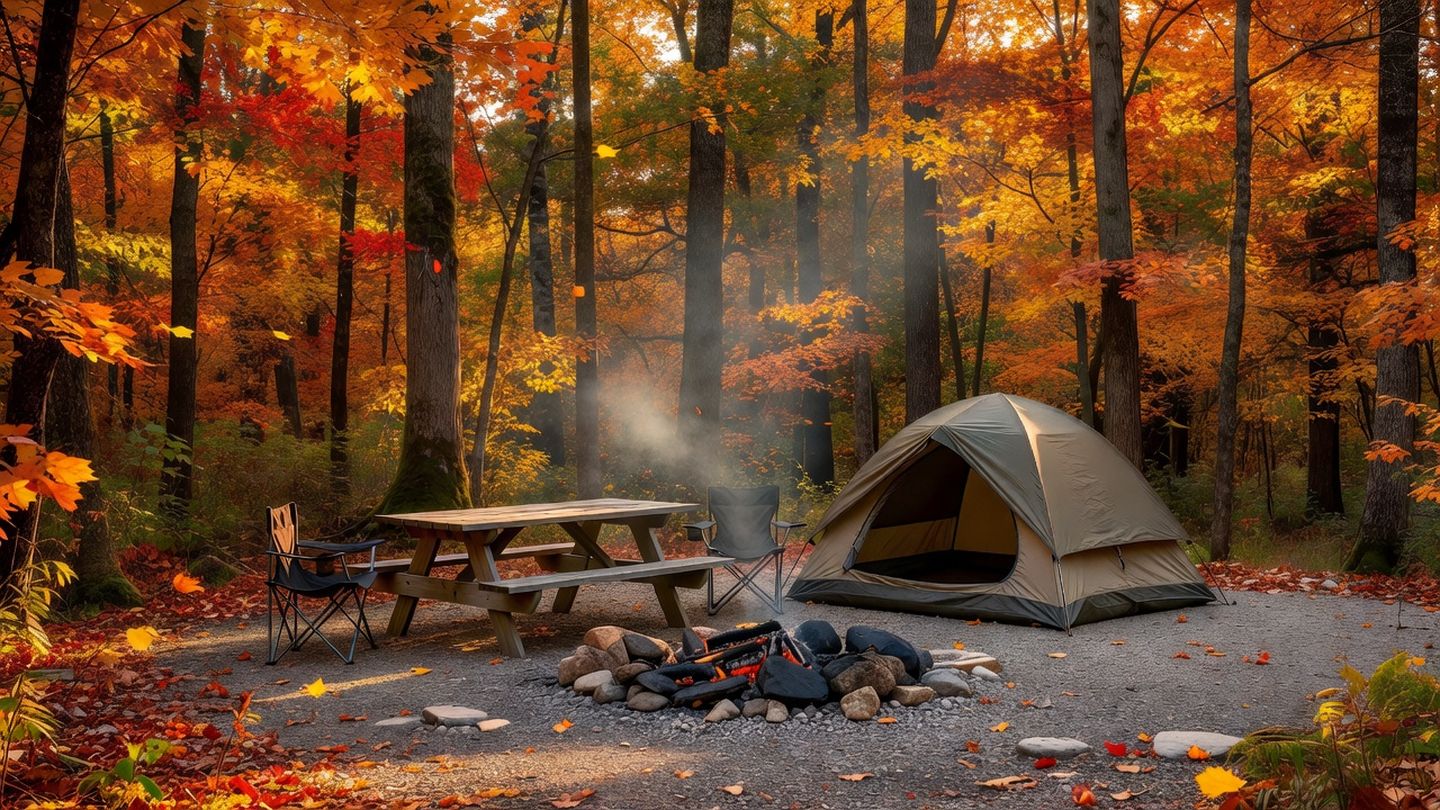
Quick Answer: Where to Camp in Pennsylvania (and When)
- Best window: late September through the third week of October. That's the foliage window, and the state's hardwood ridges are the reason. DCNR publishes a fall foliage report every Thursday during peak season — read the newest one before you pick a region.
- Best family campground type: a state park campsite. Pennsylvania state parks have actual facilities — restrooms, showers, some with yurts, cottages, and inns — and no entrance fee. Book on the Pennsylvania State Parks and Forests reservation system or call 888-PA-PARKS (888-727-2757), Monday–Saturday, 7:00 a.m.–5:00 p.m.
- Book earlier than you think: reservations open up to 11 months in advance for most state park and state forest overnight stays. Next October's good weekends are already on the calendar.
- Cheapest night in the Northeast: a state forest campsite. There are no modern facilities — no water, no dump stations, no utility hook-ups — but the land is free to be on, and the fee structure is a permit rather than a nightly rate.
- The permit rule that surprises people: primitive camping in a state forest is fine for one night, but you need a camping permit if you stay more than one night in the same area. Trailside camping (backpacking) is the most popular form and the most heavily used along the long forest trails.
- Roadside campsites are by name or number. Motorized/roadside camping must happen at designated sites, and it requires a permit through the reservation system.
- Dark-sky camping: Cherry Springs State Park. An 82-acre park sitting inside the 262,000-acre Susquehannock State Forest, famous for Milky Way visibility. Hunting is prohibited inside the park.
- The "PA Grand Canyon" is Pine Creek Gorge — Leonard Harrison State Park (585 acres, east rim, visitor center) and Colton Point on the west rim. Route 660 west out of Wellsboro; don't trust GPS, it routes RVs down dirt roads.
- Federal piece: Allegheny National Forest in the northwest corner — 16 campgrounds plus a horse camp and a lookout cabin, and 27 primitive numbered sites along the Clarion River.
- It's hunting season. Assume blaze orange is mandatory for you and your dog from late September on.
What Changed for the 2026 Season
Pennsylvania's rules don't move much, but the current state of them matters more than the history:
- The reservation window is 11 months. For most state park and state forest overnight stays, reservations can be made up to 11 months in advance. In practice that means the popular October foliage weekends at the well-known parks are gone before the summer ends.
- The phone line has holiday closures. 888-PA-PARKS runs Monday through Saturday, 7:00 a.m. to 5:00 p.m., and it is closed Thanksgiving Day, Christmas Day, and New Year's Day. Paying by credit card, a state park gift card, or a personal/traveler's/cashier's check all work.
- Motorized and roadside camping permits now flow through the reservation system, not through a handshake with a district office — the DCNR page for roadside camping points at the same Pennsylvania State Parks and Forests Reservation System used for state park sites.
- Two Allegheny National Forest roads are the current trouble spot. As of this writing the forest's alert feed lists a temporary closure on Forest Road 154 for bridge replacement and a temporary closure on Forest Road 321 for culvert replacement. If your dispersed-camp plan depends on either, check the forest's alerts page before you leave.
- Fire danger is a live reading, not a season. The Allegheny National Forest currently publishes its fire danger status as Low, and DCNR posts the statewide situation on its wildfire page. Two dry weeks in October will change that number.
- Hunting season peaks in the same weeks as foliage. Pennsylvania's fall hunting calendar runs through the foliage window, which is why orange is a packing-list item, not a suggestion.
How Pennsylvania Camping Actually Works: Three Separate Systems
Most "camping in Pennsylvania" articles blur these together. They are not the same system, and the rules are not the same.
| State Parks | State Forests | Allegheny National Forest | |
|---|---|---|---|
| Who runs it | DCNR Bureau of State Parks | DCNR Bureau of Forestry | U.S. Forest Service |
| Size | 125 parks / 300,000+ acres | 2.2 million acres in 50 of 67 counties | ~514,000 acres |
| Entrance fee | None | None | None |
| Facilities | Restrooms, showers, some yurts/cottages/inns | None — no water, no dump station, no hook-ups | Varies by campground; 16 campgrounds in the FS listing |
| Booking | Reservation, up to 11 months ahead | Permit; reservation for shelters | Recreation.gov / first-come |
| Best for | Families, RVs, first trips | Backpackers, cheap basecamps, solitude | Campground loops, river sites |
The state park system is the one to start with if you're camping with kids or in an RV. It's 125 parks and 300,000-plus acres, there is no admission fee to enter a Pennsylvania state park, and the overnight options go well past a tent pad: campsites, camping cottages, yurts and deluxe cottages, glamping setups, and two state park inns. Everything books through one system.
The state forest system is where Pennsylvania gets genuinely unusual. There are no modern conveniences anywhere on state forest land — no bathrooms, no showers, no water spigots, no dump stations, no electric hook-ups — but the state forest system covers 2.2 million acres in 50 of Pennsylvania's 67 counties and carries more than 5,000 miles of trails. Overnight options inside it are organized by how you get there:
- Primitive / trailside camping — you park, you walk in, you carry everything. This is the most popular form of primitive camping in the state and the reason the long forest trails are lined with small campsites.
- Motorized / roadside camping — you camp in or next to your vehicle, which is stored gear, not a hookup. This is the family-friendly version of state forest camping because you can bring a real cooler, real chairs, and a real tent for four.
- Organized group camping — the option for scout troops, large families, and groups who need to be in one spot.
The federal piece is the Allegheny National Forest in the northwest, which is a different agency with different rules, its own campground loops, and river-side primitive sites.
Free Camping in Pennsylvania: What "Free" Actually Means
This is the single most misunderstood thing about Pennsylvania camping, so here it is plainly.
Pennsylvania state forest land is open to overnight camping, but overnight camping is regulated, and two of the rules are triggers rather than blanket bans:
- Primitive camping in a state forest or state park requires a camping permit if you are staying more than one night in an area in a state forest. One night, no permit. A second night in the same area, permit.
- Trail shelters inside a state park require a reservation rather than a permit.
- Motorized / roadside camping is defined as overnight camping in or near a vehicle used for storage or transport, and it must be done at designated campsites that are identified by a name or a number, with a permit issued through the reservation system.
In other words: Pennsylvania is not a state where you drive into a forest and pitch wherever the logging road ends. It is a state where you either walk in (and get a permit after night one) or you book a designated roadside site by its name or number.
What that buys you: a night in the woods for the cost of a permit, in a state whose forest system is larger than several countries' national parks, within a two-to-three-hour drive of New York City, Philadelphia, Pittsburgh, Harrisburg, and Baltimore. If you can bring your own water and your own toilet solution, this is the cheapest legitimate camping in the Northeast corridor.
What it costs you: everything you'd normally take for granted. No water means you carry it or filter it. No dump station means an RV has to arrive empty and leave with its tank. No hook-ups means power is your own problem — which is the entire reason a mid-size power station or a small propane heater becomes the most important thing in the car on a cold October weekend.
Named Campgrounds and Places Worth Planning Around
You can't list all of them — the state operates more than a hundred parks — but these are the ones that consistently show up when people ask where to camp in Pennsylvania.
Cherry Springs State Park — the dark-sky park. It's a small park (82 acres) completely surrounded by the 262,000-acre Susquehannock State Forest, and its night skies are the reason people drive hours to sleep there. The Susquehannock Trail system nearby offers 85 miles of backpacking and hiking. Hunting is prohibited inside the park — which is a real difference from camping inside the surrounding state forest during the fall seasons. Bring a red-light headlamp, not a white one, and binoculars earn their place in the car here before any other accessory does.
Pine Creek Gorge — the "PA Grand Canyon." The gorge is the draw; Leonard Harrison State Park sits on the east rim with 585 acres, modern facilities, a visitor center, and the most famous canyon views, while Colton Point occupies the west rim. Logistics matter: from Wellsboro you follow Route 660 west roughly 10 miles and the road dead-ends at the park. GPS will try to route you through small dirt roads that are unsuitable for large RVs and buses — follow the paved route instead.
The Susquehannock State Forest — 262,000 acres of the state forest system in north-central PA, and the land surrounding Cherry Springs. Trailside camping here is the classic Pennsylvania backpacking night.
Allegheny National Forest — the federal option, and the one with the most straightforward campground inventory: the Forest Service's recreation listing shows 16 campgrounds, plus a horse camp and a lookout/cabin, including river sites along the Allegheny Wild and Scenic River and the Clarion River Campsites — 27 primitive, numbered sites strung along the Clarion Wild and Scenic River from Irwin Run up to Millstone Creek, reached via River Road and Forest Road 132.
The parks everyone already knows — Ohiopyle, Laurel Hill, Ricketts Glen, Worlds End, Cook Forest, Bald Eagle — are all worth a weekend, but treat them as the book-early tier rather than the fallback, because the 11-month window means their October weekends go first.
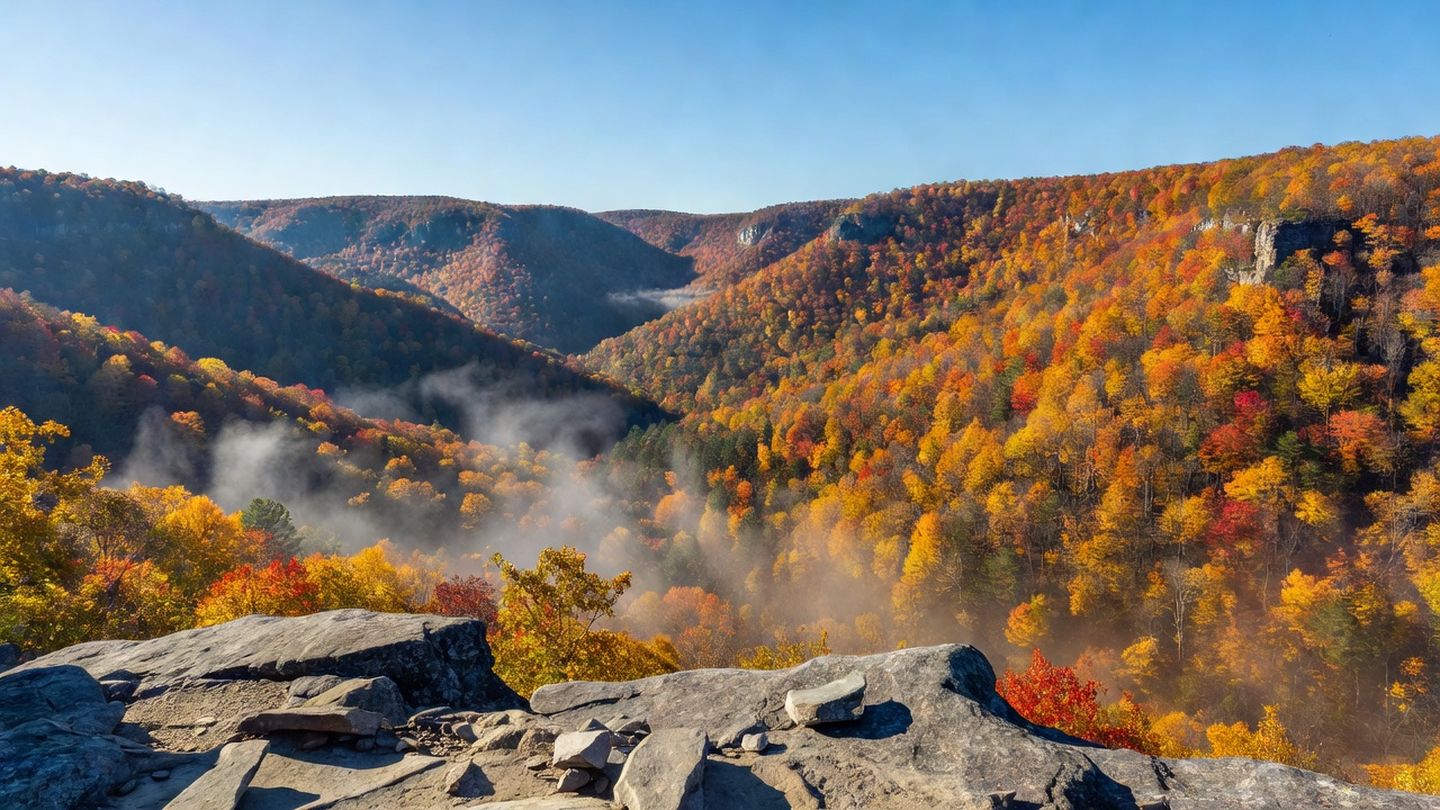
Camping in Pennsylvania by Month: September, October, November
September is the sleeper month. Warm days, cool nights, no foliage crowds yet, and the swimming and paddling still work in the southern half of the state. Bugs are finally tapering off. If you want a state park campsite without a fight, this is when you get it.
October is the reason people come. Pennsylvania's ridges turn in a wave that runs from the northern tier down through the Poconos and the Laurel Highlands, and the state's own phrasing is that it offers "one of the longest and most varied fall foliage seasons in the world." Practically: expect highs in the 50s–60s, overnight lows in the 30s–40s, and the first freeze nights at elevation. This is a three-season sleeping bag month, not a summer one. See our fall camping gear checklist and, if you want the foliage-specific version, the leaf peeping guide — plus regional timing in where to camp in October.
November flips the switch. Northern state parks and forest roads close or go unmaintained, hunting pressure peaks, and the good camping moves to the southern tier and the lower elevations. Nights drop into the 20s. If you're still camping — and plenty of people are — read camping in November before you book, and treat your sleep system as the whole trip.
Hunting Season Is Real: What to Wear and What to Do With Your Dog
Pennsylvania's fall hunting seasons overlap the entire foliage window, and state forest land is heavily hunted. The practical rules:
- Wear blaze orange, including a hat and an outer layer visible from all sides. This is not optional in October and November.
- Your dog needs high-visibility gear too. During deer season, a dog in a brown harness on a leaf-covered ridge is genuinely hard to see. A reflective, high-visibility collar or bandana is the cheapest risk reduction in your kit — see our full guide to keeping dogs visible and safe during hunting season.
- Stay on trail in the early and late hours, when hunters are moving.
- Don't camp on a game trail or near a clearing if you can choose a site. And if you're camping inside Cherry Springs State Park itself, note that hunting is prohibited there — but it resumes the moment you cross into the surrounding state forest.
If you're bringing a dog at all, the camping with dogs guide covers the rest of the trip — and cold, wet ground is the part dogs hate most about fall camping.
Cold-Weather Reality: What a Pennsylvania October Night Actually Costs You
The temperature isn't the hard part. The ground is.
A 40°F night in a tent on a bare pad is colder than a 30°F night on an insulated pad, and that's the mistake that ruins more fall trips than rain does. Three fixes, in order of return on money spent:
- Insulation under you. A pad with a real R-value, a cot that gets you off the ground, or a self-inflating pad. This is the single highest-impact purchase for fall camping.
- A bag rated for the low, not the average. Take the forecast low, subtract 10°F, and buy that. A fleece liner adds meaningful warmth for a fraction of a new bag.
- Dry layers, not more layers. A cotton hoodie that has absorbed the day's drizzle is worse than useless. Merino base layers, a fleece mid-layer, and a shell you can shed at 2 p.m. is the whole formula — and the same logic applies to staying warm while camping.
Camping in Pennsylvania With Kids
Pennsylvania is unusually good for a first family trip precisely because the state park tier exists: real restrooms, running water, and campsites you can drive to. A few things that make a Pennsylvania weekend easier than most:
- Pick a park with a lake or a creek — the afternoon is solved before you unpack anything.
- Bring the wagon. Roadside state forest camping means the car is your base, and a collapsible wagon beats forty trips across a gravel pad.
- Assume a 30°F night and over-pack the sleeping gear for small bodies. Kids sleep cold, and a kids' bag rated for 20°F is a different product from an adult 20°F bag.
- Plan the evening around light. Sunset in late October lands before 6:30 p.m. Lantern light, cards, and a lantern-lit dinner beat trying to keep a fire going in wet hardwood.
Your Pennsylvania Camping Gear List (What Actually Earns Its Space)
The catalog here is organized the same way the trip is: shelter, sleep, under-you, layers, kitchen, light and power, and the odds and ends that save a trip.
Shelter
- Coleman Skydome 4-Person Tent with LED lighting — $122.99. The default first family tent for a state park site: pre-attached poles, a real rainfly, and built-in lighting you'll use every night of a Pennsylvania fall weekend.
- EVER ADVANCED 6-Person Blackout Cabin Tent — $169.99. Blackout walls matter more than you'd expect when sunset is 6:15 p.m. and the kids are up at first light.
- CORE 6-Person Instant Cabin Tent — $169.99. Sixty-second setup, which is worth real money when you arrive after dark in October.
- Coleman Sundome with Rainfly — $153.49. The long-running budget workhorse if you want a weatherproof dome without the cabin footprint.
- Night Cat 2-Person Backpacking Tent — $53.99. The trailside-camping option for the state forest, where you carry everything in.
- Onetigris All-Season Camping Tarp — $56.98. A tarp is the difference between a rainy Pennsylvania weekend and a canceled one.
Sleep
- TETON Sports Celsius 0°F Sleeping Bag — $59.99. Rated for the low, not the average — the right call for an October ridge.
- Kelty Cosmic Down 20°F — $169.00. Down is the lighter, warmer answer if you're hiking in.
- Coleman Palmetto 40°F Bag — $44.99. Perfect for September and mild southern-tier nights.
- TETON Celsius Jr. 20°F Kids Bag — $49.99. Sized so small bodies actually stay inside it.
- Litume Fleece Sleeping Bag Liner — $57.98. The cheapest warmth upgrade you can make to a bag you already own.
- Rumpl Original Puffy Blanket — $139.00. Campfire blanket that survives a drizzle.
Under You (the part that decides the night)
- Klymit Insulated Static V Pad — $94.99. Insulated, packable, and the pad most people should buy first for cool-weather camping.
- Gear Doctors Oxylus Insulated Self-Inflating Pad — $49.99. Self-inflating and family-friendly at the price.
- Therm-a-Rest Z Lite SOL — $54.95. Indestructible foam; doubles as a sit pad and a backup for a leaking air pad.
- Coleman ComfortSmart Cot with Mattress Pad — $99.96. Off the ground entirely — the answer for adults who have stopped enjoying the floor.
- Coleman Trailhead II Folding Cot — $54.99. Lighter version of the same idea for a gravel pad.
- Sea to Summit Ether Light XT Insulated — $219.95. The premium four-season pad if cold sleeping is your one non-negotiable.
Layers and Footwear
- Columbia Steens Mountain Fleece — $34.99. The mid-layer you'll live in from 4 p.m. onward.
- Columbia Omni-Heat Base Layer Top — $49.99. Reflective lining, and it doesn't turn into a swamp under a fleece.
- Darn Tough Hiker Micro Crew Socks — $27.95. Wool socks are a sleep system component in October.
- Smartwool Merino Beanie — $35.00. You will wear it in the tent.
- Columbia Watertight II Rain Jacket — $60.00. Pennsylvania fall rain is a matter of when.
- Merrell Moab 3 Waterproof — $129.95. Wet leaves and wet rock are the Pennsylvania trail surface in October.
- KEEN Targhee 3 Low WP — $187.00. The wider fit option for the same job.
Kitchen
- Coleman Triton 2-Burner Propane Stove — $149.99. Coffee and bacon at the same time, which is the entire morning plan.
- Jetboil Flash Cooking System — $119.95. Boiling water in 100 seconds, for the state forest trip where weight matters.
- Coleman 70-Quart Xtreme Cooler — $79.99. Holds ice for a long weekend without a power source.
- Coleman 5-Gallon Water Carrier — $13.99. Non-negotiable on state forest land, where there is no water at the site.
- Sawyer Squeeze Water Filtration System — $45.95. Refill from a creek instead of carrying it.
- Lodge Cast Iron Camp Dutch Oven — $59.95. One-pot dinners that hold heat in cold weather.
- GSI Enamelware Percolator — $34.95. For the fire-and-coffee kind of morning.
Light, Power, and Cold-Weather Safety
- Black Diamond Moji Lantern — $24.95. A dimmable lantern is the right tent light — and the right choice at Cherry Springs, where white light is the enemy.
- Petzl Actik Core Headlamp — $79.95. Red mode for dark-sky parks and for not waking the tent.
- Black Diamond Spot 400 Headlamp — $39.95. The value option with the same dual-fuel flexibility.
- Occer 12x25 Compact Binoculars — $35.99. At Cherry Springs these are the whole evening.
- Anker Solix C300 Power Station — $329.99. Powers a heated blanket, charges phones for the whole family, and doubles as a light.
- Mr. Heater Buddy Radiant Heater — $74.00. The cold-tent answer, and the reason the next item exists.
- Kidde Portable Carbon Monoxide Detector — $23.97. Any fuel-burning heat source in a tent requires a CO alarm. See the full tent heater safety guide.
- HotHands Hand Warmers (40 pairs) — $29.99. Ten hours of heat, and the cheapest way to fix a kid's cold hands at bedtime.
- Adventure Medical Kits Ultralight .7 — $44.95. Small, sealed, and worth having in a state forest with no cell service.
- Garmin inReach Mini 2 — $349.99. State forest cell coverage is unreliable at best; this is the trip-insurance purchase.
- BearVault BV450 Bear Canister — $89.99. Pennsylvania has a healthy black bear population, and food storage is a real requirement, not a western-only habit.
Odds and Ends That Save Trips
- Mac Sports Collapsible Utility Wagon — $100.56. The single best piece of gear for roadside/state forest camping.
- GCI Outdoor Compact Camp Table — $45.00. A table transforms a gravel pad into a campsite.
- KingCamp Padded Quad Chair — $115.39. Padded arms in 40°F weather are not a luxury.
- Nikwax Tent & Gear Waterproofer — $19.95. Re-proof the fly before the fall season, not during it.
- Gear Aid Tenacious Tape — $14.39. A torn fly at 9 p.m. is a solved problem if this is in the bag.
- Earth Pak Roll-Top Dry Bag — $34.31. Keeps sleeping bags dry when the forecast changes its mind.
Four hundred miles south the season stretches another month, and the North Carolina camping guide is the version of this page for a state where the coast and the mountains close six weeks apart.
Camping in Pennsylvania in October: What's Open, What Turns When
October is the month Pennsylvania camping is built around, and the questions people ask about it are mostly logistical rather than scenic. Here are the ones that actually decide a trip.
The October questions people actually type
| What people are searching | The short answer |
|---|---|
| camping in pa in october | Yes — the state's best camping month, with highs in the 50s–60s and lows in the 30s–40s |
| pennsylvania camping in october | Book a state park for the easy version or a state forest site for the quiet one; the foliage wave runs north to south |
| camping in october pennsylvania | Peak color arrives in the northern tier first, then the Poconos, then the Laurel Highlands over about six weeks |
| camping pa october | Assume a three-season sleep system — this is not a summer bag month, and the first freeze nights hit elevation |
| camping in pennsylvania in october | The same trip as camping pa october: state park tier for facilities, forest tier for solitude, permits handled first |
| national parks in pennsylvania with camping | Pennsylvania has no national park with a campground — its federal camping is national forest, and Allegheny in the northwest is the one to know |
| camping in pa in november | The switch flips — northern parks and forest roads close or go unmaintained and the good camping moves to the southern tier |
| pennsylvania campgrounds open in november | Southern-tier state parks and lower elevations stay open; the northern tier and high forest roads do not |
The three October decisions
Which tier of campground. State parks give you restrooms, running water and a site you can drive to. State forest camping is free-er and quieter but runs on a permit system, and roadside sites are identified by name or number and always need a permit. Cherry Springs and Pine Creek Gorge are the two places people plan a whole trip around.
How far north. The state's foliage wave moves from the northern tier down through the Poconos and the Laurel Highlands over roughly six weeks, which means an early-October trip and a late-October trip are two different states. If you are chasing color, follow the wave rather than booking the park you already know.
What the night will cost you. The temperature is not the hard part — the ground is. A 40°F October night on a bare pad is colder than a 30°F night on an insulated one, which is why the pad, not the bag, is the purchase that saves a fall weekend.
On that last point, three specific upgrades: the Gear Doctors Oxylus 4.3 R-Value pad at $49.99 is the highest-return item for a Pennsylvania October; the Litume fleece liner at $57.98 rescues a bag you already own; and a Fiskars X7 hatchet at $29.99 makes wet hardwood firewood manageable, which is the other thing that decides an October evening.
Because dark lands before 6:30 p.m. in late October, light is part of the kit: the Black Diamond Spot 400 headlamp at $39.95 and a pack of OCOOPA rechargeable hand warmers at $39.99 cover the two things that make a cold campfire evening work. If a dog is on the trip, cold, wet ground is the part they hate most — Musher's Secret paw wax at $24.99 is the cheapest fix for it.
October's real constraint: hunting season
Pennsylvania's fall hunting seasons overlap the entire foliage window and state forest land is heavily hunted. Wear blaze orange including a hat, put high-visibility gear on the dog, stay on trail in the early and late hours, and do not camp on a game trail or next to a clearing if you have a choice. Hunting is prohibited inside Cherry Springs State Park itself, but it resumes the moment you cross into the surrounding state forest.
For the neighbouring options, West Virginia's Gauley season runs to mid-October and its campfire rules differ from Pennsylvania's — the camping in West Virginia guide covers both. New York's northern tier peaks a week or so before Pennsylvania does, which makes the camping in New York guide the early-October play. And the camping in November guide covers what happens when the switch flips.
Camping in Pennsylvania FAQ
Can you camp for free in Pennsylvania?
There is no fee to enter a Pennsylvania state park, and the state forest system — 2.2 million acres across 50 of the 67 counties — is open to overnight camping under a permit structure rather than a nightly site rate. In practice the cheapest camping in the state is a primitive state forest site you walk into, or a designated roadside site you book with a permit. State park campsites carry a reservation and a rate, but you're paying for facilities: restrooms, showers, and water.
Do you need a permit to camp in a Pennsylvania state forest?
Sometimes — and the trigger is the number of nights. For primitive camping in a state forest, you must obtain a camping permit if you are staying more than one night in an area. One night in an area is generally fine without one. Trail shelters inside a state park require a reservation instead. Motorized or roadside camping requires a permit in every case, and it can only happen at campsites identified by name or number.
How far in advance can you book a Pennsylvania state park campsite?
Up to 11 months in advance for most state park and state forest overnight stays. Book at the Pennsylvania State Parks and Forests reservation system or call 888-PA-PARKS (888-727-2757), Monday–Saturday, 7:00 a.m.–5:00 p.m., closed Thanksgiving Day, Christmas Day, and New Year's Day. Because the window is 11 months, October foliage weekends at the best-known parks are effectively booked months ahead.
What is the best month to camp in Pennsylvania?
Late September through the third week of October for most people. September gives you warm days, quiet campgrounds, and no foliage traffic. October gives you the color and the cold nights — highs in the 50s–60s and lows in the 30s–40s, with the first freezes at elevation. November pushes most northern campgrounds into closing mode and the remaining good options south and low.
Where is the best fall foliage camping in Pennsylvania?
The state's hardwood ridges run north to south, and DCNR publishes a fall foliage report every Thursday during peak season with regional updates — that report is the most reliable planning tool you have. The north-central tier (Susquehannock State Forest, Pine Creek Gorge) and the Laurel Highlands turn in the same general window, with the southern tier running later.
Can you camp at Cherry Springs State Park?
Yes — Cherry Springs is an 82-acre state park with camping, and it's surrounded by the 262,000-acre Susquehannock State Forest. Two things to know: reservations run through the state system (up to 11 months ahead), and the park exists for its dark skies, so bring red-light lighting and skip the white floodlights. Hunting is prohibited inside the park itself, but not in the surrounding state forest.
Is camping in Pennsylvania dog-friendly?
Yes, with two fall-specific caveats. First, hunting season overlaps the foliage window, so high-visibility gear for your dog is a safety item, not a fashion choice. Second, October ground is cold and often wet — an insulated pad or a raised dog cot does for your dog exactly what it does for you. Check the individual park's pet rules before booking, since facilities differ.
Do Pennsylvania state parks allow RV camping?
Yes. State parks have campsite loops suited to RVs, and the state park tier is the right choice for an RV because it's the tier with water and dump stations. State forest land has no water, no dump stations, and no utility hook-ups — arrive self-contained and leave with your tanks, or camp somewhere else.
Is there cell service in Pennsylvania state forests?
Frequently no, and it varies by valley more than by map. The Allegheny National Forest and the big north-central state forests have long stretches with no usable signal — which is fine until you need help. A satellite communicator is the honest answer for solo trips and trips with kids.
What should I pack for an October camping trip in Pennsylvania?
Four things decide the trip: a sleeping pad with real insulation, a bag rated about 10°F below the forecast low, dry wool or synthetic layers you can shed, and light that runs on red. Then add the Pennsylvania-specific items — blaze orange for people and dogs, a water carrier or filter (state forest sites have no water), a tarp, and a CO alarm if you're running any propane heat in the tent.
Where can I camp in Pennsylvania in October?
Either a state park, for facilities and a drive-in site, or a state forest site, which is quieter and runs on the permit system — roadside sites are by name or number and always need a permit. Cherry Springs for dark skies and Pine Creek Gorge for the gorge itself are the two most planned-around destinations, and both book out for peak foliage weekends.
Do Pennsylvania state parks close in October?
Most stay open through the foliage season, and October is the month they are busiest. The closures come afterward: from November, northern state parks and forest roads close or go unmaintained, and the usable camping shifts to the southern tier and lower elevations.
What is Pennsylvania camping like in November?
Colder and quieter, with nights into the 20s, hunting pressure at its peak, and the good camping concentrated in the southern half of the state. Treat the sleeping system as the whole trip — ground insulation matters more than the bag rating — and read the November guide before you book.
The Bottom Line
If you are comparing destinations, camping in Wisconsin covers the state park system's booking window, its staggered October closures and the sites that stay open all winter.
The state next door has its own full West Virginia camping guide — and it's the one place nearby where the biggest park campground is free, first-come and unreservable.
Next door, camping in Georgia runs on a 41-park state system with its own 13-month booking window and a $10 ParkPass that is not included in the reservation — useful when you are comparing state lines for the same weekend.
Pennsylvania's pitch to a family camper is simple: 125 state parks with no entrance fee and an 11-month booking window, sitting next to 2.2 million acres of state forest you can camp on for the price of a permit — with a foliage season that runs from the northern tier to the southern tier over about six weeks. It is the cheapest serious outdoor weekend available to most of the Northeast corridor.
The three things that make or break it: learn which tier you're camping in (park vs. forest vs. Allegheny), respect the permit rule (one night free-and-easy, more nights need a permit, roadside sites are by name or number and always need one), and treat the cold ground as the real opponent rather than the air temperature. Do that and an October weekend in the Pennsylvania woods beats almost anything you can drive to in a day.
If your fall trip is heading one state over, our Camping in Oregon guide covers the coast, the Cascades and the high desert with the same booking mechanics — including why Oregon's window is only six months.
If your plans land on the very last weekend of September, National Public Lands Day 2026 explains which federal lands are genuinely free that Saturday — and which ones quietly stopped waiving entrance fees this year.
One state over, Ohio runs the same kind of system on a shorter horizon: the camping in Ohio guide covers the six-month window, Hocking Hills, and the separate state forest permit system in the southeast.
Planning a trip the other direction? Our camping in Washington state guide covers the three separate booking portals, the October closing wave and the coast campgrounds that never shut for the season.