Spring Break Camping 2027: Family Trips & Destinations
Spring break camping 2027: where families camp in Texas, California and Florida, when to book, and the gear that handles wet, windy March nights.
In this article · 7 sections
Spring break is the first camping window of the year that actually works for a family with school-age kids — and it's also the most competitive one. Not because more people camp in March than in July, but because everyone in a given region takes the same week off, and they all want the same 200 campsites within a three-hour drive of home.
The planning mistake I see every year: families decide in February, discover every reservable site in their region is gone, and either give up or end up at a first-come-first-served campground that fills by Thursday afternoon. The fix is boring and takes twenty minutes in the fall — which is exactly when you're reading this.
Here's the honest version of how spring break camping works: where to go by region, when the reservation windows open, what March weather actually does to a trip, and the gear that matters when the nights are still in the 30s and the afternoons are 70°F.
When Is Spring Break 2027?
Spring break isn't a national holiday — it's a patchwork of school district calendars, which is why the "when" question has a different answer in Dallas than in Boston.
- Late February (Feb 20–28): Texas districts and a handful of Southern university systems, plus ski-week families in the Mountain West.
- Early March (Mar 6–14): The single biggest week for most of the South and Southwest, and the busiest camping weekend of the entire spring in Texas, Arizona, and Florida state parks.
- Mid-to-late March (Mar 20–28): The Northeast and Midwest catch up, and in 2027 this window gets an extra push because Easter falls on Sunday, March 28 — districts that tie break to Good Friday land here.
- Early April: A smaller tail for districts on a later calendar, and the best window for the desert Southwest before it gets genuinely hot.
Two calendar facts that matter for planning: daylight saving time begins Sunday, March 14, 2027, so the second half of the month gives you usable evening light until almost 8 p.m. — which is the difference between cooking dinner in the dark and not. And because Easter lands on March 28, the week of March 22–28 is the one week where nearly every region's break overlaps. If you have flexible dates, that is the week to avoid; if you don't, that's the week to book first.
Spring Break Camping Destinations, by Region
The right destination in March is not "somewhere warm" — it's somewhere whose spring conditions match your tolerance for mud, wind, and cold nights. Pick your region first, then the campground.
Texas: Hill Country Rivers and the Gulf Coast
Texas is the highest-volume spring break camping state in the country, and the state park system absorbs most of it. The Hill Country rivers (Guadalupe, Frio, Blanco) are the classic family pick — but be realistic: in early March the water is cold enough that most kids will wade, not swim, and tubing season hasn't started. What you get instead is quiet riverfront campgrounds, easy hiking, and wildflowers peaking in late March.
The Gulf Coast (Mustang Island, Goose Island, Galveston Island) is the better bet if you want actual beach time. Expect wind, blowing sand, and a 20°F swing between afternoon and 2 a.m. If you want the fuller state-by-state picture, our Texas camping guide covers park-by-park trade-offs, and the state park camping guide explains how the reservation systems differ.
California and Arizona: Desert First, Coast Second
Southern California and Arizona are where spring break camping is best in March — the desert is at its peak, not yet hot, and the crowds that arrive in April haven't shown up. Anza-Borrego, Joshua Tree, and the Arizona Sonoran desert campgrounds all hit 70s by day and 40s at night.
The California coast is a different calculation: March is still the wet, foggy shoulder season north of Santa Barbara, and campgrounds from Big Sur to Mendocino can be genuinely soggy. South of Malibu it's much more reliable. Our California camping guide and Arizona guide break down which parks drain well and which turn into mud.
Florida: Springs, Not Beaches
Florida's spring break camping advantage isn't the beach — it's the freshwater springs (Ichetucknee, Ginnie, Blue Spring), where the water is a constant 72°F regardless of the weather and manatees are still in residence through March. That's a genuinely unique family experience and it doesn't depend on the air temperature.
The trade-off is that Florida's best spring camping is also its most-booked, and the state's reservation window opens far earlier than most families expect. Details in our Florida camping guide.
Southeast: Lakes, Mountains, and Wet Weather
Tennessee, North Carolina, Georgia, and Arkansas are all reliable in late March — the mountains are greening up, the waterfalls are running hard, and the campgrounds are half-empty compared to summer. The price is rain: late March in the Southern Appalachians is a coin flip on a multi-day soaking. Pack for it and you'll have the place to yourself.
Pacific Northwest and the Northeast: Honest Advice
March in Oregon, Washington, and New England is not camping weather for most families — it's 45°F and raining sideways. If you're in those regions, spring break is the right week to either (a) rent a cabin instead of a tent site, or (b) drive south. Our month-by-month camping guide covers the regional timing in more detail, and if the forecast turns, the rainy-day camping gear guide is worth reading before you leave.
Five Easy Spring Break Trips for Families
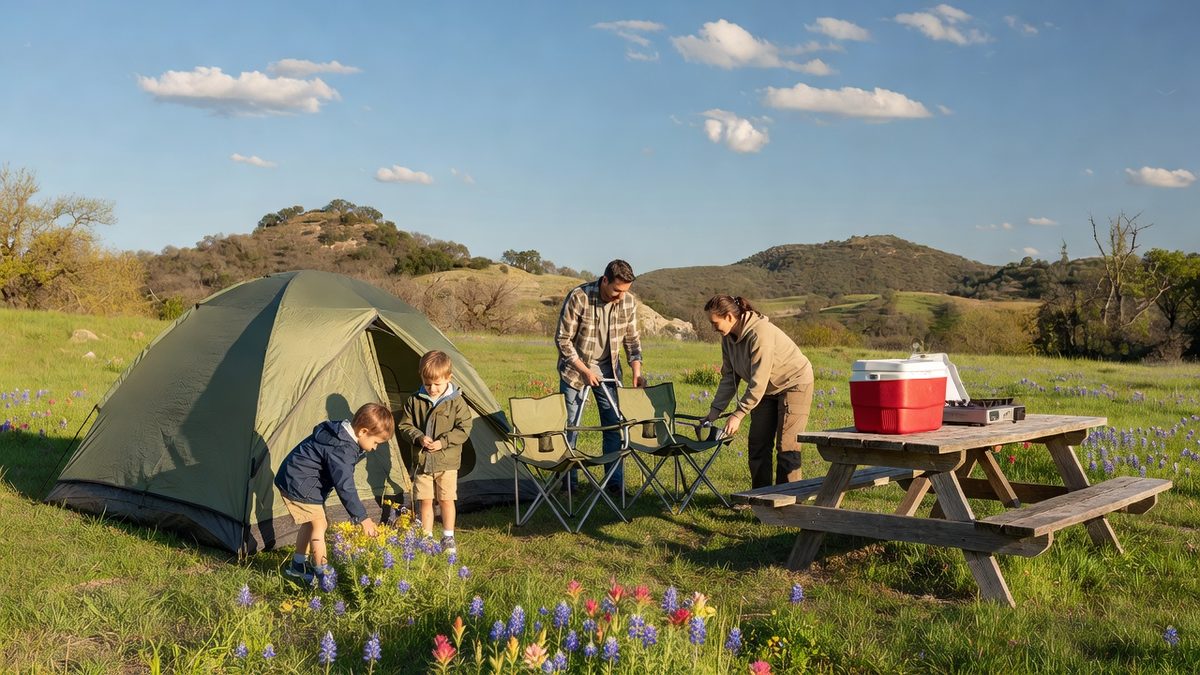
If you're searching for spring break camping near me and the answer is "the closest state park is full," these five trip shapes are the ones that actually work with kids:
- Two-night state park basecamp (the default). Drive Friday after school, set up in daylight, hike Saturday, break camp Sunday. Low commitment, high success rate, and no need to take a full week off.
- Three-night beach or lake camp with one "activity day." Add a single booked activity — kayak rental, a spring-fed swimming hole, a cave tour — so the trip has a center of gravity instead of three identical days.
- Cabin plus day-use camping. Many state parks rent cabins or yurts in March at shoulder-season rates. You get the park, the fire ring, and the hiking without the 35°F tent night. Best option for families with a toddler.
- Desert or canyon trip for older kids. March is the only comfortable month for Joshua Tree, Big Bend, or southern Utah with kids who can handle a real hike. Our teen camping guide covers the "make it not boring" problem.
- Backpacking overnight for teens. One night, 3–5 miles in, on a route you've scouted. Spring break is the ideal first backpacking window because the water sources are running and the bugs haven't hatched.
The common thread: keep it short and pick one region. A three-night trip in one place beats a five-night tour of three campgrounds with kids, every time. If you're still deciding how much to plan versus wing it, the camping trip planning guide is the walkthrough.
How Early Should You Book a Spring Break Campsite?
Earlier than you think, and the reason is structural: reservation windows are set in months, not weeks, so the site you want may already be reservable — and already reserved — right now.
- Texas State Parks: sites open about five months ahead. For a mid-March 2027 trip, the window opened in October 2026.
- Florida State Parks: one of the longest windows in the country, roughly eleven months. Spring break 2027 sites have been reservable since early 2026.
- California State Parks: varies by district, but most open six months out.
- National park campgrounds (Recreation.gov): mostly six months rolling, with some parks releasing in blocks on a specific date and time.
- Private campgrounds and KOAs: often bookable a year ahead, and they're the fallback when public sites are gone.
The practical rule: search in November for a March trip. If you're already past that, go straight to the second tier — county parks, Corps of Engineers campgrounds, private RV parks with tent sites, and first-come-first-served loops with a Thursday arrival. Our how far in advance can you book campsites guide has the per-system detail. A weekday arrival is the single most effective workaround: Sunday–Thursday nights are dramatically easier to get than Friday–Saturday, even in the busiest week of spring.
Spring Break Camping Gear: What March Actually Requires
March camping is a two-climate trip. You will be in a T-shirt at 2 p.m. and zipping a jacket at 8 p.m., and your sleeping system has to handle a 30°F night without being a winter bag. Here's the gear that earns its space.
Shelter: A Tent That Handles Rain and Wind
Spring storms are convective — they arrive fast, dump hard, and blow. A cabin-style tent with a full-coverage rainfly and decent guy-out points is the right call for families; a minimalist ultralight is not.
- CORE 6-Person Instant Cabin Tent — $169.99. The spring-break default for a family of four: 60-second setup means you're not pitching in the rain for twenty minutes, and the pre-attached poles survive wind gusts that flatten cheap dome tents.
- UNP 4-Person Cabin Tent — $115.99. Smaller footprint for two adults plus one kid, with a waterproof top rainfly that handles an all-night soaker.
- Londtren 4-Person Pop-Up Tent — $84.99. The budget pick if you're doing two nights and don't want to spend $170 on a tent. Pop-up means no pole assembly in the dark.
Sizing matters more than brand in spring, because you'll be inside the tent during a rain shower with kids and gear. Our tent size guide and best family camping tents roundup will keep you from buying one size too small.
Sleep: 40-Degree Bags, Not 0-Degree
This is the most common spring packing error — people bring their winter bags and sweat, or bring summer bags and freeze at 3 a.m. March nights in most of the country sit between 35°F and 50°F, which is exactly the 30–40°F comfort band.
- Coleman Palmetto 40°F Sleeping Bag — $44.99. Right for coastal and Southern spring nights, and it unzips into a blanket for warm afternoons.
- Kelty Woobie 30°F Kids Sleeping Bag — $39.95. Sized for kids instead of swallowed by an adult bag, which is the difference between a warm child and a cold one.
- Klymit Insulated Static V Sleeping Pad — $94.99. Insulation under you matters more than the bag's rating in spring, because the ground is still cold from winter. This pad has an R-value that holds up on 40°F nights.
Kitchen, Cooler, and Camp Comfort
- Coleman Classic 1-Burner Butane Stove — $29.99. Fast coffee in a windy morning is the whole point. Butane is simple, and the case keeps it clean.
- Coleman 70-Quart Xtreme 5-Day Cooler — $79.99. Spring means you're not restocking ice every day; five-day retention earns its keep on a four-night trip.
- Coleman Portable Camping Chair with Cooler — $39.99. One chair that carries drinks means fewer trips to the cooler.
- Coleman Kids Quad Chair — $37.45. Kids' chairs stop the "I want the big chair" fight and are sized so they don't tip backward.
- Black Diamond Moji Lantern — $24.95. Dimmable, hangs in the tent, and doesn't blind everyone at bedtime.
Kids, Dogs, and the Spring Bug Problem
Two things change in late March: the bugs wake up, and the ground turns to mud.
- OFF! Clean Feel Insect Repellent with Picaridin — $11.99. Picaridin is the right active ingredient for kids' spring trips: effective on ticks and mosquitoes without the DEET smell. Our bug protection guide covers tick checks, which matter more than most parents realize in March.
- Radio Flyer 3-in-1 EZ Fold Wagon with Canopy — $109.99. Mud, gear, tired four-year-olds: a wagon solves all three and the canopy handles the first strong spring sun.
- Ruffwear Quencher Collapsible Dog Bowl — $19.95. If the dog is coming, pack a bowl that packs flat and dries fast.
For the full checklist, the family camping gear checklist is the one to print.

Spring Break Camping Weather: The Honest Version
- Nights are still cold. 30s to low 40s across most of the country in early March. Assume one night will hit freezing if you're north of the 35th parallel.
- Rain is the main risk, not cold. Spring systems are short and violent. A full rainfly and a tarp over the picnic table do more for trip quality than any other $40 you'll spend.
- Wind arrives with the fronts. Stake everything, including the cooler lid, and don't leave the rainfly off "because it looks clear."
- Afternoon sun is stronger than it feels. First sunburn of the year happens in March on a 65°F day. Bring sunscreen and hats.
- Mud is the actual enemy of family camping. A door mat, a boot tray, and a change of shoes at the tent door prevent the "everything inside is covered in mud" spiral.
Spring Break Camping FAQ
What is the best state for spring break camping?
Texas and Florida have the most campsites and the most reliable March weather, but they're also the most competitive. Arizona and Southern California are the best combination of good weather and available sites in early March, and the Southern Appalachian states (Tennessee, North Carolina, Georgia, Arkansas) are the quietest option if you can tolerate rain.
Is spring break a good time to camp with young kids?
Yes, with one adjustment: shorten the trip. Two nights is the right length for kids under six, and a cabin or yurt beats a tent if the forecast has nights below 40°F. The advantage of spring break over summer is that it's not hot enough for heat illness to be a real risk, which makes it the safer first camping trip of the year.
Do I need a reservation for spring break camping?
For any state park in Texas, Florida, California, or Arizona during the peak week — yes, and you needed it months ago. First-come-first-served loops still work if you arrive on a weekday before noon, and private campgrounds are the reliable fallback. Never drive to a popular park on a Friday of spring break week without a reservation.
What should I pack for spring break camping that people forget?
A tarp and paracord for rain, a second pair of shoes per person for mud, a 40°F-rated bag instead of a summer bag, warm hats for sleeping, tick remover, and a lantern that dims. The gear list above covers the big purchases; the tarp, the shoes, and the hats are what actually save the trip.
<!-- AFFILIATE_DISCLOSURE -->TrailMapz earns a commission on qualifying purchases made through the product links in this article, at no extra cost to you. Prices and availability are accurate as of publication and can change.