Camping With Teens: 15 Things to Do + Gear That Gets Them Off the Phone (2026)
Camping with teens is a different trip than camping with little kids. Here are 15 things to do, how to hand them real responsibility, and the gear (hammocks, headlamps, power stations) that actually earns a spot in a teenager's pack for 2026.
Camping With Teens: 15 Things to Do + Gear That Gets Them Off the Phone
Camping with a teenager is a completely different trip than camping with a five-year-old, and most family camping advice ignores that. The little-kid playbook — bubbles, scavenger hunts, a nap schedule — falls flat the moment your kid turns fourteen and would rather be at home with wifi.
I've run both versions of this trip for years: the toddler years where the campsite had to double as a playground, and the teen years where the campfire went quiet because everyone was on a screen. The second version isn't harder. It's just different. Teens don't want to be entertained — they want to be trusted, useful, and given something genuinely interesting to do.
This guide covers the 15 activities that actually landed with my teenagers, how to hand over real responsibility at camp, and the gear that earned a permanent spot in a teen's pack (not the stuff that got left in the car).
Why Teen Camping Is a Different Trip
Three things change when your kids hit their teens, and every activity below is built around them.
They want autonomy, not supervision. A 15-year-old does not want to do a craft project with you. They want to walk to the lake alone and come back when they're ready. Camp is one of the last places where you can safely hand a teenager real independence — and they remember that.
They need a job that matters. Teenagers disengage when they're decorative. Give them the fire, the stove, the camp setup, the navigation, and the trip changes. They're not tagging along anymore; the trip depends on them.
They're built for the physical stuff. The hikes that your 6-year-old complained about are the ones your teenager will do twice. Teen bodies are ready for ridges, kayaks, bikes, and night hikes — and they want to be tired at the end of the day.
That's your playbook: independence, responsibility, and real physical effort. Here's how it looks on the ground.
15 Things to Do Camping With Teens
1. Give Them Their Own Hammock and Their Own Corner
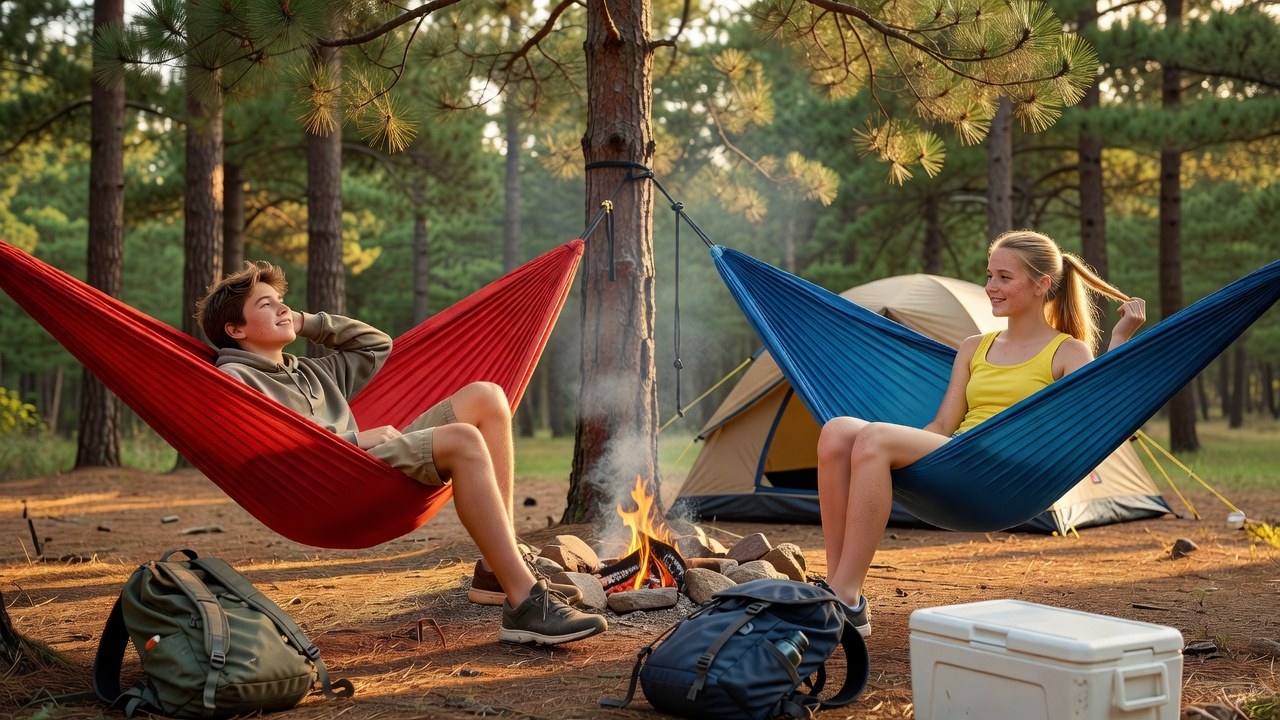
This is the single highest-value move I've made. A hammock turns a boring patch of trees into a personal room. Teens claim a hammock the way they'd claim a bedroom — and once it's their spot, they stop asking what there is to do.
The ENO DoubleNest Lightweight Camping Hammock ($75.00, 4.6 stars, 5,000+ reviews) fits two, so siblings share it or one teen sprawls. It packs down to about the size of a grapefruit and sets up in under two minutes once they've done it once — which is exactly the kind of skill you want them to own.
If you want the cheaper starter version, the ENO SingleNest ($54.95) is the same format for one person. Budget families: the Wise Owl Outfitters Camping Hammock ($43.91, 4.8 stars, 30,000+ reviews) comes with tree straps included and holds up to 500 lbs.
Don't skip the straps — bare rope damages bark and gets you kicked out of state parks. The ENO Atlas Suspension System ($29.95, 4.9 stars) is the standard answer, and it makes setup easier for a beginner. Our full hammock camping guide covers hang angles, tree selection, and how to sleep overnight in one without wrecking your back.
2. Let Them Plan and Cook One Full Meal
Hand a teenager the stove and a meal they chose, and dinner becomes their project instead of your chore. Set the rules — no risky knife work, no unattended flame — then step back.
The Coleman 70-Quart Xtreme 5-Day Cooler ($79.99, 4.6 stars) holds five days of ice, which matters when a teen is in charge of three meals and keeps opening the lid. For a splurge, the Stanley All Day Julienne Soft Cooler Bag ($100.00, 4.8 stars) is the one they'll actually carry to the lake.
Pair it with our camp cooking meal-planning guide and let them build the list from scratch.
3. Night Hike With Real Headlamps
Night hikes are the activity that surprises parents most. The same trail that got eye-rolls at noon becomes genuinely exciting at 9pm — and it's a legitimate safety skill, not just entertainment.
Buy each teen their own headlamp rather than sharing yours. The Black Diamond Spot 400 ($39.95, 4.5 stars) runs on AAA batteries or its rechargeable core, throws 400 lumens, and is waterproof enough for real weather. For something with a red-light mode and USB-C charging, the Petzl ACTIK CORE ($79.95, 4.5 stars) is the upgrade.
Red light matters here: it preserves night vision, which is the difference between spotting wildlife and scaring everything within a mile. Our night hiking safety guide covers route selection, turnaround times, and what to do if a teen wanders off the group.
4. Send Them Off With Binoculars
Give a teenager binoculars and a lake, and they'll disappear happily for an hour. This is the cheapest "entertainment" you can pack, and it quietly turns into birding, wildlife spotting, and stargazing.
The Occer 12x25 Compact Binoculars ($35.99, 4.5 stars, 24,000+ reviews) are light enough for a teen to carry all day and cheap enough that losing them isn't a crisis. If your teen is serious about wildlife, the Celestron Nature DX ED 8x42 ($166.00) is the real optics step up — and it doubles as a stargazing tool. More picks in our family binocular guide.
5. Turn the Campsite Into a Charging Station
Teens will not leave the phone at home. Accept it and make it a tool: maps, photos, star charts, downloaded playlists. What they do need is somewhere to charge.
The EF EcoFlow RIVER 2 ($169.00, 4.8 stars, 5,800+ reviews) charges phones, cameras, and a small speaker all weekend. The Jackery Explorer 300 ($199.00, 4.7 stars, 11,000+ reviews) is the more established pick if you also want to run a fan or a small cooler. Our off-grid solar guide covers how to size one for a family.
Once charging is solved, the phone stops being the enemy — and the "no wifi up here" fact becomes a novelty instead of an argument.
6. Make Them the Fire Crew
Fire is the classic teen job: genuinely useful, slightly risky, and therefore irresistible. Teach one kid to lay and light it, teach another to cook over coals, and rotate.
Package it with a MalloMe camping lantern 4-pack ($23.99, 4.7 stars, 8,100+ reviews) so each teen has their own light — you get fewer "where's the flashlight" arguments at 10pm. The LuminAID PackLite Max ($49.99) is a solar inflatable lantern that also charges a phone, which makes it a great "you own this" item.
Read our campfire cooking gear and recipes guide for the fire-lighting sequence and the meals that work over open flame.
7. Do the Hard Hike You Skipped When They Were Little
This is the payoff of the teen years: the trail you couldn't do with a 6-year-old is now the best part of the trip. Ridge lines, waterfalls, fire towers — pick something that ends with a view and starts early.
The TrailBuddy Trekking Poles ($44.91, 4.7 stars, 63,000+ reviews) are the single best cheap upgrade for a teen on steep descents — they save knees and give a bored teen something to do with their hands. Our hiking shoes buying guide and trail runners vs hiking boots comparison will help you kit them out correctly, because teens outgrow boots fast and cheap wrong boots ruin the trip faster than anything else.
8. Hand Over a Dry Bag and Let Them Pack Their Own Day Kit
Teens are more careful with gear they own. Give them a Earth Pak Waterproof Dry Bag ($34.31, 4.7 stars, 33,000+ reviews) and let them pack their own lake day: towel, sunscreen, speaker, snacks. The roll-top seal means a dropped bag at the swim spot isn't a disaster.
9. Kayak, Canoe, or Just Swim
Water fixes most teen boredom. If you're near a lake or river, build the day around it — and check our kayak camping gear checklist before you go.
10. Bike the Campground Loop
Bring bikes and let teens ride the loop unsupervised — with a helmet and a check-in time. For families who haul bikes, our bike camping essentials and hitch bike rack buying guide cover racks and secure transport (the Thule Epos 2 is the premium pick if you're carrying two adult bikes).
11. Assign Navigation
Give a teen the map and the GPS watch, and make them responsible for getting the group to the trailhead and back. The Garmin Instinct 2 Solar ($278.99, 4.6 stars) has multi-band GPS and solar charging, so it won't die on a two-day trip. This is the highest-trust job you can hand a teenager, and it changes their posture for the whole weekend.
12. Run a Campfire Challenge
S'mores variations, foil-packet cook-off, who can build a fire with the fewest matches. Structure the evening around a friendly competition and the screens stay in the tent.
13. Make It a Two-Generation Trip
Invite the grandparents. Teens behave differently around grandparents — more patient, more helpful — and our multigenerational camping guide covers the logistics of mixing ages and mobility levels.
14. Let Them Own the Morning
Teens can wake up early for one thing: coffee, sunrise, or fishing. Hand them the camp coffee setup and a lake and see what happens.
15. Give Them a Screen-Free Hour and Wait
Don't ban the phone — schedule around it. Our screen-free camping activities guide has activity stacks that work from age 8 to 16, and the teen versions of them stick once the phone is charging at the power station.
The Gear That Actually Earns Its Place
Here's the shortlist, in priority order, for a teen's own kit:
- Their own hammock — autonomy and downtime in one purchase
- Their own headlamp — safety, and it ends the flashlight arguments
- Trekking poles — knee protection on real hikes, cheap
- A dry bag — ownership and responsibility for their own gear
- A power station — turns the phone into a tool instead of a problem
- Binoculars — the cheapest self-directed activity you can pack
- A GPS watch — the "you're in charge" item that builds real confidence
Notice what's not on the list: anything that only works when you're watching them use it. Buy gear that works when they're 200 yards ahead of you on the trail.
Common Mistakes Camping With Teens
Planning toddler activities. A scavenger hunt designed for an 8-year-old is an insult to a 15-year-old. Age up the difficulty, not just the content.
Not giving them a job. The fastest way to a bored, phone-absorbed teenager is to make them a passenger. Fire, stove, navigation, camp setup — someone should depend on them.
Buying gear they don't own. Shared gear creates no attachment. If a teen has their own headlamp, hammock, and dry bag, they protect it.
Overscheduling. Teens need unstructured time more than little kids do. Leave two hours of nothing in every day.
Skipping the check-in. Autonomy works because you set expectations: where they're going, when they're back, whether they have water. Freedom with a plan is what makes independent camp time safe.
Camping With Teens FAQ
Is camping with teenagers worth it?
Yes — and often better than the little-kid years, once you change the formula. Teens can handle real hikes, real responsibilities, and real independence, which is exactly what makes camping memorable for them. The trips that fail are usually trips planned for younger kids.
What do teenagers need for camping?
Their own hammock or tent space, their own headlamp, a trekking pole or hiking pole pair, a dry bag for personal gear, sun protection, and a way to charge their phone (a power station). Give them ownership of each item and the whole trip runs smoother.
How do I get my teenager off their phone while camping?
Don't fight the phone — redirect it. Charge it at a power station, then schedule activities that are more interesting than a screen: night hikes with headlamps, wildlife spotting with binoculars, fires, and cooking challenges. Signal-free camp is a novelty for a teen, not a punishment, as long as there's something to do.
What activities work best for camping with teens?
Night hikes, hammock time, cooking their own meal over a fire or stove, kayaking, biking the campground loop, wildlife watching with binoculars, and navigation (map plus GPS watch). Physical, useful, and independent beats organized entertainment every time.
How much freedom should a teen have at a campground?
Set explicit boundaries and then honor them: the campground loop and marked trails rather than the backcountry, a check-in time, water and a headlamp, and a pair or group rather than going alone. Most campgrounds have a defined boundary — pick it visually with them before they head out.
What should we pack differently for teens than young kids?
Trade the toy bin for gear they own: hammocks, headlamps, binoculars, trekking poles, dry bags, and a power station. Add more food (teens eat constantly) and upgrade the cooler size, and bring the big tent — our family tent size guide walks through capacities for families with older kids.
The Verdict
Camping with teens works when you stop hosting and start trusting. Give them their own hammock and their own corner of camp, hand them a job that matters, buy gear they get to keep, and fill the days with real effort — night hikes, hard trails, water, and fire.
The phone will come. The trick is making sure there's something better to put it down for.
<!-- AFFILIATE_DISCLOSURE -->As an Amazon Associate, TrailMapz earns from qualifying purchases. Prices and ratings were accurate at the time of writing and can change on Amazon.