Best Binoculars for Family Camping & Hiking (2026): Kid-Friendly Picks
Best binoculars for family camping and hiking: Celestron Nature DX ED 8x42 and Occer 12x25 tested for real family trips — plus eye-relief tips, no-tears kid training, and a fall birding field guide.
Best Binoculars for Family Camping & Hiking (2026): Kid-Friendly Picks
It happens on almost every trip: someone spots a pileated woodpecker working a snag forty yards off the trail, the kids freeze, everyone squints — and the moment is gone before anybody actually sees it. Add binoculars to the camp box and that same ten-second glimpse turns into twenty quiet minutes of discovery. Binoculars are the highest-engagement, lowest-cost upgrade in family camping, and September through October — fall migration season — is when the show is best.
Here's the honest parent's version of a binocular buying guide: what actually matters when the users are 6 and 42, the two pairs we recommend for family trips, and how to get kids to use them without tears (theirs or yours).
Why Binoculars Earn a Spot in the Camp Box
- They work instantly, everywhere. From a camp chair at the meadow's edge to a summit lookout, binoculars turn "let's go for a walk" into "let's go see what's out there."
- Fall migration doubles the action. September and October push songbirds, raptors, and waterfowl through almost every state. You don't need a famous birding hotspot — the edge of a campground or a lakeside trail in early morning is plenty.
- They're screen-free entertainment that actually competes. A "find three birds first" game outlasts most tablet sessions, and it happens outside.
- They multiply the value of gear you already own. The tent, the camp chairs, the hiking shoes — binoculars make every piece of it part of a bigger outing, no new destination, reservation, or skill required. (Speaking of no-reservation trips: our Public Lands Day weekend plan is a great excuse to use them.)
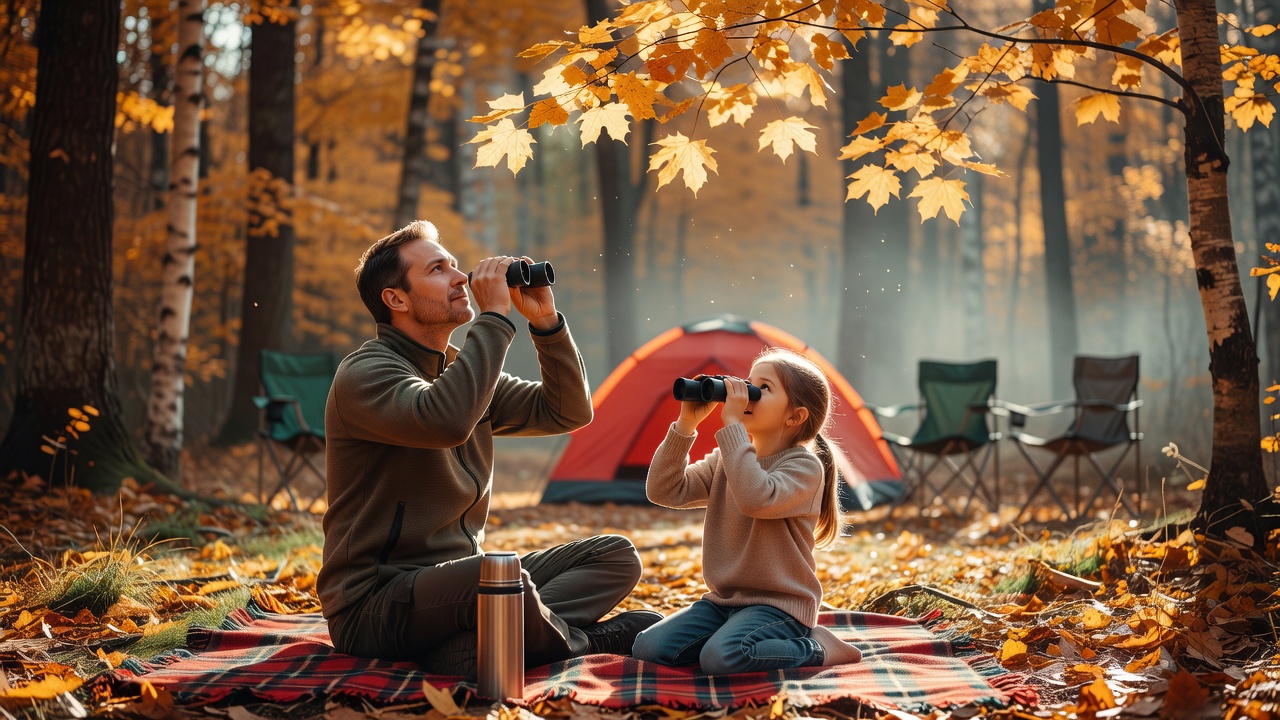
Our Top Family Picks
Two pairs cover nearly every family trip: one full-size pair for the adults that's genuinely good glass, and one cheap, tough compact pair the kids can call their own. Both are in our catalog with real specs, so here's how they split the job.
Celestron Nature DX ED 8x42 — Best Overall for Families ($166)
The Celestron Nature DX ED 8x42 is the pair we hand to adults first, and it's the one that ends up around a parent's neck for the whole weekend. The "ED" in the name is extra-low-dispersion glass — the same optical trick brands charge twice as much for — and it shows up as true-to-life color and sharpness edge to edge when you're picking out a warbler against sunlit leaves.
What makes it family-friendly rather than just "nice":
- 8x42 is the family sweet spot. 8x magnification is easy to hold steady (no shaky-image frustration), and 42mm objective lenses gather enough light for dawn and dusk — exactly when deer and owls are moving.
- Fog-proof and waterproof, nitrogen-purged. Morning dew on the picnic table, a passing rain shower, a lake splash — it shrugs them off. This is the difference between gear you worry about and gear you just use.
- Phase-coated BaK-4 prisms keep views bright and color-accurate in low light.
- Tripod adaptable, with a lifetime of Celestron support behind it. At about 1.6 lbs it's heavier than a pocket compact — that's the trade for full-size brightness.
With 750+ ratings and a 4.5-star average, it's the rare birding binocular that's also at home tracking a kid on a bike across a field. If you know you'll use a pair on every trip for the next decade, this is the one. Check current price and specs on the Celestron Nature DX ED 8x42 product page.
Honest downsides: it's over $150 (a real splurge next to budget compacts), it's heavier than pocket models, and if you only camp once a year in the backyard, it's more binocular than you need.
Occer 12x25 Compact — Best Budget & Kid Pick ($35.99)
The Occer 12x25 is the best-selling compact binocular on Amazon for one reason: it puts a clear, easy-to-focus view in everyone's hands for under $40. Twenty-four thousand ratings and a 4.5-star average tell you this isn't a toy — but it's priced like one, which is exactly why it's the pair we hand to kids.
- Kid-friendly by design. The large center focus wheel is forgiving for small fingers, and the big eyepieces work for kids and glasses wearers alike. Most kid frustration with binoculars is a focus wheel that's stiff or tiny — Occer solved both.
- Featherlight and compact. It disappears into a daypack side pocket or a camp chair cup holder, so it actually comes along instead of staying in the car.
- 12x magnification pulls in real detail — distant trail signs, a hawk on a wire, the heron at the far edge of the lake.
- Buy two. At this price, the standard family move is two pairs — one for the adults' daypack, one for the kids — so nobody fights over the view on a nature walk.
Find it on the Occer 12x25 product page.
Honest downsides: 12x25 is dimmer in low light than full-size 8x42 optics, the small objective lenses need steadier hands for a crisp image, and it is not waterproof — keep it out of rain and splash zones (a zippered pouch solves this). It's a daylight pair, and that's fine — kids mostly use it in daylight anyway.
How to Choose: A 5-Minute Crash Course
If you're shopping beyond these two, here's the short version of everything that matters.
- Magnification: 8x is the family number. 8x is bright, steady, and easy for beginners; 10x is the practical max for handheld use; anything higher (like the Occer's 12x) trades brightness and steadiness for reach, which is fine in daylight but frustrating at dusk. For kids, prefer 8x over 10x every time.
- Objective lens size: 42mm for adults, 25mm for kids. Bigger objectives gather more light (better at dawn/dusk) but add weight and cost. A compact 25mm is the right call for small hands — a 6-year-old with adult 10x42s will drop them by lunch.
- Eye relief and eyecups matter more than any other spec for kids. Eye relief is the distance between your eye and the lens while still seeing the full view. Kids (and glasses wearers) need generous eye relief and eyecups that twist up and down. This is why "cheap but with big eyepieces" beats "expensive but tiny" when the user is a child.
- Check the close focus. A pair that focuses down to 10 feet or less lets kids watch a chipmunk or butterfly at close range instead of only distant birds — the difference between five minutes of use and an afternoon.
- Waterproof/fog-proof is worth it for camping — dew, drizzle, and lake splash are guaranteed on trips. Nitrogen-purged bodies handle all three. If you buy a budget pair that isn't sealed (like the Occer), keep it in a dry pouch.
- Weight: under 20 ounces for kids, under 30 for adults. A neck strap only helps so much — if it's heavy, it stays in the car.
Teaching Kids to Use Binoculars (No Tears Edition)
Every parent who's handed a child binoculars has watched the kid stare at the rubber eyecup for a minute, then give up. The fix is a three-step method that takes one practice session:
- Find it with your eyes first. Point at the bird, the tree, the trail sign. Get the kid looking at the exact spot.
- Lock onto a landmark. Have them pick one memorable thing next to the target — "the dead branch above the bird," "the white rock beside the deer."
- Raise the binoculars to their eyes without looking away. The landmark steers the view; then the target appears in the frame. Most kids nail this by the third try.
Then add games: bird bingo (first to spot three different birds calls it), color hunts ("find something red through the binoculars"), and migration watch (count hawks circling on a sunny September afternoon — they ride thermals and often travel in groups). Keep the first sessions short, keep the neck strap on, and let them use the cheap pair. The day a 5-year-old focuses on a woodpecker by herself is the day you're hooked for life.
The Rest of the Wildlife-Watching Field Kit
Binoculars are the star, but the sit-and-scan setup works better with a few companions already in our catalog:
- scuddles Extra-Large Picnic Blanket ($24.99) — the 60" x 80" waterproof-backed basecamp by the meadow. Damp morning grass is a non-issue; it shakes clean in seconds. 20,000 ratings, 4.5 stars.
- Rumpl Original Puffy Blanket ($139) — 45°F fall mornings are real, and this recycled-insulation puffy is the layer you wrap around two kids while you scan the treeline. Water-resistant, packs to its own stuff sack, clips to a camp chair.
- CamelBak Eddy Kids Bottle, 12 oz ($19.99) — the spill-proof bite valve means a kid can hydrate mid-watch without tipping a bottle over the blanket. Insulated steel keeps water cold for hours.
- KEEN Kids Hightrail Waterproof Shoes ($74.95) — dewy grass and mud puddles are the natural enemies of a morning bird walk; the KEEN.DRY membrane and easy-cinch laces (no tying battles at the trailhead) handle both. If your kids are between sizes, our best hiking shoes for kids guide walks through fit.
Where to Use Them This Fall
September and October are the two best months of the year to own binoculars in most of the U.S.:
- Any campground edge at dawn — songbirds are most active in the first two hours after sunrise, and campgrounds are edge habitat (birds love edges).
- Lakes and reservoirs — fall waterfowl migration stacks ducks and geese in staggering numbers. A 20-minute lakeside sit beats a day of hiking for sheer volume of birds.
- On the leaf-peeping trip you're already planning — color season is wildlife season. Our leaf-peeping guide has the timing and routes; add binoculars to the packing list.
- National parks in the shoulder season — fewer crowds, active wildlife, and (if you time it right) free federal-lands weekends. Our national parks camping guide covers the planning side; this September 26 is a prime window.
- When the kids get restless — binoculars are a core screen-free camping activity that works at any age.
Common Mistakes (Learn From Mine)
- Buying adult binoculars for a 6-year-old. A 1.6-lb full-size pair is heavy, hard to hold steady, and will end up dropped or abandoned. Kids get the $36 compact; adults get the good glass. Everyone actually uses theirs.
- Shopping for magnification instead of ease of focus. 12x sounds impressive; a stiff focus wheel kills the hobby. For kids, focus-wheel ease and eyepiece size beat raw power every time.
- Skipping the neck strap. "I'll just hold them" lasts until the first squirrel sighting. Strap on, always — it's also how kids learn to carry them safely.
- Leaving them in the car "for later." Binoculars live in the camp box or daypack, not the glovebox. The trips where we forgot them are the trips with the bald eagle.
- Handing a $300 pair to a toddler "just for a second." That's what the $36 pair is for. There will be drops; budget for them.
Quick Answers
- 8x or 10x for kids? 8x. Easier to hold steady, wider view, brighter. 10x is a teenager's upgrade.
- Can a 4-year-old use real binoculars? Yes, with big eyepieces and patience — expect a lot of "I can't find it" for the first session, then sudden competence. Use the three-step method above and the cheap pair.
- Do binoculars need to be waterproof for camping? For the adults' pair, yes — nitrogen-purged waterproofing means you never think about dew, drizzle, or splash. For the kids' budget pair, a dry pouch is fine.
Bottom Line
Buy the Celestron Nature DX ED 8x42 if you're the parent who'll reach for them on every trip for the next decade, and the Occer 12x25 for every kid (and for the "spare pair" that saves the day when someone forgets theirs). Together they cost about $200 — less than one night at many campgrounds — and they'll be the most-used gear in the box from now through migration season. September is the perfect month to start: the birds are moving, the crowds are gone, and the kids are outside anyway.
<!-- AFFILIATE_DISCLOSURE -->