Camping in High Winds: Wind Speed Limits & Setup (2026)
What wind speed is too windy to camp in, how to pitch a tent that holds in gusts, and the RV, stove, and heater limits that should make you move.
In this article · 12 sections
- What Wind Speed Is Too Windy to Camp In?
- Tent Camping in High Winds: The Setup Sequence That Holds
- Which Tents Actually Survive Wind?
- RV Camping in High Winds: The Awning and Slide Rules
- Camping in Heavy Wind and Rain: The Combination That Breaks Tents
- Cooking and Heating in Wind: Where It Stops Being Safe
- Camping With Kids and Dogs in Wind
- The Five-Minute Wind Check Before You Unroll Anything
- Common High-Wind Camping Mistakes
- Every Form of the Question: A High-Wind Camping Router
- Camping in High Winds FAQ
- The Bottom Line
Quick Answer: For a three-season family tent, 20–25 mph sustained wind is the practical ceiling — beyond that you are gambling on pole quality and stake holding power, not skill. Under 10 mph nothing changes. From 15 mph up, every guy-out point needs a line, every corner needs a stake driven at an angle, and a couple of spare stakes should be sitting on the ground next to you. Above 30 mph, move to hard-sided shelter: an RV, a cabin, or the car. In an RV, retract the awning around 15–20 mph and pull the slides in around 25–30 mph.
Wind is the one weather variable that turns a good campsite into a bad night in about ninety seconds, and it is also the one most people never plan for. Rain you can see coming. Cold you dress for. Wind arrives as a gust at 2 a.m. and the first thing you hear is the rainfly flapping, then a pole ticking, then a stake popping out of the ground.
This guide is about the actual limits: what wind speed is too windy to camp in, how to pitch a tent that holds, what changes for an RV, and the points where cooking or heating gear stops being safe in a gust.
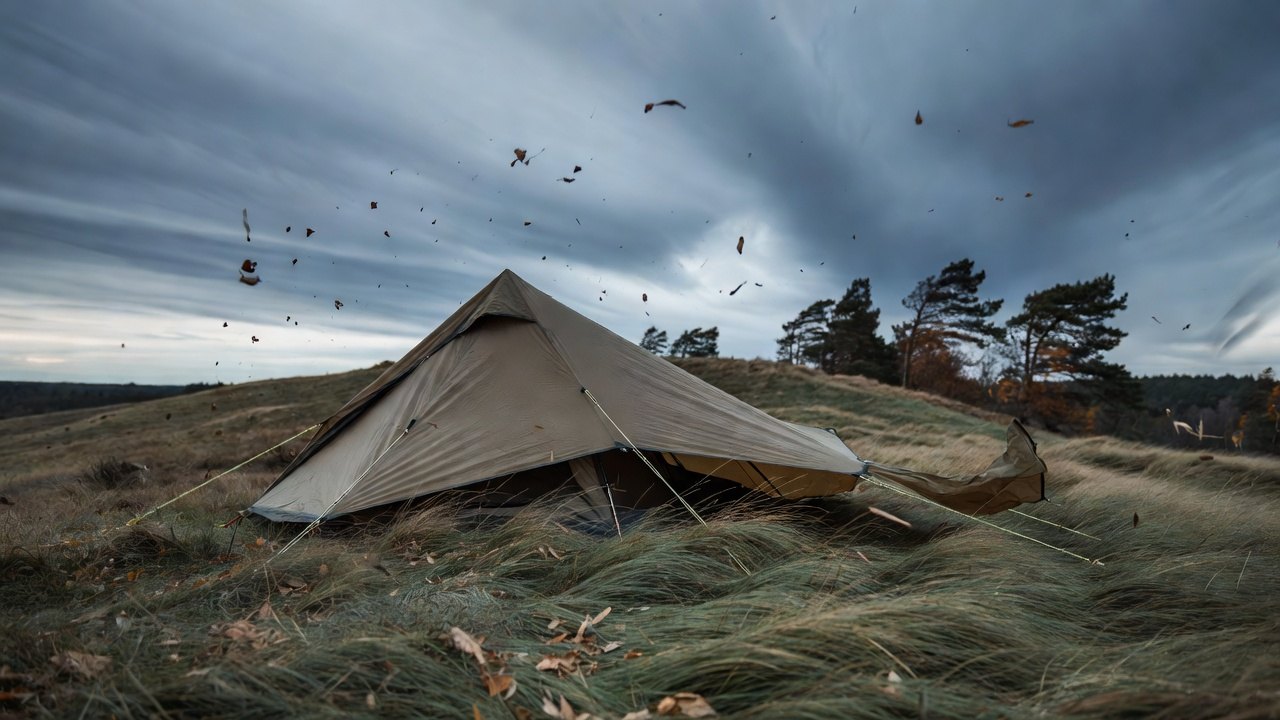
What Wind Speed Is Too Windy to Camp In?
The useful answer is a ladder, not a single number, because the difference between a sustained wind and a gust is the difference between an annoying night and a broken tent.
| Sustained wind | Gusts to expect | What actually happens | What to do |
|---|---|---|---|
| 0–10 mph | 15 mph | Nothing. Flies breathe, you sleep. | Normal setup. |
| 10–15 mph | 20 mph | Loose items move. The fly taps. | Stake all four corners. Zip the vestibule. |
| 15–20 mph | 30 mph | Unguyed tents deform. Cheap fiberglass poles start flexing hard. | Every guy-out point gets a line. Stake at an angle. |
| 20–25 mph | 35 mph | Three-season family tents are at their limit. Stakes pull in soft ground. | Add deadman anchors, tarp the windward side, or relocate to lee of trees. |
| 25–30 mph | 40 mph | Pole failure and fly shredding become realistic. Cooking outside stops. | Only purpose-built 4-season shelters. Otherwise leave. |
| 30–40 mph | 50+ mph | Tents do not survive this reliably, at any price. | Hard-sided shelter only. |
| 40+ mph | — | Structural damage, falling limbs. This is a storm, not a camping condition. | Do not camp. |
Two rules sit above that table. First, gusts matter more than sustained wind — a 15 mph average with 30 mph gusts behaves like 30 mph at the worst possible moment, and forecast apps will show the average. Check the gust number, not the average, before you commit to a site.
Second, ground matters as much as wind speed. The same 22 mph wind is a non-event on firm turf with loamy soil and a real problem on sand, gravel, or thawed mud, where a 7-inch stake in soft ground holds almost nothing.
Tent Camping in High Winds: The Setup Sequence That Holds
Setup order is the whole game. Most tents that "blow away" were never guyed out at all — the poles were fine, the anchors were decoration.
1. Pick the site for wind, not for the view. The exposed ridge with the panorama is the first place the wind hits. Camp on the leeward side of a tree line or a terrain feature, 15–20 feet back from the tallest tree so a limb cannot land on you, and not in the lowest hollow where cold air and runoff collect.
2. Pitch the tent with the lowest end into the wind. On a dome, that means a low corner or the foot end, not the door — a door panel catches wind like a sail, and a vestibule that opens into the gust will fill and snap.
3. Stake before you admire it. Drive all four corners while the tent is still slack, then tension. Stakes go in at roughly a 45–60° angle, heads angled away from the tent, so the pull is against the soil rather than lifting the stake out. In sand or loose gravel, bury the stake horizontally as a deadman anchor with the line around the middle, or use a rock stack.
4. Guy out every loop the manufacturer sewed on — then check for the loops they skipped. A 6-person cabin tent may have four guy-out points and need ten. If the fly has a loop, it wants a line. Lines should leave the tent at about 45° and run to a stake a couple of feet out, not straight down.
5. Build a windbreak if the site is exposed. A tarp rigged low on the windward side — 3–4 feet high, angled, with the bottom staked tight — kills a surprising amount of ground-level wind. A high tarp strung as a flat sail makes things worse.
Tools that make this bearable instead of a 20-minute wrestling match: a set of real stakes rather than the wire hooks in the tent bag. The MSR Groundhog stake kit ($19.99, 4.8★) is the one I reach for first — the Y-beam profile bites and holds in firm ground far better than a flat hook, and six of them cover a small tent's corners plus a couple of guy lines. For a big family cabin tent or a sandy site where you want to double-stake everything, the Cheardia 20-pack of 9.75-inch stakes ($15.99, 4.7★) is cheap enough to keep in the truck permanently, and having twenty means you never ration them.
For the windbreak, the OneTigris Bulwark all-season tarp ($56.98, 4.7★) is 12.8 × 9.5 ft with enough tie-outs to rig it low and tight rather than as a sail.
Which Tents Actually Survive Wind?
Three things decide it, and price is only loosely related to all three.
Pole material and diameter. Fiberglass poles flex and then shatter; aluminum poles bend and can often be straightened. A 6-person tent held up by 8.5 mm fiberglass is a fair-weather shelter no matter what the box says.
Number of guy-out points. This is the honest spec nobody prints on the box. A tent with six guy-out loops can be made genuinely wind-stable; a tent with two cannot, and no amount of stake buying fixes it.
Shape. Low, taut, and multi-pole (geodesic or tunnel) sheds wind. Tall vertical walls and a big flat side panel catch it. That is why cabin-style family tents are wonderful in July and miserable in a November gust.
In practice: a mainstream family dome like the Coleman Skydome 4-person ($122.99, 4.5★) handles a breezy weekend fine and is the wrong tool above about 25 mph. A blackout cabin tent such as the EVER ADVANCED 6-person ($169.99, 4.4★) buys you room and darkness, not wind resistance — its tall walls are exactly what a gust pushes on. If cold-weather trips are the plan, the Naturehike Massif hot tent ($269, 4.3★) and the budget UNP 6-person 4-season dome ($39.99, 4.4★) are built with heavier fabric and more structure. Our 4-season tent guide breaks down which of them are actually rated for snow load and wind rather than just "four season" in the marketing copy.
One more thing worth saying plainly: a tent that has been up for three days in wind has been slowly working its stakes loose. Re-tension the guy lines every morning. It takes ninety seconds and it is the difference between a tight shelter and a flapping one on night four.
RV Camping in High Winds: The Awning and Slide Rules
An RV is a hard-sided shelter, which changes the question from "will it survive" to "what will it damage".
- Awning: retract at 15–20 mph, and never leave it out unattended. Awnings are the single most common wind casualty in campgrounds, and a gust that arrives while you are at the showers will fold the arms or tear the fabric off the rail.
- Slides: bring them in around 25–30 mph sustained. Slide toppers flap and can be torn; a slide on the windward side acts as a sail on the whole rig.
- Park nose or tail into the wind where the site allows it. A broadside profile catches everything, and a high-profile trailer pushed broadside is a genuinely uncomfortable night even when nothing breaks.
- Driving in crosswind is its own skill. Keep speed down, hold the wheel with both hands, and expect the passing-truck shove. If the gusts are strong enough that you are correcting constantly, get off the highway rather than "pushing through".
- Chock and level before the wind arrives, not during it. The Camco wheel chock set is the boring purchase that stops a trailer from walking.
If you are winter camping in the rig, our RV winter camping guide covers the frozen-pipe side of the same trip.
Camping in Heavy Wind and Rain: The Combination That Breaks Tents
Wind alone is a structural problem. Wind plus rain is a structural problem and an anchoring problem, because saturated ground stops holding stakes.
What to change when both are forecast:
- Double the stake count and use wider stakes. A 7-inch stake in wet soil pulls out under half the load it holds when dry.
- Add a line to anything that flaps, and expect to re-tension when the rain stops. Wet nylon and polyester stretch.
- Rig the tarp as a roof with a slope, not a flat sheet — flat collects water and then sags into a bathtub that dumps on the tent door.
- Keep bedding off the walls. Contact between a sleeping bag and wet fly fabric wicks water straight through; that is condensation and contact leakage working together, which our tent condensation guide covers in detail.
- Check the seams before the trip, not during it. If the fly is already wetting through, the fix is a wash and a re-proof, not a prayer — see the tent leaking and waterproofing repair guide.
If the rain is the bigger story than the wind, the rainy day camping gear guide is the companion read.
Cooking and Heating in Wind: Where It Stops Being Safe
This is the section where "uncomfortable" becomes "dangerous".
Stoves lose efficiency before they lose the flame. Wind steals heat, extends boil times, and on canister stoves cools the canister until output drops. A heat reflector and windscreen ($16.97, 4.5★) is the cheap fix, and our stove windscreen and wind protection guide covers the DIY versions. Never fully enclose a stove — a sealed surround traps heat and, on a canister stove, can overheat the canister.
A gust can blow a flame out while gas keeps flowing. That is how people get a pocket of unburned propane at ground level next to a hot stove. If the flame goes out, shut the valve off before relighting, and give it a few seconds.
Propane heaters in wind are a carbon monoxide question, not a comfort question. A Buddy-style heater is indoor-safe only with its oxygen depletion sensor working and with ventilation; wind pushing against a tent can create enough pressure difference to affect how a shelter ventilates, and a heater tipped by a gust is a fire risk. Use the Mr. Heater Buddy ($74, 4.7★) on a stable, flat surface away from bedding, keep a vent cracked, and put a battery CO detector ($23.97, 4.7★) in the tent. The full safety rules are in our tent heater guide, and I would read that before the first cold-weather trip rather than at 11 p.m. with a lighter in your hand.
Fires and embers. Wind turns sparks into a fire-spread problem. Keep the fire small, keep water within reach, and if a fire ban is in effect, that is not a suggestion — see the fire ban camping guide.
Camping With Kids and Dogs in Wind
Wind is a sleep problem for kids before it is a safety problem, and a stress problem for dogs before it is anything else.
- Pitch the tent before the kids are loose. Once they are running around, guy lines become trip lines. Set lines, then hand out jobs that keep everyone inside the footprint.
- Put the youngest sleepers on the leeward side, away from the wall that is taking the wind.
- Secure everything that can leave. Hats, bowls, camp chairs, and inflatable anything become projectiles. Bags in the tent, chairs folded at night.
- Dogs: a stake and a shorter lead, not a long tie-out. A dog on a 20-foot line in a gust can wrap a pole or pull a stake. And a dog that is frightened by flapping fabric will pace all night — a familiar blanket and a covered crate help more than a pep talk. The cold-weather dog camping guide covers the temperature side.
- Have an inside plan. If the wind builds after dark, the fallback is the car with sleeping bags — decide that in advance so it is a move, not a debate.
The Five-Minute Wind Check Before You Unroll Anything
Before you commit to a site, look for these five things. It takes less time than reading this paragraph.
- The gust number in the forecast, for tonight specifically, not the daily average.
- Tree behavior. Leaves and small twigs moving constantly means 15+ mph at ground level; whole branches moving means 25+.
- Water texture. Consistent whitecaps on a lake or reservoir mean roughly 15 mph or more of sustained wind on the open water.
- Terrain. Where is the wind coming from, and what is upwind of your site for the next hundred yards? A ridge, a gap between hills, or an open field all funnel wind.
- Ground type. Soft sand, thawed mud, or gravel means plan for deadman anchors and more stakes than you think.
If two or more of those read badly, move. Relocating a tent in daylight costs ten minutes; relocating it at midnight in the rain costs the trip.
Common High-Wind Camping Mistakes
- Staking like it is a calm day. Four corner stakes and no guy lines is the default setup and it is the reason most tents fail.
- Using the wire hooks that came in the bag. They bend, they pull, and they hold nothing in wind.
- Pitching in the open "for the stars." You can have the view or the sleep, not both, on a windy night.
- Leaving the awning out. The most expensive fifteen seconds of the trip.
- Ignoring the gust column. A 12 mph average with 35 mph gusts is a 35 mph problem.
- Forgetting that wind works all night. Stakes loosen, lines stretch, zippers work open. A morning walk-around is part of the routine, not paranoia.
- Using a heater to fight the noise. Cold and wind at the same time pushes people toward unsafe heating. Add a layer and a better pad instead — our how to stay warm camping guide is the safer lever.
Every Form of the Question: A High-Wind Camping Router
People search this in a dozen word orders. They all resolve to the same small set of answers, so here is the map.
| If you're searching for | The answer is under |
|---|---|
| what wind speed is bad for camping, what wind speed is too windy to camp in | What Wind Speed Is Too Windy to Camp In? |
| what is too windy for camping, is 20 mph wind too much for a tent | What Wind Speed Is Too Windy to Camp In? |
| camping in high winds, camping in high wind, camping in strong wind, windy camping | Tent Camping in High Winds: The Setup Sequence That Holds |
| camping in heavy wind, tips for camping in high wind | The Five-Minute Wind Check + Setup Sequence |
| tent camping in high winds, tent in windy conditions, best tent for high wind | Which Tents Actually Survive Wind? |
| how to keep a tent from blowing away, tent stakes in high wind | Tent Camping in High Winds — steps 3 and 4 |
| camping in heavy wind and rain, camping in wind and rain | Camping in Heavy Wind and Rain |
| rv camping in high winds | RV Camping in High Winds |
| cooking or heating in wind | Cooking and Heating in Wind |
Camping in High Winds FAQ
Is 20 mph wind too much for a tent?
For a three-season family tent, 20 mph sustained is near the practical ceiling — it will hold if every guy line is set and the stakes are in firm ground, and it will deform and eventually fail if they are not. Gusts to 30 mph at that average are the part that breaks poles. Above 25 mph sustained, plan to move rather than to manage.
Can a tent blow away with someone inside it?
Yes, in an extreme case — an unoccupied-looking, unanchored tent can go, and a person inside adds weight but not anchoring. The realistic risk is smaller than the drama suggests: what usually happens is the tent deforms, a pole snaps, or the fly tears, and the occupants get wet and cold rather than airborne. The fix is anchorage, not body weight.
How do you keep a tent from blowing away?
Stake all four corners at an angle with the heads pointed away from the tent, guy out every loop, add a tarp windbreak on the windward side, pitch the lowest end into the wind, and re-tension the lines each morning. In sand or loose soil, use a deadman anchor — bury the stake horizontally with the line around its middle.
Should I take my tent down during high winds?
If you are staying, keep it up and anchored: a taut, guyed tent sheds wind better than a loose one, and a tent lying flat on the ground in a storm is harder to recover than one that is standing. If the forecast is calling for 35 mph or more, take it down and move to hard-sided shelter — that is a structural limit, not a setup problem.
The Bottom Line
Wind is the cheapest weather to plan for and the most expensive to ignore. The whole discipline is: know the gust number, pitch into the wind, use real stakes at an angle, guy out everything, and set a hard limit around 25 mph for a three-season family tent and 30 mph for anything else. Everything past that is a decision about where to sleep instead, and it is a much better decision at 4 p.m. than at 2 a.m.
<!-- AFFILIATE_DISCLOSURE -->TrailMapz earns a commission on qualifying purchases made through the product links in this guide, at no extra cost to you.