Camping During a Fire Ban: What Still Works (2026)
A fire ban doesn't have to cancel dinner. What the orders actually cover, which stoves and propane fire pits usually survive them, and what to cook instead.
You drive four hours, unpack the cooler, and find the yellow sign at the kiosk: NO OPEN FLAMES. No campfire, no charcoal, sometimes not even a match. The trip isn't over — but dinner has to change, and most of the gear in the truck was chosen for a fire that is now illegal.
This guide is about the version of that weekend that still works: what the orders actually cover, which appliances usually slip through the exemption, what to cook instead of hot dogs on a stick, and how to check the rule for the exact piece of ground you're standing on.
Quick Answer: What a Fire Ban Actually Stops
A fire ban is a ban on the flame, not the trip. Most orders are written to stop wood and charcoal — the fuels that throw sparks, embers and long-lived coals — while leaving a contained gas appliance with an on/off valve legal. That's why a two-burner propane stove is often fine on a night when a campfire ring is roped off.
The catch is that "usually" is doing real work in that sentence. Every order is written by a specific agency for a specific area and dates, and plenty of them explicitly name gas appliances too. The rule that decides your dinner is the exemption clause in the order that covers your campground — not the general habit of campers, and not what the site next door allowed last weekend.
Three things reliably survive most bans:
- A propane stove or grill with a valve. Two-burner stove, tabletop grill, single-burner canister stove — the device has a shutoff, the flame is enclosed under a burner, and nothing throws embers.
- A gas fire pit, sometimes. It is a visible flame, so it lives or dies on the wording of the order. Many orders exempt it under the same valve clause; some name it directly as prohibited.
- Meals that never needed a fire. Griddle food, one-pot dinners, and a stovetop dessert finish the night without a single ember.
Three things reliably do not:
- Wood and charcoal, including " smokeless" fire pits and portable wood-burning bowls.
- Fire starters, tinder tabs and lighter cubes — the fuel is the problem, not the size of the fire.
- Fireworks, tiki torches and anything with an open wick.
Who Wrote the Order Matters More Than the Word "Ban"
"Fire ban" is a headline, not a legal definition. The actual text usually comes from one of these, and they do not coordinate with each other:
- The federal agency that manages the land — Forest Service, BLM, National Park Service. Each district can issue its own order.
- The state — state forestry or parks departments, often through a staged system.
- The county — county burn bans that apply to unincorporated land, which is frequently where the good dispersed sites are.
- The campground itself — private parks and some concession-run public campgrounds add their own rules on top.
Two campgrounds twenty minutes apart, on land run by two different agencies, can have two different answers on the same Saturday. That's not inconsistency for its own sake: the order is tied to local fuel moisture, wind, and how dry the grass is on that specific parcel.
The staged systems, in plain terms
Several western states publish restrictions in stages rather than as a single ban. Colorado's Stage 1 and Stage 2 orders, and Oregon's industrial fire precaution levels, are the two campers run into most often in fall. The stages are shorthand for how strict the order is — one stage typically still allows a contained gas appliance in a developed site, the next one narrows it further or closes the door on anything with a flame.
Treat the stage as a signal to go read the actual order, not as a rule you can apply from memory. The stage number and the exemption list change between districts and between weeks.
The Three Questions That Decide Your Dinner
Before you cook, answer these in order. It takes about four minutes and it removes almost all of the guesswork.
- Who owns the ground you're camped on? Look at the campground sign, the reservation confirmation, or the agency app. Federal, state, county and private all have different rules.
- Is there an order in force right now? Check the agency's fire restrictions page, then the recorded fire information line, then the campground board — in that order. Orders go up and come down midweek.
- What does the exemption clause say about your device? Look for language about devices that use "gas or liquid fuel" with an "on/off valve," or about "contained" flames in a "developed recreation site." If your appliance matches the words, you're usually inside the exemption. If the order names your appliance as prohibited, it doesn't matter how contained it is.
One practical habit: ask the host when you check in. Hosts know what the ranger told them that morning, and they know which orders are being enforced on their loop versus which are still on the website.
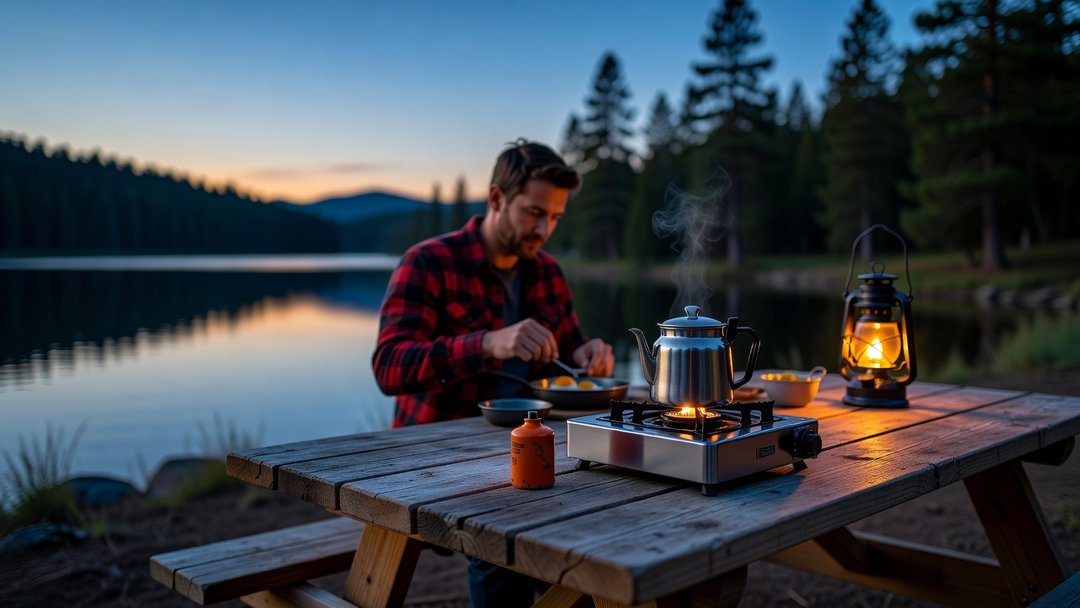
What Usually Still Works
Two-burner propane stoves
This is the workhorse of a fire-ban weekend. Two burners means a pot and a pan at once, and the flame never leaves the burner box.
- Coleman Triton+ 2-Burner Propane Camping Stove ($149.99, 4.7★) — the standard family car-camping stove; wind panels and a wide grate handle a real skillet.
- Coleman Tabletop 2-in-1 Camping Grill/Stove ($166.01, 4.4★) — one appliance for a griddle side and a burner side, which matters when you're cooking three meals a day without a fire.
- Gas One GS-3400P Dual Fuel Stove ($34.99, 4.5★) — the budget answer; runs on propane, which keeps working when morning temperatures drop.
Single-burner and canister stoves
For coffee, oatmeal, and anything that only needs one pot, a small stove is faster to set up than the big one and easier to keep attended.
- Coleman Bottle Top Propane Camp Stove ($21.99, 4.5★) — screws straight onto a 1 lb cylinder, no hose, no table.
- MSR PocketRocket 2 ($49.95, 4.8★) — 2.6 oz and it simmers, which is more than most tiny burners manage.
The gas fire pit: the campfire that often survives
If the ritual of sitting around a flame is the point of the trip for your family, a propane fire pit is the closest legal substitute — and whether it's allowed comes down to the order's wording, not the appliance.
- Outland Living 19-Inch Portable Propane Fire Pit ($142.64, 4.8★) — 58,000 BTU, a lid that turns it into a table, and a shutoff valve, which is the feature the exemption clause is usually talking about.
- Flame King 24-Inch Smokeless Propane Fire Pit ($196.48, 4.6★) — a wider bowl for a bigger group; "smokeless" here means it's burning gas, not that it escapes a wood ban.
Ask before you light one. It is a visible flame, some orders prohibit exactly that, and a ranger who finds it lit on a no-flame day is not going to debate the valve clause with you.
Griddles and cast iron on the stove
The cooking surface is what makes stove-only meals feel like real food instead of reheated camping rations.
- Lodge Round Cast Iron Griddle, 10.5 Inch ($24.90, 4.7★) — pancakes, smash burgers, and breakfast potatoes across one burner.
- Lodge Pre-Seasoned Cast Iron Skillet, 10.25 Inches ($19.99, 4.7★) — the pan that does the one-pot dinner and the dessert.
What a Fire Ban Takes Off the Table
Wood-burning "portable fire pits"
This is the most common expensive mistake of the season. A portable wood-burning bowl — a Solo Stove, a pop-up fire pit, a folding fire ring — is a wood fire with better airflow. During a ban it is exactly what the order prohibits, no matter how portable or contained it looks.
- The Solo Stove Bonfire ($299.95, 4.8★) and the Fireside Outdoor Pop-Up Fire Pit ($99.95, 4.7★) are both excellent fire pits and both wood-burning. Buy one for the trips when fires are allowed, not as a fire-ban workaround.
- The same logic kills charcoal. Briquettes and lump charcoal produce long-lived coals and embers, which is the specific hazard most orders are written around.
Fire starters and tinder
UCO Sweetfire Biofuel Fire Starters ($12.99, 4.4★) are a genuinely good product and completely useless during a ban — they exist to start the thing that's prohibited. Leave them home so nobody in the group "just tries it."
The rules that travel with a fire ban
Orders frequently bundle in restrictions that surprise people: smoking only inside a vehicle or a developed area, no fireworks, no off-highway driving on dry grass (a hot exhaust is an ignition source), and sometimes generator hours. Read the whole order, not just the fire paragraph.
Cooking a Real Dinner Without a Fire
The fire-ban menu is a stove menu, and the trick is to stop cooking "campfire food" and start cooking normal food on a burner.
Breakfast. Griddle on the two-burner: pancakes, eggs, and a pan of potatoes, all at once. Coffee on the single burner. Nothing about this feels like a compromise.
Lunch. Sandwiches and a pot of soup or chili reheated on the stove. If it's a hiking day, this is where a thermos earns its place.
Dinner. One-pot meals are the fire-ban answer — a pasta or rice dish built in a single pot, or a skillet dinner finished under a lid. If you want the full playbook for fire-free meals and the gear that makes them work, our campfire cooking gear and recipes guide covers the cooking side in depth, and the fall camp food guide handles the cold-weather menu planning.
Dessert. This is where a fire ban usually wins, and it doesn't have to. A cast iron skillet does stovetop s'mores: chocolate and marshmallows melted over low heat, grahams on the side. Our campfire dessert recipes guide has the fire-free versions already written out, including the ones that assume a burner and nothing else.
S'mores without a campfire
Two honest options:
- A gas fire pit, if the order allows one. Same ritual, same roasting fork, no embers.
- A skillet on the stove, if it doesn't. Melt, dip, assemble. Kids do not care about the delivery mechanism as much as adults do.
How to Check Before You Drive
Do this the day you leave, not the week you booked:
- The managing agency's fire restrictions page — Forest Service district pages, BLM district pages, the state parks fire page, the county emergency management page.
- The recorded fire information line, which is often updated before the website.
- The campground's own page or confirmation email — private parks and concessionaires post their own notices.
- The board at the entrance, on arrival. This is the one that's actually enforced.
- The host, when you check in — ask what's currently allowed on their loop.
If you're heading into the states where late-season bans are routine, the state guides carry the local pattern and the agency links: camping in Colorado, camping in Oregon, camping in Washington, and camping in California. If the ban changes your cooking plans entirely, the camp stove fuel guide explains which fuel performs in cold mornings, and the portable fire pit guide covers the gas-versus-wood decision in more detail.
The Fire-Ban Kit
What belongs in the truck when there might be a ban, in the order you'll actually need it:
- A stove with a valve and a spare fuel cylinder — one full 1 lb cylinder per two days of cooking for a family of four, plus a backup.
- A griddle or a wide skillet, so one burner can feed everyone.
- A windshield or wind panels, because a stove that struggles in wind burns more fuel and cooks worse.
- A lighter you can trust in wind — a flameless arc lighter is the one that doesn't care about breeze or altitude.
- A pot with a lid, for one-pot dinners and for keeping food warm while the second batch cooks.
- Lanterns instead of firelight — the evening needs light more than it needs flame.
- A printed copy of the order you checked, or a screenshot. It settles the "but the website said" conversation at 9 p.m.
Camping During a Fire Ban FAQ
Can you use a propane fire pit during a fire ban?
Sometimes. It depends entirely on the order. Many orders exempt appliances that burn gas with an on/off valve, which is what a propane fire pit is — but some orders prohibit visible flames outright or name gas fire pits directly. Check the order for your specific campground and ask the host before lighting it.
Are gas stoves allowed during a fire ban?
In most orders, yes — a contained gas or liquid-fuel stove with a shutoff valve is the standard exemption. The exceptions are the strictest orders, which prohibit all ignition sources, and orders that require the stove to be used in a developed recreation site rather than dispersed camping.
Is charcoal banned during a fire ban?
Almost always. Charcoal produces long-lived coals and embers, which is the hazard the orders are written around. Treat briquettes and lump charcoal the same as wood.
Can you have a campfire in a designated fire ring during a ban?
Usually not. A constructed ring doesn't override the order — in some staged systems a permanent grate in a developed campground is the last thing allowed, and in the next stage it's gone too. The ring is a safety feature, not a permission slip.
What if the fire ban starts while you're already camping?
Cook on the stove, put the wood away, and check with the host in the morning. Orders can be issued overnight, and enforcement starts when the order does. A ranger finding a legal stove is not a problem; a ranger finding a burning fire pit is.
Bottom Line
A fire ban removes one appliance and one ritual. It does not remove dinner, dessert, or the reason you drove out there. Bring a stove with a valve, a griddle, and a plan for the evening light — then read the actual order for the ground you're on, because it's the exemption clause, not the campfire habit, that decides what's legal on any given Saturday.
<!-- AFFILIATE_DISCLOSURE -->