Dog-Friendly National Parks (2026): Where Dogs Can Actually Hike
Dogs are allowed in every national park — just not on most trails. The parks where dogs can actually hike, the 6-foot rule, and what to pack. (2026)
Quick Answer: Can You Take Your Dog Into a National Park?
Yes — and that answer surprises most people. Every national park in the system lets you bring a leashed dog into its developed areas: campgrounds, picnic areas, parking lots, paved roads, and the paved overlooks near visitor centers. There is no per-pet fee. You pay the normal entrance fee, or enter free with an America the Beautiful pass.
The catch is the trail. In most parks, dogs are not allowed on unpaved hiking trails, in the backcountry, inside buildings, or on park shuttle buses. So the honest version of the answer is: your dog can absolutely sleep in your tent at Yosemite — but he cannot hike the Mist Trail with you. The Yosemite family camping guide covers exactly where dogs are and are not allowed in the park.
That is why the whole question collapses into one narrower one: which parks let your dog on the trails? Six of them do, broadly. The rest are scenic road trips with campground nights. This guide sorts the parks into those two piles, then covers the gear and the planning that makes a dog trip actually work.
The NPS Pet Policy Every Park Starts From
The National Park Service sets a baseline pet policy and individual parks can only tighten it — never loosen it. Learn the baseline and you can predict almost any park before you open its website.
Under the standard policy, your dog must be:
- On a leash no longer than 6 feet, at all times. No off-leash areas, and a retractable leash counts as off-leash the moment it extends past six feet.
- Attended at all times. You cannot tie your dog outside a building, leave him in a campsite while you hike, or leave him in a vehicle in unsafe temperatures.
- Only in areas open to pets. Usually campgrounds, picnic areas, roads, parking lots, and some paved paths.
- Cleaned up after. Same rule as any trail: bag it and pack it out.
And what is almost always off limits, park by park: unpaved trails, wilderness and backcountry, the inside of every building, park shuttle buses, and many swimming beaches and lakeshores. Thermal areas at Yellowstone, the dunes at Great Sand Dunes in summer, and other fragile terrain are hard no-go zones for the same reason trails are — wildlife and resource protection first, visitor safety second.
A leashed dog on a busy overlook is a normal part of a park day. A dog loose on a remote trail full of bears, bison, or ground-nesting birds is a genuine problem for the wildlife, for other visitors, and for your dog. The rules exist because of a small number of people who ignored them, and every owner who follows the camping-with-dogs basics is part of why parks still allow dogs at all.
Read the park's own pet page the week before you go. Search the park name plus "pets" and read the official NPS page — it lists exactly which trails allow dogs and which are seasonally closed. Rules get tightened at busy parks during peak season, and the only rule that matters is the one posted at the trailhead you are standing on.
The Two Lists: Parks Where Dogs Can Hike vs. Everywhere Else
Instead of memorizing sixty rule sets, sort parks into three buckets.
Dog-friendly — leashed dogs welcome on most or all trails: Shenandoah (Virginia), Acadia (Maine), Congaree (South Carolina), Cuyahoga Valley (Ohio), Petrified Forest (Arizona), White Sands (New Mexico), Great Sand Dunes (Colorado), Virgin Islands (St. John), and Wrangell-St. Elias (Alaska).
Limited access — a handful of designated trails, plus roads and campgrounds: Great Smoky Mountains (only two short trails allow dogs), Redwood (roads through the redwoods, not the trails), Denali (two roadside trails), Voyageurs, Wind Cave, Crater Lake, Great Basin, Guadalupe Mountains, and Dry Tortugas (Garden Key only).
Developed areas only — no dogs on trails at all: Yosemite, Yellowstone, Glacier, Grand Teton, Rocky Mountain, Arches, Badlands, Big Bend, Death Valley, Pinnacles, Theodore Roosevelt, Haleakalā, and Hawai'i Volcanoes. Zion belongs here too, with one exception — the paved Pa'rus Trail.
That last column is full of the parks people most want to visit with a dog, which is exactly why this list matters before you book anything. If hiking with your dog is the trip, start from the first bucket. If a road trip with campground nights is fine, nearly any park works, and you plan the days around pullouts, picnic areas, and paved paths.
| Park | Dog access on trails |
|---|---|
| Shenandoah, VA | Most of the park's ~500 miles of trail — on leash |
| Acadia, ME | 100 miles of hiking trails + 45 miles of carriage roads |
| Congaree, SC | Most or all trails, including the boardwalk loop |
| Cuyahoga Valley, OH | Most or all trails, including the Towpath |
| Petrified Forest, AZ | Every maintained trail |
| White Sands, NM | All trails across the dunes |
| Great Sand Dunes, CO | Most or all trails |
| Great Smoky Mountains | Two short trails only |
| Yosemite / Yellowstone / Glacier | Developed areas only |
| Zion | One trail (the paved Pa'rus Trail) |
Shenandoah and Acadia: The Two Parks Built for Dogs
If you are going to plan a trip around a dog, plan it around one of these two.
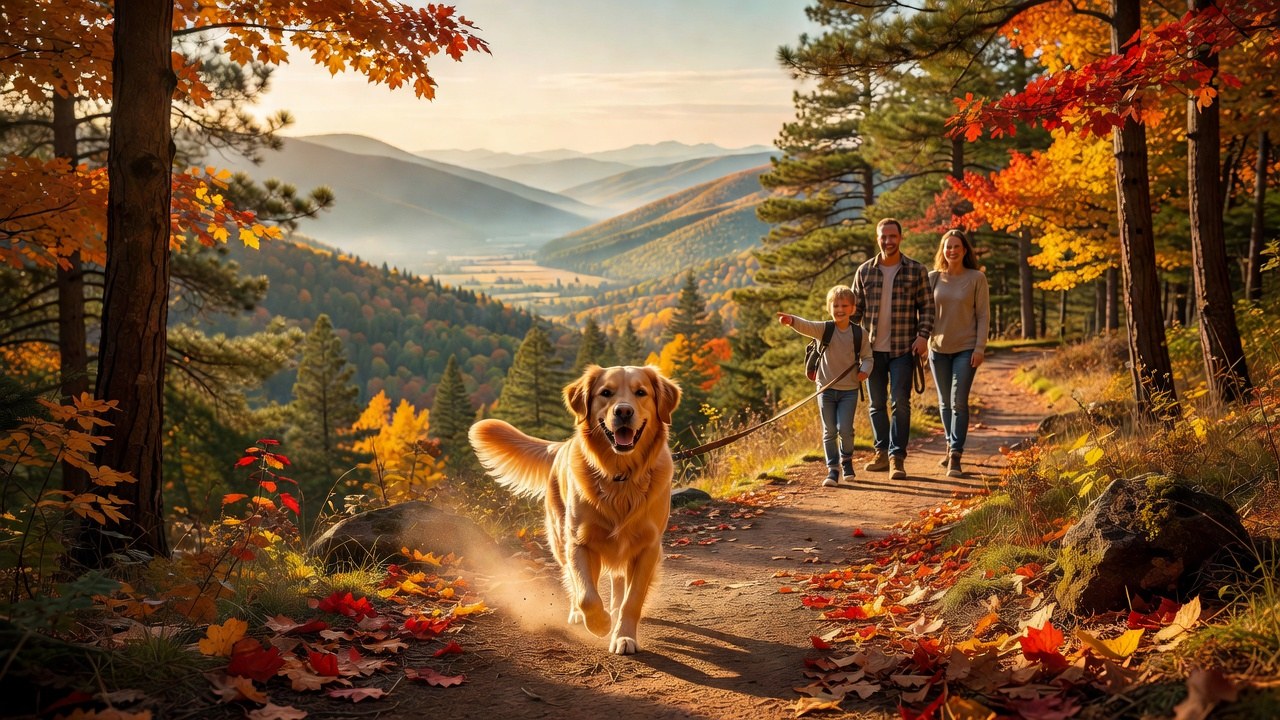
Shenandoah National Park, Virginia. Leashed dogs are allowed on roughly 480 of the park's 500 miles of trail — including the stretch of the Appalachian Trail that runs through the park — plus every campground and the picnic areas along Skyline Drive. Fewer than twenty miles of trail are off limits to pets, and those exceptions are marked at the trailheads. For a dog owner this is close to a normal hiking park: you pick a trail in the morning and go. The Virginia camping guide covers where to base yourself outside the park.
Acadia National Park, Maine. The park permits pets on 100 miles of hiking trails and 45 miles of carriage roads, and Blackwoods, Seawall, and Schoodic Woods campgrounds all allow pets. The carriage roads are the secret weapon for dogs — wide, graded gravel loops with no scrambling, so a long day is genuinely a long walk rather than a climbing problem. The Maine camping guide covers the coastal bases.
One pattern is worth noting for both: the dog-friendly parks are the ones where the access question has already been answered for you. You are not checking a trailhead sign and turning around. That is worth a longer drive.
The B.A.R.K. Ranger Program (and Why It Matters)
If you remember one thing from this article, make it B.A.R.K. It is both a memory trick and an actual National Park Service program, and it compresses the entire pet policy into four words:
- B — Bag your pet's waste.
- A — Always leash your pet.
- R — Respect wildlife.
- K — Know where you can go.
More than 100 parks run a formal B.A.R.K. Ranger program built on those four rules. It works like the Junior Ranger program but for dogs: you stop at a visitor center, take the pledge, and at many parks you can buy a collar tag — usually a few dollars — that makes your dog a sworn-in B.A.R.K. Ranger. Kids love it, and it turns "rules" into something a family does together instead of something a ranger enforces.
The program exists because off-leash dogs and unbagged waste were causing real damage, and real rule tightening was the response. Every owner who follows B.A.R.K. is part of the argument for keeping dogs allowed. Treat the tag as a commitment, not a sticker.
Gear That Makes a Park Day Work With a Dog
The park does not dictate your gear. The terrain does. A dune park and a forest park ask for very different kits, but a handful of items earn their place on almost any park trip.
A properly fitted harness beats a collar for trail control. The Ruffwear Front Range harness ($44.95, 4.5★, 17,000+ reviews) is the standard recommendation: padded, two leash attachment points, and a handle that gives you a lifting point over an obstacle or a stream crossing. On a 6-foot leash in a park, control is the whole game.
Paw protection, matched to the surface. Desert parks like Petrified Forest and White Sands, plus hot pavement everywhere in summer, can burn or shred pads. Musher's Secret paw wax ($24.99, 4.7★, 13,500+ reviews) is the cheap insurance — and if you are planning a slickrock trip with a heat-sensitive dog, add Ruffwear Grip Trex boots ($49.99 a pair) so the pads never touch the hot rock.
Water the dog will actually drink. Two pieces of gear solve this. A Cibaabo dog water bottle ($14.98, 4.8★, 7,300+ reviews) clips to a pack strap and has a built-in drinking trough plus a food container — no bowl to hold. Once you are parked at camp, the Ruffwear Quencher collapsible bowl ($19.95) or the bigger Kurgo Zippy Bowl ($15.99) fold flat.
Reflective gear, if your park trip overlaps hunting season. Fall is peak park season and peak hunting season on adjacent public land. A reflective dog collar ($18.99) and a matching bandana ($24.99) make your dog visible when a quiet forest road gets busy. The hunting-season visibility guide covers the owner's side of that.
A tick remover and a small first-aid kit. Trailhead grass and leaf litter mean ticks. The HomeSake tick remover ($14.39, 4.6★, 5,800+ reviews) is three tools for under $15, and the Adventure Medical Kits .7 ($44.95) is small enough to live in the pack for the whole family. Paw cuts, pad burns, and a cut from glass at a campsite are the three most common dog injuries on a park weekend.
Water parks need a life jacket. If your trip includes a lake, a river, or a paddle, pack one even for a strong swimmer. The Outward Hound Granby Splash jacket ($24.99, 4.5★, 14,000+ reviews) is the budget pick; the Ruffwear Float Coat ($99.99) is the premium one with a handle. Our dog water-safety guide covers lake and beach days in detail.
Where the dog sleeps. If you are camping, a raised cot keeps him off cold ground and out of the wet. The Canine Canyon folding dog cot ($49.99) packs flat, and the Chuckit travel dog bed ($29.99, 4.6★, 2,700+ reviews) is the lighter option. The dog camp-bed guide compares both against a plain pad, and the cold-weather dog camping guide covers shoulder-season nights.
When the Park Says No: The Nearby Dog-Friendly Plan B
A park that bans dogs on trails does not end the trip. Almost every famous park is ringed by land where dogs are welcome.
National forests allow dogs, generally on leash in developed recreation areas and on interpretive trails — vast terrain next to Yosemite, Rocky Mountain, and Great Smoky Mountains that most visitors ignore. BLM land is looser still. State parks are the closest thing to a coin flip: many are dog-friendly on trails, some ban dogs at beaches entirely, and each state sets its own rules — our state camping guides cover the ones that matter for weekend trips.
The practical trip shape that works: camp in the national park (developed campgrounds allow leashed dogs), drive the scenic loop and hit the paved overlooks with the dog, then spend your one real hiking day on adjacent national forest or state park trails where he is allowed. You get the park and the hike, and the dog is legal for both.
Service dogs are the exception to everything above. Under the ADA, a trained service dog is allowed anywhere the public can go — trails, buildings, shuttle buses included. Emotional support animals do not count as service animals under federal law; they are treated as pets, so the standard restrictions apply. Do not plan a trip around a status your dog does not legally hold — it is the fastest way to be turned around at a trailhead.
How to Plan a Dog-Friendly Park Trip, in Order
- Decide whether the trip is a hike or a road trip. This single question picks your park. Want trail miles? Start from the dog-friendly list. Fine with pullouts and campground loops? Almost any park works.
- Read the park's official pet page the week before. Confirm which trails, if any, allow dogs, plus any seasonal closures. Trust the current NPS page over any blog, including this one.
- Book a campground that allows pets. Most park campgrounds do; a few do not, and some have pet loops. This is a booking-filter question, not a guess.
- Pack for the dog's day, not just yours. Water and a bowl, waste bags, the harness, weather-appropriate paw protection, and a small first-aid kit. For a longer hike, the dog hiking checklist is the full list.
- Build in a plan B. Even in a dog-friendly park, a trail can close for wildlife, weather, or a bear sighting. Know one paved loop or campground walk so a closure does not end the day.
If you are travelling with kids as well as a dog, the October fall camping guide and the holiday free-admission park guide both include the family logistics that the dog rules do not cover. And if the dog is joining a bigger trip with the whole crew, the dog camping hub collects every dog-guide we have in one place.
Dog-Friendly National Parks FAQ
Can you camp with dogs in national parks?
Yes, in almost every park. Developed campgrounds allow leashed dogs, and camping is the part of a park trip where dogs are genuinely welcome. What you cannot do is leave the dog alone in the campsite while you hike — the policy requires pets to be attended at all times, which is why a dog park trip is planned around what the dog can join, not around solo trail days. Dogs may also not be left in a vehicle in unsafe temperatures. The dog camping checklist covers the campsite setup.
Are dogs allowed on national park trails?
In most parks, no — not on unpaved trails or in the backcountry. The parks that allow dogs on most or all trails are Shenandoah, Acadia, Congaree, Cuyahoga Valley, Petrified Forest, White Sands, Great Sand Dunes, Virgin Islands, and Wrangell-St. Elias. Great Smoky Mountains allows dogs on two short trails only, and parks like Yosemite, Yellowstone, Glacier, Rocky Mountain, Grand Teton, and Arches restrict dogs to developed areas with no trail access at all.
What is the leash rule for dogs in national parks?
A leash no longer than 6 feet, at all times, in every park. There are no off-leash areas, and a retractable leash counts as off-leash once it extends past six feet. Dogs must also be attended at all times, so you cannot tie one up outside a building or a visitor center.
What is the B.A.R.K. Ranger program?
B.A.R.K. is a National Park Service program, run at more than 100 parks, that teaches four rules: Bag your pet's waste, Always leash your pet, Respect wildlife, and Know where you can go. You take the pledge at a visitor center, and many parks sell a collar tag so your dog can be a sworn-in B.A.R.K. Ranger. It is the fastest way to explain the park rules to kids.
Is there a fee to bring a dog into a national park?
No. There is no per-pet fee anywhere in the National Park Service. You pay the standard entrance fee or enter free with an America the Beautiful pass, and the only optional cost is a few dollars for a B.A.R.K. Ranger tag at parks that sell them.
For the Southeast's newest dog-friendly option, camping in South Carolina covers Congaree's campground rules and the leash law across all 47 state parks.
<!-- AFFILIATE_DISCLOSURE -->If your trip is drifting west instead of east, the Missouri camping guide covers the Ozarks float season, the trout parks and one booking number for 41 state parks.
For leash rules on a national river, see the Arkansas camping guide.
The Bottom Line
Dogs are welcome in every national park and on the trails of a small, specific group of them. Pick the park by the access you want — Shenandoah and Acadia if hiking with the dog is the point, anywhere else if camping and scenic pullouts are — read the official pet page the week before, keep him on a 6-foot leash, and pack a harness, water, paw protection, and a tick tool. That is the whole system, and it is a genuinely great trip for the dog and the family both.