Winter Car Camping: Setup, Heat & Staying Warm (2026)
Winter car camping without the 3 a.m. shiver: how cold is too cold, the 20-minute setup, heater options ranked by risk, and sleeping-bag math for a cold cabin.
In this article · 12 sections
- How Cold Is Too Cold for Winter Car Camping?
- Winter Car Camping Setup: The 20-Minute Version
- Winter Car Camping Essentials: What Earns Its Space
- Winter Car Camping Heater Options, Ranked by Risk
- Car Camping in Winter Without a Heater
- Winter Car Camping Sleeping Bag: Rating Math for a Cold Cabin
- Winter Car Camping Condensation: Why the Windows Rain Inside
- Winter Car Camping Tent: When to Sleep Outside Instead
- CO and Fire Safety: The Non-Negotiables
- Winter Car Camping Tips From Cold Mornings
- Winter Car Camping With Kids and Dogs
- Winter Car Camping FAQ
Winter car camping is the cheapest way to keep camping when the temperature drops — no snow shelter to build, no tent to shake ice off at dawn, and a windshield that keeps the wind off your face. It is also the setup where families make the two mistakes that matter: they sleep on a bare metal floor that pulls heat out of them all night, and they run a propane heater in a sealed cabin.
This guide covers both. Every winter car camping trip below is built around three numbers: how cold it will actually get at 4 a.m., how much insulation is between you and the vehicle floor, and how much fresh air is moving through the cabin.
How Cold Is Too Cold for Winter Car Camping?
The honest answer most guides avoid: there is no universal cutoff — there is a cutoff for your gear. A 20°F night is comfortable in a 0°F bag on an insulated pad, and miserable in a 40°F bag on a bare mattress. What matters is the gap between the overnight low and what your sleep system is rated for.
Use these bands as a starting point, then adjust for wind and elevation:
| Overnight low | Who this works for | What changes |
|---|---|---|
| 40–50°F | Anyone, any vehicle | A 30–40°F bag, windows cracked, no heater needed |
| 30–40°F | Most families | Add a foam pad under the bag, warm hat, expect condensation |
| 20–30°F | Prepared adults and kids in good bags | 0–20°F bag + insulated pad, ventilation plan, no bare metal |
| 10–20°F | Experienced cold campers | Insulated floor layer, bag liner, dry base layers, heat only while awake |
| Below 10°F | Not a first family trip | Vehicle-specific setup, dual heat plan, hard CO discipline |
The two hard limits worth respecting: kids under about 5 have less ability to regulate heat and can't reliably tell you they're cold at 3 a.m., and anyone sleeping in a vehicle below freezing needs ventilation and a CO alarm, not just a warm bag. If the forecast low is below your bag's comfort rating by more than about 15°F, plan to run the engine briefly before bed, or move the trip.
Winter Car Camping Setup: The 20-Minute Version
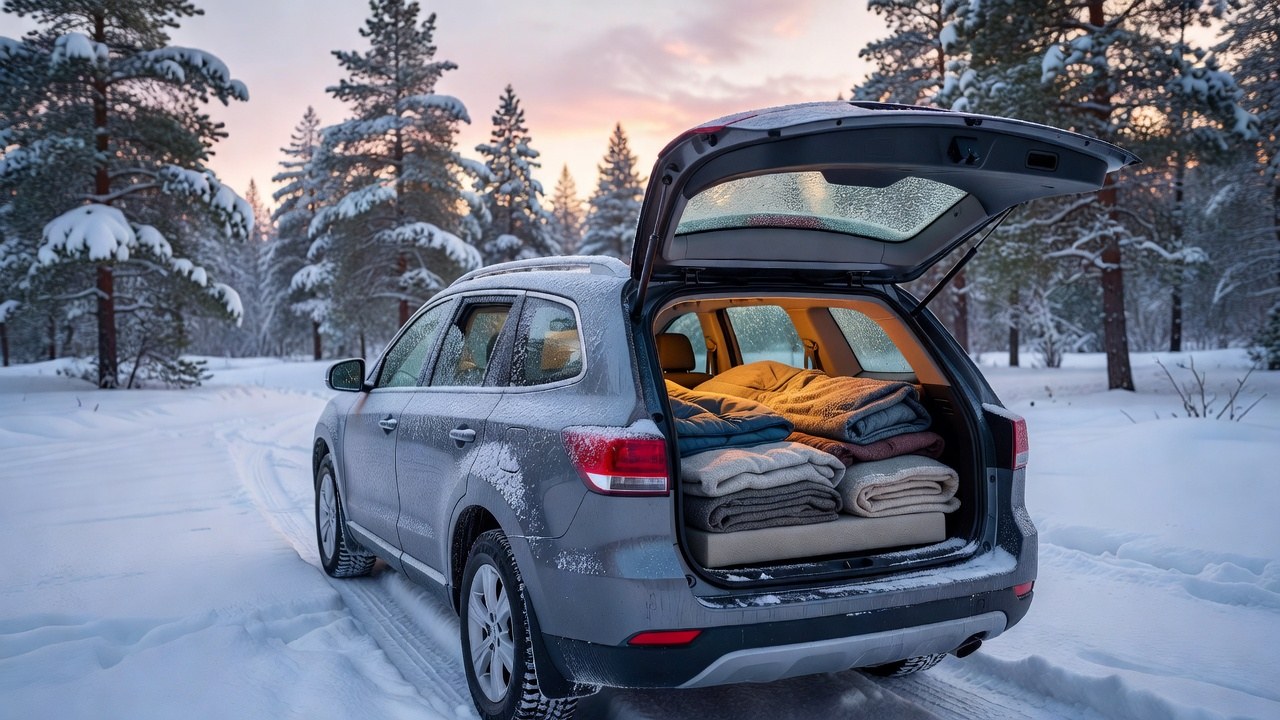
You do not need a build-out. You need four layers between your body and the cold, assembled in this order:
- Level the vehicle and clear the floor. Fold or remove seats so you have a flat platform. Anything metal that touches your bedding becomes a heat sink.
- Insulate the floor first. A closed-cell foam pad (about R-2) or a thick moving blanket goes down before any mattress. This one step changes the whole night.
- Add your sleep surface. An insulated air pad or a cot with a pad on top. See the rating math below.
- Layer on top. Sleeping bag, then a wool or synthetic blanket over it if the night is going below the bag's rating.
- Set ventilation before you sleep. Crack two windows on opposite sides a finger's width — cross-flow beats one window, and rain guards let you do it in the rain. This is what stops the windows raining inside.
- Stage heat and light where you can reach them without getting out of the bag. Headlamp, water bottle, phone, keys, shoes upside down so frost doesn't settle in them.
That is the whole setup. Everything else — the heater, the power station, the boot dryer — is comfort and safety detail layered onto these six steps.
Winter Car Camping Essentials: What Earns Its Space
Cold-weather car camping rewards a small kit that does specific jobs. These are the pieces worth packing, in rough order of how much difference they make:
- A real insulation layer for the floor. Cheapest version is closed-cell foam; the Therm-a-Rest Z Lite Sol ($54.95) is the classic foldable option and doubles as a sit pad. If you want an inflatable with actual cold-weather rating, the Klymit Insulated Static V ($94.99) is the value pick.
- A bag rated colder than the forecast. Covered below, but do not skip it — this is the single biggest comfort variable.
- A CO alarm. Non-negotiable if any fuel-burning device comes in the vehicle. The Kidde battery-powered CO detector ($23.97) is travel-sized and runs on AA batteries. This is the cheapest insurance in the whole kit.
- A wool or puffy blanket for the layer over the bag, and for sitting around camp in the evening. The Rumpl Original Puffy ($139) packs small; the Arcturus Military Wool Blanket ($42.99) is the budget workhorse that survives sparks and dog claws.
- Boots that dry overnight. Wet boots at 7 a.m. ruin a winter trip. The PEET portable propane boot dryer ($109.99) or the JobSite fanless boot dryer ($41.99) solve it without a plug.
- A headlamp with a red mode so you can check on kids at 2 a.m. without blinding everyone. The Petzl Actik Core ($79.95) is rechargeable and dimmable.
- A bottle that keeps water liquid. Insulated, not clear plastic. A frozen water bottle at dawn is a small thing that makes a cold morning feel like a failure.
Winter Car Camping Heater Options, Ranked by Risk
This is the section to read twice. Heat in a vehicle cabin is a real safety question, not a comfort preference, because a car holds far less air than a tent — roughly 3,000 liters — and CO builds fast in a sealed volume.
1. A parking heater (lowest risk, highest cost). Diesel air heaters like the LF Bros 5kW parking heater ($249.99) are designed for vehicle cabins: combustion happens in a sealed chamber and exhaust is routed outside. This is the only category that is genuinely built to heat a car while you sleep, and it still needs a CO alarm as a backstop.
2. A 12V heated blanket (low risk, engine-dependent). The Sealy 12-volt heated car blanket ($31.99) runs off the accessory socket and warms the person, not the air — which is more efficient and much safer than heating the cabin. Watch the battery: run it while the engine idles or off a Jackery Explorer 300 ($199). At roughly 50W draw, 292Wh gives you about five hours of blanket time on paper, less in practice.
3. A radiant propane heater (moderate risk — supervised only). The Buddy series is certified for indoor use in ventilated spaces, and in a tent with a vent open it is a known quantity: Little Buddy ($69.99, 3,800 BTU), Buddy/MH9BX ($74, 4,000–9,000 BTU), Big Buddy ($146.48, up to 18,000 BTU). In a vehicle, treat it as an awake-hours device: light it to take the edge off before bed, shut it off before you sleep, crack a window the whole time, and keep a CO alarm at head height. If you are already carrying one, the fuel filter ($15.97) is what keeps it running clean, and the refill cylinder + 1lb-to-20lb adapter cut fuel cost if you camp often.
4. A campfire or charcoal pan (do not). Never inside, never in an attached garage, never "just to warm up." This is the leading cause of the CO deaths that show up in every winter camping season.
For run-time math — how long a 1 lb canister actually lasts at each setting — see our Buddy heater run-time breakdown, and for the refilling side, the 1 lb propane refill guide.
Car Camping in Winter Without a Heater
Most winter car camping trips do not need heat at all — they need insulation and a dry layer. A heated cabin is comfortable for ten minutes and then the heater cycles off and the walls are still cold.
What works instead:
- Heat the person, not the air. A bag liner adds real warmth for little money and no fuel. The Litume fleece liner ($57.98) is the one we reach for.
- Pre-warm the bag before you get in. Fill a bottle with hot water, dry it, and put it in the bag ten minutes early. Same trick for kids: a warm bag is a sleeping kid.
- Double up thin layers instead of buying one huge bag. Two 30°F bags nested outperform most single bags in a vehicle, and you already own them.
- Wear dry, not thick. Damp cotton is worse than a thin merino layer. Base layers, wool socks, a beanie — and change socks before bed.
- Run the engine 10 minutes before sleep with the heater on full and the windows cracked, then shut it off. The cabin holds that warmth for about an hour, which is enough to fall asleep.
If you are camping in a tent instead of the vehicle, our winter camping guide for beginners covers the tent-specific version of the same problem, and the 30-degree weather guide covers what breaks first at that temperature.
Winter Car Camping Sleeping Bag: Rating Math for a Cold Cabin
Bag ratings assume you are on an insulated pad, wearing a dry base layer, in a tent. A vehicle cabin is usually colder at the floor and warmer at head height, so treat the rating as an upper bound.
Rule of thumb: add 10°F to the bag's limit rating if you are sleeping on a bare mattress or cot without a pad. Then compare to the forecast low.
| Forecast low | Bag rating to bring | Pad underneath |
|---|---|---|
| 40°F | 40°F comfort bag | Foam or any pad |
| 30°F | 30°F bag | Closed-cell foam |
| 20°F | 20°F or 0°F bag | Insulated pad (R-4 class) |
| 10°F | 0°F bag + liner | Insulated pad + foam layer |
| 0°F | Expedition bag + liner | Two pads, or cot + pad |
Catalog options that map to those bands: the Coleman Palmetto 40°F ($44.99) for mild nights, the TETON Celsius 0°F ($59.99) as the family value pick, and the Kelty Cosmic Down 20°F ($169) when pack size matters too. For kids, size the bag to the child — an adult bag on a small body is a cold air pocket: the TETON Celsius Jr 20°F ($49.99) and the Kelty Woobie 30°F ($39.95) are built for that.
Winter Car Camping Condensation: Why the Windows Rain Inside
Every person in the vehicle puts roughly half a liter to a liter of water vapor into the air overnight, and burning propane adds more. In a sealed cabin that vapor condenses on the coldest surface — the glass — and by morning you have ice on the inside of the windshield and damp bedding.
Fixes, in order of effectiveness:
- Cross-ventilation. Two windows cracked on opposite sides, a finger's width each. This is the whole fix in most cases.
- Circulate air. A small battery fan pointed at the glass keeps the surface above the dew point. The Frizcol 3-in-1 fan/lantern ($29.98) runs all night on its own battery.
- Don't burn fuel while you sleep. Propane combustion produces water vapor as well as CO — a heater running all night makes the condensation worse, not better.
- Keep bedding off the walls. Contact with cold metal wicks moisture into the bag.
Our tent condensation guide explains the dew-point mechanics if you want the full version.
Winter Car Camping Tent: When to Sleep Outside Instead
Sometimes the better setup is a hybrid: sleep in the tent and use the vehicle as the warm room, or the reverse in bad weather.
- Cold, dry, calm nights — a tent with a proper pad and bag is drier than a vehicle, because condensation leaves through the tent fabric instead of running down the glass.
- Wind, rain, or snow — the vehicle wins outright. Solid walls beat any fabric in weather.
- With kids — the vehicle is easier to manage at 2 a.m., and it's easier to keep their bedding dry.
If you go the tent route, the 4-season tent guide covers which tents actually handle snow load, and the winter camping gear checklist is the packing list version of this article.
CO and Fire Safety: The Non-Negotiables
Carbon monoxide is colorless, odorless, and slightly lighter than air, which is why it pools at head height in a cabin and why "I didn't smell anything" is not evidence of safety. A battery CO alarm belongs at head height, not in the trunk.
- Never sleep with a propane, butane, or charcoal device burning in a sealed vehicle. Not with a window cracked, not "just on low."
- Run any fuel-burning heater only while you are awake and can smell/see/monitor it.
- Keep a CO alarm in the cabin whenever any fuel device is inside — including a stove you lit to make coffee.
- Test the alarm before the trip. A detector with a dead battery is a plastic box.
- Know the symptoms: headache, nausea, dizziness, and unusual sleepiness in a cold environment are CO symptoms, not "just tired." Get out, get air, get help.
Winter Car Camping Tips From Cold Mornings
- Park facing east. Morning sun through the windshield does more for morale than any gear.
- Put tomorrow's clothes in the bag with you. They'll be warm and dry at 6 a.m.
- Fill the water bottle with hot water at bedtime and wrap it in a sock — foot warmer at 2 a.m., drinking water at 6 a.m.
- Cook outside, always. Even a simple coffee setup inside the cabin adds moisture and CO.
- Keep a dry bag for wet layers. One damp jacket in a small cabin raises the humidity for the whole night.
- Check the kids at midnight and again at 4 a.m. The 4 a.m. check is the one that matters — that's when body temperature is lowest.
Winter Car Camping With Kids and Dogs
Kids: the rule is one layer more than you'd wear, a dedicated kid-sized bag, and a warm hat that stays on. Our winter camping with kids guide has the age-by-age version.
Dogs: a short-coated dog in a 25°F vehicle is cold, and a dog that's been running in snow is wet. Bring a towel, a raised bed to keep them off the cold floor, and an insulated jacket. Dogs also add moisture to the cabin — expect more condensation, and ventilate more.
Winter Car Camping FAQ
Can you car camp in freezing temperatures?
Yes, with three conditions: an insulated layer between you and the vehicle floor, a sleeping bag rated at or below the forecast low, and open ventilation. Below about 20°F most families also need a secondary heat plan — either a parking heater or a heated blanket — plus a CO alarm.
Is it safe to run a propane heater in a car overnight?
No. A vehicle cabin holds roughly 3,000 liters of air, and any propane heater consumes oxygen and can produce carbon monoxide. Use a radiant heater only while you are awake, with a window cracked and a CO alarm in the cabin, and shut it off before you sleep.
How do I stop condensation in a car while sleeping?
Crack two windows on opposite sides a finger's width, run a small battery fan at the glass, don't burn fuel while you sleep, and keep bedding off the metal walls. That combination handles most nights.
Do I need a tent for winter car camping?
No — the vehicle is the shelter. A tent is worth bringing when the night is cold but dry and calm, because fabric vents moisture better than glass. In wind, rain, or snow, sleep in the vehicle.
What sleeping bag rating do I need for winter car camping?
Match the bag to the overnight low and add about 10°F of margin if you're sleeping on a cot or bare mattress. A 20°F night wants a 20°F or 0°F bag on an insulated pad; a 10°F night wants a 0°F bag plus a liner and a foam layer.
<!-- AFFILIATE_DISCLOSURE -->TrailMapz earns a small commission from Amazon links at no extra cost to you — it's how we keep testing cold-weather setups at 4 a.m. instead of describing them from a desk.