Stargazing While Camping: A Family Guide to Dark-Sky Nights (2026)
Camping stargazing with kids: how to pick a dark site, the red-light rule, 2026 meteor shower dates, and the gear that actually helps.
For genuinely dark sky within a day's drive, the Oklahoma camping guide covers Black Mesa in the panhandle — the state's 4,973-foot high point and some of the darkest public sky in the lower 48.
Quick Answer: How to Plan a Stargazing Camping Night
Pick a new-moon weekend, drive 30+ minutes from town, and arrive before sunset so your eyes and your setup are ready. Bring one dim red light instead of white flashlights, a reclining or low chair, and a warm blanket — stargazing is sitting still in the cold, which is why most people quit after ten minutes. Binoculars beat a telescope for beginners. Then wait 20 minutes for your eyes to fully adapt; that adaptation, not the equipment, is what actually shows you the Milky Way.
That's the whole method. The rest of this guide is how to do it well with kids in the group.
Why Fall and Winter Are the Best Time to Stargaze With Kids
Almost every family tries stargazing in July, gets dark at 9:45pm, and gives up because the kids are already melting down.
Fall and winter invert that. Sunset moves earlier and earlier from late September through December, which means the sky is genuinely dark by dinnertime. You can run a real stargazing session at 7pm and still have everyone in a sleeping bag at a normal hour. The nights are longer, and — this is the part people don't expect — cold air holds less moisture, so haze and humidity drop and more stars come through per square mile of sky.
The tradeoff is obvious: it's cold, and you're sitting still. That's a gear problem, and it's solvable. What is not solvable is a full moon over your campsite, so start there.
Moon Phase: The One Thing That Ruins a Star Trip
Before you pick a campground, pick a new moon.
A full moon near a campsite is bright enough to read by and washes out everything fainter than the brightest stars. Under a full moon you will see the moon and maybe fifty stars. Under a new moon, at a genuinely dark site, you'll see the Milky Way as a texture across the sky and a few thousand stars without moving your eyes.
The moon also rises and sets about 50 minutes later each night, so a half moon that sets at 11pm still gives you a dark early evening. Practical rules:
- New moon ± 3 days is the target window for a planned trip.
- First-quarter and last-quarter (half moon) still work if you plan around moonrise or moonset.
- Two days either side of full is a write-off for deep-sky viewing. Book that weekend for campfire cooking instead.
If your trip is already locked in, check the moon phase and moonrise time for that exact date before you promise anyone a Milky Way.
2026 Meteor Showers Worth Planning a Camping Trip Around
Meteor showers are the easiest possible win for kids: you don't need equipment, you don't need to know any constellations, and you only need to look up. The named showers recur every year on roughly the same calendar dates.
- Orionids — peaks around October 21–22, 2026. Fast, faint meteors radiating from Orion. Best in the hours after midnight. A good excuse for an October camping weekend.
- Leonids — peaks around November 17–18, 2026. Usually modest, but occasionally produces a burst. Worth a look if you're already out.
- Geminids — peaks around December 13–14, 2026. This is the one to plan around. The Geminids are typically the strongest shower of the year, and they're bright enough to survive some moonlight and some light pollution. Cold-weather camping plus the Geminids is the single best night sky of the year for a family.
- Perseids — peaks around August 12 each year. The warm-weather option, but the late-summer sunset means a later start with young kids.
Two timing notes that matter more than which shower you pick. First, the hours after midnight are usually better than the evening, because your part of the planet is rotating into the debris stream. Second, meteor watching needs a wide view, not a zoomed one — so leave the binoculars in the tent and just lie back.
How to Find a Dark Site Near Your Campsite
You do not need a certified dark-sky park. You need to get away from the light dome of a town — 30 to 60 minutes of driving past the last streetlight is usually the difference between "a few stars" and "the Milky Way."
How to pick, in order:
- Start from where you're already camping. Most campgrounds are darker than home. Check whether your campground has a lighting policy — many state park campgrounds dim or shut off lights after quiet hours.
- Look at a light-pollution map, not a star map. You want a spot in a Bortle 1–4 zone; the Bortle scale runs 1 (pristine) to 9 (inner city), and moving even one or two classes changes what you can see more than any equipment upgrade.
- Check the horizon. A ridgeline, canyon wall, or treeline that blocks the southern and eastern horizon also blocks the sky you came for. Open meadows, lake shorelines, and desert flats are ideal.
- Consider elevation and dryness. Altitude puts you above some of the atmosphere and some of the haze. Dry climates beat humid ones on the same night.
If you're still deciding where to go, our state guides cover specific dark-sky friendly areas and campgrounds: camping in Texas, camping in Colorado, camping in Utah, camping in Michigan, and camping in California. Wherever you go, check the park's own rules — some designated dark-sky areas ask visitors to keep vehicle lights off after arrival.
The Red Light Rule (and Why White Flashlights Blow It)
Your eyes need roughly 20 to 30 minutes in darkness to reach full sensitivity — the chemical change in your retina that turns a faint smudge into the Milky Way.
One blast of a white phone flashlight resets that clock. This is the single most common reason a family stargazing session disappoints: someone checks their phone, and everyone starts over.
The fix is a headlamp or flashlight with a red mode, used at the lowest setting that still works. Red light preserves dark adaptation far better than white or blue, which is why every astronomy club and observatory on earth runs red.
For adults, the Petzl ACTIK CORE headlamp has a dedicated red mode plus a rechargeable battery, and the Black Diamond Spot 400 does the same at a lower price with dimming so you can drop it to a whisper. Kids get their own — the Black Diamond Wiz Kid headlamp is built child-safe and dimmed down to 4 lumens so it won't blind the group or ruin anyone's adaptation.
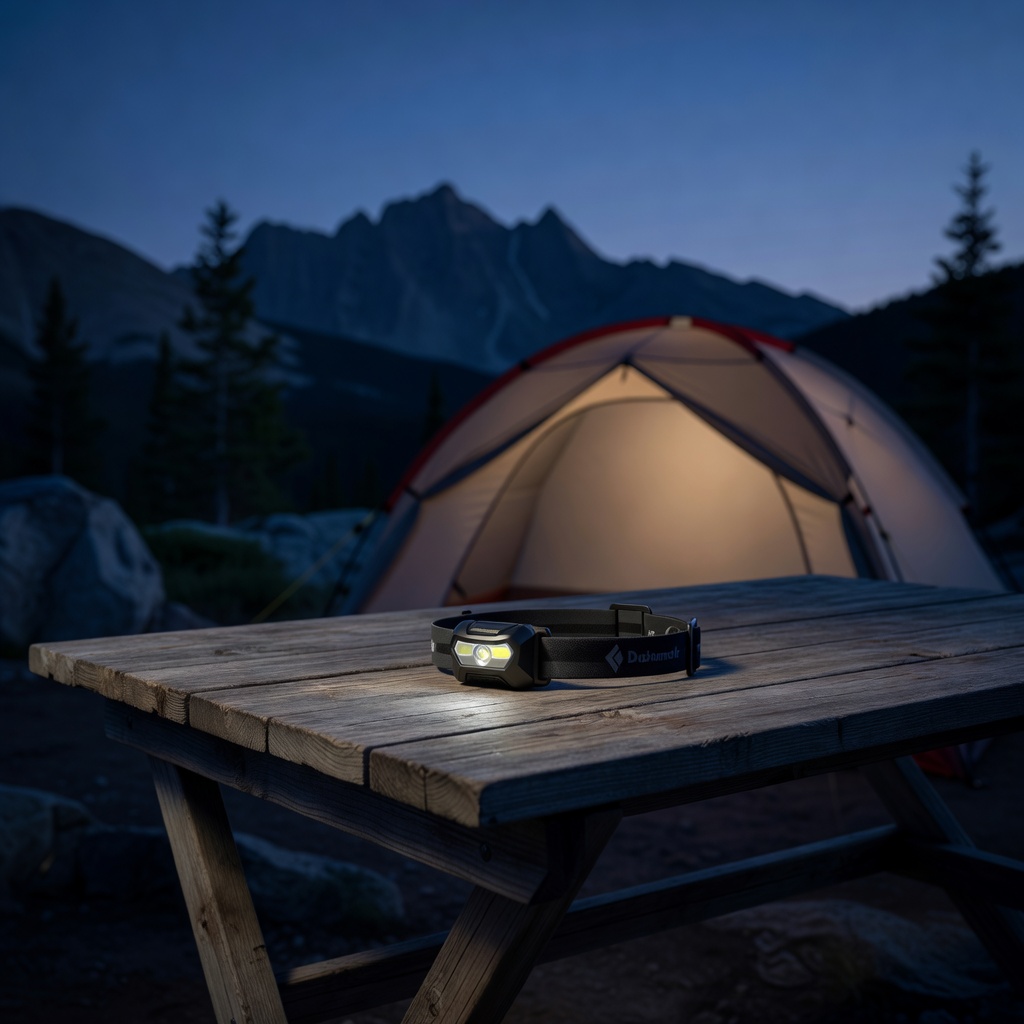
For the campsite itself, a dimmable lantern beats a bright one: the Black Diamond Moji drops low enough to be usable while you're stargazing. Our camp lighting guide goes deeper on lantern versus headlamp versus string lights if you want the full picture.
Stargazing With Kids: The Bedtime Problem, Solved
The reason fall stargazing works with children is that it fits before bedtime instead of after it. Three things make it land:
- Run it as a 45-minute session, not an all-nighter. Look up, find three things, go to bed. Kids remember the thing you did every night of a trip more than the one heroic late night.
- Give every kid a job. One holds the red light, one picks the first thing everyone looks at, one calls out meteors. Ownership beats entertainment.
- Do the "wow" item first, while they're fresh. That means the moon through binoculars, the Pleiades, or the Milky Way — not a 20-minute explanation of why the sky is dark.
If you need daytime filler so the night session isn't the only thing on the schedule, our screen-free camping activities for kids pairs well with this, and the family camping with kids guide covers the rest of the trip.
Binoculars vs Telescope vs Naked Eye
Beginners almost always buy the wrong thing first. Here's the honest ranking for a family camping trip:
- Naked eye — for meteor showers, the Milky Way, constellations, and satellites. This is 90% of stargazing and it costs nothing.
- Binoculars — the best first purchase for most families. They show lunar craters, Jupiter's moons, the Pleiades, and star clusters, they're packable, and everyone can share them. The Occer 12x25 compact binoculars are light enough for kids to hold steady and focus themselves. We compare more options in our binoculars for family camping and hiking guide.
- Telescope — a distant third for a family camping trip. A telescope plus a dark site is wonderful, but a telescope that lives in a car and gets set up in the cold after a hike usually doesn't get used. Get binoculars first; get the telescope when someone in the family is genuinely hooked.
A useful trick: whatever you bring, mount the binoculars or use a pod for anything above about 10x magnification. Hand shake is what makes people think binoculars are blurry.
The Gear That Actually Helps (Because You're Sitting Still in the Cold)
This is the part that separates a 45-minute session from a ten-minute one. You are not hiking. You are lying or sitting motionless in the coldest hour of the trip, looking at a fixed point. Cold is the enemy and comfort is the entire game.
To look up comfortably:
- A low chair or recliner — a chair that lets you lean back past vertical is the difference between a relaxed neck and a sore one. The SUNNYFEEL folding low beach chair sits low enough that you barely have to tip your head, and the two-pack covers both parents. For a budget option, the Coleman portable camping chair reclines and has a built-in cooler pouch for the thermos. We compare more in our camping chairs comparison guide.
- A blanket you'll actually use. Sitting still in 40°F air is a different sensation than hiking in it. The Rumpl Original Puffy blanket is warm, water-resistant, and doubles as a picnic and campfire blanket all trip. For lying flat on the ground, a closed-cell pad like the Therm-a-Rest Z Lite Sol insulates you from the ground far better than a blanket alone.
- Hand warmers. Cheap, boring, and the reason kids stay out longer. Rechargeable warmers like the OCOOPA pair last through several sessions, while a bulk box of HotHands is the no-thinking option for a group.
To look up in comfort, on the same trip:
- Layers, and one more than you think you need. A still, seated body loses heat much faster than a moving one. Our how to stay warm camping guide covers the layering math.
- A thermos. Hot drinks keep hands warm and give the session a second act. Our fall camping food and meals guide has campfire-friendly dinners, and if you're staying up past midnight, a percolator like the GSI Outdoors enamelware percolator makes pre-dawn viewing much more civilized.
- Head-to-toe warmth on the ground. A blanket across the legs is worth more than a second jacket.
Where This Fits in Your Trip
Stargazing is one of the few outdoor activities that is genuinely free, genuinely photogenic, and genuinely works better in the cold season — which is why it earns a slot in almost every fall and winter camping trip. The fall camping gear checklist covers the rest of the cold-weather kit, and our November camping guide is where to look if you're planning a late-season dark-sky weekend.
Common Stargazing Mistakes (Learn From Mine)
- Checking your phone "just once." That's 25 minutes of dark adaptation gone. Put it in the tent, screen down.
- Bringing only white flashlights. Everyone means well. Everyone ruins the night sky by accident. Red modes, set low, before you leave the house.
- Booking a full-moon weekend. The single most common planning error, and the easiest to avoid.
- Standing up. Neck pain ends sessions. Sit low, lean back, or lie down.
- Using a bright lantern as a "red light." A dim white lantern is still white. Check that your light has an actual red mode.
- Expecting a telescope photo. What you'll see through binoculars is a small, sharp, real moon — not a Hubble image. Telling kids that in advance prevents real disappointment.
- Skipping the layers. Cold is what actually sends families back to the tent, not boredom.
What People Search Before Planning a Dark-Sky Camping Night
The searches that bring families to this page cluster tightly, so here is the short version. A search for stargazing camping near me is really a question about distance rather than about a famous park — any stargazing campsite 30 minutes past the last streetlight beats a certified site in town — while camping stargazing near me, camping stargazing chair and camping stargazing tent are the same question with the words rearranged, and stargazing camping chair plus stargazing camping tent are the two purchases people ask about most, because a chair that leans back past vertical and a tent you can pitch while your eyes are adapting are exactly what turn a ten-minute session into a 45-minute one. Plenty of people frame the whole weekend as a stargazing camping trip or a star gazing camping trip, others want stargazing camping california, stargazing camping michigan or stargazing camping texas specifically, and a few are weighing a stargazing camping vehicle against a plain tent. If the question is where rather than how, best places to stargaze near me and best places to stargaze in the us are really questions about the Bortle map, best places to stargaze in arizona, best places to stargaze in texas, best places to stargaze in california and best places to stargaze in florida are state-guide questions, best places to stargaze usa is the same list with no state attached, and best places to stargaze joshua tree, best places to stargaze flagstaff, best places to stargaze in sedona and best places to stargaze in yosemite are the four park names that come up most often, with best places to stargaze in the world and stargazing vacation spots the two that usually mean flying somewhere instead of driving. The dark sky camping family is the same idea said differently: dark sky camping near me and dark sky camping sites are generic, while dark sky camping utah, dark sky camping colorado, dark sky camping new mexico, dark sky camping arizona, dark sky camping oregon, dark sky camping michigan, dark sky camping nebraska, dark sky camping ohio, dark sky camping virginia and dark sky camping pa are all places people are already half-committed to. On timing, what time is the meteor shower, what time is best for the meteor shower and when can i see the meteor showers all resolve to the same answer — the hours after midnight — and what time is best to go stargazing depends on moonrise rather than on the clock. For a specific date, orionid meteor shower 2026, orionid meteor shower peak, orionid meteor shower peak date, orionid meteor shower location and orionid meteor shower october all point at the third week of October, leonid meteor shower 2026, leonid meteor shower dates and leonid meteor shower visibility map point at mid-November, and perseid meteor shower camping, meteor shower camping, meteor shower campout, meteor shower tent and meteor shower camera are five ways people phrase one weekend that may or may not be cold.
Stargazing Camping FAQ
What is the best time of year for camping stargazing?
Fall and winter, for three reasons: the sky is dark earlier, the nights are longer, and cold air holds less moisture so there's less haze. You can run a real session at 7pm and still get kids to bed on time — which is why October through December works so much better for families than July.
Do I need a telescope to see the Milky Way?
No. The Milky Way is visible to the naked eye from a genuinely dark site on a moonless night, and binoculars make it dramatically better. What matters far more than equipment is getting away from town lights, going on or near a new moon, and giving your eyes 20–30 minutes to adapt.
Why do astronomers use red light?
Red light preserves your night vision far better than white or blue light. Your eyes take roughly 20–30 minutes to fully adapt to darkness, and a single white flashlight resets that. A headlamp or flashlight with a low red mode lets you find things without losing the sky.
Can you stargaze at a regular campground?
Yes. Most campgrounds are darker than home, and many state park campgrounds dim or turn off lights after quiet hours. If your campground is bright, walk to the edge of the campground, or drive 30–60 minutes past the last streetlight for the biggest visible difference.
What should kids bring stargazing?
A red-mode headlamp of their own, a warm layer, hand warmers, and something to lie on. Kids get far more out of it when they have a job — holding the light, spotting meteors, or picking the first thing everyone looks at.
The Bottom Line
Stargazing is the cheapest upgrade you can add to a fall or winter camping trip, and it's the rare activity where the cold season is the advantage. Run it on a new-moon weekend, get 30 minutes past the town's light dome, hand everyone a red light, and sit still with a blanket. Whatever you bring, bring enough warmth to stay out for 45 minutes — that's the whole trick.
<!-- AFFILIATE_DISCLOSURE -->