Does Propane Go Bad? How Long Propane Lasts Unused and in Storage (2026)
Propane does not spoil, but cylinders do. What the DOT 12-year stamp means and how to store 1 lb bottles and 20 lb tanks safely.
Quick Answer: Does propane go bad? No. Propane is a stable, sealed, single-component fuel — it does not oxidize, gum, or spoil the way gasoline does, so how long propane lasts in a tank unused is effectively "indefinitely." What does have a shelf life is the cylinder holding it. A refillable propane tank has to be requalified 12 years after the date stamped on its collar, and every 5 years after that. Disposable 1 lb bottles have no requalification cycle at all because they are single-use — and legally nobody may refill them. So if you searched does propane expire or does propane go bad after sitting in the garage all winter, the short answer is that the gas is fine and the container is the thing to inspect.
That answer covers about 80% of what people actually want to know. The rest of this page is the storage part that matters: how long a propane tank lasts in storage, what temperature does to it, where you are allowed to keep a cylinder, and the specific failure points that make an old tank worth replacing even when the gas inside is perfectly good.
Does Propane Go Bad Over Time? What Actually Ages
Propane is C₃H₈ — a short, saturated hydrocarbon. There is nothing in it to go rancid, nothing to polymerize, and no bacterial or biological process that can spoil it, because it is stored as a liquid under pressure with essentially no oxygen and no water in contact with it.
That is the whole reason a propane tank can sit for years and still light on the first click. Compare it with what people are actually thinking of when they ask whether propane goes bad over time:
- Gasoline oxidizes. It forms gums and varnish in as little as three to six months, and ethanol blends absorb water. That is a real shelf-life problem.
- Diesel can grow microbial contamination and gels in cold.
- Propane does none of it. There is no gum, no varnish, no phase separation, no microbial growth.
So does propane go bad with age? Commercially supplied propane, no. What ages is the steel vessel: rust on the inside or outside, a dried-out or nicked valve O-ring, a relief valve that no longer seats, dents near a weld, or a damaged collar thread. Those are all container failures, and they are the reason the answer to "does propane expire" is really "your cylinder does."
Two phrasings of the same question come up constantly, so they are worth answering head-on: does propane go bad sitting in a tank, and does propane go bad after a while. Both describe the same fear — a cylinder that sat idle for a season and then disappointed on the first trip — and in both cases the fuel is not the variable. Does propane go bad like gasoline is the comparison people reach for, and it is the wrong one: gasoline is a mixture that reacts with the oxygen sealed in the tank, while propane is a single compound in a pressure vessel with almost no oxygen to react with.
How Long Does Propane Last in a Tank Unused?
If the cylinder is sound and the valve is closed, the propane inside does not deteriorate on any timescale a camper cares about. A tank you filled in 2021, parked in a dry shed, and forgot about will still burn at full strength next spring — the burn time does not shorten because the fuel "sat."
Two things do change with time, and both are about the tank rather than the fuel:
The requalification clock. Under US DOT rules, a refillable propane cylinder must be requalified 12 years after its manufacture date, then on a recurring cycle (commonly every 5 years, depending on which requalification method the shop uses). The date is stamped on the collar. If you are past the stamp and you take the tank to a refill station, they can refuse it — not because the propane is bad, but because the vessel is out of certification.
The condition of the valve and collar. Valve seals sit compressed for years. If a tank has been stored with the valve open, in a damp garage, or on its side, expect corrosion at the collar and a valve that needs replacing. A valve replacement is cheap; a leaking relief valve is not something to shrug off.
For a practical gut check before reusing a long-stored tank: it should be upright, dry, rust-free at the collar and base, undented, and the valve should turn smoothly and smell of nothing at all. Any hiss, any faint odor, and the tank goes to a refill or exchange point — do not try to "burn it off."
How Long Does a Propane Tank Last? Storage Life vs Burn Time
How long does a propane tank last is really two questions wearing one sentence, and they have different answers. If you mean how long does propane last in storage, the answer is measured in years — indefinitely, in a sound cylinder with a closed valve.
If instead you mean how long does a propane tank last before refill — or any run-time phrasing, such as how long does a propane tank last on a grill, how long does a propane tank last on a blackstone, how long does a propane tank last on a generator, how long does a propane tank last in a fire table or how long does a propane tank last on a fire pit — then you are asking about burn rate, not shelf life. The mirror phrasings how long does propane last on a blackstone and how long does propane last on a generator mean the same thing.
The same split untangles the rest of the family, because how long does a propane tank last for a house, how long does a propane tank last in a camper, how long does a propane tank last for cooking, how long does propane last for grill nights, how long does propane last in a tank for grill use, how long does propane last when cooking, and how long does propane last in rv all describe run time rather than storage life.
Those run-time numbers live on our how long a propane canister lasts, how much propane for camping and 1 lb vs 20 lb cost per trip pages. This page stays on the storage side, because that is where the confusion and the safety questions actually are.
Propane Shelf Life: One Question Under Many Names
Propane tank shelf life, propane cylinder shelf life, propane canister shelf life, liquid propane shelf life and lp shelf life are five names for a single question, and all five get the same answer. Camping propane shelf life and coleman propane shelf life are that question asked by product type and by brand, and a bernzomatic propane shelf life search for a torch cylinder is the same question again. Propane storage life is not set by the fuel in any of those cases — it is set by the container, which is what the rest of this page covers.
Propane Shelf Life by Container Type
Shelf life questions get confusing because four quite different containers all get called "propane tanks." They are governed differently.
Disposable 1 lb bottles (DOT 39)
These are the small green and blue cylinders that feed a Coleman bottle-top burner or a Mr. Heater Buddy. They are classified as DOT 39 single-use cylinders and are exempt from the requalification cycle that applies to refillable tanks — there is no 12-year stamp to read because they were never meant to be retested and reused.
PHMSA, the federal agency that regulates them, is explicit: never refill a 1 lb propane bottle. They were not built to survive the stresses of emptying and refilling, and hazmat incidents from refilled DOT 39 cylinders have included a fatality. If you want a different answer to the refill question, buy a cylinder that is actually designed for it — our breakdown of refilling 1 lb propane bottles safely covers what is legal and what is not. For spares, a Coleman 16.4 oz propane cylinder 12-pack runs about $64.99, which works out near $5.40 a bottle — the honest cost of not refilling.
So does propane go bad in a tank of this size? The gas, no. The bottle usually rusts at the seam long before anything inside changes. If a bottle has visible corrosion, a dent, or a valve that will not seal, retire it — they are $5 of fuel, not worth a gamble.
20 lb refillable tanks
This is the standard grill tank that also runs a Camp Chef Explorer two-burner on a group trip. You get 12 years from the stamped manufacture date, then requalification every 5 years.
Camping canisters (isobutane and propane blends)
The threaded canisters sold as MSR IsoPro 110 g are a propane–isobutane blend in a thin-walled steel canister with a self-sealing valve. They do not carry an expiration date, and the fuel does not go off. The realistic failure points are a corroded seam, a valve port that has picked up grit, and cold-weather performance — a canister that feels weak in November is responding to temperature, not age. We cover the burn-time side of that in the camp stove fuel guide and the isobutane vs propane comparison.
An isoPro canister that has been damp in a gear bin for two winters is a canister to dry off and inspect, not to throw away. Butane canisters for a butane stove — like this GasOne butane canister 4-pack — store identically: dry, upright, and seam-free.
RV and mounted ASME tanks
The permanently mounted tank on a motorhome is an ASME vessel, not a DOT cylinder, so it follows a different inspection regime than your portable grill tank. If you are dealing with that side of propane, our RV setup checklist covers the fittings and hoses around it.
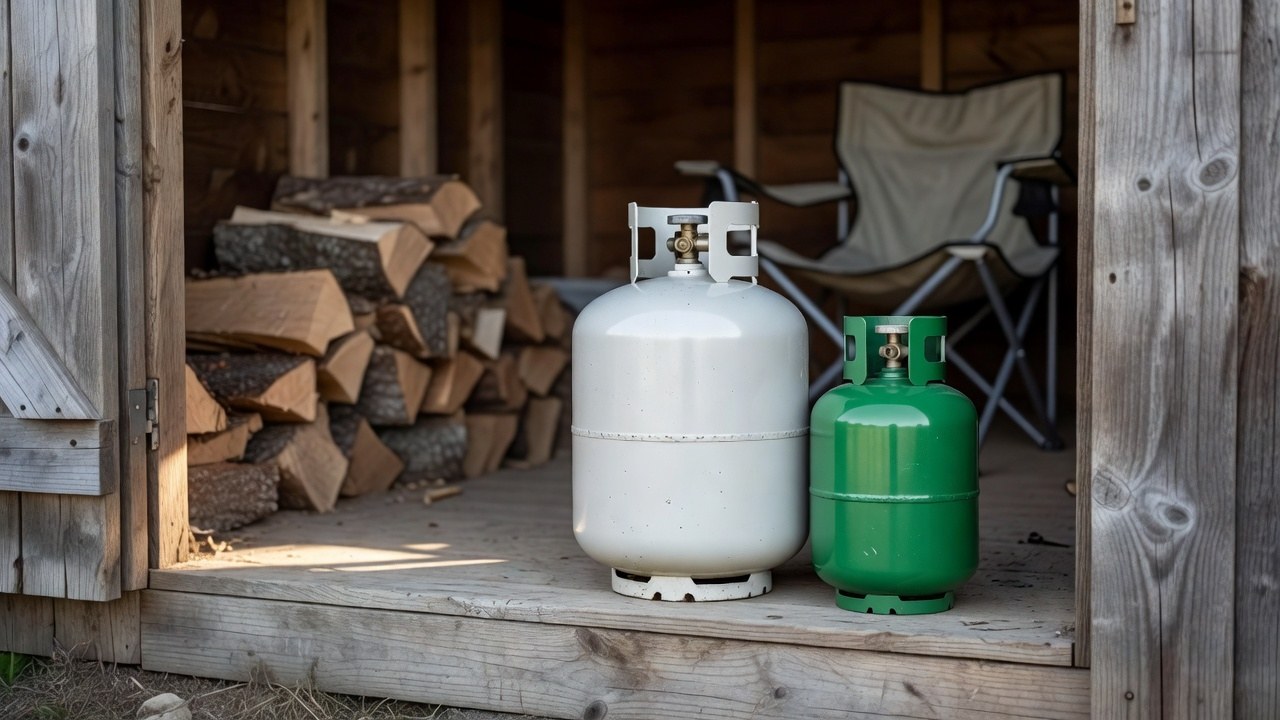
Propane Tank Storage Requirements
Most of what people call "propane going bad" is really propane being stored badly. The rules are short.
- Keep it upright, always. Lying a cylinder down can let liquid propane reach the valve and regulator instead of vapor.
- Store it outside or in a well-ventilated spot. Propane is heavier than air. If it leaks, it pools low rather than drifting away, which is exactly why an enclosed basement or a sealed cabinet is the wrong home for it.
- Away from ignition sources and heat. No water heaters, no furnace closets, no grills that get used, no space directly under a window.
- Never in a hot vehicle. A closed car or truck bed in summer sun can push a cylinder past the temperatures its relief valve is designed around.
- Valve closed, cap on, threads protected. A plastic cap costs nothing and keeps grit out of the valve seat.
For propane tank storage at home, the practical version is a shed, a garage with ventilation, or a covered outdoor rack — not the trunk of the car and not the closet under the stairs. If code in your area matters to you, a propane tank storage cabinet or cage sold for the purpose is the safest answer, and propane tank storage boxes with a latching lid do the same job for a 20 lb tank and a spare.
One more note on propane tank storage temperature: cold is not a durability problem. Propane stays liquid at atmospheric pressure down to about −44 °F, so a tank on a February deck is fine as a tank. Cold only lowers the pressure, which is why an appliance can seem to underperform in a cold snap — that is a pressure story, not a fuel-quality story, and our cold-weather stove guide is the place to solve it.
Where People Actually Keep a Propane Tank
Propane tank storage outside is the default answer, and the propane tank storage ideas that hold up all share three traits: shaded, ventilated, and clear of anything that sparks. A propane tank storage rack keeps a 20 lb cylinder upright and off a damp floor, a propane tank storage cage or a lockable propane tank storage cabinet gives it a proper home, and the simplest propane tank storage box is a latching tote with the lid cracked open. What none of those should be is airtight, because a sealed box turns a slow leak into a concentration. Propane tank storage outside in a shaded corner — upright, valve closed, cap on — beats any clever indoor solution.
Does Propane Go Bad Over Winter or Like Gasoline?
These are the two comparisons people actually search, so they are worth separating.
Over winter: no. Freeze-thaw cycles are hard on water lines and on people, not on sealed propane. Bring the tank in, yes — but for convenience and rust avoidance, not because the propane is perishing.
Like gasoline: also no, and this is the cleanest way to remember it. Gasoline degrades in months because it is a complex mixture that reacts with oxygen. Propane is one compound in a sealed pressure vessel. There is nothing for it to react with, and nothing to separate out. Ethanol gasoline absorbs water from the air; propane cannot, because air is not in the tank.
Long-Term Storage: Full or Empty?
If you are parking a tank for the season, a full or mostly full cylinder is the better long-term home for it. A partially empty steel cylinder has more internal surface exposed and more air space above the liquid, and over a long enough horizon moisture and oxygen are what produce internal rust. A full cylinder has very little of either.
What you should not do is leave a tank connected to an appliance all winter. Hoses and regulators are the parts that fail — they dry out, crack, and collect spider webs and grit in the orifice. Disconnect, cap the tank, and store the hose indoors. Our camping gear maintenance guide walks through that off-season pass, and the propane hose and regulator guide covers what to replace when a hose does go brittle.
How Long Does Propane Last When You Actually Burn It?
Storage life and burn life are different questions, and mixing them up is what makes this topic feel confusing. A tank that has sat for three years does not burn out faster — but knowing the burn side is what lets you buy the right container in the first place.
- A 1 lb bottle typically gives you one to two hours of cooking on a single-burner Gas One GS-3400P or on an ultralight canister stove like the MSR PocketRocket 2.
- A 20 lb tank runs a two-burner like the Coleman Triton+ for many weekends of normal camp cooking.
- A fire pit is the fastest drain in camp — an Outland Living propane fire pit at 58,000 BTU can empty a 20 lb tank over a long evening.
- A tent heater like the Mr. Heater Buddy sits somewhere in between and is worth running on its own tank.
For the actual numbers, our how long a propane canister lasts page does the canister math, how much propane for camping sizes tanks to trips, and 1 lb vs 20 lb cost per trip settles the budget question.
Storage Mistakes That Make People Think Propane Went Bad
Almost every "my propane went bad" story is one of these five:
- The tank was fine and the regulator was not. A blocked or failing regulator mimics weak fuel. If a stove lights and then dies, suspect the regulator and hose before the tank.
- The appliance was used in the cold. Pressure drops with temperature, so the flame gets lazy. The fuel is unchanged.
- The tank was stored on its side or valve-down. Liquid reached places only vapor should go.
- The valve was left open in a damp space. Corrosion at the collar, grit in the seat, and a slow leak that empties the tank over a season.
- The tank is past its stamp. Nothing wrong with the gas — the refill counter is simply not allowed to fill it.
If a burner will not light at all, work through the stove troubleshooting guide; if you can smell gas, stop and fix it first with our propane leak safety guide. And for anything that lives inside a tent — a heater, a lantern, a stove you are tempted to run overnight — the tent heater safety guide is the one to read before the trip, not after.
Propane Storage and Shelf Life FAQ
Does propane go bad in a tank over time?
No. Propane does not oxidize, spoil, or degrade with age the way gasoline does. What degrades is the cylinder: rust, a worn valve, or a relief valve that no longer seats. Keep the cylinder dry, upright, and capped and the fuel inside will still burn normally years later.
How long does propane last in a tank unused?
Effectively indefinitely, provided the tank is sound. There is no burn-time penalty for a tank that sat for a season or three. The one clock that matters is the cylinder's 12-year requalification date, which is stamped on the collar.
Does propane expire on a 20 lb tank?
The propane does not expire. The tank's certification does. A 20 lb refillable cylinder must be requalified 12 years from its manufacture date and then on a recurring requalification cycle, typically every 5 years. Past that point, refill stations can legally turn it away even though the gas inside is fine.
Can I store a propane tank outside in the winter?
Yes, and outdoors or in a ventilated shed is the preferred place for it. Cold does not harm propane — it stays liquid down to roughly −44 °F. It only lowers the pressure, which can make an appliance seem sluggish on a freezing morning. Bring the tank in if you like, but store it upright, capped, and away from heat sources and living space.
Is it safe to store a propane tank in a garage or a car trunk?
A ventilated garage is generally acceptable; a sealed car trunk is not. Propane is heavier than air, so a leak in an enclosed space pools at floor level instead of dispersing, and a closed vehicle in summer sun can get very hot. Transport tanks upright and secured so the valve cannot be knocked, and never leave one in a hot vehicle for days.
How do I know if my propane tank is too old?
Look at the collar. It is stamped with a manufacture date, and the requalification rule counts 12 years from that date. Rust at the collar or base, dents near a weld, a sticky valve, or a valve with a damaged seat thread are all reasons to exchange the tank regardless of the date.
<!-- AFFILIATE_DISCLOSURE -->