RV Water Pump Won't Prime: 9 Fixes That Work
RV water pump won't prime, won't shut off, or won't build pressure? Work the nine causes in the order a tech checks them, plus the winterizing fix.
The first hard freeze of the year is when most RV water pumps "fail." Not because they broke — because that's the weekend you finally flip the pump switch to pull antifreeze through the lines, and instead of pink you get a sad gurgle and a pump that runs forever or not at all.
Here's the good news: an RV water pump is one of the few systems on a camper you can diagnose with your ears, a screwdriver, and ten minutes. There are no circuit boards to guess at. Almost every failure is air getting into the suction side, a valve left in the wrong position, or a $2 O-ring.
This guide works the causes in the order a mobile RV tech checks them, so you stop at the first one that's actually your problem. It also covers the two symptoms people miscategorize — a pump that won't shut off, and a camper water pump not working after winterizing — because those have different causes than "won't prime."
Quick Answer: Check These Three Things First
If your RV water pump won't prime and you only have two minutes, do this before you touch a wrench:
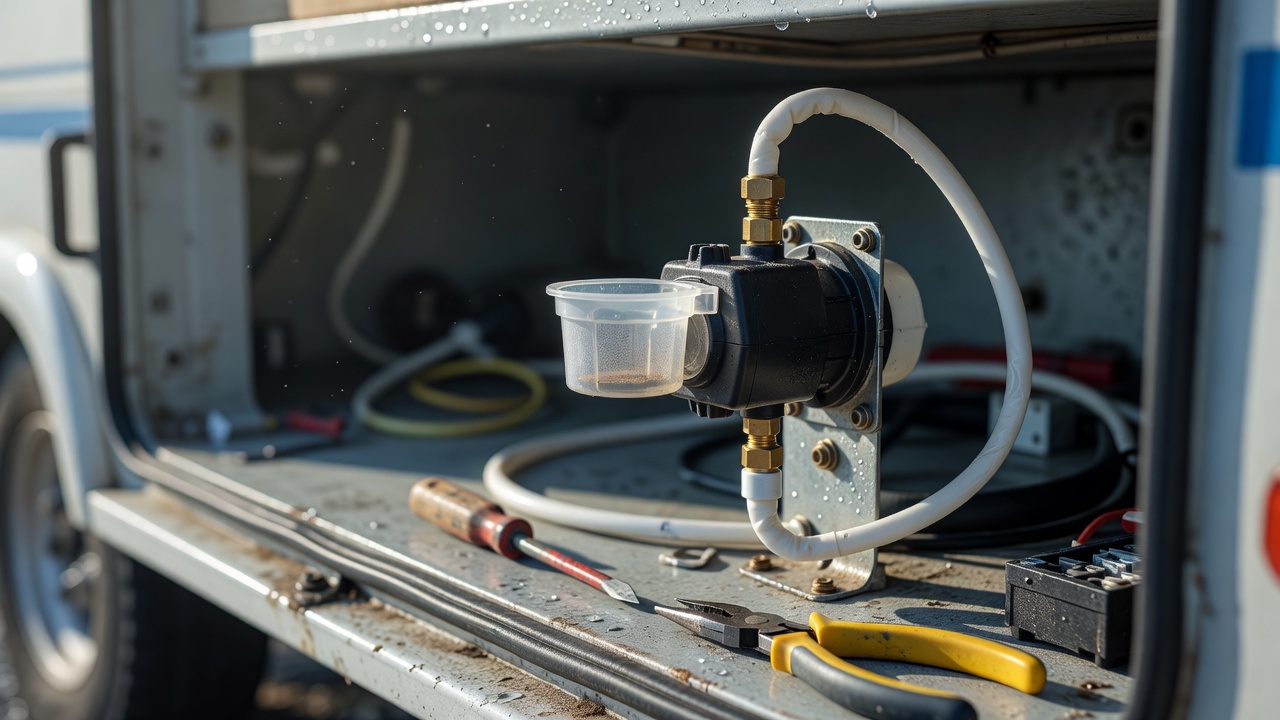
- Tighten the strainer bowl by hand. It's the clear plastic cup on the inlet side of the pump. Half a turn loose is enough to break the suction seal. This is the single most common cause, and it usually happens right after somebody cleaned it out.
- Look for a valve in the wrong position. Winterizing bypasses, tank drain valves, and antifreeze suction valves all sit between the tank and the pump. One left open means the pump is sucking air, not water.
- Confirm the tank actually has water in it. The fresh tank gauge lies. Pull the drain a second and see.
If those three are fine, keep reading — the remaining six causes are all still cheap and all still diagnosable at home.
| Symptom | Most likely cause | First move |
|---|---|---|
| Pump runs, no water at any faucet | Air leak on suction side | Hand-tighten strainer bowl, check hose clamps |
| Pump runs, water spits and surges | Air being drawn in, or low tank | Fill tank, re-check inlet fittings |
| Pump runs constantly, never shuts off | Leak on pressure side or stuck check valve | Look for drips, test city-water inlet check valve |
| Pump won't turn on at all | Fuse, switch, or ground | Check the inline fuse at the pump |
| Pump hums but doesn't pump | Low voltage | Test at the pump with a multimeter |
| Water flows but weak everywhere | Clogged aerators or strainer, or regulator | Clean strainer, remove regulator to test |
How an RV Water Pump Actually Works (30 Seconds That Save an Hour)
A camper water pump is a small 12-volt diaphragm pump. A motor pushes a rubber diaphragm back and forth; one-way valves on each side turn that motion into flow. It pulls water from the fresh tank through a hose, a strainer, and into the pump, then pushes it out to the plumbing at roughly 45 to 55 psi.
Two things matter for troubleshooting:
These pumps are self-priming, but only barely. They can lift water a few feet and clear a small air pocket. They cannot pull air indefinitely and they cannot lift water from a tank 8 feet below the pump. If the pump is dry and there's a big air gap in the suction line, it will run forever without ever catching water.
The pressure switch is what shuts the pump off. When you close a faucet, pressure builds in the line until it hits the cut-out setting, the switch opens, and the pump stops. That's why "won't shut off" almost always means the system never reached pressure — a leak, a stuck check valve, or an empty tank — and rarely means the switch itself.
Once you see the pump as three separate parts — suction side, pump body, pressure side — most symptoms point at exactly one of them.
RV Water Pump Won't Prime or Build Pressure: Nine Causes, In Order
If your RV water pump won't build pressure at the faucet, or the RV water pump won't pressurize even with a full tank, the cause is on this list. Work down it in order.
1. Air Is Getting In on the Suction Side
Air leaks don't drip water, which is why they're invisible. A loose hose clamp, a cracked barb, a split in the short section of hose between the tank and the pump, or a missing O-ring will let the pump suck air instead of water. The pump sounds normal and moves nothing.
Work backwards from the pump to the tank. Wiggle each fitting while the pump runs — if the sound changes, you found the leak. Replace any hose that has gone hard or shows a crack at the clamp. A foot of 1/2-inch reinforced hose costs less than the fuel to drive to a parts store.
2. The Strainer Bowl Is Loose, Cracked, or Clogged
Every camper water pump filter is a clear plastic bowl on the inlet with a mesh screen inside. It's there to stop tank debris from destroying the pump valves, and it's also the number one air-leak point on the whole system. The O-ring flattens over time. The bowl gets cross-threaded by someone in a hurry. The screen packs with sediment and chokes flow to a trickle.
Unscrew it, rinse the screen from the inside out, inspect the O-ring for flattening or nicks, and thread it back on by hand until snug — no pliers. If the bowl is cloudy or cracked, replace it. A spare bowl and O-ring in the spare-parts bin is cheap insurance.
3. A Bypass or Winterizing Valve Is Still in the Wrong Position
This is the autumn classic. Winterizing setups add a valve and a short suction hose that let the pump draw antifreeze out of a jug instead of water out of the tank. If that valve is still open to the antifreeze hose — or the tank valve is still closed — the pump does exactly what you asked and pulls air.
Trace the line from the tank to the pump with your hand. You're looking for any valve handle that isn't in line with the hose. Photograph the correct positions with your phone before you winterize next year; future you will not remember.
4. The Tank Is Empty, Valved Off, or the Pickup Fell Off
A camper water pump not priming on a "full" tank is often a tank that isn't full, a drain valve left open, or a pickup tube that has fallen off inside the tank. A camper water pump won't prime on a tank you believe is full when the pickup has fallen off inside, or when an RV water pump not priming after a refill is really air coming in upstream. On older trailers the pickup can also sit slightly above the low point, so the last inch of water is unusable.
Fill the tank from the gravity fill until it overflows, close every drain, and try again. If the tank is genuinely full and the pump still won't catch, you're back to a suction leak — or the pickup.
5. The Pump Is Dry and Past Its Self-Priming Limit
If the pump has been dry all summer, it may need help getting the first slug of water. Open a faucet to give the air somewhere to go, then crack the outlet fitting at the pump head for a few seconds while it runs. Once water appears, close it. On some installations you can also pour a cup of water into the suction hose before reconnecting it.
Do not let a dry pump run for minutes at a time. Thirty seconds on, thirty off is the safe rhythm while you diagnose. A diaphragm pump tolerates brief dry running; it does not tolerate ten minutes of it.
6. The Pump Sits Too High Above the Tank
A pump mounted well above the tank has to lift water, and these pumps are weak lifters. If your pump is in a cabinet two feet above the tank and the suction hose loops upward before it drops, you have given it the hardest possible job. Re-route the suction hose so it runs downhill or level to the pump, and shorten it. If the pump must sit high, that's when a priming assist or a different pump location is worth considering.
7. Low Voltage — the Pump Hums but Doesn't Pump
RV water pumps are voltage-sensitive. A pump that hums, buzzes, or turns slowly is often seeing 9 or 10 volts instead of 12 because of a corroded connection, a blown-but-still-touching fuse, a bad ground, or a battery that's low after a cold night off shore power. Test at the pump's positive and negative terminals with the pump running. Below about 11 volts, fix the electrical problem before you blame the pump.
8. Worn Diaphragm or Internal Check Valves
If the pump is 8 or 10 years old, runs quietly, and simply won't hold pressure, the internal valves may be tired. Most major pump brands sell a rebuild kit — diaphragm, valves, and screws — for a fraction of a new pump. It's a bench job with a screwdriver, and it brings a weak pump back to roughly new performance.
9. A Plugged Inlet Screen or Stuck City-Water Check Valve
Two less obvious blockages: the screen at the gravity fill or the inlet fitting can pack with debris, and the check valve at the city water inlet can stick. A stuck city-water check valve is the sneaky one — it lets water run backwards out the city water port, so the pump can never build pressure. If you see water weeping out of the city water inlet while the pump runs on tank water, that's your culprit.
RV Water Pump Won't Shut Off or Runs Constantly
If the RV water pump won't shut off, the system is telling you it never reached the cut-out pressure. There are four usual reasons, and three of them are leaks. An RV water pump won't stop running because the system never reaches cut-out pressure — that's the whole story. A camper water pump won't shut off for the same four reasons below.
A leak on the pressure side. A dripping faucet, a loose shower connection, a toilet valve, or the water heater's drain plug will keep the pump cycling forever. Dry every fitting with a paper towel, run the pump for a minute, and touch each one.
A stuck check valve. Covered above. On many trailers the check valve lives in the city water inlet, and it fails open.
An empty tank or an air pocket. The pump can't compress air to 50 psi because there's nothing to compress — it just runs. Prime the system and open a faucet to let air out.
A waterlogged accumulator tank. If your rig has a small accumulator, its internal bladder can fail, leaving it full of water. The pump then cycles on and off every few seconds. If you can shake the accumulator and hear no slosh, the bladder has failed and the tank needs replacing.
A camper water pump constantly running with no visible leak and a full tank usually means the check valve. A camper water pump not shutting off after you close a faucet usually means a drip somewhere you haven't looked yet. And an RV water pump not stopping with no visible drip at all can be a pressure switch that never opens — the one case where the pump itself is the culprit.
RV Water Pump Won't Turn On At All
No sound at all is an electrical problem, full stop. Check, in this order:
- The inline fuse holder within a foot of the pump. These corrode silently and often look fine.
- The pump switch on the monitor panel — a failed switch is common on trailers over 10 years old.
- The ground wire where it meets the frame. A rusty ground screw will kill a pump.
- Battery voltage. A camper water pump won't turn on with a deeply discharged battery even if the lights still glow.
If the RV water pump not turning on happened right after you worked on the plumbing, suspect a pulled wire at the pump connector before anything else.
Camper Water Pump Not Working After Winterizing
A camper water pump not working after winterizing is the most common October and April service call, and the cause is almost always one of four leftover winterizing steps:
- The antifreeze suction valve is still open. The pump draws air from the empty jug instead of water from the tank.
- The water heater bypass is still set to bypass. You get flow at the cold taps but nothing at the hot, or weak flow everywhere.
- The fresh tank drain is still open. Fill the tank and watch the drain.
- The strainer bowl was left loose or off to dry out. Hand-tighten it and refill the bowl.
If your RV water pump not working after winterizing and the pump sounds dry and fast, it's sucking air. If it sounds laboured and slow, it's a voltage or blockage problem. The sound tells you which half of the system to check.
RV Water Pump Won't Pull Antifreeze (the Winterizing Fix)
Here's the sequence that works, and the reason each step matters. If the RV water pump won't pull antifreeze, work down this list — don't skip to buying a new pump.
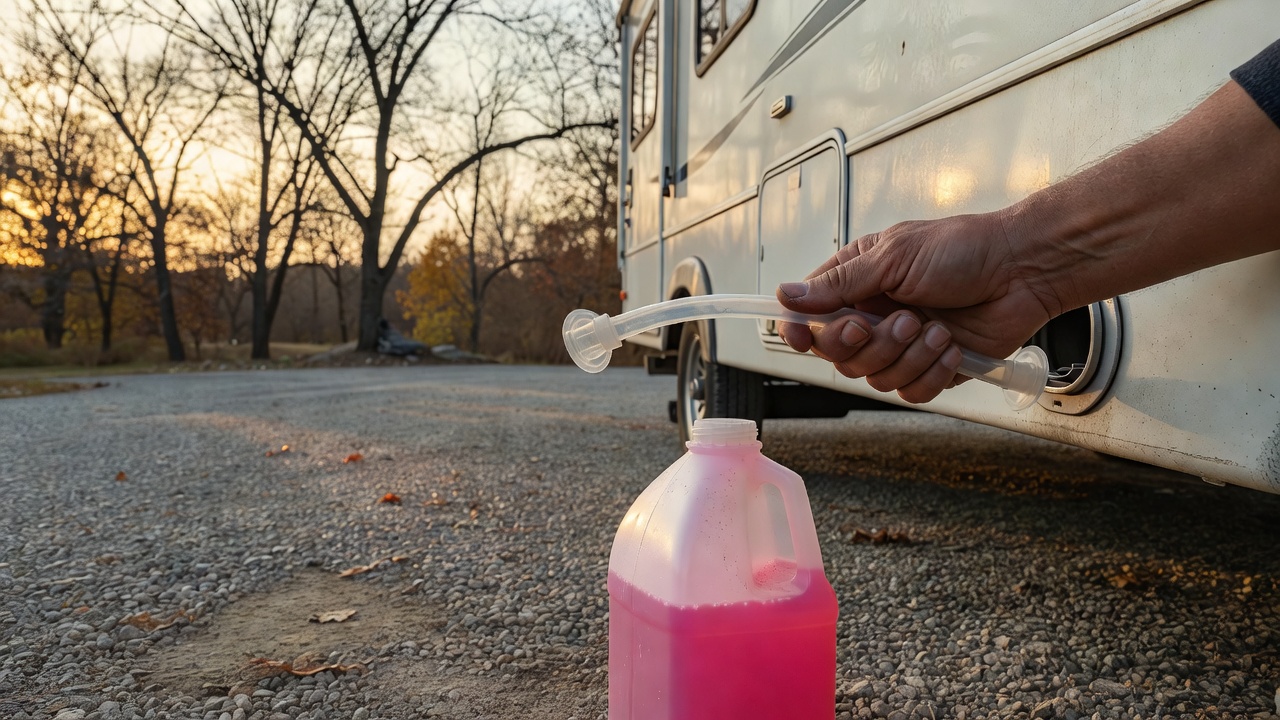
- Drain the fresh tank and the water heater. The pump can't pull antifreeze into a system full of water; it just dilutes what you pour in. Bypass the water heater before you pump anything.
- Set the winterizing valve to the suction hose position and drop the hose into the antifreeze jug.
- Open one faucet — the farthest cold tap. The pump needs somewhere to push air. A closed system won't prime no matter how good the pump is.
- Watch the jug. If the level doesn't drop within about 20 seconds, stop and check the hose connection and the strainer bowl. Air is entering between the jug and the pump.
- Run each fixture until it runs solid pink: every faucet hot and cold, the shower, the toilet, and the outdoor shower if you have one. A typical trailer takes two to three gallons.
- Pour a cup down each drain to protect the P-traps, and leave a little in the toilet bowl to keep the seal wet.
A camper water pump not priming during this process is nearly always a loose suction hose or an open bypass. One more thing worth knowing: propylene glycol RV antifreeze is designed to be diluted slightly by residual water and still protect, but a system that's half full of water won't be protected at all. If the pink comes out pale, drain and repeat.
Why Is My Camper Water Pump So Loud?
A camper water pump loud enough to wake the campground is usually not failing — it's transmitting vibration into the trailer's framing. Three fixes, in order of effort:
- Check for air in the lines. Air makes a pump hammer and chatter. Purge every faucet, including the outdoor shower.
- Mount it on soft feet. A pump screwed directly to a hard floor turns the whole cabinet into a speaker. Rubber isolation feet and a loop of flexible hose on both the inlet and outlet cut the noise dramatically.
- Add or replace an accumulator. A small accumulator absorbs the pressure spikes and lets the pump run longer and quieter.
If your RV water pump not running quietly started suddenly after years of being fine, look for a new air leak or a loose mounting screw before you replace the pump.
Camper Water Pump Check Valve and Filter Maintenance
Two parts deserve a spot in your annual routine.
The camper water pump check valve keeps water from flowing backwards through the pump when you're on city water. Test it once a year: hook up city water, then watch the fresh tank fill port. Water coming out means the check valve has failed and needs replacing.
The camper water pump filter — the strainer screen — should be rinsed at the start of every season and any time flow drops. It's also the first place to look if the RV water pump not pumping water issue appears suddenly after a trip to a lake with silty water.
While you're in there, look at the hose clamps. Stainless clamps last; the zinc-plated ones from the factory rust and lose tension in two or three seasons.
Repair or Replace? The Decision That Saves the Most Money
A camper water pump replacement runs roughly $70 to $180 for the pump plus an hour of your time. A rebuild kit is usually $25 to $45. Age and symptom decide which:
- Under 5 years old, won't prime: fix the suction side. It's not the pump.
- 5 to 10 years old, weak but working: rebuild kit. Diaphragm and valves restore most of the original performance.
- Over 10 years old, leaking from the pump body: replace. Cracks in the housing aren't worth chasing.
- Any age, dead motor with good voltage: replace.
Match the flow rating and the pressure cutoff of the old pump when you replace it, and keep the old one if you rebuild it — a rebuilt spare has saved more than one trip.
When the Pump Is Fine and the Water Still Isn't
Sometimes the pump is doing its job and the problem is downstream. If flow is weak at every fixture but the pump behaves normally, check the aerators for scale, then test without the pressure regulator in line — a failed regulator strangles the whole system. A Camco 40055 brass pressure regulator at $16.99 is the part that protects your plumbing from campground spigots, but it's also a part that can fail shut; removing it for two minutes tells you whether it's the restriction.
If the water tastes or smells off after the system sat all summer, an inline filter handles it: the Camco TastePURE inline water filter at $17.99 is the standard one-gallon-per-minute answer and threads onto any standard hose fitting. Pair it with a dedicated 25-foot drinking water hose ($13.97) that never touches the sewer side.
If the shower is the only weak fixture, the pump isn't the problem — the shower head is. The Oxygenics BodySpa handheld shower ($31.99) is the usual upgrade because it maintains pressure with less water, which also stretches your fresh tank.
And if the pump has quit entirely on a boondocking trip, a 5-gallon water carrier ($13.99) keeps the camp kitchen running, with a Sawyer Squeeze filter ($45.95) as the drinking-water backup.
Camper Water Pump FAQ
RV water pump won't prime but runs — why?
Air is entering the suction side, or the tank valve is closed. Tighten the strainer bowl, check every clamp between the tank and the pump, and confirm the tank valve is open.
RV water pump won't shut off after the faucet closes
The system isn't reaching cut-out pressure. Look for a dripping fixture, a stuck city-water check valve, or a waterlogged accumulator. A pump that never shuts off is doing its job; the pressure is escaping.
RV water pump not pressurizing even with a full tank
Test the pump's voltage first, then the internal valves. A pump seeing under 11 volts turns slowly and never builds full pressure. An old pump with tired valves does the same thing.
Camper water pump not priming after sitting all winter
The suction valve is usually still open to the antifreeze hose, or the strainer bowl was left loose. Reset both, fill the tank, and open a faucet to let the air out.
Camper water pump not pumping water but the tank is full
Check the pickup tube inside the tank and the inlet screen. A pickup that fell off pulls air from the top of the tank.
RV water pump not pulling water from the tank — where's the air coming from?
Start at the strainer bowl and work toward the tank. Every clamp, barb, and O-ring in that run is a candidate. Wiggle each fitting while the pump runs and listen for a change in pitch.
RV water pump not turning off and no leaks — what now?
Suspect the check valve at the city water inlet. If water weeps out of that port while you're running on tank water, the valve has failed.
Camper water pump not working after winterizing — is the pump ruined?
Almost never. Pumps survive winterizing; they don't survive a hard freeze with water left in the head. If the pump was bypassed and drained, it's a valve position or air problem, not a dead pump.
Can I run an RV water pump dry?
Briefly, yes — a few seconds while priming. For minutes, no. Dry running overheats the diaphragm and shortens its life.
Is a noisy camper water pump normal?
Some noise is normal; hammering and chatter are not. Purge the air, add rubber isolation feet, and consider an accumulator.
<!-- AFFILIATE_DISCLOSURE -->The Takeaway
Work the list in order: strainer bowl, valve position, tank level, suction fittings, voltage, then the pump itself. In our experience that order finds the answer inside the first four steps roughly nine times out of ten, and it costs nothing but a screwdriver and ten minutes in the driveway.
If you're still getting the system ready for cold weather, the RV winterization checklist walks the whole sequence, and the RV water system setup guide covers the city-water and tank sides from scratch. If the problem is hot water rather than cold, the RV water heater troubleshooting guide picks up where this one stops — and if the furnace is also acting up on that first cold morning, the RV furnace won't ignite guide is the companion piece.
For the full cold-weather setup, see our RV winter camping guide and the RV boondocking guide for running water off-grid. Keep a spare strainer bowl, an O-ring, and a fuse in the toolbox — those three parts cover most of this page.