RV Water Heater Not Working: Gas, Electric & DSI Fixes
RV water heater not working? Split the fault by side — bypass valve, 120V element, thermal cutoff, DSI lockout, anode rod. Fixes for Suburban and Atwood.
The shower is running and the water never gets warm. You check the propane — the stove lights fine. You flip the switch on the panel a few times, hear nothing, and start mentally pricing a new water heater.
Before you do that: an RV water heater that stopped making hot water is usually failing in one of five places, and the fastest way to find out which one is to notice which half of the heater failed. These units are two appliances bolted into one tank — a 12-volt-controlled propane burner and a 120-volt electric element — and they share almost nothing but the water inside. If one side still works, you have already eliminated half the possible causes.
This guide walks the same order a mobile tech walks it, with the tests for each step. It applies to the tank-type heaters in most travel trailers and motorhomes — Suburban SW6D and SW6DE, Atwood and Dometic GC6AA and GC10A series, and the Girard and Furrion tankless units where noted.
Quick Answer: Why Your RV Water Heater Stopped Working
Whether you searched "RV water heater not working," "camper water heater not working," or "RV water heater not working on propane," the diagnosis starts with the same question: does it work on the other side?
- No hot water at all, on gas or electric → the bypass valve is still in the winterize position, the tank is empty or air-locked, or the 12-volt control circuit is dead. This is what "RV water heater not working on gas or electric" almost always means, and after a spring de-winterization it is the bypass valve more often than anything else.
- RV water heater not working on electric but works on gas → the 120-volt side: shore power breaker, the small rocker switch behind the outside access panel on Suburban models, a burned-out element, or the relay that feeds it.
- RV water heater not working on gas but the electric side heats fine → the burner side: propane supply, air in the line after a tank swap, a mud dauber nest in the burner tube, a fouled electrode, the one-shot thermal cutoff, or the gas valve.
- DSI fault light on the panel → direct spark ignition tried three times, never lit, and locked itself out. Cycle the switch off for 30 seconds and back on; if it faults again, the gas side is the problem.
- Warm, not hot — or hot water runs out in two minutes → sediment, a partially open bypass, a failing mixing valve, or a dip tube that has broken off.
Ninety percent of no-hot-water calls get solved by the first four bullets, and none of them require pulling the heater out.
How an RV Water Heater Actually Makes Hot Water
A tank-type RV water heater holds six, ten, or twelve gallons. Two independent heat sources sit against that tank:
The gas side is a 12-volt appliance that happens to burn propane. The control board needs at least about 10.5 volts from the house battery to do anything at all — that is why a heater "dies" the same week the battery does. When the thermostat calls for heat, the board opens the gas valve, fires the electrode, and watches for flame. Newer units prove flame and shut the valve if they lose it. No flame proof, no gas.
The electric side is dumb and separate: a 120-volt AC element screwed into the tank, fed from a breaker in your distribution panel and controlled by its own thermostat, usually through a relay on the board. It does not care about your battery, your propane, or your furnace.
That split is the whole diagnostic. The gas side needs 12 volts and propane; the electric side needs 120 volts and a working element. If neither works, look for something they share — the tank, the water in it, or the bypass.
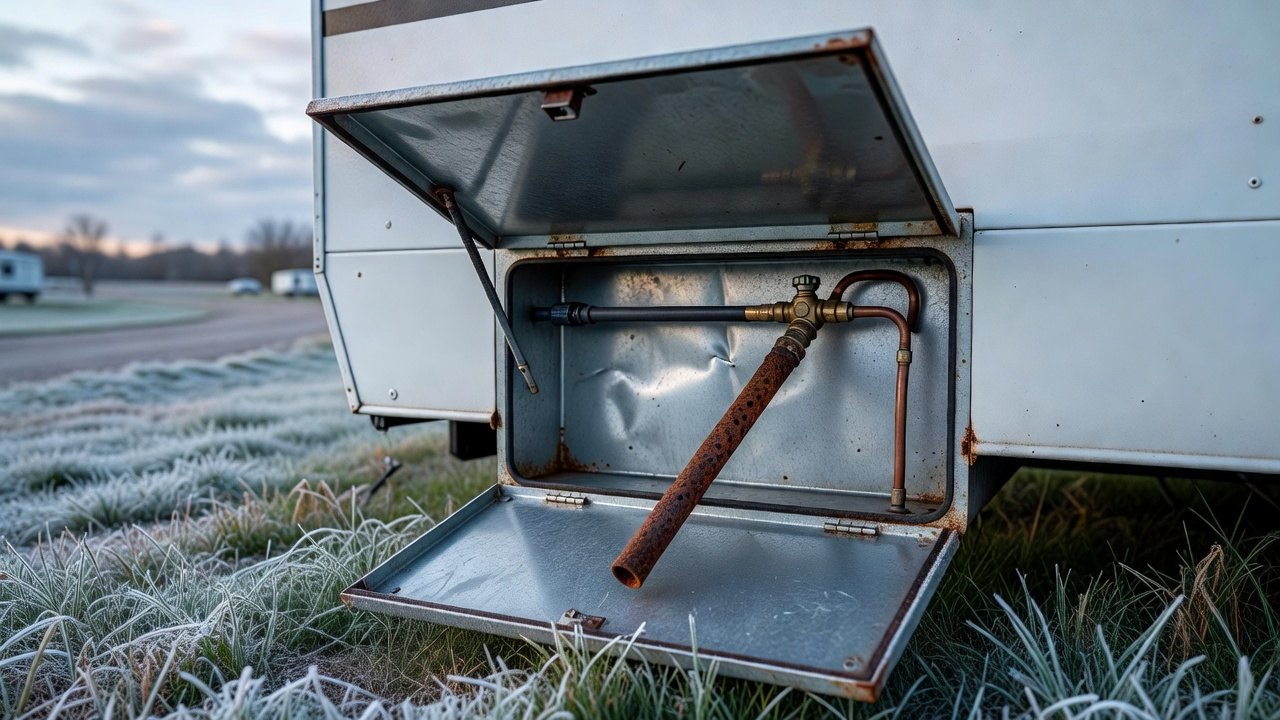
Symptom → Likely Cause → First Test
| What you are seeing | Most likely cause | First test |
|---|---|---|
| No hot water at all, both sides | Bypass valve still open, tank empty, or air-locked | Open the access panel, check valve positions, crack the T&P lever |
| Works on gas, dead on electric | 120V breaker, outside rocker switch, burned element | Check the breaker, then ohm the element |
| Works on electric, won't fire on gas | Propane supply, air in line, dirty burner tube | Light the stove, then inspect the burner tube |
| Clicks and then the DSI light comes on | Electrode gap, no gas at the burner, thermal cutoff open | Power-cycle once, then watch the electrode while someone turns it on |
| Hot water for 60 seconds, then cold | Sediment, broken dip tube, bypass partially open | Feel the tank: hot at top, cold at bottom = sediment |
| Popping or rumbling that shakes the rig | Scale on the element and tank floor | Flush the tank |
| Water on the ground near the panel | T&P relief valve, loose fitting, split tank | Dry it, run it, watch where it returns |
Fix 1 — The Bypass Valve (the #1 "Camper Water Heater Not Working" Cause)
If you winterized the rig last fall and this is your first trip out, check this before you touch a tool.
Winterizing requires two or three valves that isolate the heater tank so you can pump antifreeze through the lines without filling six gallons of tank. Those valves have to go back to the normal position in spring. Leave them in bypass and the pump pushes water straight past the heater — every faucet runs, nothing leaks, and the water never warms, because the tank has no water in it at all.
Worse: if the heater's 120-volt switch was left on while the tank was empty, the element cooked itself dry in about thirty seconds. That is a real failure, and it is not the valve's fault for hiding it.
The test: open the outside access panel. Find the bypass valve or valves at the back of the heater — usually one valve between the cold in and hot out, or a three-valve setup. On most trailers the camper water heater bypass valve is a single quarter-turn valve on the cold inlet; on older rigs it is a pair with a third valve between them, and that middle one is the one people leave half-open. Confirm they are in the normal-flow position. Then, with the pump on, open a hot tap and let it run. If it keeps sputtering air, the tank never filled.
One more thing worth knowing: a proper tank-type heater wants a small air pocket at the top of the tank for expansion. On a Suburban, that pocket is restored by the way the inlet tube is built, and you should not "fix" a sputtering hot tap by drilling anything. Vent it, refill, and let the pocket re-form.
If your winterizing kit is the old hand-pump style, the whole mistake is easy to make twice. A permanent three-way valve setup exists so that turning one handle isolates the tank and you cannot leave it half-open.
If your rig has no bypass at all, that is why the antifreeze went into the heater. The 3-way converter winterizing kit is the retrofit most people do in ten minutes, and the hand pump kit is the no-plumbing version. Full valve-by-valve walkthrough: RV winterization checklist.
Fix 2 — RV Water Heater Not Working on Electric
The electric side is the easiest one to diagnose with a multimeter and the one people skip because it is "just a switch."
Work down this list:
- Shore power breaker. Find the breaker labeled WATER HEATER in the distribution panel. Trip it off and back on — a tripped breaker that looks on is a classic. If it trips again immediately, stop and go to the element.
- The outside rocker switch. Suburban units have a small black switch inside the exterior access panel, separate from the wall panel switch, and it is the most commonly forgotten "off" in the whole system. Many owners turn it off for the season and forget.
- The wall switch and the relay. If both switches are on and the element never gets warm, the control board relay may not be closing. Listen for a click when you flip the panel switch.
- The element itself. Kill the 120-volt breaker first — this is mains power, not 12 volts. Disconnect the two element wires and measure resistance across the element terminals. A healthy 1,400-watt 120-volt element reads roughly 9 to 11 ohms. A reading of infinite resistance is a burned-out element; a reading near zero is a shorted one. Either way it is a screw-in part: on almost every brand the camper water heater element threads into the tank behind one large nut, so replacement is a socket, a wrench, and a new gasket rather than a tank-out job.
- The thermostat and high-limit on the electric side. Some units use a separate electric thermostat with its own reset button. If the tank over-heated once, that button is out and the element never gets power.
Water pressure connects to this more than people expect: a park pedestal pushing 90 PSI will make the temperature-and-pressure relief valve weep, and repeated weeping looks like a heater failure. A brass pressure regulator at the pedestal is cheap insurance for the whole plumbing system, not just the heater.
Fix 3 — RV Water Heater Not Working on Gas
Gas-side failures follow a fixed order, and the first test costs nothing: light a stove burner. If the stove is lazy or won't stay lit, the problem is upstream — empty tank, closed valve, or a regulator that has frozen or failed — and the water heater is innocent.
If the stove burns clean and strong, work the burner assembly:
- Air in the line. After a tank swap or a long sit, the line is full of air and the heater gets three ignition attempts to push it out. Cycle the switch three or four times before you take anything apart.
- The burner tube. Mud daubers, spiders, and stink bugs love a warm, dry, sheltered tube with a propane smell. A nest two inches inside the tube blocks ignition completely and is invisible until you take the burner assembly out. This is the single most common spring no-fire cause in the South and Midwest.
- The electrode. It should be clean, unbent, and gapped to roughly an eighth of an inch from the burner, sparking across the gas path rather than into the metal. A cracked ceramic insulator lets the spark ground out on the housing instead.
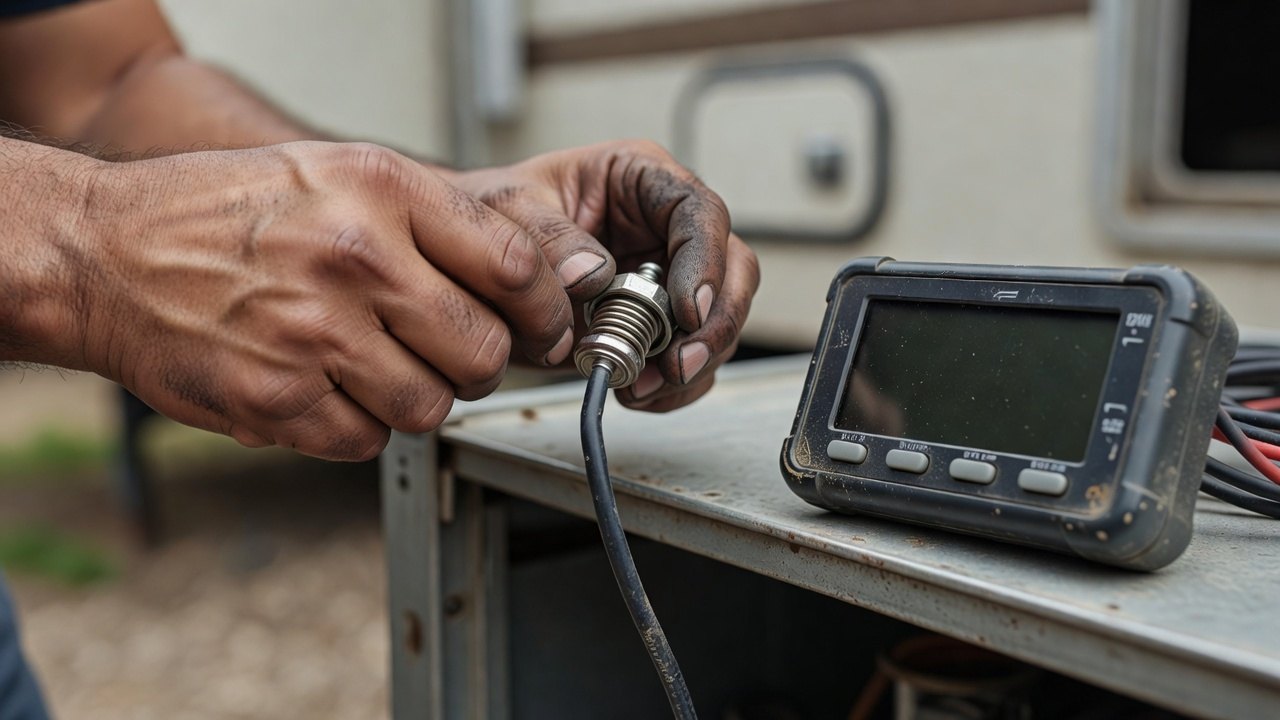
- The thermal cutoff. Many Atwood and Dometic units have a one-shot thermal fuse on the burner tube that opens permanently if the tube gets too hot or flame rolls out. It cannot be reset. Test it for continuity; if it is open, replace it — and then find out why it opened, because a blocked flue will open the new one too.
- The gas valve and the board. If you have spark, clean gas, and an open cutoff, and it still won't light, the valve is not opening. That is a board or valve diagnosis, and it is where most DIY work ends.
Propane that smells anywhere near the heater compartment is a stop-everything situation. Shut the tank valve, ventilate, and find it with a combustible gas sniffer rather than a flame. If the rig is winter-tight and the heater has been running, a battery CO detector belongs in the cabin regardless of what the heater is doing.
Fix 4 — Camper Water Heater DSI Fault
DSI means direct spark ignition, and the fault light is the board telling you it tried and gave up.
The sequence: thermostat calls for heat → board opens the gas valve → electrode sparks → board looks for flame → no flame after about three attempts over roughly ten seconds → board closes the valve and lights the fault. On most units it stays locked out until the switch is cycled off and back on.
So a DSI fault is not a mysterious new failure — it is the gas-side list from Fix 3, compressed into one light. Power-cycle once. If it faults a second time in the same conditions, go straight to the burner tube and the electrode, and check the thermal cutoff for continuity.
Two conditions produce a false DSI fault worth knowing: a propane tank that is nearly empty (liquid draw drops, pressure falls, flame fails to prove) and a very cold morning, where a 20-pound tank in the twenties can't vaporize fast enough for a 10-gallon heater. If it faults only on the coldest mornings, the heater is telling you about the tank, not itself. How long a tank actually lasts under that load: how long a 20 lb propane tank lasts.
Fix 5 — Sediment, Anode Rod, and "Only Warm" Water
If the heater works but the hot water runs out fast, or the tank pops and rumbles while heating, the problem is inside.
Sediment settles on the tank floor and buries the element and the burner contact area. Water boils under the scale, the popping is steam escaping, and the usable hot water drops because the tank is effectively smaller. Flush it: kill power and gas, pull the drain plug or anode, and run water through until it comes clear. In hard-water country, once a year.
The anode rod is a Suburban rule, not a universal one. Suburban tanks are steel with a glass lining, and the anode rod sacrifices itself to protect the lining — when it is eaten down to the core wire, the tank is next. Atwood and Dometic tanks are aluminum and take no anode rod; the drain plug fills that hole. Putting an anode in an Atwood is a common and harmless mistake, but skipping one in a Suburban is how tanks get pinholes at year six. "Camper water heater anode rod" is a search that ends with a $15 part and a tank that lasts another five years.
A broken dip tube delivers cold water at the top of the tank, so you get a few seconds of hot and then a long lukewarm dribble. It is a tank-out repair on most units.
A partially open bypass behaves exactly like a failing heater: hot and cold mix at the valve and every tap runs warm. Re-check Fix 1 before ordering parts.
If the shower is the complaint rather than the tank — weak flow, not weak heat — that is a separate fix, and an RV handheld showerhead plus a clean inline filter and hose solves most of it.
Suburban vs Atwood vs Dometic: Where to Look
- Suburban (SW6D, SW6DE, SW10DE) — steel tank with a glass lining, anode rod required, outside rocker switch for the electric element, separate electric and gas thermostats. The anode is the first thing to check on an older unit.
- Atwood / Dometic (GC6AA-10E, GC10A-4E) — aluminum tank, no anode, drain plug only. On these units the camper water heater plug is both the drain and the flush port, so it is the part you remove to rinse sediment — and it needs a fresh wrap of thread tape each time. These use a one-shot thermal cutoff on the burner tube and a combined control module; the cutoff is the part that fails silently.
- Tankless (Girard, Furrion, Truma) — no tank to bypass and no anode. Most "not working" calls are flow-switch related: too little water flow to trigger the burner, or a scale-clogged heat exchanger. Winterizing a tankless means a full bypass and a drain, and freeze damage is fatal to the exchanger.
If your rig is one of the big motorhome brands, the same three series show up under different labels — the panel and part layout is what changes, not the physics.
Running the Heater in Cold Weather Without Breaking It
A water heater that works fine in July can look broken in January for reasons that have nothing to do with the heater:
- A 20-pound tank at 20°F cannot keep up with a 10-gallon heater plus a furnace. Cold propane vaporizes slowly. Swap to a full tank, or keep a spare, and expect a fault light on the coldest mornings if the tank is below half.
- A frozen supply hose cuts flow to nothing, and low flow plus a hot element is how elements die. Heated hoses exist for exactly this — the Camco 25-foot heated hose and the Wufoty 25-foot heated hose both protect to well below freezing, and either one is cheaper than a split line.
- Never run the electric element on an empty tank. If you winterized, the breaker and the outside switch both come off, and they stay off until water is in the tank.
- Keep the tank full when camping in freezing weather rather than drained — a full tank of water is far more thermally stable than an empty one, and the burner cycling keeps the compartment above pipe-freezing temperatures.
The wider cold-weather picture, from water lines to batteries, is in the RV winter camping guide. And if your heat is the thing that failed rather than your hot water, that is a different appliance with a different checklist: RV furnace won't ignite.

Safety: Three Things You Should Not Do
- Do not poke around the electric element with the breaker on. 120 volts at a campground pedestal is not a hobby voltage. Breaker off, then meter it to confirm.
- Do not test for a propane leak with a flame, ever. Soapy water or a gas sniffer. If you smell gas inside the rig, get out, shut the tank off from outside, and ventilate before anything else.
- Do not ignore exhaust smell or a headache. A blocked flue or a cracked heat exchanger puts combustion gas into the living space. That is a CO event, not a maintenance item.
A multi-tool earns its place here — the access panel screws, the burner bracket, and the anode nut are three different fasteners in one 18-inch square. The Leatherman Rev covers the panel work; the anode nut wants a real socket.
When to Stop and Call a Tech
Stop diagnosing and book service if:
- the tank itself is leaking from the shell, not a fitting — a split tank is a replacement, and no sealant fixes it;
- you have 120 volts at the element terminals and a good element, and it still won't heat (board or wiring fault behind the panel);
- the gas valve does not open with spark and clean gas present;
- the flame burns yellow and lazy instead of blue — that is an air-mix or orifice problem with a CO risk attached;
- you've had water in the compartment and the board is corroded.
Everything above that line is a Saturday afternoon. Below it, a mobile RV tech charges a service call and saves you a tank.
RV Water Heater Not Working FAQ
Why is my camper water heater not working after winterizing?
The bypass valves are almost certainly still open, so the tank never filled. Water runs at every tap, nothing leaks, and the water stays cold because it never enters the heater. Close the bypass, open a hot tap to let the tank fill and purge air, then turn the electric switch back on — never before.
My RV water heater works on gas but not on electric. What's first?
The 120-volt breaker, then the small rocker switch inside the outside access panel on Suburban units. If both are on, ohm the element: about 9 to 11 ohms is healthy, infinite is burned out. The element is a screw-in part and does not require removing the heater.
My RV water heater is not working on gas but the electric side is fine. Why?
The burner side. Check propane at the stove first, cycle the switch to clear air from the line, then inspect the burner tube for an insect nest and the electrode for gap and a cracked insulator. On Atwood and Dometic units, test the one-shot thermal cutoff for continuity — it opens permanently and cannot be reset.
What does the DSI fault light mean on a camper water heater?
Direct spark ignition failed to prove flame after about three attempts, so the board locked out the gas valve. Cycle the switch off for thirty seconds and back on. A repeat fault means no gas at the burner, a fouled electrode, or an open thermal cutoff — not a failed board.
Why does my RV hot water heater not work on electric but work on gas in cold weather?
Cold weather hits the gas side, not the electric side, so the reverse usually points at the pedestal: a 30-amp shore connection shared with a space heater, a tripped breaker, or a GFCI upstream of the outlet. Test the element with a meter before replacing anything.
Does my camper water heater need an anode rod?
Suburban: yes, always — steel tank, glass lining, and the anode is what keeps the lining alive. Atwood and Dometic: no — aluminum tank, drain plug only. A consumed anode in a Suburban is the difference between replacing a $15 rod and a $600 tank.
How do I know if the water heater element is bad?
With the 120-volt breaker off and both wires removed, measure resistance across the element terminals. Roughly 9 to 11 ohms on a 1,400-watt element is good. Infinite resistance means the element burned out — commonly from being switched on with an empty tank.
Why is my Suburban RV water heater not working on electric when the gas side is fine?
Suburban units run two separate control paths, and the electric one has parts the gas path never touches: the 120-volt breaker, the small rocker switch inside the outside access panel, a dedicated electric thermostat with its own high-limit reset, and the relay on the board. Check the rocker switch first — it is the switch owners turn off for the season and forget in spring — then the breaker, then ohm the element. A Suburban that heats on gas and not on electric is almost never the tank.
RV hot water heater not working on electric — what do I check first?
Shore power, in this order: the pedestal breaker, the 30-amp cord and its twist-lock ends, the WATER HEATER breaker in the distribution panel, then the panel switch. Most "hot water heater not working on electric" calls are power that never arrived, not a failed element. If the panel has 120 volts and the element reads 9 to 11 ohms, the heater is fine and the switch or relay is not.
Camper water heater not working on electric after a storm or a move?
Suspect the pedestal before the heater. A campground outlet with reversed polarity or an open ground will leave some appliances working and others dead, and a rig plugged into a marginal 30-amp circuit shared with a space heater will brown out exactly when the element kicks on. A 30-amp circuit analyzer at the pedestal tells you in seconds whether the outlet is wired correctly, which is worth knowing before you spend an afternoon on the heater.
The Bottom Line
An RV water heater that stops making hot water is nearly always a one-component failure, and the trick is to stop treating it as one appliance. Ask which half still works. Both dead means bypass, water, or 12-volt control. Dead on electric means breaker, outside switch, element. Dead on gas means propane, burner tube, electrode, thermal cutoff. A DSI light is just the gas list with a warning label.
Fix the cheapest thing that matches the symptom first — a valve position costs nothing and is wrong more often than any part on this page.
<!-- AFFILIATE_DISCLOSURE -->