E-Bike Hitch Rack Guide 2026: Weight Limits, Hitch Classes, and Racks That Actually Fit
E-bikes weigh 40-70 lb, so most hitch racks cannot carry one. Per-bike ratings, hitch classes, and the racks that actually fit an e-bike.
Short answer: yes, an e-bike can ride on a hitch rack — but only on a rack whose per-bike weight rating clears your bike, and most hitch racks do not. A regular bike weighs 20–30 lb. An e-bike weighs 40–70 lb, and fat-tire or cargo e-bikes run past 80 lb. The cheap two-bike hanging rack in your garage is rated for around 35 lb per bike, which means a 55 lb e-bike on it is not a "slightly overloaded" situation — it is a snapped arm, a bike on the interstate, and a very bad day.
This guide is the e-bike-specific companion to our hitch bike rack buying guide. It covers the three numbers that decide compatibility, how hitch class and receiver size actually limit you, what fenders and step-through frames do to rack choice, and which of the racks we track are genuinely e-bike-capable versus which ones only look like it.
Quick Answer: Can You Put an E-Bike on a Hitch Rack?
Yes, if three things are true:
- The rack's per-bike rating is at or above your heaviest bike's real weight (battery in, as you'll ride it).
- The rack's total capacity clears both bikes together — including the rack itself, which weighs 30–50 lb on platform models.
- Your receiver and vehicle can take the total tongue load, which is a bigger number than people expect once two e-bikes are on board.
If any one of those fails, the correct move is a different rack, not a creative workaround. There is no strap, bungee, or "it's only ten minutes down the road" that fixes a rack rated 35 lb per bike carrying a 58 lb e-bike.
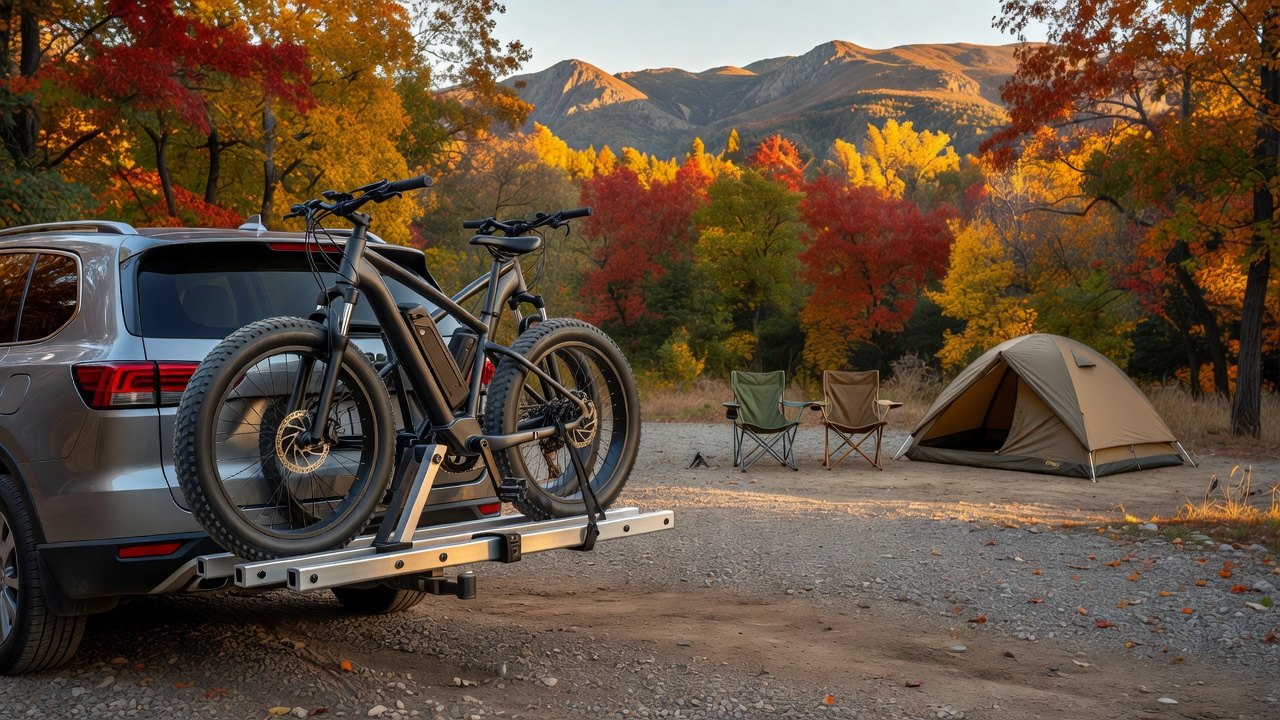
Why Ordinary Bike Racks Fail With E-Bikes
The weight gap is the entire story. Here is what the numbers look like in practice:
| Bike | Typical weight | Rack that carries it |
|---|---|---|
| Kids' bike | 15–22 lb | Any rack |
| Adult road / hybrid bike | 20–28 lb | Any rack |
| Mountain bike | 28–35 lb | Most racks |
| Commuter e-bike | 45–55 lb | Tray rack rated 60 lb+ per bike |
| Step-through e-bike | 50–60 lb | Tray rack, wheel-contact only |
| Cargo e-bike | 60–80 lb | Heavy-duty tray rack, 70 lb+ per bike |
| Fat-tire e-bike | 65–85 lb | Heavy-duty tray rack, wide trays required |
Two things make this worse than the table suggests.
The battery is 6–10 lb of it, and it usually is not removable on the side of a highway. Removing the battery is the single best weight-reduction trick (more below), but plenty of e-bikes have integrated batteries you can only pull with a key, and some owners never take them off at all. Plan for the loaded weight, not the optimistic one.
Hanging racks are the wrong shape for e-bikes, not just the wrong rating. A hanging rack carries a bike by its top tube. Step-through e-bikes — which is most of the comfort and cruiser e-bike market — have no top tube to hang from, and the adapters people buy to bridge that gap put the entire load through one point on a frame that was never designed for it. This is why the e-bike category has effectively converged on platform (tray) racks that hold each wheel.
How to Read a Rack Spec Sheet (Per-Bike, Total, and Tongue Load)
Every rack spec sheet has these, and they are the whole decision:
1. Per-bike weight rating. Usually listed as "40 lb per bike" or "75 lb per bike." This is the number that gets violated. Compare it against your heaviest bike, not the average of your two.
2. Total capacity. "2 bikes, 140 lb total" is a different constraint from per-bike. A rack can be rated 75 lb per bike but 140 lb total, which means two 75 lb bikes is not allowed even though each one individually is.
3. Rack weight plus payload. A platform rack weighs 30–50 lb. Two 55 lb e-bikes plus a 45 lb rack is 155 lb of tongue load hanging off the back of your vehicle. That has to be inside your receiver's rating, and it also affects how the vehicle handles.
Hitch Class and Receiver Size, Decoded
The receiver on your vehicle has a class, and the class sets the tongue-weight ceiling:
- Class I — 1.25" receiver, roughly 200 lb tongue weight. Enough for a light hanging rack and two ordinary bikes. Not enough for a platform rack plus two e-bikes.
- Class II — 1.25" receiver, roughly 350 lb tongue weight. Workable for a heavier rack, but 1.25" hitches also wobble more under a long lever arm, which is exactly what a 50 lb bike on a tray creates.
- Class III — 2" receiver, roughly 350–600 lb tongue weight depending on the vehicle. This is the configuration that makes e-bike hauling straightforward.
Two practical consequences. First, if you drive a sedan or small crossover with a 1.25" receiver, the honest answer is that a two-e-bike setup is close to the edge, and a single-e-bike rack or a lighter single bike is the sane plan. Second, verify the tongue rating in your vehicle's manual — it is on the door-jamb sticker or in the towing section, and it is often lower than people assume for unibody crossovers.
What Actually Fits an E-Bike: Frame, Fenders, and Fat Tires
Weight is the headline, but fit is what generates the returns and the one-star reviews.
Fenders. Bikes with full fenders are the classic rack-fit failure. Front fenders collide with the wheel tray on many tray racks, and rear fenders with lights or a battery rack hit the ratcheting arm. Wheel-only clamping designs handle fendered bikes far more gracefully than frame-clamping designs, because nothing has to reach across the frame.
Step-through and low-step frames. No top tube means hanging racks need an adapter, and adapters are a weak point. Wheel-tray racks do not care about frame shape at all.
Fat tires. A 4" to 5" tire does not sit in a tray built for a 2.3" tire, and the ratchet strap will not close. Fat-tire e-bikes need trays with wide, adjustable cradles.
Ramps. Once an e-bike is 55 lb, lifting it to chest height on the back of an SUV is a two-person job. A ramp accessory (or a rack with a low loading position) is the difference between loading alone and waiting for a helper. This is one of the most-searched e-bike rack topics for a reason.
The Racks: Budget to Flagship
Here are the four hitch racks we track for families, ordered by what they can genuinely carry.
Thule Epos 2 — the e-bike answer
The Thule Epos 2 is the only rack in this group with a per-bike rating that comfortably clears real e-bikes: 60 lb per bike and 132 lb total on the model we track, with some current trims listed as high as 75 lb per bike — check Thule's spec sheet for your exact model year. Either figure covers a step-through commuter e-bike, a fat-tire e-bike, or a loaded mountain e-bike without drama. The design choice that matters most is that it never touches the frame. Telescoping wheel trays clamp the wheels only, so carbon frames, fenders, and odd geometry are all non-issues, and the tool-free tilt gets you into the trunk with both bikes still loaded. It is $749.95, which is real money — but it is the difference between hauling e-bikes and not hauling e-bikes.
Kuat Sherpa 2.0 — excellent rack, not an e-bike rack
The Kuat Sherpa 2.0 is a beautifully made all-aluminum platform rack at $449 — light enough (35 lb) to hang on the wall, with foot-assisted pivot and an integrated cable lock. Its rating is 40 lb per bike, which covers mountain, gravel, and road bikes and just about anyone under 40 lb. Put a 52 lb commuter e-bike on it and you are over spec. Worth knowing as the guardrail: an expensive rack is not automatically an e-bike rack.
Yakima RidgeBack 2 — great for non e-bikes, wrong tool here
The Yakima RidgeBack 2 at $279 is the practical answer for a family carrying two ordinary bikes: it fits both 1.25" and 2" receivers out of the box, ships assembled, tilts away with the UpperHand lever for hatch access, and holds bikes with padded arms and ZipStrips. It carries bikes by the frame, though, so it is the wrong tool for e-bikes — and positively unusable for a step-through without an adapter.
Allen Sports 522RR — the budget baseline
The Allen Sports 522RR at $114 is the rack most families start with, and for two regular bikes it is genuinely good value: tool-free install, fits both receiver sizes, and 4.5 stars across thousands of reviews. Its capacity is 70 lb total / 35 lb per bike. That is a regular-bike rack, full stop. It is in this guide as the honest "do not do this" example — a 55 lb e-bike on a 522RR is double-rated abuse.
Loading an E-Bike Without Hurting Your Back or Your Bike
- Pull the battery first if your bike allows it. Removing 6–10 lb from the top of the load is the easiest win available, and it also means the expensive part of the bike is inside the car instead of on the rack at a trailhead.
- Lift by the frame, not the rear wheel. Wheel-motor e-bikes have a lot of mass in the hub; grabbing the wheel rotates the bike and puts a torque load into the dropouts.
- Load the heaviest bike first and closest to the vehicle. On a two-tray rack, the inner position has a shorter lever arm and less bounce.
- Two straps per bike on a hanging rack, and check them at every stop. E-bikes bounce harder than light bikes and settle straps faster.
- Re-check the rack's hitch bolt after the first 20 minutes. Platform racks break in under load, and new racks wobble on the first trip in a way they will not on the second.
- Roll the whole thing back a notch before a long drive. A slight inward tilt on a tray rack reduces the rear overhang and the sway.
Extras That Make a Family Bike Day Work
Once the rack is sorted, the small stuff is what determines whether a Saturday actually happens. A Giro Scamp MIPS II kids' helmet ($52.80) covers the rider most likely to grow out of gear mid-season, and MIPS is worth the small premium for a child on a trail with roots. A Topeak Mini Morph pump ($29.93) with a foot pad lives in the car and handles both your e-bike's low-pressure fat tire and a kid's bike in the same afternoon — pumping 30 psi into a 4" tire with a frame pump is a lost cause, and the hose-and-footpad design solves it. For night rides back to the campground, the Cygolite Hotrod 110/50 light combo ($36.95) is USB-rechargeable and clips on without tools.
If you are heading somewhere with the bikes in tow, our bike camping gear essentials covers what to pack once you arrive, and the RV vs tent camping comparison is worth reading if the e-bikes are the reason you are thinking about a different vehicle.
E-Bike Rack FAQ
Can you put an e-bike on a regular bike rack?
Not safely, in most cases. "Regular" racks are rated around 35–40 lb per bike, and an e-bike is 40–70 lb before you add a lock, a bottle, or a pannier. The exception is a heavy-duty platform rack rated 60–75 lb per bike, which is not a regular rack even though it looks similar.
How much does an e-bike weigh?
Most e-bikes land between 40 and 70 lb, with the typical bike around 50–55 lb. Lightweight commuters can dip into the high 30s; fat-tire and full-suspension models can exceed 80 lb. A regular adult bike is 20–30 lb, so budget roughly double the weight of whatever bike you used to own.
Do I need a 2-inch hitch for an e-bike rack?
Practically, yes for a two-e-bike setup. A 2" (Class III) receiver typically takes 350–600 lb of tongue weight, which comfortably covers a 45 lb platform rack plus two 55 lb bikes. A 1.25" (Class I) receiver is usually around 200 lb and is over its limit in that scenario. Single-e-bike setups on a 1.25" receiver can work within the ratings.
Can I put an e-bike on a hanging rack with a top-tube adapter?
You can, but it is the weakest option. Adapters concentrate the whole load at one point on a frame that is often a step-through design, and hanging racks are usually rated lower per bike than tray racks. If the e-bike has a real top tube and the rack's per-bike rating clears it, it is technically within spec — but a tray rack is the design that suits the weight.
How do I carry an e-bike with fenders?
Choose a wheel-contact rack. Trays or cradles that clamp the tires leave the frame and fenders completely alone, so full fenders with lights and a rear rack cause no interference. Frame-clamping racks are where fenders turn into a fit problem.
Is it worth taking the battery off before a long drive?
Yes. The battery is 6–10 lb at the highest point of the load, it is the most valuable and most theft-prone component on the bike, and on most e-bikes it comes off with a key in under ten seconds. Just confirm your bike's manual allows transport with the battery removed and that the empty bay is sealed against rain.
The Bottom Line
Match the rack to the weight, and e-bike hauling is boring — which is exactly what you want on a highway. The rule of thumb: if the rack's per-bike rating does not have 10 lb of headroom over your heaviest bike, do not use it. Buy for the heaviest bike you will ever own, not the one you have today, because the 45 lb commuter e-bike tends to become a 60 lb one eventually. Start with our hitch bike rack buying guide if you are still deciding between rack types, and the Kuat vs Thule vs Yakima comparison if you are choosing between the three brands in this price band.
<!-- AFFILIATE_DISCLOSURE -->As an Amazon Associate, TrailMapz earns from qualifying purchases. Prices and ratings reflect the catalog at the time of writing.