Camping in Bear Country: Complete Safety Guide & Essential Gear for 2026
Everything you need to know about camping safely in bear country — bear spray, food storage, campsite setup, and what to do if you encounter a bear. Updated for 2026.
Camping in Bear Country: Complete Safety Guide & Essential Gear for 2026
There's a moment every backcountry camper knows — the first time you hear a branch snap in the dark and realize you're not alone out here. I've camped in grizzly territory in Montana, black bear country in the Smokies, and brown bear habitat in Alaska. The bears were never the problem. My own preparedness — or lack of it — was.
This guide covers everything you need to know about camping safely in bear country: the essential gear to carry, how to set up a bear-safe campsite, how to store food (and what "bear-proof" actually means), and what to do if you encounter a bear on the trail or at camp. No fear-mongering — just practical, tested advice from someone who's been doing this for two decades.
First, Understand the Bears You're Dealing With
North America has three bear species, and your response to an encounter depends entirely on which one you're facing:
- Black bears (most common): Found across the US and Canada. Typically 150-400 lbs. They're usually timid and will run if you make noise. If attacked by a black bear, fight back — don't play dead. Aim for the face and muzzle.
- Grizzly/brown bears (Alaska, Montana, Wyoming, Idaho, western Canada): 300-800 lbs with a distinctive shoulder hump. More aggressive than black bears, especially sows with cubs. If a grizzly attacks defensively, play dead — lie flat on your stomach, hands clasped behind your neck, legs spread to prevent being flipped. If the attack is predatory (stalking you), fight back.
- Polar bears (Alaska Arctic): If a polar bear is interested in you, you're in serious trouble. This guide doesn't cover polar bear country — that's a whole different level of preparation.
How to tell them apart: A grizzly has a pronounced shoulder hump, a dish-shaped face profile, and long (3-4 inch) claws. A black bear has no hump, a straight face profile, and shorter claws. But don't rely on color — black bears can be brown, cinnamon, or even blonde. The hump is the most reliable field marker.
Essential Bear Country Gear Checklist
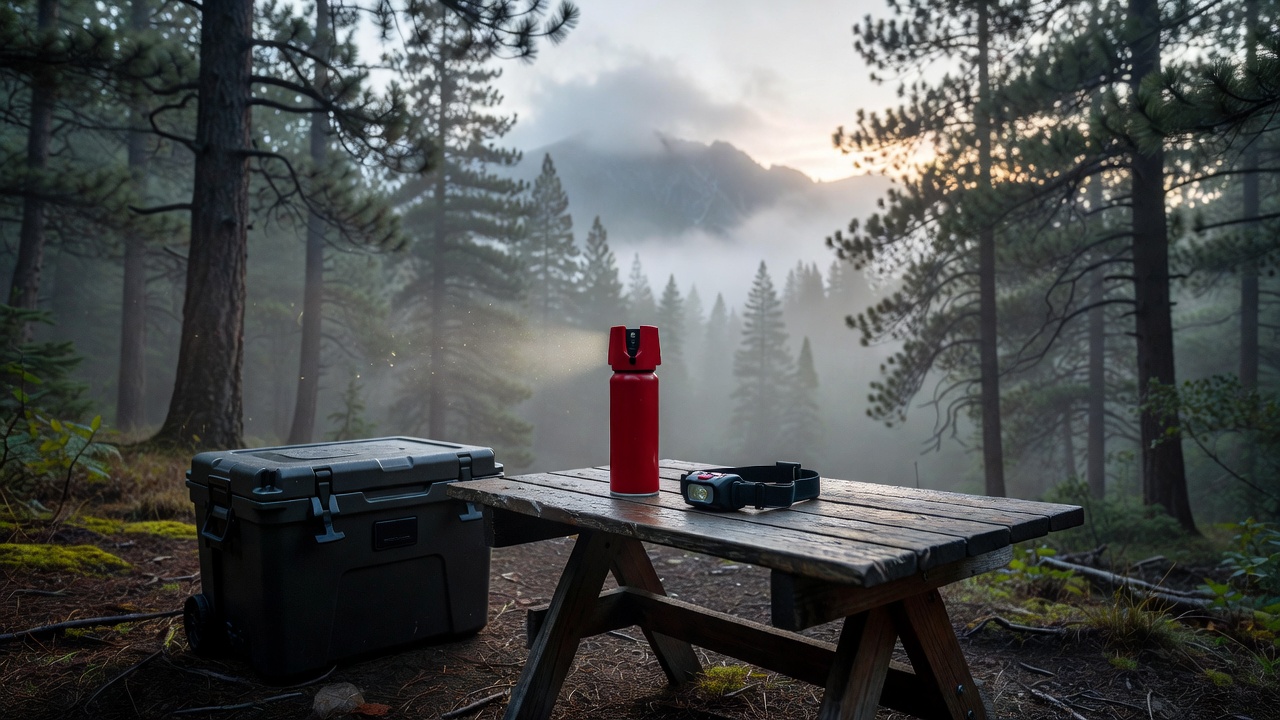
1. Bear Spray (Non-Negotiable)
The single most important piece of bear country gear is bear spray — a high-concentration pepper spray designed specifically for bears. The SABRE Frontiersman at $39.99 is my top recommendation: 7.9 oz can with a 40-foot range and a 2.0% major capsaicinoid concentration (the maximum allowed by the EPA). It deploys a fog pattern that creates a wall between you and the bear — aim slightly downward at the bear's face, not up into the wind.
Critical rules for bear spray:
- Carry it on your hip or chest — not in your pack. In an encounter, you have 3-5 seconds to deploy.
- Practice drawing and removing the safety clip at home before your trip. You don't want to fumble with a safety clip while a bear charges.
- Check the expiration date. Bear spray loses propellant over time and won't spray as far after 3-4 years.
- Do not spray it on your tent or gear as a repellent. It doesn't work that way and can actually attract bears once the capsaicin dries.
2. Headlamp (For Nighttime Camp Movement)
Most bear encounters at camp happen at night — you get up to pee, fumble in the dark, and startle a bear that's investigating your site. A quality headlamp keeps your hands free for bear spray while illuminating what's around you.
The Black Diamond Spot 400 ($49.95) gives you 400 lumens with a red night-vision mode — critical because white light destroys your night vision for 20-30 minutes. The red mode lets you navigate camp without blinding yourself.
For more demanding conditions, the Petzl ACTIK CORE ($79.95) bumps output to 650 lumens and runs on a rechargeable battery (with AAA backup compatibility). If you're in grizzly country where you want maximum visibility, the extra lumens and beam distance are worth the upgrade.
3. Bear-Proof Food Storage
Bears have a sense of smell 7 times better than a bloodhound. They can smell your freeze-dried lasagna from a mile away. Your food storage strategy depends on where you're camping:
- Developed campgrounds: Use the provided bear-proof lockers. If there aren't any, keep all food, trash, and scented items (toothpaste, deodorant, sunscreen) in your car with windows closed.
- Backcountry with bear canister requirements: Some parks (Yosemite, Olympic, parts of the Adirondacks) require hard-sided bear canisters. Rent them at the park visitor center if you don't own one.
- Backcountry without canister requirements: Use the "bear hang" method — suspend your food bag at least 10 feet off the ground and 4 feet from the trunk of a tree. The PCT hang method (with a carabiner and a stick toggle) is the most reliable. Practice tying it before your trip — it's harder than YouTube makes it look.
What goes in the bear storage: Not just food. Anything with a scent — toothpaste, deodorant, sunscreen, bug spray, lip balm, wet wipes, and even your camp stove (it smells like food). If it smells like anything, it goes in the bear bag at night.
4. Cooler (For Car Campers)
If you're car camping in bear country, a bear-resistant cooler isn't optional — it's the regulation in many national parks. The YETI Tundra Haul ($400.00) is the gold standard: certified bear-resistant by the Interagency Grizzly Bear Committee (IGBC), rotomolded construction, and wheels for hauling from car to campsite. At 38 quarts, it holds a weekend's worth of food for 2-3 people.
The price is high, but consider the alternative: a bear that gets into your cooler once will return to that campsite for weeks. You're not just protecting your food — you're protecting future campers at that site.
5. Insect Protection (Bears Aren't the Only Threat)
In bear country, you're usually in deep wilderness — which means mosquitoes, ticks, and biting flies. Bring a reliable bug repellent. I recommend Murphy's Naturals ($19.99) — plant-based, DEET-free, and effective against both mosquitoes and ticks. For lighter coverage, Babyganics Insect Spray ($5.48) uses essential oils and is gentle enough for kids.
Bug spray is a scented item — it goes in your bear storage at night along with your food and toothpaste.
How to Set Up a Bear-Safe Campsite
The "bearmuda triangle" is the classic backcountry campsite layout that separates cooking, sleeping, and food storage by at least 100 yards:
- Sleeping area: Your tent and sleeping gear. Nothing smelly enters this zone — no food, no wrappers, not even lip balm. If you ate a granola bar in your tent three trips ago, wash the tent before your bear country trip. Bears remember.
- Cooking area: At least 100 yards from your tent, downwind if possible. Cook, eat, and clean here. Strain food particles from dishwater and pack them out or store them with your food.
- Food storage: Another 100 yards from both cooking and sleeping areas. Bear canister or hang here. This is also where you store your camp stove, dishes, and any clothing you wore while cooking (which now smells like food).
Bonus safety tips:
- Avoid camping near berry patches, salmon streams, or animal carcasses — these are bear feeding zones.
- Look for bear sign before pitching your tent: scat (bear droppings), claw marks on trees, dug-up roots, or overturned rocks. If you see fresh bear sign, move on.
- Make noise as you move around camp — talking, singing, or clipping a bear bell to your pack. Surprised bears are dangerous bears.
- Keep your dog leashed. Off-leash dogs can provoke bears and lead them straight back to your camp.
What to Do If You Encounter a Bear
On the Trail (You See the Bear From a Distance)
- Stop. Stay calm. Do not run — running triggers a chase response, and you cannot outrun a bear (they hit 35 mph).
- Make yourself look big. Raise your arms. If you're with others, group together to appear larger.
- Talk in a calm, firm voice. "Hey bear. I'm human. I'm leaving now." The bear needs to identify you as human, not prey.
- Back away slowly, diagonally. Give the bear an escape route. Don't turn your back.
- If the bear approaches: Deploy bear spray when the bear is within 30-40 feet. Aim for the face. Don't wait until it's charging — once a bear is at full sprint, your window is 2-3 seconds.
At Camp (The Bear is Investigating Your Site)
Nighttime camp encounters usually involve a bear that smells food. These bears are often habituated — they've learned that campsites mean easy calories. They're not aggressive, just opportunistic.
- From inside your tent: Make noise. Yell, bang pots, blast an air horn. Most bears will retreat when they realize humans are present.
- Do not leave your tent unless the bear is actively trying to get inside. A tent provides a visual barrier that a curious bear typically respects.
- If you must exit your tent (bear is persistent or aggressive): Have your bear spray ready. Exit slowly while making noise. Back away from the bear and the food source.
- Report the encounter to park rangers. A habituated bear that repeatedly visits campsites may need to be relocated.
Beyond Bears: General Wilderness Safety
Bear country overlaps with a lot of other backcountry hazards. These complementary guides cover what you need:
- Medical emergencies: Our wilderness first aid guide covers everything from snakebites to hypothermia — know it before you need it.
- Survival skills: The wilderness survival skills guide covers navigation, fire-starting, and signal techniques when things go sideways.
- Gear repair: A ripped tent or broken pole is annoying at a developed campground, dangerous in the backcountry. Our field repair guide covers Tenacious Tape ($7.95) and other emergency fixes.
- Leave No Trace: Camping responsibly in bear country means packing out everything — including food scraps. Our Leave No Trace guide covers the seven principles.
- National Park camping: If you're heading to Yellowstone, Glacier, or Grand Teton, check our national park camping guide for reservation tips and bear activity reports.
Common Bear Country Mistakes (I've Made Several)
Keeping a "clean" campsite but forgetting the wet wipes
Used wet wipes smell like the food you wiped up. They go in the bear storage. I learned this when a black bear shredded my daypack for a pack of lemon-scented wipes.
Cooking dinner, then sleeping in the same clothes
The shirt you wore while cooking bacon now smells like bacon to a bear. Change into clean sleeping clothes and store your cooking clothes with your food.
Only carrying bear spray — never practicing with it
Buy an inert practice canister (same size and weight, no active ingredient) and practice the draw-and-spray motion at home. In a real encounter, muscle memory is the difference between deploying in 2 seconds and fumbling for 10.
Assuming "bear-proof" means bear-proof
No container is truly bear-proof. IGBC-certified means it survived a 60-minute test with captive grizzlies — not that it's indestructible. A motivated bear with enough time can compromise anything. The goal is to make it difficult enough that the bear gives up and moves on.
Forgetting that bears can climb
A food bag hung 6 feet off the ground with a lazy branch tie is a bear snack waiting to happen. Bears climb trees like they were born in them. The 10-foot height and 4-foot-from-trunk rule exists for a reason — a bear can reach out from the trunk if your bag is too close.
Final Thoughts: Respect, Not Fear
I've spent hundreds of nights in bear country and have had exactly three close encounters. In every case, the bear wanted nothing to do with me — it wanted my food, got spooked when it realized I was there, and left. Bears aren't monsters. They're intelligent, opportunistic animals doing what they've evolved to do: find calories efficiently.
Your job as a camper is simple: don't make it easy for them. Store your food properly, carry bear spray ($39.99), make noise, and keep a clean camp. Do those four things and your odds of a negative encounter drop to near zero.
The wilderness is their home and our privilege to visit. Treat it — and them — with respect, and you'll come home with incredible stories instead of cautionary tales.
<!-- AFFILIATE_DISCLOSURE -->